Mode SUBARU FORESTER 2017 SJ / 4.G User Guide
[x] Cancel search | Manufacturer: SUBARU, Model Year: 2017, Model line: FORESTER, Model: SUBARU FORESTER 2017 SJ / 4.GPages: 634, PDF Size: 11.77 MB
Page 29 of 634
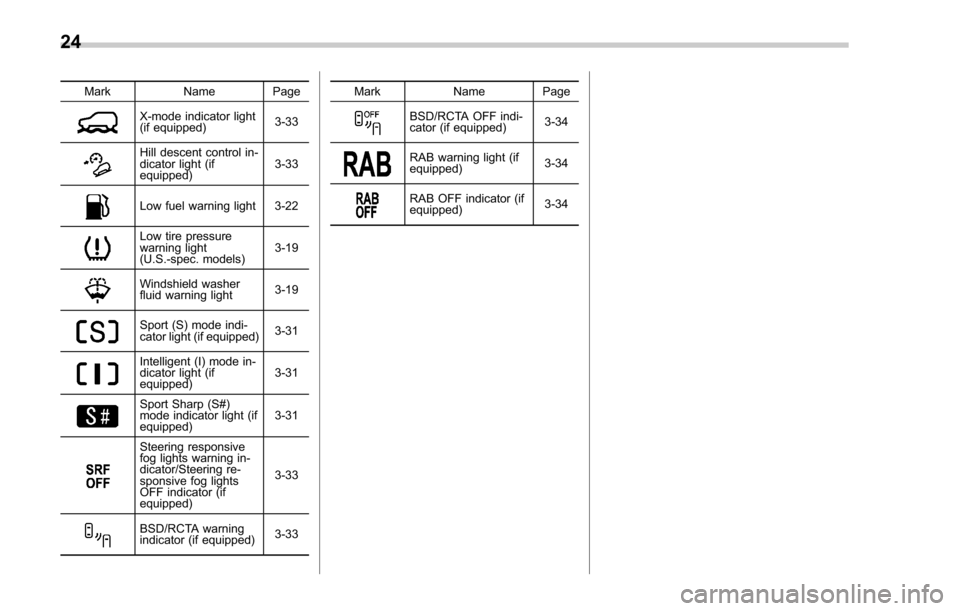
MarkName Page
X-mode indicator light
(if equipped) 3-33
Hill descent control in-
dicator light (if
equipped)3-33
Low fuel warning light 3-22
Low tire pressure
warning light
(U.S.-spec. models)3-19
Windshield washer
fluid warning light
3-19
Sport (S) mode indi-
cator light (if equipped)3-31
Intelligent (I) mode in-
dicator light (if
equipped)3-31
Sport Sharp (S#)
mode indicator light (if
equipped)3-31
Steering responsive
fog lights warning in-
dicator/Steering re-
sponsive fog lights
OFF indicator (if
equipped)3-33
BSD/RCTA warning
indicator (if equipped)
3-33Mark Name Page
BSD/RCTA OFF indi-
cator (if equipped)
3-34
RAB warning light (if
equipped)3-34
RAB OFF indicator (if
equipped)3-34
24
Page 30 of 634
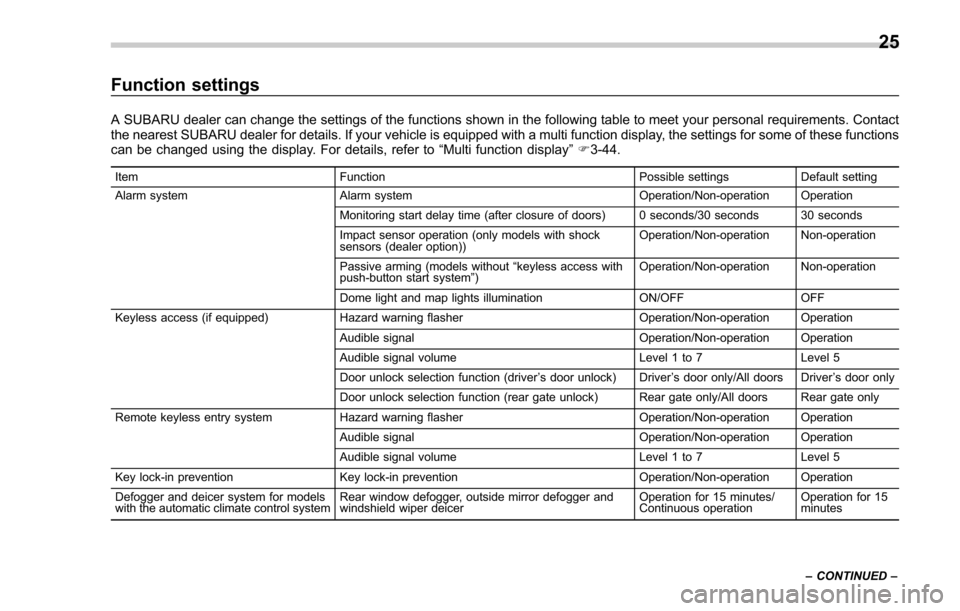
Function settings
A SUBARU dealer can change the settings of the functions shown in the following table to meet your personal requirements. Contact
the nearest SUBARU dealer for details. If your vehicle is equipped with a multi function display, the settings for some of these functions
can be changed using the display. For details, refer to“Multi function display”F 3-44.
Item Function Possible settingsDefault setting
Alarm system Alarm system Operation/Non-operation Operation
Monitoring start delay time (after closure of doors) 0 seconds/30 seconds 30 seconds
Impact sensor operation (only models with shock
sensors (dealer option)) Operation/Non-operation Non-operation
Passive arming (models without “keyless access with
push-button start system ”) Operation/Non-operation Non-operation
Dome light and map lights illumination ON/OFFOFF
Keyless access (if equipped) Hazard warning flasher Operation/Non-operation Operation
Audible signal Operation/Non-operation Operation
Audible signal volume Level 1 to 7Level 5
Door unlock selection function (driver ’s door unlock) Driver ’s door only/All doors Driver ’s door only
Door unlock selection function (rear gate unlock) Rear gate only/All doors Rear gate only
Remote keyless entry system Hazard warning flasher Operation/Non-operation Operation
Audible signal Operation/Non-operation Operation
Audible signal volume Level 1 to 7Level 5
Key lock-in prevention Key lock-in prevention Operation/Non-operation Operation
Defogger and deicer system for models
with the automatic climate control system Rear window defogger, outside mirror defogger and
windshield wiper deicer Operation for 15 minutes/
Continuous operationOperation for 15
minutes
– CONTINUED –
25
Page 31 of 634
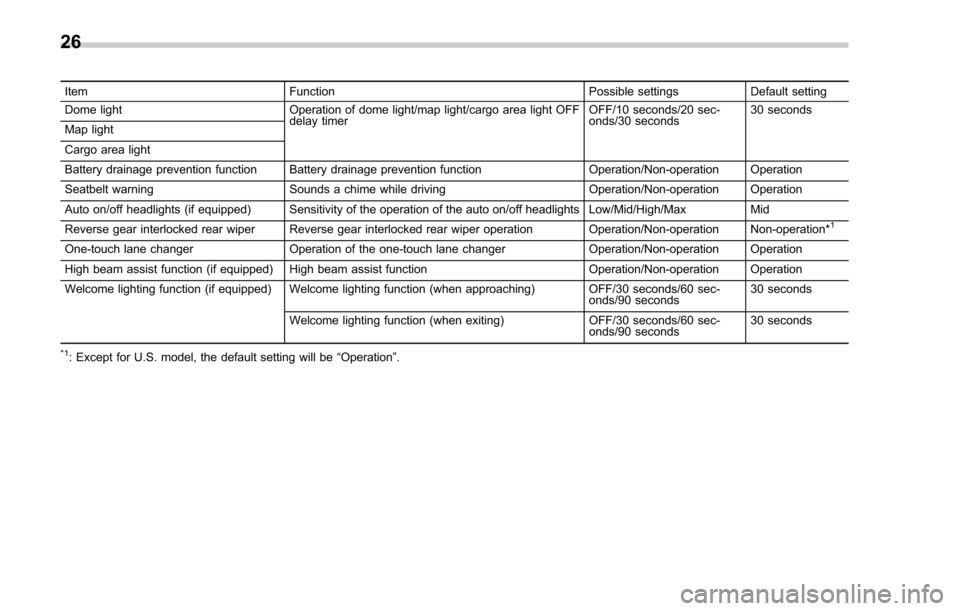
ItemFunction Possible settingsDefault setting
Dome light Operation of dome light/map light/cargo area light OFF
delay timer OFF/10 seconds/20 sec-
onds/30 seconds30 seconds
Map light
Cargo area light
Battery drainage prevention function Battery drainage prevention function Operation/Non-operation Operation
Seatbelt warning Sounds a chime while driving Operation/Non-operation Operation
Auto on/off headlights (if equipped) Sensitivity of the operation of the auto on/off headlights Low/Mid/High/Max Mid
Reverse gear interlocked rear wiper Reverse gear interlocked rear wiper operation Operation/Non-operation Non-operation*
1
One-touch lane changer Operation of the one-touch lane changer Operation/Non-operation Operation
High beam assist function (if equipped) High beam assist function Operation/Non-operation Operation
Welcome lighting function (if equipped) Welcome lighting function (when approaching) OFF/30 seconds/60 sec- onds/90 seconds30 seconds
Welcome lighting function (when exiting) OFF/30 seconds/60 sec-
onds/90 seconds30 seconds
*1: Except for U.S. model, the default setting will be
“Operation ”.
26
Page 41 of 634
Seat, seatbelt and SRS airbags/Seat heater
or“HIGH ”position on the switch, as
desired, depending on the temperature.
Selecting the “HIGH”position will cause
the seat to heat up quicker.
To turn off the seat heater, lightly press the
opposite side of the current position.
The indicator located on the switch illumi-
nates when the seat heater is in operation.& Rear seat heater (if equipped)
The seat heater operates when the igni-
tion switch is in the “ON”position.
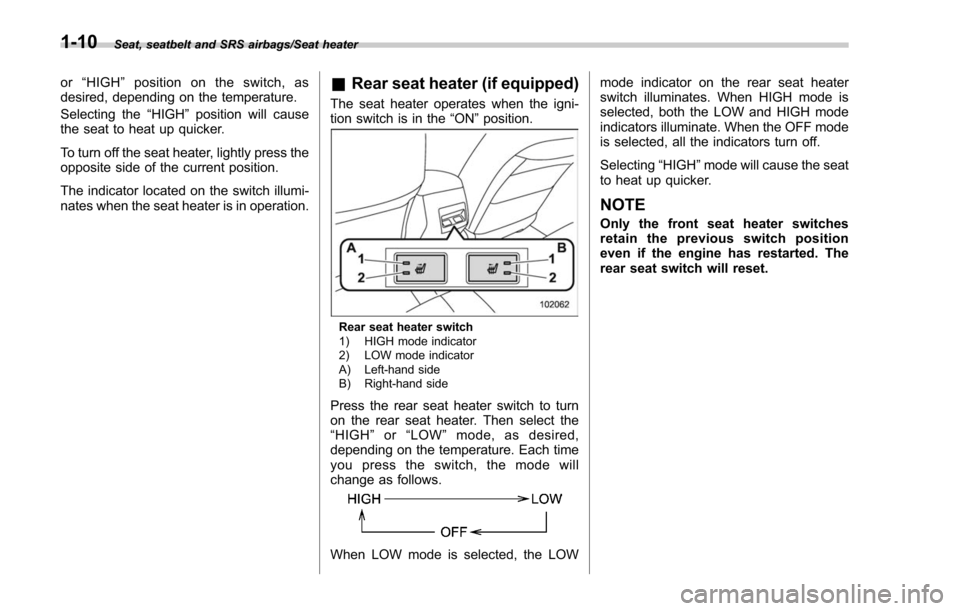
Rear seat heater switch
1) HIGH mode indicator
2) LOW mode indicator
A) Left-hand side
B) Right-hand side
Press the rear seat heater switch to turn
on the rear seat heater. Then select the
“HIGH ”or “LOW ”mode, as desired,
depending on the temperature. Each time
youpresstheswitch,themodewill
change as follows.
When LOW mode is selected, the LOW mode indicator on the rear seat heater
switch illuminates. When HIGH mode is
selected, both the LOW and HIGH mode
indicators illuminate. When the OFF mode
is selected, all the indicators turn off.
Selecting
“HIGH”mode will cause the seat
to heat up quicker.
NOTE
Only the front seat heater switches
retainthepreviousswitchposition
even if the engine has restarted. The
rear seat switch will reset.
1-10
Page 48 of 634
According to accident statistics,
children are safer when properly
restrained in the rear seating
positions than in the front seat-
ing positions. For instructions
and precautions concerning the
child restraint system, refer to
“Child restraint systems”F 1-29.
! Infants or small children
Use a child restraint system that is
suitable for your vehicle. Refer to “Child
restraint systems ”F 1-29.
! Children
If a child is too big for a child restraint
system, the child should sit in the rear seat
and be restrained using the seatbelts.
According to accident statistics, children
are safer when properly restrained in the
rear seating positions than in the front
seating positions. Never allow a child to
stand up or kneel on the seat.
If the shoulder portion of the belt crosses
the face or neck, move the child closer to
the belt buckle to help provide a good
shoulder belt fit. Care must be taken to
securely place the lap belt as low as
possible on the hips and not on the child ’s
waist. If the shoulder portion of the belt
cannot be properly positioned, a child
restraint system should be used. Never place the shoulder belt under the child
’s
arm or behind the child ’s back.
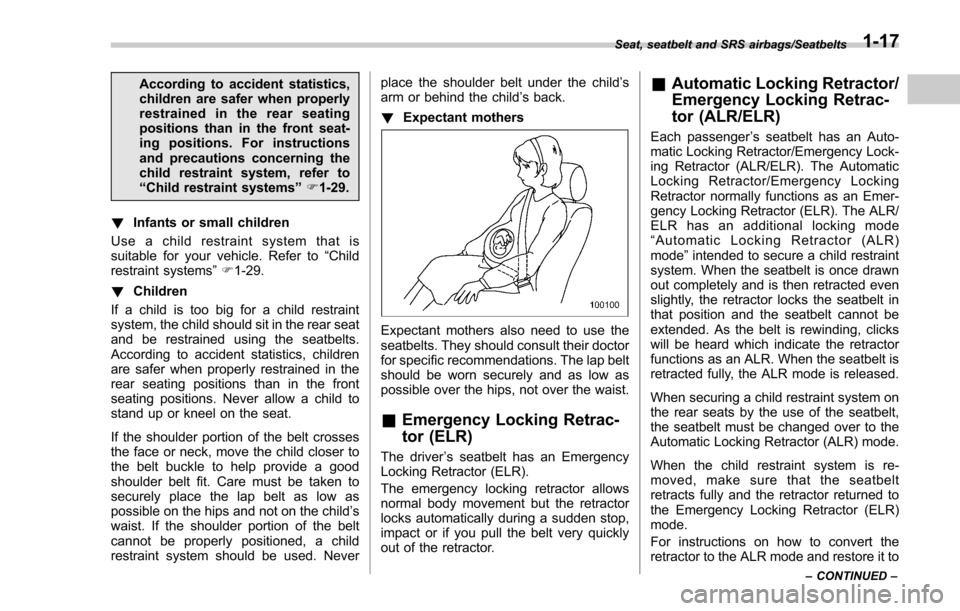
! Expectant mothers
Expectant mothers also need to use the
seatbelts. They should consult their doctor
for specific recommendations. The lap belt
should be worn securely and as low as
possible over the hips, not over the waist.
&Emergency Locking Retrac-
tor (ELR)
The driver ’s seatbelt has an Emergency
Locking Retractor (ELR).
The emergency locking retractor allows
normal body movement but the retractor
locks automatically during a sudden stop,
impact or if you pull the belt very quickly
out of the retractor.
& Automatic Locking Retractor/
Emergency Locking Retrac-
tor (ALR/ELR)
Each passenger ’s seatbelt has an Auto-
matic Locking Retractor/Emergency Lock-
ing Retractor (ALR/ELR). The Automatic
Locking Retractor/Emergency Locking
Retractor normally functions as an Emer-
gency Locking Retractor (ELR). The ALR/
ELR has an additional locking mode
“ Automatic Locking Retractor (ALR)
mode ”intended to secure a child restraint
system. When the seatbelt is once drawn
out completely and is then retracted even
slightly, the retractor locks the seatbelt in
that position and the seatbelt cannot be
extended. As the belt is rewinding, clicks
will be heard which indicate the retractor
functions as an ALR. When the seatbelt is
retracted fully, the ALR mode is released.
When securing a child restraint system on
the rear seats by the use of the seatbelt,
the seatbelt must be changed over to the
Automatic Locking Retractor (ALR) mode.
When the child restraint system is re-
moved, make sure that the seatbelt
retracts fully and the retractor returned to
the Emergency Locking Retractor (ELR)
mode.
For instructions on how to convert the
retractor to the ALR mode and restore it to
Seat, seatbelt and SRS airbags/Seatbelts
–CONTINUED –1-17
Page 49 of 634
Seat, seatbelt and SRS airbags/Seatbelts
the ELR mode, refer to“Installing child
restraint systems with ALR/ELR seatbelt ”
F 1-32.
&Seatbelt warning light
and chime
Refer to “Seatbelt warning light and
chime ”F 3-14.
& Fastening the seatbelt
WARNING
. Never use a belt that is twisted or
reversed. In an accident, this can
increase the risk or severity of
injury.
. Keep the lap belt as low as
possible on your hips. In a colli-
sion, this spreads the force of the
lap belt over stronger hip bones
instead of across the weaker
abdomen.
. Seatbelts provide maximum re-
straint when the occupant sits
well back and upright in the seat.
To reduce the risk of sliding
under the seatbelt in a collision,
the front seatbacks should be
always used in the upright posi-
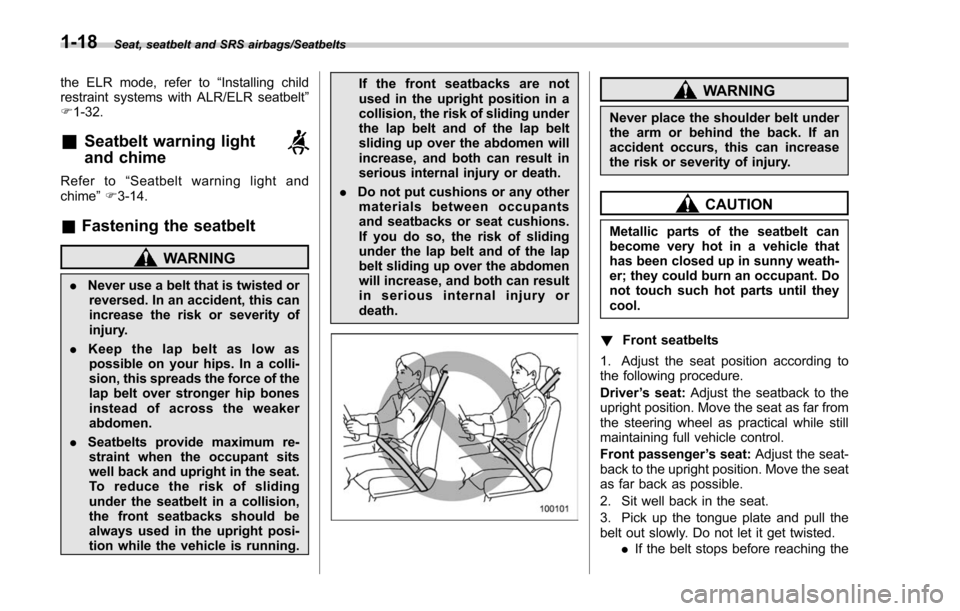
tion while the vehicle is running. If the front seatbacks are not
used in the upright position in a
collision, the risk of sliding under
the lap belt and of the lap belt
sliding up over the abdomen will
increase, and both can result in
serious internal injury or death.
. Do not put cushions or any other
materials between occupants
and seatbacks or seat cushions.
If you do so, the risk of sliding
under the lap belt and of the lap
belt sliding up over the abdomen
will increase, and both can result
in serious internal injury or
death.
WARNING
Never place the shoulder belt under
the arm or behind the back. If an
accident occurs, this can increase
the risk or severity of injury.
CAUTION
Metallic parts of the seatbelt can
become very hot in a vehicle that
has been closed up in sunny weath-
er; they could burn an occupant. Do
not touch such hot parts until they
cool.
! Front seatbelts
1. Adjust the seat position according to
the following procedure.
Driver ’s seat: Adjust the seatback to the
upright position. Move the seat as far from
the steering wheel as practical while still
maintaining full vehicle control.
Front passenger ’s seat: Adjust the seat-
back to the upright position. Move the seat
as far back as possible.
2. Sit well back in the seat.
3. Pick up the tongue plate and pull the
belt out slowly. Do not let it get twisted.
.If the belt stops before reaching the
1-18
Page 56 of 634
Front seatbelt pretensioners
The driver’s and front passenger ’s seat-
belts have a seatbelt pretensioner. The
seatbelt pretensioners are designed to be
activated in the event of an accident
involving moderate to severe frontal and
side collisions and rollover accidents.
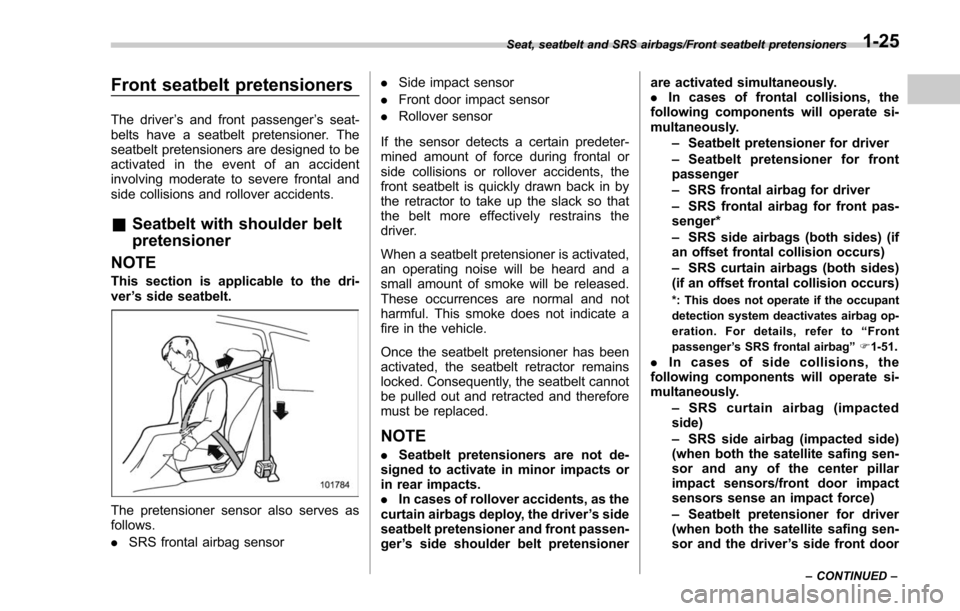
& Seatbelt with shoulder belt
pretensioner
NOTE
This section is applicable to the dri-
ver ’s side seatbelt.
The pretensioner sensor also serves as
follows.
. SRS frontal airbag sensor .
Side impact sensor
. Front door impact sensor
. Rollover sensor
If the sensor detects a certain predeter-
mined amount of force during frontal or
side collisions or rollover accidents, the
front seatbelt is quickly drawn back in by
the retractor to take up the slack so that
the belt more effectively restrains the
driver.
When a seatbelt pretensioner is activated,
an operating noise will be heard and a
small amount of smoke will be released.
These occurrences are normal and not
harmful. This smoke does not indicate a
fire in the vehicle.
Once the seatbelt pretensioner has been
activated, the seatbelt retractor remains
locked. Consequently, the seatbelt cannot
be pulled out and retracted and therefore
must be replaced.
NOTE
. Seatbelt pretensioners are not de-
signed to activate in minor impacts or
in rear impacts.
. In cases of rollover accidents, as the
curtain airbags deploy, the driver ’s side
seatbelt pretensioner and front passen-
ger ’s side shoulder belt pretensioner are activated simultaneously.
.
In cases of frontal collisions, the
following components will operate si-
multaneously.
–Seatbelt pretensioner for driver
– Seatbelt pretensioner for front
passenger
– SRS frontal airbag for driver
– SRS frontal airbag for front pas-
senger*
– SRS side airbags (both sides) (if
an offset frontal collision occurs)
– SRS curtain airbags (both sides)
(if an offset frontal collision occurs)
*: This does not operate if the occupant
detection system deactivates airbag op-
eration. For details, refer to “Front
passenger ’s SRS frontal airbag ”F 1-51
.
. In cases of side collisions, the
following components will operate si-
multaneously.
–SRS curtain airbag (impacted
side)
– SRS side airbag (impacted side)
(when both the satellite safing sen-
sor and any of the center pillar
impact sensors/front door impact
sensors sense an impact force)
– Seatbelt pretensioner for driver
(when both the satellite safing sen-
sor and the driver ’s side front door
Seat, seatbelt and SRS airbags/Front seatbelt pretensioners
–CONTINUED –1-25
Page 60 of 634
der the center of the instrument
panel
If you need service or repair in those
areas or near the front seatbelt
retractors, have the work performed
by your authorized SUBARU dealer.
NOTE
If the front or side part of the vehicle is
damaged in an accident to the extent
that the seatbelt pretensioner does not
operate, contact your SUBARU dealer
as soon as possible.
& Precautions against vehicle
modification
Always consult your SUBARU dealer if
you want to install any accessory parts to
your vehicle.
CAUTION
Do not perform any of the following
modifications. Such modifications
can interfere with proper operation
of the seatbelt pretensioners.
. Attachment of any equipment
(bush bar, winches, snow plow,
skid plate, etc.) other than genu-
ine SUBARU accessory parts to the front end.
. Modification of the suspension
system or front end structure.
. Installation of a tire of different
size and construction from the
tires specified on the vehicle
placard attached to the driver ’s
door pillar or specified for indivi-
dual vehicle models in this Own-
er ’s Manual.
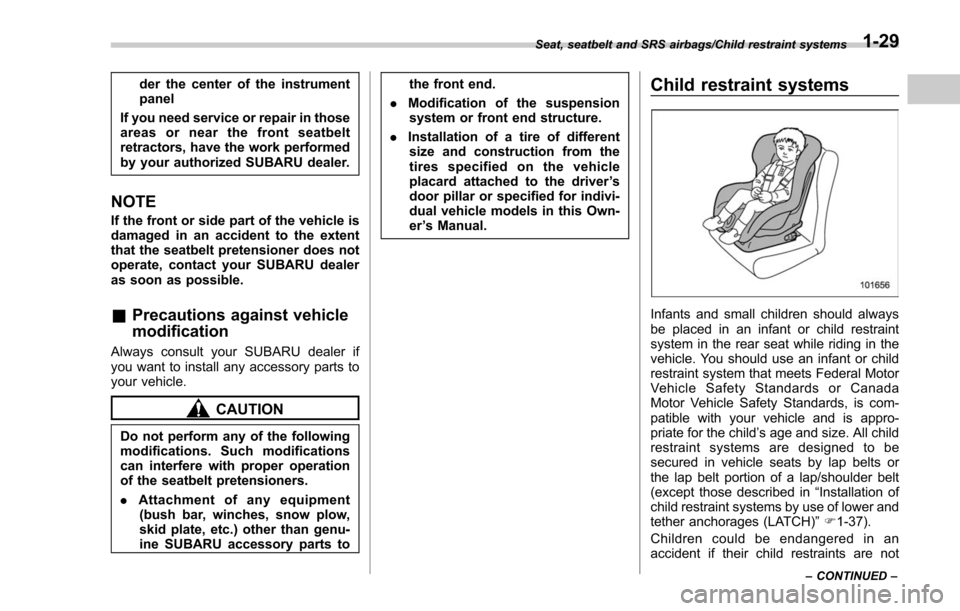
Child restraint systems
Infants and small children should always
be placed in an infant or child restraint
system in the rear seat while riding in the
vehicle. You should use an infant or child
restraint system that meets Federal Motor
Vehicle Safety Standards or Canada
Motor Vehicle Safety Standards, is com-
patible with your vehicle and is appro-
priate for the child ’s age and size. All child
restraint systems are designed to be
secured in vehicle seats by lap belts or
the lap belt portion of a lap/shoulder belt
(except those described in “Installation of
child restraint systems by use of lower and
tether anchorages (LATCH) ”F 1-37).
Children could be endangered in an
accident if their child restraints are not
Seat, seatbelt and SRS airbags/Child restraint systems
–CONTINUED –1-29
Page 65 of 634
Seat, seatbelt and SRS airbags/Child restraint systems
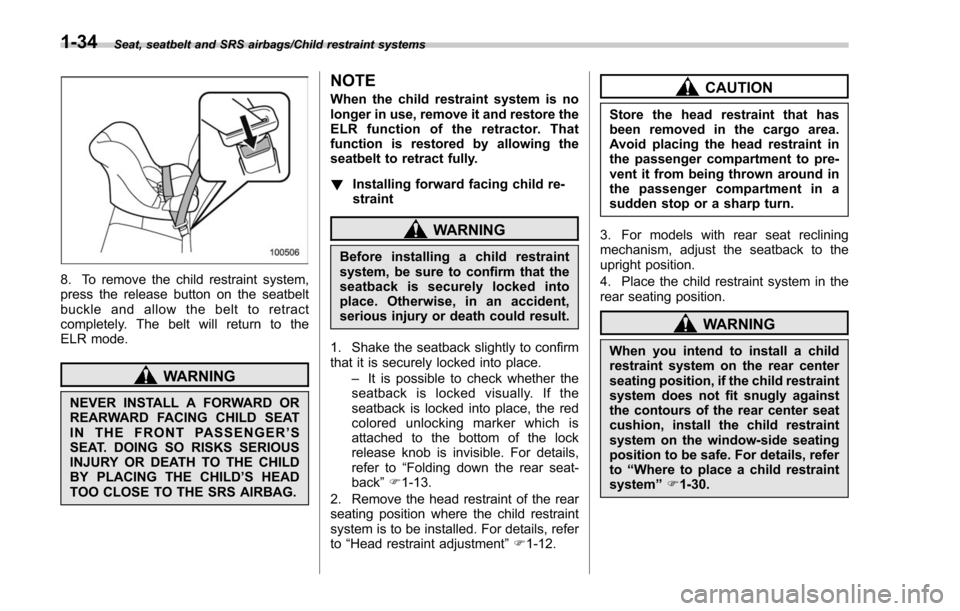
8. To remove the child restraint system,
press the release button on the seatbelt
buckle and allow the belt to retract
completely. The belt will return to the
ELR mode.
WARNING
NEVER INSTALL A FORWARD OR
REARWARD FACING CHILD SEAT
IN THE FRONT PASSENGER’S
SEAT. DOING SO RISKS SERIOUS
INJURY OR DEATH TO THE CHILD
BY PLACING THE CHILD ’S HEAD
TOO CLOSE TO THE SRS AIRBAG.
NOTE
When the child restraint system is no
longer in use, remove it and restore the
ELR function of the retractor. That
function is restored by allowing the
seatbelt to retract fully.
! Installing forward facing child re-
straint
WARNING
Before installing a child restraint
system, be sure to confirm that the
seatback is securely locked into
place. Otherwise, in an accident,
serious injury or death could result.
1. Shake the seatback slightly to confirm
that it is securely locked into place. –It is possible to check whether the
seatback is locked visually. If the
seatback is locked into place, the red
colored unlocking marker which is
attached to the bottom of the lock
release knob is invisible. For details,
refer to “Folding down the rear seat-
back ”F 1-13.
2. Remove the head restraint of the rear
seating position where the child restraint
system is to be installed. For details, refer
to “Head restraint adjustment ”F 1-12.
CAUTION
Store the head restraint that has
been removed in the cargo area.
Avoid placing the head restraint in
the passenger compartment to pre-
vent it from being thrown around in
the passenger compartment in a
sudden stop or a sharp turn.
3. For models with rear seat reclining
mechanism, adjust the seatback to the
upright position.
4. Place the child restraint system in the
rear seating position.
WARNING
When you intend to install a child
restraint system on the rear center
seating position, if the child restraint
system does not fit snugly against
the contours of the rear center seat
cushion, install the child restraint
system on the window-side seating
position to be safe. For details, refer
to “Where to place a child restraint
system ”F 1-30.
1-34
Page 67 of 634
Seat, seatbelt and SRS airbags/Child restraint systems
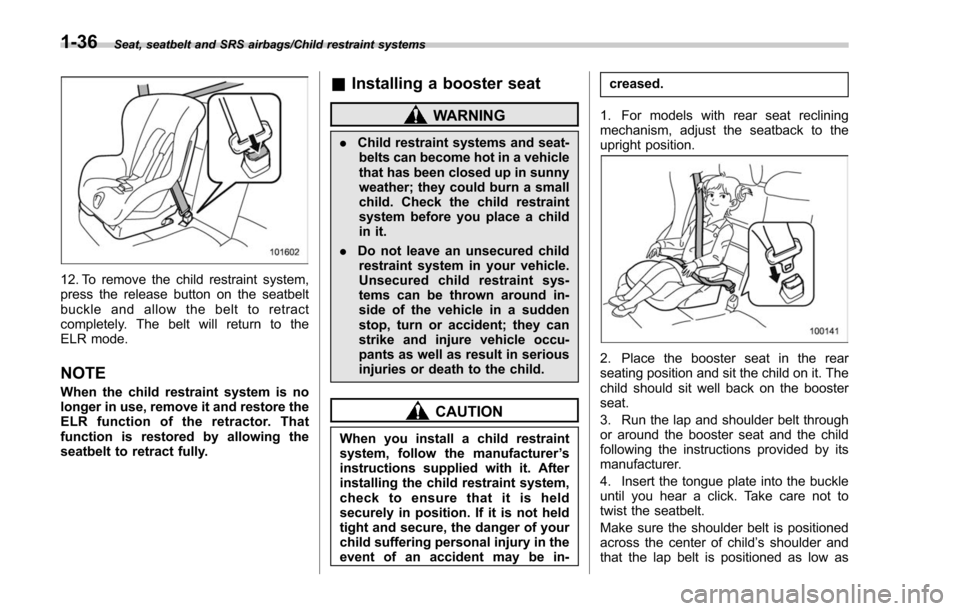
12. To remove the child restraint system,
press the release button on the seatbelt
buckle and allow the belt to retract
completely. The belt will return to the
ELR mode.
NOTE
When the child restraint system is no
longer in use, remove it and restore the
ELR function of the retractor. That
function is restored by allowing the
seatbelt to retract fully.
&Installing a booster seat
WARNING
. Child restraint systems and seat-
belts can become hot in a vehicle
that has been closed up in sunny
weather; they could burn a small
child. Check the child restraint
system before you place a child
in it.
. Do not leave an unsecured child
restraint system in your vehicle.
Unsecured child restraint sys-
tems can be thrown around in-
side of the vehicle in a sudden
stop, turn or accident; they can
strike and injure vehicle occu-
pants as well as result in serious
injuries or death to the child.
CAUTION
When you install a child restraint
system, follow the manufacturer ’s
instructions supplied with it. After
installing the child restraint system,
check to ensure that it is held
securely in position. If it is not held
tight and secure, the danger of your
child suffering personal injury in the
event of an accident may be in- creased.
1. For models with rear seat reclining
mechanism, adjust the seatback to the
upright position.
2. Place the booster seat in the rear
seating position and sit the child on it. The
child should sit well back on the booster
seat.
3. Run the lap and shoulder belt through
or around the booster seat and the child
following the instructions provided by its
manufacturer.
4. Insert the tongue plate into the buckle
until you hear a click. Take care not to
twist the seatbelt.
Make sure the shoulder belt is positioned
across the center of child ’s shoulder and
that the lap belt is positioned as low as
1-36