ac control SUBARU FORESTER 2017 SJ / 4.G User Guide
[x] Cancel search | Manufacturer: SUBARU, Model Year: 2017, Model line: FORESTER, Model: SUBARU FORESTER 2017 SJ / 4.GPages: 634, PDF Size: 11.77 MB
Page 28 of 634
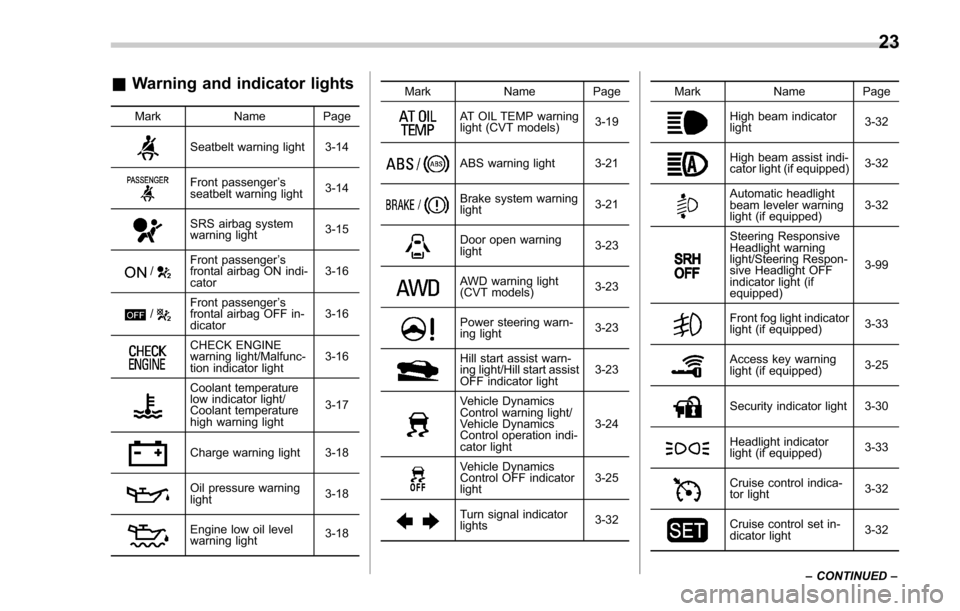
&Warning and indicator lights
Mark Name Page
Seatbelt warning light 3-14
Front passenger’s
seatbelt warning light 3-14
SRS airbag system
warning light3-15
/Front passenger
’s
frontal airbag ON indi-
cator 3-16
/Front passenger
’s
frontal airbag OFF in-
dicator 3-16
CHECK ENGINE
warning light/Malfunc-
tion indicator light3-16
Coolant temperature
low indicator light/
Coolant temperature
high warning light3-17
Charge warning light 3-18
Oil pressure warning
light
3-18
Engine low oil level
warning light3-18Mark Name Page
AT OIL TEMP warning
light (CVT models)
3-19
ABS warning light 3-21
Brake system warning
light
3-21
Door open warning
light3-23
AWD warning light
(CVT models)
3-23
Power steering warn-
ing light3-23
Hill start assist warn-
ing light/Hill start assist
OFF indicator light3-23
Vehicle Dynamics
Control warning light/
Vehicle Dynamics
Control operation indi-
cator light3-24
Vehicle Dynamics
Control OFF indicator
light
3-25
Turn signal indicator
lights
3-32Mark Name Page
High beam indicator
light
3-32
High beam assist indi-
cator light (if equipped)3-32
Automatic headlight
beam leveler warning
light (if equipped)3-32
Steering Responsive
Headlight warning
light/Steering Respon-
sive Headlight OFF
indicator light (if
equipped)3-99
Front fog light indicator
light (if equipped)
3-33
Access key warning
light (if equipped)3-25
Security indicator light 3-30
Headlight indicator
light (if equipped)
3-33
Cruise control indica-
tor light3-32
Cruise control set in-
dicator light3-32
– CONTINUED –
23
Page 29 of 634
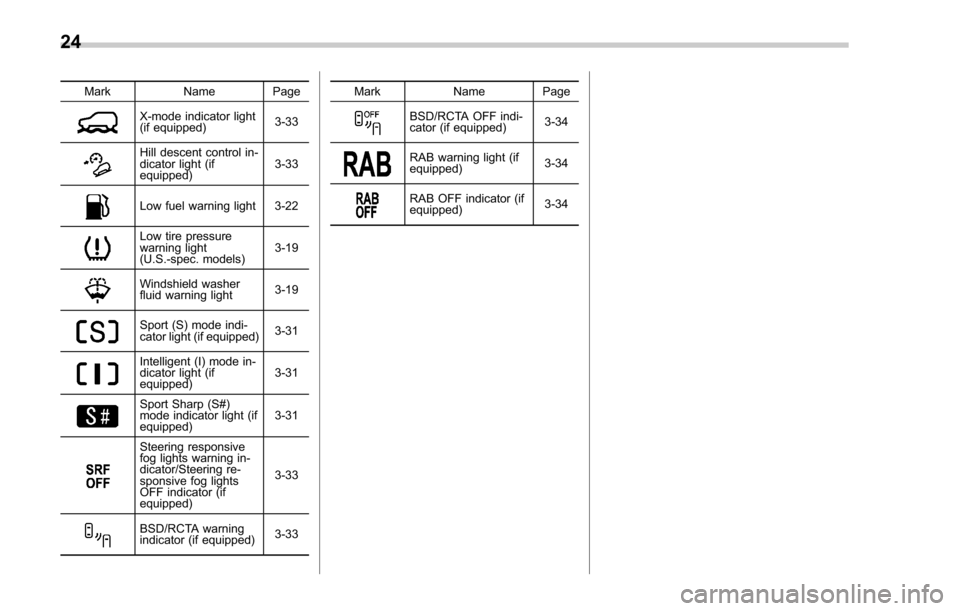
MarkName Page
X-mode indicator light
(if equipped) 3-33
Hill descent control in-
dicator light (if
equipped)3-33
Low fuel warning light 3-22
Low tire pressure
warning light
(U.S.-spec. models)3-19
Windshield washer
fluid warning light
3-19
Sport (S) mode indi-
cator light (if equipped)3-31
Intelligent (I) mode in-
dicator light (if
equipped)3-31
Sport Sharp (S#)
mode indicator light (if
equipped)3-31
Steering responsive
fog lights warning in-
dicator/Steering re-
sponsive fog lights
OFF indicator (if
equipped)3-33
BSD/RCTA warning
indicator (if equipped)
3-33Mark Name Page
BSD/RCTA OFF indi-
cator (if equipped)
3-34
RAB warning light (if
equipped)3-34
RAB OFF indicator (if
equipped)3-34
24
Page 30 of 634
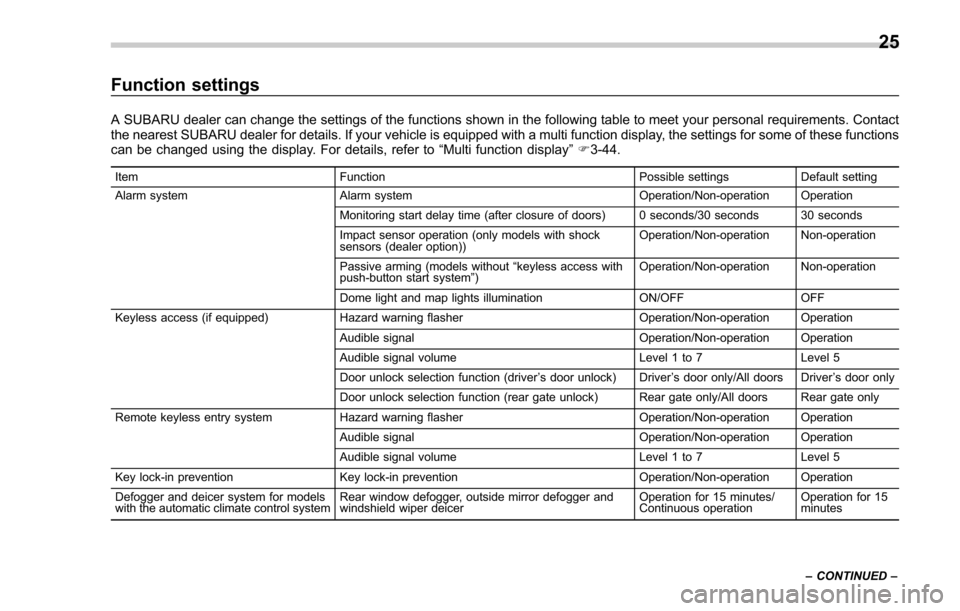
Function settings
A SUBARU dealer can change the settings of the functions shown in the following table to meet your personal requirements. Contact
the nearest SUBARU dealer for details. If your vehicle is equipped with a multi function display, the settings for some of these functions
can be changed using the display. For details, refer to“Multi function display”F 3-44.
Item Function Possible settingsDefault setting
Alarm system Alarm system Operation/Non-operation Operation
Monitoring start delay time (after closure of doors) 0 seconds/30 seconds 30 seconds
Impact sensor operation (only models with shock
sensors (dealer option)) Operation/Non-operation Non-operation
Passive arming (models without “keyless access with
push-button start system ”) Operation/Non-operation Non-operation
Dome light and map lights illumination ON/OFFOFF
Keyless access (if equipped) Hazard warning flasher Operation/Non-operation Operation
Audible signal Operation/Non-operation Operation
Audible signal volume Level 1 to 7Level 5
Door unlock selection function (driver ’s door unlock) Driver ’s door only/All doors Driver ’s door only
Door unlock selection function (rear gate unlock) Rear gate only/All doors Rear gate only
Remote keyless entry system Hazard warning flasher Operation/Non-operation Operation
Audible signal Operation/Non-operation Operation
Audible signal volume Level 1 to 7Level 5
Key lock-in prevention Key lock-in prevention Operation/Non-operation Operation
Defogger and deicer system for models
with the automatic climate control system Rear window defogger, outside mirror defogger and
windshield wiper deicer Operation for 15 minutes/
Continuous operationOperation for 15
minutes
– CONTINUED –
25
Page 33 of 634
Seat, seatbelt and SRS airbags/Front seats
Front seats
WARNING
.Never adjust the seat while driv-
ing to avoid loss of vehicle con-
trol and personal injury.
. Before adjusting the seat, make
sure the hands and feet of rear
seat passengers and cargo are
clear of the adjusting mechan-
ism.
. After adjusting the seat, push it
slightly to make sure it is se-
curely locked. If the seat is not
securely locked, it may move or
the seatbelt may not operate
properly.
. Do not put objects under the front
seats. They may interfere with
front seat locking and cause an
accident.
. Seatbelts provide maximum re-
straint when the occupant sits
well back and upright in the seat.
To reduce the risk of sliding
under the seatbelt in a collision,
the front seatbacks should be
always used in the upright posi-
tion while the vehicle is running.
If the front seatbacks are not used in the upright position in a
collision, the risk of sliding under
the lap belt and of the lap belt
sliding up over the abdomen will
increase, and both can result in
serious internal injury or death.
. The SRS airbags deploy with
considerable speed and force.
Occupants who are out of proper
position when the SRS airbag
deploys could suffer very serious
injuries. Because the SRS airbag
needs enough space for deploy-
ment, the driver should always
sit upright and well back in the
seat as far from the steering
wheel as practical while still
maintaining full vehicle control
and the front passenger should
move the seat as far back as
possible and sit upright and well
back in the seat.
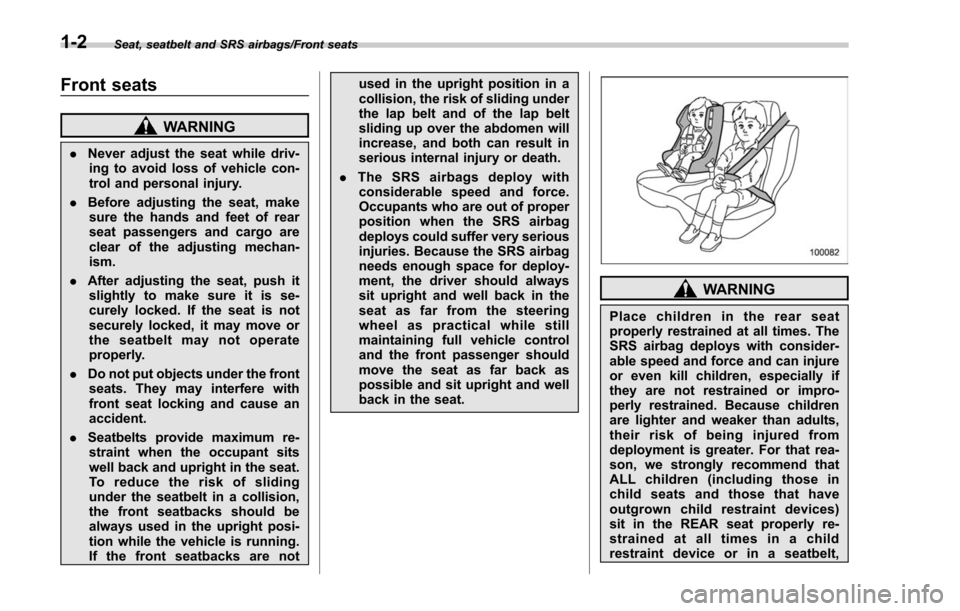
WARNING
Place children in the rear seat
properly restrained at all times. The
SRS airbag deploys with consider-
able speed and force and can injure
or even kill children, especially if
they are not restrained or impro-
perly restrained. Because children
are lighter and weaker than adults,
their risk of being injured from
deployment is greater. For that rea-
son, we strongly recommend that
ALL children (including those in
child seats and those that have
outgrown child restraint devices)
sit in the REAR seat properly re-
strained at all times in a child
restraint device or in a seatbelt,
1-2
Page 36 of 634
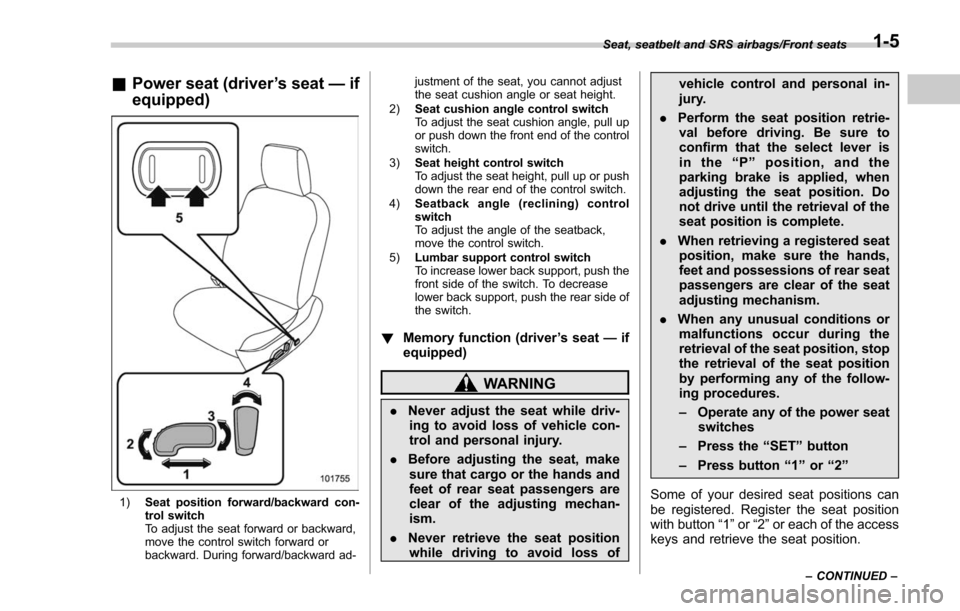
&Power seat (driver ’s seat —if
equipped)
1) Seat position forward/backward con-
trol switch
To adjust the seat forward or backward,
move the control switch forward or
backward. During forward/backward ad- justment of the seat, you cannot adjust
the seat cushion angle or seat height.
2) Seat cushion angle control switch
To adjust the seat cushion angle, pull up
or push down the front end of the control
switch.
3) Seat height control switch
To adjust the seat height, pull up or push
down the rear end of the control switch.
4) Seatback angle (reclining) control
switch
To adjust the angle of the seatback,
move the control switch.
5) Lumbar support control switch
To increase lower back support, push the
front side of the switch. To decrease
lower back support, push the rear side of
the switch.
!Memory function (driver ’s seat —if
equipped)
WARNING
. Never adjust the seat while driv-
ing to avoid loss of vehicle con-
trol and personal injury.
. Before adjusting the seat, make
sure that cargo or the hands and
feet of rear seat passengers are
clear of the adjusting mechan-
ism.
. Never retrieve the seat position
while driving to avoid loss of vehicle control and personal in-
jury.
. Perform the seat position retrie-
val before driving. Be sure to
confirm that the select lever is
in the “P ” position, and the
parking brake is applied, when
adjusting the seat position. Do
not drive until the retrieval of the
seat position is complete.
. When retrieving a registered seat
position, make sure the hands,
feet and possessions of rear seat
passengers are clear of the seat
adjusting mechanism.
. When any unusual conditions or
malfunctions occur during the
retrieval of the seat position, stop
the retrieval of the seat position
by performing any of the follow-
ing procedures.
– Operate any of the power seat
switches
– Press the “SET ”button
– Press button “1 ” or “2 ”
Some of your desired seat positions can
be registered. Register the seat position
with button “1 ” or “2 ” or each of the access
keys and retrieve the seat position.
Seat, seatbelt and SRS airbags/Front seats
–CONTINUED –1-5
Page 49 of 634
Seat, seatbelt and SRS airbags/Seatbelts
the ELR mode, refer to“Installing child
restraint systems with ALR/ELR seatbelt ”
F 1-32.
&Seatbelt warning light
and chime
Refer to “Seatbelt warning light and
chime ”F 3-14.
& Fastening the seatbelt
WARNING
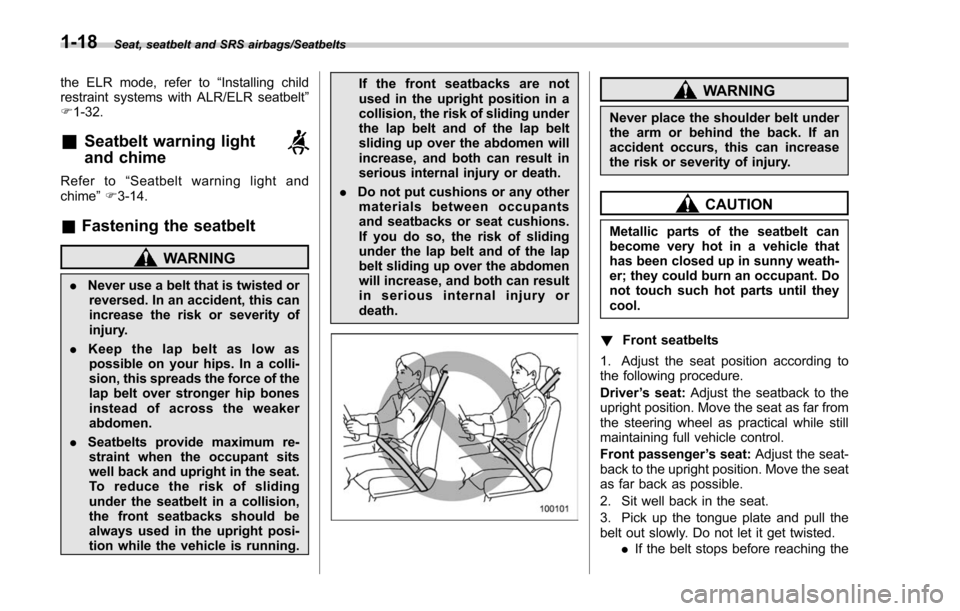
. Never use a belt that is twisted or
reversed. In an accident, this can
increase the risk or severity of
injury.
. Keep the lap belt as low as
possible on your hips. In a colli-
sion, this spreads the force of the
lap belt over stronger hip bones
instead of across the weaker
abdomen.
. Seatbelts provide maximum re-
straint when the occupant sits
well back and upright in the seat.
To reduce the risk of sliding
under the seatbelt in a collision,
the front seatbacks should be
always used in the upright posi-
tion while the vehicle is running. If the front seatbacks are not
used in the upright position in a
collision, the risk of sliding under
the lap belt and of the lap belt
sliding up over the abdomen will
increase, and both can result in
serious internal injury or death.
. Do not put cushions or any other
materials between occupants
and seatbacks or seat cushions.
If you do so, the risk of sliding
under the lap belt and of the lap
belt sliding up over the abdomen
will increase, and both can result
in serious internal injury or
death.
WARNING
Never place the shoulder belt under
the arm or behind the back. If an
accident occurs, this can increase
the risk or severity of injury.
CAUTION
Metallic parts of the seatbelt can
become very hot in a vehicle that
has been closed up in sunny weath-
er; they could burn an occupant. Do
not touch such hot parts until they
cool.
! Front seatbelts
1. Adjust the seat position according to
the following procedure.
Driver ’s seat: Adjust the seatback to the
upright position. Move the seat as far from
the steering wheel as practical while still
maintaining full vehicle control.
Front passenger ’s seat: Adjust the seat-
back to the upright position. Move the seat
as far back as possible.
2. Sit well back in the seat.
3. Pick up the tongue plate and pull the
belt out slowly. Do not let it get twisted.
.If the belt stops before reaching the
1-18
Page 59 of 634
Seat, seatbelt and SRS airbags/Front seatbelt pretensioners
pretensioner, contact your SUBARU
dealer as soon as possible.
.If the front seatbelt retractor assem-
bly or surrounding area has been
damaged, contact your SUBARU dealer
as soon as possible.
. When you sell your vehicle, we urge
you to explain to the buyer that it has
seatbelt pretensioners by alerting the
buyer to the contents of this section.
WARNING
. To obtain maximum protection,
the occupants should sit in an
upright position with their seat-
belts properly fastened. Refer to
“ Seatbelts ”F 1-16.
. Do not modify, remove or strike
the front seatbelt retractor as-
semblies or surrounding area.
This could result in accidental
activation of the seatbelt preten-
sioners or could make the sys-
tem inoperative, possibly result-
ing in serious injury. Seatbelt
pretensioners have no user-ser-
viceable parts. For required ser-
vicing of front seatbelt retractors
equipped with seatbelt preten-
sioners, consult your SUBARU
dealer. .
When discarding front seatbelt
retractor assemblies or scrap-
ping the entire vehicle due to
collision damage or for other
reasons, consult your SUBARU
dealer.
& System monitors
A diagnostic system continually monitors
the readiness of the seatbelt pretensioner
while the vehicle is being driven. The
seatbelt pretensioners share the control
module with the SRS airbag system.
Therefore, if any malfunction occurs in a
seatbelt pretensioner, the SRS airbag
system warning light will illuminate. For
details, refer to “SRS airbag system
monitors ”F 1-69.
& System servicing
WARNING
. When discarding a seatbelt re-
tractor assembly or scrapping
the entire vehicle damaged by a
collision, consult your SUBARU
dealer.
. Tampering with or disconnecting
the system ’s wiring could result
in accidental activation of the seatbelt pretensioner and/or SRS
airbag or could make the system
inoperative, which may result in
serious injury. Do not use elec-
trical test equipment on any
circuit related to the seatbelt
pretensioner and SRS airbag
systems. For required servicing
of the seatbelt pretensioner, con-
sult your nearest SUBARU deal-
er.
CAUTION
The sensors and SRS airbag control
modules are located in the following
locations.
.
Front sub sensors: on both the
right and left side at the front of
the vehicle
. Front door impact sensors: on
both front doors
. Satellite safing sensor: under the
rear center seat
. Side airbag sensors: on both
center pillars
. Curtain airbag sensors: on both
rear wheel houses
. SRS airbag control module (in-
cluding the impact sensors): un-
1-28
Page 73 of 634
Seat, seatbelt and SRS airbags/*SRS airbag (Supplemental Restraint System airbag)
*SRS airbag (Supplemental
Restraint System airbag)
*SRS: This stands for supplemental re-
straint system. This name is used be-
cause the airbag system supplements the
vehicle’s seatbelts.
Your vehicle is equipped with a supple-
mental restraint system in addition to a
lap/shoulder belt at each front seating
position and each rear window-side seat-
ing positions. The supplemental restraint
system (SRS) consists of seven airbags.
The configurations are as follows.
. Driver ’s and front passenger ’s frontal
airbags
. Driver ’s and front passenger ’s side
airbags
. Curtain airbags (for driver, front pas-
senger, and window-side rear passen-
gers)
. Knee airbag for driver
These SRS airbags are designed only
as a supplement to the primary protec-
tion provided by the seatbelt.
The system also controls front seatbelt
pretensioners. For operation instructions
and precautions concerning the seatbelt
pretensioner, refer to “Front seatbelt pre-
tensioners ”F 1-25.
& General precautions regard-
ing SRS airbag system
WARNING
. To obtain maximum protection in
the event of an accident, the
driver and all passengers must
always wear seatbelts when in
the vehicle. The SRS airbag is
designed only to be a supple-
ment to the primary protection
provided by the seatbelt. It does
not eliminate the need to fasten
seatbelts. In combination with
the seatbelts, it offers the best
combined protection in case of a
serious accident.
Not wearing a seatbelt increases
the chance of severe injury or
death in a crash even when the
vehicle has the SRS airbag.
For instructions and precautions
concerning the seatbelt system,
refer to “Seatbelts ”F 1-16.
. The SRS side airbag and SRS
curtain airbag are designed only
to be a supplement to the primary
protection provided by the seat-
belt. They do not eliminate the
need to fasten seatbelts. It is also
important to wear your seatbelt to help avoid injuries that can
result when an occupant is not
seated in a proper upright posi-
tion.
WARNING
.
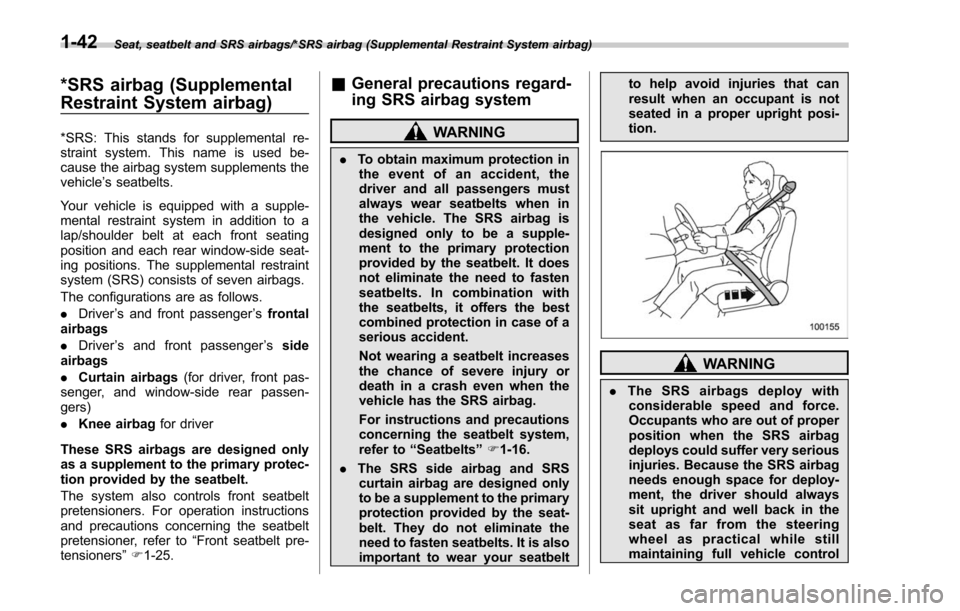
The SRS airbags deploy with
considerable speed and force.
Occupants who are out of proper
position when the SRS airbag
deploys could suffer very serious
injuries. Because the SRS airbag
needs enough space for deploy-
ment, the driver should always
sit upright and well back in the
seat as far from the steering
wheel as practical while still
maintaining full vehicle control
1-42
Page 81 of 634
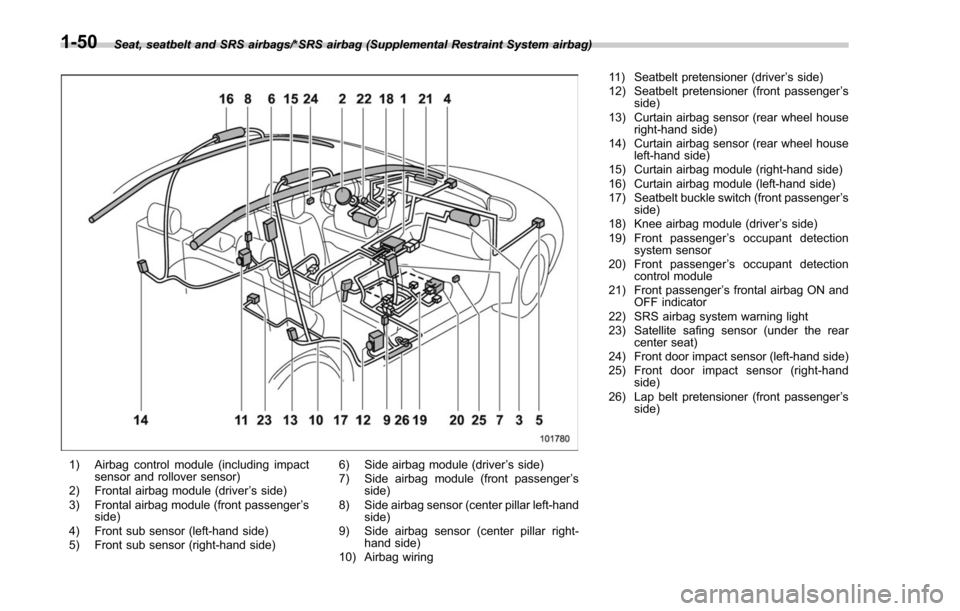
Seat, seatbelt and SRS airbags/*SRS airbag (Supplemental Restraint System airbag)
1) Airbag control module (including impactsensor and rollover sensor)
2) Frontal airbag module (driver ’s side)
3) Frontal airbag module (front passenger ’s
side)
4) Front sub sensor (left-hand side)
5) Front sub sensor (right-hand side) 6) Side airbag module (driver
’s side)
7) Side airbag module (front passenger ’s
side)
8) Side airbag sensor (center pillar left-hand side)
9) Side airbag sensor (center pillar right- hand side)
10) Airbag wiring 11) Seatbelt pretensioner (driver
’s side)
12) Seatbelt pretensioner (front passenger ’s
side)
13) Curtain airbag sensor (rear wheel house right-hand side)
14) Curtain airbag sensor (rear wheel house left-hand side)
15) Curtain airbag module (right-hand side)
16) Curtain airbag module (left-hand side)
17) Seatbelt buckle switch (front passenger ’s
side)
18) Knee airbag module (driver ’s side)
19) Front passenger ’s occupant detection
system sensor
20) Front passenger ’s occupant detection
control module
21) Front passenger ’s frontal airbag ON and
OFF indicator
22) SRS airbag system warning light
23) Satellite safing sensor (under the rear center seat)
24) Front door impact sensor (left-hand side)
25) Front door impact sensor (right-hand side)
26) Lap belt pretensioner (front passenger ’s
side)
1-50
Page 88 of 634
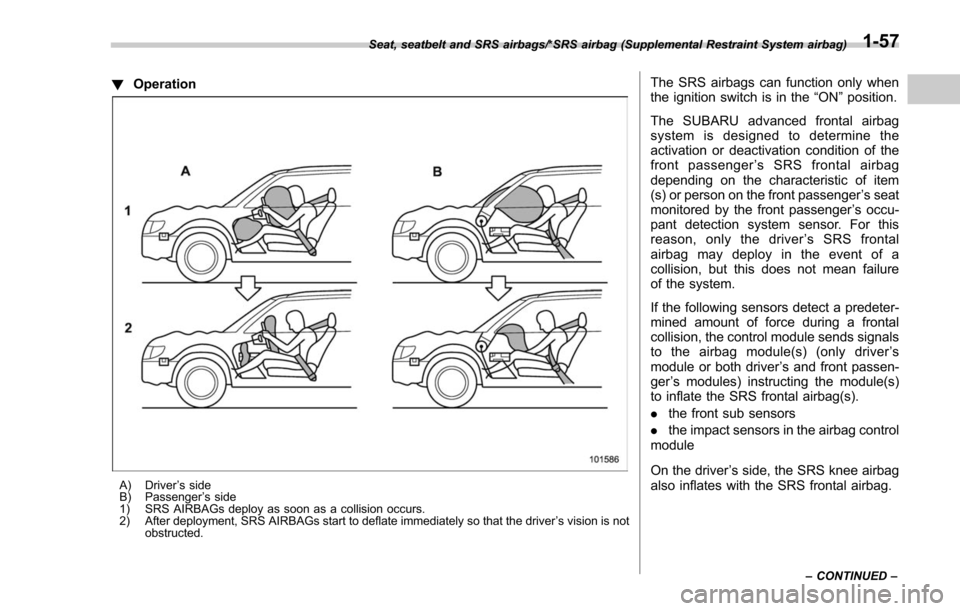
!Operation
A) Driver ’s side
B) Passenger ’s side
1) SRS AIRBAGs deploy as soon as a collision occurs.
2) After deployment, SRS AIRBAGs start to deflate immediately so that the driver ’s vision is not
obstructed.
The SRS airbags can function only when
the ignition switch is in the “ON”position.
The SUBARU advanced frontal airbag
system is designed to determine the
activation or deactivation condition of the
front passenger ’s SRS frontal airbag
depending on the characteristic of item
(s) or person on the front passenger ’s seat
monitored by the front passenger ’s occu-
pant detection system sensor. For this
reason, only the driver ’s SRS frontal
airbag may deploy in the event of a
collision, but this does not mean failure
of the system.
If the following sensors detect a predeter-
mined amount of force during a frontal
collision, the control module sends signals
to the airbag module(s) (only driver ’s
module or both driver ’s and front passen-
ger ’s modules) instructing the module(s)
to inflate the SRS frontal airbag(s).
. the front sub sensors
. the impact sensors in the airbag control
module
On the driver ’s side, the SRS knee airbag
also inflates with the SRS frontal airbag.
Seat, seatbelt and SRS airbags/*SRS airbag (Supplemental Restraint System airbag)
–CONTINUED –1-57