belt SUBARU IMPREZA 2001 2.G Owner's Manual
[x] Cancel search | Manufacturer: SUBARU, Model Year: 2001, Model line: IMPREZA, Model: SUBARU IMPREZA 2001 2.GPages: 316, PDF Size: 3.78 MB
Page 76 of 316
Seat, seat belt and SRS airbag2-19
–
CONTINUED –
NOTE
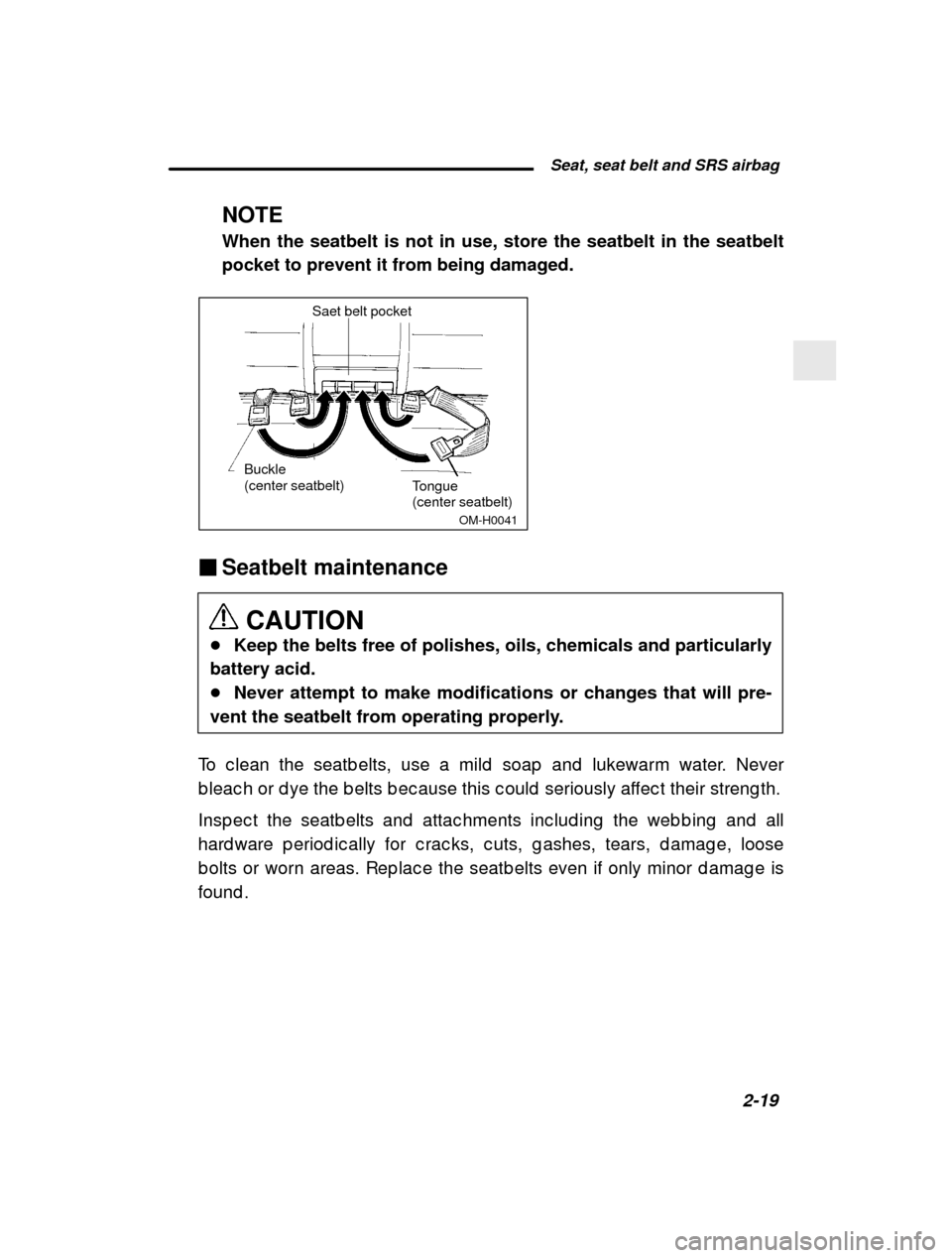
When the seatbelt is not in use, store the seatbelt in the seatbelt pocket to prevent it from being damaged.
Buckle
(center seatbelt)Tongue (center seatbelt)
Saet belt pocket
OM-H0041
Seatbelt maintenance
CAUTION
Keep the belts free of polishes, oils, chemicals and particularly
battery acid. Never attempt to make modifications or changes that will pre-
vent the seatbelt from operating properly.
To c lean the seatb elts, use a mild soap and lukewar m water. Never
b leac h or d ye the b elts b ec ause this c ould seriousl y affec t their streng th.
Insp ec t the seatb elts and attac hments inc lud ing the web b ing and all
hard ware p eriod ic ally for c rac ks, c uts, g ashes, tea rs, d amag e, loose
b olts or worn areas. Rep lac e the seatb elts even if only minor d amag e is
found .
Page 78 of 316
Seat, seat belt and SRS airbag2-21
–
CONTINUED –
HS0042 OM-H0051
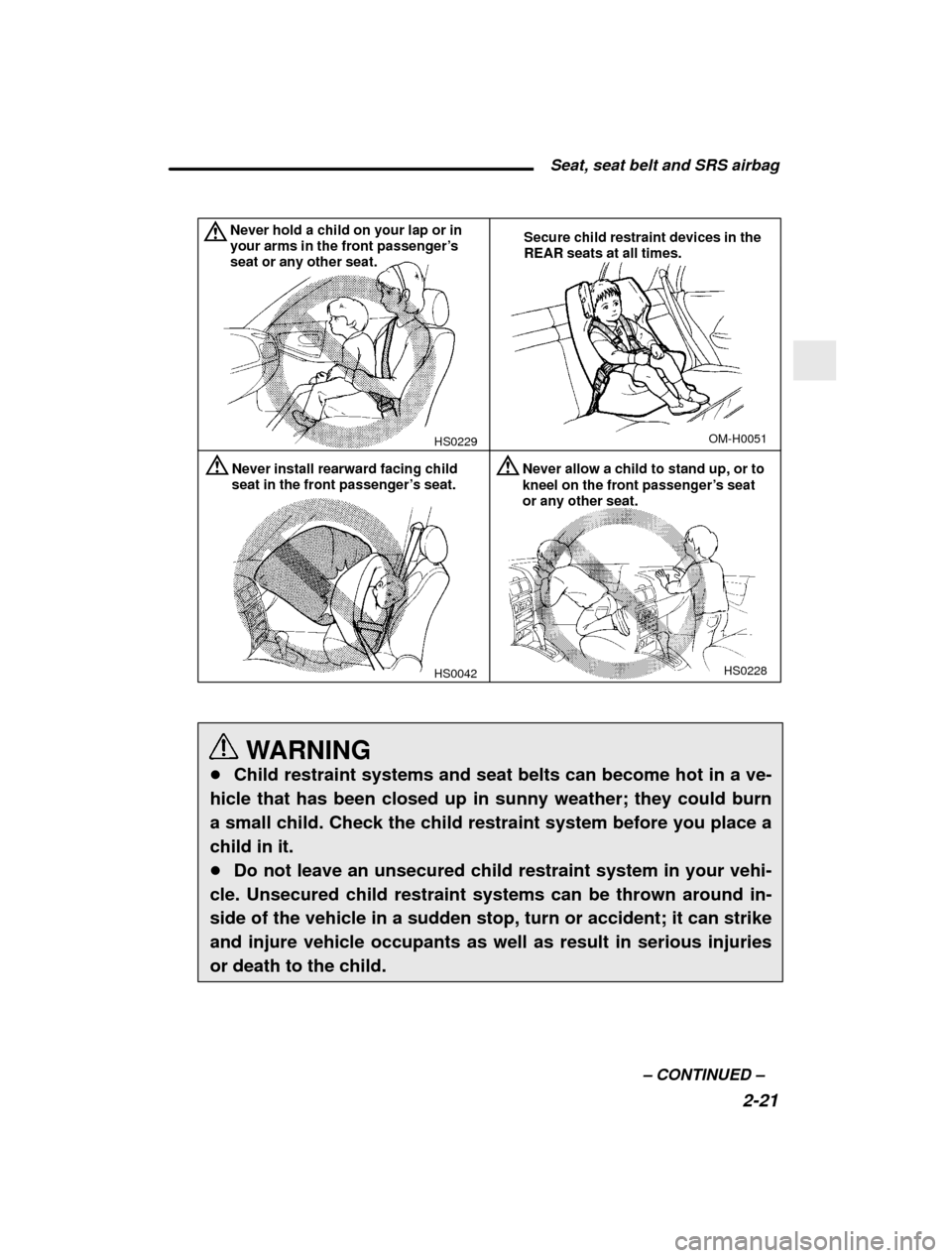
Never install rearward facing child seat in the front passenger
’s seat.
HS0228
Never allow a child to stand up, or to kneel on the front passenger ’s seat
or any other seat.
Secure child restraint devices in the REAR seats at all times.
HS0229
Never hold a child on your lap or in your arms in the front passenger ’s
seat or any other seat.
WARNING
Child restraint systems and seat belts can become hot in a ve-
hicle that has been closed up in sunny weather; they could burn a small child. Check the child restraint system before you place achild in it. Do not leave an unsecured child restraint system in your vehi-
cle. Unsecured child restraint systems can be thrown around in-
side of the vehicle in a sudden stop, turn or accident; it can strikeand injure vehicle occupants as well as result in serious injuriesor death to the child.
Page 79 of 316

2-22Infants and small c hild ren should always b e p lac ed
in an infant or c hild
restraint system in the rear seat while rid ing in t he vehic le. You should
use an infant or c hild restraint system that meets Fed eral Motor Vehic le
Safety Stand ard s or Canad a Motor Vehic le Safety Sta nd ard s, is c omp at-
ib le with your vehic le and is ap p rop riate for the c hild’s ag e and size. All
c hild restraint systems are d esig ned to b e sec ured in the vehic le seats
b y lap b elts or the lap b elt p ortion of a lap /shoul d er b elt.
Child ren c ould b e end ang ered in an ac c id ent if thei r c hild restraints are
not p rop erly sec ured in the vehic le. When installin g the c hild restraint
system, c arefully follow the manufac turer ’s instruc tions.
Ac c ord ing to ac c id ent statistic s, c hild ren are safe r when p rop erly re-
strained in the rear seating p ositions than in the front seating p ositions.
All U.S. states and Canad ian p rovinc es req uire that infants and small
c hild ren b e restrained in an ap p roved c hild restrai nt system at all times
while the vehic le is moving .
Installing child restraint systems in the 2-point type seat belt position (Rear center seating position)
CAUTION
When you install a child restraint system, follow the manufactur-
er’ s instructions supplied with it. After installing the child re-
straint system, check to ensure that it is held securely in posi-
tion. If it is not held tight and secure, the danger of your childsuffering personal injury in the event of an accident may be in-creased.
Page 80 of 316
Seat, seat belt and SRS airbag2-23
–
CONTINUED –
HS2002BA
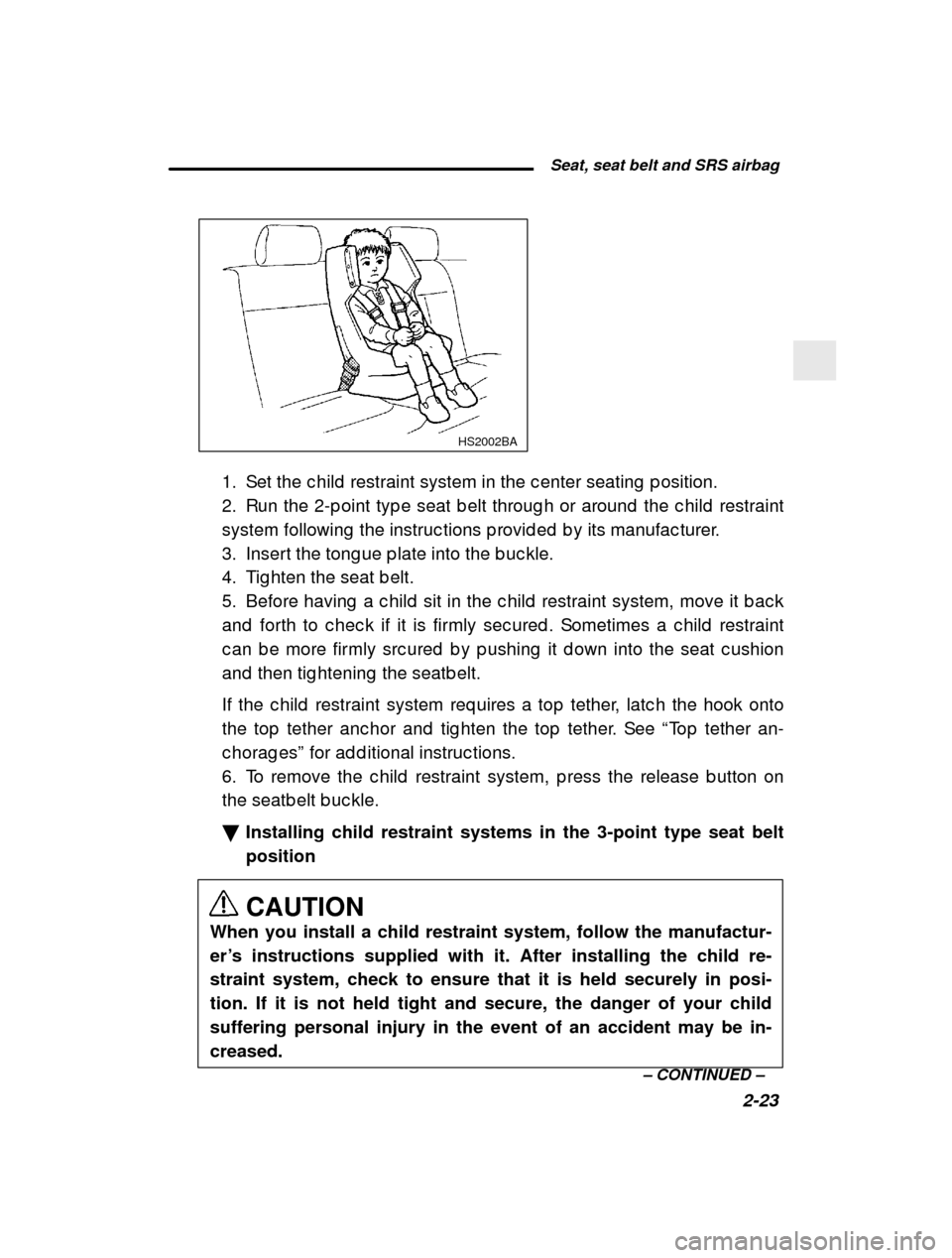
1. Set the c hild restraint system in the c enter seat ing p osition.
2. Run the 2-p oint typ e seat b elt throug h or around the c hild restraint
system following the instruc tions p rovid ed b y its m anufac turer.
3. Insert the tong ue p late into the b uc kle.
4. Tig hten the seat b elt.
5. Before having a c hild sit in the c hild restraint system, move it b ac k
and forth to c hec k if it is firmly sec ured . Sometim es a c hild restraint
c an b e more firmly src ured b y p ushing it d own into the seat c ushion
and then tig htening the seatb elt.
If the c hild restraint system req uires a top tether , latc h the hook onto
the top tether anc hor and tig hten the top tether. S ee “Top tether an-
c horag es ” for ad d itional instruc tions.
6. To remove the c hild restraint system, p ress the r elease b utton on
the seatb elt b uc kle. Installing child restraint systems in the 3-point type seat belt position CAUTION
When you install a child restraint system, follow the manufactur-
er’ s instructions supplied with it. After installing the child re-
straint system, check to ensure that it is held securely in posi-
tion. If it is not held tight and secure, the danger of your childsuffering personal injury in the event of an accident may be in-creased.
Page 81 of 316

2-24NOTE When the child restraint system is no longer in use, remove it and
restore the ELR function of the retractor. That function is restored
by allowing the seat belt to retract fully.
HGS021BA
1. Set the c hild restraint system in the seating p os
ition.
2. Run the lap and should er b elts throug h or around the c hild re-
straint system following the instruc tions p rovid ed b y its manufac turer.
If the should er b elt g oes in front of the c hild ’s fac e or nec k, p ut it b e-
hind the c hild restraint system.
3. Insert the tong ue p late into the b uc kle.
4. Take up the slac k in the lap b elt.
5. Pull out the seat b elt fully from the retrac tor t o c hang e the retrac tor
over from the Emerg enc y Loc king Retrac tor(ELR) to t he Automatic
Loc king Retrac tor (ALR) func tion. Then, allow the b elt to rewind into
the retrac tor. As the b elt is rewind ing , c lic ks wil l b e heard whic h ind i-
c ate the retrac tor func tions as ALR.
6. Before having a c hild sit in the c hild restraint system, move it b ac k
and forth to c hec k if it is firmly sec ured . Sometim es a c hild restraint
c an b e more firmly sec ured b y p ushing it d own into the seat c ushion
and then tig htening the seat b elt.
7. Pull at the should er p ortion of the b elt to c onfi rm that it c annot b e
p ulled out (ALR p rop erly func tioning ).
If the c hild restraint system req uires a top tether , latc h the hook onto the
top tether anc hor and tig hten the top tether. See “Top tether anc horag es ”
Page 82 of 316
Seat, seat belt and SRS airbag2-25
–
CONTINUED –
for ad d itional instruc tions.
HG0188HGS022BA
8. To remove the c hild restraint system, p ress the r
elease b utton on
the seatb elt b uc kle and allow the b elt to retrac t c omp letely. The b elt
will return to the ELR mod e.
Top tether anchorages Anchorage location
HG2005BB
HG2004BB
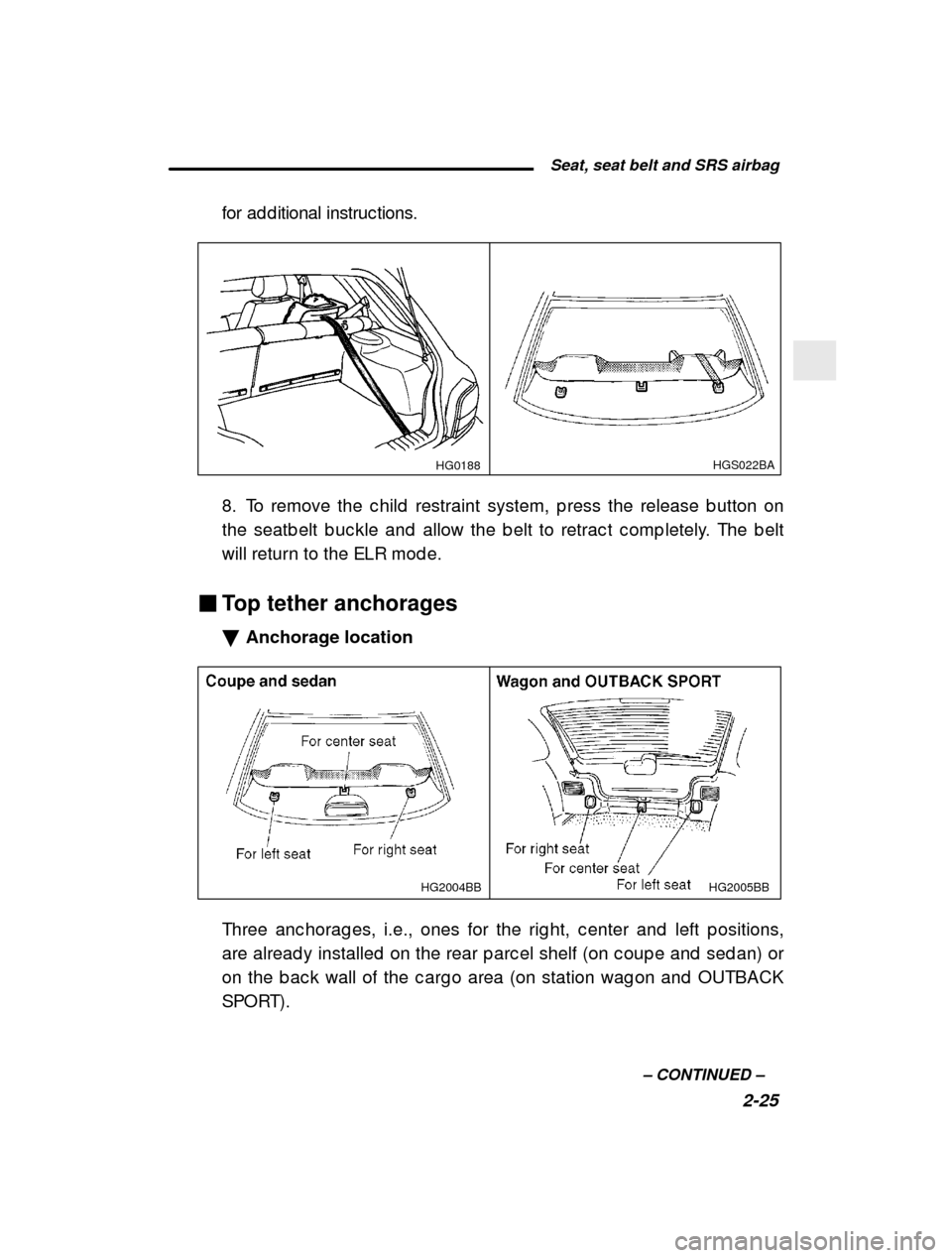
Three anc horag es, i.e., ones for the rig ht, c enter and left p ositions,
are alread y installed on the rear p arc el shelf (on c oup e and sed an) or
on the b ac k wall of the c arg o area (on station wag o n and OUTBACK
SPORT).
Page 84 of 316
Seat, seat belt and SRS airbag2-27
–
CONTINUED –
*SRS airbag (Supplemental Restraint System airbag)
*SRS: This stand s for sup p lemental restraint system
. This name is used
b ec ause the airb ag system sup p lements the vehic le ’s seatb elts.
Vehicle with driver ’s and front passenger ’s SRS air-
bags and lap/shoulder restraint
WARNING
To obtain maximum protection in the event of an accident, the
driver and all passengers in the vehicle should always wear seat- belts when the vehicle is moving. The SRS airbag is designed
only as a supplement to the primary protection provided by the
seatbelt. It does not do away with the need to fasten seatbelts. In
combination with the seatbelts, it offers the best combinedprotection in case of a serious accident.Not wearing a seatbelt increases the chance of severe injury ordeath in a crash even when the car has the SRS airbag.
For instructions and precautions concerning the seatbelt system,see the “Seatbelts” sections in this chapter.
Do not sit or lean unnecessarily close to the SRS airbag. Be-
cause the SRS airbag deploys with considerable speed – faster
than the blink of an eye – and force to protect in high speed colli-
sions, the force of an airbag can injure an occupant whose bodyis too close to SRS airbag. It is also important to wear your seatbelt to help avoid injuriesthat can result when the SRS airbag contacts an occupant not inproper position such as one thrown forward during pre-accidentbraking.Even when properly positioned, there remains a possibility thatan occupant may suffer minor injury such as abrasions andbruises to the face or arms because of the SRS airbag deploy-ment force.
Page 85 of 316
2-28
Do not place any objects over or near the SRS airbag cover or
between you and the SRS airbag. If the SRS airbag deploys, those objects could interfere with its proper operation and could
be propelled inside the car and cause injury. The SRS airbags deploy with considerable speed and force.
Occupants who are out of proper position when the SRS airbag
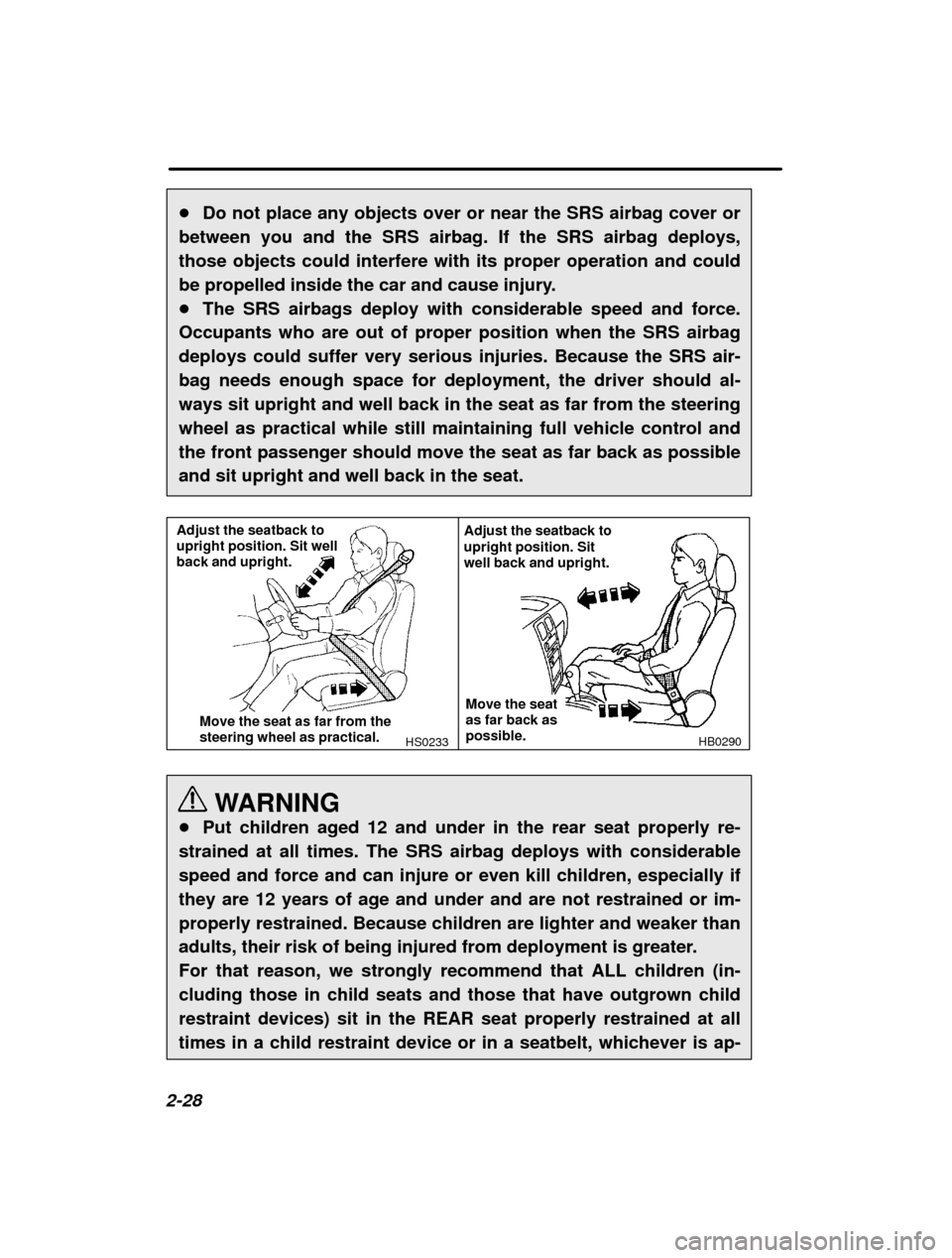
deploys could suffer very serious injuries. Because the SRS air-bag needs enough space for deployment, the driver should al-ways sit upright and well back in the seat as far from the steeringwheel as practical while still maintaining full vehicle control and
the front passenger should move the seat as far back as possibleand sit upright and well back in the seat.
HS0233
Adjust the seatback to upright position. Sit well back and upright.
Move the seat as far from the steering wheel as practical.HB0290
Adjust the seatback to upright position. Sit well back and upright.
Move the seat as far back as possible.
WARNING
Put children aged 12 and under in the rear seat properly re-
strained at all times. The SRS airbag deploys with considerable speed and force and can injure or even kill children, especially ifthey are 12 years of age and under and are not restrained or im-properly restrained. Because children are lighter and weaker than
adults, their risk of being injured from deployment is greater.
For that reason, we strongly recommend that ALL children (in-cluding those in child seats and those that have outgrown child
restraint devices) sit in the REAR seat properly restrained at alltimes in a child restraint device or in a seatbelt, whichever is ap-
Page 86 of 316
Seat, seat belt and SRS airbag2-29
–
CONTINUED –
propriate for the child
’s age, height and weight.
Secure ALL types of child restraint devices (including forward facing child seats) in the REAR seats at all times.According to accident statistics, children are safer when properlyrestrained in the rear seating positions than in the front seatingpositions.For instructions and precautions concerning the child restraint
system, see the “Child restraint systems ” section in this chapter.
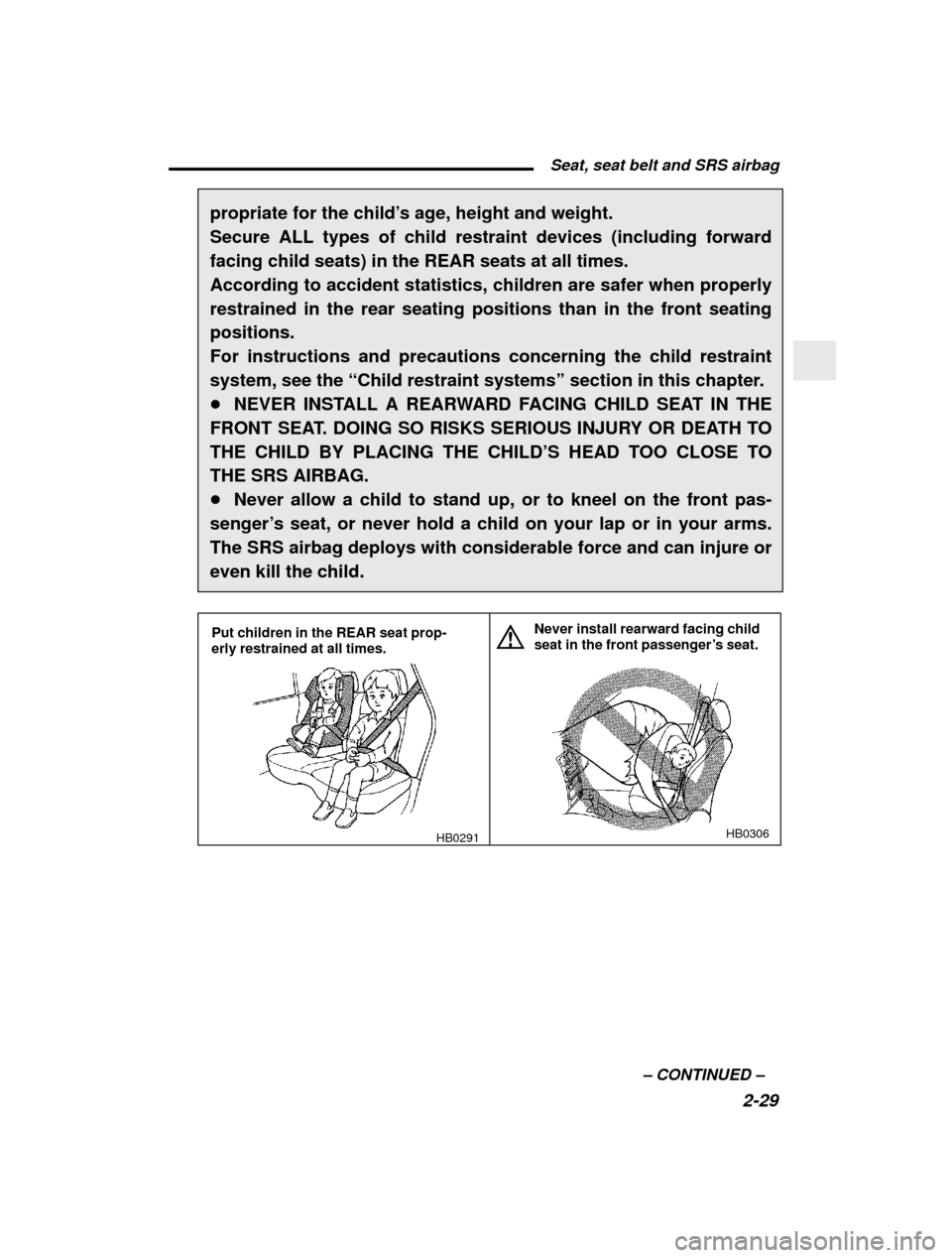
NEVER INSTALL A REARWARD FACING CHILD SEAT IN THE
FRONT SEAT. DOING SO RISKS SERIOUS INJURY OR DEATH TOTHE CHILD BY PLACING THE CHILD ’S HEAD TOO CLOSE TO
THE SRS AIRBAG. Never allow a child to stand up, or to kneel on the front pas-
senger’ s seat, or never hold a child on your lap or in your arms.
The SRS airbag deploys with considerable force and can injure oreven kill the child.
HB0306
HB0291
Put children in the REAR seat prop- erly restrained at all times.
Never install rearward facing child seat in the front passenger
’s seat.
Page 88 of 316
Seat, seat belt and SRS airbag2-31
–
CONTINUED –
CAUTION
When the SRS airbag deploys, some smoke will be released.
This smoke could cause breathing problems for people with a history of asthma or other breathing trouble. If you or your pas-
sengers have breathing problems after SRS airbag deploys, get
fresh air promptly. A deploying SRS airbag releases hot gas. Occupants could get
burnt if they come into direct contact with the hot gas.
The sup p lemental restraint system (SRS) c onsists of two airb ag s (d river’s
and front p asseng er ’s SRS airb ag s).
These SRS airbags are designed only as a supplement to the prima-ry protection provided by the seatbelt.
The d river ’s SRS airb ag is stowed in the c enter p ortion of the steering
wheel. The p asseng er ’s SRS airb ag is stowed near the top of the d ash-
b oard und er an “SRS AIRBAG ” mark.
In a mod erate to severe frontal c ollision, the d riv er’s and front p assen-
g er ’s SRS airb ag s d ep loy and sup p lement the seatb elts b y red uc ing the
imp ac t on the d river ’s and front p asseng er ’s head and c hest.
NOTE When you sell your vehicle, we urge you to explain to the buyer that
it is equipped with SRS airbags by alerting him to the applicablesection in this owner ’s manual.