change SUBARU IMPREZA 2003 2.G Owner's Guide
[x] Cancel search | Manufacturer: SUBARU, Model Year: 2003, Model line: IMPREZA, Model: SUBARU IMPREZA 2003 2.GPages: 425, PDF Size: 5.75 MB
Page 271 of 425

Driving tips
8-18
load. Therefore, the GVW changes depending on
the situation. The GVWR equals Curb Weight (actualweight of your vehicle – including standard equip-
ment, fluids, emergency tools and spare tire assem-bly) plus the vehicle capacity weight. In addition, the total weight applied to each axle
(GAW) must never exceed the GAWR. The front and
rear GAWs can be adjusted by relocating luggageinside the vehicle.Even if the total weight of your luggage is lower than
the vehicle capacity weight, either front or rear GAW
may exceed the GAWR, depending on the distribu-
tion of the luggage.
If you carry heavy loads in the vehicle, you should
confirm that GVW and front and rear GAWs are with-
in the GVWR and GAWR by putting your vehicle on
a vehicle scale, found at a commercial weighing sta- tion.
Do not use replacement tires with a lower load range than the originals because they may lower the
GVWR and GAWR limitations. Replacement tireswith a higher load range than the originals do not in-
crease the GVWR and GAWR limitations.
Roof rail and crossbar (if equipped)
1) Crossbar kit
The roof rail is not designed to carry cargo by itself.
Cargo can be carried after securing the roof cross-
bar kit to the roof rail and installing the appropriate
carrying attachment. When installing the roof cross-
bar kit, follow the manufacturer ’s instructions.
When you carry cargo on the roof using the roof
crossbar kit and a carrying attachment, never ex-
ceed the maximum load limit explained below. You
should also be careful that your vehicle does not ex-
ceed the Gross Vehicle Weight Rating (GVWR) and
Page 276 of 425
Driving tips
8-23
– CONTINUED –
the four T-30 crossbar clamp screws have been
checked, and retightened if necessary to 35 inch
lbs. (4.0 N-m, 0.41 kg-m), as outlined in Step #5above. Trailer hitch (if equipped) The trailer hitch is designed to tow a Class 1 rated
load. A maximum of
2,000 lbs. (906 kg) gross trailer
weight and a maximum of 200 lbs. (90 kg) gross
tongue weight are permissible for the trailer hitch.
When you tow a trailer, follow the instructions in the next section “Trailer towing ”.
WARNING
Never exceed the maximum weight specified
for the trailer hitch. Exceeding the maximum weight could cause an accident resulting inserious personal injuries. Permissible trailerweight changes depending on the situation.Refer to the next section “Trailer towing ” for
possible recommendations and limitations. Trailer brakes are required when the towing
load exceeds 1,000 lbs. (453 kg). Be sure yourtrailer has safety chains and that each chainwill hold the trailer ’s maximum gross weight.
Towing trailers without safety chains could create a traffic safety hazard if the trailer sepa- rates from the hitch due to coupling damageor hitch ball damage. Be sure to check the hitch pin and safety pin
Page 282 of 425

Driving tips
8-29
– CONTINUED –
Gross Vehicle Weight (GVW) and Gross
Vehicle Weight Rating (GVWR)
Gross Vehicle Weight
The Gross Vehicle Weight (GVW) must never
exceed the Gross Vehicle Weight Rating (GVWR).
Gross Vehicle Weight (GVW) is the combined total of
the weight of the vehicle, driver, passengers, lug-gage, trailer hitch, trailer tongue load and any other
optional equipment installed on your vehicle. There-
fore, the GVW changes depending on the situation.
Determine the GVW each time before going on a tripby putting your vehicle and trailer on a vehiclescale.
Certification label
GVWR is shown on the certification label located on the driver ’s side door jamb of your vehicle.
Page 283 of 425

Driving tips
8-30
Gross Axle Weight (GAW) and Gross Axle
Weight Rating (GAWR)
Gross Axle Weight
The total weight applied to each axle (GAW) must
never exceed the Gross Axle Weight Rating
(GAWR). The front and rear GAWs can be adjusted
by relocating passengers and luggage inside the
vehicle. The front and rear GAWR are also shown on
the certification label.
Certification label
To check both GVWR and GAWR and to confirm that
the total weight and weight distribution are withinsafe driving limits, you should have your vehicle and
trailer weighed at a commercial weighing station.
Be sure that all cargo is firmly secured to prevent a
change in weight distribution while driving.
Page 285 of 425
Driving tips
8-32
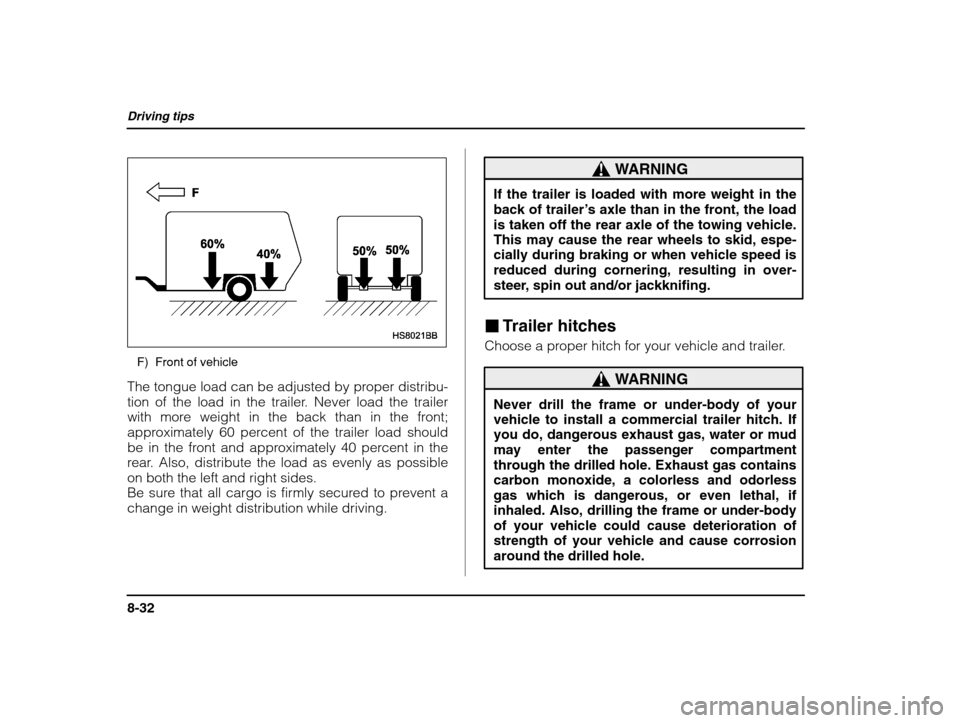
F) Front of vehicle
The tongue load can be adjusted by proper distribu-
tion of the load in the trailer. Never load the trailer
with more weight in the back than in the front;
approximately 60 percent of the trailer load should
be in the front and approximately 40 percent in the
rear. Also, distribute the load as evenly as possible on both the left and right sides.
Be sure that all cargo is firmly secured to prevent a
change in weight distribution while driving.
WARNING
If the trailer is loaded with more weight in the back of trailer ’s axle than in the front, the load
is taken off the rear axle of the towing vehicle.This may cause the rear wheels to skid, espe-
cially during braking or when vehicle speed is reduced during cornering, resulting in over-
steer, spin out and/or jackknifing.
Trailer hitches
Choose a proper hitch for your vehicle and trailer.
WARNING
Never drill the frame or under-body of your
vehicle to install a commercial trailer hitch. If you do, dangerous exhaust gas, water or mudmay enter the passenger compartment
through the drilled hole. Exhaust gas containscarbon monoxide, a colorless and odorless
gas which is dangerous, or even lethal, if
inhaled. Also, drilling the frame or under-body of your vehicle could cause deterioration ofstrength of your vehicle and cause corrosionaround the drilled hole.
Page 288 of 425
Driving tips
8-35
– CONTINUED –
eral, state/province and/or other applicable regula- tions.
Trailer lights
Connection of trailer lights to your vehicle ’s electrical
system requires modifications to the vehicle ’s light-
ing circuit to increase its capacity and accommo-
date wiring changes. To ensure the trailer lights are
connected properly, please consult your SUBARU
dealer. Check for proper operation of the turn sig-nals, the brake lights and parking lights each timeyou hitch up.
CAUTION
Direct splicing or other improper connection
of trailer lights may damage your vehicle ’s
electrical system and cause a malfunction ofyour vehicle ’s lighting system.
Tires
Make sure that all the tires on your vehicle are prop-
erly inflated to the pressure specified on the tire
placard located on the left center pillar of your ve-hicle.
Trailer tire condition, size, load rating and proper
inflation pressure should be in accordance with the trailer manufacturer
’s specifications.
In the event your vehicle gets a flat tire when towing
a trailer, ask a commercial road service to repair the
flat tire.
If you carry a regular size spare tire in your vehicle
or trailer as a precaution against getting a flat tire,
be sure that the spare tire is firmly secured.
WARNING
Never tow a trailer when the temporary spare tire is used. The temporary spare tire is not
designed to sustain the towing load. Use ofthe temporary spare tire when towing canresult in failure of the spare tire and/or less
stability of the vehicle.
Trailer towing tips
CAUTION
Never exceed 45 mph (72 km/h) when tow-
ing a trailer in hilly country on hot days. When towing a trailer, steering, stability,
stopping distance and braking performancewill be different from normal operation. For
Page 289 of 425

Driving tips
8-36
safety’s sake, you should employ extra cau-
tion when towing a trailer and you should
never speed. You should also keep the follow-ing tips in mind:
Before starting out on a trip
Check that the vehicle and vehicle-to-hitch mount-
ing are in good condition. If any problems are
apparent, do not tow the trailer. Check that the vehicle sits horizontally with the
trailer attached. If the vehicle is tipped sharply up at
the front and down at the rear, check the total trailer
weight, GVW, GAWs and tongue load again, then
confirm that the load and its distribution are accept-able. Check that the tire pressures are correct.
Check that the vehicle and trailer are connected
properly. Confirm that
–the trailer tongue is connected properly to the
hitch ball.– the trailer lights connector is connected prop-
erly and trailer ’s brake lights illuminate when the
vehicle’ s brake pedal is pressed, and that the trail-
er’ s turn signal lights flash when the vehicle ’s turn
signal lever is operated.– the safety chains are connected properly. –
all cargo in the trailer is secured safety in posi-
tion.– the side mirrors provide a good rearward field of
view without a significant blind spot.
Sufficient time should be taken to learn the “feel”
of the vehicle/trailer combination before starting out
on a trip. In an area free of traffic, practice turning, stopping and backing up.
Driving with a trailer
You should allow for considerably more stopping
distance when towing a trailer. Avoid sudden brak-
ing because it may result in skidding or jackknifing
and loss of control. Avoid abrupt starts and sudden accelerations. If
your vehicle has a manual transmission, always start
out in first gear and release the clutch at moderate
engine revolution. Avoid uneven steering, sharp turns and rapid lane
changes. Slow down before turning. Make a longer than
normal turning radius because the trailer wheels will
be closer than the vehicle wheels to the inside of the
turn. In a tight turn, the trailer could hit your vehicle. Crosswinds will adversely affect the handling of
your vehicle and trailer, causing sway. Crosswindscan be due to weather conditions or the passing of
Page 334 of 425

Maintenance and service
11-11
– CONTINUED –
If you check the oil level just after stopping the en-
gine, wait a few minutes for the oil to drain back into
the oil pan before checking the level.
Just after driving or while the engine is warm, the
engine oil level reading may be in a range betweenthe upper level and the notch mark. This is caused
by thermal expansion of the engine oil.
To prevent overfilling the engine oil, do not add any
additional oil above the upper level when the engineis cold. Changing the oil and oil filter
Change the oil and oil filter according to the mainte-
nance schedule in the “Warranty and Maintenance
Booklet”.
The engine oil and oil filter must be changed more
frequently than listed in the maintenance schedule
when driving on dusty roads, when short trips are
frequently made, or when driving in extremely cold
whether.
1. Warm up the engine by letting the engine idle for
about 10 minutes to ease draining the engine oil.
2. Park the vehicle on a level surface and stop theengine.
3. Remove the oil filler cap.
1) Drain plug
4. Drain out the engine oil by removing the drain
plug while the engine is still warm. The used oil
should be drained into an appropriate container and
disposed of properly.
WARNING
Be careful not to burn yourself with hot en- gine oil.
5. Wipe the seating surface of the drain plug with a
clean cloth and tighten it securely with a new seal-
Page 340 of 425

Maintenance and service
11-17
– CONTINUED –
1) Rubber gaskets
3. After refilling the reserve tank and the radiator, re- install the caps and check that the rubber gaskets
inside the radiator cap are in the proper position.
CAUTION
Be careful not to spill engine coolant when
adding it. If coolant touches the exhaust pipe, it may cause a bad smell, smoke, and/or a fire. Do not splash the engine coolant over
painted parts. The alcohol contained in the en-gine coolant may damage the paint surface.
Changing the coolant
1) Drain plug
Change the engine coolant using the following pro-
cedures according to the maintenance schedule.
1. Remove the under cover.
2. Place a proper container under the drain plugand loosen the drain plug.
3. Loosen the radiator cap to drain the coolant from
the radiator. Then drain the coolant from the reserve
tank. Tighten the drain plug securely.
Page 359 of 425

Maintenance and service
11-36
have the vehicle checked at your SUBARU
dealer.Never use different brands of clutch fluid to-
gether. When clutch fluid is added, be careful not to
allow any dirt into the tank.
Recommended clutch fluid
FMVSS No. 116, fresh DOT 3 or 4 brake fluidBrake booster If the brake booster does not operate as described
below, have it checked by your SUBARU dealer.
1. With the engine off, depress the brake pedal sev-
eral times, applying the same pedal force each time.
The distance the pedal travels should not vary.
2. With the brake pedal depressed, start the en-
gine. The pedal should move slightly down to the
floor.
3. With the brake pedal depressed, stop the engine
and keep the pedal depressed for 30 seconds. The pedal height should not change.
4. Start the engine again and run for about one min-
ute then turn it off. Depress the brake pedal several
times to check the brake booster. Brake booster op-
erates properly if the pedal stroke decreases with
each depression.