check engine SUBARU IMPREZA 2004 2.G User Guide
[x] Cancel search | Manufacturer: SUBARU, Model Year: 2004, Model line: IMPREZA, Model: SUBARU IMPREZA 2004 2.GPages: 491, PDF Size: 5.93 MB
Page 270 of 491

7-1
7
Starting and operating
F uel .. ... ... ... .. ... ... ... ... .. ... ... ... ... ... .. ... ... ... ... .. ... ... 7-2
F uel re quire ments ..................... ..................... ... 7-2
Fuel filler lid and cap ........................................ 7-4
State emission testing (U.S. only) ............... 7-7
Preparing to drive ......................................... 7-9
Starting the engine ....................................... 7-9 Manual transmission vehicle ........................... 7-9
Automatic transmission vehicle ...................... 7-10
Starting the engine during cold weather below −4 °F ( −20 °C) ......................................... 7-10
Starting a flooded engine ................................. 7-11
Stopping the engine ..................................... 7-11
Manual transmission – 6 speed (WRX-STi) 7-12 Selecting reverse gear ...................................... 7-12
Shifting speeds ................................................. 7-13
Driving tips ........................................................ 7-14
Manual transmission – 5 speed (except WRX-STi) ...................................... 7-15Shifting speeds ................................................. 7-15
Driving tips ........................................................ 7-17
Driver’s Control Center Differential (DCCD) (WRX-STi) ..................................... 7-18Auto mode ......................................................... 7-18
Manual mode ..................................................... 7-19
Temporary release ............................................ 7-21
Automatic transmission ............................... 7-21 Selector lever for automatic transmission ..... 7-22
Shift lock release .............................................. 7-26
Limited slip differential (LSD) (if equipped) 7-27 Power steering .............................................. 7-28
Braking ........................................................... 7-28
Braking tips ....................................................... 7-28
Brake system .................................................... 7-29
Disc brake pad wear warning indicators ........ 7-29
ABS (Anti-lock Brake System) ..................... 7-30 ABS system self-check .................................... 7-30
ABS warning light ............................................. 7-31
Electronic Brake Force Distribution (EBD) system ........................................................ 7-32Steps to take if EBD system fails .................... 7-33
Parking your vehicle ..................................... 7-34 Parking brake .................................................... 7-34
Parking tips ....................................................... 7-35
Cruise control ................................................ 7-37 To set cruise control ........................................ 7-37
To temporarily cancel the cruise control ....... 7-39
To turn off the cruise control ........................... 7-40
To change the cruising speed ......................... 7-40
Page 275 of 491
7-6
Starting and operating
weather, which may cause injury.
3. Stop filling the tank after the fuel filler pump auto-
matically stops. Do not add any more fuel.
4. Put the cap back on, turn it clockwise until you hear
a clicking noise. Be certain not to catch the tether un-
der the cap while tightening.
5. Close the fuel filler lid completely.
If you spill any fuel on the painted surface, rinse it off
immediately. Otherwise, the painted surface could be
damaged.
NOTE
If the fuel filler cap is not tightened until it clicks or
if the tether is caught under the cap, the CHECK
ENGINE warning light may come on. Refer to the
“Warning and indicator lights” section located in
chapter 3.
" Never add any cleaning agents to the fuel
tank. The addition of a cleaning agent may
cause damage to the fuel system." Make sure that the cap is tightened until it
clicks to prevent fuel spillage in the event of an
accident. "
Do not let fuel spill on the exterior surfaces of
the vehicle.
Fuels may cause paint damage, which is not
covered under the SUBARU Limited Warranty. " Always use a genuine SUBARU fuel filler cap.
If you use the wrong cap, it may not fit or have
proper venting, and your fuel tank and emis-
sion control system might be damaged.
Page 277 of 491

7-8
Starting and operating
inspection program or its contractors or licens-ees.
The EPA has issued regulations for inspecting the On-
Board Diagnostic (OBD) system as part of the state
emissions inspection. The OBD system is designed to
detect engine and transmission problems that might
cause vehicle emissions to exceed allowable limits.
These inspections apply to all 1996 model year and
newer passenger cars and light trucks. Several states
plus the District of Columbia have opted to start the
OBD system inspection prior to the required EPA reg-
ulation effective date of January 1, 2002. Other states
will add OBD system inspection in 2002. " The inspection of the OBD system consists of a vi-
sual operational check of the “ CHECK ENGINE” warn-
ing light/malfunction indicator lamp (MIL) and an ex-
amination of the OBD system with an electronic scan
tool while the engine is running." A vehicle passes
the OBD system inspection if
proper the “ CHECK ENGINE ” warning light/MIL illumi-
nation is observed, there is no stored diagnostic trou-
ble codes, and the OBD system readiness monitors
are complete. " A vehicle fails
the OBD inspection if the “ CHECK
ENGINE ” warning light/MIL is not properly operating or there is one or more diagnostic trouble codes stored
in vehicle’s computer with the “
CHECK ENGINE”
warning light/MIL illuminated. " A state emission inspection may reject (not pass or
fail) a vehicle if the number of OBD system readinessmonitors “ Not Ready ” is greater than three. Under this
condition, the vehicle operator should be instructed to
drive his/her vehicle for a few days to set the monitors
and return for an emission re-inspection. " Owners of rejected or failing vehicles should contact
their Subaru Dealer for service.
Page 278 of 491
7-9
Starting and operating
– CONTINUED –
Preparing to drive
You should perform the following checks and adjust-
ments every day before you start driving.
1. Check that all windows, mirrors, and lights are
clean and unobstructed.
2. Check the appearance and condition of the tires.
Also check tires for proper inflation.
3. Look under the vehicle for any sign of leaks.
4. Check that the hood, trunk and rear gate are fully
closed.
5. Check the adjustment of the seat.
6. Check the adjustment of the inside and outside mir-
rors.
7. Fasten your seatbelt. Check that your passengers
have fastened their seatbelts.
8. Check the operation of the warning and indicator
lights when the ignition switch is turned to the “ON” po-sition.
9. Check the gauges, indicator and warning lights af-
ter starting the engine.
NOTE
Engine oil, engine coolant, brake fluid, washer flu-
id and other fluid levels should be checked daily,
weekly or at fuel stops.
Starting the engine
Do not operate the starter motor continuously
for more than ten seconds. If the engine fails to
start after operating the starter for five to ten
seconds, wait for ten seconds or more before
trying again.
! Manual transmission vehicle
1. Apply the parking brake.
2. Turn off unnecessary lights and accessories.
3. Press the clutch pedal to the floor and shift the shift
lever into neutral. Hold the clutch pedal to the floor
while starting the engine.
The starter motor will only operate when the clutch
pedal is pressed fully to the floor.
4. Turn the ignition switch to the “ON” position and
check the operation of the warning and indicator lights.
Refer to the “Warning and indicator lights” section (chapter 3).
5. Turn the ignition switch to the “START” position
without depressing the accelerator pedal. Release
the key immediately after the engine has started.
Page 279 of 491
7-10
Starting and operating
If the engine does not start within ten seconds, wait a
while and then turn the ignition switch to the “START”
position again while depressing the accelerator pedal
half way down.
6. Confirm that all warning and indicator lights have
gone off after the engine has started. The fuel injection
system automatically lowers the idle speed as the en-
gine warms up. !
Automatic transmission vehicle
1. Apply the parking brake.
2. Turn off unnecessary lights and accessories.
3. Shift the selector lever to the “P” or “N” position
(preferably “P” position).
The starter motor will only operate when the select le-
ver is at the “P” or “N” position.
4. Turn the ignition switch to the “ON” position and
check the operation of the warning and indicator lights.
Refer to the “Warning and indicator lights” section
(chapter 3).
5. Turn the ignition switch to the “START” position
without depressing the accelerator pedal. Release
the key immediately after the engine has started.
If the engine does not start within ten seconds, wait a
while and then turn the ignition switch to the “START”
position again while depressing the accelerator pedal half way down.
6. Confirm that all warning and indicator lights have
gone out after the engine has started. The fuel injec-
tion system automatically lowers the idle speed as the
engine warms up.
While the engine is warming up, make sure that the
selector lever is at the “P” or “N” position and that the
parking brake is applied.
If you restart the engine while the vehicle is
moving, shift the selector lever into the “N” po-
sition. Do not attempt to place the selector lever
of a moving vehicle into the “P” position.
! Starting the engine during cold weath- er below −4 °F ( −20 °C)
If the engine is difficult to start using the normal meth-
od (without depressing the accelerator pedal), turn the
ignition switch to the “START” position while slightly
depressing the accelerator pedal.
Page 298 of 491
7-29
Starting and operating
– CONTINUED –
!Braking when a tire is punctured
Do not depress the brake pedal suddenly when a tire
is punctured. This could cause a loss of control of the
vehicle. Keep driving straight ahead while gradually
reducing speed. Then slowly pull off the road to a safe
place. ! Brake system
! Two separate circuits
Your vehicle has two separate circuit brake systems.
Each circuit works diagonally across the vehicle. If one
circuit of the brake system should fail, the other half of
the system still works. If one circuit fails, the brake
pedal will go down much closer to the floor than usual
and you will need to press it down much harder. And a
much longer distance will be needed to stop the vehi- cle. ! Brake booster
The brake booster uses engine manifold vacuum to
assist braking force. Do not turn off the engine while
driving because that will turn off the brake booster, re-
sulting in poor braking power.
The brakes will continue to work even when the brake
booster completely stops functioning. If this happens,
however, you will have to push the pedal much harder than normal and the braking distance will increase. !
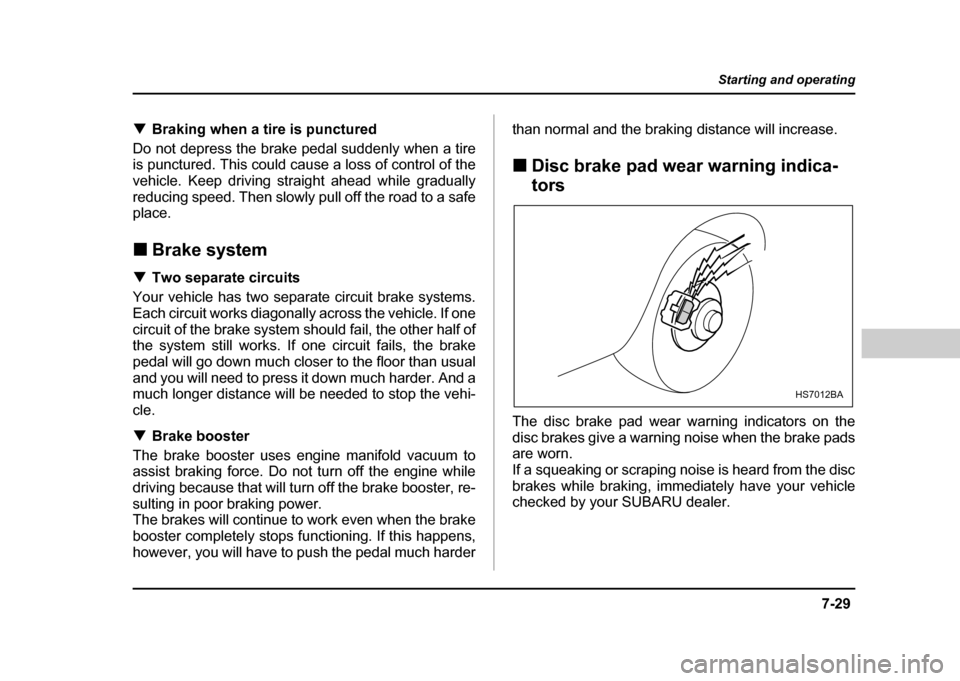
Disc brake pad wear warning indica- tors
The disc brake pad wear warning indicators on the
disc brakes give a warning noise when the brake pads
are worn.
If a squeaking or scraping noise is heard from the disc
brakes while braking, immediately have your vehicle
checked by your SUBARU dealer.
HS7012BA
Page 299 of 491
7-30
Starting and operating
ABS (Anti-lock Brake System)
The ABS system prevents the lock-up of wheels which
may occur during sudden braking or braking on slip-
pery road surfaces. This helps prevent the loss of
steering control and directional stability caused by
wheel lock-up.
When the ABS system is operating, you may hear a
chattering noise or feel a slight vibration in the brake
pedal. This is normal when the ABS operates.
The ABS system will not operate when the vehicle
speed is below approximately 6 mph (10 km/h).
Always use the utmost care in driving – over-
confidence because you are driving with an
ABS equipped vehicle could easily lead to a se-
rious accident.
"
The ABS system does not always decrease
stopping distance. You should always main-
tain a safe following distance from other vehi- cles. "
When driving on badly surfaced roads, gravel
roads, icy roads, or over deep newly fallen
snow, stopping distances may be longer for a
vehicle with the ABS system than one without.
When driving under these conditions, there-
fore, reduce your speed and leave ample dis-
tance from other vehicles. " When you feel the ABS system operating,
you should maintain constant brake pedal pres-
sure. Do not pump the brake pedal since doing
so may defeat the operation of the ABS system.
! ABS system self-check
You may feel a slight shock in the brake pedal and hear the operating sound of ABS from the engine com-
partment just after the vehicle is started. This is
caused by an automatic functional test of the ABS sys-
tem being carried out and does not indicate any abnor-
mal condition.
Page 302 of 491
7-33
Starting and operating
– CONTINUED –
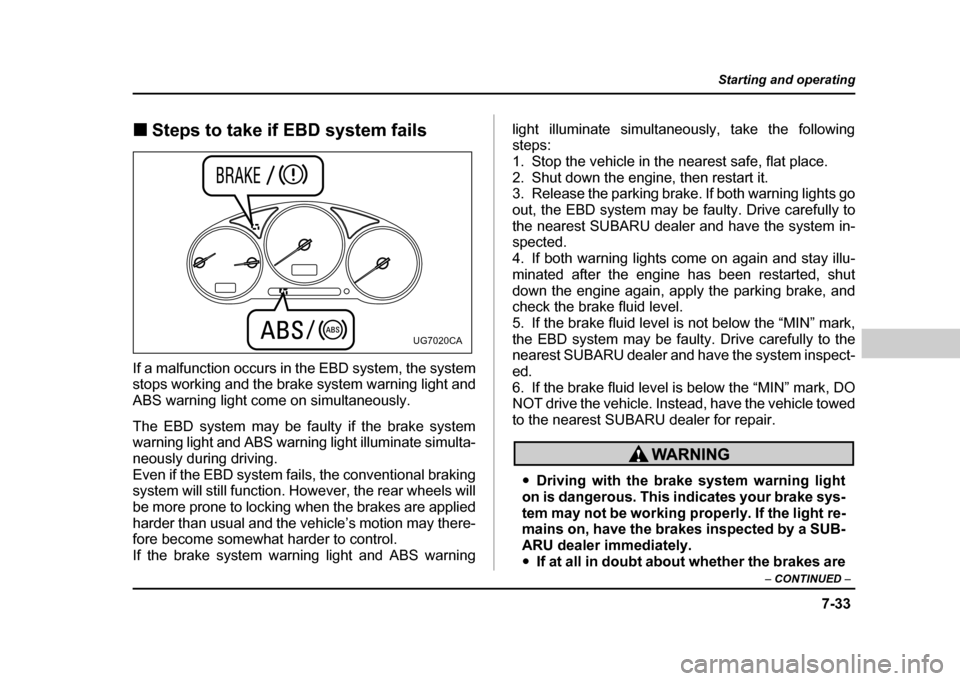
!Steps to take if EBD system fails
If a malfunction occurs in the EBD system, the system
stops working and the brake system warning light and
ABS warning light come on simultaneously.
The EBD system may be faulty if the brake system
warning light and ABS warning light illuminate simulta-
neously during driving.
Even if the EBD system fails, the conventional braking
system will still function. However, the rear wheels will
be more prone to locking when the brakes are applied
harder than usual and the vehicle’s motion may there-
fore become somewhat harder to control. If the brake system warning light and ABS warning light illuminate simultaneously, take the following steps:
1. Stop the vehicle in the nearest safe, flat place.
2. Shut down the engine, then restart it.
3. Release the parking brake. If both warning lights go
out, the EBD system may be faulty. Drive carefully to
the nearest SUBARU dealer and have the system in- spected.
4. If both warning lights come on again and stay illu-
minated after the engine has been restarted, shut
down the engine again, apply the parking brake, and
check the brake fluid level.
5. If the brake fluid level is not below the “MIN” mark,
the EBD system may be faulty. Drive carefully to the
nearest SUBARU dealer and have the system inspect- ed.
6. If the brake fluid level is below the “MIN” mark, DO
NOT drive the vehicle. Instead, have the vehicle towed
to the nearest SUBARU dealer for repair.
"
Driving with the brake system warning light
on is dangerous. This indicates your brake sys-
tem may not be working properly. If the light re-
mains on, have the brakes inspected by a SUB-
ARU dealer immediately." If at all in doubt about whether the brakes are
UG7020CA
Page 314 of 491
8-3
Driving tips
– CONTINUED –
Engine exhaust gas (Carbon monox-
ide)
"Never inhale engine exhaust gas. Engine ex-
haust gas contains carbon monoxide, a color-
less and odorless gas which is dangerous, or
even lethal, if inhaled. " Always properly maintain the engine exhaust
system to prevent engine exhaust gas from en-
tering the vehicle. " Never run the engine in a closed space, such
as a garage, except for the brief time needed to
drive the vehicle in or out of it. " Avoid remaining in a parked vehicle for a
lengthy time while the engine is running. If that
is unavoidable, then use the ventilation fan to
force fresh air into the vehicle." Always keep the front ventilator inlet grille
free from snow, leaves or other obstructions to
ensure that the ventilation system always
works properly." If at any time you suspect that exhaust fumes
are entering the vehicle, have the problem
checked and corrected as soon as possible. If
you must drive under these conditions, drive only with all windows fully open. "
Keep the trunk lid or rear gate closed while
driving to prevent exhaust gas from entering
the vehicle.
NOTE
Due to the expansion and contraction of the met-
als used in the manufacture of the exhaust sys-
tem, you may hear a crackling sound coming from
the exhaust system for a short time after the en-
gine has been shut off. This sound is normal.
Page 316 of 491
8-5
Driving tips
– CONTINUED –
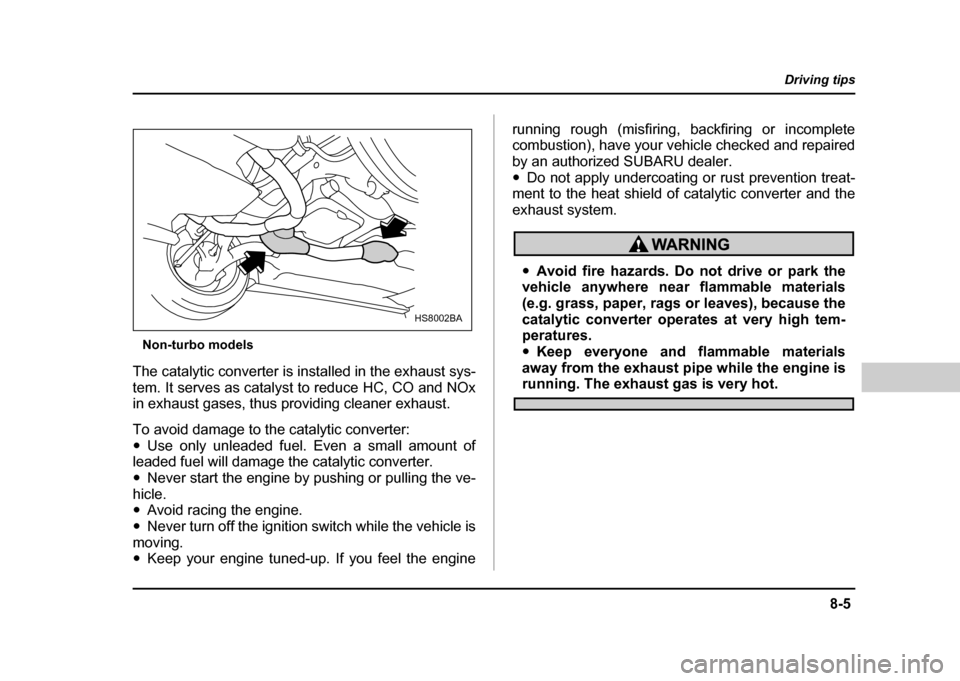
Non-turbo models
The catalytic converter is installed in the exhaust sys-
tem. It serves as catalyst to reduce HC, CO and NOx
in exhaust gases, thus providing cleaner exhaust.
To avoid damage to the catalytic converter: " Use only unleaded fuel. Even a small amount of
leaded fuel will damage the catalytic converter." Never start the engine by pushing or pulling the ve-
hicle. " Avoid racing the engine.
" Never turn off the ignition switch while the vehicle is
moving." Keep your engine tuned-up. If you feel the engine running rough (misfiring, backfiring or incomplete
combustion), have your vehicle checked and repaired
by an authorized SUBARU dealer."
Do not apply undercoating or rust prevention treat-
ment to the heat shield of catalytic converter and the
exhaust system.
" Avoid fire hazards. Do not drive or park the
vehicle anywhere near flammable materials
(e.g. grass, paper, rags or leaves), because the
catalytic converter operates at very high tem-
peratures. " Keep everyone and flammable materials
away from the exhaust pipe while the engine is
running. The exhaust gas is very hot.
HS8002BA