ESP SUBARU IMPREZA 2004 2.G Owners Manual
[x] Cancel search | Manufacturer: SUBARU, Model Year: 2004, Model line: IMPREZA, Model: SUBARU IMPREZA 2004 2.GPages: 491, PDF Size: 5.93 MB
Page 10 of 491
7
–
CONTINUED –
ment, the driver should always sit upright and
well back in the seat as far from the steering
wheel as practical while still maintaining full ve-
hicle control and the front passenger should
move the seat as far back as possible and sit
upright and well back in the seat.
Carefully read the sections “Seatbelts” and “*SRS air-
bag (Supplemental Restraint System airbag)” in chap-
ter 1 of this owner’s manual for instructions and pre-
cautions concerning the seatbelt system and SRS air-
bag system. ! Child safety
"Never hold a child on your lap or in your arms
while the vehicle is moving. The passenger
cannot protect the child from injury in a colli-
sion, because the child will be caught between
the passenger and objects inside the vehicle. " While riding in the vehicle, infants and small
children should always be placed in the REAR
seat in an infant or child restraint system which
is appropriate for the child’s age, height and weight. If a child is too big for a child restraint
system, the child should sit in the REAR seat
and be restrained using the seatbelts. Accord-
ing to accident statistics, children are safer
when properly restrained in the rear seating po-
sitions than in the front seating positions. Nev-
er allow a child to stand up or kneel on the seat. "
Put children aged 12 and under in the REAR
seat properly restrained at all times in a child
restraint device or in a seatbelt. The SRS airbag
deploys with considerable speed and force and
can injure or even kill children, especially if
they are 12 years of age and under and are not
restrained or improperly restrained. Because
children are lighter and weaker than adults,
their risk being injured from deployment is
greater. " NEVER INSTALL A REARWARD FACING
CHILD SEAT IN THE FRONT SEAT. DOING SO
RISKS SERIOUS INJURY OR DEATH TO THE
CHILD BY PLACING THE CHILD’S HEAD TOO
CLOSE TO THE SRS AIRBAG." Always use the child safety locks whenever a
child rides in the rear seat. Serious injury could
result if a child accidentally opened the door
and fell out. Refer to the “Child safety locks”
section in chapter 2.
Page 29 of 491
1-2
Seat, seatbelt and SRS airbags
Seat, seatbelt and SRS airbagsFront seats
"
Never adjust the seat while driving to avoid
the possibility of loss of vehicle control and of
personal injury." Before adjusting the seat, make sure the
hands and feet of rear seat passengers are
clear of the adjusting mechanism." Seatbelts provide maximum restraint when
the occupant sits well back and upright in the
seat. To reduce the risk of sliding under the
seatbelt in a collision, the front seatbacks
should be always used in the upright position
while the vehicle is running. If the front seat-
backs are not used in the upright position in a
collision, the risk of sliding under the lap belt
and of the lap belt sliding up over the abdomen
will increase, and both can result in serious in-
ternal injury or death.
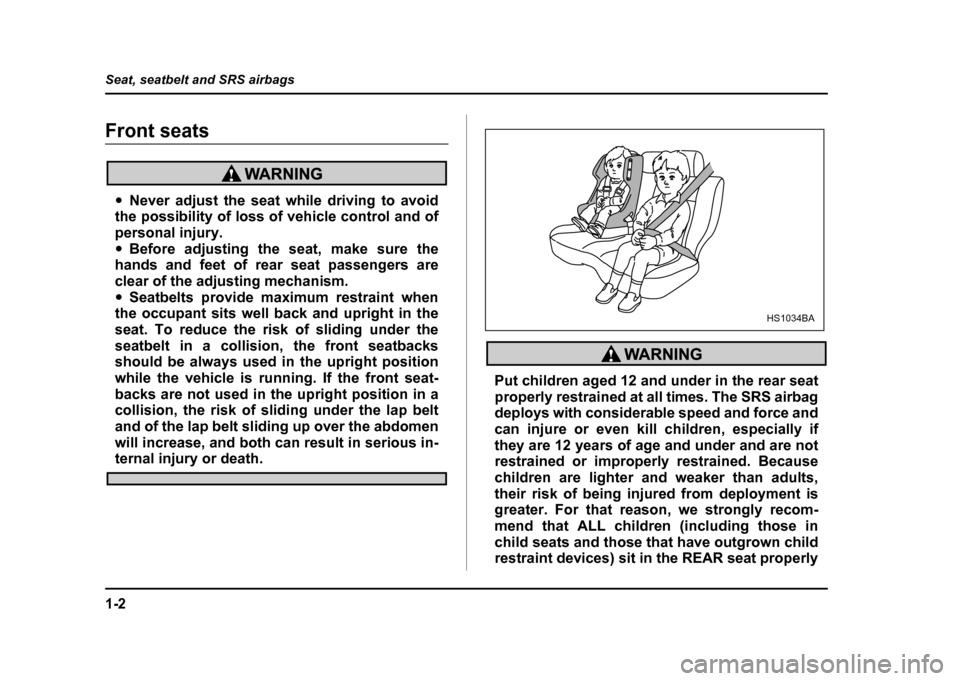
Put children aged 12 and under in the rear seat
properly restrained at all times. The SRS airbag
deploys with considerable speed and force and
can injure or even kill children, especially if
they are 12 years of age and under and are not
restrained or improperly restrained. Because
children are lighter and weaker than adults,
their risk of being injured from deployment is
greater. For that reason, we strongly recom-
mend that ALL children (including those in
child seats and those that have outgrown child
restraint devices) sit in the REAR seat properly
HS1034BA
Page 40 of 491
1-13
Seat, seatbelt and SRS airbags
– CONTINUED –
Seatbelts !Seatbelt safety tips
"All persons in the vehicle should fasten their
seatbelts BEFORE the vehicle starts to move.
Otherwise, the possibility of serious injury be-
comes greater in the event of a sudden stop or
accident. " All belts should fit snugly in order to provide
full restraint. Loose fitting belts are not as ef-
fective in preventing or reducing injury. " Each seatbelt is designed to support only
one person. Never use a single belt for two or
more persons — even children. Otherwise, in
an accident, serious injury or death could re-
sult. " Replace all seatbelt assemblies including re-
tractors and attaching hardware worn by occu-
pants of a vehicle that has been in a serious ac-
cident. The entire assembly should be replaced
even if damage is not obvious." Put children aged 12 and under in the rear
seat properly restrained at all times. The SRS
airbag deploys with considerable speed and force and can injure or even kill children, espe-
cially if they are 12 years of age and under and
are not restrained or improperly restrained. Be-
cause children are lighter and weaker than
adults, their risk of being injured from deploy-
ment is greater. For that reason, we strongly
recommend that ALL children (including those
in child seats and those that have outgrown
child restraint devices) sit in the REAR seat
properly restrained at all times in a child re-
straint device or in a seatbelt, whichever is ap-
propriate for the child’s height and weight.
Secure ALL types of child restraint devices (in-
cluding forward facing child seats) in the REAR
seats at all times.
NEVER INSTALL A REARWARD FACING CHILD
SEAT IN THE FRONT SEAT. DOING SO RISKS SERIOUS INJURY OR DEATH TO THE CHILD
BY PLACING THE CHILD’S HEAD TOO CLOSE
TO THE SRS AIRBAG.
According to accident statistics, children are
safer when properly restrained in the rear seat-
ing positions than in the front seating posi-
tions. For instructions and precautions con-
cerning the child restraint system, see the
“Child restraint systems” section in this chap-
Page 48 of 491
1-21
Seat, seatbelt and SRS airbags
– CONTINUED –
retracted properly to avoid catching the belt webbing
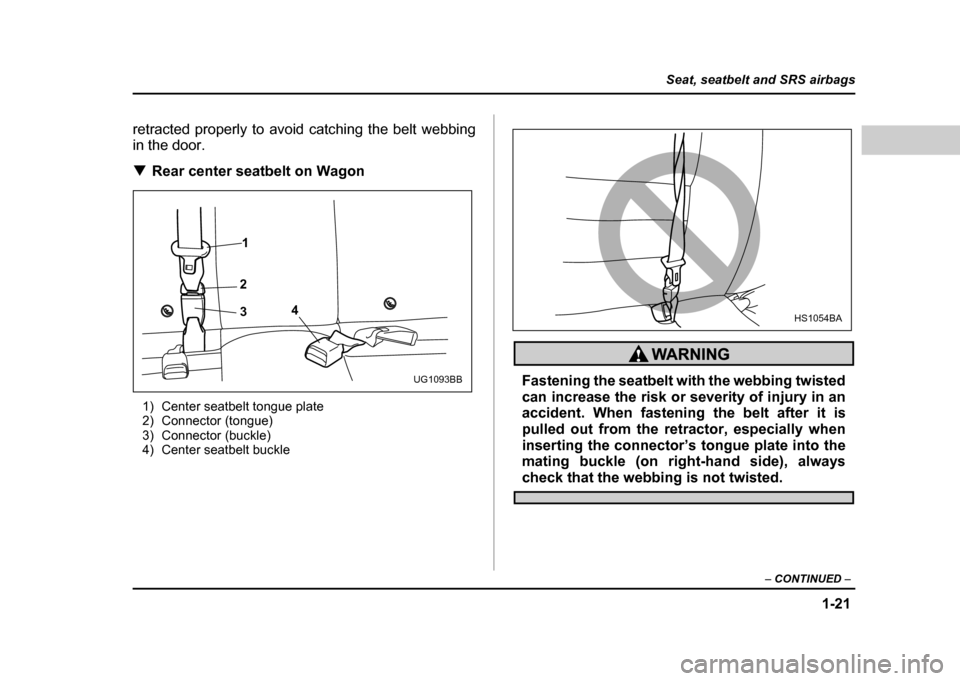
in the door. !Rear center seatbelt on Wagon
1) Center seatbelt tongue plate
2) Connector (tongue)
3) Connector (buckle)
4) Center seatbelt buckle
Fastening the seatbelt with the webbing twisted
can increase the risk or severity of injury in an
accident. When fastening the belt after it is
pulled out from the retractor, especially when
inserting the connector’s tongue plate into the mating buckle (on right-hand side), always
check that the webbing is not twisted.
3 4
1
2
UG1093BB
HS1054BA
Page 60 of 491
1-33
Seat, seatbelt and SRS airbags
– CONTINUED –
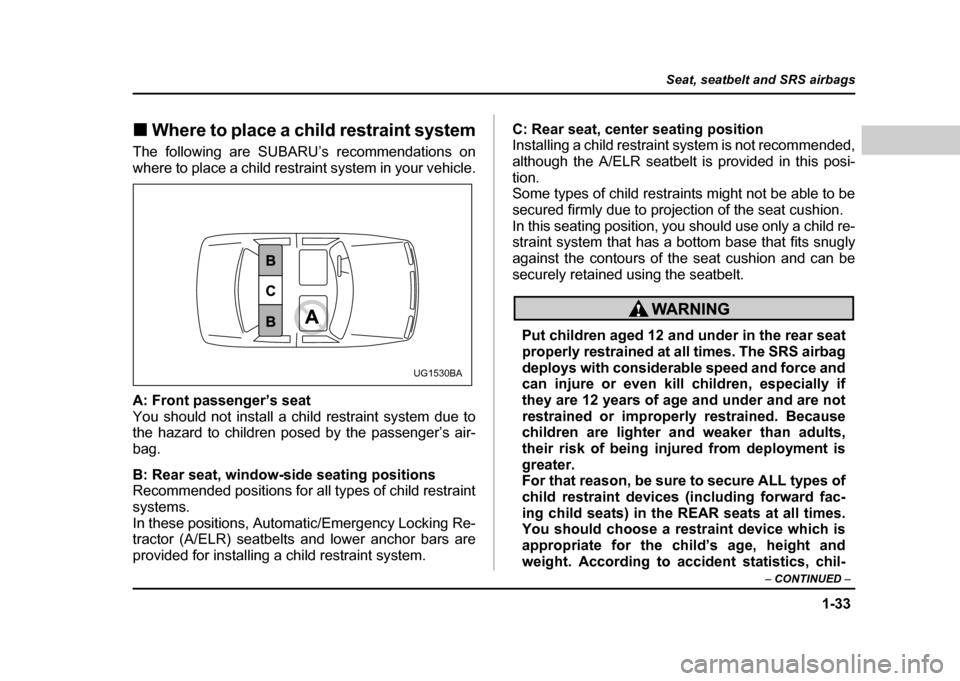
!Where to place a child restraint system
The following are SUBARU’s recommendations on
where to place a child restraint system in your vehicle.
A: Front passenger’s seat
You should not install a child restraint system due to
the hazard to children posed by the passenger’s air-
bag.
B: Rear seat, window-side seating positions
Recommended positions for all types of child restraint systems.
In these positions, Automatic/Emergency Locking Re-
tractor (A/ELR) seatbelts and lower anchor bars are
provided for installing a child restraint system. C: Rear seat, center seating position
Installing a child restraint system is not recommended,
although the A/ELR seatbelt is provided in this posi-
tion.
Some types of child restraints might not be able to be
secured firmly due to projection of the seat cushion.
In this seating position, you should use only a child re-
straint system that has a bottom base that fits snugly
against the contours of the seat cushion and can be
securely retained using the seatbelt.
Put children aged 12 and under in the rear seat
properly restrained at all times. The SRS airbag
deploys with considerable speed and force and
can injure or even kill children, especially if
they are 12 years of age and under and are not
restrained or improperly restrained. Because
children are lighter and weaker than adults,
their risk of being injured from deployment is
greater.
For that reason, be sure to secure ALL types of
child restraint devices (including forward fac-
ing child seats) in the REAR seats at all times.
You should choose a restraint device which is
appropriate for the child’s age, height and
weight. According to accident statistics, chil-
UG1530BA
Page 80 of 491
1-53
Seat, seatbelt and SRS airbags
– CONTINUED –
injury such as abrasions and bruises to the
face or arms because of the SRS airbag deploy-
ment force."The SRS airbags deploy with considerable
speed and force. Occupants who are out of
proper position when the SRS airbag deploys
could suffer very serious injuries. Because the
SRS airbag needs enough space for deploy-
ment, the driver should always sit upright and
well back in the seat as far from the steering
wheel as practical while still maintaining full ve-
hicle control and the front passenger should
move the seat as far back as possible and sit
upright and well back in the seat. " Do not place any objects over or near the
SRS airbag cover or between you and the SRS
airbag. If the SRS airbag deploys, those objects
could interfere with its proper operation and
could be propelled inside the car and cause in-
jury.
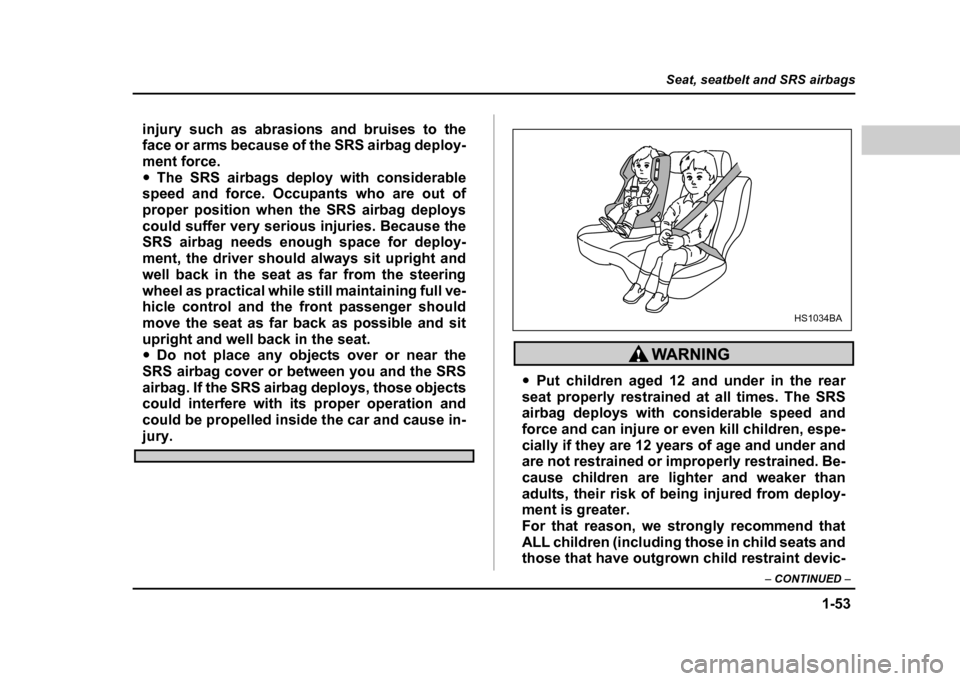
" Put children aged 12 and under in the rear
seat properly restrained at all times. The SRS
airbag deploys with considerable speed and
force and can injure or even kill children, espe-
cially if they are 12 years of age and under and
are not restrained or improperly restrained. Be-
cause children are lighter and weaker than
adults, their risk of being injured from deploy-
ment is greater.
For that reason, we strongly recommend that
ALL children (including those in child seats and
those that have outgrown child restraint devic-
HS1034BA
Page 108 of 491
2-5
Keys and doors
– CONTINUED –
is unlocked.
Pull the inside door handle to open an unlocked door.
Always make sure that all doors and the rear gate (for
wagon) are closed before starting to drive.
Keep all doors locked when you drive, especial-
ly when small children are in your vehicle.
Along with the proper use of seat belts and
child restraints, locking the doors reduces the
chance of being thrown out of the vehicle in an
accident.
It also helps prevent passengers from falling
out if a door is accidentally opened, and intrud-
ers from unexpectedly opening doors and en-
tering your vehicle.
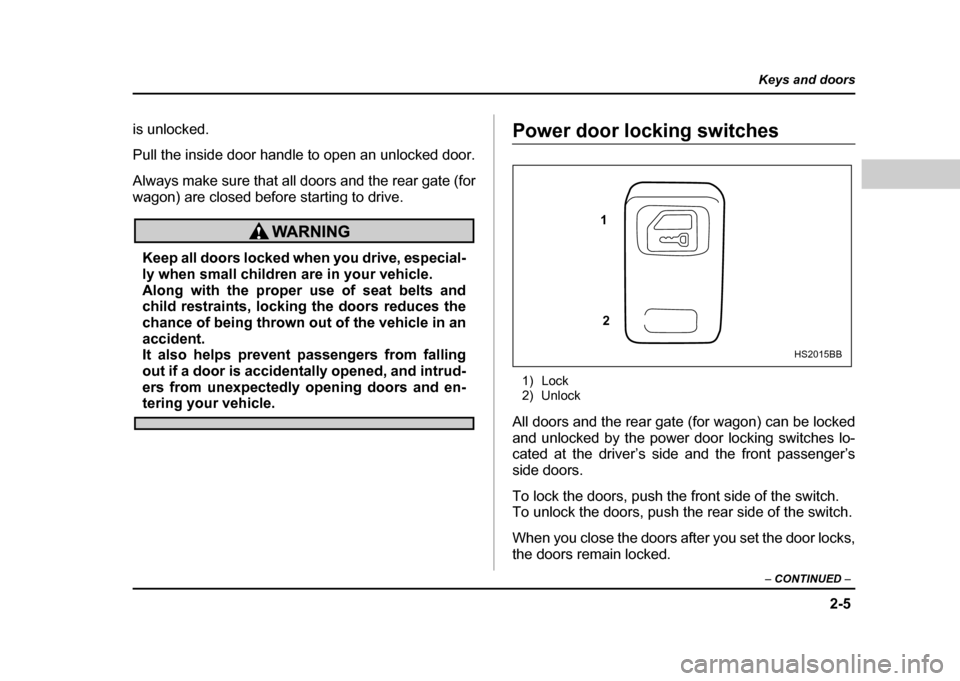
Power door locking switches
1) Lock
2) Unlock
All doors and the rear gate (for wagon) can be locked
and unlocked by the power door locking switches lo-
cated at the driver’s side and the front passenger’s
side doors.
To lock the doors, push the front side of the switch.
To unlock the doors, push the rear side of the switch.
When you close the doors after you set the door locks,
the doors remain locked.
1
2
HS2015BB
Page 109 of 491
2-6
Keys and doors
NOTE
Make sure that you do not leave the key inside the
vehicle before locking the doors from the outside
using power door locking switches.Remote keyless entry system
Two transmitters are provided for your vehicle.
The remote keyless entry system has the following
functions. "
Locking and unlocking the doors (and rear gate on
the wagon) without a key " Sounding a panic alarm
" Arming and disarming the security system (if your
vehicle is equipped with an optional security system).
See the next section “Security system (if equipped)”
for detailed information.
This device complies with Part 15 of the FCC
Rules and with RSS-210 of Industry Canada. Oper- ation is subject to the following two conditions: (1)
This device may not cause harmful interference,
and (2) this device must accept any interference
received, including interference that may cause
undesired operation.
Changes or modifications not expressly approved
by the party responsible for compliance could
void the user’s authority to operate the equipment.
The operable distance of the keyless entry system is
approximately 30 feet (10 meters). However, this dis-
tance will vary depending on environmental condi-
Page 111 of 491
2-8
Keys and doors
wagon).
An electronic chirp will sound one time and the turn
signal lights will flash one time.
If any of the doors (or the rear gate) is not fully closed,
an electronic chirp will sound five times and the turn
signal lights will flash five times to alert you that the
doors (or the rear gate) are not properly closed. When
you close the door, it will automatically lock.
NOTE
If the “LOCK/ALARM” button is pressed for two
seconds or longer, the panic alarm will sound.
When locking the doors in normal circumstances,press the “LOCK/ALARM” button for less than two
seconds. For details on the panic alarm, refer to
“Sounding a panic alarm”. !
Unlocking the doors
Briefly press the “UNLOCK/DISARM” button (for less
than two seconds) to unlock the driver’s door. An elec-
tronic chirp will sound two times and the turn signal
lights will flash two times. To unlock all other doors
(and rear gate on the wagon), briefly press the “UN-
LOCK/DISARM” button a second time within 5 sec-
onds.
NOTE
If the interval between the first and second press-
es of the “UNLOCK/DISARM” button (for unlock-
ing of all of the doors and the rear gate) is extreme-
ly short, the system may not respond. ! Illuminated entry
The interior (dome) light and ignition switch light (for
turbo models) will illuminate when the “UNLOCK/DIS-
ARM” button is pressed. These lights stay illuminated
for approximately 30 seconds if any of the doors (or
the rear gate on the wagon) is not opened.
If the “LOCK/ARM” button is pressed before 30 sec-
onds have elapsed, these lights will go out. Also, these
lights will go out if the key is inserted in the ignition switch. The interior light must be set to the middle po-
sition in order for this function to operate.
! Vehicle finder function
Use this function to find your vehicle parked among
many vehicles in a large parking lot. Provided you are
within 30 feet (10 meters) of the vehicle, pressing the
“LOCK/ARM” button three times in a five-second peri-
od will cause your vehicle’s horn to sound one time
and its turn signal lights to flash three times.
Page 156 of 491

3-19
Instruments and controls
– CONTINUED –
ing a shutdown. "When the actual ambient temperature falls outside
the specified indicator range.Warning and indicator lights
Several of the warning and indicator lights come on
momentarily and then go out when the ignition switch
is initially turned to the “ON” position. This permits
checking the operation of the bulbs.
Apply the parking brake and turn the ignition switch to
the “ON” position. The following lights come on:
Seatbelt warning light
SRS airbag system warning light
CHECK ENGINE warning light/Malfunction indica- tor lamp
Charge warning light
Oil pressure warning light
AT OIL temperature warning light (AT vehicles)ABS warning light
Brake system warning light
If any lights fail to come on, it indicates a burned-out
bulb or a malfunction of the corresponding system.
Consult your authorized SUBARU dealer for repair. ! Seatbelt warning light and chime
When the ignition switch is turned to the “ON” position,
the seatbelt warning light will come on and the remind-
er chime will sound for about six seconds to remind the