flat tire SUBARU IMPREZA 2004 2.G User Guide
[x] Cancel search | Manufacturer: SUBARU, Model Year: 2004, Model line: IMPREZA, Model: SUBARU IMPREZA 2004 2.GPages: 491, PDF Size: 5.93 MB
Page 348 of 491
8-37
Driving tips
– CONTINUED –
use towing mirrors that conform with Federal, state/
province and/or other applicable regulations. !Trailer lights
Connection of trailer lights to your vehicle’s electrical
system requires modifications to the vehicle’s lighting
circuit to increase its capacity and accommodate wir-
ing changes. To ensure the trailer lights are connected
properly, please consult your SUBARU dealer. Check
for proper operation of the turn signals, the brake
lights and parking lights each time you hitch up.
Direct splicing or other improper connection of
trailer lights may damage your vehicle’s electri-
cal system and cause a malfunction of your ve-
hicle’s lighting system.
! Tires
Make sure that all the tires on your vehicle are properly
inflated to the pressure specified on the tire placard lo-
cated on the left center pillar of your vehicle.
Trailer tire condition, size, load rating and proper infla-
tion pressure should be in accordance with the trailer
manufacturer’s specifications. In the event your vehicle gets a flat tire when towing a
trailer, ask a commercial road service to repair the flat
tire.
If you carry a regular size spare tire in your vehicle or
trailer as a precaution against getting a flat tire, be
sure that the spare tire is firmly secured.
Never tow a trailer when the temporary spare
tire is used. The temporary spare tire is not de-
signed to sustain the towing load. Use of the
temporary spare tire when towing can result in
failure of the spare tire and/or less stability of
the vehicle.
! Trailer towing tips
"Never exceed 45 mph (72 km/h) when towing
a trailer in hilly country on hot days. " When towing a trailer, steering, stability,
stopping distance and braking performance
will be different from normal operation. For
safety’s sake, you should employ extra caution
Page 352 of 491
9-1
9
In case of emergency
If you park your vehicle in case of an emergency ............................................ 9-2
Temporary spare tire .................................... 9-3
Flat tires ......................................................... 9-5 Changing a flat tire ........................................... 9-5
Jump starting ................................................ 9-14 How to jump start ............................................. 9-14
Engine overheating ....................................... 9-16 If steam is coming from the engine compartment .................................................. 9-16
If no steam is coming from the engine compartment .................................................. 9-16
Towing ........................................................... 9-17 Towing and tie-down hooks ............................ 9-18
Using a flat-bed truck ....................................... 9-20
Towing with all wheels on the ground ............ 9-21
Rear gate – if the rear gate cannot be unlocked ..................................................... 9-22
Moonroof – if the moonroof cannot be closed ......................................................... 9-23
Maintenance tools ......................................... 9-24 Jack and jack handle ........................................ 9-24
Page 354 of 491
9-3
In case of emergency
– CONTINUED –
Temporary spare tire
The temporary spare tire is smaller and lighter than a
conventional tire and is designed for emergency use
only. Remove the temporary spare tire and re-install
the conventional tire as soon as possible because the
spare tire is designed only for temporary use.
Check the inflation pressure of the temporary spare
tire periodically to keep the tire ready for use. The cor-
rect pressure is 60 psi (4.2 kg/cm 2
, 420 kPa) .
When using the temporary spare tire, note the follow-
ing:" Do not exceed 50 mph (80 km/h).
" Do not put a tire chain on the temporary spare tire.
Because of the smaller tire size, a tire chain will not fit
properly. " Do not use two or more temporary spare tires at the
same time. " Do not drive over obstacles. This tire has a smaller
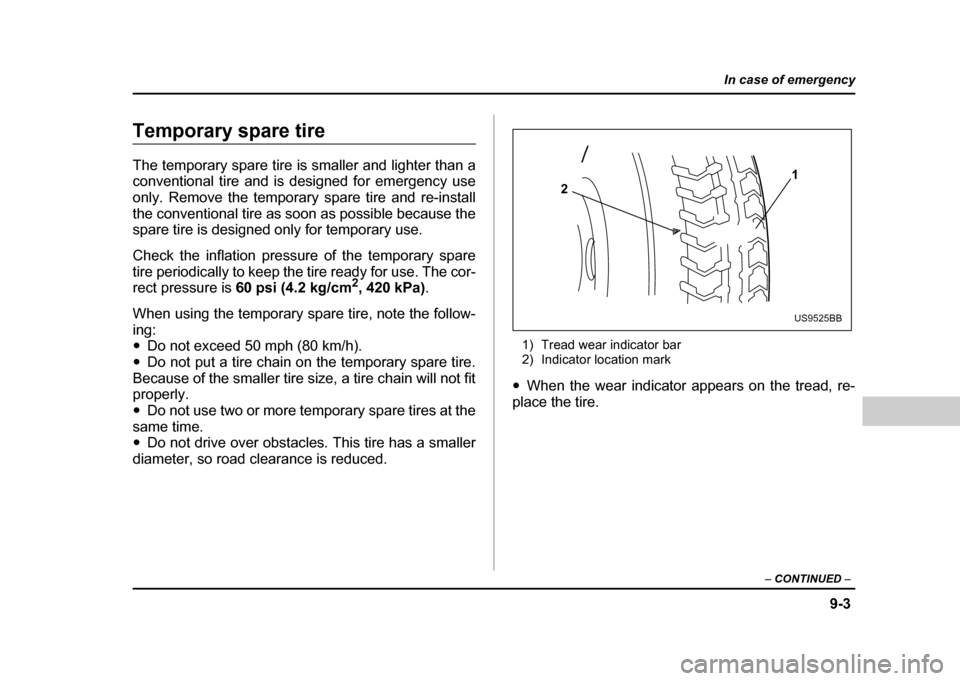
diameter, so road clearance is reduced. 1) Tread wear indicator bar
2) Indicator location mark
" When the wear indicator appears on the tread, re-
place the tire.
1
2
US9525BB
Page 356 of 491
9-5
In case of emergency
– CONTINUED –
Flat tires
If you have a flat tire while driving, never brake sud-
denly; keep driving straight ahead while gradually re-
ducing speed. Then slowly pull off the road to a safe
place. !Changing a flat tire
"Do not jack up the vehicle on an incline or a
loose road surface. The jack can come out of
the jacking point or sink into the ground and
this can result in a severe accident. " Use only the jack provided with your vehicle.
The jack supplied with the vehicle is designed
only for changing a tire. Never get under the ve-
hicle while supporting the vehicle with thisjack. " Always turn the engine off before raising the
flat tire off the ground using the jack. Never
swing or push the vehicle supported with the
jack. The jack can come out of the jacking point
due to a jolt and this can result in a severe acci-
dent. 1. Park on a hard, level surface, whenever possible,
then stop the engine.
2. Set the parking brake securely and shift a manual
transmission vehicle in reverse or an automatic trans-
mission vehicle in the “P” (Park) position.
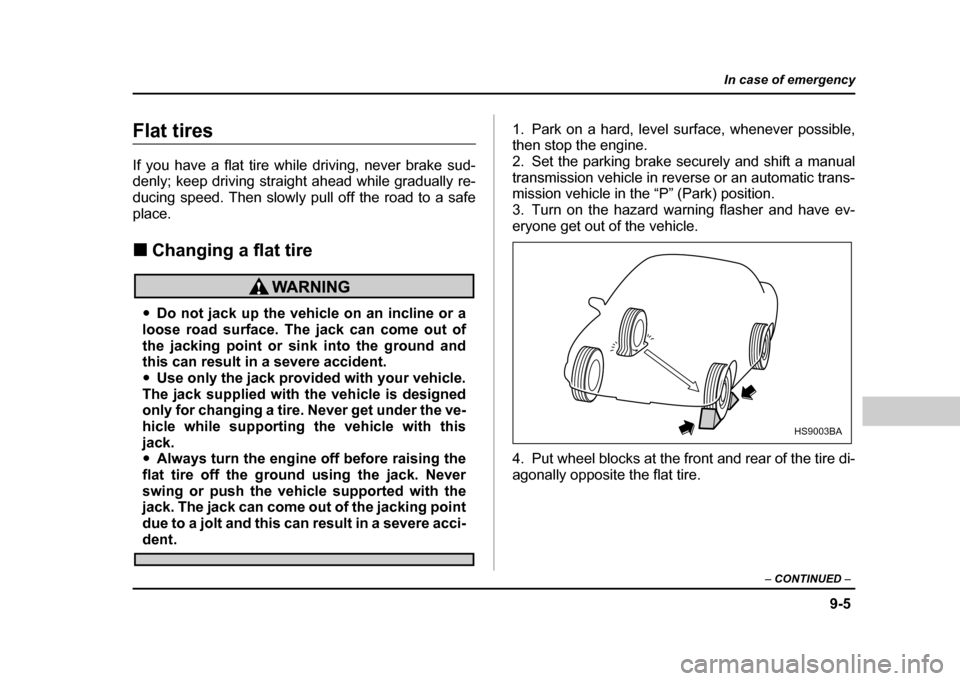
3. Turn on the hazard warning flasher and have ev-
eryone get out of the vehicle.
4. Put wheel blocks at the front and rear of the tire di-
agonally opposite the flat tire.
HS9003BA
Page 361 of 491

9-10
In case of emergency
Vehicle with side sill skirt
Others
8. Place the jack under the side sill at the front or rear
jack-up point closest to the flat tire.
Turn the jackscrew by hand until the jack head engag-
HG9020BAHG9021BA
Page 362 of 491

9-11
In case of emergency
– CONTINUED –
es firmly into the jack-up point.
9. Insert the jack handle into the jackscrew, and turn
the handle until the tire clears the ground. Do not raise
the vehicle higher than necessary.
10.Remove the wheel nuts and the flat tire.
11.Before putting the spare tire on, clean the mounting
UG9510BAHS9011BA
HS9012AA
Page 363 of 491
9-12
In case of emergency
surface of the wheel and hub with a cloth.
12.Put on the spare tire. Replace the wheel nuts.
Tighten them by hand.
Do not use oil or grease on the wheel studs or
nuts when the spare tire is installed. This could
cause the nuts to become loose and lead to an
accident.
13.Turn the jack handle counterclockwise to lower the
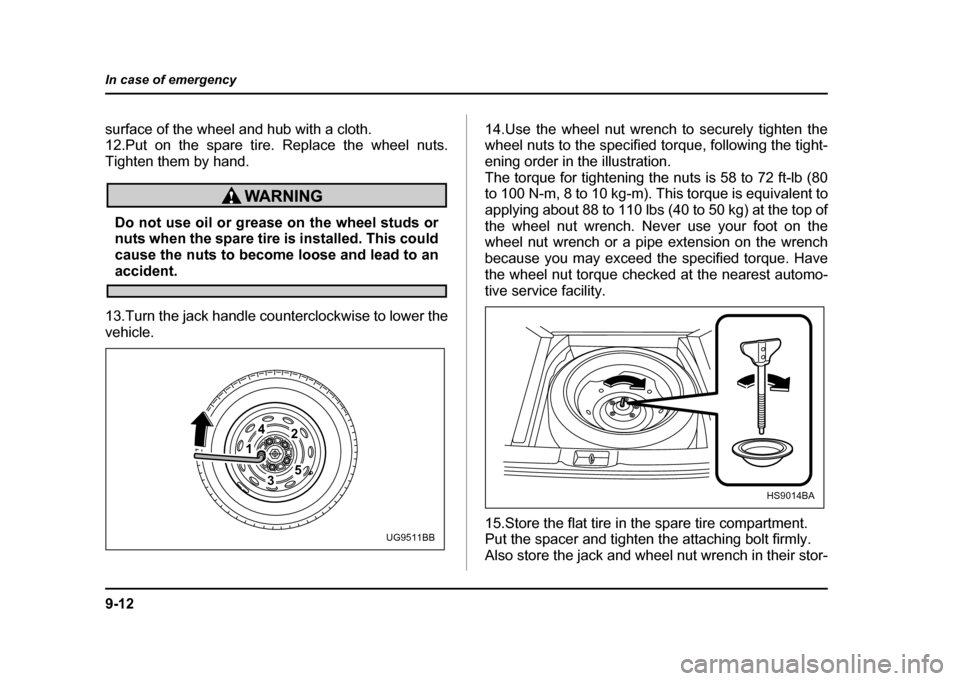
vehicle. 14.Use the wheel nut wrench to securely tighten the
wheel nuts to the specified torque, following the tight-
ening order in the illustration.
The torque for tightening the nuts is 58 to 72 ft-lb (80
to 100 N-m, 8 to 10 kg-m). This torque is equivalent to
applying about 88 to 110 lbs (40 to 50 kg) at the top of
the wheel nut wrench. Never use your foot on the
wheel nut wrench or a pipe extension on the wrench
because you may exceed the specified torque. Have
the wheel nut torque checked at the nearest automo-
tive service facility.
15.Store the flat tire in the spare tire compartment.
Put the spacer and tighten the attaching bolt firmly.
Also store the jack and wheel nut wrench in their stor-
1
42
53
UG9511BB
HS9014BA
Page 369 of 491
9-18
In case of emergency
terioration of the center differential.
! Towing and tie-down hooks
The towing hooks should be used only in an emergen-
cy (e.g., to free a stuck vehicle from mud, sand or
snow).
Front towing hook:
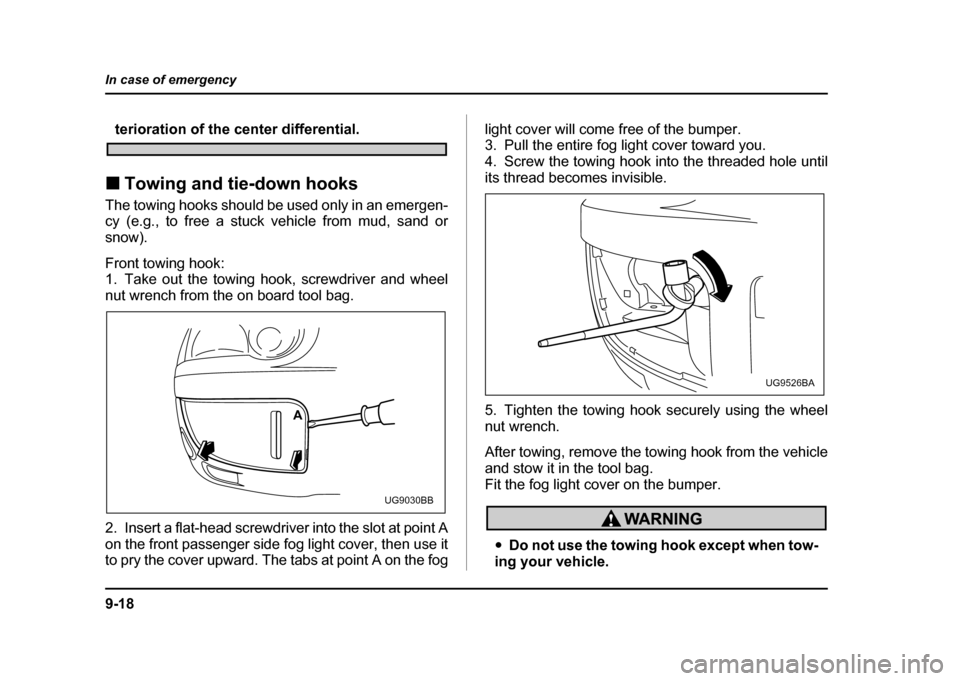
1. Take out the towing hook, screwdriver and wheel
nut wrench from the on board tool bag.
2. Insert a flat-head screwdriver into the slot at point A
on the front passenger side fog light cover, then use it
to pry the cover upward. The tabs at point A on the fog light cover will come free of the bumper.
3. Pull the entire fog light cover toward you.
4. Screw the towing hook into the threaded hole until
its thread becomes invisible.
5. Tighten the towing hook securely using the wheel
nut wrench.
After towing, remove the towing hook from the vehicle
and stow it in the tool bag.
Fit the fog light cover on the bumper.
"
Do not use the towing hook except when tow-
ing your vehicle.
A
UG9030BB
UG9526BA
Page 376 of 491

9-25
In case of emergency
– CONTINUED –
wise to loosen it, then remove the jack.
Sedan
1) Jack
2) Jack handle
3) Spare tire Wagon
1) Jack
2) Jack handle
3) Spare tire
The jack handle is stored under the spare tire cover.
For how to use the jack, refer to “Flat tires”.
1
2 3
UG9501BB
3
1
2
UG9502BB
Page 437 of 491
11 - 5 2
Maintenance and service
dent.
! Wheel covers
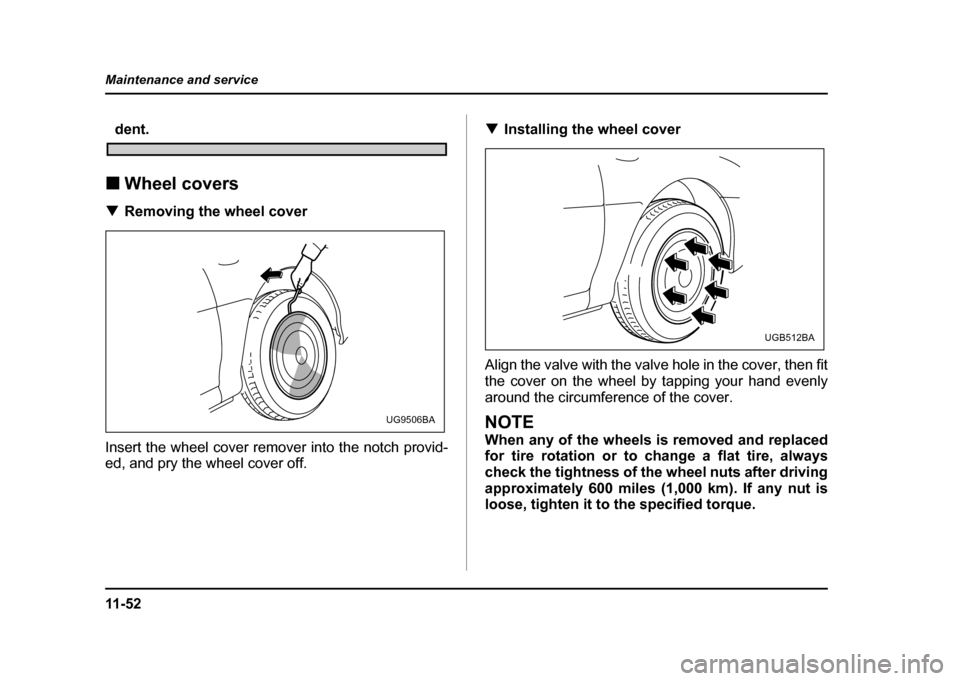
! Removing the wheel cover
Insert the wheel cover remover into the notch provid-
ed, and pry the wheel cover off. !
Installing the wheel cover
Align the valve with the valve hole in the cover, then fit
the cover on the wheel by tapping your hand evenly
around the circumference of the cover.
NOTE
When any of the wheels is removed and replaced
for tire rotation or to change a flat tire, always
check the tightness of the wheel nuts after driving
approximately 600 miles (1,000 km). If any nut is
loose, tighten it to the specified torque.UG9506BA
UGB512BA