fuel SUBARU IMPREZA 2004 2.G User Guide
[x] Cancel search | Manufacturer: SUBARU, Model Year: 2004, Model line: IMPREZA, Model: SUBARU IMPREZA 2004 2.GPages: 491, PDF Size: 5.93 MB
Page 158 of 491
3-21
Instruments and controls
– CONTINUED –
NOTE
This light also comes on when the fuel filler cap is
not tightened until it clicks.
If you have recently refueled your vehicle, the cause of
the CHECK ENGINE warning light/malfunction indica-
tor lamp coming on could be a loose or missing fuel fill-
er cap. Remove the cap and retighten it until it clicks.
Make sure nothing is interfering with the sealing of the
cap. Tightening the cap will not make the CHECK EN-
GINE warning light turn off immediately. It may take
several driving trips. If the light does not go out, take
your vehicle to your authorized SUBARU dealer im-
mediately. !If the light is blinking:
If the light is blinking while driving, an engine misfire
condition has been detected which may damage the
emission control system.
To prevent serious damage to the emission control
system, you should do the following: "Reduce vehicle speed.
" Avoid hard acceleration.
" Avoid steep uphill grades.
" Reduce the amount of cargo, if possible.
" Stop towing a trailer as soon as possible.
The CHECK ENGINE warning light may stop blinking and come on steadily after several driving trips. You
should have your vehicle checked by an authorized
SUBARU dealer immediately. !
Charge warning light
If this light comes on when the engine is running, it
may indicate that the charging system is not working
properly.
If the light comes on while driving or does not go out
after the engine starts, stop the engine at the first safe
opportunity and check the alternator belt. If the belt is
loose, broken or if the belt is in good condition but the
light remains on, contact your nearest SUBARU deal-
er immediately. ! Oil pressure warning light
If this light comes on when the engine is running, it
may indicate that the engine oil pressure is low and the
lubricating system is not working properly.
If the light comes on while driving or does not go out
after the engine starts, stop the engine at the first safe
opportunity and check the engine oil level. If the oil lev-
el is low, add oil immediately. If the engine oil is at the
proper level but the light remains on, contact your
nearest SUBARU dealer immediately.
Page 172 of 491
3-35
Instruments and controls
– CONTINUED –
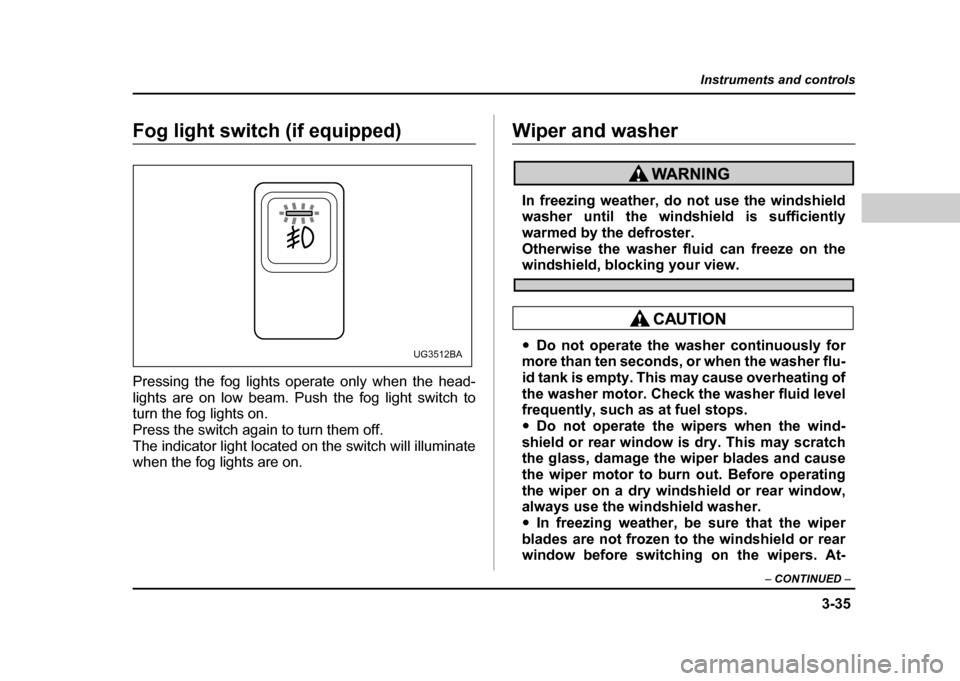
Fog light switch (if equipped)
Pressing the fog lights operate only when the head-
lights are on low beam. Push the fog light switch to
turn the fog lights on.
Press the switch again to turn them off.
The indicator light located on the switch will illuminate
when the fog lights are on.Wiper and washer
In freezing weather, do not use the windshield
washer until the windshield is sufficiently
warmed by the defroster.
Otherwise the washer fluid can freeze on the
windshield, blocking your view.
"Do not operate the washer continuously for
more than ten seconds, or when the washer flu-
id tank is empty. This may cause overheating of
the washer motor. Check the washer fluid level
frequently, such as at fuel stops. " Do not operate the wipers when the wind-
shield or rear window is dry. This may scratch
the glass, damage the wiper blades and cause
the wiper motor to burn out. Before operating
the wiper on a dry windshield or rear window,
always use the windshield washer. " In freezing weather, be sure that the wiper
blades are not frozen to the windshield or rear
window before switching on the wipers. At-UG3512BA
Page 262 of 491
6-13
Interior equipment
– CONTINUED –
Do not use ashtrays as waste receptacles or
leave a lighted cigarette in an ashtray. This
could cause a fire.
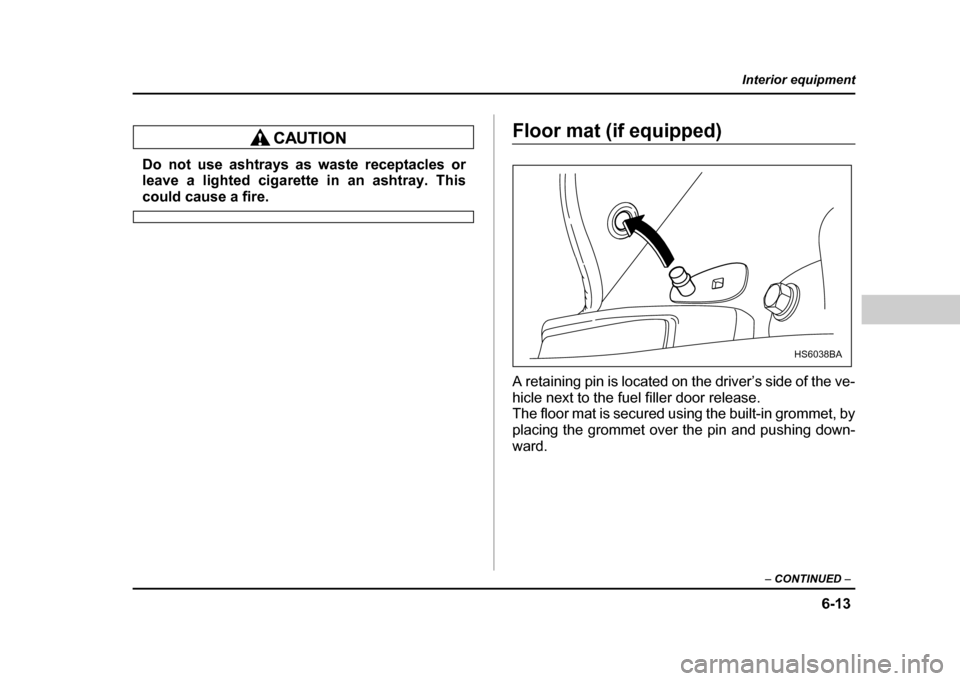
Floor mat (if equipped)
A retaining pin is located on the driver’s side of the ve-
hicle next to the fuel filler door release.
The floor mat is secured using the built-in grommet, by
placing the grommet over the pin and pushing down- ward.
HS6038BA
Page 270 of 491

7-1
7
Starting and operating
F uel .. ... ... ... .. ... ... ... ... .. ... ... ... ... ... .. ... ... ... ... .. ... ... 7-2
F uel re quire ments ..................... ..................... ... 7-2
Fuel filler lid and cap ........................................ 7-4
State emission testing (U.S. only) ............... 7-7
Preparing to drive ......................................... 7-9
Starting the engine ....................................... 7-9 Manual transmission vehicle ........................... 7-9
Automatic transmission vehicle ...................... 7-10
Starting the engine during cold weather below −4 °F ( −20 °C) ......................................... 7-10
Starting a flooded engine ................................. 7-11
Stopping the engine ..................................... 7-11
Manual transmission – 6 speed (WRX-STi) 7-12 Selecting reverse gear ...................................... 7-12
Shifting speeds ................................................. 7-13
Driving tips ........................................................ 7-14
Manual transmission – 5 speed (except WRX-STi) ...................................... 7-15Shifting speeds ................................................. 7-15
Driving tips ........................................................ 7-17
Driver’s Control Center Differential (DCCD) (WRX-STi) ..................................... 7-18Auto mode ......................................................... 7-18
Manual mode ..................................................... 7-19
Temporary release ............................................ 7-21
Automatic transmission ............................... 7-21 Selector lever for automatic transmission ..... 7-22
Shift lock release .............................................. 7-26
Limited slip differential (LSD) (if equipped) 7-27 Power steering .............................................. 7-28
Braking ........................................................... 7-28
Braking tips ....................................................... 7-28
Brake system .................................................... 7-29
Disc brake pad wear warning indicators ........ 7-29
ABS (Anti-lock Brake System) ..................... 7-30 ABS system self-check .................................... 7-30
ABS warning light ............................................. 7-31
Electronic Brake Force Distribution (EBD) system ........................................................ 7-32Steps to take if EBD system fails .................... 7-33
Parking your vehicle ..................................... 7-34 Parking brake .................................................... 7-34
Parking tips ....................................................... 7-35
Cruise control ................................................ 7-37 To set cruise control ........................................ 7-37
To temporarily cancel the cruise control ....... 7-39
To turn off the cruise control ........................... 7-40
To change the cruising speed ......................... 7-40
Page 271 of 491
7-2
Starting and operating
Starting and operatingFuel
Use of a fuel which is low in quality or use of an
inappropriate fuel additive may cause engine
damage.
! Fuel requirements
! 2.5 Liter models
The 2.5 Liter engine is designed to operate using un-
leaded gasoline with an octane rating of 87 AKI or
higher. ! 2.0 Liter (turbo) models
The 2.0 Liter turbo engine is designed to operate using
premium unleaded gasoline with an octane rating of
91 AKI or higher. If premium unleaded gasoline is not
available, regular unleaded gasoline with an octane
rating of 87 AKI or higher may be temporarily used.
For optimum engine performance and driveability, it is
recommended that you use premium grade unleaded
gasoline. !
2.5 Liter (turbo) model
The 2.5 Liter turbo engine is designed to operate using
super-premium unleaded gasoline with an octane rat-
ing of 93 AKI or higher. If super-premium unleaded
gasoline with an octane rating of 93 AKI or higher is
not available, premium unleaded gasoline with an oc-
tane rating of 91 AKI or higher can be used. For opti-
mum engine performance and driveability, it is recom-
mended that you use super-premium grade unleaded
gasoline with an octane rating of 93 AKI or higher. ! Fuel octane rating
This octane rating is the average of the Research Oc-
tane and Motor Octane numbers and is commonly re-
ferred to as the Anti Knock Index (AKI).
Using a gasoline with a lower octane rating can cause
persistent and heavy knocking, which can damage the
engine. Do not be concerned if your vehicle some-
times knocks lightly when you drive up a hill or when
you accelerate. See your dealer or a qualified service
technician if you use a fuel with the specified octane
rating and your vehicle knocks heavily or persistently. ! Unleaded gasoline
The neck of the fuel filler pipe is designed to accept
only an unleaded gasoline filler nozzle. Under no cir-
cumstances should leaded gasoline be used because
it will damage the emission control system and may
Page 272 of 491

7-3
Starting and operating
– CONTINUED –
impair driveability and fuel economy. !Gasoline for California-certified LEV
Your vehicle was certified to California’s low emission
vehicle (LEV) standards as indicated on the under-
hood tune-up label. It is designed to optimize engine
and emission performance with gasoline that meets
the clean burning low-sulfur California gasoline spec-
ifications. If you live in any other state than California,
your vehicle will operate on gasoline meeting Federal
specifications. Gasoline sold outside California is per-
mitted to have higher sulfur levels, which may affect
the performance of your vehicle’s catalytic converter
and may produce a sulfur exhaust odor or smell.
SUBARU recommends that you try a different brand of
unleaded gasoline having lower sulfur to determine if
the problem is fuel related before returning your vehi-
cle to an authorized dealer for service. ! Gasoline for cleaner air
Your use of gasoline with detergent additives will help
prevent deposits from forming in your engine and fuel
system. This helps keep your engine in tune and your
emission control system working properly, and is a
way of doing your part for cleaner air. If you continu-
ously use a high quality fuel with the proper detergent
and other additives, you should never need to add any
fuel system cleaning agents to your fuel tank. Many gasolines are now blended with materials called
oxygenates. Use of these fuels can also help keep the
air cleaner. Oxygenated blend fuels, such as MTBE
(Methyl Tertiary Butyl ether) or ethanol (ethyl or grain
alcohol) may be used in your vehicle, but should con-
tain no more than 15% MTBE or 10% ethanol for the
proper operation of your SUBARU.
In addition, some gasoline suppliers are now produc-
ing reformulated gasolines, which are designed to re-
duce vehicle emissions. SUBARU approves the use ofreformulated gasoline.
If you are not sure what the fuel contains, you should
ask your service station operators if their gasolines
contain detergents and oxygenates and if they have
been reformulated to reduce vehicle emissions.
As additional guidance, only use fuels suited for your
vehicle as explained below. "
Fuel should be unleaded and have an octane rating
no lower than that specified in this manual. " Methanol (methyl or wood alcohol) is sometimes
mixed with unleaded gasoline. Methanol can be used
in your vehicle ONLYif it does not exceed 5% of the
fuel mixture AND if it is accompanied by sufficient
quantities of the proper cosolvents and corrosion in-
hibitors required to prevent damage to the fuel system.
Do not use fuel containing methanol EXCEPT under
Page 273 of 491
7-4
Starting and operating
these conditions. "
If undesirable driveability problems are experienced
and you suspect they may be fuel related, try a differ-
ent brand of gasoline before seeking service at your
SUBARU dealer. " Fuel system damage or driveability problems which
result from the use of improper fuel are not covered
under the SUBARU Limited Warranty.
Do not let fuel spill on the exterior surfaces of
the vehicle. Fuels containing alcohol may
cause paint damage, which is not covered un-
der the SUBARU Limited Warranty. !
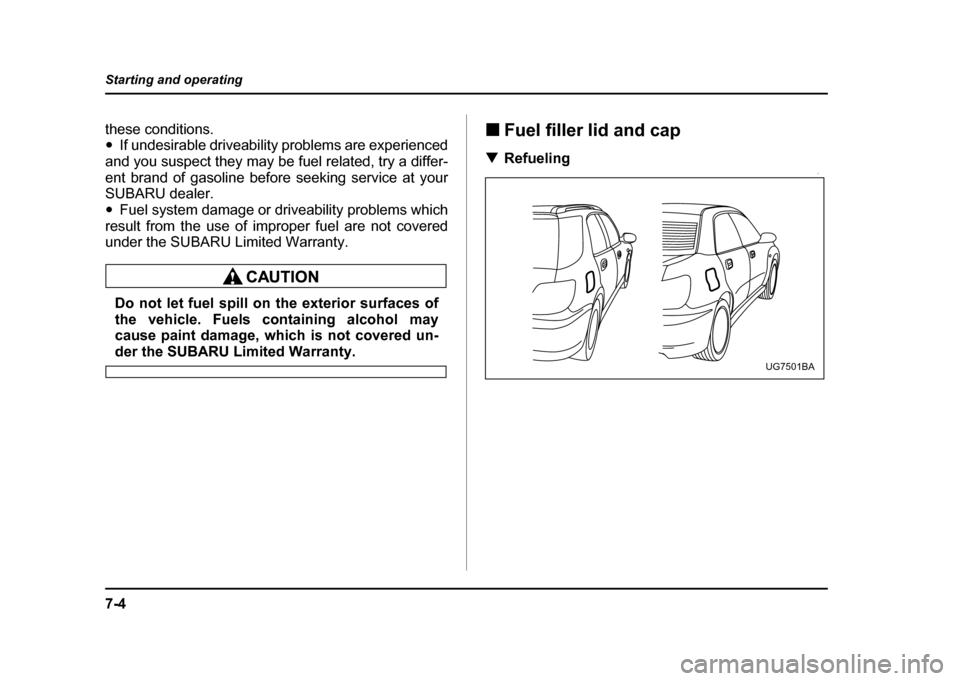
Fuel filler lid and cap
! Refueling
0
UG7501BA
Page 274 of 491
7-5
Starting and operating
– CONTINUED –
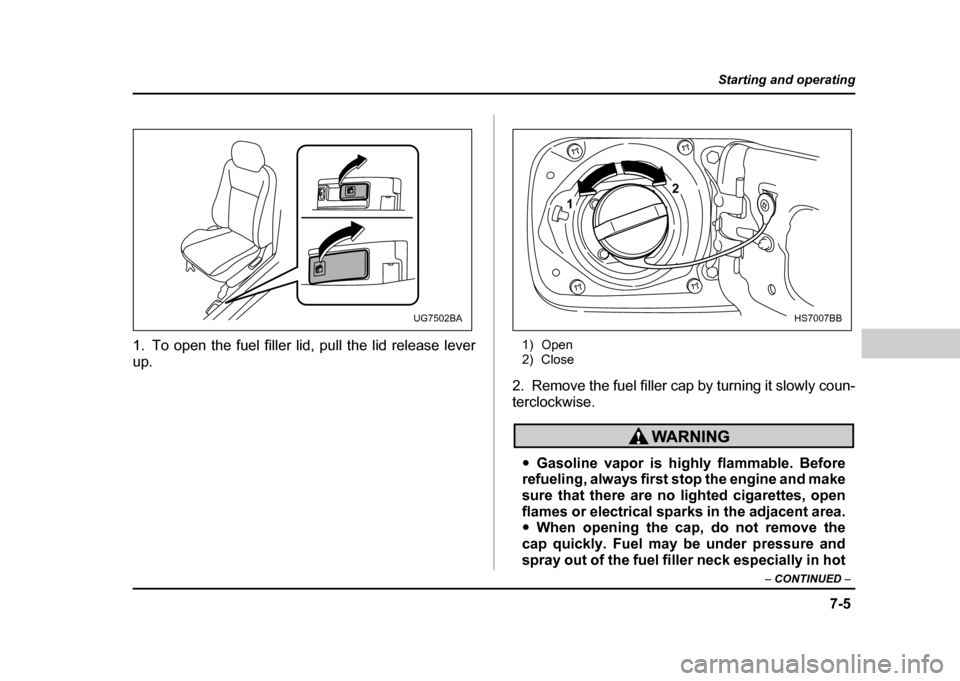
1. To open the fuel filler lid, pull the lid release lever
up. 1) Open
2) Close
2. Remove the fuel filler cap by turning it slowly coun-
terclockwise.
" Gasoline vapor is highly flammable. Before
refueling, always first stop the engine and make
sure that there are no lighted cigarettes, open
flames or electrical sparks in the adjacent area." When opening the cap, do not remove the
cap quickly. Fuel may be under pressure and
spray out of the fuel filler neck especially in hot
UG7502BA
1 2
HS7007BB
Page 275 of 491
7-6
Starting and operating
weather, which may cause injury.
3. Stop filling the tank after the fuel filler pump auto-
matically stops. Do not add any more fuel.
4. Put the cap back on, turn it clockwise until you hear
a clicking noise. Be certain not to catch the tether un-
der the cap while tightening.
5. Close the fuel filler lid completely.
If you spill any fuel on the painted surface, rinse it off
immediately. Otherwise, the painted surface could be
damaged.
NOTE
If the fuel filler cap is not tightened until it clicks or
if the tether is caught under the cap, the CHECK
ENGINE warning light may come on. Refer to the
“Warning and indicator lights” section located in
chapter 3.
" Never add any cleaning agents to the fuel
tank. The addition of a cleaning agent may
cause damage to the fuel system." Make sure that the cap is tightened until it
clicks to prevent fuel spillage in the event of an
accident. "
Do not let fuel spill on the exterior surfaces of
the vehicle.
Fuels may cause paint damage, which is not
covered under the SUBARU Limited Warranty. " Always use a genuine SUBARU fuel filler cap.
If you use the wrong cap, it may not fit or have
proper venting, and your fuel tank and emis-
sion control system might be damaged.
Page 278 of 491
7-9
Starting and operating
– CONTINUED –
Preparing to drive
You should perform the following checks and adjust-
ments every day before you start driving.
1. Check that all windows, mirrors, and lights are
clean and unobstructed.
2. Check the appearance and condition of the tires.
Also check tires for proper inflation.
3. Look under the vehicle for any sign of leaks.
4. Check that the hood, trunk and rear gate are fully
closed.
5. Check the adjustment of the seat.
6. Check the adjustment of the inside and outside mir-
rors.
7. Fasten your seatbelt. Check that your passengers
have fastened their seatbelts.
8. Check the operation of the warning and indicator
lights when the ignition switch is turned to the “ON” po-sition.
9. Check the gauges, indicator and warning lights af-
ter starting the engine.
NOTE
Engine oil, engine coolant, brake fluid, washer flu-
id and other fluid levels should be checked daily,
weekly or at fuel stops.
Starting the engine
Do not operate the starter motor continuously
for more than ten seconds. If the engine fails to
start after operating the starter for five to ten
seconds, wait for ten seconds or more before
trying again.
! Manual transmission vehicle
1. Apply the parking brake.
2. Turn off unnecessary lights and accessories.
3. Press the clutch pedal to the floor and shift the shift
lever into neutral. Hold the clutch pedal to the floor
while starting the engine.
The starter motor will only operate when the clutch
pedal is pressed fully to the floor.
4. Turn the ignition switch to the “ON” position and
check the operation of the warning and indicator lights.
Refer to the “Warning and indicator lights” section (chapter 3).
5. Turn the ignition switch to the “START” position
without depressing the accelerator pedal. Release
the key immediately after the engine has started.