towing SUBARU IMPREZA 2004 2.G User Guide
[x] Cancel search | Manufacturer: SUBARU, Model Year: 2004, Model line: IMPREZA, Model: SUBARU IMPREZA 2004 2.GPages: 491, PDF Size: 5.93 MB
Page 345 of 491
8-34
Driving tips
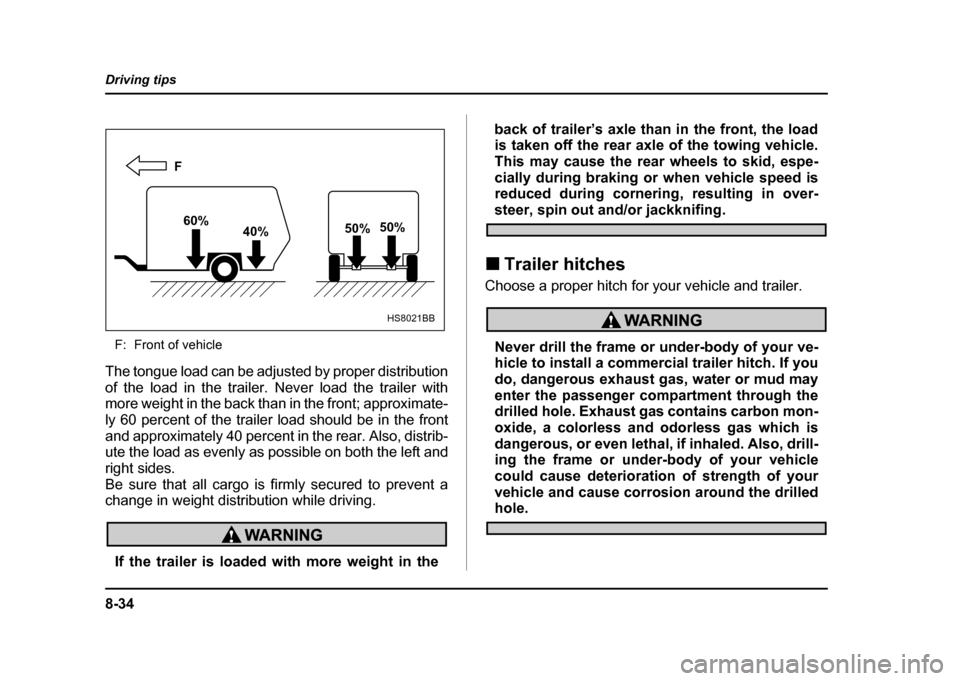
F: Front of vehicle
The tongue load can be adjusted by proper distribution
of the load in the trailer. Never load the trailer with
more weight in the back than in the front; approximate-
ly 60 percent of the trailer load should be in the front
and approximately 40 percent in the rear. Also, distrib-
ute the load as evenly as possible on both the left and
right sides.
Be sure that all cargo is firmly secured to prevent a
change in weight distribution while driving.
If the trailer is loaded with more weight in the back of trailer’s axle than in the front, the load
is taken off the rear axle of the towing vehicle.
This may cause the rear wheels to skid, espe-
cially during braking or when vehicle speed is
reduced during cornering, resulting in over-
steer, spin out and/or jackknifing.
! Trailer hitches
Choose a proper hitch for your vehicle and trailer.
Never drill the frame or under-body of your ve-
hicle to install a commercial trailer hitch. If you
do, dangerous exhaust gas, water or mud may
enter the passenger compartment through the
drilled hole. Exhaust gas contains carbon mon-
oxide, a colorless and odorless gas which is
dangerous, or even lethal, if inhaled. Also, drill-
ing the frame or under-body of your vehicle
could cause deterioration of strength of your
vehicle and cause corrosion around the drilled
hole.
F
60% 40% 50%
50%
HS8021BB
Page 346 of 491
8-35
Driving tips
– CONTINUED –
"Do not modify the vehicle exhaust system,
brake system, or other systems when installing
a hitch or other trailer towing equipment." Do not use axle-mounted hitches as they can
cause damage to the axle housing, wheel bear-
ings, wheels or tires.
! WAGON including OUTBACK SPORT
The use of a genuine SUBARU trailer hitch is recom-
mended. A genuine SUBARU hitch is available from
your SUBARU dealer.
If use of a non-genuine hitch is unavoidable, be sure
the hitch is suited to your vehicle and trailer. Consult
with a professional hitch supplier to assist you in
choosing an appropriate hitch for your vehicle. Be sure
to follow all of the hitch manufacturer’s instructions for
installation and use.
Never use a hitch that mounts only to the rear bumper.
The bumper is not designed to handle that type of
load.
For all types of hitches, regularly check that the hitch
mounting bolts and nuts are tight. !
SEDAN
SUBARU does not offer accessory trailer hitches.
Consult with a professional hitch supplier to assist you
in choosing an appropriate hitch for your vehicle. Be
sure to follow all of the hitch manufacturer’s instruc-
tions for installation and use.
Never use a hitch that mounts only to the rear bumper.
The bumper is not designed to handle that type of
load.
Regularly check that the hitch mounting bolts and nutsare tight. ! Connecting a trailer
! Trailer brakes
If your trailer’s total weight (trailer weight plus its cargo
weight) exceeds 1,000 lbs (453 kg), the trailer is re-
quired to be equipped with its own brake system. Elec-
tric brakes or surge brakes are recommended, and
must be installed properly. Check that your trailer’s
brakes conform with Federal, state/province and/or
other applicable regulations. Your SUBARU’s brake
system is not designed to be tapped into the trailer’s hydraulic brake system.
Please ask your SUBARU dealer and professional
trailer supplier for more information about the trailer’s brake system.
Page 347 of 491
8-36
Driving tips
"
Adequate size trailer brakes are required
when the trailer and its cargo exceed 1,000 lbs
(453 kg) total weight." Do not directly connect your trailer’s hydrau-
lic brake system to the hydraulic brake system
in your vehicle. Direct connection would cause
the vehicle’s brake performance to deteriorate
and could lead to an accident.
! Trailer safety chains
In case the trailer hitch connector or hitch ball should
break or become disconnected, the trailer could get
loose and create a traffic safety hazard.
For safety, always connect the towing vehicle and
trailer with trailer safety chains. Pass the chains cross-
ing each other under the trailer tongue to prevent the
trailer from dropping onto the ground in case the trailer
tongue should disconnect from the hitch ball. Allow
sufficient slack in the chains taking tight-turn situations
into account; however, be careful not to let them drag
on the ground.
For more information about the safety chain connec-
tion, refer to the instructions for your hitch and trailer.
Always use safety chains between your vehicle
and the trailer. Towing a trailer without safety
chains could create a traffic safety hazard if the
trailer separates from the hitch due to coupling
damage or hitch ball damage.
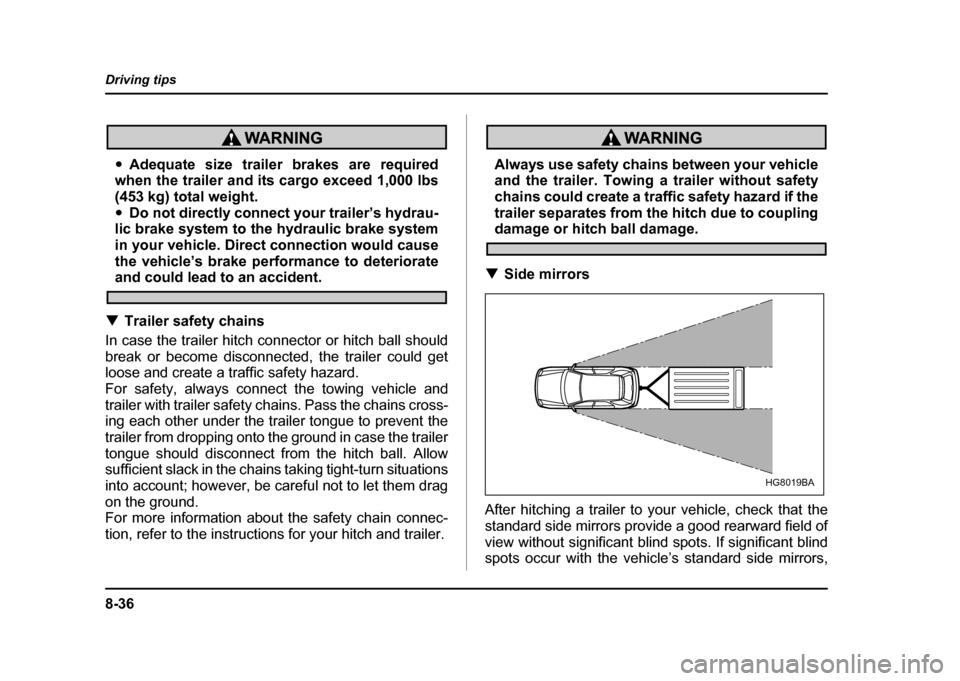
! Side mirrors
After hitching a trailer to your vehicle, check that the
standard side mirrors provide a good rearward field of
view without significant blind spots. If significant blind
spots occur with the vehicle’s standard side mirrors,
HG8019BA
Page 348 of 491
8-37
Driving tips
– CONTINUED –
use towing mirrors that conform with Federal, state/
province and/or other applicable regulations. !Trailer lights
Connection of trailer lights to your vehicle’s electrical
system requires modifications to the vehicle’s lighting
circuit to increase its capacity and accommodate wir-
ing changes. To ensure the trailer lights are connected
properly, please consult your SUBARU dealer. Check
for proper operation of the turn signals, the brake
lights and parking lights each time you hitch up.
Direct splicing or other improper connection of
trailer lights may damage your vehicle’s electri-
cal system and cause a malfunction of your ve-
hicle’s lighting system.
! Tires
Make sure that all the tires on your vehicle are properly
inflated to the pressure specified on the tire placard lo-
cated on the left center pillar of your vehicle.
Trailer tire condition, size, load rating and proper infla-
tion pressure should be in accordance with the trailer
manufacturer’s specifications. In the event your vehicle gets a flat tire when towing a
trailer, ask a commercial road service to repair the flat
tire.
If you carry a regular size spare tire in your vehicle or
trailer as a precaution against getting a flat tire, be
sure that the spare tire is firmly secured.
Never tow a trailer when the temporary spare
tire is used. The temporary spare tire is not de-
signed to sustain the towing load. Use of the
temporary spare tire when towing can result in
failure of the spare tire and/or less stability of
the vehicle.
! Trailer towing tips
"Never exceed 45 mph (72 km/h) when towing
a trailer in hilly country on hot days. " When towing a trailer, steering, stability,
stopping distance and braking performance
will be different from normal operation. For
safety’s sake, you should employ extra caution
Page 349 of 491

8-38
Driving tips
when towing a trailer and you should never
speed. You should also keep the following tips
in mind:
! Before starting out on a trip
" Check that the vehicle and vehicle-to-hitch mount-
ing are in good condition. If any problems are appar-
ent, do not tow the trailer. " Check that the vehicle sits horizontally with the trail-
er attached. If the vehicle is tipped sharply up at the
front and down at the rear, check the total trailer
weight, GVW, GAWs and tongue load again, then con-
firm that the load and its distribution are acceptable. " Check that the tire pressures are correct.
" Check that the vehicle and trailer are connected
properly. Confirm that – the trailer tongue is connected properly to the
hitch ball.
– the trailer lights connector is connected properly
and trailer’s brake lights illuminate when the vehi-
cle’s brake pedal is pressed, and that the trailer’s
turn signal lights flash when the vehicle’s turn signal
lever is operated.
– the safety chains are connected properly.
– all cargo in the trailer is secured safety in position.
– the side mirrors provide a good rearward field of view without a significant blind spot.
" Sufficient time should be taken to learn the “feel” of
the vehicle/trailer combination before starting out on a
trip. In an area free of traffic, practice turning, stopping
and backing up. ! Driving with a trailer
" You should allow for considerably more stopping
distance when towing a trailer. Avoid sudden braking
because it may result in skidding or jackknifing and
loss of control." Avoid abrupt starts and sudden accelerations. If
your vehicle has a manual transmission, always start
out in first gear and release the clutch at moderate en-
gine revolution." Avoid uneven steering, sharp turns and rapid lane
changes." Slow down before turning. Make a longer than nor-
mal turning radius because the trailer wheels will be
closer than the vehicle wheels to the inside of the turn.
In a tight turn, the trailer could hit your vehicle." Crosswinds will adversely affect the handling of
your vehicle and trailer, causing sway. Crosswinds
can be due to weather conditions or the passing of
large trucks or buses. If swaying occurs, firmly grip the
steering wheel and slow down immediately but gradu-
ally." When passing other vehicles, considerable dis-
Page 350 of 491
8-39
Driving tips
– CONTINUED –
tance is required because of the added weight and
length caused by attaching the trailer to your vehicle.
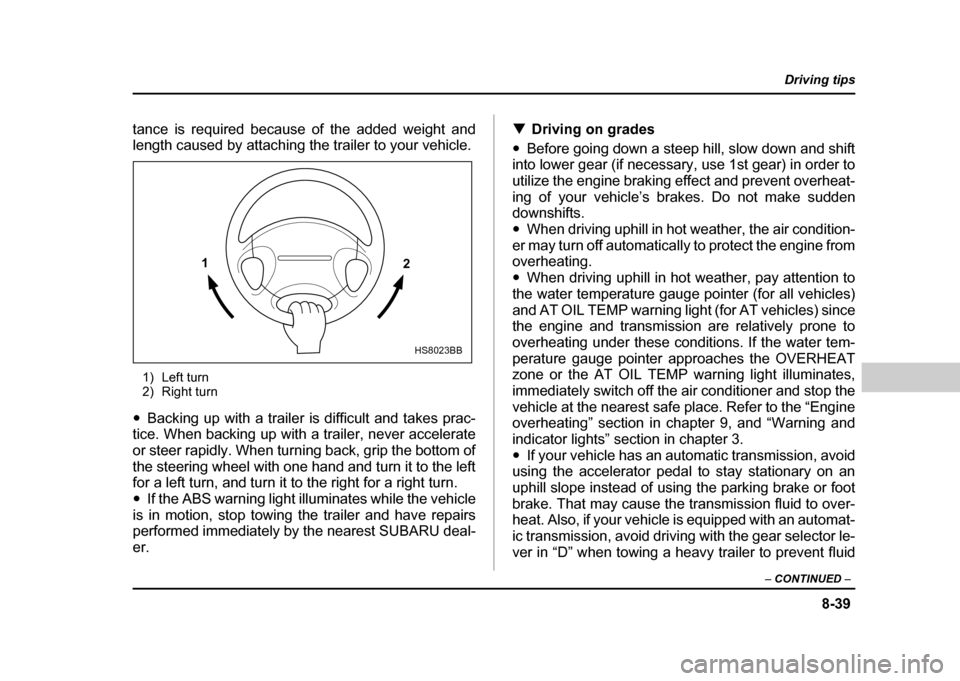
1) Left turn
2) Right turn
" Backing up with a trailer is difficult and takes prac-
tice. When backing up with a trailer, never accelerate
or steer rapidly. When turning back, grip the bottom of
the steering wheel with one hand and turn it to the left
for a left turn, and turn it to the right for a right turn." If the ABS warning light illuminates while the vehicle
is in motion, stop towing the trailer and have repairs
performed immediately by the nearest SUBARU deal-er. !
Driving on grades
" Before going down a steep hill, slow down and shift
into lower gear (if necessary, use 1st gear) in order to
utilize the engine braking effect and prevent overheat-
ing of your vehicle’s brakes. Do not make sudden
downshifts. " When driving uphill in hot weather, the air condition-
er may turn off automatically to protect the engine from
overheating. " When driving uphill in hot weather, pay attention to
the water temperature gauge pointer (for all vehicles)
and AT OIL TEMP warning light (for AT vehicles) since
the engine and transmission are relatively prone to
overheating under these conditions. If the water tem-
perature gauge pointer approaches the OVERHEAT
zone or the AT OIL TEMP warning light illuminates,
immediately switch off the air conditioner and stop the
vehicle at the nearest safe place. Refer to the “Engine
overheating” section in chapter 9, and “Warning and
indicator lights” section in chapter 3." If your vehicle has an automatic transmission, avoid
using the accelerator pedal to stay stationary on an
uphill slope instead of using the parking brake or foot
brake. That may cause the transmission fluid to over-
heat. Also, if your vehicle is equipped with an automat-
ic transmission, avoid driving with the gear selector le-
ver in “D” when towing a heavy trailer to prevent fluid
1 2
HS8023BB
Page 352 of 491

9-1
9
In case of emergency
If you park your vehicle in case of an emergency ............................................ 9-2
Temporary spare tire .................................... 9-3
Flat tires ......................................................... 9-5 Changing a flat tire ........................................... 9-5
Jump starting ................................................ 9-14 How to jump start ............................................. 9-14
Engine overheating ....................................... 9-16 If steam is coming from the engine compartment .................................................. 9-16
If no steam is coming from the engine compartment .................................................. 9-16
Towing ........................................................... 9-17 Towing and tie-down hooks ............................ 9-18
Using a flat-bed truck ....................................... 9-20
Towing with all wheels on the ground ............ 9-21
Rear gate – if the rear gate cannot be unlocked ..................................................... 9-22
Moonroof – if the moonroof cannot be closed ......................................................... 9-23
Maintenance tools ......................................... 9-24 Jack and jack handle ........................................ 9-24
Page 355 of 491
9-4
In case of emergency
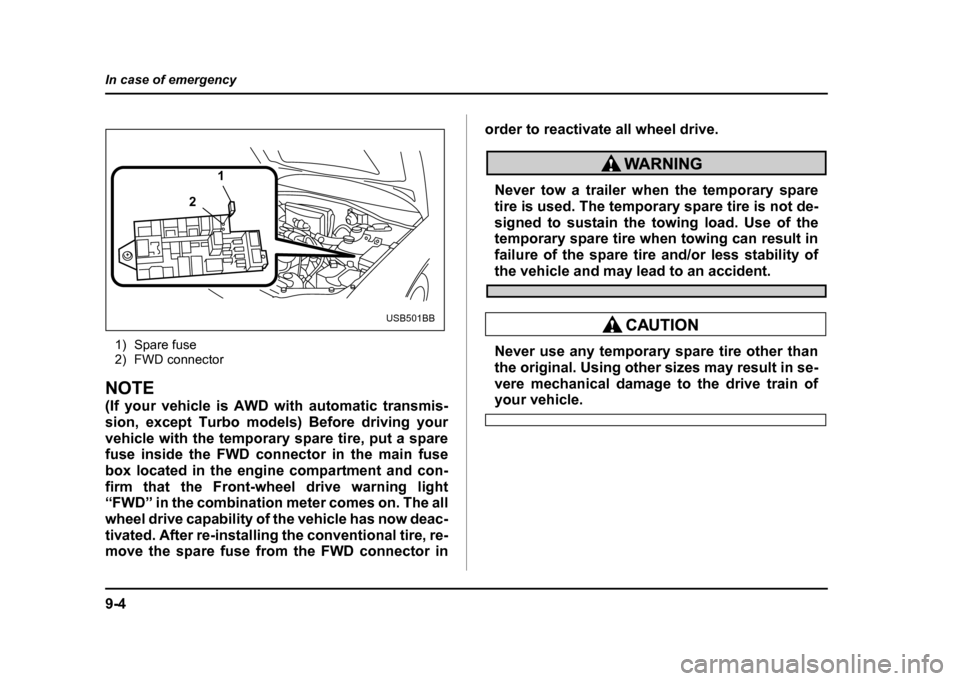
1) Spare fuse
2) FWD connector
NOTE
(If your vehicle is AWD with automatic transmis-
sion, except Turbo models) Before driving your
vehicle with the temporary spare tire, put a sparefuse inside the FWD connector in the main fuse
box located in the engine compartment and con-
firm that the Front-wheel drive warning light
“FWD” in the combination meter comes on. The all
wheel drive capability of the vehicle has now deac-
tivated. After re-installing the conventional tire, re-
move the spare fuse from the FWD connector in
order to reactivate all wheel drive.
Never tow a trailer when the temporary spare
tire is used. The temporary spare tire is not de-
signed to sustain the towing load. Use of the
temporary spare tire when towing can result in
failure of the spare tire and/or less stability of
the vehicle and may lead to an accident.
Never use any temporary spare tire other than
the original. Using other sizes may result in se-
vere mechanical damage to the drive train of
your vehicle.
1
2
USB501BB
Page 368 of 491
9-17
In case of emergency
– CONTINUED –
Confirm that the cooling fan is turning. If the fan is not
turning, immediately turn the engine off and contact
your authorized dealer for repair.
3. After the engine coolant temperature has dropped, turn off the engine.
If the temperature gauge stays at the overheated
zone, turn the engine off.
4. After the engine has fully cooled down, check the
coolant level in the reserve tank.
If the coolant level is below the “LOW” mark, add cool-
ant up to the “FULL” mark.
5. If there is no coolant in the reserve tank, add cool-
ant to the reserve tank. Then remove the radiator cap
and fill the radiator with coolant.
If you remove the radiator cap from a hot radiator, first
wrap a thick cloth around the radiator cap, then turn
the cap counterclockwise slowly without pressing
down until it stops. Release the pressure from the ra-
diator. After the pressure has been fully released, re-
move the cap by pressing down and turning it.Towing
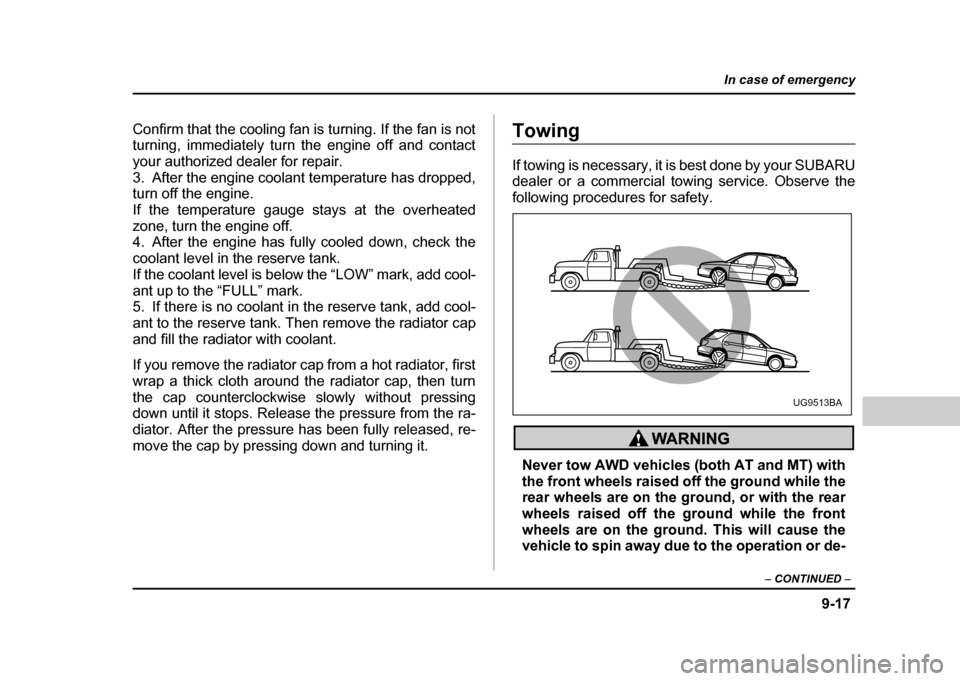
If towing is necessary, it is best done by your SUBARU
dealer or a commercial towing service. Observe the
following procedures for safety.
Never tow AWD vehicles (both AT and MT) with
the front wheels raised off the ground while the
rear wheels are on the ground, or with the rear
wheels raised off the ground while the front
wheels are on the ground. This will cause the
vehicle to spin away due to the operation or de-
UG9513BA
Page 369 of 491
9-18
In case of emergency
terioration of the center differential.
! Towing and tie-down hooks
The towing hooks should be used only in an emergen-
cy (e.g., to free a stuck vehicle from mud, sand or
snow).
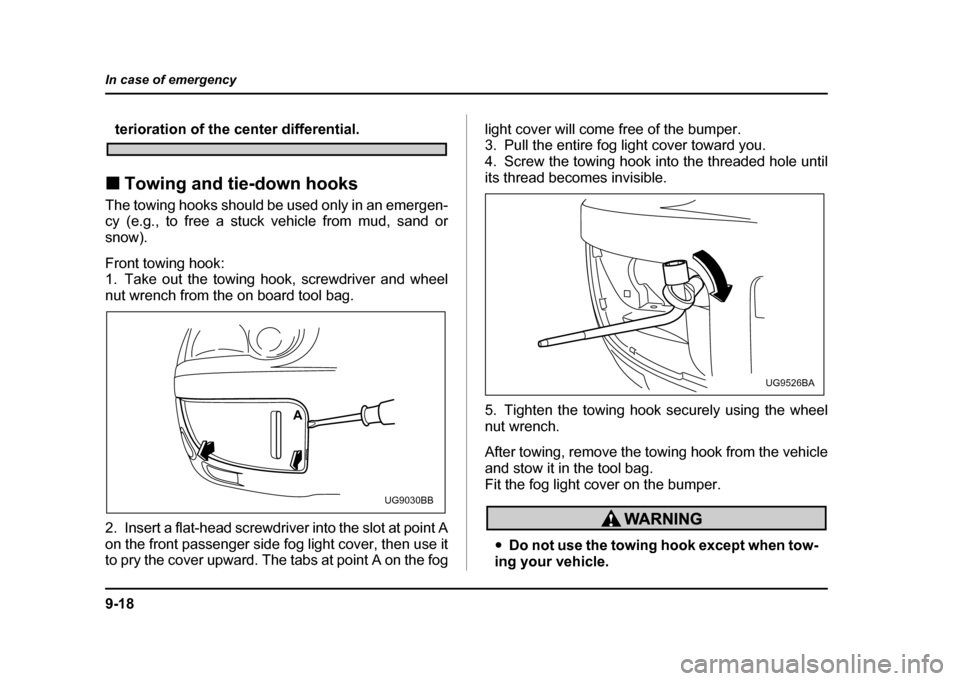
Front towing hook:
1. Take out the towing hook, screwdriver and wheel
nut wrench from the on board tool bag.
2. Insert a flat-head screwdriver into the slot at point A
on the front passenger side fog light cover, then use it
to pry the cover upward. The tabs at point A on the fog light cover will come free of the bumper.
3. Pull the entire fog light cover toward you.
4. Screw the towing hook into the threaded hole until
its thread becomes invisible.
5. Tighten the towing hook securely using the wheel
nut wrench.
After towing, remove the towing hook from the vehicle
and stow it in the tool bag.
Fit the fog light cover on the bumper.
"
Do not use the towing hook except when tow-
ing your vehicle.
A
UG9030BB
UG9526BA