engine SUBARU IMPREZA 2004 2.G Repair Manual
[x] Cancel search | Manufacturer: SUBARU, Model Year: 2004, Model line: IMPREZA, Model: SUBARU IMPREZA 2004 2.GPages: 491, PDF Size: 5.93 MB
Page 297 of 491
7-28
Starting and operating
Power steering
The power steering system operates only when the
engine is running.
If you lose power steering assist because the engine
stops or the system fails to function, you can steer butit will take much more effort.
NOTE
Right after the engine has been started and before
it has warmed up, you may hear a noise coming
from areas adjacent to the power steering pump
which is located at the right-front area of the en-
gine compartment. This noise is normal. It does
not indicate power steering system trouble.
Do not hold the steering wheel at the fully
locked position left or right for more than five
seconds. This may damage the power steering
pump.
Braking !
Braking tips
Never rest your foot on the brake pedal while
driving. This can cause dangerous overheating
of the brakes and needless wear on the brake
pads and linings.
! When the brakes get wet
When driving in rain or after washing the vehicle, the
brakes may get wet. As a result, brake stopping dis-
tance will be longer. To dry the brakes, drive the vehi-
cle at a safe speed while lightly depressing the brake
pedal to heat up the brakes. ! Use of engine braking
Remember to make use of engine braking in addition
to foot braking. When descending a grade, if only the
foot brake is used, the brakes may start working im-
properly because of brake fluid overheating, caused
by overheated brake pads. To help prevent this, shift
into a lower gear to get stronger engine braking.
Page 298 of 491
7-29
Starting and operating
– CONTINUED –
!Braking when a tire is punctured
Do not depress the brake pedal suddenly when a tire
is punctured. This could cause a loss of control of the
vehicle. Keep driving straight ahead while gradually
reducing speed. Then slowly pull off the road to a safe
place. ! Brake system
! Two separate circuits
Your vehicle has two separate circuit brake systems.
Each circuit works diagonally across the vehicle. If one
circuit of the brake system should fail, the other half of
the system still works. If one circuit fails, the brake
pedal will go down much closer to the floor than usual
and you will need to press it down much harder. And a
much longer distance will be needed to stop the vehi- cle. ! Brake booster
The brake booster uses engine manifold vacuum to
assist braking force. Do not turn off the engine while
driving because that will turn off the brake booster, re-
sulting in poor braking power.
The brakes will continue to work even when the brake
booster completely stops functioning. If this happens,
however, you will have to push the pedal much harder than normal and the braking distance will increase. !
Disc brake pad wear warning indica- tors
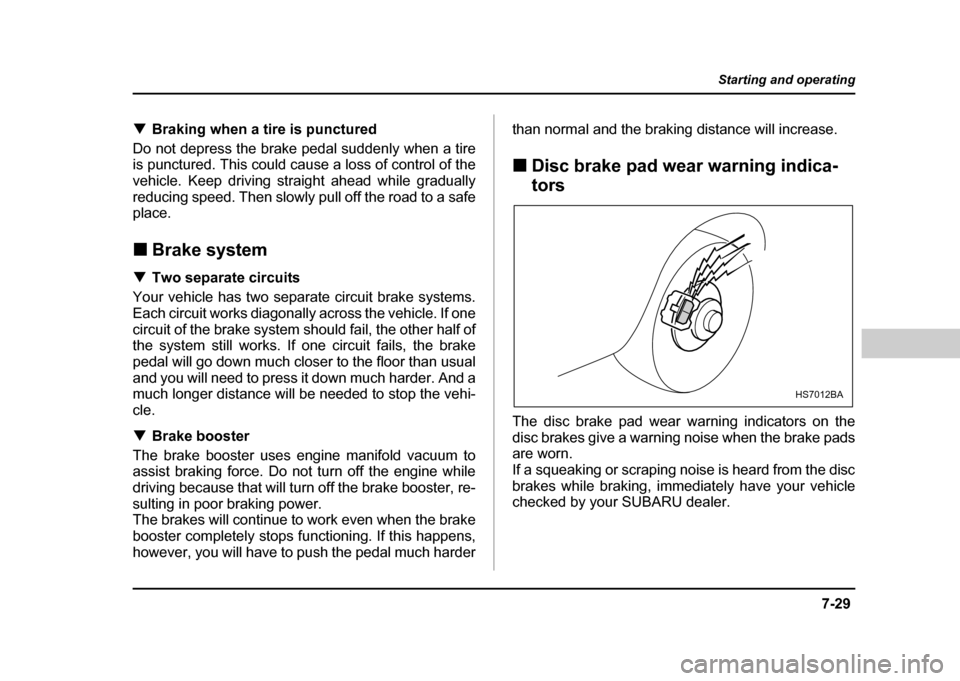
The disc brake pad wear warning indicators on the
disc brakes give a warning noise when the brake pads
are worn.
If a squeaking or scraping noise is heard from the disc
brakes while braking, immediately have your vehicle
checked by your SUBARU dealer.
HS7012BA
Page 299 of 491
7-30
Starting and operating
ABS (Anti-lock Brake System)
The ABS system prevents the lock-up of wheels which
may occur during sudden braking or braking on slip-
pery road surfaces. This helps prevent the loss of
steering control and directional stability caused by
wheel lock-up.
When the ABS system is operating, you may hear a
chattering noise or feel a slight vibration in the brake
pedal. This is normal when the ABS operates.
The ABS system will not operate when the vehicle
speed is below approximately 6 mph (10 km/h).
Always use the utmost care in driving – over-
confidence because you are driving with an
ABS equipped vehicle could easily lead to a se-
rious accident.
"
The ABS system does not always decrease
stopping distance. You should always main-
tain a safe following distance from other vehi- cles. "
When driving on badly surfaced roads, gravel
roads, icy roads, or over deep newly fallen
snow, stopping distances may be longer for a
vehicle with the ABS system than one without.
When driving under these conditions, there-
fore, reduce your speed and leave ample dis-
tance from other vehicles. " When you feel the ABS system operating,
you should maintain constant brake pedal pres-
sure. Do not pump the brake pedal since doing
so may defeat the operation of the ABS system.
! ABS system self-check
You may feel a slight shock in the brake pedal and hear the operating sound of ABS from the engine com-
partment just after the vehicle is started. This is
caused by an automatic functional test of the ABS sys-
tem being carried out and does not indicate any abnor-
mal condition.
Page 300 of 491
7-31
Starting and operating
– CONTINUED –
!ABS warning light
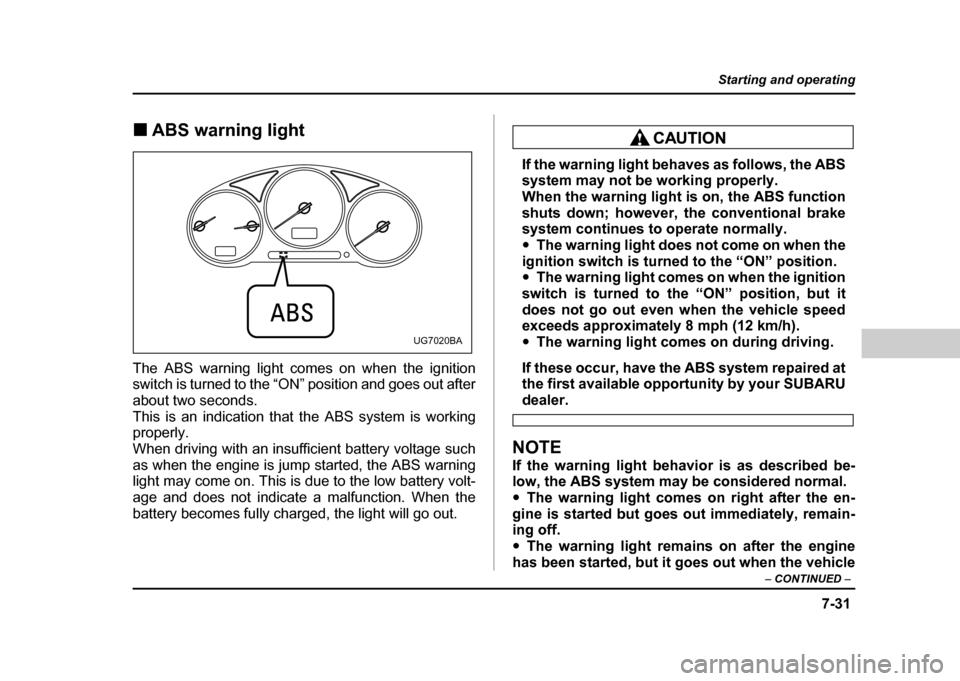
The ABS warning light comes on when the ignition
switch is turned to the “ON” position and goes out after
about two seconds.
This is an indication that the ABS system is working
properly.
When driving with an insufficient battery voltage such
as when the engine is jump started, the ABS warning
light may come on. This is due to the low battery volt-
age and does not indicate a malfunction. When the
battery becomes fully charged, the light will go out.
If the warning light behaves as follows, the ABS
system may not be working properly.
When the warning light is on, the ABS function
shuts down; however, the conventional brake
system continues to operate normally. " The warning light does not come on when the
ignition switch is turned to the “ON” position. " The warning light comes on when the ignition
switch is turned to the “ON” position, but it
does not go out even when the vehicle speed
exceeds approximately 8 mph (12 km/h). " The warning light comes on during driving.
If these occur, have the ABS system repaired at
the first available opportunity by your SUBARU
dealer.
NOTE
If the warning light behavior is as described be-
low, the ABS system may be considered normal." The warning light comes on right after the en-
gine is started but goes out immediately, remain-
ing off." The warning light remains on after the engine
has been started, but it goes out when the vehicle
UG7020BA
Page 302 of 491
7-33
Starting and operating
– CONTINUED –
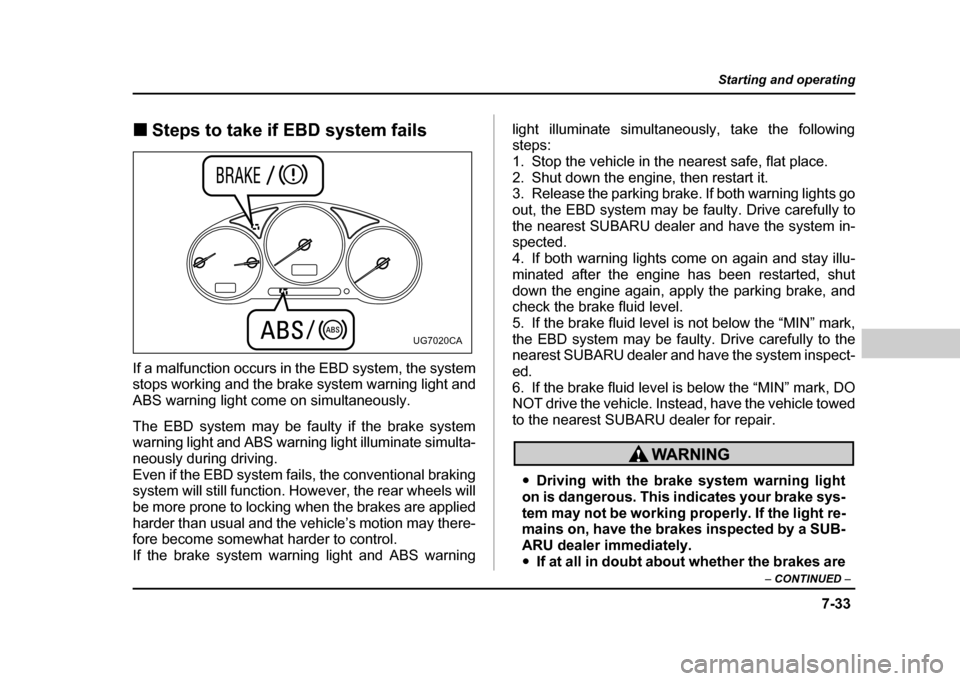
!Steps to take if EBD system fails
If a malfunction occurs in the EBD system, the system
stops working and the brake system warning light and
ABS warning light come on simultaneously.
The EBD system may be faulty if the brake system
warning light and ABS warning light illuminate simulta-
neously during driving.
Even if the EBD system fails, the conventional braking
system will still function. However, the rear wheels will
be more prone to locking when the brakes are applied
harder than usual and the vehicle’s motion may there-
fore become somewhat harder to control. If the brake system warning light and ABS warning light illuminate simultaneously, take the following steps:
1. Stop the vehicle in the nearest safe, flat place.
2. Shut down the engine, then restart it.
3. Release the parking brake. If both warning lights go
out, the EBD system may be faulty. Drive carefully to
the nearest SUBARU dealer and have the system in- spected.
4. If both warning lights come on again and stay illu-
minated after the engine has been restarted, shut
down the engine again, apply the parking brake, and
check the brake fluid level.
5. If the brake fluid level is not below the “MIN” mark,
the EBD system may be faulty. Drive carefully to the
nearest SUBARU dealer and have the system inspect- ed.
6. If the brake fluid level is below the “MIN” mark, DO
NOT drive the vehicle. Instead, have the vehicle towed
to the nearest SUBARU dealer for repair.
"
Driving with the brake system warning light
on is dangerous. This indicates your brake sys-
tem may not be working properly. If the light re-
mains on, have the brakes inspected by a SUB-
ARU dealer immediately." If at all in doubt about whether the brakes are
UG7020CA
Page 303 of 491
7-34
Starting and operating
operating properly, do not drive the vehicle.
Have your vehicle towed to the nearest SUBA-
RU dealer for repair.
Parking your vehicle !
Parking brake
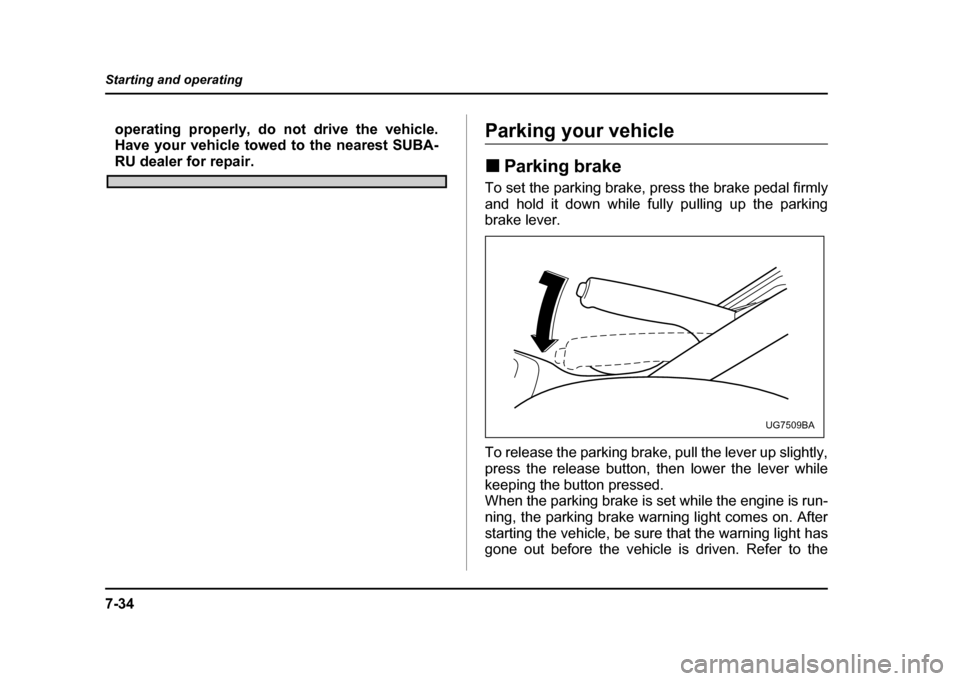
To set the parking brake, press the brake pedal firmly
and hold it down while fully pulling up the parking
brake lever.
To release the parking brake, pull the lever up slightly,
press the release button, then lower the lever while
keeping the button pressed.
When the parking brake is set while the engine is run-
ning, the parking brake warning light comes on. After
starting the vehicle, be sure that the warning light has
gone out before the vehicle is driven. Refer to the
UG7509BA
Page 305 of 491
7-36
Starting and operating
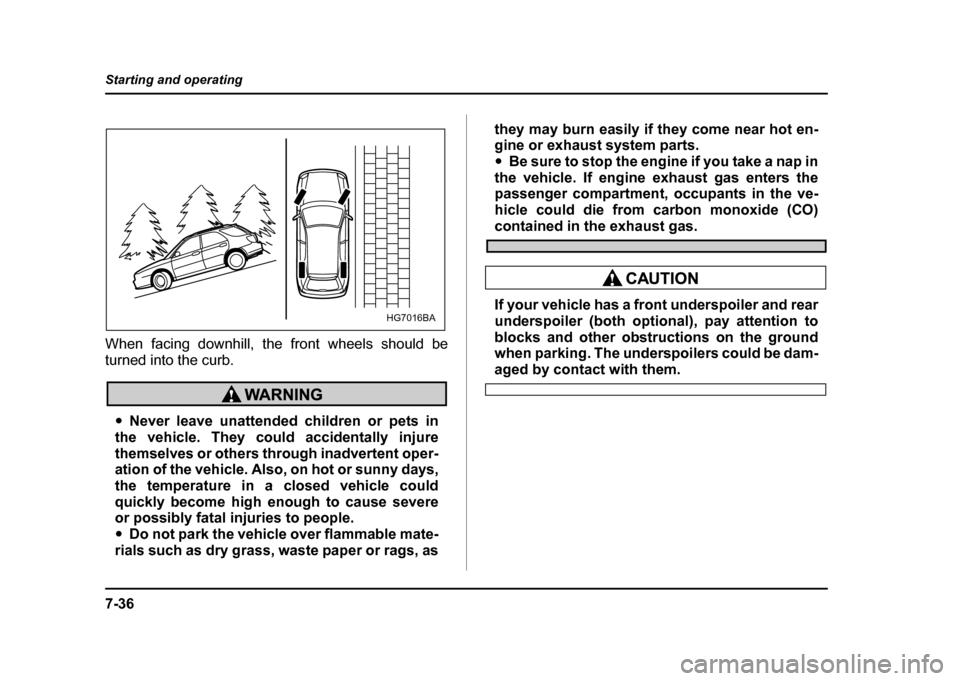
When facing downhill, the front wheels should be
turned into the curb.
"
Never leave unattended children or pets in
the vehicle. They could accidentally injure
themselves or others through inadvertent oper-
ation of the vehicle. Also, on hot or sunny days,
the temperature in a closed vehicle could
quickly become high enough to cause severe
or possibly fatal injuries to people. " Do not park the vehicle over flammable mate-
rials such as dry grass, waste paper or rags, as they may burn easily if they come near hot en-
gine or exhaust system parts. "
Be sure to stop the engine if you take a nap in
the vehicle. If engine exhaust gas enters the
passenger compartment, occupants in the ve-
hicle could die from carbon monoxide (CO)
contained in the exhaust gas.
If your vehicle has a front underspoiler and rear
underspoiler (both optional), pay attention to
blocks and other obstructions on the ground
when parking. The underspoilers could be dam-
aged by contact with them.
HG7016BA
Page 312 of 491

8-1
8
Driving tips
New vehicle break-in driving – the first 1,000 miles (1,600 km) ................ 8-2
Fuel economy hints ...................................... 8-2
Engine exhaust gas (Carbon monoxide) .... 8-3
Catalytic converter ....................................... 8-4
Periodic inspections .................................... 8-6
Driving in foreign countries ......................... 8-6
Driving tips for AWD vehicles ..................... 8-7
Off road driving ............................................ 8-8 All AWD models except OUTBACK SPORT and vehicles with 17 inch tires ..................... 8-9
OUTBACK SPORT ............................................. 8-9
Winter driving ............................................... 8-11 Operation during cold weather ........................ 8-11
Driving on snowy and icy roads ...................... 8-13
Corrosion protection ........................................ 8-14
Snow tires .......................................................... 8-14
Tire chains ......................................................... 8-16
Rocking the vehicle .......................................... 8-16
Loading your vehicle ................................... 8-17 Vehicle capacity weight .................................... 8-19
GVWR and GAWR (Gross Vehicle Weight Rating and Gross Axle Weight Rating) ........ 8-20
Roof rail and crossbar (if equipped) ............... 8-21
Trailer hitch (if equipped) ............................ 8-25 Connecting a trailer .......................................... 8-25
When you do not tow a trailer .......................... 8-28
Trailer towing ................................................ 8-29 Warranties and maintenance ........................... 8-29 Maximum load limits ........................................ 8-29
Trailer hitches ................................................... 8-34
Connecting a trailer .......................................... 8-35
Trailer towing tips ............................................. 8-37
Page 313 of 491

8-2
Driving tips
Driving tipsNew vehicle break-in driving – the
first 1,000 miles (1,600 km)
The performance and long life of your vehicle are de-
pendent on how you handle and care for your vehicle
while it is new. Follow these instructions during the
first 1,000 miles (1,600 km): "
Do not race the engine. And do not allow engine
speed to exceed 4,000 rpm except in an emergency. " Do not drive at one constant engine or vehicle
speed for a long time, either fast or slow." Avoid starting suddenly and rapid acceleration, ex-
cept in an emergency. " Avoid hard braking, except in an emergency.
The same break-in procedures should be applied to
an overhauled engine, newly mounted engine or when
brake pads or brake linings are replaced with new
ones.
Fuel economy hints
The following suggestions will help to save your fuel. " Select the proper gear position for the speed and
road conditions. " Avoid sudden acceleration or deceleration. Always
accelerate gently until you reach the desired speed.
Then try to maintain that speed for as long as possible. " Do not pump the accelerator and avoid racing the
engine. " Avoid unnecessary engine idling.
" Keep the engine properly tuned.
" Keep the tires inflated to the correct pressure shown
on the tire placard, which is located under the door
latch on the driver’s side. Low pressure will increase
tire wear and fuel consumption. " Use the air conditioner only when necessary.
" Keep the front and rear wheels in proper alignment.
" Avoid carrying unnecessary luggage or cargo.
Page 314 of 491
8-3
Driving tips
– CONTINUED –
Engine exhaust gas (Carbon monox-
ide)
"Never inhale engine exhaust gas. Engine ex-
haust gas contains carbon monoxide, a color-
less and odorless gas which is dangerous, or
even lethal, if inhaled. " Always properly maintain the engine exhaust
system to prevent engine exhaust gas from en-
tering the vehicle. " Never run the engine in a closed space, such
as a garage, except for the brief time needed to
drive the vehicle in or out of it. " Avoid remaining in a parked vehicle for a
lengthy time while the engine is running. If that
is unavoidable, then use the ventilation fan to
force fresh air into the vehicle." Always keep the front ventilator inlet grille
free from snow, leaves or other obstructions to
ensure that the ventilation system always
works properly." If at any time you suspect that exhaust fumes
are entering the vehicle, have the problem
checked and corrected as soon as possible. If
you must drive under these conditions, drive only with all windows fully open. "
Keep the trunk lid or rear gate closed while
driving to prevent exhaust gas from entering
the vehicle.
NOTE
Due to the expansion and contraction of the met-
als used in the manufacture of the exhaust sys-
tem, you may hear a crackling sound coming from
the exhaust system for a short time after the en-
gine has been shut off. This sound is normal.