weight SUBARU IMPREZA 2004 2.G Owners Manual
[x] Cancel search | Manufacturer: SUBARU, Model Year: 2004, Model line: IMPREZA, Model: SUBARU IMPREZA 2004 2.GPages: 491, PDF Size: 5.93 MB
Page 10 of 491
7
–
CONTINUED –
ment, the driver should always sit upright and
well back in the seat as far from the steering
wheel as practical while still maintaining full ve-
hicle control and the front passenger should
move the seat as far back as possible and sit
upright and well back in the seat.
Carefully read the sections “Seatbelts” and “*SRS air-
bag (Supplemental Restraint System airbag)” in chap-
ter 1 of this owner’s manual for instructions and pre-
cautions concerning the seatbelt system and SRS air-
bag system. ! Child safety
"Never hold a child on your lap or in your arms
while the vehicle is moving. The passenger
cannot protect the child from injury in a colli-
sion, because the child will be caught between
the passenger and objects inside the vehicle. " While riding in the vehicle, infants and small
children should always be placed in the REAR
seat in an infant or child restraint system which
is appropriate for the child’s age, height and weight. If a child is too big for a child restraint
system, the child should sit in the REAR seat
and be restrained using the seatbelts. Accord-
ing to accident statistics, children are safer
when properly restrained in the rear seating po-
sitions than in the front seating positions. Nev-
er allow a child to stand up or kneel on the seat. "
Put children aged 12 and under in the REAR
seat properly restrained at all times in a child
restraint device or in a seatbelt. The SRS airbag
deploys with considerable speed and force and
can injure or even kill children, especially if
they are 12 years of age and under and are not
restrained or improperly restrained. Because
children are lighter and weaker than adults,
their risk being injured from deployment is
greater. " NEVER INSTALL A REARWARD FACING
CHILD SEAT IN THE FRONT SEAT. DOING SO
RISKS SERIOUS INJURY OR DEATH TO THE
CHILD BY PLACING THE CHILD’S HEAD TOO
CLOSE TO THE SRS AIRBAG." Always use the child safety locks whenever a
child rides in the rear seat. Serious injury could
result if a child accidentally opened the door
and fell out. Refer to the “Child safety locks”
section in chapter 2.
Page 30 of 491
1-3
Seat, seatbelt and SRS airbags
– CONTINUED –
restrained at all times in a child restraint device
or in a seatbelt, whichever is appropriate for the
child’s age, height and weight. Secure ALL
types of child restraint devices (including for-
ward facing child seat) in the REAR seats at all times.
NEVER INSTALL A REARWARD FACING CHILD SEAT IN THE FRONT SEAT. DOING SO RISKS
SERIOUS INJURY OR DEATH TO THE CHILD
BY PLACING THE CHILD’S HEAD TOO CLOSE
TO THE SRS AIRBAG.
According to accident statistics, children are
safer when properly restrained in the rear seat-
ing positions than in the front seating posi-
tions. For instructions and precautions con-
cerning child restraint systems, see the “Child
restraint systems” section in this chapter. !
Fore and aft adjustment
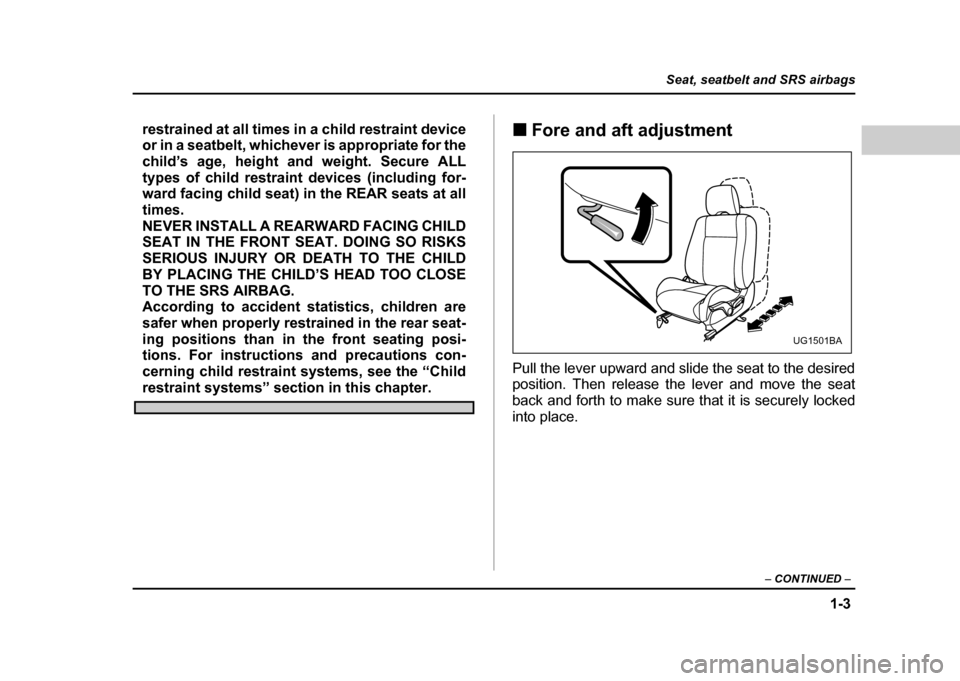
Pull the lever upward and slide the seat to the desired
position. Then release the lever and move the seat
back and forth to make sure that it is securely locked
into place.
UG1501BA
Page 40 of 491
1-13
Seat, seatbelt and SRS airbags
– CONTINUED –
Seatbelts !Seatbelt safety tips
"All persons in the vehicle should fasten their
seatbelts BEFORE the vehicle starts to move.
Otherwise, the possibility of serious injury be-
comes greater in the event of a sudden stop or
accident. " All belts should fit snugly in order to provide
full restraint. Loose fitting belts are not as ef-
fective in preventing or reducing injury. " Each seatbelt is designed to support only
one person. Never use a single belt for two or
more persons — even children. Otherwise, in
an accident, serious injury or death could re-
sult. " Replace all seatbelt assemblies including re-
tractors and attaching hardware worn by occu-
pants of a vehicle that has been in a serious ac-
cident. The entire assembly should be replaced
even if damage is not obvious." Put children aged 12 and under in the rear
seat properly restrained at all times. The SRS
airbag deploys with considerable speed and force and can injure or even kill children, espe-
cially if they are 12 years of age and under and
are not restrained or improperly restrained. Be-
cause children are lighter and weaker than
adults, their risk of being injured from deploy-
ment is greater. For that reason, we strongly
recommend that ALL children (including those
in child seats and those that have outgrown
child restraint devices) sit in the REAR seat
properly restrained at all times in a child re-
straint device or in a seatbelt, whichever is ap-
propriate for the child’s height and weight.
Secure ALL types of child restraint devices (in-
cluding forward facing child seats) in the REAR
seats at all times.
NEVER INSTALL A REARWARD FACING CHILD
SEAT IN THE FRONT SEAT. DOING SO RISKS SERIOUS INJURY OR DEATH TO THE CHILD
BY PLACING THE CHILD’S HEAD TOO CLOSE
TO THE SRS AIRBAG.
According to accident statistics, children are
safer when properly restrained in the rear seat-
ing positions than in the front seating posi-
tions. For instructions and precautions con-
cerning the child restraint system, see the
“Child restraint systems” section in this chap-
Page 60 of 491
1-33
Seat, seatbelt and SRS airbags
– CONTINUED –
!Where to place a child restraint system
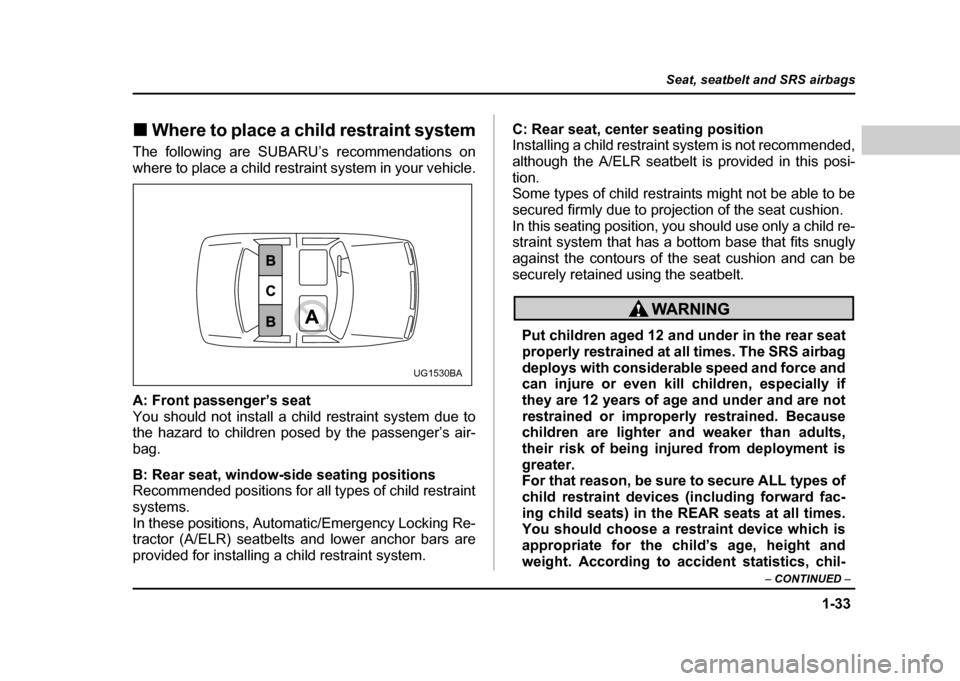
The following are SUBARU’s recommendations on
where to place a child restraint system in your vehicle.
A: Front passenger’s seat
You should not install a child restraint system due to
the hazard to children posed by the passenger’s air-
bag.
B: Rear seat, window-side seating positions
Recommended positions for all types of child restraint systems.
In these positions, Automatic/Emergency Locking Re-
tractor (A/ELR) seatbelts and lower anchor bars are
provided for installing a child restraint system. C: Rear seat, center seating position
Installing a child restraint system is not recommended,
although the A/ELR seatbelt is provided in this posi-
tion.
Some types of child restraints might not be able to be
secured firmly due to projection of the seat cushion.
In this seating position, you should use only a child re-
straint system that has a bottom base that fits snugly
against the contours of the seat cushion and can be
securely retained using the seatbelt.
Put children aged 12 and under in the rear seat
properly restrained at all times. The SRS airbag
deploys with considerable speed and force and
can injure or even kill children, especially if
they are 12 years of age and under and are not
restrained or improperly restrained. Because
children are lighter and weaker than adults,
their risk of being injured from deployment is
greater.
For that reason, be sure to secure ALL types of
child restraint devices (including forward fac-
ing child seats) in the REAR seats at all times.
You should choose a restraint device which is
appropriate for the child’s age, height and
weight. According to accident statistics, chil-
UG1530BA
Page 61 of 491
1-34
Seat, seatbelt and SRS airbags
dren are safer when properly restrained in the
rear seating positions than in the front seating
positions.
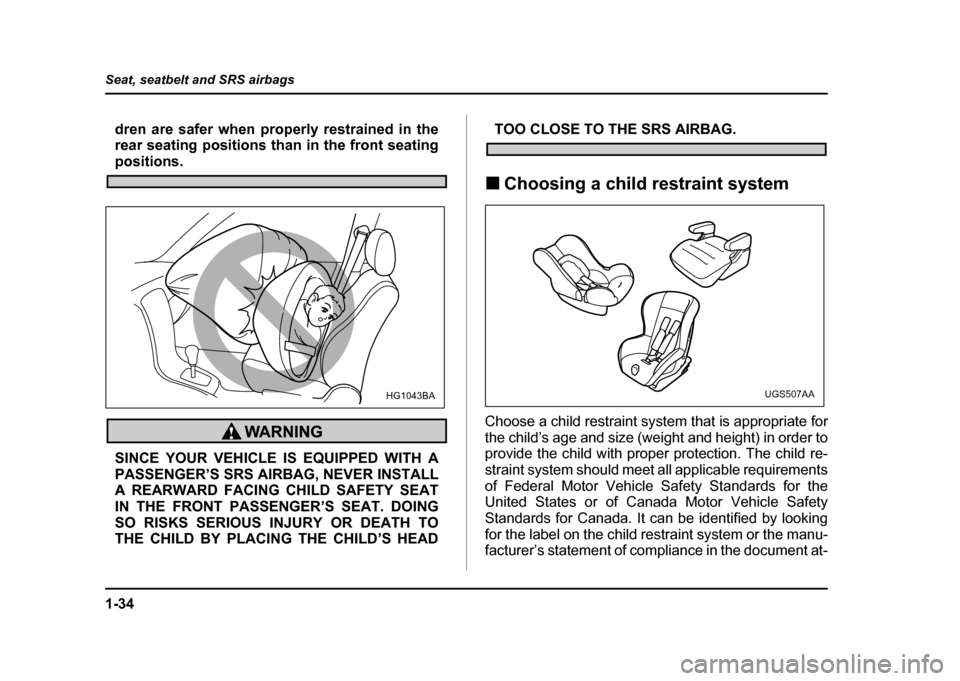
SINCE YOUR VEHICLE IS EQUIPPED WITH A PASSENGER’S SRS AIRBAG, NEVER INSTALL
A REARWARD FACING CHILD SAFETY SEAT
IN THE FRONT PASSENGER’S SEAT. DOING SO RISKS SERIOUS INJURY OR DEATH TO
THE CHILD BY PLACING THE CHILD’S HEAD
TOO CLOSE TO THE SRS AIRBAG.
! Choosing a child restraint system
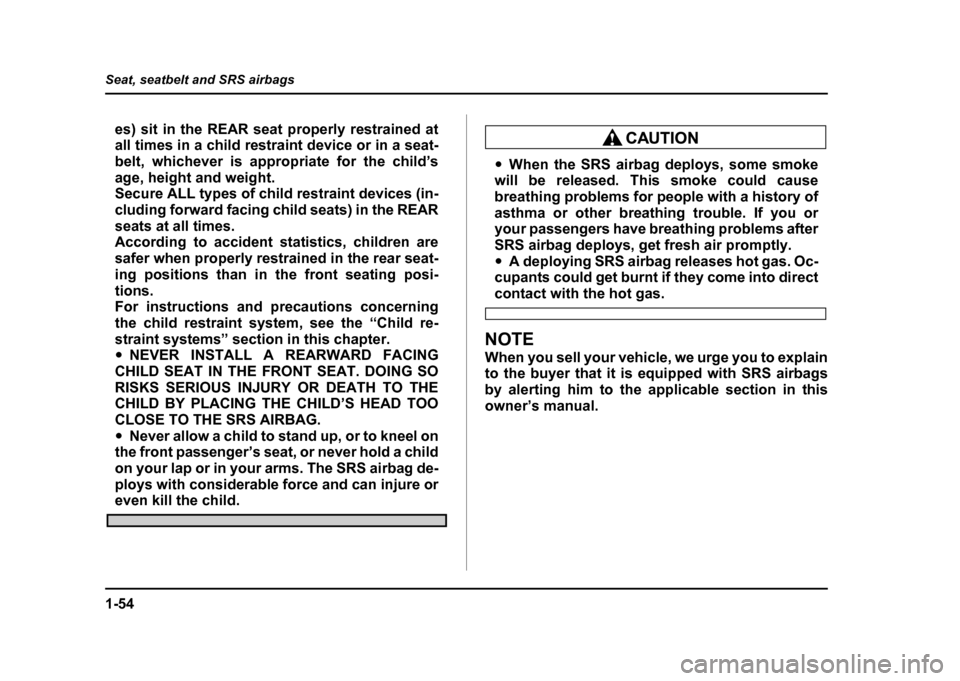
Choose a child restraint system that is appropriate for
the child’s age and size (weight and height) in order to
provide the child with proper protection. The child re-
straint system should meet all applicable requirements
of Federal Motor Vehicle Safety Standards for the
United States or of Canada Motor Vehicle Safety
Standards for Canada. It can be identified by looking
for the label on the child restraint system or the manu-
facturer’s statement of compliance in the document at-
HG1043BAUGS507AA
Page 81 of 491
1-54
Seat, seatbelt and SRS airbags
es) sit in the REAR seat properly restrained at
all times in a child restraint device or in a seat-
belt, whichever is appropriate for the child’s
age, height and weight.
Secure ALL types of child restraint devices (in-
cluding forward facing child seats) in the REAR
seats at all times.
According to accident statistics, children are
safer when properly restrained in the rear seat-
ing positions than in the front seating posi-
tions.
For instructions and precautions concerning
the child restraint system, see the “Child re-
straint systems” section in this chapter. "
NEVER INSTALL A REARWARD FACING
CHILD SEAT IN THE FRONT SEAT. DOING SO RISKS SERIOUS INJURY OR DEATH TO THE
CHILD BY PLACING THE CHILD’S HEAD TOO
CLOSE TO THE SRS AIRBAG." Never allow a child to stand up, or to kneel on
the front passenger’s seat, or never hold a child
on your lap or in your arms. The SRS airbag de-
ploys with considerable force and can injure or
even kill the child.
" When the SRS airbag deploys, some smoke
will be released. This smoke could cause
breathing problems for people with a history of
asthma or other breathing trouble. If you or
your passengers have breathing problems after
SRS airbag deploys, get fresh air promptly." A deploying SRS airbag releases hot gas. Oc-
cupants could get burnt if they come into direct
contact with the hot gas.
NOTE
When you sell your vehicle, we urge you to explain
to the buyer that it is equipped with SRS airbags
by alerting him to the applicable section in this
owner’s manual.
Page 264 of 491
6-15
Interior equipment
– CONTINUED –
Cargo area cover (if equipped)
The cargo area cover is provided for covering the car-
go area and to protect its contents from direct sunlight.
This cover is detachable to make room for additional
cargo. !Using the cover
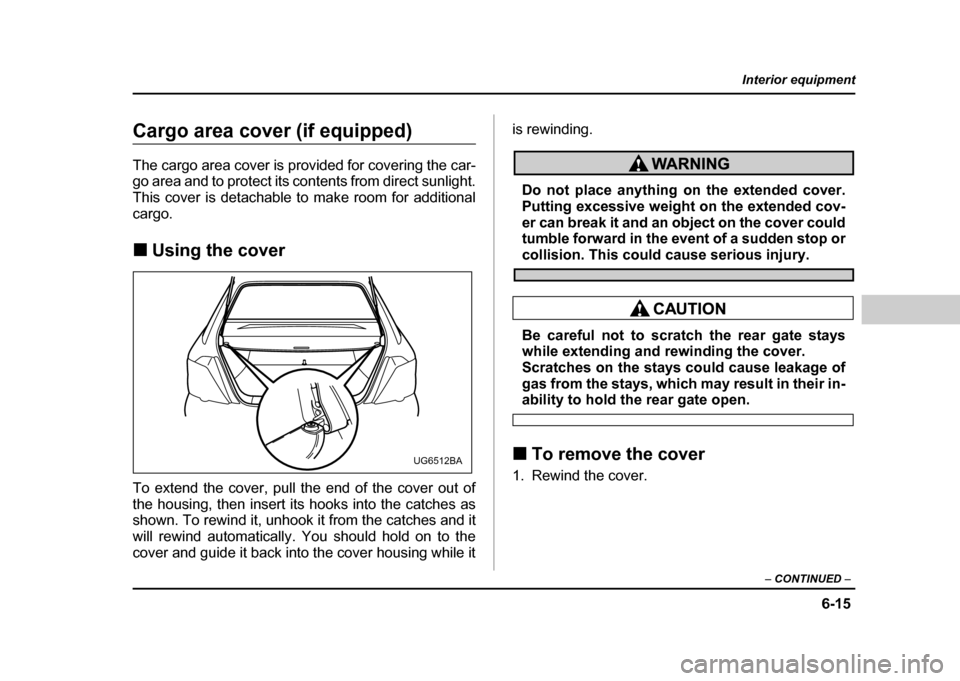
To extend the cover, pull the end of the cover out of
the housing, then insert its hooks into the catches as
shown. To rewind it, unhook it from the catches and it
will rewind automatically. You should hold on to the
cover and guide it back into the cover housing while it is rewinding.
Do not place anything on the extended cover.
Putting excessive weight on the extended cov-
er can break it and an object on the cover could
tumble forward in the event of a sudden stop or
collision. This could cause serious injury.
Be careful not to scratch the rear gate stays
while extending and rewinding the cover.
Scratches on the stays could cause leakage of
gas from the stays, which may result in their in-
ability to hold the rear gate open.
! To remove the cover
1. Rewind the cover.
UG6512BA
Page 312 of 491

8-1
8
Driving tips
New vehicle break-in driving – the first 1,000 miles (1,600 km) ................ 8-2
Fuel economy hints ...................................... 8-2
Engine exhaust gas (Carbon monoxide) .... 8-3
Catalytic converter ....................................... 8-4
Periodic inspections .................................... 8-6
Driving in foreign countries ......................... 8-6
Driving tips for AWD vehicles ..................... 8-7
Off road driving ............................................ 8-8 All AWD models except OUTBACK SPORT and vehicles with 17 inch tires ..................... 8-9
OUTBACK SPORT ............................................. 8-9
Winter driving ............................................... 8-11 Operation during cold weather ........................ 8-11
Driving on snowy and icy roads ...................... 8-13
Corrosion protection ........................................ 8-14
Snow tires .......................................................... 8-14
Tire chains ......................................................... 8-16
Rocking the vehicle .......................................... 8-16
Loading your vehicle ................................... 8-17 Vehicle capacity weight .................................... 8-19
GVWR and GAWR (Gross Vehicle Weight Rating and Gross Axle Weight Rating) ........ 8-20
Roof rail and crossbar (if equipped) ............... 8-21
Trailer hitch (if equipped) ............................ 8-25 Connecting a trailer .......................................... 8-25
When you do not tow a trailer .......................... 8-28
Trailer towing ................................................ 8-29 Warranties and maintenance ........................... 8-29 Maximum load limits ........................................ 8-29
Trailer hitches ................................................... 8-34
Connecting a trailer .......................................... 8-35
Trailer towing tips ............................................. 8-37
Page 330 of 491
8-19
Driving tips
– CONTINUED –
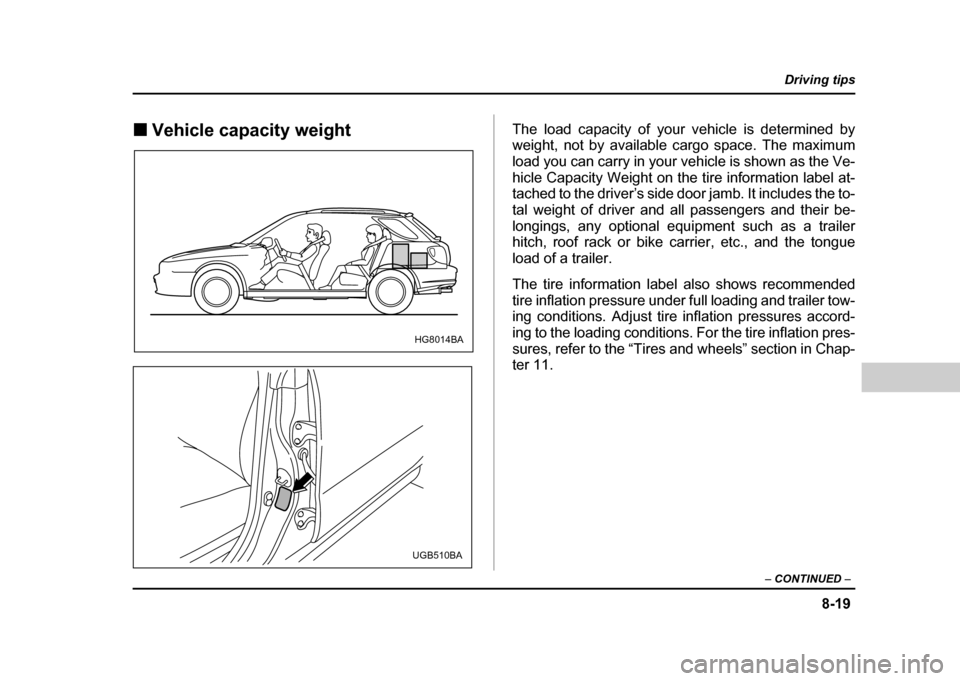
!Vehicle capacity weight The load capacity of your vehicle is determined by
weight, not by available cargo space. The maximum
load you can carry in your vehicle is shown as the Ve-
hicle Capacity Weight on the tire information label at-
tached to the driver’s side door jamb. It includes the to-
tal weight of driver and all passengers and their be-
longings, any optional equipment such as a trailer
hitch, roof rack or bike carrier, etc., and the tongue
load of a trailer.
The tire information label also shows recommended
tire inflation pressure under full loading and trailer tow-
ing conditions. Adjust tire inflation pressures accord-
ing to the loading conditions. For the tire inflation pres-
sures, refer to the “Tires and wheels” section in Chap-
ter 11.
HG8014BA
UGB510BA
Page 331 of 491
8-20
Driving tips
!
GVWR and GAWR (Gross Vehicle
Weight Rating and Gross Axle Weight Rating)
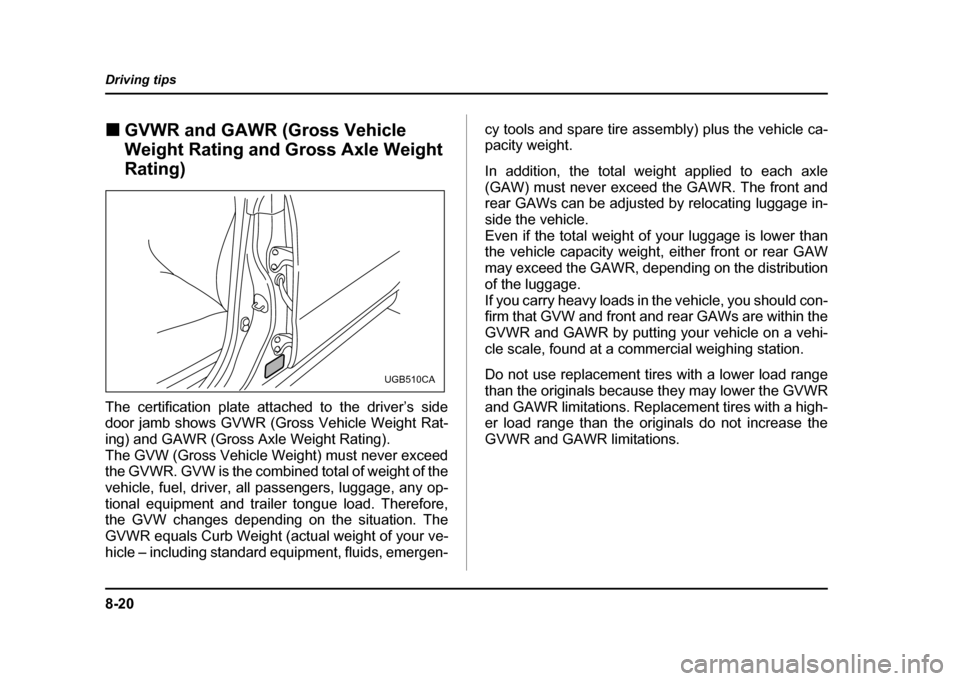
The certification plate attached to the driver’s side
door jamb shows GVWR (Gross Vehicle Weight Rat-
ing) and GAWR (Gross Axle Weight Rating).
The GVW (Gross Vehicle Weight) must never exceed
the GVWR. GVW is the combined total of weight of the
vehicle, fuel, driver, all passengers, luggage, any op-
tional equipment and trailer tongue load. Therefore,
the GVW changes depending on the situation. The
GVWR equals Curb Weight (actual weight of your ve-
hicle – including standard equipment, fluids, emergen- cy tools and spare tire assembly) plus the vehicle ca-
pacity weight.
In addition, the total weight applied to each axle
(GAW) must never exceed the GAWR. The front and
rear GAWs can be adjusted by relocating luggage in-
side the vehicle.
Even if the total weight of your luggage is lower than
the vehicle capacity weight, either front or rear GAW
may exceed the GAWR, depending on the distribution
of the luggage.
If you carry heavy loads in the vehicle, you should con-
firm that GVW and front and rear GAWs are within the
GVWR and GAWR by putting your vehicle on a vehi-
cle scale, found at a commercial weighing station.
Do not use replacement tires with a lower load range
than the originals because they may lower the GVWR
and GAWR limitations. Replacement tires with a high-
er load range than the originals do not increase the
GVWR and GAWR limitations.
UGB510CA