weight SUBARU IMPREZA 2004 2.G User Guide
[x] Cancel search | Manufacturer: SUBARU, Model Year: 2004, Model line: IMPREZA, Model: SUBARU IMPREZA 2004 2.GPages: 491, PDF Size: 5.93 MB
Page 332 of 491
8-21
Driving tips
– CONTINUED –
!Roof rail and crossbar (if equipped)
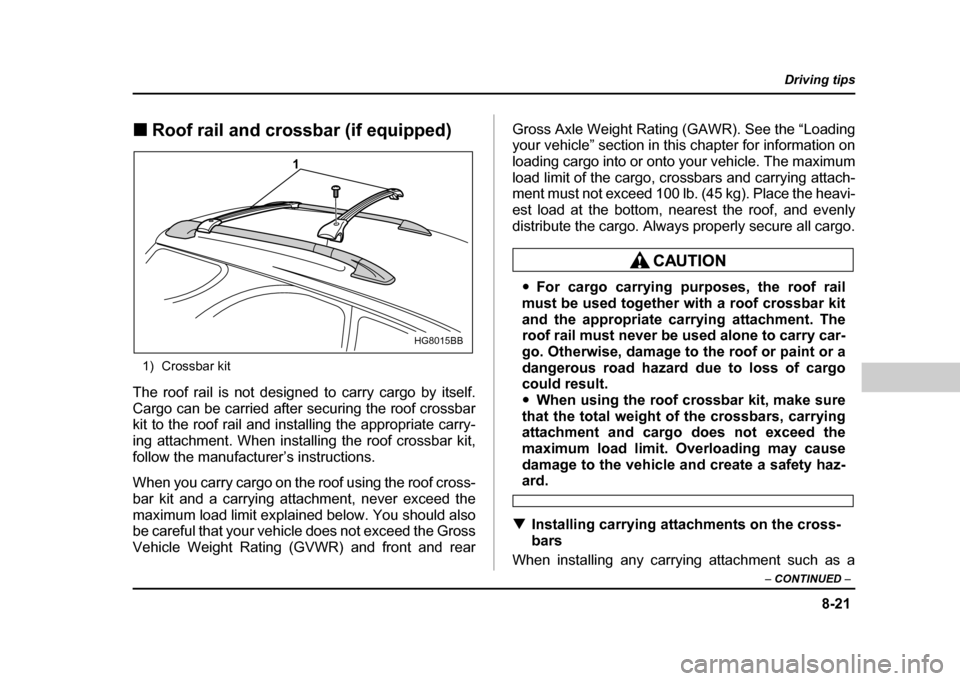
1) Crossbar kit
The roof rail is not designed to carry cargo by itself.
Cargo can be carried after securing the roof crossbar
kit to the roof rail and installing the appropriate carry-
ing attachment. When installing the roof crossbar kit,
follow the manufacturer’s instructions.
When you carry cargo on the roof using the roof cross-
bar kit and a carrying attachment, never exceed the
maximum load limit explained below. You should also
be careful that your vehicle does not exceed the Gross
Vehicle Weight Rating (GVWR) and front and rear Gross Axle Weight Rating (GAWR). See the “Loading
your vehicle” section in this chapter for information on
loading cargo into or onto your vehicle. The maximum
load limit of the cargo, crossbars and carrying attach-
ment must not exceed 100 lb. (45 kg). Place the heavi-
est load at the bottom, nearest the roof, and evenly
distribute the cargo. Always properly secure all cargo.
"
For cargo carrying purposes, the roof rail
must be used together with a roof crossbar kit
and the appropriate carrying attachment. The
roof rail must never be used alone to carry car-
go. Otherwise, damage to the roof or paint or a
dangerous road hazard due to loss of cargo
could result. " When using the roof crossbar kit, make sure
that the total weight of the crossbars, carrying
attachment and cargo does not exceed the
maximum load limit. Overloading may cause
damage to the vehicle and create a safety haz-
ard.
! Installing carrying attachments on the cross-
bars
When installing any carrying attachment such as a
1
HG8015BB
Page 333 of 491
8-22
Driving tips
bike carrier, ski carrier, kayak carrier, cargo basket,
etc. on the crossbars, follow the manufacturer’s in-
structions and make sure that the attachment is se-
curely fixed to the crossbars. Use only attachments
designed specifically for the crossbars. A set of the
crossbars is designed to carry loads (cargo and at-
tachment) of not more than
100 lb. (45 kg). Before op-
erating the vehicle, make sure that the cargo is prop-
erly secured on the attachment.
NOTE
Remember that the vehicle’s center of gravity is al-
tered with the weight of the load on the roof, thus
affecting the driving characteristics.
Drive carefully. Avoid rapid starts, hard cornering
and abrupt stops. Crosswind effects will be in-
creased. ! Removal and installation of the crossbars
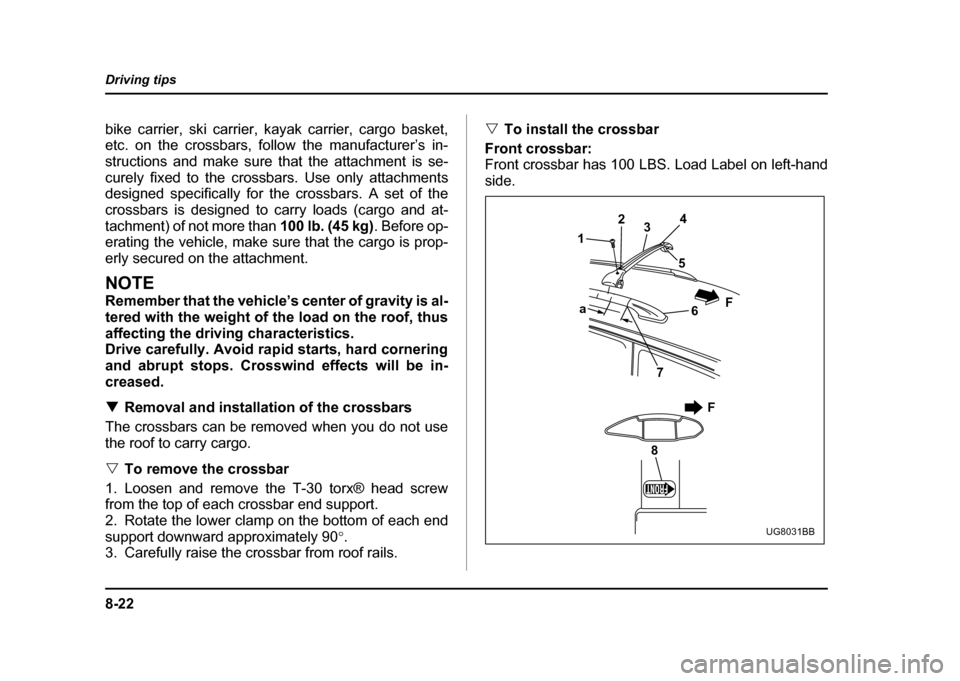
The crossbars can be removed when you do not use the roof to carry cargo. " To remove the crossbar
1. Loosen and remove the T-30 torx® head screw
from the top of each crossbar end support.
2. Rotate the lower clamp on the bottom of each end
support downward approximately 90 °.
3. Carefully raise the crossbar from roof rails. "
To install the crossbar
Front crossbar:
Front crossbar has 100 LBS. Load Label on left-hand
side.
1 2
3 4
5
6
7
a
8
F
F
UG8031BB
Page 336 of 491
8-25
Driving tips
– CONTINUED –
Trailer hitch (if equipped)
The trailer hitch is designed to tow a Class 1 rated
load. A maximum of 2,000 lbs. (906 kg) gross trailer
weight and a maximum of 200 lbs. (90 kg) gross
tongue weight are permissible for the trailer hitch.
When you tow a trailer, follow the instructions in the
section “Trailer towing” in this chapter.
" Never exceed the maximum weight specified
for the trailer hitch. Exceeding the maximum
weight could cause an accident resulting in se-
rious personal injuries. Permissible trailer
weight changes depending on the situation. Re-
fer to the section “Trailer towing” in this chap-
ter for possible recommendations and limita- tions. " Trailer brakes are required when the towing
load exceeds 1,000 lbs. (453 kg). Be sure your
trailer has safety chains and that each chain
will hold the trailer’s maximum gross weight.
Towing trailers without safety chains could cre-
ate a traffic safety hazard if the trailer separates
from the hitch due to coupling damage or hitch
ball damage. "
Be sure to check the hitch pin and safety pin
for positive locking placement before towing a
trailer. If the ball mount comes off the hitch re-
ceiver, the trailer could get loose and create a
traffic safety hazard. " Use only the ball mount supplied with this
hitch. Use the hitch only as a weight carrying
hitch. Do not use with any type of weight dis-
tributing hitch.
! Connecting a trailer
1. Remove the receiver cover from the hitch receiver
tube. Then insert the ball mount into the hitch receiver
tube.
Page 338 of 491
8-27
Driving tips
– CONTINUED –
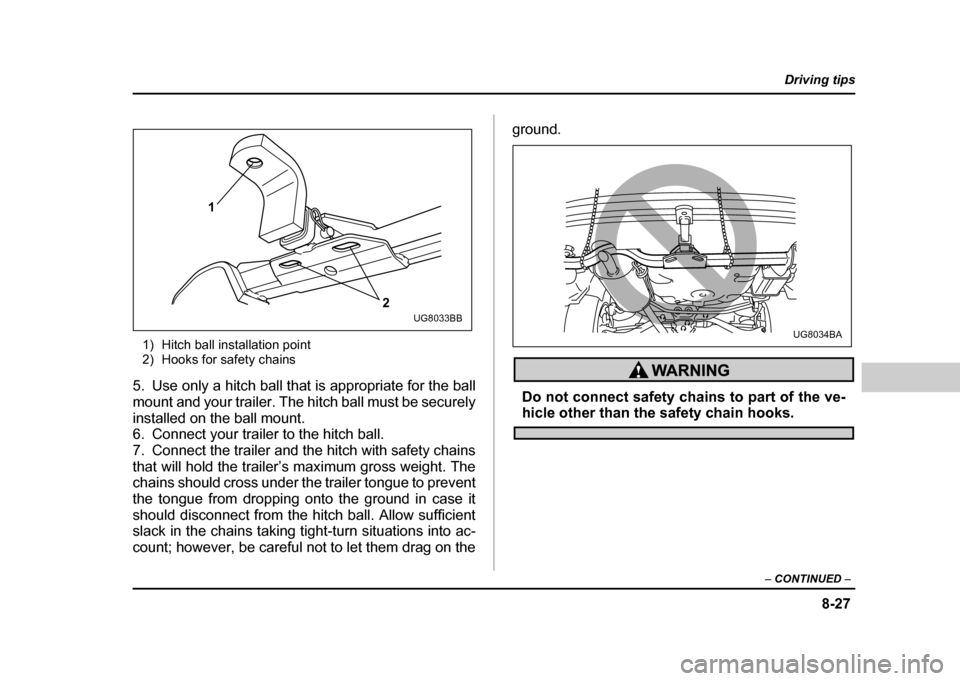
1) Hitch ball installation point
2) Hooks for safety chains
5. Use only a hitch ball that is appropriate for the ball
mount and your trailer. The hitch ball must be securely
installed on the ball mount.
6. Connect your trailer to the hitch ball.
7. Connect the trailer and the hitch with safety chains
that will hold the trailer’s maximum gross weight. The
chains should cross under the trailer tongue to prevent
the tongue from dropping onto the ground in case it
should disconnect from the hitch ball. Allow sufficient
slack in the chains taking tight-turn situations into ac-
count; however, be careful not to let them drag on the ground.
Do not connect safety chains to part of the ve-hicle other than the safety chain hooks.
1
2
UG8033BBUG8034BA
Page 340 of 491
8-29
Driving tips
– CONTINUED –
Trailer towing
Your car is designed and intended to be used primarily
as a passenger-carrying vehicle. Towing a trailer puts
additional loads on your car’s engine, drivetrain,
brakes, tires and suspension and has an adverse ef-
fect on fuel economy.
If you do decide to tow a trailer, your safety and satis-
faction depend upon proper use of correct equipment
and cautious operation of your vehicle. Seek the ad-
vice of your SUBARU dealer to assist you in purchas-
ing a hitch and other necessary towing equipment ap-
propriate for your vehicle. In addition, be sure to follow
the instructions on correct installation and use provid-
ed by the trailer and other towing equipment manufac-
turers.
SUBARU assumes no responsibility for injuries or ve-
hicle damage that result from trailer towing equipment,
or from any errors or omissions in the instructions ac-
companying such equipment or for your failure to fol-
low the proper instructions. !Warranties and maintenance
SUBARU warranties do not apply to vehicle damage
or malfunction caused by trailer towing. If you use your
vehicle to tow a trailer, more frequent maintenance will
be required due to the additional load. (Refer to “Main- tenance schedule under severe driving conditions” in
the “Warranty and Maintenance Booklet”.)
Under no circumstances should a trailer be towed with
a new vehicle or a vehicle with any new powertrain
component (engine, transmission, differential, wheel
bearings, etc.) for the first 1,000 miles (1,600 km) of
driving. !
Maximum load limits
Never exceed the maximum load limits ex-
plained below. Exceeding the maximum load
limits could cause personal injury and/or vehi-
cle damage.
"Adequate size trailer brakes are required
when the trailer and its cargo exceed 1,000 lbs
(453 kg) total weight." Before towing a trailer, check the trailer total
weight, GVW, GAWs and tongue load. Make
sure the load and its distribution in your vehicle
Page 341 of 491
8-30
Driving tips
and trailer are acceptable.
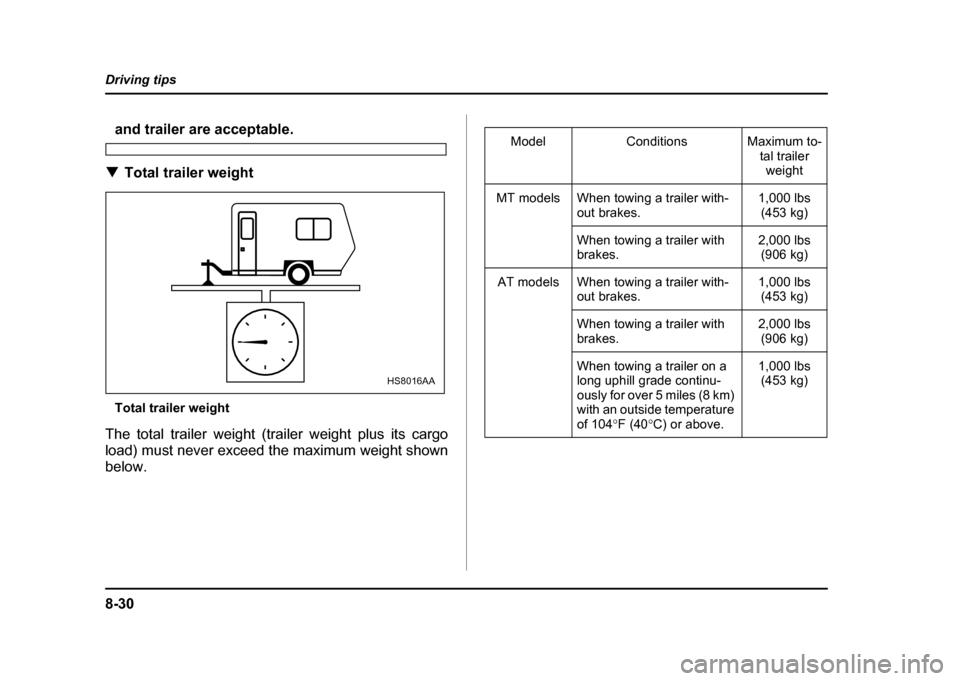
! Total trailer weight
Total trailer weight
The total trailer weight (trailer weight plus its cargo
load) must never exceed the maximum weight shown
below.
HS8016AA
Model Conditions Maximum to- tal trailer weight
MT models When towing a trailer with- out brakes. 1,000 lbs
(453 kg)
When towing a trailer with
brakes. 2,000 lbs
(906 kg)
AT models When towing a trailer with- out brakes. 1,000 lbs
(453 kg)
When towing a trailer with
brakes. 2,000 lbs
(906 kg)
When towing a trailer on a
long uphill grade continu-
ously for over 5 miles (8 km)
with an outside temperature
of 104 °F (40 °C) or above. 1,000 lbs
(453 kg)
Page 342 of 491
8-31
Driving tips
– CONTINUED –
!Gross Vehicle Weight (GVW) and Gross Vehicle
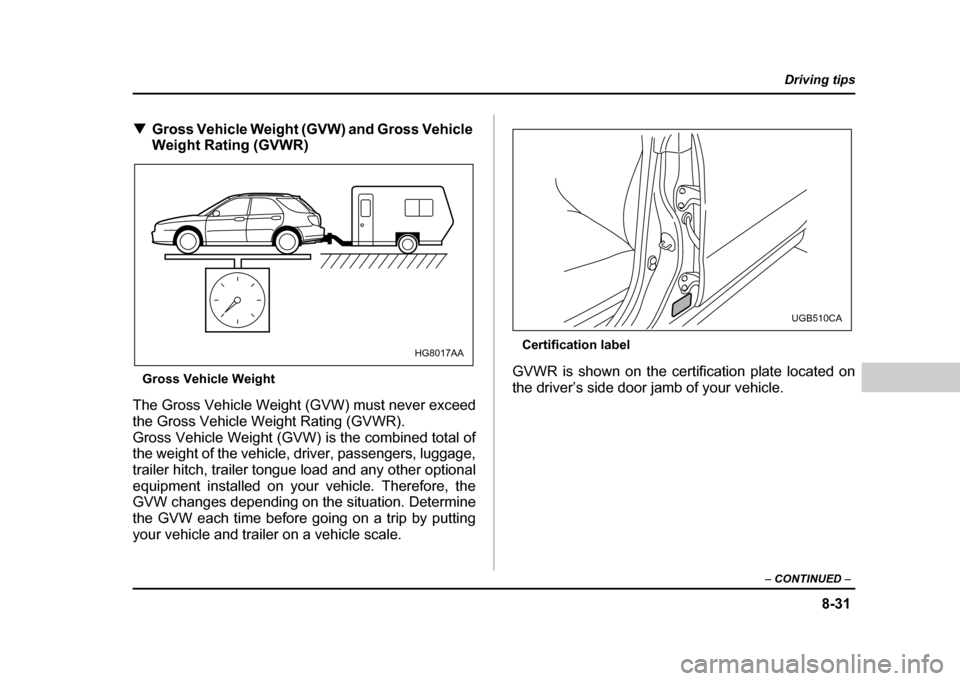
Weight Rating (GVWR)
Gross Vehicle Weight
The Gross Vehicle Weight (GVW) must never exceed
the Gross Vehicle Weight Rating (GVWR).
Gross Vehicle Weight (GVW) is the combined total of
the weight of the vehicle, driver, passengers, luggage,
trailer hitch, trailer tongue load and any other optional
equipment installed on your vehicle. Therefore, the
GVW changes depending on the situation. Determine
the GVW each time before going on a trip by putting
your vehicle and trailer on a vehicle scale. Certification label
GVWR is shown on the certification plate located on
the driver’s side door jamb of your vehicle.
HG8017AA
UGB510CA
Page 343 of 491
8-32
Driving tips
!
Gross Axle Weight (GAW) and Gross Axle
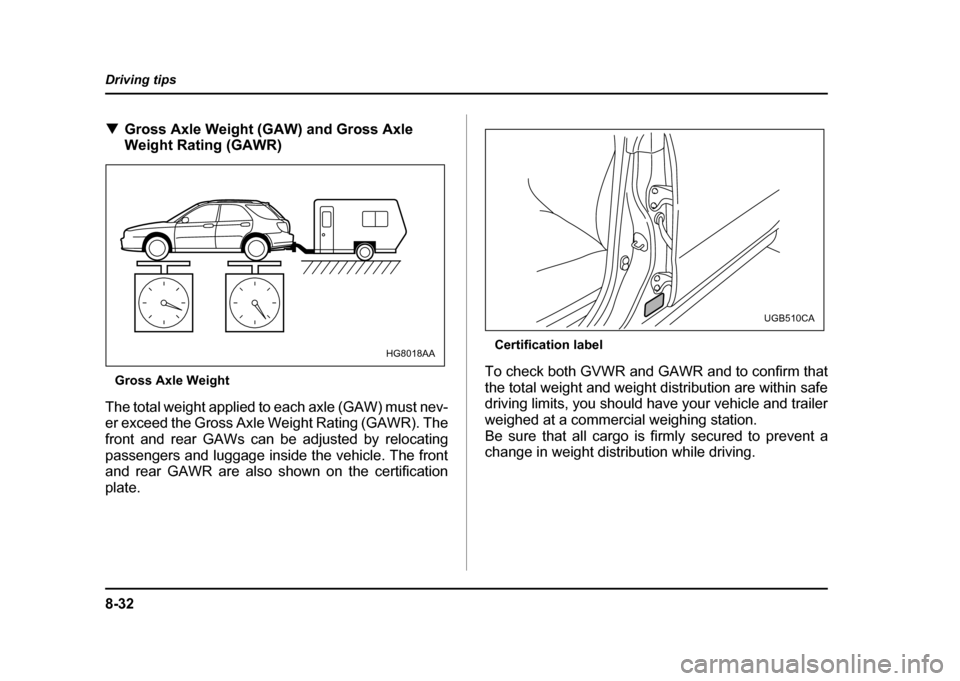
Weight Rating (GAWR)
Gross Axle Weight
The total weight applied to each axle (GAW) must nev-
er exceed the Gross Axle Weight Rating (GAWR). The
front and rear GAWs can be adjusted by relocating
passengers and luggage inside the vehicle. The front
and rear GAWR are also shown on the certification
plate. Certification label
To check both GVWR and GAWR and to confirm that
the total weight and weight distribution are within safe
driving limits, you should have your vehicle and trailer
weighed at a commercial weighing station.
Be sure that all cargo is firmly secured to prevent a
change in weight distribution while driving.
HG8018AA
UGB510CA
Page 344 of 491
8-33
Driving tips
– CONTINUED –
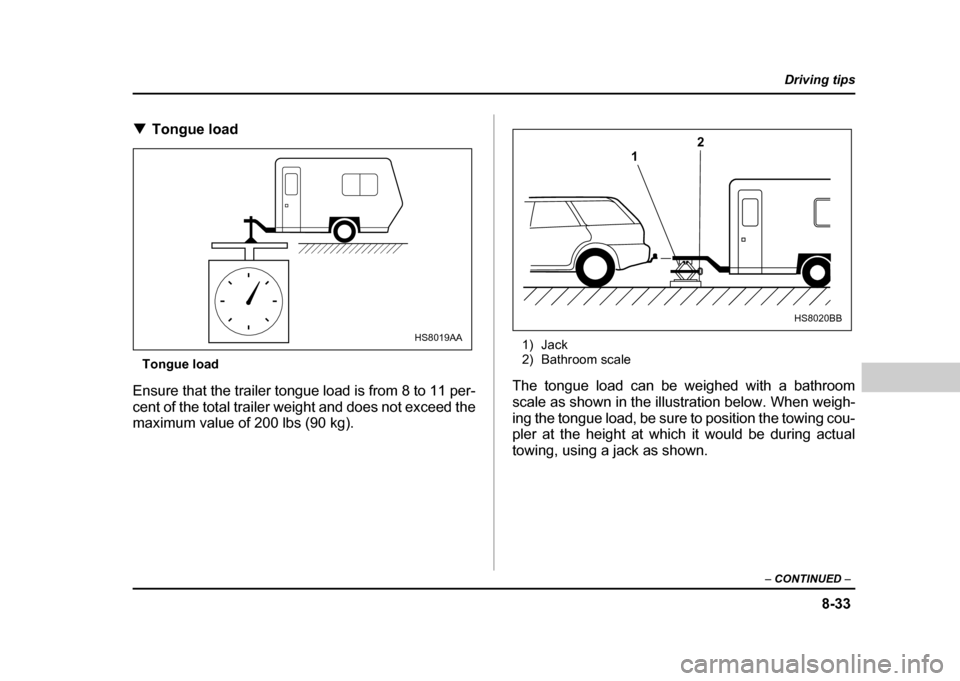
!Tongue load
Tongue load
Ensure that the trailer tongue load is from 8 to 11 per-
cent of the total trailer weight and does not exceed the
maximum value of 200 lbs (90 kg). 1) Jack
2) Bathroom scale
The tongue load can be weighed with a bathroom
scale as shown in the illustration below. When weigh-
ing the tongue load, be sure to position the towing cou-
pler at the height at which it would be during actual
towing, using a jack as shown.
HS8019AA
1 2
HS8020BB
Page 345 of 491
8-34
Driving tips
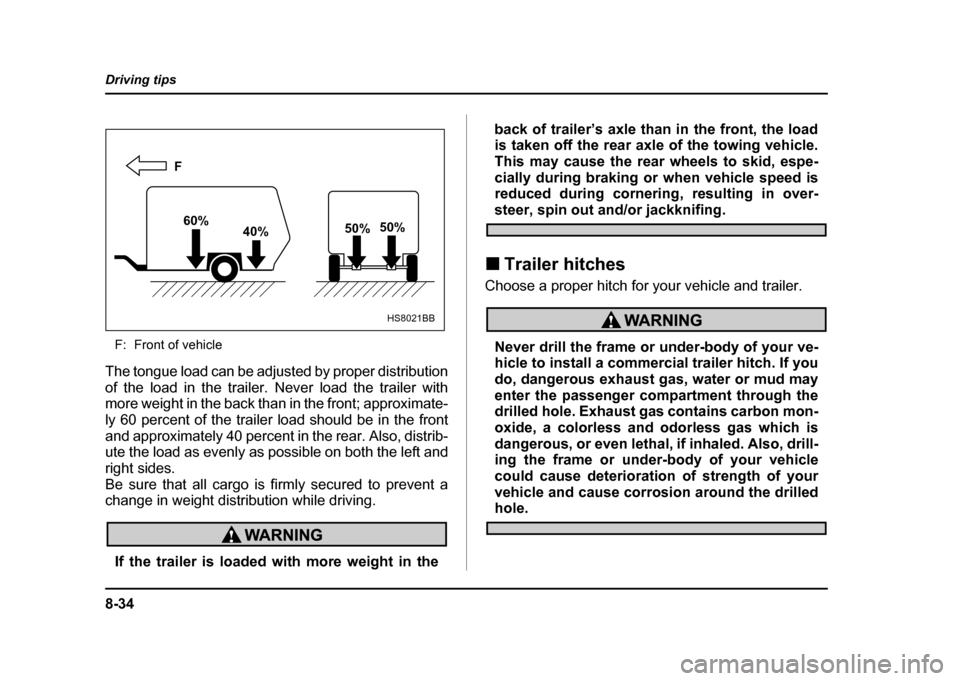
F: Front of vehicle
The tongue load can be adjusted by proper distribution
of the load in the trailer. Never load the trailer with
more weight in the back than in the front; approximate-
ly 60 percent of the trailer load should be in the front
and approximately 40 percent in the rear. Also, distrib-
ute the load as evenly as possible on both the left and
right sides.
Be sure that all cargo is firmly secured to prevent a
change in weight distribution while driving.
If the trailer is loaded with more weight in the back of trailer’s axle than in the front, the load
is taken off the rear axle of the towing vehicle.
This may cause the rear wheels to skid, espe-
cially during braking or when vehicle speed is
reduced during cornering, resulting in over-
steer, spin out and/or jackknifing.
! Trailer hitches
Choose a proper hitch for your vehicle and trailer.
Never drill the frame or under-body of your ve-
hicle to install a commercial trailer hitch. If you
do, dangerous exhaust gas, water or mud may
enter the passenger compartment through the
drilled hole. Exhaust gas contains carbon mon-
oxide, a colorless and odorless gas which is
dangerous, or even lethal, if inhaled. Also, drill-
ing the frame or under-body of your vehicle
could cause deterioration of strength of your
vehicle and cause corrosion around the drilled
hole.
F
60% 40% 50%
50%
HS8021BB