warning lights SUBARU IMPREZA 2006 2.G User Guide
[x] Cancel search | Manufacturer: SUBARU, Model Year: 2006, Model line: IMPREZA, Model: SUBARU IMPREZA 2006 2.GPages: 365, PDF Size: 7.09 MB
Page 204 of 365
Starting and operating 7-7
CONTINUED
Starting the engine
Manual transmission vehicle
1. Apply the parking brake.
2. Turn off unnecessary lights and acces-
sories.
3. Press the clutch pedal to the floor and
shift the shift lever into neutral. Hold the
clutch pedal to the floor while starting the
engine.
The starter motor will only operate when
the clutch pedal is pressed fully to the
floor.
4. Turn the ignition switch to the ON po-
sition and check the operation of the warn-
ing and indicator lights. Refer to the Warning and indicator lights section
(chapter 3).
5. Turn the ignition switch to the START
position without depressing the accelera-
tor pedal. Release the key immediately af-
ter the engine has started. If the engine does not start, try the follow-
ing.
1) Turn the ignition switch to the OFF
position and wait for at least 10 sec-
onds. After checking that the parking
brake is firmly set, turn the ignition
switch to the START position while de-
pressing the accelerator pedal slightly
(approximately a quarter of the full
stroke). Release the accelerator pedal
as soon as the engine starts.
2) If this fails to start the engine, turn the
ignition switch back to the OFF posi-
tion and wait for at least 10 seconds.
Then fully depress the accelerator ped-
al and turn the ignition switch to the START position. If the engine starts,
quickly release the accelerator pedal.
3) If this fails to start the engine, turn the
ignition switch again to the OFF posi-
tion. After waiting for 10 seconds or
longer, turn the ignition switch to the START position without depressing
the accelerator pedal.
4) If the engine still refuses to start, con-
tact your nearest SUBARU dealer for
assistance.
6. Confirm that all warning and indicator
lights have gone off after the engine has
started. The fuel injection system auto-
matically lowers the idle speed as the en-
gine warms up.
NOTE
The engine may be difficult to start
when the battery has been disconnect-
ed and reconnected (for maintenance
or other purposes). This difficulty is
caused by the electronically controlled
throttle s self-diagnosis function. To
overcome it, keep the ignition switch in
the ON position for approximately 10
seconds before starting the engine.
Automatic transmission vehi-
cle
1. Apply the parking brake.
2. Turn off unnecessary lights and acces-
sories.
3. Shift the selector lever to the P or N
position (preferably P position).
The starter motor will only operate when
the select lever is at the P or N position.
4. Turn the ignition switch to the ON po-
sition and check the operation of the warn-
ing and indicator lights. Refer to the Warning and indicator lights section
(chapter 3).
5. Turn the ignition switch to the START
position without depressing the accelera-
tor pedal. Release the key immediately af-
ter the engine has started.
If the engine does not start, try the follow-
Do not operate the starter motor
continuously for more than ten sec-
onds. If the engine fails to start after
operating the starter for five to ten
seconds, wait for ten seconds or
more before trying again.
Page 205 of 365
7-8 Starting and operating
ing.
1) Turn the ignition switch to the OFF
position and wait for at least 10 sec-
onds. After checking that the parking
brake is firmly set, turn the ignition
switch to the START position while de-
pressing the accelerator pedal slightly
(approximately a quarter of the full
stroke). Release the accelerator pedal
as soon as the engine starts.
2) If this fails to start the engine, turn the
ignition switch back to the OFF posi-
tion and wait for at least 10 seconds.
Then fully depress the accelerator ped-
al and turn the ignition switch to the START position. If the engine starts,
quickly release the accelerator pedal.
3) If this fails to start the engine, turn the
ignition switch again to the OFF posi-
tion. After waiting for 10 seconds or
longer, turn the ignition switch to the START position without depressing
the accelerator pedal.
4) If the engine still refuses to start, con-
tact your nearest SUBARU dealer for
assistance.
6. Confirm that all warning and indicator
lights have gone out after the engine has
started. The fuel injection system auto-
matically lowers the idle speed as the en-
gine warms up.
While the engine is warming up, make sure that the selector lever is at the
P or
N position and that the parking brake is
applied.
NOTE
The engine may be difficult to start
when the battery has been disconnect-
ed and reconnected (for maintenance
or other purposes). This difficulty is
caused by the electronically controlled
throttle s self-diagnosis function. To
overcome it, keep the ignition switch in
the ON position for approximately 10
seconds before starting the engine.
Stopping the engine
The ignition switch should be turned off
only when the vehicle is stopped and the
engine is idling.
If you restart the engine while the
vehicle is moving, shift the selector
lever into the N position. Do not
attempt to place the selector lever of
a moving vehicle into the P posi-
tion.
Do not stop the engine when the ve-
hicle is moving. This will cause loss
of power to the power steering and
the brake booster, making steering
and braking more difficult. It could
also result in accidental activation
of the LOCK position on the igni-
tion switch, causing the steering
wheel to lock.
Page 221 of 365
7-24 Starting and operating
Electronic Brake Force Dis-
tribution (EBD) system
The EBD system maximizes the effective-
ness of the brakes by allowing the rear
brakes to supply a greater proportion of
the braking force. It functions by adjusting
the distribution of braking force to the rear
wheels in accordance with the vehicle s
loading condition and speed.
The EBD system is an integral part of the
ABS system and uses some of the ABS
system s components to perform its func-
tion of optimizing the distribution of brak-
ing force. If any of the ABS components
used by the EBD function fails, the EBD
system also stops working.
When the EBD system is operating, you
may hear a chattering noise or feel a slight
vibration in the brake pedal. This is normal
and does not indicate a malfunction.
Steps to take if EBD system
fails
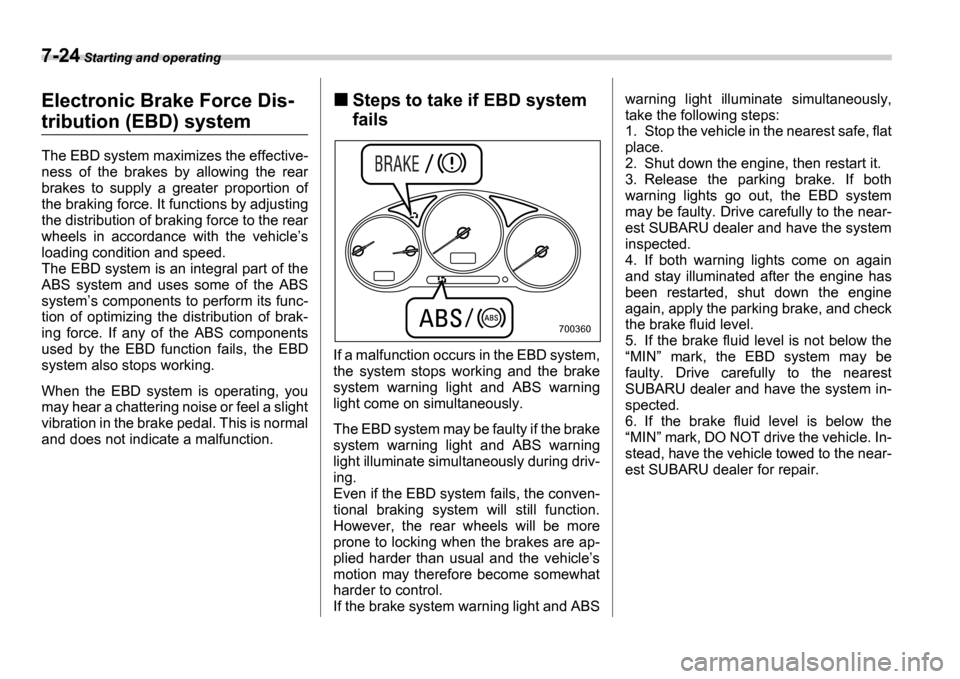
If a malfunction occurs in the EBD system,
the system stops working and the brake
system warning light and ABS warning
light come on simultaneously.
The EBD system may be faulty if the brake
system warning light and ABS warning
light illuminate simultaneously during driv-
ing.
Even if the EBD system fails, the conven-
tional braking system will still function.
However, the rear wheels will be more
prone to locking when the brakes are ap-
plied harder than usual and the vehicle s
motion may therefore become somewhat
harder to control.
If the brake system warning light and ABS warning light illuminate simultaneously,
take the following steps:
1. Stop the vehicle in the nearest safe, flat
place.
2. Shut down the engine, then restart it.
3. Release the parking brake. If both
warning lights go out, the EBD system
may be faulty. Drive carefully to the near-
est SUBARU dealer and have the system
inspected.
4. If both warning lights come on again
and stay illuminated after the engine has
been restarted, shut down the engine
again, apply the parking brake, and check
the brake fluid level.
5. If the brake fluid level is not below the
MIN mark, the EBD system may be
faulty. Drive carefully to the nearest
SUBARU dealer and have the system in-
spected.
6. If the brake fluid level is below the MIN mark, DO NOT drive the vehicle. In-
stead, have the vehicle towed to the near-
est SUBARU dealer for repair.
700360
Page 222 of 365
Starting and operating 7-25
CONTINUED
Parking your vehicle
Parking brake
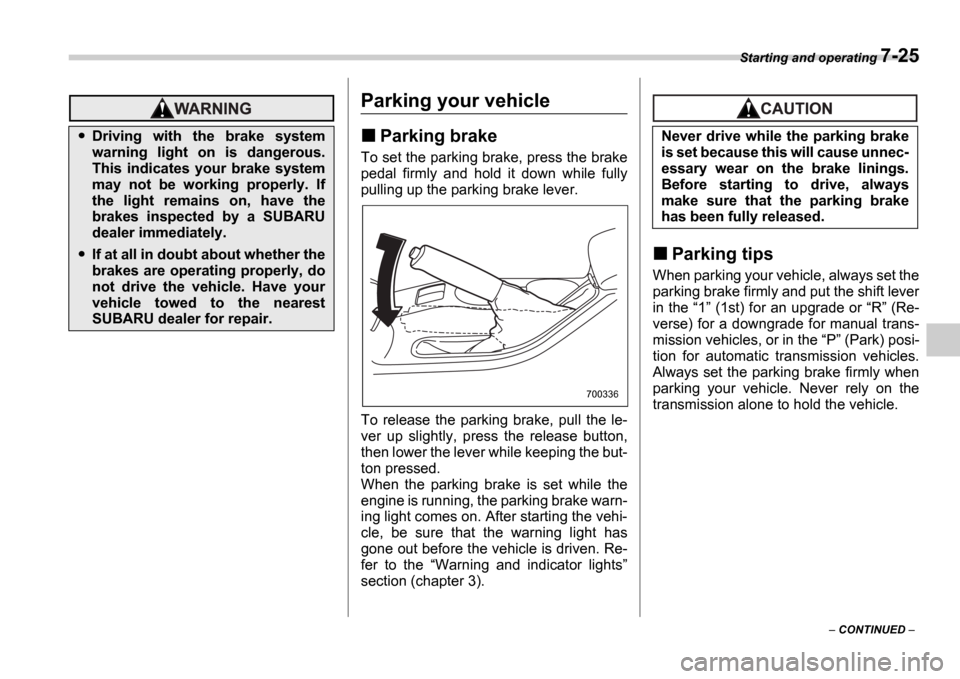
To set the parking brake, press the brake
pedal firmly and hold it down while fully
pulling up the parking brake lever.
To release the parking brake, pull the le-
ver up slightly, press the release button,
then lower the lever while keeping the but-
ton pressed.
When the parking brake is set while the
engine is running, the parking brake warn-
ing light comes on. After starting the vehi-
cle, be sure that the warning light has
gone out before the vehicle is driven. Re-
fer to the Warning and indicator lights
section (chapter 3).
Parking tips
When parking your vehicle, always set the
parking brake firmly and put the shift lever
in the 1 (1st) for an upgrade or R (Re-
verse) for a downgrade for manual trans-
mission vehicles, or in the P (Park) posi-
tion for automatic transmission vehicles.
Always set the parking brake firmly when
parking your vehicle. Never rely on the
transmission alone to hold the vehicle.
Driving with the brake system
warning light on is dangerous.
This indicates your brake system
may not be working properly. If
the light remains on, have the
brakes inspected by a SUBARU
dealer immediately.
If at all in doubt about whether the
brakes are operating properly, do
not drive the vehicle. Have your
vehicle towed to the nearest
SUBARU dealer for repair.
700336
Never drive while the parking brake
is set because this will cause unnec-
essary wear on the brake linings.
Before starting to drive, always
make sure that the parking brake
has been fully released.
Page 253 of 365
8-26 Driving tips
trailer.
Check that the vehicle sits horizontally
with the trailer attached. If the vehicle is
tipped sharply up at the front and down at
the rear, check the total trailer weight,
GVW, GAWs and tongue load again, then
confirm that the load and its distribution
are acceptable.
Check that the tire pressures are cor-
rect.
Check that the vehicle and trailer are
connected properly. Confirm that the trailer tongue is connected prop-
erly to the hitch ball. the trailer lights connector is connect-
ed properly and trailer s brake lights illu-
minate when the vehicle s brake pedal
is pressed, and that the trailer s turn sig-
nal lights flash when the vehicle s turn
signal lever is operated. the safety chains are connected prop-
erly. all cargo in the trailer is secured safe-
ty in position. the side mirrors provide a good rear-
ward field of view without a significant
blind spot.
Sufficient time should be taken to learn
the feel of the vehicle/trailer combination
before starting out on a trip. In an area free
of traffic, practice turning, stopping and
backing up.
Driving with a trailer
You should allow for considerably more
stopping distance when towing a trailer.
Avoid sudden braking because it may re-
sult in skidding or jackknifing and loss of
control.
Avoid abrupt starts and sudden acceler-
ations. If your vehicle has a manual trans-
mission, always start out in first gear and
release the clutch at moderate engine rev-
olution.
Avoid uneven steering, sharp turns and
rapid lane changes.
Slow down before turning. Make a long-
er than normal turning radius because the
trailer wheels will be closer than the vehi-
cle wheels to the inside of the turn. In a
tight turn, the trailer could hit your vehicle.
Crosswinds will adversely affect the
handling of your vehicle and trailer, caus-
ing sway. Crosswinds can be due to
weather conditions or the passing of large
tracks or buses. If swaying occurs, firmly
grip the steering wheel and slow down im-
mediately but gradually.
When passing other vehicles, consider-
able distance is required because of the
added weight and length caused by at-
taching the trailer to your vehicle.
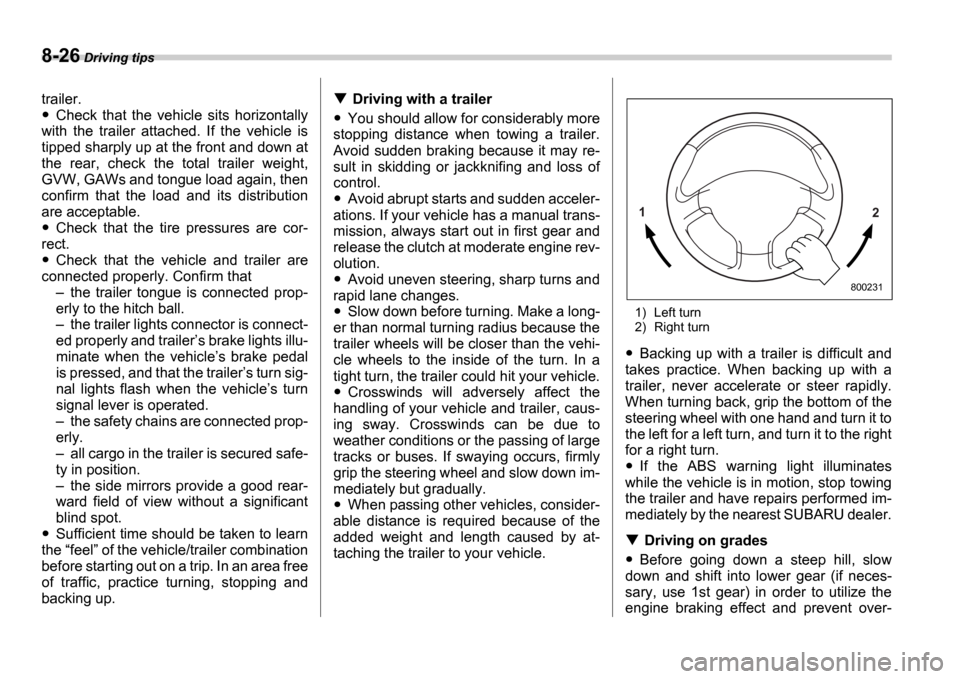
1) Left turn
2) Right turn
Backing up with a trailer is difficult and
takes practice. When backing up with a
trailer, never accelerate or steer rapidly.
When turning back, grip the bottom of the
steering wheel with one hand and turn it to
the left for a left turn, and turn it to the right
for a right turn.
If the ABS warning light illuminates
while the vehicle is in motion, stop towing
the trailer and have repairs performed im-
mediately by the nearest SUBARU dealer.
Driving on grades
Before going down a steep hill, slow
down and shift into lower gear (if neces-
sary, use 1st gear) in order to utilize the
engine braking effect and prevent over-
1 2
800231
Page 254 of 365

Driving tips 8-27
heating of your vehicle s brakes. Do not
make sudden downshifts.
When driving uphill in hot weather, the
air conditioner may turn off automatically
to protect the engine from overheating.
When driving uphill in hot weather, pay
attention to the water temperature gauge
pointer (for all vehicles) and AT OIL TEMP
warning light (for AT vehicles) since the
engine and transmission are relatively
prone to overheating under these condi-
tions. If the water temperature gauge
pointer approaches the OVERHEAT zone
or the AT OIL TEMP warning light illumi-
nates, immediately switch off the air con-
ditioner and stop the vehicle at the nearest
safe place. Refer to the Engine overheat-
ing section in chapter 9, and Warning
and indicator lights section in chapter 3.
If your vehicle has an automatic trans-
mission, avoid using the accelerator pedal
to stay stationary on an uphill slope in-
stead of using the parking brake or foot
brake. That may cause the transmission
fluid to overheat.
If your vehicle has an automatic trans-
mission, place the selector lever as fol-
lows:
Uphill slopes: D position
Downhill slopes: A low-speed gear posi-
tion to use engine braking
Parking on a grade
Always block the wheels under both vehi-
cle and trailer when parking. Apply the
parking brake firmly. You should not park
on a hill or slope. But if parking on a hill or
slope cannot be avoided, you should take
the following steps:
1. Apply the brakes and hold the pedal
down.
2. Have someone place wheel blocks un-
der both the vehicle and trailer wheels.
3. When the wheel blocks are in place, re-
lease the regular brakes slowly until the
blocks absorb the load.
4. Apply the regular brakes and then ap-
ply the parking brake; slowly release the
regular brakes.
5. Shift into 1st or reverse gear (manual
transmission) or P (automatic transmis-
sion) and shut off the engine.
Page 339 of 365
12-8 Specifications
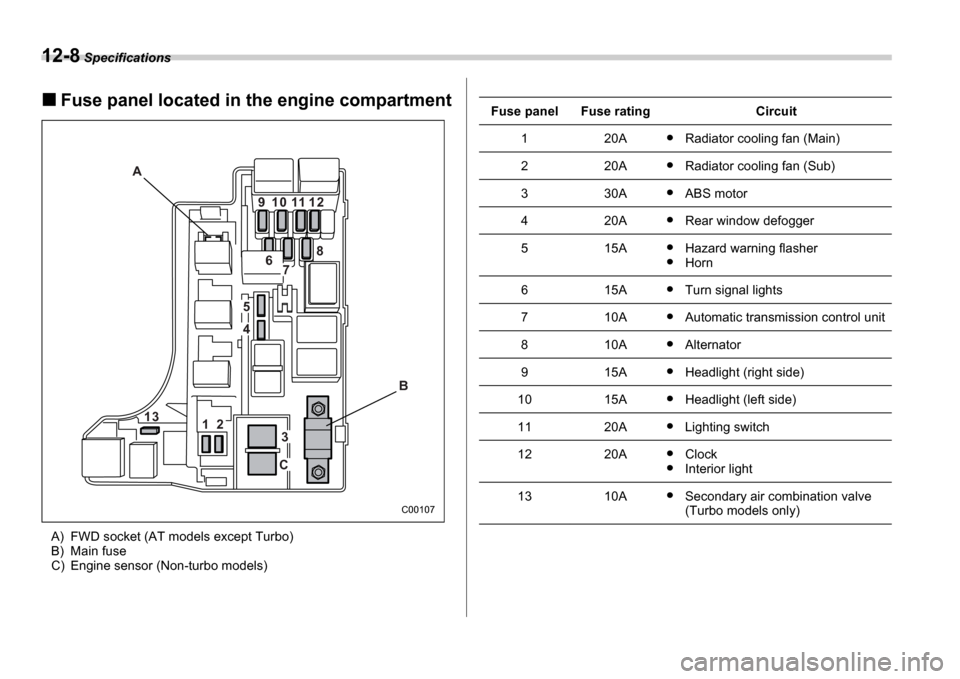
Fuse panel located in the engine compartment
A) FWD socket (AT models except Turbo)
B) Main fuse
C) Engine sensor (Non-turbo models)
1 3
A
B
9
6
5
7
C
312
4 8
1 0 11 1 2
C00107
Fuse panelFuse ratingCircuit
120ARadiator cooling fan (Main)
220ARadiator cooling fan (Sub)
330AABS motor
420ARear window defogger
515AHazard warning flasher
Horn
615ATurn signal lights
710AAutomatic transmission control unit
810AAlternator
915AHeadlight (right side)
1015AHeadlight (left side)
1120ALighting switch
1220AClock
Interior light
1310ASecondary air combination valve
(Turbo models only)
Page 358 of 365

Index 14-3
Oil and oil filter ................................ ............................. 11-8
Charge warning light .............................. .......................... 3-16
CHECK ENGINE warning light/Malfunction indicator lamp .............................................. ................................ 3-16
Checking Brake pedal free play ............................... .................. 11-27
Brake pedal reserve distance ........................... ......... 11-27
Clutch function ..................................... ...................... 11-28
Clutch pedal free play .............................. .................. 11-28
Engine oil level ................................... ......................... 11-8
Fluid level ................................. 11-20 , 11-24, 11-25, 11-26
Gear oil level ..................................... ... 11-18, 11-21, 11-22
Child restraint systems ............................... ...................... 1-23
Installation with A/ELR seatbelt ................... ................ 1-26
Lower and tether anchorages ........................ .............. 1-30
Child safety ........................................ .................................... 5
Locks ................................................ ........................... 2-18
Chime Key ................................................ ................................ 3-5
Seatbelt .......................................... .................... 1-11, 3-14
Cigarette lighter socket ............................ ........................... 6-6
Cleaning Aluminum wheels .................................... .................... 10-3
Interior .......................................... ............................... 10-5
Ventilator grille ................................. ............................ 4-11
Climate control system Automatic ......................................... .............................. 4-7
Manual ............................................ ............................... 4-3
Clock ............................................... ................................. 3-22
Clutch fluid ....................................... ............................... 11-26
Clutch pedal ....................................... ............................ 11-28
Coat hook .......................................... ................................. 6-9Coin tray ..........................................
................................... 6-4
Cooling system ....................................... ........................ 11-12
Corrosion protection ................................ ................ 8-10, 10-4
Cruise control ...................................... .............................. 7-27
Indicator light .................................... ............................ 3-20
Set indicator light ................................ ......................... 3-20
Cup holder ........................................ .................................. 6-5
D
Daytime running light system ......................... ................... 3-23
Differential gear oil Front ............................................. .............................. 11-21
Rear .............................................. ............................. 11-22
Dimensions .......................................... ............................. 12-2
Disarming the system ................................. ...................... 2-15
Disc brake pad wear warning indicators ................ ........... 7-22
Dome light ........................................ ........................ 6-2, 11-50
Door locks ......................................... .................................. 2-4
Door open warning light ........................... ......................... 3-19
Drive belts ........................................ ............................... 11-18
Driver s control center differential ....................... .............. 7-12
Drivers control center differential Auto indicator light ............................... ........................ 3-20
Indicator lights .................................... .......................... 3-21
Driving Car phone/cell phone ............................... ......................... 7
Drinking ........................................... .................................. 6
Drugs .............................................. .................................. 7
Foreign countries ................................... ........................ 8-4
Pets ............................................... .................................... 7
Snowy and icy roads ................................... ................... 8-9
Tips ............................................... .............. 7-10, 7-12, 8-5
Page 359 of 365

14-4 Index
Tired or sleepy .................................... ............................... 7
E
EBD (Electronic brake force distribution) system ........ ..... 7-24
Electrical system ..................................... ......................... 12-3
Electronic Brake Force Distribution (EBD) system ......... .. 7-24
Emergency Locking Retractor (ELR) .................... ............ 1-11
Engine Compartment overview ................................ ................ 11-6
Coolant ........................................... ........................... 11-12
Exhaust gas (Carbon monoxide) ....................... ........ 6, 8-2
Hood .............................................. .............................. 11-4
Oil ............................................... ................................. 11-8
Overheating ........................................ ......................... 9-11
Starting .......................................... ................................ 7-7
Stopping .......................................... .............................. 7-8
Exterior care ....................................... .............................. 10-2
F
Flat tires ......................................... .................................... 9-4
Floor mat ......................................... ................................... 6-9
Fluid level
Automatic transmission ............................... .............. 11-20
Brake .............................................. ........................... 11-25
Clutch ............................................. ........................... 11-26
Power steering ..................................... ...................... 11-24
Folding down the rear seat ......................... ........................ 1-8
Front
Differential gear oil ............................. ........................ 11-21
Fog light ......................................... ............................ 11-48
Fog light button .................................. .......................... 3-26Seatbelt pretensioners ..............................
................... 1-20
Seats .............................................. ................................ 1-2
Turn signal light .................................. ....................... 11-48
Fuel .............................................. ....................................... 7-2
Economy hints ........................................ ....................... 8-2
Filler lid and cap ................................. ............................ 7-4
Gauge ............................................. ...................... 3-8, 3-12
Requirements ...................................... .......................... 7-2
Fuses .............................................. ................................ 11-41
Fuses and circuits ..................................... ........................ 12-6
G
GAWR (Gross Axle Weight Rating) ..................... ............. 8-14
Glove box ........................................... ................................ 6-4
GVWR (Gross Vehicle Weight Rating) ................... .......... 8-14
H
Hazard warning flasher ............................. .......................... 3-6
Head restraint adjustment (Front) ................... .................... 1-4
Head restraint adjustment (Wagon) .................. .................. 1-7
Headlight beam leveler ............................ ......................... 3-25
Headlight flasher .................................. ............................. 3-23
Headlight indicator light .......................... .......................... 3-21
Headlights ......................................... ..................... 3-22, 11-45
Heater operation .................................. ............................... 4-5
High beam indicator light .......................... ........................ 3-20
High mount stop light .............................. ........................ 11-51
Horn .............................................. .................................... 3-35
Hose and connections .................................. .................. 11-12
Page 361 of 365

14-6 Index
Off road driving ................................... ................................ 8-6
Oil filter ........................................ ..................................... 11-8
Oil level Engine ............................................ ............................. 11-8
Front differential (AT vehicles) ..................... .............. 11-21
Manual transmission ................................. ................. 11-18
Rear differential ................................. ........................ 11-22
Oil pressure warning light .......................... ....................... 3-16
Outside mirrors ..................................... ............................ 3-33
Outside temperature indicator ....................... ............ 3-9, 3-13
Overheating engine ................................. ......................... 9-11
P
Parking Brake .............................................. ............................. 7-25
Brake stroke ......................................... ..................... 11-29
Light switch ........................................ .......................... 3-25
Tips ............................................... ............................... 7-25
Periodic inspections .................................. ......................... 8-4
Power Door locking switches ................................. ................... 2-6
Steering .......................................... ............................. 7-21
Steering fluid .................................... ......................... 11-24
Windows ........................................... ........................... 2-18
Preparing to drive ................................. .............................. 7-6
Printed antenna ................................... ............................... 5-2
R
Rear Combination lights ................................. .................... 11-48
Differential gear oil ............................. ........................ 11-22Differential oil temperature warning light ........
.............. 3-17
Gate .............................................. ............................... 2-23
Seats .............................................. ................................ 1-6
Rear seat Folding down (Wagon) .............................. ..................... 1-8
Rear window Defogger button ................................... ........................ 3-29
Wiper and washer switch ............................. ................ 3-28
Recommended Automatic transmission fluid .......................... ............ 11-21
Brake fluid ........................................ .......................... 11-25
Clutch fluid ....................................... .......................... 11-26
Oil grade and viscosity .............................. ..... 11-10, 11-11,
11-19, 11-22, 11-23
Power steering fluid ............................... .................... 11-24
Spark plugs ......................................... ....................... 11-17
Remote keyless entry system .............................. ............... 2-7
Replacement Brake pad and lining ............................... ................... 11-28
Wiper blades ....................................... ....................... 11-37
Replacing Air cleaner element ................................ .................... 11-15
Battery (Remote keyless entry system) ..................... .... 2-9
Lost transmitters (keyless entry system) ................. ..... 2-10
Replacing bulbs ..................................... ......................... 11-44
Cargo area light .................................. ....................... 11-50
Dome light ........................................ .......................... 11-50
Front fog light ................................... .......................... 11-48
Front turn signal light ............................ ..................... 11-48
Headlights ......................................... ......................... 11-45
High mount stop light .............................. ................... 11-51
License plate light ................................. ..................... 11-50