tires SUBARU IMPREZA 2006 2.G Owner's Manual
[x] Cancel search | Manufacturer: SUBARU, Model Year: 2006, Model line: IMPREZA, Model: SUBARU IMPREZA 2006 2.GPages: 365, PDF Size: 7.09 MB
Page 256 of 365

9
In case of emergency
If you park your vehicle in case of an emergency ......................................... .............. 9-2
Temporary spare tire .............................. ............ 9-2
Flat tires ........................................ ...................... 9-4
Changing a flat tire .............................. ................... 9-4
Jump starting ..................................... ................. 9-9
How to jump start ................................. .................. 9-9
Engine overheating ................................ ............ 9-11
If steam is coming from the engine compartment ....................................... .................. 9-11
If no steam is coming from the engine
compartment ....................................... .................. 9-11
Towing ............................................ ..................... 9-11
Towing and tie-down hooks ......................... ......... 9-12
Using a flat-bed truck ............................ ................. 9-13
Towing with all wheels on the ground .............. .... 9-14
Rear gate if the rear gate cannot be
unlocked .......................................... ................ 9-15
Moonroof if the moonroof cannot be
closed ............................................ ................... 9-15
Maintenance tools ................................. ............. 9-16
Jack and jack handle .............................. ................ 9-16
Page 257 of 365
9-2 In case of emergency
In case of emergencyIf you park your vehicle in
case of an emergency
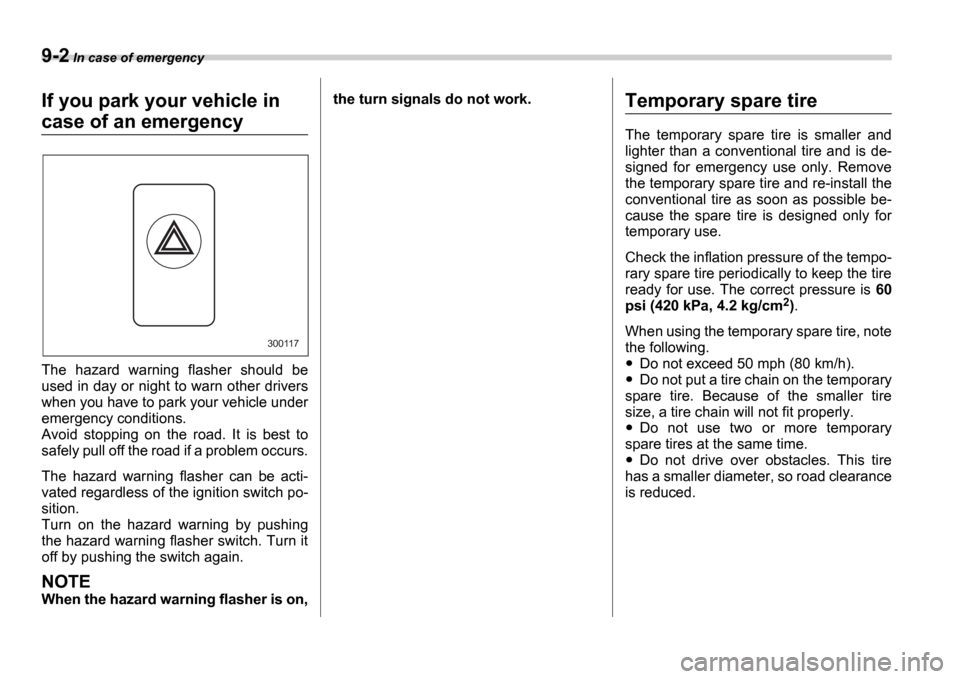
The hazard warning flasher should be
used in day or night to warn other drivers
when you have to park your vehicle under
emergency conditions.
Avoid stopping on the road. It is best to
safely pull off the road if a problem occurs.
The hazard warning flasher can be acti-
vated regardless of the ignition switch po-
sition.
Turn on the hazard warning by pushing
the hazard warning flasher switch. Turn it
off by pushing the switch again.
NOTE
When the hazard warning flasher is on, the turn signals do not work.
Temporary spare tire
The temporary spare tire is smaller and
lighter than a conventional tire and is de-
signed for emergency use only. Remove
the temporary spare tire and re-install the
conventional tire as soon as possible be-
cause the spare tire is designed only for
temporary use.
Check the inflation pressure of the tempo-
rary spare tire periodically to keep the tire
ready for use. The correct pressure is
60
psi (420 kPa, 4.2 kg/cm
2) .
When using the temporary spare tire, note
the following.
Do not exceed 50 mph (80 km/h).
Do not put a tire chain on the temporary
spare tire. Because of the smaller tire
size, a tire chain will not fit properly.
Do not use two or more temporary
spare tires at the same time.
Do not drive over obstacles. This tire
has a smaller diameter, so road clearance
is reduced.
300117
Page 259 of 365
9-4 In case of emergency
Flat tires
If you have a flat tire while driving, never
brake suddenly; keep driving straight
ahead while gradually reducing speed.
Then slowly pull off the road to a safe
place.
Changing a flat tire1. Park on a hard, level surface, whenev-
er possible, then stop the engine.
2. Set the parking brake securely and
shift a manual transmission vehicle in re-
verse or an automatic transmission vehi-
cle in the P (Park) position.
3. Turn on the hazard warning flasher and
have everyone get out of the vehicle.
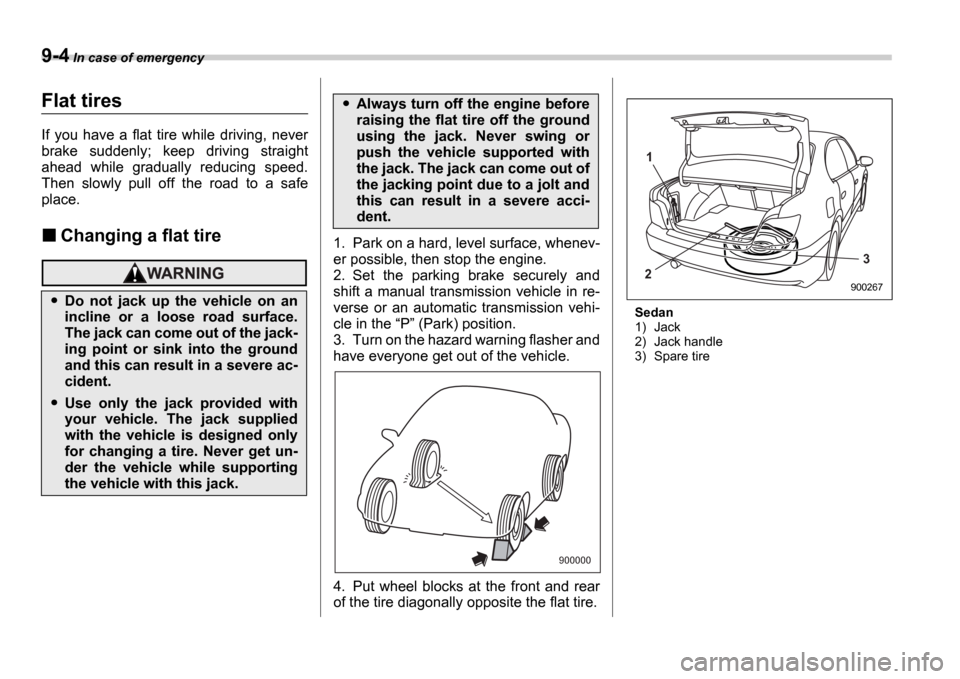
4. Put wheel blocks at the front and rear
of the tire diagonally opposite the flat tire.
Sedan
1) Jack
2) Jack handle
3) Spare tireDo not jack up the vehicle on an
incline or a loose road surface.
The jack can come out of the jack-
ing point or sink into the ground
and this can result in a severe ac-
cident.
Use only the jack provided with
your vehicle. The jack supplied
with the vehicle is designed only
for changing a tire. Never get un-
der the vehicle while supporting
the vehicle with this jack.
Always turn off the engine before
raising the flat tire off the ground
using the jack. Never swing or
push the vehicle supported with
the jack. The jack can come out of
the jacking point due to a jolt and
this can result in a severe acci-
dent.
900000
1
2 3
900267
Page 272 of 365
In case of emergency 9-17
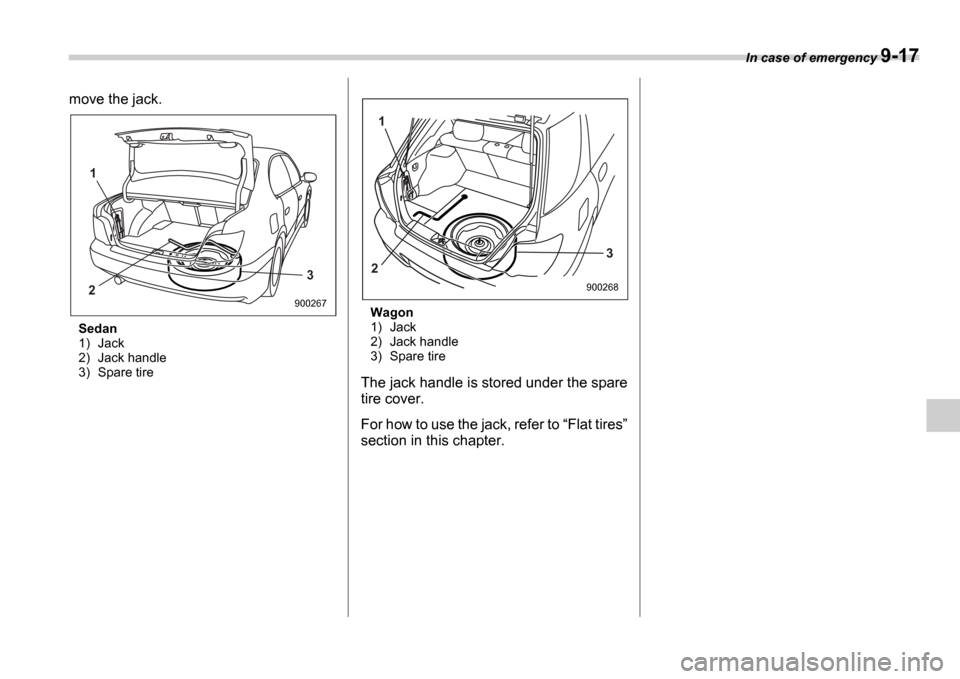
move the jack.
Sedan
1) Jack
2) Jack handle
3) Spare tire Wagon
1) Jack
2) Jack handle
3) Spare tire
The jack handle is stored under the spare
tire cover.
For how to use the jack, refer to
Flat tires
section in this chapter.
1
2 3
900267
3
1
2
900268
Page 281 of 365

Maintenance and service
Tires and wheels ................................................ 11-30
Types of tires .................................... ...................... 11-30
Tire inspection ................................... ..................... 11-30
Tire pressures and wear ........................... ............. 11-30
Wheel balance ..................................... ................... 11-32
Wear indicators ................................... .................... 11-33
Tire rotation ..................................... ........................ 11-33
Tire replacement .................................. ................... 11-33
Wheel replacement ................................. ................ 11-34
Aluminum wheels ................................... ............ 11-35
Intercooler water spray (WRX-STI) ................. .. 11-35
Windshield washer fluid ........................... ......... 11-36
Replacement of wiper blades ....................... ..... 11-37
Windshield wiper blades assembly .................. .... 11-37
Windshield wiper blade rubber ..................... ........ 11-38
Rear window wiper blade assembly .................. ... 11-38
Rear window wiper blade rubber .................... ...... 11-39
Battery ........................................... ...................... 11-40
Fuses ............................................. ...................... 11-41
Main fuse ......................................... .................... 11-43
Installation of accessories ....................... ......... 11-43
Replacing bulbs ................................... ............... 11-44
Headlights (WRX-STI) .............................. ............... 11-45
Headlights (Except WRX-STI) ....................... ......... 11-46
Front turn signal light bulbs ..................... ............. 11-48
Parking light ..................................... ....................... 11-48
Front fog light ................................... ...................... 11-48
Rear combination lights ........................... .............. 11-48
License plate light ............................... ................... 11-50
Dome light, map light and cargo area light ........ .. 11-50Trunk light .......................................
........................ 11-51
High mount stop light ............................. ............... 11-51
Page 309 of 365
11-30 Maintenance and service
Tires and wheels
Types of tires
You should be familiar with type of tires
present on your vehicle.
The factory-fitted 17-inch tires on the
WRX-STI are summer tires. The factory-
fitted tires on other versions are all-sea-
son tires.
All season tires
All season tires are designed to provide
an adequate measure of traction, handling
and braking performance in year-round
driving including snowy and icy road con-
ditions. However all season tires do not of-
fer as much traction performance as win-
ter (snow) tires in heavy or loose snow or
on icy roads.
All season tires are identified by ALL
SEASON and/or M+S (Mud & Snow) on
the tire sidewall.
Summer tires
Summer tires are high-speed capability
tires best suited for highway driving under
dry conditions.
Summer tires are inadequate for driving
on slippery roads such as on snow-cov-
ered or icy roads.
If you drive your vehicle on snow-covered
or icy roads, we strongly recommend the use of winter (snow) tires.
When installing winter tires, be sure to re-
place all four tires.
Winter (snow) tires
Winter tires are best suited for driving on
snow-covered and icy roads. However
winter tires do not perform as well as sum-
mer tires and all season tires on roads oth-
er than snow-covered and icy roads.
Tire inspection
Check on a daily basis that the tires are
free from serious damage, nails, and
stones. At the same time, check the tires
for abnormal wear.
Contact your SUBARU dealer immediate-
ly if you find any problem.
NOTE
When the wheels and tires strike
curbs or are subjected to harsh treat-
ment as when the vehicle is driven on a
rough surface, they can suffer damage
that cannot be seen with the naked eye.
This type of damage does not become
evident until time has passed. Try not
to drive over curbs, potholes or on oth-
er rough surfaces. If doing so is un-
avoidable, keep the vehicle s speed
down to a walking pace or less, and ap-
proach the curbs as squarely as possi- ble. Also, make sure the tires are not
pressed against the curb when you
park the vehicle.
If you feel unusual vibration while
driving or find it difficult to steer the ve-
hicle in a straight line, one of the tires
and/or wheels may be damaged. Drive
slowly to the nearest authorized
SUBARU dealer and have the vehicle
inspected.
Tire pressures and wear
Maintaining the correct tire pressures
helps to maximize the tires service lives
and is essential for good running perfor-
mance. Check and, if necessary, adjust
the pressure of each tire (including the
spare) at least once a month (for example,
during a fuel stop) and before any long
journey.
Page 310 of 365
Maintenance and service 11-31
CONTINUED
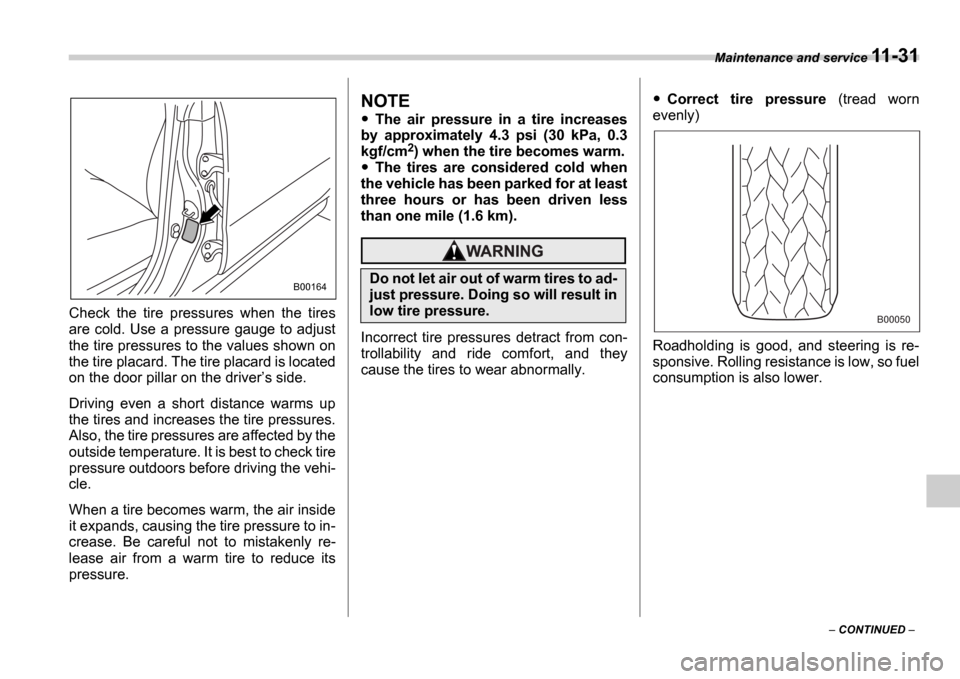
Check the tire pressures when the tires
are cold. Use a pressure gauge to adjust
the tire pressures to the values shown on
the tire placard. The tire placard is located
on the door pillar on the driver
s side.
Driving even a short distance warms up
the tires and increases the tire pressures.
Also, the tire pressures are affected by the
outside temperature. It is best to check tire
pressure outdoors before driving the vehi-
cle.
When a tire becomes warm, the air inside
it expands, causing the tire pressure to in-
crease. Be careful not to mistakenly re-
lease air from a warm tire to reduce its
pressure.
NOTE
The air pressure in a tire increases
by approximately 4.3 psi (30 kPa, 0.3
kgf/cm
2) when the tire becomes warm.
The tires are considered cold when
the vehicle has been parked for at least
three hours or has been driven less
than one mile (1.6 km).
Incorrect tire pressures detract from con-
trollability and ride comfort, and they
cause the tires to wear abnormally.
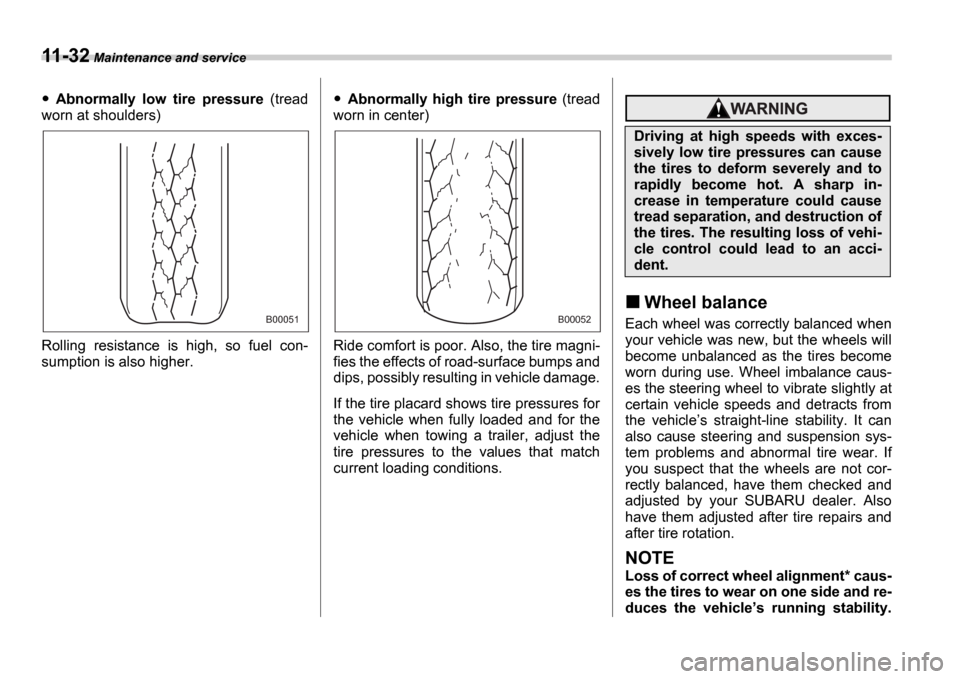
Correct tire pressure (tread worn
evenly)
Roadholding is good, and steering is re-
sponsive. Rolling resistance is low, so fuel
consumption is also lower.
B00164Do not let air out of warm tires to ad-
just pressure. Doing so will result in
low tire pressure.
B00050
Page 311 of 365
11-32 Maintenance and service
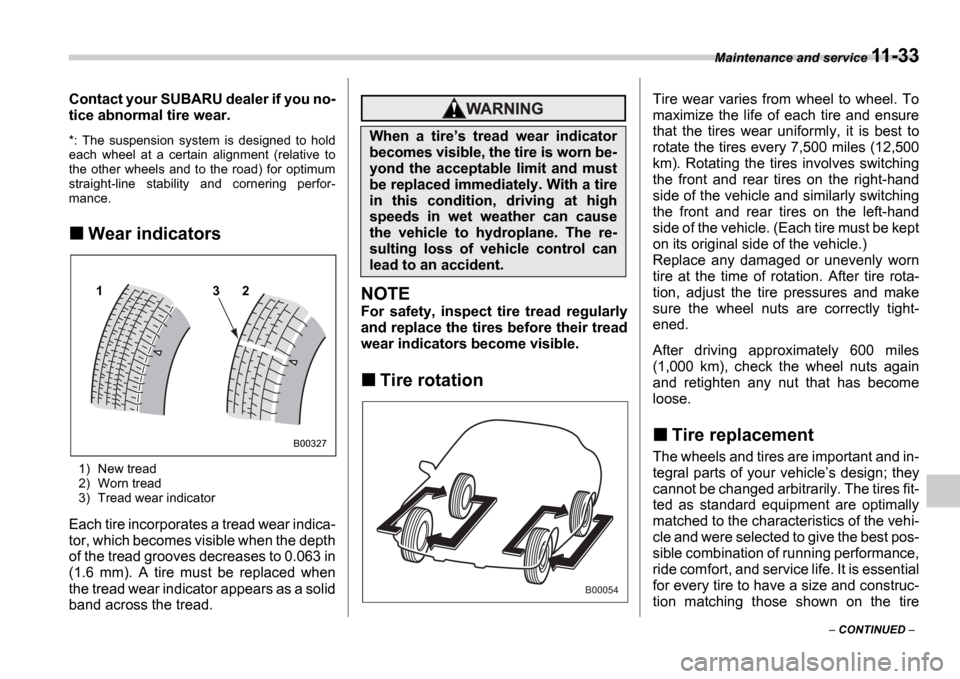
Abnormally low tire pressure (tread
worn at shoulders)
Rolling resistance is high, so fuel con-
sumption is also higher.Abnormally high tire pressure (tread
worn in center)
Ride comfort is poor. Also, the tire magni-
fies the effects of road-surface bumps and
dips, possibly resulting in vehicle damage.
If the tire placard shows tire pressures for
the vehicle when fully loaded and for the
vehicle when towing a trailer, adjust the
tire pressures to the values that match
current loading conditions.
Wheel balance
Each wheel was correctly balanced when
your vehicle was new, but the wheels will
become unbalanced as the tires become
worn during use. Wheel imbalance caus-
es the steering wheel to vibrate slightly at
certain vehicle speeds and detracts from
the vehicle s straight-line stability. It can
also cause steering and suspension sys-
tem problems and abnormal tire wear. If
you suspect that the wheels are not cor-
rectly balanced, have them checked and
adjusted by your SUBARU dealer. Also
have them adjusted after tire repairs and
after tire rotation.
NOTE
Loss of correct wheel alignment* caus-
es the tires to wear on one side and re-
duces the vehicle s running stability.
B00051B00052
Driving at high speeds with exces-
sively low tire pressures can cause
the tires to deform severely and to
rapidly become hot. A sharp in-
crease in temperature could cause
tread separation, and destruction of
the tires. The resulting loss of vehi-
cle control could lead to an acci-
dent.
Page 312 of 365
Maintenance and service 11-33
CONTINUED
Contact your SUBARU dealer if you no-
tice abnormal tire wear.
*: The suspension system is designed to hold
each wheel at a certain alignment (relative to
the other wheels and to the road) for optimum
straight-line stability and cornering perfor-
mance.
Wear indicators
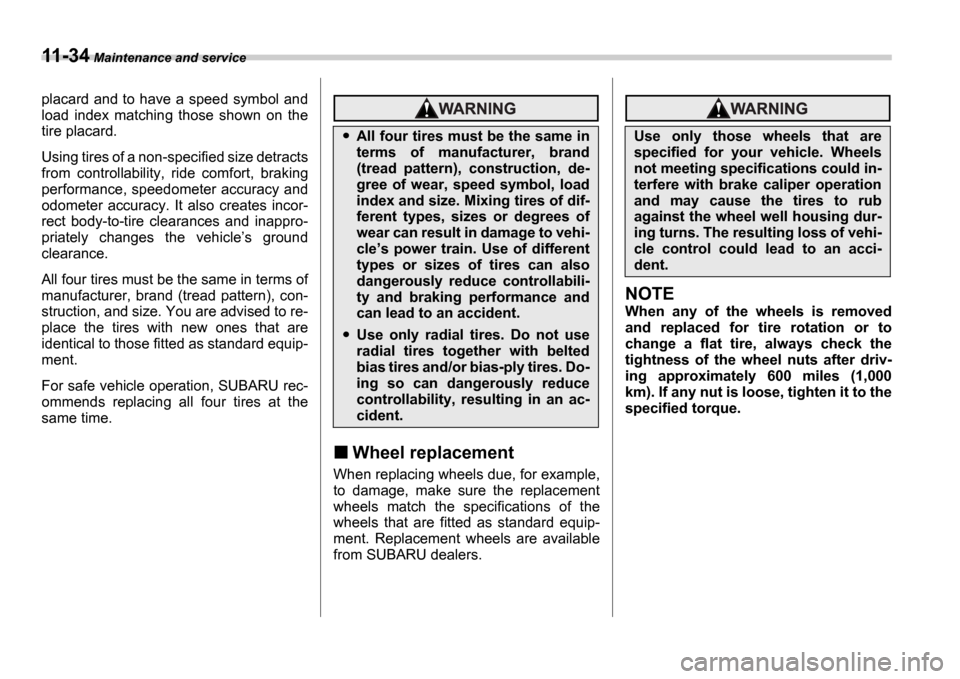
1) New tread
2) Worn tread
3) Tread wear indicator
Each tire incorporates a tread wear indica-
tor, which becomes visible when the depth
of the tread grooves decreases to 0.063 in
(1.6 mm). A tire must be replaced when
the tread wear indicator appears as a solid
band across the tread.
NOTE
For safety, inspect tire tread regularly
and replace the tires before their tread
wear indicators become visible.
Tire rotation
Tire wear varies from wheel to wheel. To
maximize the life of each tire and ensure
that the tires wear uniformly, it is best to
rotate the tires every 7,500 miles (12,500
km). Rotating the tires involves switching
the front and rear tires on the right-hand
side of the vehicle and similarly switching
the front and rear tires on the left-hand
side of the vehicle. (Each tire must be kept
on its original side of the vehicle.)
Replace any damaged or unevenly worn
tire at the time of rotation. After tire rota-
tion, adjust the tire pressures and make
sure the wheel nuts are correctly tight-
ened.
After driving approximately 600 miles
(1,000 km), check the wheel nuts again
and retighten any nut that has become
loose.
Tire replacement
The wheels and tires are important and in-
tegral parts of your vehicle s design; they
cannot be changed arbitrarily. The tires fit-
ted as standard equipment are optimally
matched to the characteristics of the vehi-
cle and were selected to give the best pos-
sible combination of running performance,
ride comfort, and service life. It is essential
for every tire to have a size and construc-
tion matching those shown on the tire
1 2 3
B00327
When a tires tread wear indicator
becomes visible, the tire is worn be-
yond the acceptable limit and must
be replaced immediately. With a tire
in this condition, driving at high
speeds in wet weather can cause
the vehicle to hydroplane. The re-
sulting loss of vehicle control can
lead to an accident.
B00054
Page 313 of 365
11-34 Maintenance and service
placard and to have a speed symbol and
load index matching those shown on the
tire placard.
Using tires of a non-specified size detracts
from controllability, ride comfort, braking
performance, speedometer accuracy and
odometer accuracy. It also creates incor-
rect body-to-tire clearances and inappro-
priately changes the vehicle s ground
clearance.
All four tires must be the same in terms of
manufacturer, brand (tread pattern), con-
struction, and size. You are advised to re-
place the tires with new ones that are
identical to those fitted as standard equip-
ment.
For safe vehicle operation, SUBARU rec-
ommends replacing all four tires at the
same time.
Wheel replacement
When replacing wheels due, for example,
to damage, make sure the replacement
wheels match the specifications of the
wheels that are fitted as standard equip-
ment. Replacement wheels are available
from SUBARU dealers.
NOTE
When any of the wheels is removed
and replaced for tire rotation or to
change a flat tire, always check the
tightness of the wheel nuts after driv-
ing approximately 600 miles (1,000
km). If any nut is loose, tighten it to the
specified torque.
All four tires must be the same in
terms of manufacturer, brand
(tread pattern), construction, de-
gree of wear, speed symbol, load
index and size. Mixing tires of dif-
ferent types, sizes or degrees of
wear can result in damage to vehi-
cle s power train. Use of different
types or sizes of tires can also
dangerously reduce controllabili-
ty and braking performance and
can lead to an accident.
Use only radial tires. Do not use
radial tires together with belted
bias tires and/or bias-ply tires. Do-
ing so can dangerously reduce
controllability, resulting in an ac-
cident.
Use only those wheels that are
specified for your vehicle. Wheels
not meeting specifications could in-
terfere with brake caliper operation
and may cause the tires to rub
against the wheel well housing dur-
ing turns. The resulting loss of vehi-
cle control could lead to an acci-
dent.