ESP SUBARU IMPREZA 2007 3.G Owner's Guide
[x] Cancel search | Manufacturer: SUBARU, Model Year: 2007, Model line: IMPREZA, Model: SUBARU IMPREZA 2007 3.GPages: 364, PDF Size: 11.91 MB
Page 319 of 364
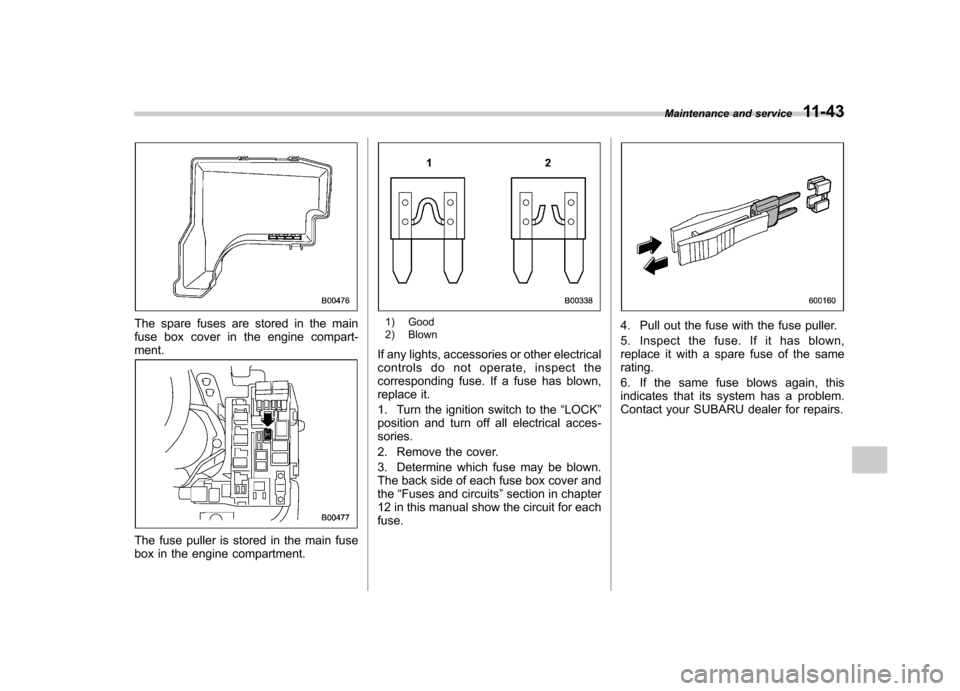
The spare fuses are stored in the main
fuse box cover in the engine compart-ment.
The fuse puller is stored in the main fuse
box in the engine compartment.
1) Good
2) Blown
If any lights, accessories or other electrical
controls do not operate, inspect the
corresponding fuse. If a fuse has blown,
replace it.
1. Turn the ignition switch to the “LOCK ”
position and turn off all electrical acces- sories.
2. Remove the cover.
3. Determine which fuse may be blown.
The back side of each fuse box cover andthe “Fuses and circuits ”section in chapter
12 in this manual show the circuit for eachfuse.4. Pull out the fuse with the fuse puller.
5. Inspect the fuse. If it has blown,
replace it with a spare fuse of the samerating.
6. If the same fuse blows again, this
indicates that its system has a problem.
Contact your SUBARU dealer for repairs. Maintenance and service
11-43
Page 352 of 364
13-12Consumer information and Reporting safety defects
Uniform tire quality grading standards
This information indicates the relative
performance of passenger car tires in
the area of treadwear, traction, and
temperature resistance. This is to aid
the consumer in making an informed
choice in the purchase of tires.
Quality grades can be found where
applicable on the tire sidewall be-
tween tread shoulder and maximum
section width. For example:
Treadwear 200 Traction AA Tem-
perature A
The quality grades apply to new
pneumatic tires for use on passenger
cars. However, they do not apply to
deep tread, winter type snow tires,
space-saver or temporary use spare
tires, tires with nominal rim diameters
of 12 inches or less, or to some limited
production tires.
All passenger car tires must conform
to Federal Safety Requirements in
addition to these grades. &
Treadwear
The treadwear grade is a comparative
rating based on the wear rate of the
tire when tested under controlled
conditions on a specified government
test course.
For example, a tire graded 150 would
wear one and one-half (1-1/2) times
as well on the government course as
a tire graded 100. The relative perfor-
mance of tires depends upon the
actual conditions of their use, how-
ever, and may depart significantly
from the norm due to variations in
driving habits, service practices and
differences in road characteristics and
climate. & Traction AA, A, B, C
The traction grades, from highest to
lowest, are AA, A, B and C. Those
grades represent the tire ’s ability to
stop on wet pavement as measured
under controlled conditions on speci-
fied government test surfaces of
asphalt and concrete. A tire marked
C may have poor traction perfor- mance.WARNING
The traction grade assigned to
this tire is based on straight-
ahead braking traction tests,
and does not include accelera-
tion, cornering, hydroplaning, or
peak traction characteristics.
& Temperature A, B, C
The temperature grades are A (the
highest), B, and C, representing thetire ’s resistance to the generation of
heat and its ability to dissipate heat
when tested under controlled condi-
tions on a specified indoor laboratory
test wheel. Sustained high tempera-
ture can cause the material of the tire
to degenerate and reduce tire life, and
excessive temperature can lead to
sudden tire failure. The grade C
corresponds to a level of performance
which all passenger car tires must
meet under the Federal Motor Vehicle
Safety Standards No. 109. Grades B
and A represent higher levels of
performance on the laboratory test
wheel than the minimum required by