Switch SUBARU IMPREZA WRX 2004 2.G User Guide
[x] Cancel search | Manufacturer: SUBARU, Model Year: 2004, Model line: IMPREZA WRX, Model: SUBARU IMPREZA WRX 2004 2.GPages: 491, PDF Size: 5.93 MB
Page 87 of 491
1-60
Seat, seatbelt and SRS airbags
The SRS airbag can function only when the ignition
switch is in the “ON” position.
If the front sub sensors inside the both front fenders
and the impact sensors in the airbag control module
detect a certain predetermined amount of force during
a frontal collision, the control module sends signals to
the frontal airbag modules instructing them to inflate
the SRS frontal airbags. Then both airbag modules
produce gas, which instantly inflates driver’s and pas-
senger’s SRS frontal airbags. After the deployment,
the SRS airbags immediately start to deflate so that
the driver’s vision is not obstructed. The time required
from detecting impact to the deflation of the SRS air-
bag after deployment is shorter than the blink of an eye.
The front passenger’s SRS frontal airbag deploys to-
gether with driver’s SRS frontal airbag even when no
one occupies the front passenger’s seat.
Although it is highly unlikely that the SRS airbag would
activate in a non-accident situation, should it occur,
the SRS airbag will deflate quickly, not obscuring vi-
sion and will not interfere with the driver’s ability to
maintain control of the vehicle.
When the SRS airbag deploys, a sudden, fairly loud
inflation noise will be heard and some smoke will be
released. These occurrences are normal result of the
deployment. This smoke does not indicate a fire in the vehicle.
Do not touch the SRS airbag system compo-
nents around the steering wheel and dash-
board with bare hands right after deployment.
Doing so can cause burns because the compo-
nents can be very hot as a result of deployment.
The SRS frontal airbag is designed to deploy in the
event of an accident involving a moderate to severe
frontal collision. It is basically not designed to deploy
in lesser frontal impacts because the necessary pro-
tection can be achieved by the seatbelt alone. Also, it
is basically not designed to deploy in side or rear im-
pacts or in roll-over accidents because deployment of
the SRS frontal airbag would not help the occupant in
those situations. The SRS airbag is designed to func-
tion on a one-time-only basis.
SRS airbag deployment depends on the level of force
experienced in the passenger compartment during a
collision. That level differs from one type of collision to
another, and it may have no bearing on the visible
Page 95 of 491
1-68
Seat, seatbelt and SRS airbags
C) After deployment, SRS side airbag starts to deflate im-
mediately.
The SRS side airbag can function only when the igni-
tion switch is in the “ON” position.
The driver’s and front passenger’s SRS side airbags
deploy independently of each other since each has its
own impact sensor. Also, the SRS side airbag deploys
independently of the frontal airbags in the steering
wheel and instrument panel.
An impact sensor is incorporated into each of the ve-
hicle’s center pillars. If either sensor detects a certain
predetermined amount of force during a side impact
collision, the control module sends a signal to the side
airbag module on the impacted side of the vehicle, in-
structing it to inflate the SRS side airbag. Then the
side airbag module produces gas, which instantly in-
flates the SRS side airbag. After the deployment, the
SRS side airbag immediately starts to deflate. The
time required from detecting impact to the deflation of
the SRS side airbag after deployment is shorter than
the blink of an eye.
The SRS side airbag deploys even when no one occu-
pies the seat on the side on which an impact is ap-
plied. When the SRS side airbag deploys, a sudden, fairly
loud inflation noise will be heard and some smoke will
be released. These occurrences are normal result of
the deployment. This smoke does not indicate a fire in
the vehicle.
Do not touch the SRS side airbag system com-
ponents around the front seatback with bare
hands right after deployment. Doing so can
cause burns because the components can be
very hot as a result of deployment.
The SRS side airbag is designed to deploy in the event
of an accident involving a moderate to severe side im-
pact collision. It is basically not designed to deploy in
lesser side impact. Also, it is basically not designed to
deploy in frontal or rear impacts because SRS side air-
bag deployment would not help the occupant in those
situations.
Each SRS side airbag is designed to function on a one-time-only basis.
SRS side airbag deployment depends on the level of
force experienced in the passenger compartment dur-
ing a side impact collision. That level differs from one
Page 100 of 491
1-73
Seat, seatbelt and SRS airbags
– CONTINUED –
"Airbag control module (including impact sensors)
" Frontal airbag module (Driver’s side)
" Frontal airbag module (Passenger’s side)
" Side airbag sensor (Driver’s side — if equipped)
" Side airbag sensor (Passenger’s side — if
equipped) " Side airbag module (Driver’s side — if equipped)
" Side airbag module (Passenger’s side — if
equipped)" Seatbelt pretensioner (Driver’s side)
" Seatbelt pretensioner (Passenger’s side)
" All related wiring
In the event of a malfunction indicated by any of follow-
ing, the vehicle should be taken promptly to your near-
est SUBARU dealer to have the system checked. Un-
less checked and repaired, the SRS airbags will not
function reliably: " Flashing or flickering of the indicator light.
" No illumination of the warning light when the ignition
switch is first turned to the “ON” position." Continuous illumination of the warning light.
" Illumination of the warning light while driving. !
SRS airbag system servicing
"When discarding an airbag module or scrap-
ping the entire car damaged by a collision, con-
sult your SUBARU dealer." The SRS airbag has no user-serviceable
parts. Do not use electrical test equipment on
any circuit related to the SRS airbag system.
For required servicing of the SRS airbag, see
your nearest SUBARU dealer. Tampering with
or disconnecting the system’s wiring could re-
sult in accidental inflation of the SRS airbag or
could make the system inoperative, which may
result in serious injury. The wiring harnesses of
the SRS airbag system are covered with yellow
insulation and system connectors are yellow
for easy identification.
If you need service or repair in areas listed be-
low, we recommend that you have an autho-
rized SUBARU dealer perform the work. The
SRS airbag control module, impact sensors
and airbag modules are stored in these areas.
Page 104 of 491

2-1
2
Keys and doors
Keys ............................................................... 2-2 Key number ....................................................... 2-3
Door locks ..................................................... 2-3 Locking and unlocking from the outside ........ 2-3
Locking and unlocking from the inside .......... 2-4
Power door locking switches ...................... 2-5
Remote keyless entry system ..................... 2-6 Locking the doors ............................................. 2-7
Unlocking the doors ......................................... 2-8
Illuminated entry ............................................... 2-8
Vehicle finder function ..................................... 2-8
Sounding a panic alarm ................................... 2-9
Selecting audible signal operation .................. 2-9
Replacing the battery ....................................... 2-9
Replacing lost transmitters .............................. 2-10
Security system (if equipped) ..................... 2-14 System operation .............................................. 2-14
Arming the system ............................................ 2-15
Disarming the system ....................................... 2-17
Valet mode ......................................................... 2-17
Passive arming .................................................. 2-18
Child safety locks ......................................... 2-21
Windows ........................................................ 2-22 Power windows ................................................. 2-22
Trunk lid (Sedan) .......................................... 2-25 To open and close the trunk lid from outside 2-25
To open the trunk lid from inside .................... 2-26
To cancel the trunk lid release ........................ 2-26
Internal trunk lid release handle ...................... 2-26
Rear gate (Wagon) ........................................ 2-29 Moonroof (if equipped) ................................. 2-31
Tilt function ....................................................... 2-31
Sliding function ................................................. 2-31
Sun shades ........................................................ 2-33
Page 105 of 491
2-2
Keys and doors
Keys and doorsKeys
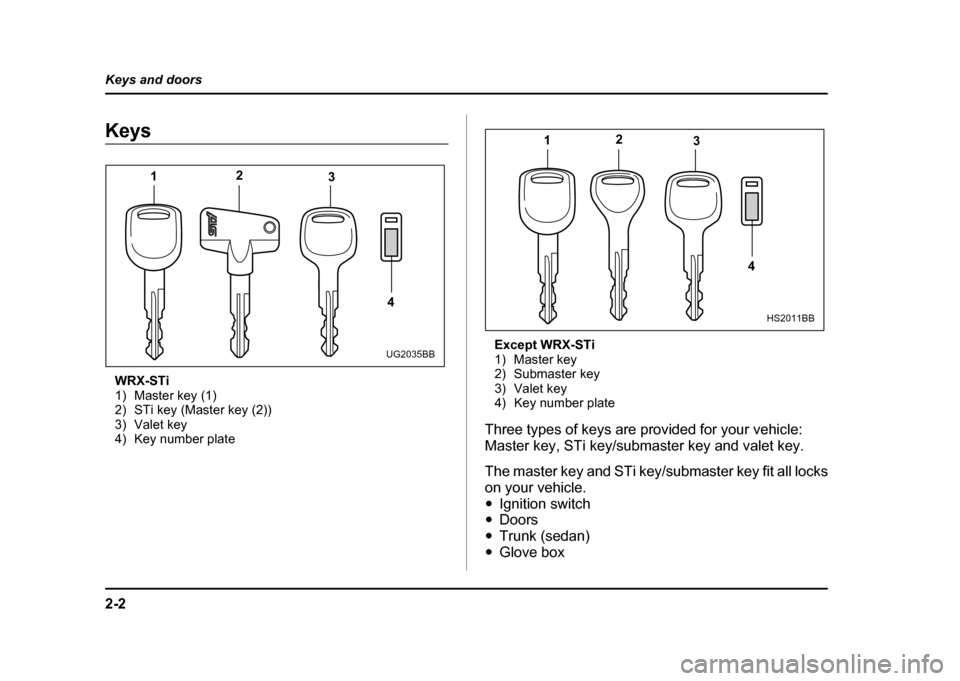
WRX-STi
1) Master key (1)
2) STi key (Master key (2))
3) Valet key
4) Key number plate Except WRX-STi
1) Master key
2) Submaster key
3) Valet key
4) Key number plate
Three types of keys are provided for your vehicle:
Master key, STi key/submaster key and valet key.
The master key and STi key/submaster key fit all locks
on your vehicle." Ignition switch
" Doors
" Trunk (sedan)
" Glove box
1 2
3
4
UG2035BB
1 2
3
4
HS2011BB
Page 106 of 491
2-3
Keys and doors
– CONTINUED –
The valet key fits only the ignition switch and driver’s
door lock. You can keep the trunk and glove box
locked when you leave your vehicle and valet key at a
parking facility.
Do not attach a large key holder or key case to
either key. If it banged against your knees while
you were driving, it could turn the ignition switch from the ON position to the ACC or OFF
position, thereby stopping the engine.
! Key number
The key number is stamped on the metal plate at-
tached to the key set. Write down the key number and
keep it in another safe place, not in the vehicle. This
number is needed to make a replacement key if you
lose your key or lock it inside the vehicle.
Door locks ! Locking and unlocking from the out-
side
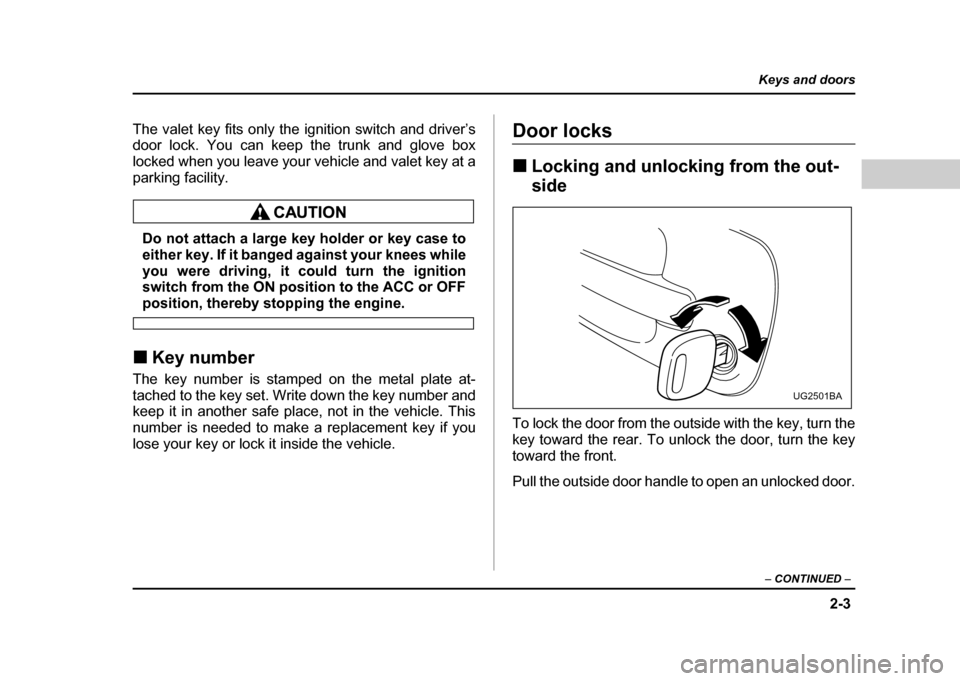
To lock the door from the outside with the key, turn the
key toward the rear. To unlock the door, turn the key
toward the front.
Pull the outside door handle to open an unlocked door.
UG2501BA
Page 107 of 491
2-4
Keys and doors
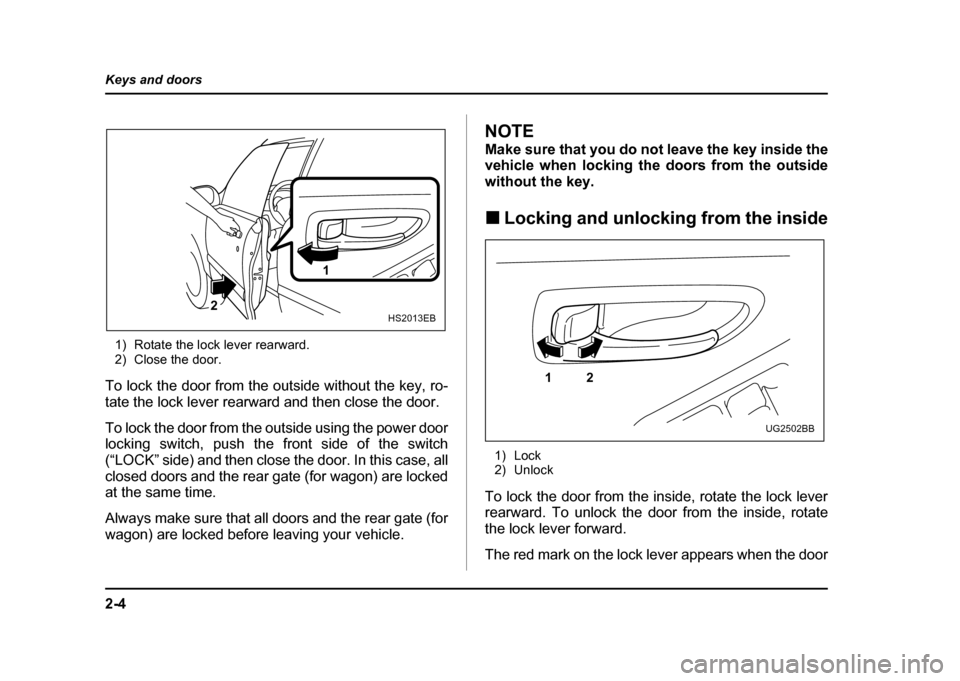
1) Rotate the lock lever rearward.
2) Close the door.
To lock the door from the outside without the key, ro-
tate the lock lever rearward and then close the door.
To lock the door from the outside using the power door
locking switch, push the front side of the switch
(“LOCK” side) and then close the door. In this case, all
closed doors and the rear gate (for wagon) are locked
at the same time.
Always make sure that all doors and the rear gate (for
wagon) are locked before leaving your vehicle.
NOTE
Make sure that you do not leave the key inside the
vehicle when locking the doors from the outside
without the key. ! Locking and unlocking from the inside
1) Lock
2) Unlock
To lock the door from the inside, rotate the lock lever
rearward. To unlock the door from the inside, rotate the lock lever forward.
The red mark on the lock lever appears when the door
HS2013EB
1
2
12
UG2502BB
Page 108 of 491
2-5
Keys and doors
– CONTINUED –
is unlocked.
Pull the inside door handle to open an unlocked door.
Always make sure that all doors and the rear gate (for
wagon) are closed before starting to drive.
Keep all doors locked when you drive, especial-
ly when small children are in your vehicle.
Along with the proper use of seat belts and
child restraints, locking the doors reduces the
chance of being thrown out of the vehicle in an
accident.
It also helps prevent passengers from falling
out if a door is accidentally opened, and intrud-
ers from unexpectedly opening doors and en-
tering your vehicle.
Power door locking switches
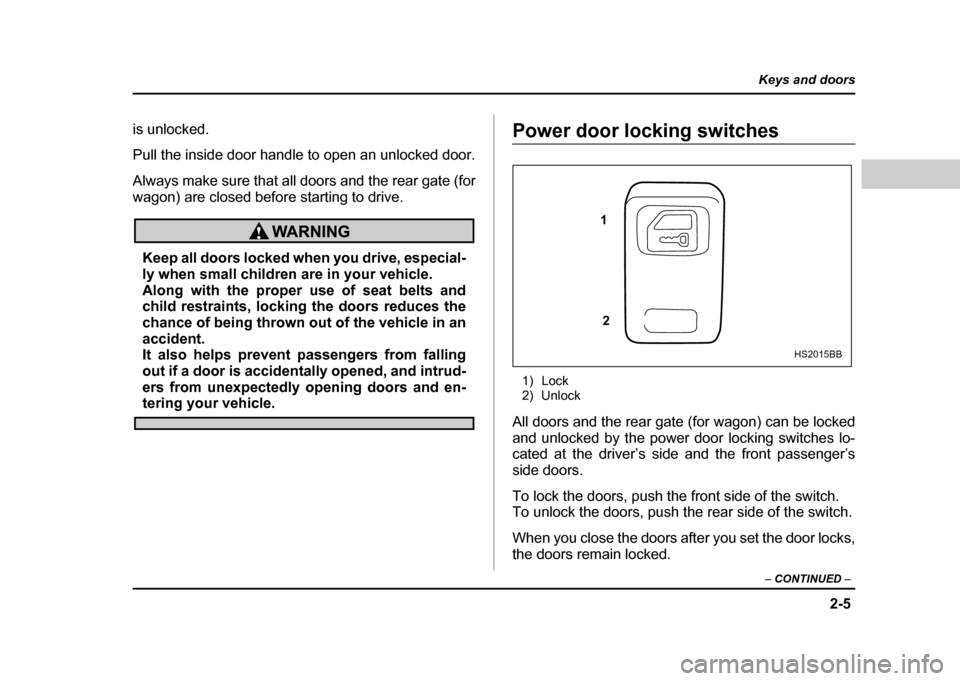
1) Lock
2) Unlock
All doors and the rear gate (for wagon) can be locked
and unlocked by the power door locking switches lo-
cated at the driver’s side and the front passenger’s
side doors.
To lock the doors, push the front side of the switch.
To unlock the doors, push the rear side of the switch.
When you close the doors after you set the door locks,
the doors remain locked.
1
2
HS2015BB
Page 109 of 491

2-6
Keys and doors
NOTE
Make sure that you do not leave the key inside the
vehicle before locking the doors from the outside
using power door locking switches.Remote keyless entry system
Two transmitters are provided for your vehicle.
The remote keyless entry system has the following
functions. "
Locking and unlocking the doors (and rear gate on
the wagon) without a key " Sounding a panic alarm
" Arming and disarming the security system (if your
vehicle is equipped with an optional security system).
See the next section “Security system (if equipped)”
for detailed information.
This device complies with Part 15 of the FCC
Rules and with RSS-210 of Industry Canada. Oper- ation is subject to the following two conditions: (1)
This device may not cause harmful interference,
and (2) this device must accept any interference
received, including interference that may cause
undesired operation.
Changes or modifications not expressly approved
by the party responsible for compliance could
void the user’s authority to operate the equipment.
The operable distance of the keyless entry system is
approximately 30 feet (10 meters). However, this dis-
tance will vary depending on environmental condi-
Page 110 of 491
2-7
Keys and doors
– CONTINUED –
tions. Range may be reduced near sources of RF in-
terference such as power plants and radio/television
broadcasting towers.
The remote keyless entry system does not operate
when the key is inserted in the ignition switch to pre-
vent accidental lockout.
"Do not expose the transmitter to severe
shocks, such as those experienced as a result
of dropping or throwing." Do not take the transmitter apart except when
replacing the battery." Do not get the transmitter wet. If it gets wet,
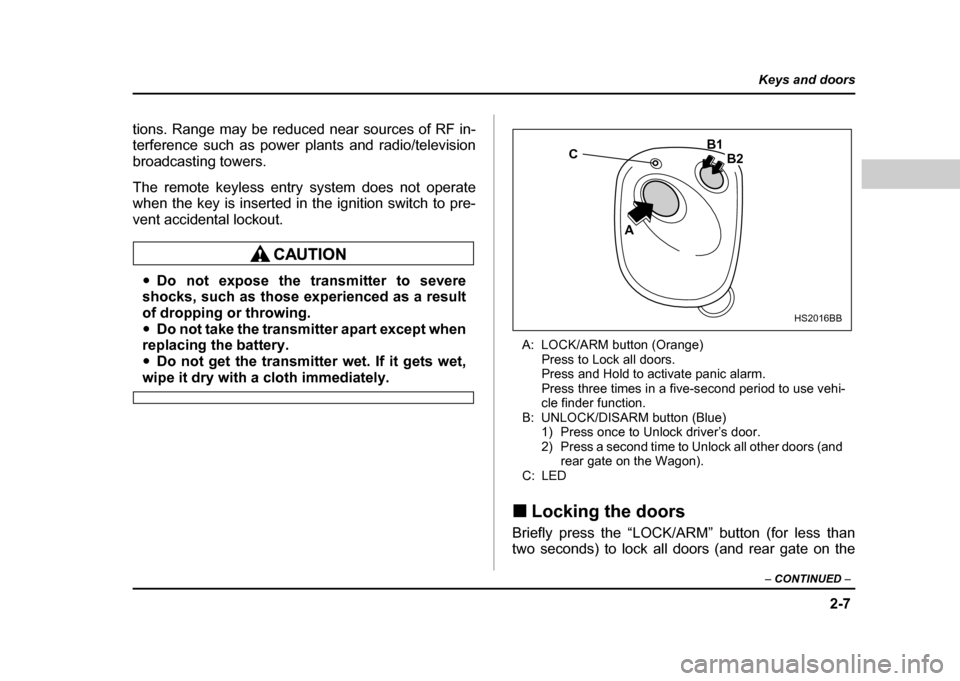
wipe it dry with a cloth immediately. A: LOCK/ARM button (Orange)
Press to Lock all doors.
Press and Hold to activate panic alarm.
Press three times in a five-second period to use vehi-
cle finder function.
B: UNLOCK/DISARM button (Blue) 1) Press once to Unlock driver’s door.
2) Press a second time to Unlock all other doors (and rear gate on the Wagon).
C: LED
! Locking the doors
Briefly press the “LOCK/ARM” button (for less than
two seconds) to lock all doors (and rear gate on the
C
A B1
B2
HS2016BB