spare tire SUBARU IMPREZA WRX 2006 2.G Owners Manual
[x] Cancel search | Manufacturer: SUBARU, Model Year: 2006, Model line: IMPREZA WRX, Model: SUBARU IMPREZA WRX 2006 2.GPages: 365, PDF Size: 7.09 MB
Page 11 of 365
8
driving. In a collision or sudden stop, unre-
strained pets or cages can be thrown
around inside the vehicle and hurt you or
your passengers. Besides, the pets can
be hurt under these situations. It is also for
their own safety that pets should be prop-
erly restrained in your vehicle. Restrain a
pet with a special traveling harness which
can be secured to the rear seat with a
seatbelt or use a pet carrier which can be
secured to the rear seat by routing a seat-
belt through the carriers handle. Never re-
strain pets or pet carriers in the front pas-
senger s seat. For further information,
consult your veterinarian, local animal
protection society or pet shop.
Tire pressures
Check and, if necessary, adjust the pres-
sure of each tire (including the spare) at
least once a month and before any long
journey.
Check the tire pressure when the tires are
cold. Use a pressure gauge to adjust the
tire pressures to the values shown on the
tire placard.
Refer to the Tires and wheels section in
chapter 11 for detailed information.
California proposition 65
warning
Driving at high speeds with exces-
sively low tire pressures can cause
the tires to deform severely and to
rapidly become hot. A sharp in-
crease in temperature could cause
tread separation, and destruction of
the tires. The resulting loss of vehi-
cle control could lead to an acci-
dent.
Engine exhaust, some of its constit-
uents, and certain vehicle compo-
nents contain or emit chemicals
known to the State of California to
cause cancer and birth defects or
other reproductive harm. In addi-
tion, certain fluids in vehicles and
certain components of product wear
contain or emit chemicals known to
the State of California to cause can-
cer and birth defects or other repro-
ductive harm.
Page 26 of 365
23
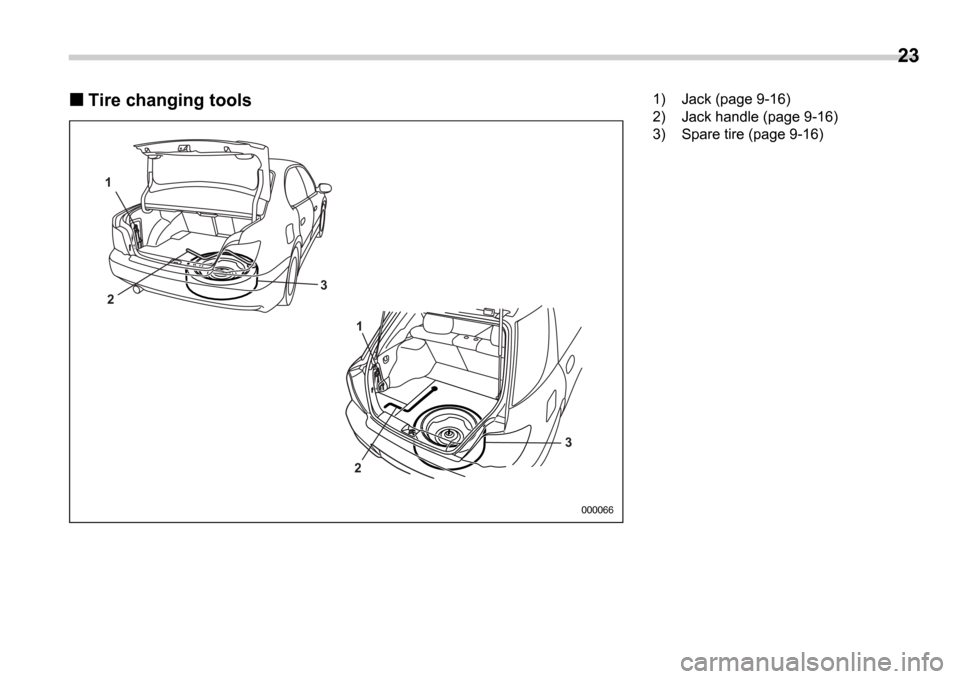
Tire changing tools
12 3
1
2 3
000066
1) Jack (page 9-16)
2) Jack handle (page 9-16)
3) Spare tire (page 9-16)
Page 212 of 365
Starting and operating 7-15
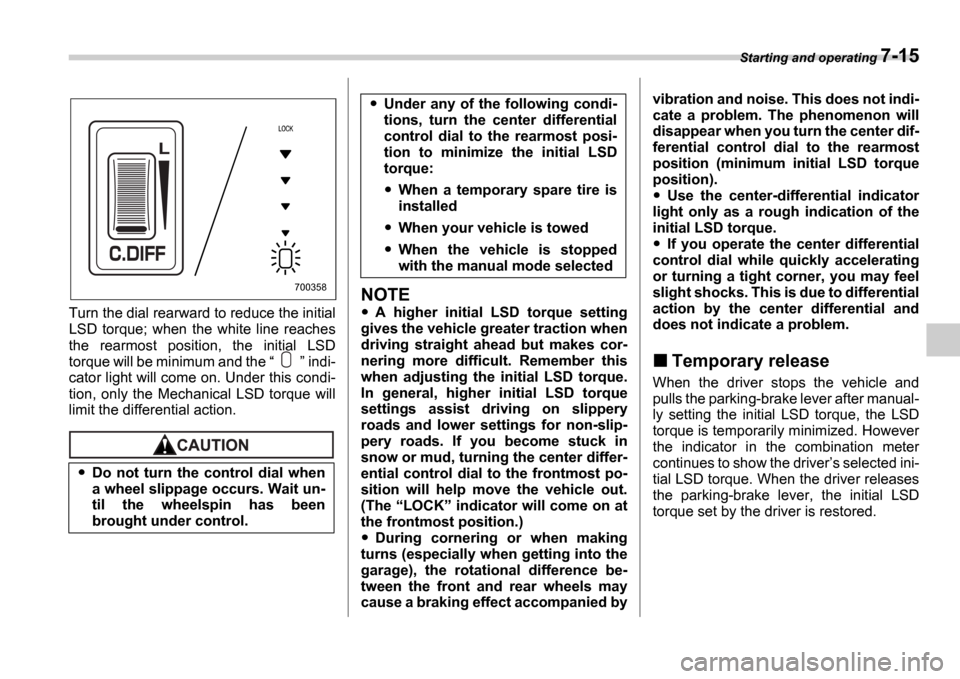
Turn the dial rearward to reduce the initial
LSD torque; when the white line reaches
the rearmost position, the initial LSD
torque will be minimum and the indi-
cator light will come on. Under this condi-
tion, only the Mechanical LSD torque will
limit the differential action.
NOTE
A higher initial LSD torque setting
gives the vehicle greater traction when
driving straight ahead but makes cor-
nering more difficult. Remember this
when adjusting the initial LSD torque.
In general, higher initial LSD torque
settings assist driving on slippery
roads and lower settings for non-slip-
pery roads. If you become stuck in
snow or mud, turning the center differ-
ential control dial to the frontmost po-
sition will help move the vehicle out.
(The LOCK indicator will come on at
the frontmost position.)
During cornering or when making
turns (especially when getting into the
garage), the rotational difference be-
tween the front and rear wheels may
cause a braking effect accompanied by vibration and noise. This does not indi-
cate a problem. The phenomenon will
disappear when you turn the center dif-
ferential control dial to the rearmost
position (minimum initial LSD torque
position).
Use the center-differential indicator
light only as a rough indication of the
initial LSD torque.
If you operate the center differential
control dial while quickly accelerating
or turning a tight corner, you may feel
slight shocks. This is due to differential
action by the center differential and
does not indicate a problem.
Temporary release
When the driver stops the vehicle and
pulls the parking-brake lever after manual-
ly setting the initial LSD torque, the LSD
torque is temporarily minimized. However
the indicator in the combination meter
continues to show the driver s selected ini-
tial LSD torque. When the driver releases
the parking-brake lever, the initial LSD
torque set by the driver is restored.
Do not turn the control dial when
a wheel slippage occurs. Wait un-
til the wheelspin has been
brought under control.
700358
Under any of the following condi-
tions, turn the center differential
control dial to the rearmost posi-
tion to minimize the initial LSD
torque:
When a temporary spare tire is
installed
When your vehicle is towed
When the vehicle is stopped
with the manual mode selected
Page 217 of 365
7-20 Starting and operating
gine.
Take your vehicle to the nearest SUBARU
dealer immediately to have the system re-
paired.Limited slip differential (LSD)
(if equipped)
The LSD provides optimum distribution of
power according to the difference in revo-
lutions between the right and left wheels
that may be caused by certain driving con-
ditions, thereby improving driving stability
on snow-covered, muddy or other slippery
roads or when high speed driving.
NOTE (WRX-STI)
The rear differential may emit a knock-
ing sound when the vehicle is driven
slowly with the steering wheel turned
fully to either side. This sound occurs
because of the design of the mechani-
cal LSD. It does not indicate a problem.
Never start the engine while a tire
on one side is jacked up, as the
vehicle may move.
If one tire is spinning in mud,
avoid continued spinning at high
speed as this could adversely af-
fect the LSD.
If you use a temporary spare tire
to replace a flat tire, be sure to use
the original temporary spare tire
stored in the vehicle. Using other
sizes will adversely affect the
LSD.
Page 232 of 365
Driving tips 8-5
Driving tips for AWD vehicles
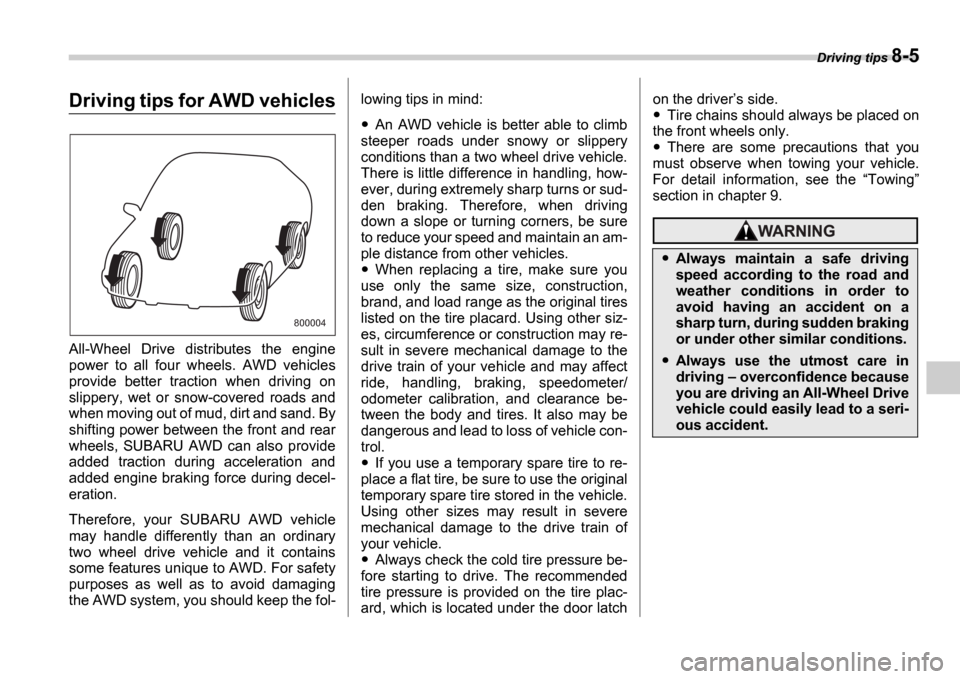
All-Wheel Drive distributes the engine
power to all four wheels. AWD vehicles
provide better traction when driving on
slippery, wet or snow-covered roads and
when moving out of mud, dirt and sand. By
shifting power between the front and rear
wheels, SUBARU AWD can also provide
added traction during acceleration and
added engine braking force during decel-
eration.
Therefore, your SUBARU AWD vehicle
may handle differently than an ordinary
two wheel drive vehicle and it contains
some features unique to AWD. For safety
purposes as well as to avoid damaging
the AWD system, you should keep the fol- lowing tips in mind:
An AWD vehicle is better able to climb
steeper roads under snowy or slippery
conditions than a two wheel drive vehicle.
There is little difference in handling, how-
ever, during extremely sharp turns or sud-
den braking. Therefore, when driving
down a slope or turning corners, be sure
to reduce your speed and maintain an am-
ple distance from other vehicles.
When replacing a tire, make sure you
use only the same size, construction,
brand, and load range as the original tires
listed on the tire placard. Using other siz-
es, circumference or construction may re-
sult in severe mechanical damage to the
drive train of your vehicle and may affect
ride, handling, braking, speedometer/
odometer calibration, and clearance be-
tween the body and tires. It also may be
dangerous and lead to loss of vehicle con-
trol.
If you use a temporary spare tire to re-
place a flat tire, be sure to use the original
temporary spare tire stored in the vehicle.
Using other sizes may result in severe
mechanical damage to the drive train of
your vehicle.
Always check the cold tire pressure be-
fore starting to drive. The recommended
tire pressure is provided on the tire plac-
ard, which is located under the door latch on the driver
s side.
Tire chains should always be placed on
the front wheels only.
There are some precautions that you
must observe when towing your vehicle.
For detail information, see the Towing
section in chapter 9.
800004
Always maintain a safe driving
speed according to the road and
weather conditions in order to
avoid having an accident on a
sharp turn, during sudden braking
or under other similar conditions.
Always use the utmost care in
driving overconfidence because
you are driving an All-Wheel Drive
vehicle could easily lead to a seri-
ous accident.
Page 239 of 365
8-12 Driving tips
pension.
When driving with tire chains, drive at
speeds below 19 mph (30 km/h).
When a temporary spare tire is on a front
wheel, replace the temporary spare tire
with the rear tire on the same side of the
vehicle, and then fit chains on the front
tires.
Always use the utmost care when driving
with tire chains overconfidence be-
cause you are driving with tire chains
could easily lead to a serious accident.
Rocking the vehicle
If you must rock the vehicle to free it from
snow, sand, or mud, depress the acceler-
ator pedal slightly and move the selector
lever back and forth between D and R
repeatedly. Do not race the engine. For
the best possible traction, avoid spinning
the wheels when trying to free the vehicle. When the road surface is extremely slip-
pery, you can obtain better traction by
starting the vehicle with the transmission
in 2nd than 1st (both for MT and AT).
Refer to the
Automatic transmission sec-
tion in chapter 7 for information on holding
the transmission in 2nd position.
Loading your vehicle
Tire chains cannot be used on tires
listed in the following because of
lack of clearance between the tires
and vehicle body.
225/45R17 tires for WRX-STI
215/45R17 tires for WRX
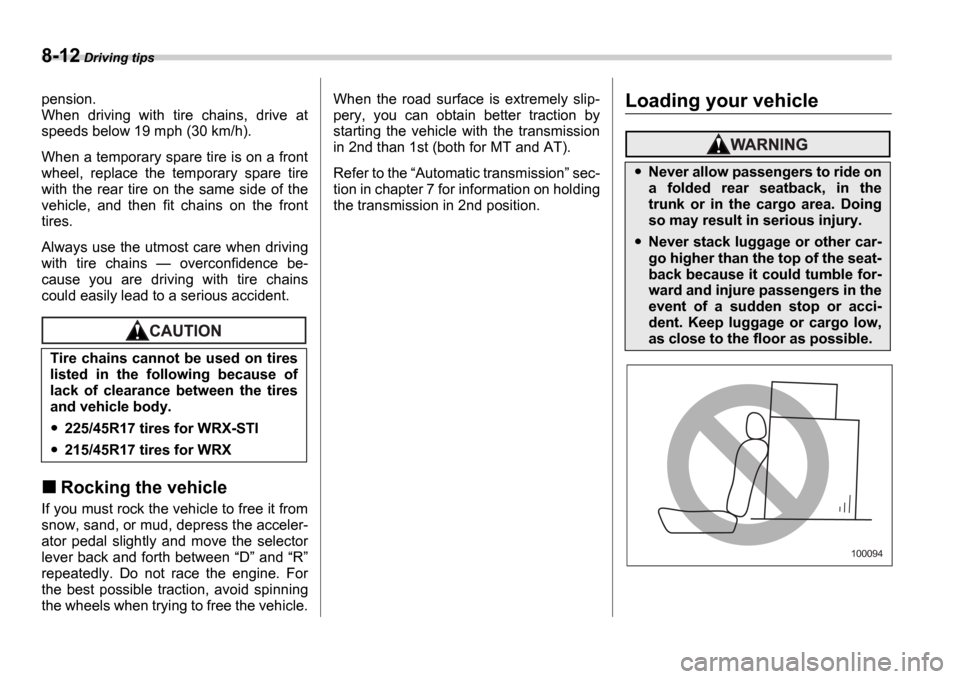
Never allow passengers to ride on
a folded rear seatback, in the
trunk or in the cargo area. Doing
so may result in serious injury.
Never stack luggage or other car-
go higher than the top of the seat-
back because it could tumble for-
ward and injure passengers in the
event of a sudden stop or acci-
dent. Keep luggage or cargo low,
as close to the floor as possible.
100094
Page 241 of 365
8-14 Driving tips
placard attached to the driver s side door
pillar. It includes the total weight of the
driver and all passengers and their be-
longings, any optional equipment such as
a trailer hitch, roof rack or bike carrier,
etc., and the tongue load of a trailer.
GVWR and GAWR (Gross Ve-
hicle Weight Rating and
Gross Axle Weight Rating)
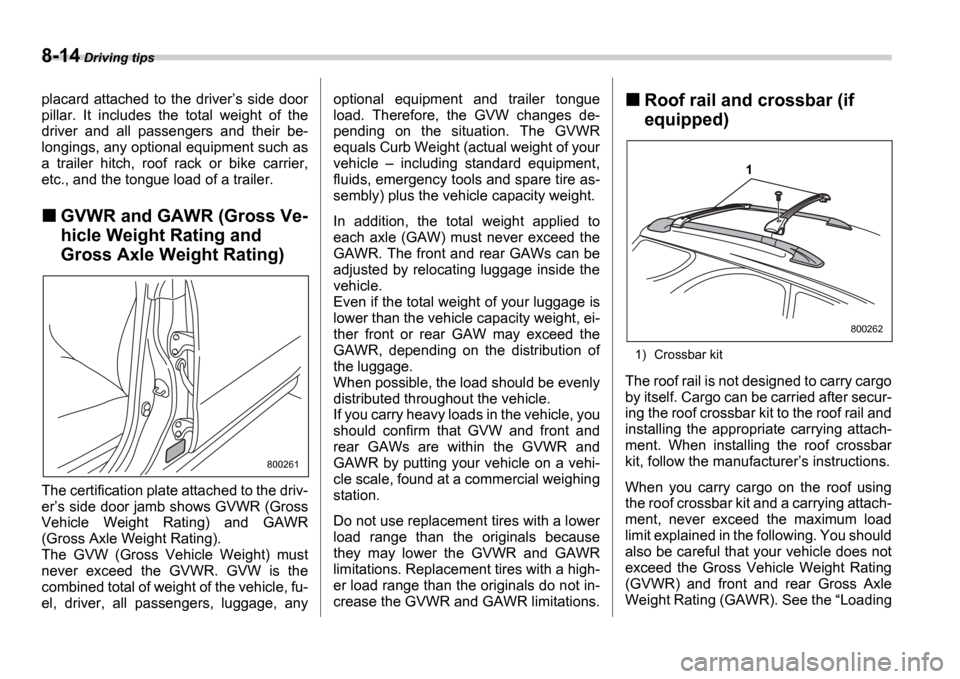
The certification plate attached to the driv-
er s side door jamb shows GVWR (Gross
Vehicle Weight Rating) and GAWR
(Gross Axle Weight Rating).
The GVW (Gross Vehicle Weight) must
never exceed the GVWR. GVW is the
combined total of weight of the vehicle, fu-
el, driver, all passengers, luggage, any optional equipment and trailer tongue
load. Therefore, the GVW changes de-
pending on the situation. The GVWR
equals Curb Weight (actual weight of your
vehicle
including standard equipment,
fluids, emergency tools and spare tire as-
sembly) plus the vehicle capacity weight.
In addition, the total weight applied to
each axle (GAW) must never exceed the
GAWR. The front and rear GAWs can be
adjusted by relocating luggage inside the
vehicle.
Even if the total weight of your luggage is
lower than the vehicle capacity weight, ei-
ther front or rear GAW may exceed the
GAWR, depending on the distribution of
the luggage.
When possible, the load should be evenly
distributed throughout the vehicle.
If you carry heavy loads in the vehicle, you
should confirm that GVW and front and
rear GAWs are within the GVWR and
GAWR by putting your vehicle on a vehi-
cle scale, found at a commercial weighing
station.
Do not use replacement tires with a lower
load range than the originals because
they may lower the GVWR and GAWR
limitations. Replacement tires with a high-
er load range than the originals do not in-
crease the GVWR and GAWR limitations.
Roof rail and crossbar (if
equipped)
1) Crossbar kit
The roof rail is not designed to carry cargo
by itself. Cargo can be carried after secur-
ing the roof crossbar kit to the roof rail and
installing the appropriate carrying attach-
ment. When installing the roof crossbar
kit, follow the manufacturer s instructions.
When you carry cargo on the roof using
the roof crossbar kit and a carrying attach-
ment, never exceed the maximum load
limit explained in the following. You should
also be careful that your vehicle does not
exceed the Gross Vehicle Weight Rating
(GVWR) and front and rear Gross Axle
Weight Rating (GAWR). See the Loading
800261
1
800262
Page 252 of 365
Driving tips 8-25
CONTINUED
Side mirrors
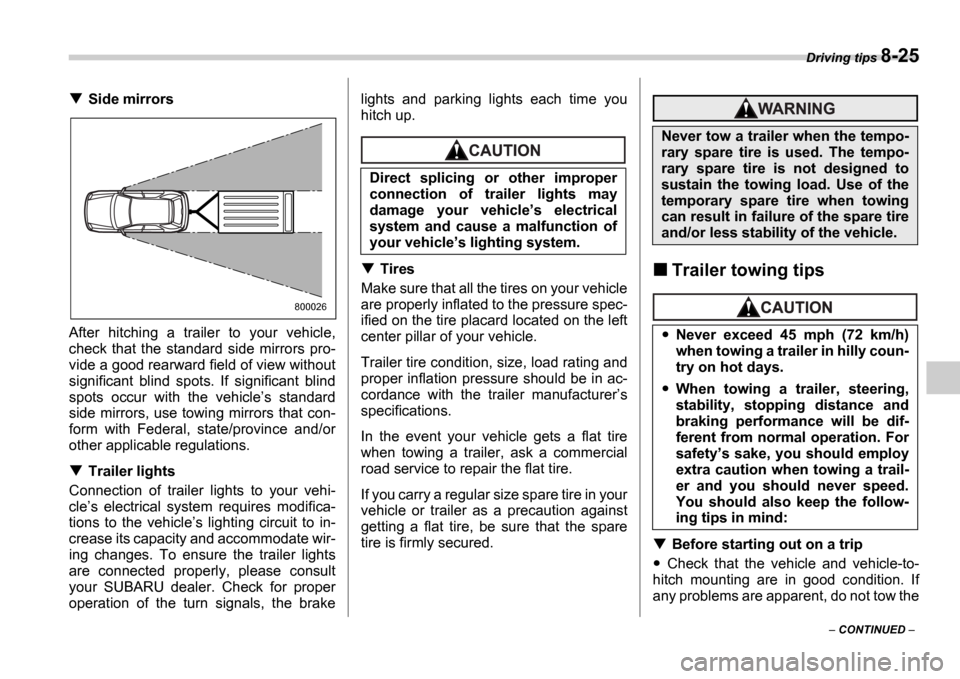
After hitching a trailer to your vehicle,
check that the standard side mirrors pro-
vide a good rearward field of view without
significant blind spots. If significant blind
spots occur with the vehicle s standard
side mirrors, use towing mirrors that con-
form with Federal, state/province and/or
other applicable regulations.
Trailer lights
Connection of trailer lights to your vehi-
cle s electrical system requires modifica-
tions to the vehicle s lighting circuit to in-
crease its capacity and accommodate wir-
ing changes. To ensure the trailer lights
are connected properly, please consult
your SUBARU dealer. Check for proper
operation of the turn signals, the brake lights and parking lights each time you
hitch up.
Tires
Make sure that all the tires on your vehicle
are properly inflated to the pressure spec-
ified on the tire placard located on the left
center pillar of your vehicle.
Trailer tire condition, size, load rating and
proper inflation pressure should be in ac-
cordance with the trailer manufacturer s
specifications.
In the event your vehicle gets a flat tire
when towing a trailer, ask a commercial
road service to repair the flat tire.
If you carry a regular size spare tire in your
vehicle or trailer as a precaution against
getting a flat tire, be sure that the spare
tire is firmly secured.Trailer towing tips
Before starting out on a trip
Check that the vehicle and vehicle-to-
hitch mounting are in good condition. If
any problems are apparent, do not tow the
800026
Direct splicing or other improper
connection of trailer lights may
damage your vehicle s electrical
system and cause a malfunction of
your vehicle s lighting system.
Never tow a trailer when the tempo-
rary spare tire is used. The tempo-
rary spare tire is not designed to
sustain the towing load. Use of the
temporary spare tire when towing
can result in failure of the spare tire
and/or less stability of the vehicle.
Never exceed 45 mph (72 km/h)
when towing a trailer in hilly coun-
try on hot days.
When towing a trailer, steering,
stability, stopping distance and
braking performance will be dif-
ferent from normal operation. For
safety s sake, you should employ
extra caution when towing a trail-
er and you should never speed.
You should also keep the follow-
ing tips in mind:
Page 256 of 365

9
In case of emergency
If you park your vehicle in case of an emergency ......................................... .............. 9-2
Temporary spare tire .............................. ............ 9-2
Flat tires ........................................ ...................... 9-4
Changing a flat tire .............................. ................... 9-4
Jump starting ..................................... ................. 9-9
How to jump start ................................. .................. 9-9
Engine overheating ................................ ............ 9-11
If steam is coming from the engine compartment ....................................... .................. 9-11
If no steam is coming from the engine
compartment ....................................... .................. 9-11
Towing ............................................ ..................... 9-11
Towing and tie-down hooks ......................... ......... 9-12
Using a flat-bed truck ............................ ................. 9-13
Towing with all wheels on the ground .............. .... 9-14
Rear gate if the rear gate cannot be
unlocked .......................................... ................ 9-15
Moonroof if the moonroof cannot be
closed ............................................ ................... 9-15
Maintenance tools ................................. ............. 9-16
Jack and jack handle .............................. ................ 9-16
Page 257 of 365
9-2 In case of emergency
In case of emergencyIf you park your vehicle in
case of an emergency
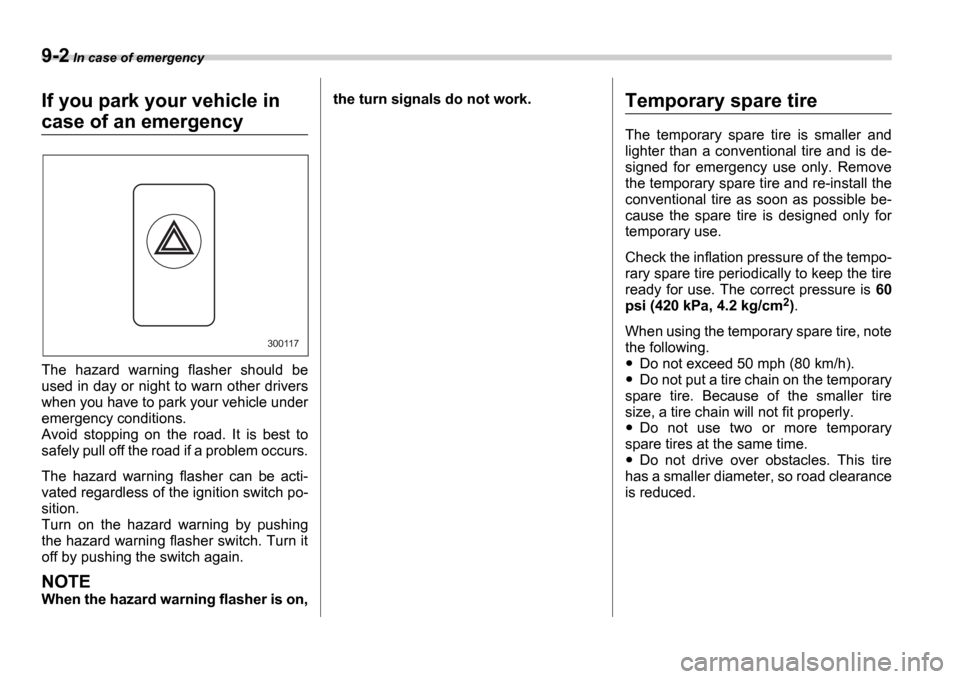
The hazard warning flasher should be
used in day or night to warn other drivers
when you have to park your vehicle under
emergency conditions.
Avoid stopping on the road. It is best to
safely pull off the road if a problem occurs.
The hazard warning flasher can be acti-
vated regardless of the ignition switch po-
sition.
Turn on the hazard warning by pushing
the hazard warning flasher switch. Turn it
off by pushing the switch again.
NOTE
When the hazard warning flasher is on, the turn signals do not work.
Temporary spare tire
The temporary spare tire is smaller and
lighter than a conventional tire and is de-
signed for emergency use only. Remove
the temporary spare tire and re-install the
conventional tire as soon as possible be-
cause the spare tire is designed only for
temporary use.
Check the inflation pressure of the tempo-
rary spare tire periodically to keep the tire
ready for use. The correct pressure is
60
psi (420 kPa, 4.2 kg/cm
2) .
When using the temporary spare tire, note
the following.
Do not exceed 50 mph (80 km/h).
Do not put a tire chain on the temporary
spare tire. Because of the smaller tire
size, a tire chain will not fit properly.
Do not use two or more temporary
spare tires at the same time.
Do not drive over obstacles. This tire
has a smaller diameter, so road clearance
is reduced.
300117