compression ratio SUBARU LEGACY 1999 Service Repair Manual
[x] Cancel search | Manufacturer: SUBARU, Model Year: 1999, Model line: LEGACY, Model: SUBARU LEGACY 1999Pages: 1456, PDF Size: 59.93 MB
Page 36 of 1456
![SUBARU LEGACY 1999 Service Repair Manual CAUTION:
Never rotate idle adjusting screw. If idle speed
is out of specifications, refer to General On-
board Diagnosis Table under ª2-7 On-Board
Diagnostics II Systemº.
<Ref. to 2-7 [T6A0].>4. Eng](/img/17/57435/w960_57435-35.png "SUBARU LEGACY 1999 Service Repair Manual CAUTION:
Never rotate idle adjusting screw. If idle speed
is out of specifications, refer to General On-
board Diagnosis Table under ª2-7 On-Board
Diagnostics II Systemº.
<Ref. to 2-7 [T6A0].>4. Eng")
CAUTION:
Never rotate idle adjusting screw. If idle speed
is out of specifications, refer to General On-
board Diagnosis Table under ª2-7 On-Board
Diagnostics II Systemº.
A: MEASUREMENT
1. 2200 cc MODEL
1) After warming-up the engine, turn ignition
switch to OFF.
2) Make sure that the battery is fully charged.
3) Remove all the spark plugs.
4) Disconnect connectors from fuel injectors.
5) Fully open throttle valve.
6) Check the starter motor for satisfactory perfor-
mance and operation.
7) Hold the compression gauge tight against the
spark plug hole.
CAUTION:
When using a screw-in type compression
gauge, the screw (put into cylinder head spark
plug hole) should be less than 18 mm (0.71 in)
long.
8) Crank the engine by means of the starter motor,
and read the maximum value on the gauge when
the pointer is steady.
G2M0098
9) Perform at least two measurements per
cylinder, and make sure that the values are correct.
Compression (200 Ð 300 rpm and fully open
throttle):
Standard;
1,079 Ð 1,275 kPa (11.0 Ð 13.0 kg/cm
2,
156 Ð 185 psi)
Limit;
883 kPa (9.0 kg/cm
2, 128 psi)
Difference between cylinders;
196 kPa (2.0 kg/cm
2, 28 psi)
4
2-2[W4A1]SERVICE PROCEDURE
4. Engine Compression
Page 37 of 1456
![SUBARU LEGACY 1999 Service Repair Manual CAUTION:
Never rotate idle adjusting screw. If idle speed
is out of specifications, refer to General On-
board Diagnosis Table under ª2-7 On-Board
Diagnostics II Systemº.
<Ref. to 2-7 [T6A0].>4. Eng](/img/17/57435/w960_57435-36.png "SUBARU LEGACY 1999 Service Repair Manual CAUTION:
Never rotate idle adjusting screw. If idle speed
is out of specifications, refer to General On-
board Diagnosis Table under ª2-7 On-Board
Diagnostics II Systemº.
<Ref. to 2-7 [T6A0].>4. Eng")
CAUTION:
Never rotate idle adjusting screw. If idle speed
is out of specifications, refer to General On-
board Diagnosis Table under ª2-7 On-Board
Diagnostics II Systemº.
A: MEASUREMENT
1. 2200 cc MODEL
1) After warming-up the engine, turn ignition
switch to OFF.
2) Make sure that the battery is fully charged.
3) Remove all the spark plugs.
4) Disconnect connectors from fuel injectors.
5) Fully open throttle valve.
6) Check the starter motor for satisfactory perfor-
mance and operation.
7) Hold the compression gauge tight against the
spark plug hole.
CAUTION:
When using a screw-in type compression
gauge, the screw (put into cylinder head spark
plug hole) should be less than 18 mm (0.71 in)
long.
8) Crank the engine by means of the starter motor,
and read the maximum value on the gauge when
the pointer is steady.
G2M0098
9) Perform at least two measurements per
cylinder, and make sure that the values are correct.
Compression (200 Ð 300 rpm and fully open
throttle):
Standard;
1,079 Ð 1,275 kPa (11.0 Ð 13.0 kg/cm
2,
156 Ð 185 psi)
Limit;
883 kPa (9.0 kg/cm
2, 128 psi)
Difference between cylinders;
196 kPa (2.0 kg/cm
2, 28 psi)
4
2-2[W4A1]SERVICE PROCEDURE
4. Engine Compression
Page 38 of 1456
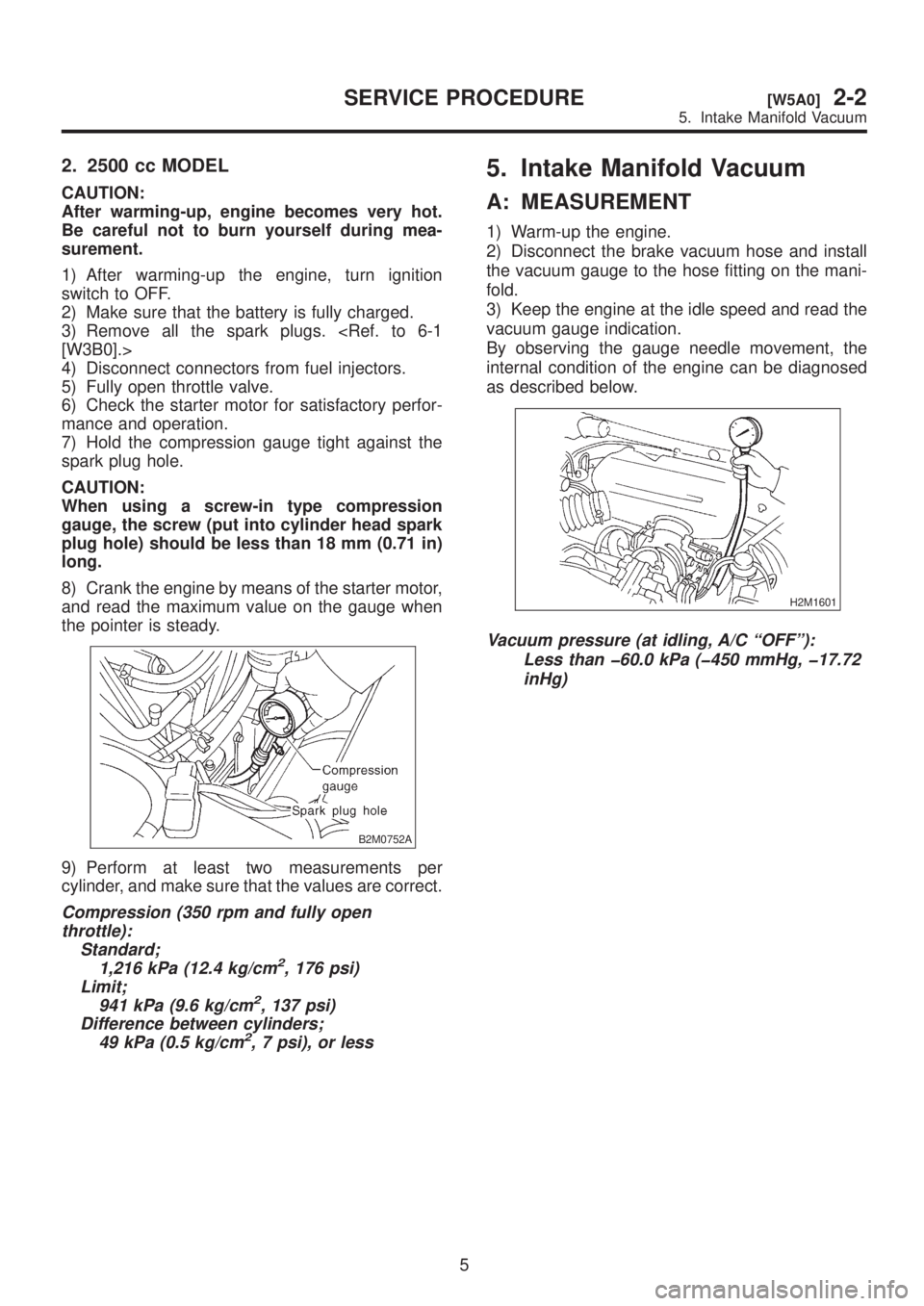
2. 2500 cc MODEL
CAUTION:
After warming-up, engine becomes very hot.
Be careful not to burn yourself during mea-
surement.
1) After warming-up the engine, turn ignition
switch to OFF.
2) Make sure that the battery is fully charged.
3) Remove all the spark plugs.
4) Disconnect connectors from fuel injectors.
5) Fully open throttle valve.
6) Check the starter motor for satisfactory perfor-
mance and operation.
7) Hold the compression gauge tight against the
spark plug hole.
CAUTION:
When using a screw-in type compression
gauge, the screw (put into cylinder head spark
plug hole) should be less than 18 mm (0.71 in)
long.
8) Crank the engine by means of the starter motor,
and read the maximum value on the gauge when
the pointer is steady.
B2M0752A
9) Perform at least two measurements per
cylinder, and make sure that the values are correct.
Compression (350 rpm and fully open
throttle):
Standard;
1,216 kPa (12.4 kg/cm
2, 176 psi)
Limit;
941 kPa (9.6 kg/cm
2, 137 psi)
Difference between cylinders;
49 kPa (0.5 kg/cm
2, 7 psi), or less
5. Intake Manifold Vacuum
A: MEASUREMENT
1) Warm-up the engine.
2) Disconnect the brake vacuum hose and install
the vacuum gauge to the hose fitting on the mani-
fold.
3) Keep the engine at the idle speed and read the
vacuum gauge indication.
By observing the gauge needle movement, the
internal condition of the engine can be diagnosed
as described below.
H2M1601
Vacuum pressure (at idling, A/C ªOFFº):
Less than þ60.0 kPa (þ450 mmHg, þ17.72
inHg)
5
[W5A0]2-2SERVICE PROCEDURE
5. Intake Manifold Vacuum
Page 39 of 1456
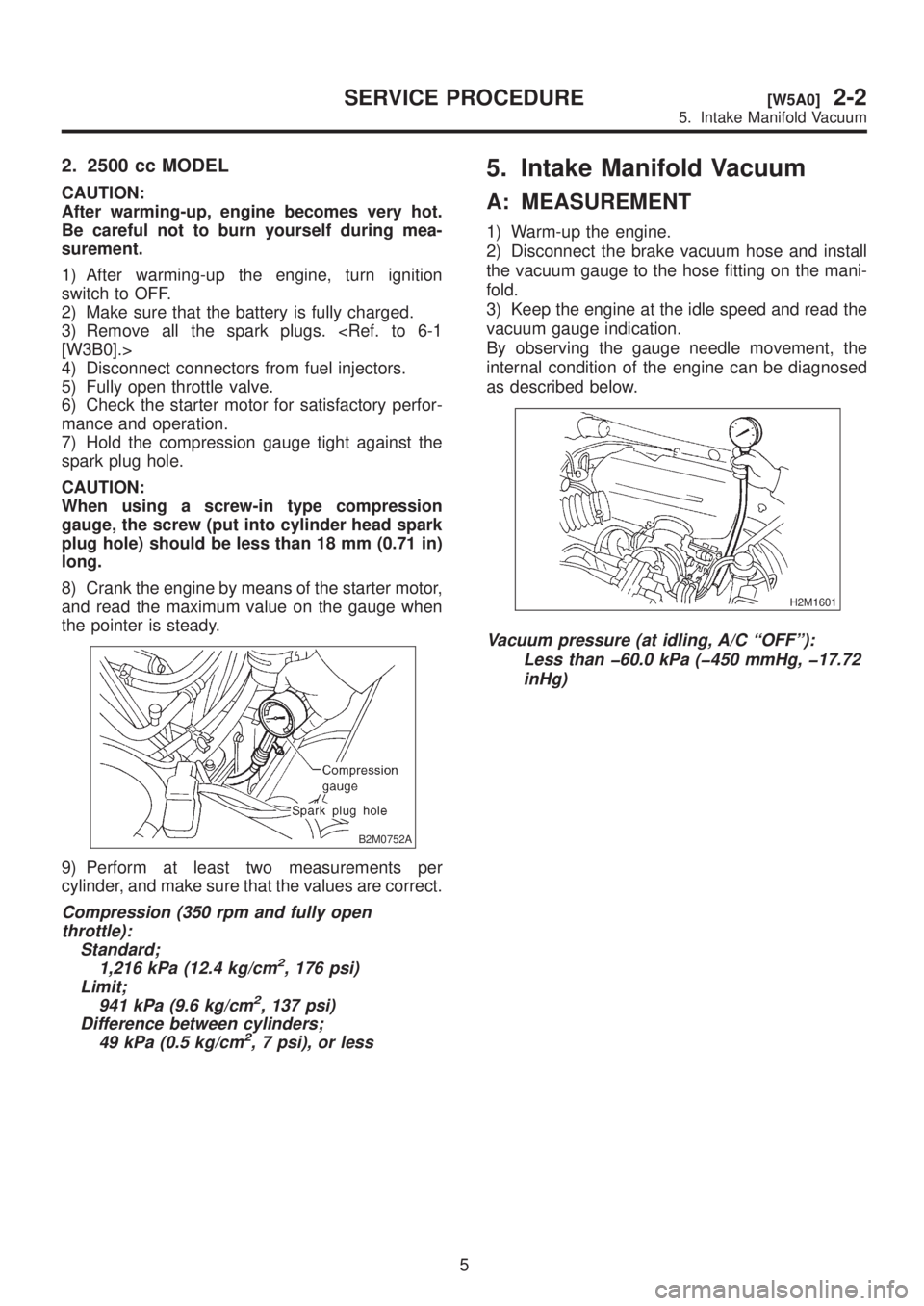
2. 2500 cc MODEL
CAUTION:
After warming-up, engine becomes very hot.
Be careful not to burn yourself during mea-
surement.
1) After warming-up the engine, turn ignition
switch to OFF.
2) Make sure that the battery is fully charged.
3) Remove all the spark plugs.
4) Disconnect connectors from fuel injectors.
5) Fully open throttle valve.
6) Check the starter motor for satisfactory perfor-
mance and operation.
7) Hold the compression gauge tight against the
spark plug hole.
CAUTION:
When using a screw-in type compression
gauge, the screw (put into cylinder head spark
plug hole) should be less than 18 mm (0.71 in)
long.
8) Crank the engine by means of the starter motor,
and read the maximum value on the gauge when
the pointer is steady.
B2M0752A
9) Perform at least two measurements per
cylinder, and make sure that the values are correct.
Compression (350 rpm and fully open
throttle):
Standard;
1,216 kPa (12.4 kg/cm
2, 176 psi)
Limit;
941 kPa (9.6 kg/cm
2, 137 psi)
Difference between cylinders;
49 kPa (0.5 kg/cm
2, 7 psi), or less
5. Intake Manifold Vacuum
A: MEASUREMENT
1) Warm-up the engine.
2) Disconnect the brake vacuum hose and install
the vacuum gauge to the hose fitting on the mani-
fold.
3) Keep the engine at the idle speed and read the
vacuum gauge indication.
By observing the gauge needle movement, the
internal condition of the engine can be diagnosed
as described below.
H2M1601
Vacuum pressure (at idling, A/C ªOFFº):
Less than þ60.0 kPa (þ450 mmHg, þ17.72
inHg)
5
[W5A0]2-2SERVICE PROCEDURE
5. Intake Manifold Vacuum
Page 55 of 1456
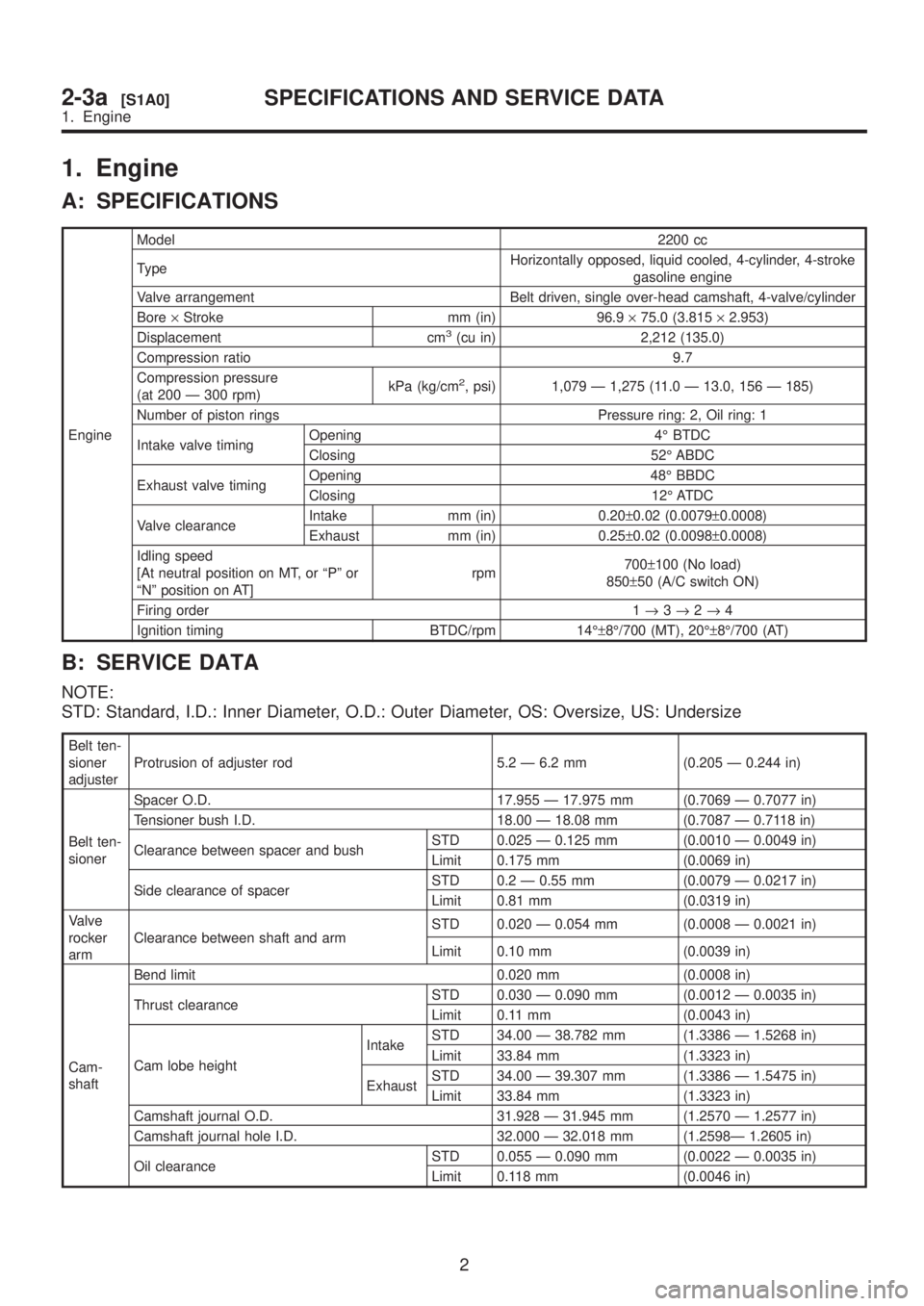
1. Engine
A: SPECIFICATIONS
EngineModel2200 cc
TypeHorizontally opposed, liquid cooled, 4-cylinder, 4-stroke
gasoline engine
Valve arrangement Belt driven, single over-head camshaft, 4-valve/cylinder
Bore´Stroke mm (in) 96.9´75.0 (3.815´2.953)
Displacement cm
3(cu in) 2,212 (135.0)
Compression ratio 9.7
Compression pressure
(at 200 Ð 300 rpm)kPa (kg/cm
2, psi) 1,079 Ð 1,275 (11.0 Ð 13.0, 156 Ð 185)
Number of piston rings Pressure ring: 2, Oil ring: 1
Intake valve timingOpening 4É BTDC
Closing 52É ABDC
Exhaust valve timingOpening 48É BBDC
Closing 12É ATDC
Valve clearanceIntake mm (in) 0.20±0.02 (0.0079±0.0008)
Exhaust mm (in) 0.25±0.02 (0.0098±0.0008)
Idling speed
[At neutral position on MT, or ªPº or
ªNº position on AT]rpm700±100 (No load)
850±50 (A/C switch ON)
Firing order 1®3®2®4
Ignition timing BTDC/rpm 14ɱ8É/700 (MT), 20ɱ8É/700 (AT)
B: SERVICE DATA
NOTE:
STD: Standard, I.D.: Inner Diameter, O.D.: Outer Diameter, OS: Oversize, US: Undersize
Belt ten-
sioner
adjusterProtrusion of adjuster rod 5.2 Ð 6.2 mm (0.205 Ð 0.244 in)
Belt ten-
sionerSpacer O.D. 17.955 Ð 17.975 mm (0.7069 Ð 0.7077 in)
Tensioner bush I.D. 18.00 Ð 18.08 mm (0.7087 Ð 0.7118 in)
Clearance between spacer and bushSTD 0.025 Ð 0.125 mm (0.0010 Ð 0.0049 in)
Limit 0.175 mm (0.0069 in)
Side clearance of spacerSTD 0.2 Ð 0.55 mm (0.0079 Ð 0.0217 in)
Limit 0.81 mm (0.0319 in)
Valve
rocker
armClearance between shaft and armSTD 0.020 Ð 0.054 mm (0.0008 Ð 0.0021 in)
Limit 0.10 mm (0.0039 in)
Cam-
shaftBend limit 0.020 mm (0.0008 in)
Thrust clearanceSTD 0.030 Ð 0.090 mm (0.0012 Ð 0.0035 in)
Limit 0.11 mm (0.0043 in)
Cam lobe heightIntakeSTD 34.00 Ð 38.782 mm (1.3386 Ð 1.5268 in)
Limit 33.84 mm (1.3323 in)
ExhaustSTD 34.00 Ð 39.307 mm (1.3386 Ð 1.5475 in)
Limit 33.84 mm (1.3323 in)
Camshaft journal O.D. 31.928 Ð 31.945 mm (1.2570 Ð 1.2577 in)
Camshaft journal hole I.D. 32.000 Ð 32.018 mm (1.2598Ð 1.2605 in)
Oil clearanceSTD 0.055 Ð 0.090 mm (0.0022 Ð 0.0035 in)
Limit 0.118 mm (0.0046 in)
2
2-3a[S1A0]SPECIFICATIONS AND SERVICE DATA
1. Engine
Page 129 of 1456
![SUBARU LEGACY 1999 Service Repair Manual TROUBLE PROBLEM PARTS, ETC. POSSIBLE CAUSE RANK
3. Low output, hesitation and
poor accelerationIFuel injection system <Ref. to 2-7 [T6A0].> A
IIntake systemILoosened or cracked intake duct A
ILoosened](/img/17/57435/w960_57435-128.png "SUBARU LEGACY 1999 Service Repair Manual TROUBLE PROBLEM PARTS, ETC. POSSIBLE CAUSE RANK
3. Low output, hesitation and
poor accelerationIFuel injection system <Ref. to 2-7 [T6A0].> A
IIntake systemILoosened or cracked intake duct A
ILoosened")
TROUBLE PROBLEM PARTS, ETC. POSSIBLE CAUSE RANK
3. Low output, hesitation and
poor accelerationIFuel injection system
IIntake systemILoosened or cracked intake duct A
ILoosened or cracked PCV hose A
ILoosened or cracked vacuum hose B
IDefective intake manifold gasket B
IDefective throttle body gasket B
IDefective PCV valve B
ILoosened oil filter cap B
IDirty air cleaner element A
IFuel lineIDefective fuel pump and relay B
IClogged fuel line B
ILack of or insufficient fuel C
IBeltIDefective timing B
ICompressionIIncorrect valve clearance B
ILoosened spark plugs or defective gasket B
ILoosened cylinder head bolts or defective gasket B
IImproper valve seating B
IDefective valve stem C
IWorn or broken valve spring B
IWorn or stuck piston rings, cylinder and piston C
IIncorrect valve timing A
IImproper engine oil (low viscosity) B
ILubrication systemIIncorrect oil pressure B
ICooling systemIOverheating C
IOver cooling C
IOthersIMalfunction of evaporative emission control system A
4. SurgingIFuel injection system
IIntake systemILoosened or cracked intake duct A
ILoosened or cracked PCV hose A
ILoosened or cracked vacuum hose A
IDefective intake manifold gasket B
IDefective throttle body gasket B
IDefective PCV valve B
ILoosened oil filter cap B
IDirty air cleaner element B
IFuel lineIDefective fuel pump and relay B
IClogged fuel line B
ILack of or insufficient fuel C
IBeltIDefective timing B
ICompressionIIncorrect valve clearance B
ILoosened spark plugs or defective gasket C
ILoosened cylinder head bolts or defective gasket C
IImproper valve seating C
IDefective valve stem C
IWorn or broken valve spring C
IWorn or stuck piston rings, cylinder and piston C
IIncorrect valve timing A
IImproper engine oil (low viscosity) B
ICooling systemIOverheating B
IOthersIMalfunction of evaporative emission control system C
75
[K100]2-3aDIAGNOSTICS
1. Engine Trouble in General
Page 133 of 1456
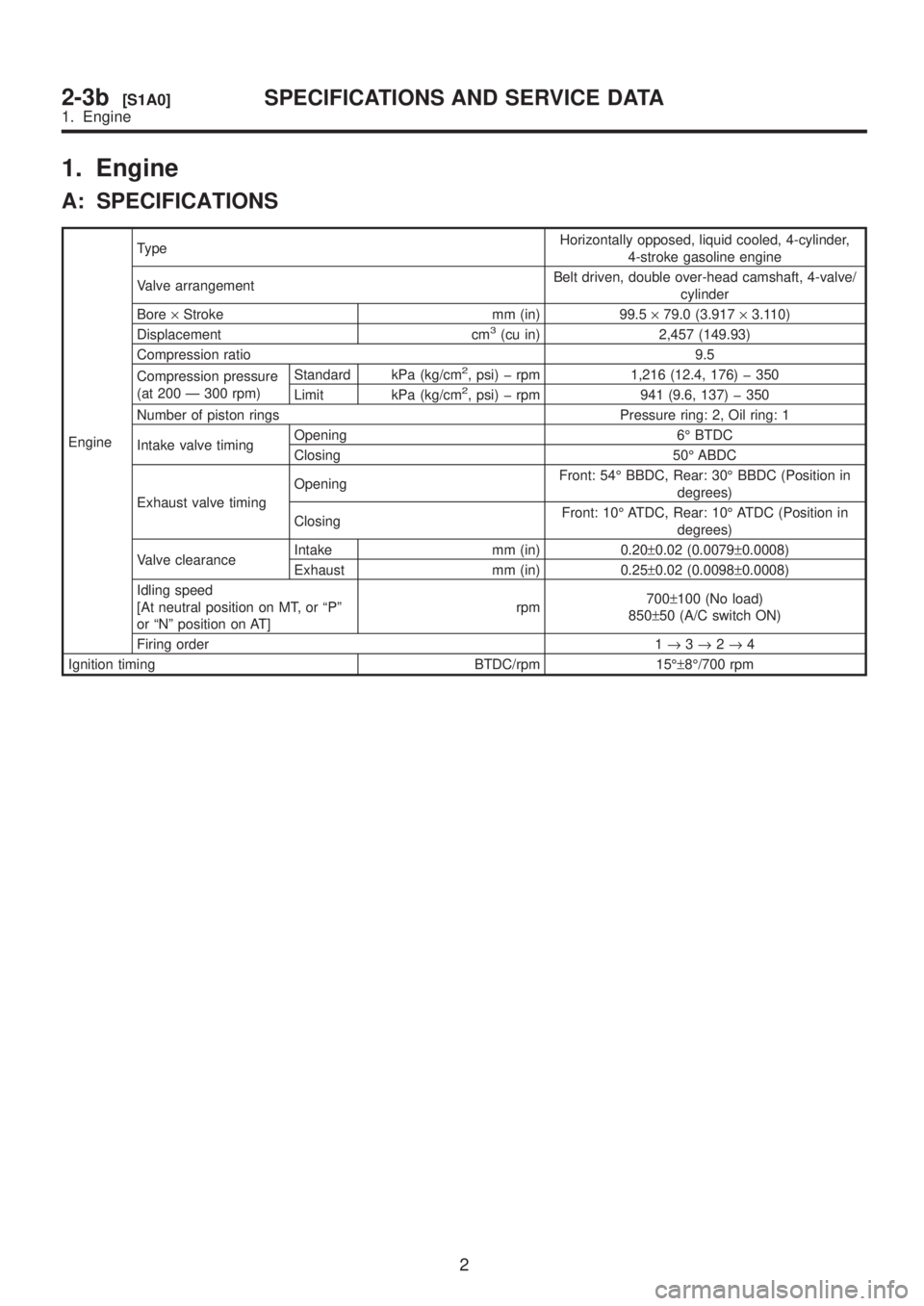
1. Engine
A: SPECIFICATIONS
EngineTypeHorizontally opposed, liquid cooled, 4-cylinder,
4-stroke gasoline engine
Valve arrangementBelt driven, double over-head camshaft, 4-valve/
cylinder
Bore´Stroke mm (in) 99.5´79.0 (3.917´3.110)
Displacement cm
3(cu in) 2,457 (149.93)
Compression ratio 9.5
Compression pressure
(at 200 Ð 300 rpm)Standard kPa (kg/cm
2, psi) þ rpm 1,216 (12.4, 176) þ 350
Limit kPa (kg/cm2, psi) þ rpm 941 (9.6, 137) þ 350
Number of piston rings Pressure ring: 2, Oil ring: 1
Intake valve timingOpening 6É BTDC
Closing 50É ABDC
Exhaust valve timingOpeningFront: 54É BBDC, Rear: 30É BBDC (Position in
degrees)
ClosingFront: 10É ATDC, Rear: 10É ATDC (Position in
degrees)
Valve clearanceIntake mm (in) 0.20±0.02 (0.0079±0.0008)
Exhaust mm (in) 0.25±0.02 (0.0098±0.0008)
Idling speed
[At neutral position on MT, or ªPº
or ªNº position on AT]rpm700±100 (No load)
850±50 (A/C switch ON)
Firing order 1®3®2®4
Ignition timing BTDC/rpm 15ɱ8É/700 rpm
2
2-3b[S1A0]SPECIFICATIONS AND SERVICE DATA
1. Engine
Page 204 of 1456
![SUBARU LEGACY 1999 Service Repair Manual TROUBLE PROBLEM PARTS, ETC. POSSIBLE CAUSE RANK
3. Low output, hesitation
and poor accelerationIFuel injection system <Ref. to 2-7 [T6A0].> A
IIntake systemILoosened or cracked intake duct A
ILoosened](/img/17/57435/w960_57435-203.png "SUBARU LEGACY 1999 Service Repair Manual TROUBLE PROBLEM PARTS, ETC. POSSIBLE CAUSE RANK
3. Low output, hesitation
and poor accelerationIFuel injection system <Ref. to 2-7 [T6A0].> A
IIntake systemILoosened or cracked intake duct A
ILoosened")
TROUBLE PROBLEM PARTS, ETC. POSSIBLE CAUSE RANK
3. Low output, hesitation
and poor accelerationIFuel injection system
IIntake systemILoosened or cracked intake duct A
ILoosened or cracked PCV hose A
ILoosened or cracked vacuum hose B
IDefective intake manifold gasket B
IDefective throttle body gasket B
IDefective PCV valve B
ILoosened oil filler cap B
IDirty air cleaner element A
IFuel lineIDefective fuel pump and relay B
IClogged fuel line B
ILack of/or insufficient fuel C
IBeltIDefective timing B
ICompressionIIncorrect valve clearance B
ILoosened spark plugs or defective gasket B
ILoosened cylinder head bolts or defective gasket B
IImproper valve seating B
IDefective valve stem C
IWorn or broken valve spring B
IWorn or stuck piston rings, cylinder and piston C
IIncorrect valve timing A
IImproper engine oil (low viscosity) B
ILubrication systemIIncorrect oil pressure B
ICooling systemIOverheating C
IOver cooling C
IOthersIMalfunction of evaporative emission control system A
4. SurgingIFuel injection system
IIntake systemILoosened or cracked intake duct A
ILoosened or cracked PCV hose A
ILoosened or cracked vacuum hose A
IDefective intake manifold gasket B
IDefective throttle body gasket B
IDefective PCV valve B
ILoosened oil filler cap B
IDirty air cleaner element B
IFuel lineIDefective fuel pump and relay B
IClogged fuel line B
ILack of/or insufficient fuel C
IBeltIDefective timing B
ICompressionIIncorrect valve clearance B
ILoosened spark plugs or defective gasket C
ILoosened cylinder head bolts or defective gasket C
IImproper valve seating C
IDefective valve stem C
IWorn or broken valve spring C
IWorn or stuck piston rings, cylinder and piston C
IIncorrect valve timing A
IImproper engine oil (low viscosity) B
ICooling systemIOverheating B
IOthersIMalfunction of evaporative emission control system C
73
[K100]2-3bDIAGNOSTICS
1. Engine Trouble in General
Page 869 of 1456
![SUBARU LEGACY 1999 Service Repair Manual Trouble Possible cause Corrective action
Rattling noise (intermittent)
While engine is running.Interference with adjacent parts Check clearance.
Correct if necessary.
<Ref. to 4-3 [K1F0].>
Loosened in](/img/17/57435/w960_57435-868.png "SUBARU LEGACY 1999 Service Repair Manual Trouble Possible cause Corrective action
Rattling noise (intermittent)
While engine is running.Interference with adjacent parts Check clearance.
Correct if necessary.
<Ref. to 4-3 [K1F0].>
Loosened in")
Trouble Possible cause Corrective action
Rattling noise (intermittent)
While engine is running.Interference with adjacent parts Check clearance.
Correct if necessary.
Loosened installation of oil pump, oil tank, pump bracket, gear-
box or crossmemberRetighten.
Loosened installation of oil pump pulley or other pulley(s) Retighten.
Loosened linkage or play of steering or suspension
Loosened tightening of joint or steering columnRetighten or replace.
Sound generates from the inside of gearbox or oil pump. Replace the gearbox or oil
pump.
Knocking
When turning steering wheel
in both direction with small
angle repeatedly at engine
ON or OFF.Excessive backlash
Loosened lock nut for adjusting backlashAdjust and retighten.
Loosened tightening or play of tie-rod, tie-rod end Retighten or replace.
Grinding noise (continuous)
While engine is running.Vane pump aeration Inspect and retighten fluid line
connection.
Refill fluid and vent air.
Vane pump seizing Replace oil pump.
Pulley bearing seizing of oil pump Replace oil pump.
Folded hose, flat pipe Replace.
Squeal, squeak (intermittent
or continuous)
While engine is running.Maladjustment of pulley belt
Damaged or charged pulley belt
Unequal length of pulley beltsAdjust or replace.
(Replace two belts as a set.)
Run out or soilage of V-groove surface of oil pump pulley Clean or replace.
Sizzling noise (continuous)
While engine is running.Fluid aeration Fix wrong part causing aera-
tion.
Replace fluid and vent air.
Damaged pipe of gearbox Replace pipe.
Abnormal inside of hose or pipe
Flat hose or pipeRectify or replace.
Abnormal inside of oil tank Replace.
Removed oil tank cap Install cap.
Whistle (continuous)
While engine is running.Abnormal pipe of gearbox or abnormal inside of hose Replace bad parts of gearbox
or hose.
Whine or growl (continuous or
intermittent)
While engine is running with/
without steering turned.Loosened installation of oil pump, oil pump bracket Retighten.
Abnormal inside of oil pump, hose Replace oil pump, hose, if the
noise can be heard when run-
ning as well as stand still.
Torque converter growl air conditioner compression growl Remove power steering pul-
ley belt and confirm.
Creaking noise (intermittent)
While engine is running with
steering turned.Abnormal inside of gearbox Replace bad parts of gear-
box.
Abnormal bearing for steering shaft Apply grease or replace.
Generates when turning steering wheel with brake (service or
parking) applied.If the noise goes off when
brake is released, it is normal.
Vibration
While engine is running with/
without steering turned.Too low engine speed at start Adjust and instruct custom-
ers.
Vane pump aeration Fix wrong part.
Vent air.
Damaged valve in oil pump, gearbox Replace oil pump, bad parts
of gearbox.
Looseness of play of steering, suspension parts Retighten.
75
[K1E0]4-3DIAGNOSTICS
1. Power Steering
Page 933 of 1456
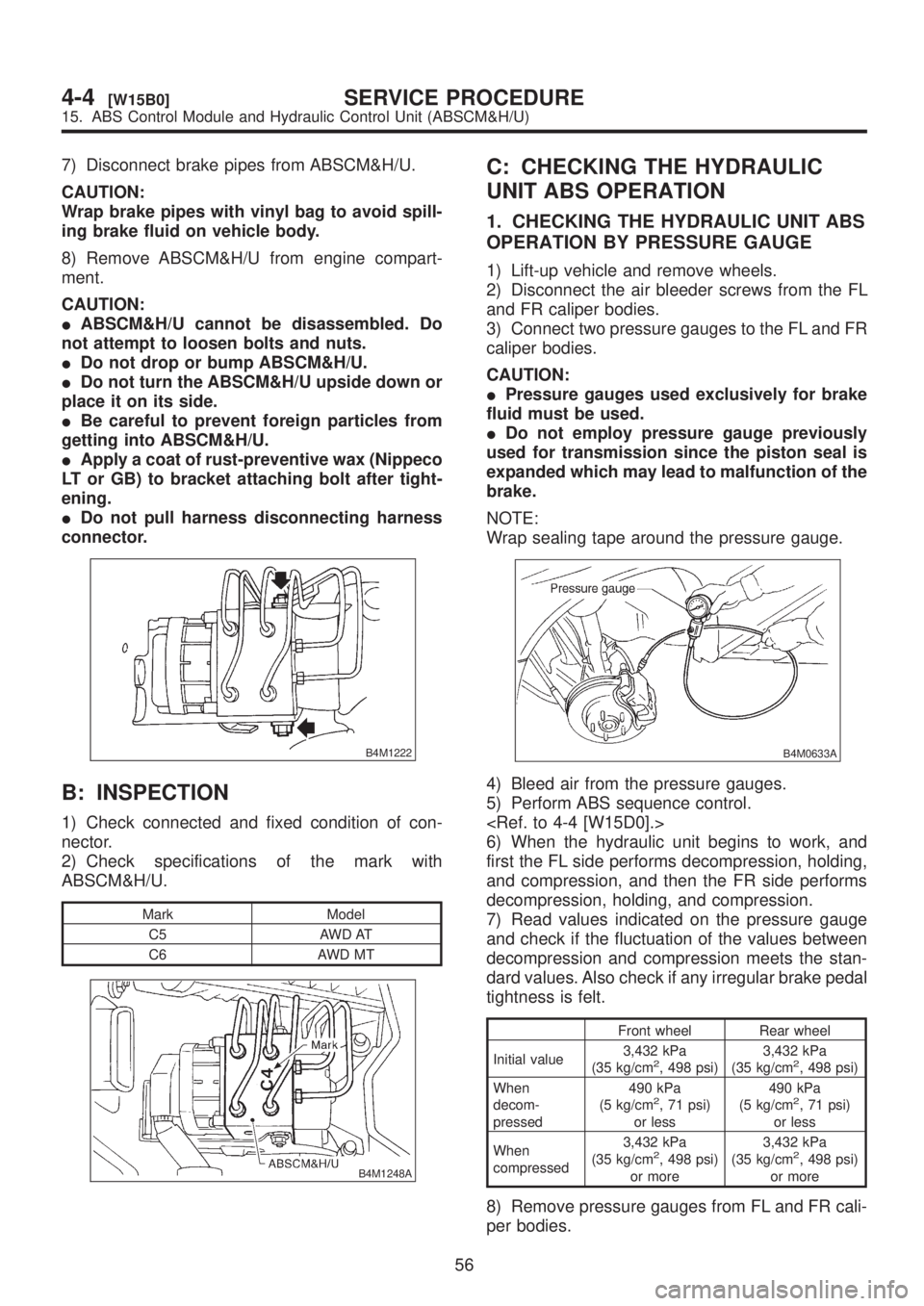
7) Disconnect brake pipes from ABSCM&H/U.
CAUTION:
Wrap brake pipes with vinyl bag to avoid spill-
ing brake fluid on vehicle body.
8) Remove ABSCM&H/U from engine compart-
ment.
CAUTION:
IABSCM&H/U cannot be disassembled. Do
not attempt to loosen bolts and nuts.
IDo not drop or bump ABSCM&H/U.
IDo not turn the ABSCM&H/U upside down or
place it on its side.
IBe careful to prevent foreign particles from
getting into ABSCM&H/U.
IApply a coat of rust-preventive wax (Nippeco
LT or GB) to bracket attaching bolt after tight-
ening.
IDo not pull harness disconnecting harness
connector.
B4M1222
B: INSPECTION
1) Check connected and fixed condition of con-
nector.
2) Check specifications of the mark with
ABSCM&H/U.
Mark Model
C5 AWD AT
C6 AWD MT
B4M1248A
C: CHECKING THE HYDRAULIC
UNIT ABS OPERATION
1. CHECKING THE HYDRAULIC UNIT ABS
OPERATION BY PRESSURE GAUGE
1) Lift-up vehicle and remove wheels.
2) Disconnect the air bleeder screws from the FL
and FR caliper bodies.
3) Connect two pressure gauges to the FL and FR
caliper bodies.
CAUTION:
IPressure gauges used exclusively for brake
fluid must be used.
IDo not employ pressure gauge previously
used for transmission since the piston seal is
expanded which may lead to malfunction of the
brake.
NOTE:
Wrap sealing tape around the pressure gauge.
B4M0633A
4) Bleed air from the pressure gauges.
5) Perform ABS sequence control.
6) When the hydraulic unit begins to work, and
first the FL side performs decompression, holding,
and compression, and then the FR side performs
decompression, holding, and compression.
7) Read values indicated on the pressure gauge
and check if the fluctuation of the values between
decompression and compression meets the stan-
dard values. Also check if any irregular brake pedal
tightness is felt.
Front wheel Rear wheel
Initial value3,432 kPa
(35 kg/cm
2, 498 psi)3,432 kPa
(35 kg/cm2, 498 psi)
When
decom-
pressed490 kPa
(5 kg/cm
2, 71 psi)
or less490 kPa
(5 kg/cm2, 71 psi)
or less
When
compressed3,432 kPa
(35 kg/cm
2, 498 psi)
or more3,432 kPa
(35 kg/cm2, 498 psi)
or more
8) Remove pressure gauges from FL and FR cali-
per bodies.
56
4-4[W15B0]SERVICE PROCEDURE
15. ABS Control Module and Hydraulic Control Unit (ABSCM&H/U)