light SUBARU LEGACY 2005 4.G Owners Manual
[x] Cancel search | Manufacturer: SUBARU, Model Year: 2005, Model line: LEGACY, Model: SUBARU LEGACY 2005 4.GPages: 627, PDF Size: 6.42 MB
Page 458 of 627
9-3
In case of emergency
– CONTINUED –
Temporary spare tire
"Never tow a trailer when the temporary spare
tire is used. The temporary spare tire is not de-
signed to sustain the towing load. Use of the
temporary spare tire when towing can result in
failure of the spare tire and/or less stability of
the vehicle and may lead to an accident. " When a spare tire is mounted or a wheel rim
is replaced without the original pressure sen-
sor/transmitter being transferred, the low tire
pressure warning light will flash. This indicates
the tire pressure monitoring system (TPMS) is
unable to monitor all four road wheels. Contact
your SUBARU dealer as soon as possible for
tire and sensor replacement and/or system re-
setting.
Never use any temporary spare tire other than
the original. Using other sizes may result in se-
vere mechanical damage to the drive train of
your vehicle.
The temporary spare tire is smaller and lighter than a
conventional tire and is designed for emergency use
only. Remove the temporary spare tire and re-install
the conventional tire as soon as possible because the
spare tire is designed only for temporary use.
Check the inflation pressure of the temporary spare
tire periodically to keep the tire ready for use. The cor-
rect pressure is 60 psi (420 kPa, 4.2 kgf/cm 2
).
When using the temporary spare tire, note the follow-
ing: " Do not exceed 50 mph (80 km/h).
" Do not put a tire chain on the temporary spare tire.
Because of the smaller tire size, a tire chain will not fit
properly. " Do not use two or more temporary spare tires at the
same time. " Do not drive over obstacles. This tire has a smaller
diameter, so road clearance is reduced.
Page 459 of 627
9-4
In case of emergency
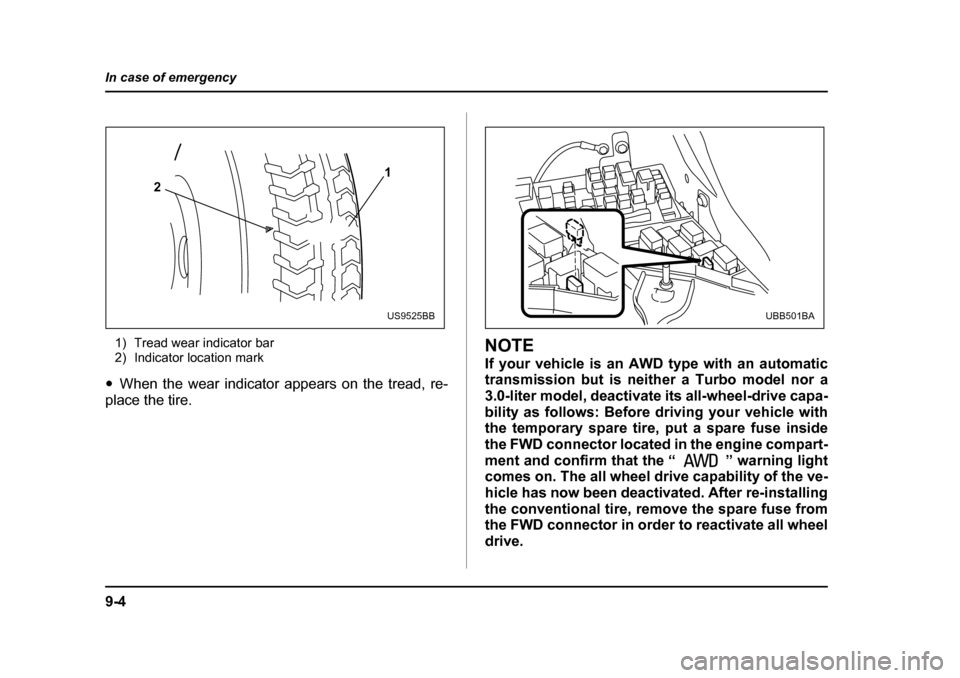
1) Tread wear indicator bar
2) Indicator location mark
" When the wear indicator appears on the tread, re-
place the tire.NOTE
If your vehicle is an AWD type with an automatic
transmission but is neither a Turbo model nor a
3.0-liter model, deactivate its all-wheel-drive capa-
bility as follows: Before driving your vehicle with
the temporary spare tire, put a spare fuse inside
the FWD connector located in the engine compart-
ment and confirm that the “ ” warning light
comes on. The all wheel drive capability of the ve-
hicle has now been deactivated. After re-installing
the conventional tire, remove the spare fuse from
the FWD connector in order to reactivate all wheel
drive.
1
2
US9525BBUBB501BA
Page 471 of 627
9-16
In case of emergency
cations.
Never place a tire or tire changing tools in the
passenger compartment after changing
wheels. In a sudden stop or collisions, loose
equipment could strike occupants and cause
injury. Store the tire and all tools in the proper
place.
! Tire pressure monitoring system
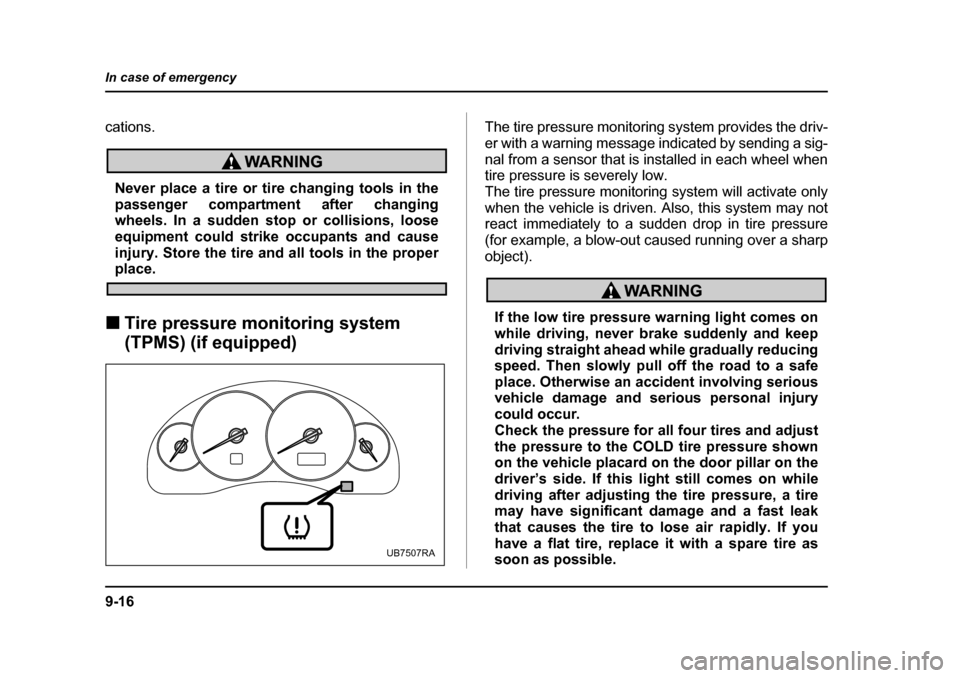
(TPMS) (if equipped) The tire pressure monitoring system provides the driv-
er with a warning message indicated by sending a sig-
nal from a sensor that is installed in each wheel when
tire pressure is severely low.
The tire pressure monitoring system will activate only
when the vehicle is driven. Also, this system may not
react immediately to a sudden drop in tire pressure
(for example, a blow-out caused running over a sharp
object).
If the low tire pressure warning light comes on
while driving, never brake suddenly and keep
driving straight ahead while gradually reducing
speed. Then slowly pull off the road to a safe
place. Otherwise an accident involving serious
vehicle damage and serious personal injury
could occur.
Check the pressure for all four tires and adjust
the pressure to the COLD tire pressure shown
on the vehicle placard on the door pillar on the
driver’s side. If this light still comes on while
driving after adjusting the tire pressure, a tire
may have significant damage and a fast leak
that causes the tire to lose air rapidly. If you
have a flat tire, replace it with a spare tire as
soon as possible.
UB7507RA
Page 472 of 627
9-17
In case of emergency
– CONTINUED –
When a spare tire is mounted or a wheel rim is
replaced without the original pressure sensor/
transmitter being transferred, the low tire pres-
sure warning light will flash. This indicates the
TPMS is unable to monitor all four road wheels.
Contact your SUBARU dealer as soon as possi-
ble for tire and sensor replacement and/or sys-
tem resetting.
Do not inject any tire liquid or aerosol tire seal-
ant into the tires, as this may cause a malfunc-
tion of the tire pressure sensors.
If the light flashes, promptly contact a SUBARU
dealer to have the system inspected.
Jump starting
"Battery fluid is SULFURIC ACID. Do not let it
come in contact with the eyes, skin, clothing or
the vehicle.
If battery fluid gets on you, thoroughly flush the
exposed area with water immediately. Get med-
ical help if the fluid has entered your eyes.
If battery fluid is accidentally swallowed, imme-
diately drink a large amount of milk or water,
and obtain immediate medical help.
Keep everyone including children away from the battery." The gas generated by a battery explodes if a
flame or spark is brought near it. Do not smoke
or light a match while jump starting." Never attempt jump starting if the discharged
battery is frozen. It could cause the battery to
burst or explode." Whenever working on or around a battery, al-
ways wear suitable eye protectors, and remove
metal objects such as rings, bands or other
metal jewelry. " Be sure the jumper cables and clamps on
them do not have loose or missing insulation.
Page 473 of 627

9-18
In case of emergency
Do not jump start unless cables in suitable con-
dition are available."
A running engine can be dangerous. Keep
your fingers, hands, clothing, hair and tools
away from the cooling fan, belts and any other
moving engine parts. Removing rings, watches
and ties is advisable. " Jump starting is dangerous if it is done incor-
rectly. If you are unsure about the proper proce-
dure for jump starting, consult a competent me-
chanic.
When your vehicle does not start due to a run down
(discharged) battery, the vehicle may be jump started
by connecting your battery to another battery (called
the booster battery) with jumper cables. ! How to jump start
1. Make sure the booster battery is 12 volts and the
negative terminal is grounded.
2. If the booster battery is in another vehicle, do not let
the two vehicles touch.
3. Turn off all unnecessary lights and accessories.
4. Connect the jumper cables exactly in the sequence
illustrated.
Page 477 of 627
9-22
In case of emergency
dealer or a commercial towing service. Observe the
following procedures for safety. !
Towing and tie-down hooks
The towing hooks should be used only in an emergen-
cy (e.g., to free a stuck vehicle from mud, sand or
snow).
" Use only the specified towing hooks and tie-
down hooks. Never use suspension parts or
other body parts for towing or tie-down purpos-
es. " Never use the tie-down hook closest to the
muffler under the vehicle for towing purposes. " To prevent deformation to the bumper and
the towing hook, do not apply excessive lateral
load to the towing hooks.
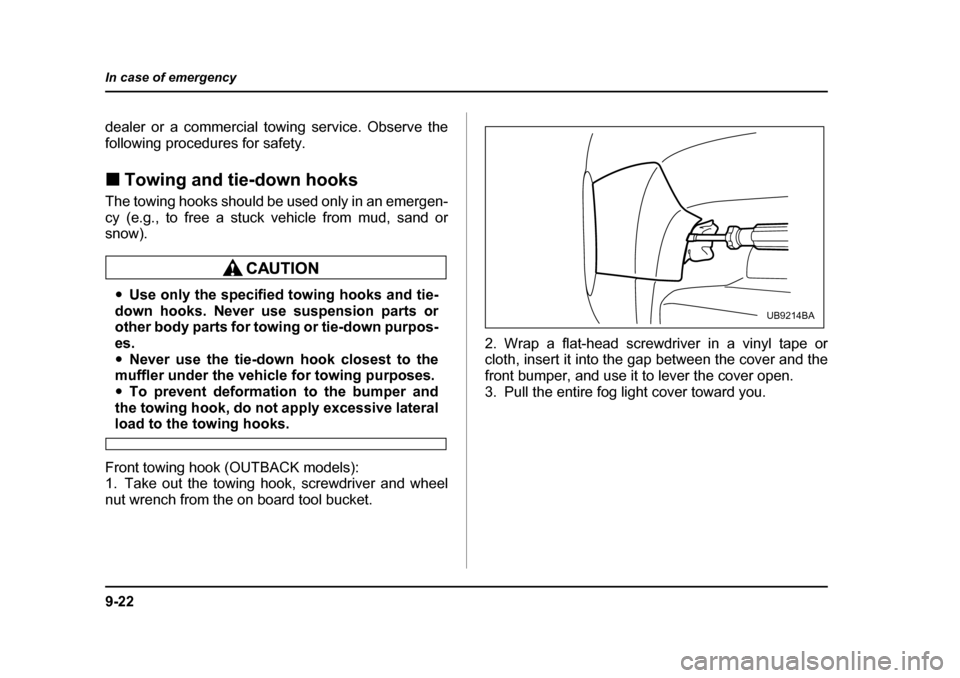
Front towing hook (OUTBACK models):
1. Take out the towing hook, screwdriver and wheel
nut wrench from the on board tool bucket. 2. Wrap a flat-head screwdriver in a vinyl tape or
cloth, insert it into the gap between the cover and the
front bumper, and use it to lever the cover open.
3. Pull the entire fog light cover toward you.
UB9214BA
Page 479 of 627
9-24
In case of emergency
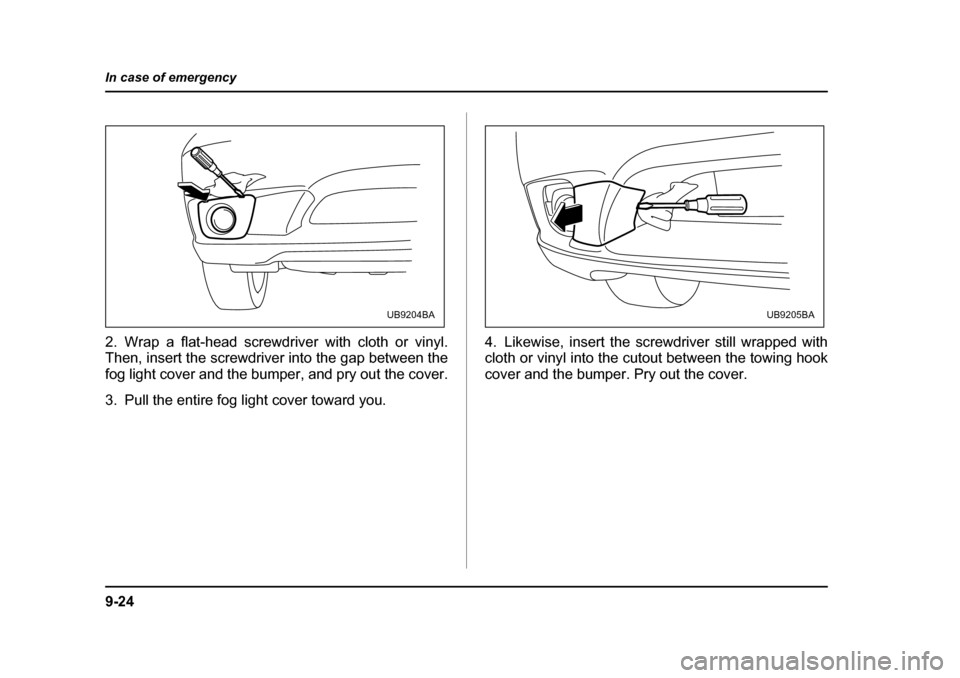
2. Wrap a flat-head screwdriver with cloth or vinyl.
Then, insert the screwdriver into the gap between the
fog light cover and the bumper, and pry out the cover.
3. Pull the entire fog light cover toward you.
4. Likewise, insert the screwdriver still wrapped with
cloth or vinyl into the cutout between the towing hook
cover and the bumper. Pry out the cover.
UB9204BAUB9205BA
Page 480 of 627
9-25
In case of emergency
– CONTINUED –
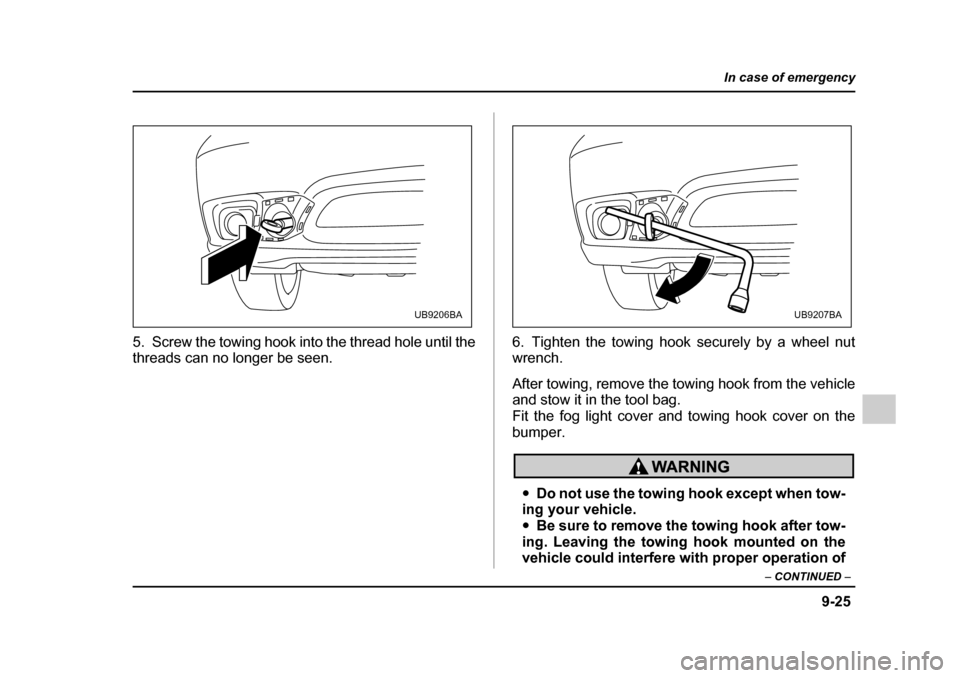
5. Screw the towing hook into the thread hole until the
threads can no longer be seen. 6. Tighten the towing hook securely by a wheel nut
wrench.
After towing, remove the towing hook from the vehicle
and stow it in the tool bag.
Fit the fog light cover and towing hook cover on the
bumper.
"
Do not use the towing hook except when tow-
ing your vehicle. " Be sure to remove the towing hook after tow-
ing. Leaving the towing hook mounted on the
vehicle could interfere with proper operation of
UB9206BAUB9207BA
Page 485 of 627
9-30
In case of emergency
Moonroof – if the moonroof cannot be
closed
If the moonroof cannot be closed with the moonroof
switch, you can close the moonroof manually.
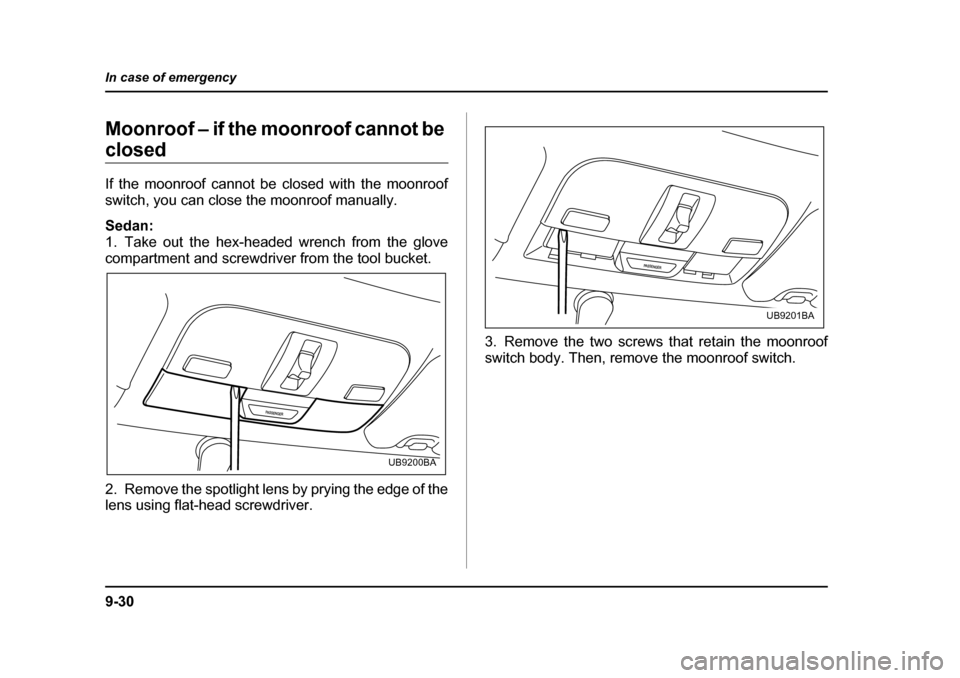
Sedan:
1. Take out the hex-headed wrench from the glove
compartment and screwdriver from the tool bucket.
2. Remove the spotlight lens by prying the edge of the
lens using flat-head screwdriver.
3. Remove the two screws that retain the moonroof
switch body. Then, remove the moonroof switch.
PASSENGER
UB9200BA
PASSENGER
UB9201BA
Page 493 of 627
10-2
Appearance care
Appearance careExterior care !
Washing
"When washing the vehicle, the brakes may
get wet. As a result, the brake stopping dis-
tance will be longer. To dry the brakes, drive the
vehicle at a safe speed while lightly pressing
the brake pedal to heat up the brakes." Do not wash the engine compartment and ar-
eas adjacent to it. If water enters the engine air
intake, electrical parts or the power steering flu-
id reservoir, it will cause engine trouble or
faulty power steering respectively.
The best way to preserve your vehicle’s beauty is fre-
quent washing. Wash the vehicle at least once a
month to avoid contamination by road grime.
Wash dirt off with a wet sponge and plenty of luke-
warm or cold water. Do not wash the vehicle with hot
water and in direct sunlight.
Salt, chemicals, insects, tar, soot and bird droppings
should be washed off by using a light detergent, as re- quired. If you use a light detergent, make certain that
it is a neutral detergent. Do not use strong soap or
chemical detergents. All cleaning agents should be
promptly flushed from the surface and not allowed to
dry there. Rinse the vehicle thoroughly with plenty of
lukewarm water. Wipe the remaining water off with a
chamois or soft cloth.
NOTE
When having your vehicle washed in an automatic
car wash, make sure beforehand that the car wash
is of suitable type. Automatic car wash brushes or
other equipment may damage the rear wiper and
rear/roof spoiler (if equipped). !
Washing the underbody
Chemicals, salts and gravel used for deicing road sur-
faces are extremely corrosive, accelerating the corro-
sion of underbody components, such as the exhaust
system, fuel and brake lines, brake cables, floor pan
and fenders, and suspension.
Thoroughly flush the underbody and inside of the
fenders with lukewarm or cold water at frequent inter-
vals to reduce the harmful effects of such agents.
Mud and sand adhering to the underbody components may accelerate their corrosion.
After driving off-road or muddy or sandy roads, wash