cvt SUBARU LEGACY 2012 5.G Owner's Guide
[x] Cancel search | Manufacturer: SUBARU, Model Year: 2012, Model line: LEGACY, Model: SUBARU LEGACY 2012 5.GPages: 474, PDF Size: 17.45 MB
Page 359 of 474
9-16In case of emergency
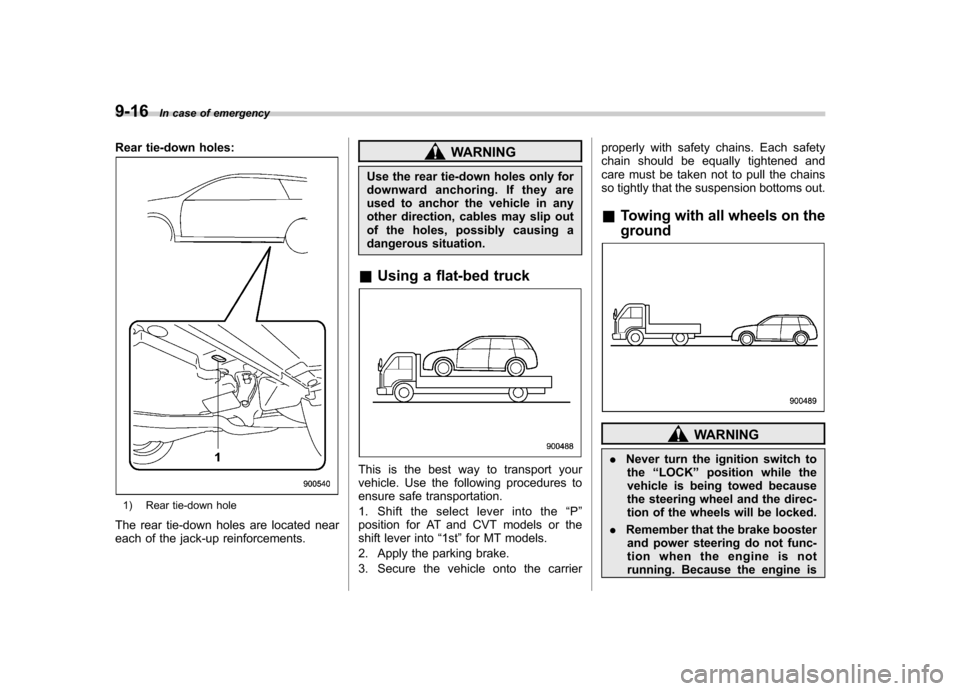
Rear tie-down holes:
1) Rear tie-down hole
The rear tie-down holes are located near
each of the jack-up reinforcements.
WARNING
Use the rear tie-down holes only for
downward anchoring. If they are
used to anchor the vehicle in any
other direction, cables may slip out
of the holes, possibly causing a
dangerous situation.
& Using a flat-bed truck
This is the best way to transport your
vehicle. Use the following procedures to
ensure safe transportation.
1. Shift the select lever into the “P ”
position for AT and CVT models or the
shift lever into “1st ”for MT models.
2. Apply the parking brake.
3. Secure the vehicle onto the carrier properly with safety chains. Each safety
chain should be equally tightened and
care must be taken not to pull the chains
so tightly that the suspension bottoms out. &
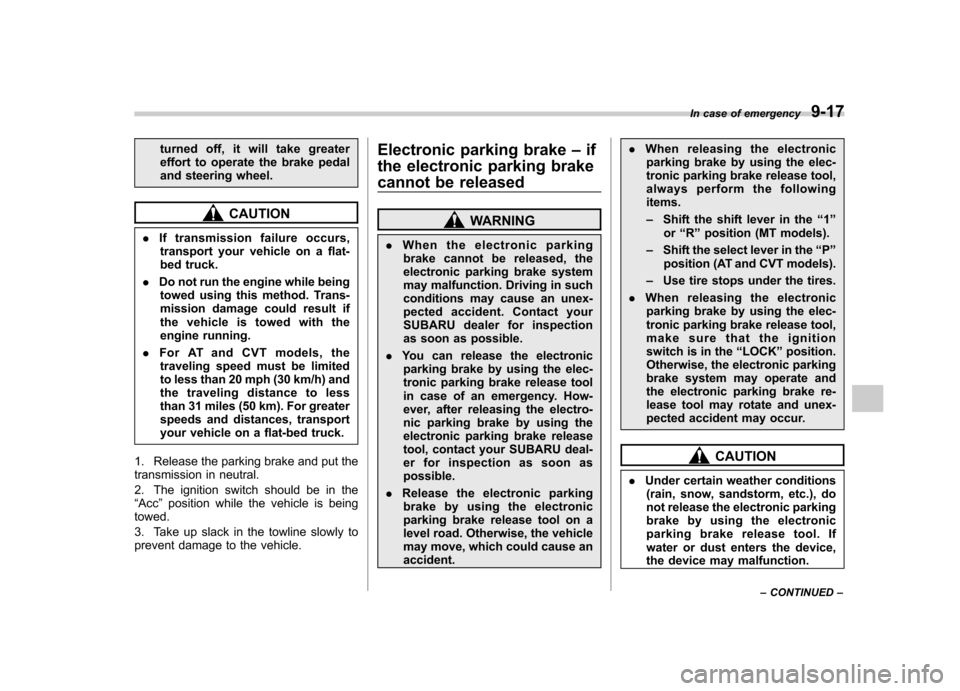
Towing with all wheels on the ground
WARNING
. Never turn the ignition switch to
the “LOCK ”position while the
vehicle is being towed because
the steering wheel and the direc-
tion of the wheels will be locked.
. Remember that the brake booster
and power steering do not func-
tion when the engine is not
running. Because the engine is
Page 360 of 474
turned off, it will take greater
effort to operate the brake pedal
and steering wheel.
CAUTION
. If transmission failure occurs,
transport your vehicle on a flat-
bed truck.
. Do not run the engine while being
towed using this method. Trans-
mission damage could result if
the vehicle is towed with the
engine running.
. For AT and CVT models, the
traveling speed must be limited
to less than 20 mph (30 km/h) and
the traveling distance to less
than 31 miles (50 km). For greater
speeds and distances, transport
your vehicle on a flat-bed truck.
1. Release the parking brake and put the
transmission in neutral.
2. The ignition switch should be in the “ Acc ”position while the vehicle is being
towed.
3. Take up slack in the towline slowly to
prevent damage to the vehicle. Electronic parking brake
–if
the electronic parking brake
cannot be releasedWARNING
. When the electronic parking
brake cannot be released, the
electronic parking brake system
may malfunction. Driving in such
conditions may cause an unex-
pected accident. Contact your
SUBARU dealer for inspection
as soon as possible.
. You can release the electronic
parking brake by using the elec-
tronic parking brake release tool
in case of an emergency. How-
ever, after releasing the electro-
nic parking brake by using the
electronic parking brake release
tool, contact your SUBARU deal-
er for inspection as soon aspossible.
. Release the electronic parking
brakebyusingtheelectronic
parking brake release tool on a
level road. Otherwise, the vehicle
may move, which could cause anaccident. .
When releasing th e electronic
parking brake by using the elec-
tronic parking brake release tool,
always perform the followingitems. – Shift the shift lever in the “1 ”
or “R ” position (MT models).
– Shift the select lever in the “P ”
position (AT and CVT models).
– Use tire stops under the tires.
. When releasing th e electronic
parking brake by using the elec-
tronic parking brake release tool,
make sure that the ignition
switch is in the “LOCK ”position.
Otherwise, the electronic parking
brake system may operate and
the electronic parking brake re-
lease tool may rotate and unex-
pected accident may occur.
CAUTION
. Under certain weather conditions
(rain, snow, sandstorm, etc.), do
not release the electronic parking
brakebyusingtheelectronic
parking brake release tool. If
water or dust enters the device,
the device may malfunction. In case of emergency
9-17
– CONTINUED –
Page 361 of 474
9-18In case of emergency
.If the cap cannot be removed,
contact your SUBARU dealer for inspection.
. After releasing the electronic
parking brake by using the elec-
tronic parking brake release tool,
make sure that the cap is rein-
stalled to the parking brake re-
lease device. If the cap is not
reinstalled, water or dust enters
the device and the device maymalfunction.
NOTE
It may be difficult to release the elec-
tronic parking brake by using the
electronic parking brake release tool.
Have your SUBARU dealer release the
electronic parking brake if necessary.
In the event that you cannot release the
electronic parking brake by pulling the
electronic parking brake switch or by
depressing the accelerator pedal, you
can release the electronic parking brake
manually by using the electronic parking
brake release tool.
1. Shift the shift lever in the “1 ” or “R ”
position (MT models) or the select lever in the “P ”position (AT and CVT models).
2. Turn the ignition switch to the “LOCK ”
position. 3. Make sure that the brake system
warning light and the indicator light on
the parking brake switch have turned off.
4. Use tire stops under the tires to
prevent the vehicle from moving.
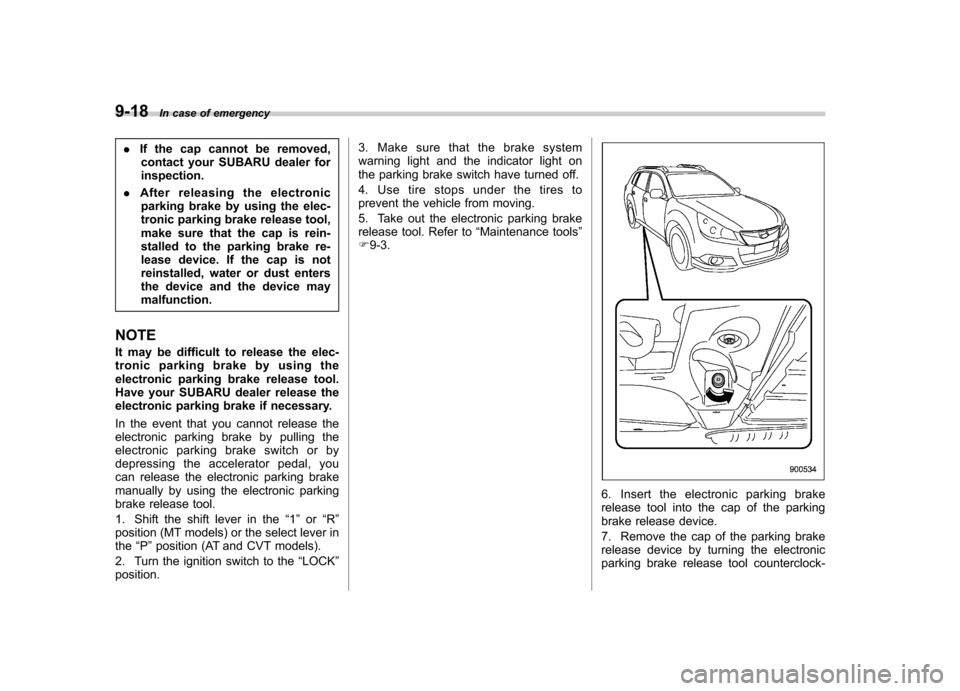
5. Take out the electronic parking brake
release tool. Refer to
“Maintenance tools ”
F 9-3.
6. Insert the electronic parking brake
release tool into the cap of the parking
brake release device.
7. Remove the cap of the parking brake
release device by turning the electronic
parking brake release tool counterclock-
Page 372 of 474
Maintenance schedule....................................... 11-3
Maintenance precautions ................................... 11-3
Before checking or servicing in the engine compartment .................................................... 11-4
When checking or servicing in the engine compartment (2.5 L non-turbo models) .. ........... 11-4
When checking or servicing in the engine compartment while the engine is running .......... 11-5
Maintenance tips ................................................ 11-5
Removing and reinstalling clips .......................... 11-5
Removing air intake duct .................................... 11-7
Pulling off the fender lining ................................ 11-7
Engine hood ....................................................... 11-7
Engine compartment overview .......................... 11-9
2.5 L non-turbo models ...................................... 11-9
2.5 L turbo models ........................................... 11-10
3.6 L models .................................................... 11-11
Engine oil .......................................................... 11-12
Checking the oil level ....................................... 11-12
Changing the oil and oil filter ............................ 11-14
Recommended grade and viscosity .................. 11-16
Synthetic oil ..................................................... 11-16
Cooling system ................................................ 11-16
Cooling fan, hose and connections ................... 11-17
Engine coolant ................................................. 11-17
Air cleaner element .......................................... 11-18
Replacing the air cleaner element ..................... 11-18
Spark plugs ...................................................... 11-20
Recommended spark plugs .............................. 11-20
Drive belts ........................................................ 11-21 Manual transmission oil
.................................. 11-21
Recommended grade and viscosity .................. 11-21
Automatic transmission fluid .......................... 11-21
Checking the fluid level .................................... 11-21
Recommended fluid ......................................... 11-22
Continuously variable transmission fluid ...... 11-23
Front differential gear oil (AT and CVT models) .......................................................... 11-23
Checking the oil level ...................................... 11-23
Recommended grade and viscosity .................. 11-24
Rear differential gear oil .................................. 11-24
Recommended grade and viscosity .................. 11-24
Power steering fluid ........................................ 11-24
Checking the fluid level .................................... 11-24
Recommended fluid ......................................... 11-25
Brake fluid ........................................................ 11-25
Checking the fluid level .................................... 11-25
Recommended brake fluid ............................... 11-26
Clutch fluid (MT models) ................................. 11-26
Checking the fluid level .................................... 11-26
Recommended clutch fluid ............................... 11-27
Brake booster .................................................. 11-27
Brake pedal ...................................................... 11-28
Checking the brake pedal free play .................. 11-28
Checking the brake pedal reserve distance....... 11-28
Clutch pedal (MT models) ............................... 11-29
Checking the clutch function ............................ 11-29
Checking the clutch pedal free play .................. 11-29
Replacement of brake pad and lining ............ 11-29
Breaking-in of new brake pads and linings ....... 11-30 Maintenance and service
11
Page 394 of 474

Continuously variable trans-
mission fluid
There is no fluid level gauge. It is
unnecessary to check the continuously
variable transmission fluid level. However,
if necessary, consult your SUBARU dealer
for inspection.Front differential gear oil
(AT and CVT models) &
Checking the oil level
! AT models
1) Yellow handle
1. Park the vehicle on a level surface and
stop the engine.
2. Pull out the level gauge, wipe it clean,
and insert it again.
1) Upper level
2) Lower level
3. Pull out the level gauge again and
check the oil level on it. If it is below the
lower level, add oil to bring the level up to
the upper level.
CAUTION
Be careful not to spill front differ-
ential gear oil when adding it. If oil
touches the exhaust pipe, it may
cause a bad smell, smoke, and/or a
fire. If oil gets on the exhaust pipe,
be sure to wipe it off. Maintenance and service
11-23
– CONTINUED –
Page 395 of 474
11-24Maintenance and service
!CVT models
There is no oil level gauge. To check the
front differential gear oil level, we recom-
mend that you consult your SUBARU
dealer for inspection. & Recommended grade and viscosity
Each oil manufacturer has its own base
oils and additives. Never use different
brands together. For details, refer to“ Manual transmission, front differential
and rear differential gear oil ”F 12-7. Rear differential gear oil
There is no oil level gauge. To check the
rear differential gear oil level, we recom-
mend that you consult your SUBARU
dealer for inspection. &
Recommended grade and viscosity
Each oil manufacturer has its own base
oils and additives. Never use different
brands together. For details, refer to“ Manual transmission, front differential
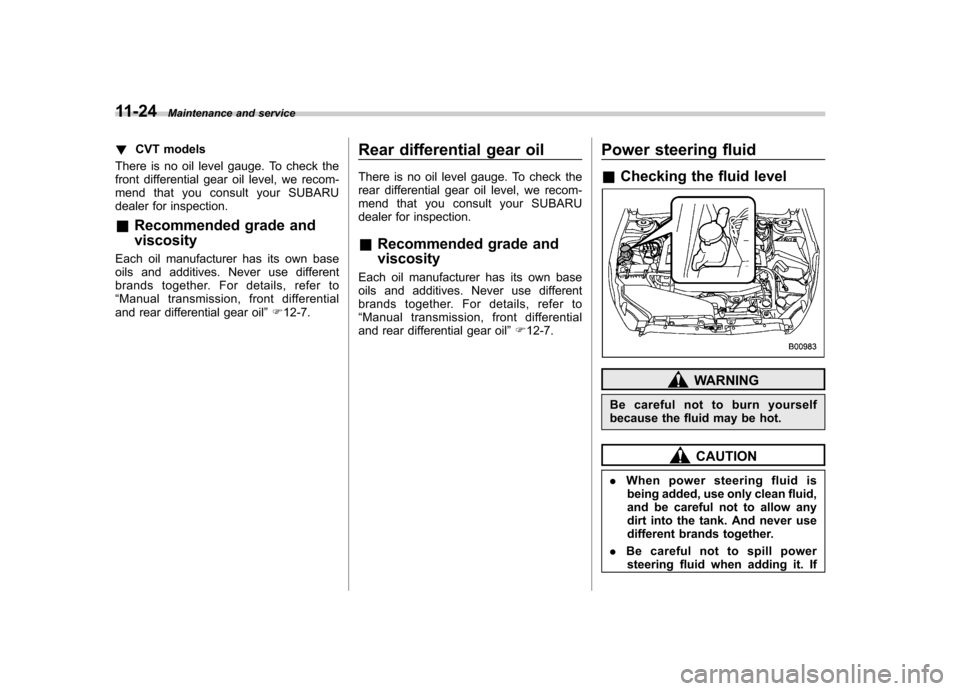
and rear differential gear oil ”F 12-7. Power steering fluid &
Checking the fluid level
WARNING
Be careful not to burn yourself
because the fluid may be hot.
CAUTION
. When power steering fluid is
being added, use only clean fluid,
and be careful not to allow any
dirt into the tank. And never use
different brands together.
. Be careful not to spill power
steering fluid when adding it. If
Page 429 of 474

12-2Specifications
Specifications
These specifications are subject to change without notice. &Dimensions
in (mm)
Item Legacy
Outback
2.5 L non-turbo 2.5 L turbo 3.6 L 2.5 L non-turbo
3.6 L
Drive system AWD
Transmission type MT CVT MT AT MT CVT AT
Overall length 186.4 (4,735) 188.2 (4,780)
Overall width 71.7 (1,820) 71.7 (1,820)
Overall height 59.3 (1,505) 66.1 (1,680)
*2
65.7 (1,670)*3
Wheelbase
108.3 (2,750) 107.9 (2,740)
Tread Front 61.6 (1,565) 61.0 (1,550) 61.6 (1,565) 61.0 (1,550)
Rear 61.8 (1,570) 61.2 (1,555) 61.8 (1,570) 61.0 (1,550)
Ground clearance
*15.9 (150) 8.7 (220)
*1: Measured with vehicle empty
*2: Measured when roof rails are used as crossbars
*3: Measured when roof rails are not used as crossbars
AT: Automatic transmission
MT: Manual transmission
CVT: Continuously variable transmission
AWD: All-Wheel Drive
Page 434 of 474

&Manual transmission, front differential and rear differential gear oil
Oil grade API classification GL-5
SAE viscosity No. and applicable temperature
Oil capacity*1
– Remarks*2
Manual transmission oil 3.9 US qt (3.7 liters, 3.3 Imp qt) “Manual transmission oil ”F 11-21
Front differential gear oil
(AT and CVT models) 1.5 US qt (1.4 liters, 1.2 Imp qt)“
Front differential gear oil (AT and
CVT models) ”F 11-23
Rear differential gear oil 0.8 US qt (0.8 liters, 0.7 Imp qt) “
Rear differential gear oil ”F 11-24
*1: The indicated oil quantity is only a guideline. The necessary quantity for replacement may differ slightly depending on the temperature and other
factors. After refilling the gearbox with oil, the oil level should be checked.
*2: For more details about maintenance and service, refer to the indicated section. Specifications
12-7
– CONTINUED –
Page 435 of 474

12-8Specifications
&Fluids
Fluid Fluid type*
1Fluid capacity*2Remarks*3
Automatic transmission fluid (5AT models) · SUBARU ATF
· IDEMITSU ATF HP
10.4 US qt (9.8 liters, 8.6 Imp qt)“
Automatic transmission fluid ”
F 11-21
Continuously variable transmission
fluid (CVT models) Consult your SUBARU dealer. 13.2 US qt (12.5 liters, 11.0 Imp qt) “
Continuously variable trans-
mission fluid ”F 11-23
Power steering fluid · SUBARU ATF
· IDEMITSU ATF HP ·“Dexron III ”Type Automatic
Transmission Fluid 0.7 US qt (0.7 liters, 0.6 Imp qt)
·
“Power steering ”F 7-23
· “Power steering fluid ”F 11-24
Brake fluid FMVSS No. 116, fresh DOT 3 or DOT 4
brake fluid –“
Brake fluid ”F 11-25
Clutch fluid (MT models) FMVSS No. 116, fresh DOT 3 or DOT 4
brake fluid –“
Clutch fluid (MT models) ”F 11 -
26
*1: Use one of the indicated types of fluid.
*2: The indicated fluid quantity is only a guideline. The necessary quantity for replacement may differ slightly depending on the temperature and other factors.
*3: For more details about maintenance and service, refer to the indicated section. & Engine coolant
Vehicle model Coolant capacity Coolant type
2.5 L non-turbo models MT models 6.9 US qt (6.5 liters, 5.7 Imp qt)
SUBARU Super Coolant
CVT models 6.8 US qt (6.4 liters, 5.6 Imp qt)
2.5 L turbo models 6.9 US qt (6.5 liters, 5.7 Imp qt)
3.6 L models 6.9 US qt (6.5 liters, 5.7 Imp qt)
The indicated coolant quantity is only a guideline. The necessary quantity for replacement may differ slightly depending on the temperature and other
factors. For more details about maintenance and service, refer to “Cooling system ”F 11-16.
Page 439 of 474
12-12Specifications
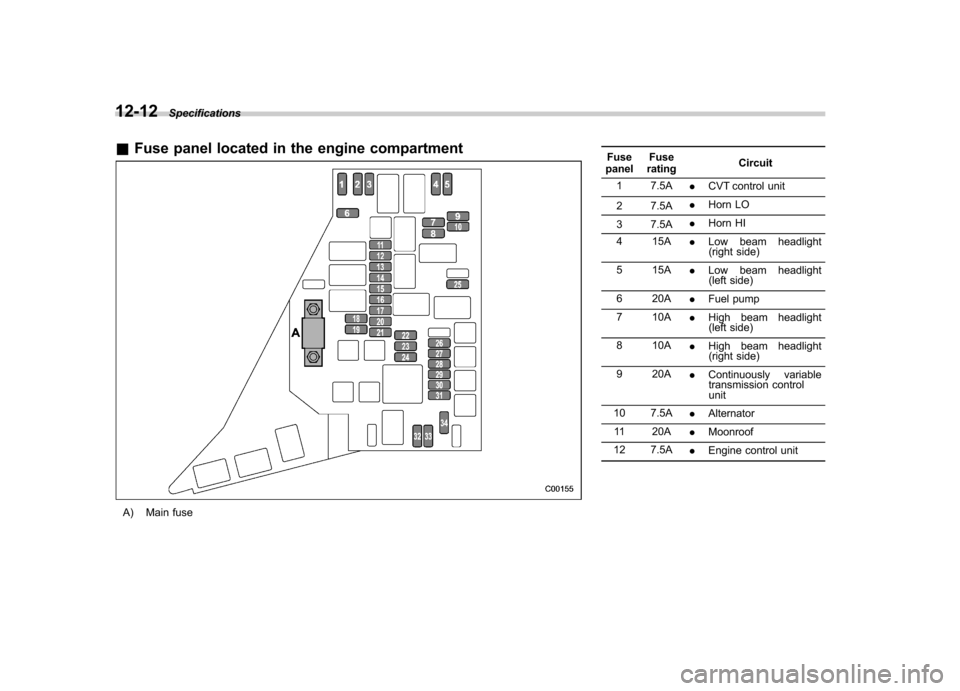
&Fuse panel located in the engine compartment
A) Main fuse Fuse
panel Fuse
rating Circuit
1 7.5A .CVT control unit
2 7.5A .
Horn LO
3 7.5A .
Horn HI
4 15A .Low beam headlight
(right side)
5 15A .Low beam headlight
(left side)
6 20A .Fuel pump
7 10A .High beam headlight
(left side)
8 10A .High beam headlight
(right side)
9 20A .Continuously variable
transmission control unit
10 7.5A .Alternator
11 20A .Moonroof
12 7.5A .Engine control unit