ESP SUBARU OUTBACK 2002 3.G Owner's Guide
[x] Cancel search | Manufacturer: SUBARU, Model Year: 2002, Model line: OUTBACK, Model: SUBARU OUTBACK 2002 3.GPages: 466
Page 368 of 466
Appearance care10-5
–
CONTINUED –
the fog light’s horizontal center line. Then, turn the protector clockwise
until it stops. Finally, check that the protector ’s horizontal bars are parallel
with the fog light ’s horizontal center line.
Corrosion protection
Your SUBARU has been designed and built to resist corrosion. Special
materials and protective finishes have been used on most parts of the
vehicle to help maintain fine appearance, strength, and reliable opera-tion. Most common causes of corrosion
The most common causes of corrosion are:
1. The accumulation of moisture retaining dirt and debris in body
panel sections, cavities, and other areas.
2. Damage to paint and other protective coatings caused by graveland stone chips or minor accidents.
Corrosion is accelerated on the vehicle when:
1. It is exposed to road salt or dust control chemicals, or used in
coastal areas where there is more salt in the air, or in areas where
there is considerable industrial pollution.
2. It is driven in areas of high humidity, especially when temperatures
range just above freezing.
3. Dampness in certain parts of the vehicle remains for a long time,
even though other parts of the vehicle may be dry.
4. High temperatures will cause corrosion to parts of the vehicle
which cannot dry quickly due to lack of proper ventilation. To help prevent corrosion
Wash the vehicle frequently. If you drive on salted roads in the winter
or if you live in a coastal area, you should flush the underbody with
fresh water frequently.
After the winter has ended, it is recommended that the underbody be
given a very thorough washing.
Page 384 of 466
11-14
Cooling systemWARNING
Never attempt to remove the radiator cap until the engine has
been shut off and has cooled down completely. Since the coolantis under pressure, you may suffer serious burns from a spray ofboiling hot coolant when the cap is removed.
CAUTION
The cooling system has been filled at the factory with a high
quality, corrosion-inhibiting, year-around coolant which providesprotection against freezing down to –33°F ( –36 °C). For adding,
use genuine SUBARU coolant or an equivalent: a mixture of 50%
soft water and 50% ethylene-glycol basis coolant. Use of improp-er coolants may result in corrosion in the cooling system. It is im-portant to maintain protection against freezing and corrosion,even if freezing temperatures are not expected. Never mix differ-ent kinds of coolant. Do not splash the engine coolant over painted parts. The alco-
hol contained in the engine coolant may damage the paint sur-face.
Hose and connections
Your vehicle employs an electric cooling fan which is thermostatically
controlled to operate when the engine coolant reaches a specific tem-
perature.If the radiator cooling fan does not operate even when the engine
coolant temperature gauge exceeds the normal operating range, the
cooling fan circuit may be defective. Check the fuse and replace it if
necessary. If the fuse is not blown, have the cooling system checked
by your SUBARU dealer.
If frequent addition of coolant is necessary, there may be a leak in the
engine cooling system. It is recommended that the cooling systemand connections be checked for leaks, damage, or looseness.
Page 406 of 466
11-36
Replacement of brake pad and liningCAUTION
If you continue to drive despite the scraping noise from the audi-
ble brake pad wear indicator, it will result in the need for costlybrake rotor repair or replacement.
OM-H0163
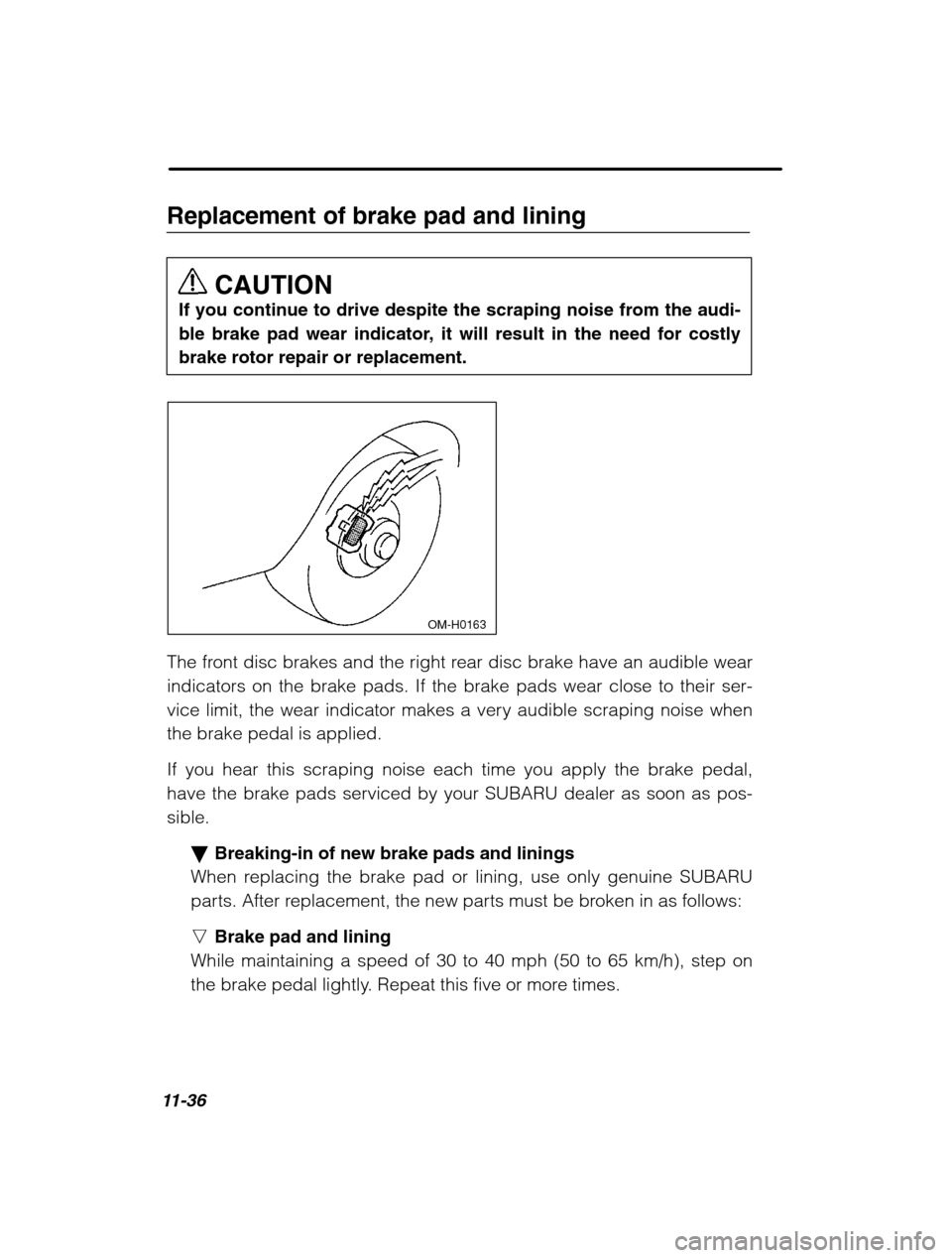
The front disc brakes and the right rear disc brake have an audible wear
indicators on the brake pads. If the brake pads wear close to their ser-
vice limit, the wear indicator makes a very audible scraping noise whenthe brake pedal is applied.
If you hear this scraping noise each time you apply the brake pedal, have the brake pads serviced by your SUBARU dealer as soon as pos-sible.
Breaking-in of new brake pads and linings
When replacing the brake pad or lining, use only genuine SUBARU
parts. After replacement, the new parts must be broken in as follows: n Brake pad and lining
While maintaining a speed of 30 to 40 mph (50 to 65 km/h), step on
the brake pedal lightly. Repeat this five or more times.
Page 411 of 466
Maintenance and service11-41
–
CONTINUED –
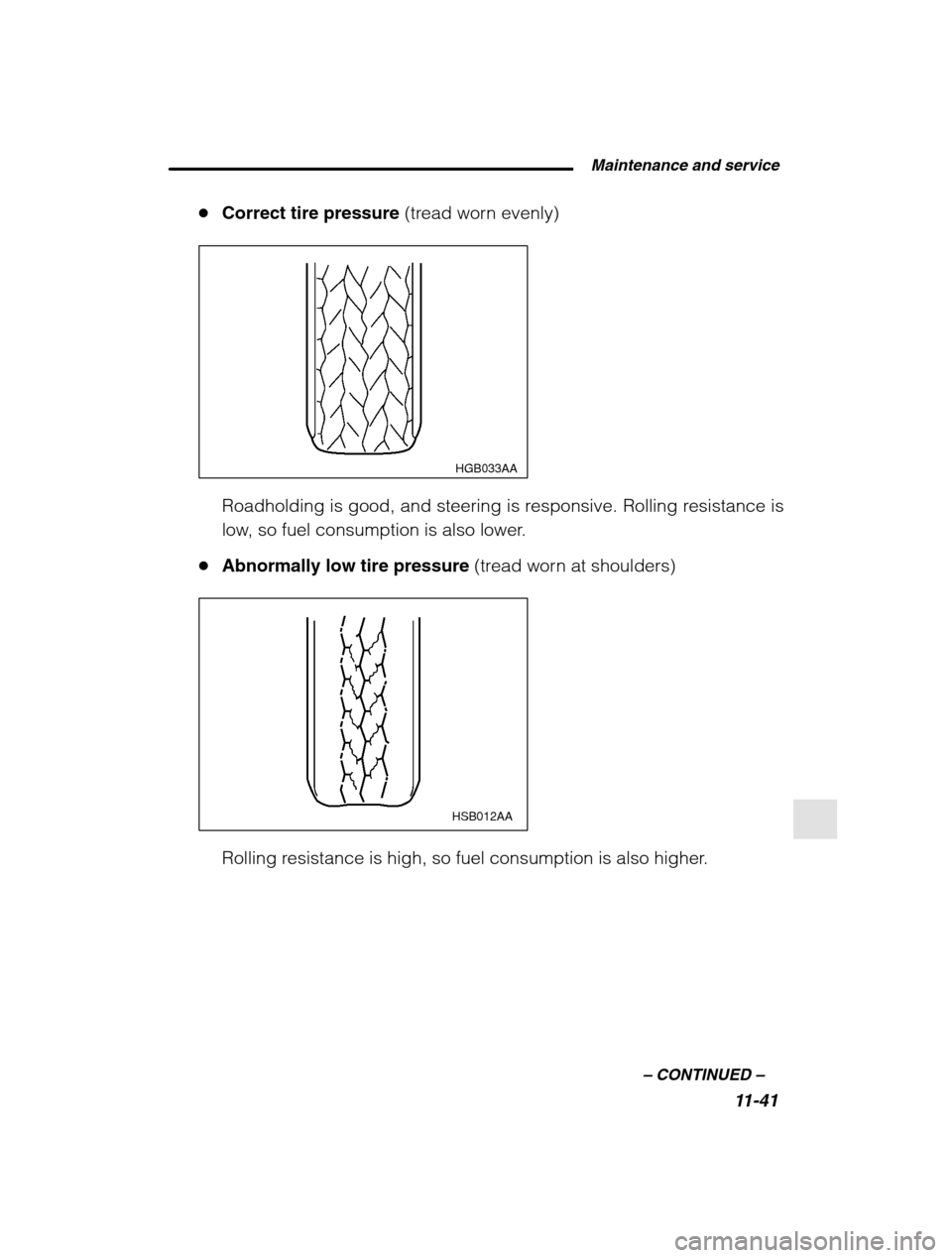
Correct tire pressure (tread worn evenly)
HGB033AA
Roadholding is good, and steering is responsive. Rolling resistance is
low, so fuel consumption is also lower.
Abnormally low tire pressure (tread worn at shoulders)
HSB012AA
Rolling resistance is high, so fuel consumption is also higher.
Page 422 of 466
11-52
It is unnecessary to periodically check the battery fluid level or periodi-
cally refill with distilled water. FusesCAUTION
Never replace a fuse with one having a higher rating or with mate-
rial other than a fuse because serious damage or a fire could re-sult.
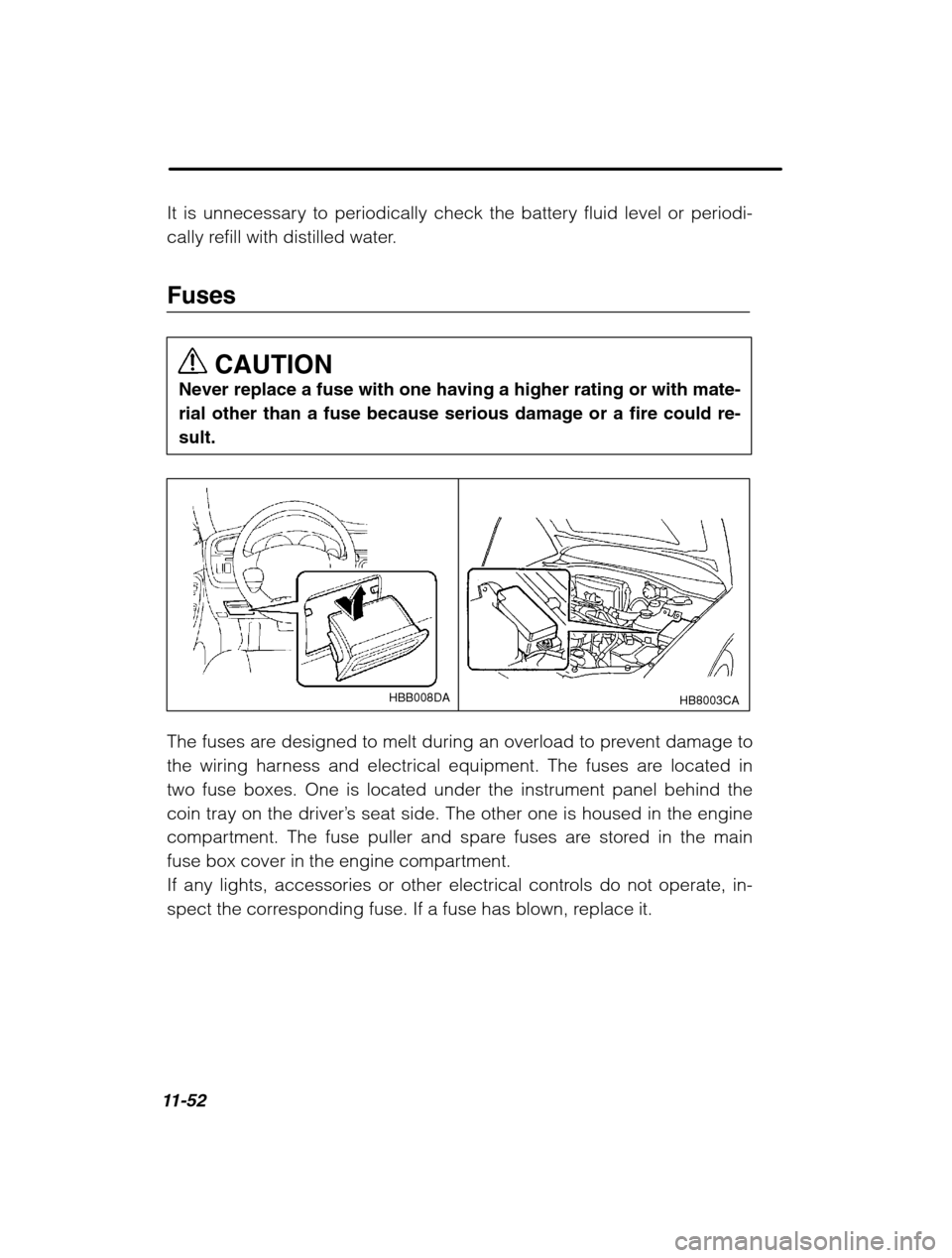
HBB008DA HB8003CA
The fuses are designed to melt during an overload to prevent damage to
the wiring harness and electrical equipment. The fuses are located intwo fuse boxes. One is located under the instrument panel behind the
coin tray on the driver’s seat side. The other one is housed in the engine
compartment. The fuse puller and spare fuses are stored in the main
fuse box cover in the engine compartment.
If any lights, accessories or other electrical controls do not operate, in-
spect the corresponding fuse. If a fuse has blown, replace it.
Page 456 of 466
Consumer information and Reporting safety defects13-3
–
CONTINUED –
phalt and concrete. A tire marked C may have poor traction perfor- mance.
WARNING
The traction grade assigned to this tire is based on straight-
ahead braking traction tests, and does not include acceleration,cornering, hydroplaning, or peak traction characteristics.
Temperature A, B, C
The temperature grades are A (the highest), B, and C, representing the
tire’ s resistance to the generation of heat and its ability to dissipate heat
when tested under controlled conditions on a specified indoor laboratory
test wheel. Sustained high temperature can cause the material of the tire
to degenerate and reduce tire life, and excessive temperature can lead
to sudden tire failure. The grade C corresponds to a level of perfor-
mance which all passenger car tires must meet under the Federal Motor
Vehicle Safety Standards No. 109. Grades B and A represent higher lev-
els of performance on the laboratory test wheel than the minimum re-
quired by law.
WARNING
The temperature grade for this tire is established for a tire that isproperly inflated and not overloaded. Excessive speed, under-inflation, or excessive loading, either separately or in combina-tion, can cause heat buildup and possible tire failure.