belt SUBARU OUTBACK 2005 4.G Owners Manual
[x] Cancel search | Manufacturer: SUBARU, Model Year: 2005, Model line: OUTBACK, Model: SUBARU OUTBACK 2005 4.GPages: 627, PDF Size: 6.42 MB
Page 365 of 627
7-10
Starting and operating
Preparing to drive
You should perform the following checks and adjust-
ments every day before you start driving.
1. Check that all windows, mirrors, and lights are
clean and unobstructed.
2. Check the appearance and condition of the tires.
Also check tires for proper inflation.
3. Look under the vehicle for any sign of leaks.
4. Check that the hood, trunk and rear gate are fullyclosed.
5. Check the adjustment of the seat.
6. Check the adjustment of the inside and outside mir-rors.
7. Fasten your seatbelt. Check that your passengers
have fastened their seatbelts.
8. Check the operation of the warning and indicator
lights when the ignition switch is turned to the “ON” po- sition.
9. Check the gauges, indicator and warning lights af-
ter starting the engine.
NOTE
Engine oil, engine coolant, brake fluid, washer flu-
id and other fluid levels should be checked daily,
weekly or at fuel stops.
Starting the engine
Do not operate the starter motor continuously
for more than ten seconds. If the engine fails to
start after operating the starter for five to ten
seconds, wait for ten seconds or more before
trying again.
! Manual transmission vehicle
1. Apply the parking brake.
2. Turn off unnecessary lights and accessories.
3. Press the clutch pedal to the floor and shift the shift
lever into neutral.
Hold the clutch pedal to the floor while starting the en-
gine. The starter motor will only operate when the
clutch pedal is pressed fully to the floor.
4. Turn the ignition switch to the “ON” position and
check the operation of the warning and indicator lights.
Refer to the “Warning and indicator lights” section
(chapter 3).
5. Turn the ignition switch to the “START” position
without depressing the accelerator pedal. Release
the key immediately after the engine has started.
Page 423 of 627

8-10
Driving tips
next section (applicable to the OUTBACK) for general
guidance. But please keep in mind that your vehicle’s
off-road capabilities are more limited than those of the OUTBACK.
Never attempt to drive through pools and puddles, or
roads flooded with water. Water entering the engine
air intake or the exhaust pipe or water splashing onto
electrical parts may damage your vehicle and may
cause it to stall. !
OUTBACK
Because of the AWD feature and higher ground clear-
ance, your SUBARU can be driven on ordinary roads
or off-road. But please keep in mind that an AWD
SUBARU is a passenger car and is neither a conven-
tional off-road vehicle nor an all-terrain vehicle. If you
do take your SUBARU off-road, certain common
sense precautions such as the following should be taken: " Make certain that you and all of your passengers
are wearing seatbelts. " Carry some emergency equipment, such as a tow-
ing rope or chain, a shovel, wheel blocks, first aid kit
and cell phone or citizens band radio. " Drive carefully. Do not take unnecessary risks by
driving in dangerous areas or over rough terrain. " Slow down and employ extra caution at all times. When driving off-road, you will not have the benefit of
marked traffic lanes, banked curves, traffic signs andthe like. "
Do not drive across steep slopes. Instead, drive ei-
ther straight up or straight down the slopes. A vehicle
can much more easily tip over sideways than it can
end over end. Avoid driving straight up or down slopes
that are too steep." Avoid sharp turning maneuvers, especially at higher
speeds. " Do not grip the inside or spokes of the steering
wheel. A bad bump could jerk the wheel and injure
your hands. Instead drive with your fingers and
thumbs on the outside of the rim." If driving through water, such as when crossing
shallow streams, first check the depth of the water and
the bottom of the stream bed for firmness and ensure
that the bed of the stream is flat. Drive slowly and com-
pletely through the stream. The water should be shal-
low enough that it does not reach the vehicle’s under-
carriage. Water entering the engine air intake or the
exhaust pipe or water splashing onto electrical parts
may damage your vehicle and may cause it to stall.
Never attempt to drive through rushing water; regard-
less of its depth, it can wash away the ground from un-
der your tires, resulting in possible loss of traction and
even vehicle rollover.
Page 428 of 627
8-15
Driving tips
– CONTINUED –
!Snow tires
! All models except OUTBACK
"When replacing original tires with winter
(snow) tires, make sure you use only the same
size, construction and load range as the origi-
nal tires listed on the tire placard. Using other
sizes and construction may affect speedome-
ter/odometer calibration and clearance be-
tween the body and tires. It also may be danger-
ous and lead to loss of vehicle control. " You must install four winter tires that are of
the same size, circumferences, construction,
brand, and load range. Mixing other sizes, cir-
cumferences or constructions may result in se-
vere mechanical damage to the drive train of
your vehicle and may affect ride, handling,
braking and speedometer/odometer calibra-
tion. It also may be dangerous and lead to loss
of vehicle control. " Do not use a combination of radial, belted
bias or bias tires since it may cause dangerous
handling characteristics and lead to an acci-
dent. Your vehicle is equipped with “all season tires” which
are designed to provide an adequate measure of trac-
tion, handling and braking performance in year-round
driving. In winter, it may be possible to enhance per-
formance through use of tires designed specifically for
winter driving conditions.
If you choose to install winter tires on your vehicle, be
sure to use the correct tire size and type. You must in-
stall four winter tires that are of the same size, con-
struction, brand and load range and you should never
mix radial, belted bias or bias tires since this may re-
sult in dangerous handling characteristics. When you
choose a tire, make sure that there is enough clear-
ance between the tire and vehicle body.
Remember to drive with care at all times regardless of
the type of tires on your vehicle. !
OUTBACK models only
"When replacing original tires with winter
(snow) tires, make sure you use only the same
size and construction as recommended. Using
other sizes or construction may affect speed-
ometer/odometer calibration and clearance be-
tween the body and tires. It also may be danger-
Page 429 of 627
8-16
Driving tips
ous and lead to loss of vehicle control. "
You must install four winter tires that are of
the same size, circumferences, construction,
brand, and load range. Mixing other sizes, cir-
cumferences or constructions may result in se-
vere mechanical damage to the drive train of
your vehicle and may affect ride, handling,
braking and speedometer/odometer calibra-
tion. It also may be dangerous and lead to loss
of vehicle control. " Do not use a combination of radial, belted
bias or bias tires since it may cause dangerous
handling characteristics and lead to an acci-
dent.
Your vehicle is equipped with “all season tires” which
are designed to provide an adequate measure of trac-
tion, handling and braking performance in year-round
driving. In winter, it may be possible to enhance per-
formance through use of tires designed specifically for
winter driving conditions.
If you choose to install winter tires on your vehicle, be
sure to use the correct tire size and type. You must in-
stall four winter tires that are of the same size, con-
struction, brand and load range and you should never
mix radial, belted bias or bias tires since this may re-
sult in dangerous handling characteristics. When you choose a tire, make sure that there is enough clear-
ance between the tire and vehicle body.
Remember to drive with care at all times regardless of
the type of tires on your vehicle.
Your OUTBACK comes with P225/60R16 or P225/
55R17 “all season tires” as original equipment.
You should be aware that some winter tires with
that same size designation may actually be too
large for the vehicle and may cause rubbing on
sharp turns. Listed below is the winter tire size
that we recommend.Recommended winter (snow) tire size
2.5-liter non-turbo models: P225/60R16 or P215/
60R16 Studless
All models other than 2.5-liter non-turbo models:
P215/55R17, P225/60R16 or P215/60R16 Studless
Page 473 of 627

9-18
In case of emergency
Do not jump start unless cables in suitable con-
dition are available."
A running engine can be dangerous. Keep
your fingers, hands, clothing, hair and tools
away from the cooling fan, belts and any other
moving engine parts. Removing rings, watches
and ties is advisable. " Jump starting is dangerous if it is done incor-
rectly. If you are unsure about the proper proce-
dure for jump starting, consult a competent me-
chanic.
When your vehicle does not start due to a run down
(discharged) battery, the vehicle may be jump started
by connecting your battery to another battery (called
the booster battery) with jumper cables. ! How to jump start
1. Make sure the booster battery is 12 volts and the
negative terminal is grounded.
2. If the booster battery is in another vehicle, do not let
the two vehicles touch.
3. Turn off all unnecessary lights and accessories.
4. Connect the jumper cables exactly in the sequence
illustrated.
Page 500 of 627

11 - 1
11
Maintenance and service
Maintenance schedule ................................. 11-3
Maintenance precautions ............................ 11-3 Before checking or servicing in the engine compartment .................................................. 11-4
When you do checking or servicing in the engine compartment while the engine is
running ............................................................ 11-5
Engine hood .................................................. 11-5
Engine compartment overview ................... 11-8 2.5-liter non-turbo models ................................ 11-8
2.5-liter non-turbo California-spec. models .... 11-9
2.5-liter turbo models ....................................... 11-10
3.0-liter models .................................................. 11-11
Engine oil ...................................................... 11-12 Checking the oil level ....................................... 11-12
Changing the oil and oil filter .......................... 11-13
Recommended grade and viscosity ................ 11-16
Recommended grade and viscosity under severe driving conditions .............................. 11-17
Cooling system ............................................. 11-18 Hose and connections ...................................... 11-19
Engine coolant .................................................. 11-19
Air cleaner element ...................................... 11-24 Replacing the air cleaner element ................... 11-24
Spark plugs ................................................... 11-29 Recommended spark plugs ............................. 11-29
Drive belts ..................................................... 11-30 2.5-liter models .................................................. 11-30
3.0-liter models .................................................. 11-30
Manual transmission oil ............................... 11-31 Checking the oil level ....................................... 11-31
Recommended grade and viscosity ............... 11-32
Automatic transmission fluid ...................... 11-33 Checking the fluid level .................................... 11-33
Recommended fluid ......................................... 11-35
Front differential gear oil (AT vehicles) ...... 11-35 Checking the oil level ....................................... 11-35
Recommended grade and viscosity ............... 11-36
Rear differential gear oil ............................... 11-37 Checking the gear oil level .............................. 11-37
Recommended grade and viscosity ............... 11-40
Power steering fluid ...................................... 11-41 Checking the fluid level .................................... 11-41
Recommended fluid ......................................... 11-42
Brake fluid ..................................................... 11-42 Checking the fluid level .................................... 11-42
Recommended brake fluid ............................... 11-43
Clutch fluid (MT vehicles) ............................ 11-43 Checking the fluid level .................................... 11-43
Recommended clutch fluid .............................. 11-44
Brake booster ................................................ 11-44
Brake pedal .................................................... 11-45 Checking the brake pedal free play ................ 11-45
Checking the brake pedal reserve distance ... 11-45
Clutch pedal (Manual transmission vehicles) ..................................................... 11-46Checking the clutch function .......................... 11-46
Checking the clutch pedal free play ............... 11-46
Replacement of brake pad and lining ......... 11-47
Page 503 of 627
11 - 4
Maintenance and service
the materials in the vehicle may be hazardous if
improperly used or handled, for example, bat-tery acid. "
Your vehicle should only be serviced by per-
sons fully competent to do so. Serious person-
al injury may result to persons not experienced
in servicing vehicles. " Always use the proper tools and make certain
that they are well maintained. " Never get under the vehicle supported only
by a jack. Always use a safety stands to sup-
port the vehicle. " Never keep the engine running in a poorly
ventilated area, such as a garage or other
closed areas. " Do not smoke or allow open flames around
the fuel or battery. This will cause a fire. " Because the fuel system is under pressure,
replacement of the fuel filter should be per-
formed only by your SUBARU dealer." Wear adequate eye protection to guard
against getting oil or fluids in your eyes. If
something does get in your eyes, thoroughly
wash them out with clean water. " Do not tamper with the wiring of the SRS air-
bag system or seatbelt pretensioner system, or
attempt to take its connectors apart, as that may activate the system or it can render it inop-
erative. The wiring and connectors of these
systems are yellow for easy identification. NEV-
ER use a circuit tester for these wiring.
If your SRS airbag or seatbelt pretensioner
needs service, consult your nearest SUBARU
dealer.
! Before checking or servicing in the en-
gine compartment
"Always stop the engine and set the parking
brake firmly to prevent the vehicle from mov-
ing. " Always let the engine cool down. Engine
parts become very hot when the engine is run-
ning and remain hot for some time after the en-
gine is stopped." Do not spill engine oil, engine coolant, brake
fluid or any other fluid on hot engine compo-
nents. This may cause a fire." Always remove the key from the ignition
switch. When the ignition switch is in the “ON”
position, the cooling fan may operate suddenly
Page 504 of 627
11 - 5
Maintenance and service
– CONTINUED –
even when the engine is stopped.
! When you do checking or servicing in
the engine compartment while the en-
gine is running
A running engine can be dangerous. Keep your
fingers, hands, clothing, hair and tools away
from the cooling fan, belts and any other mov-
ing engine parts. Removing rings, watches and
ties is advisable.
Engine hood
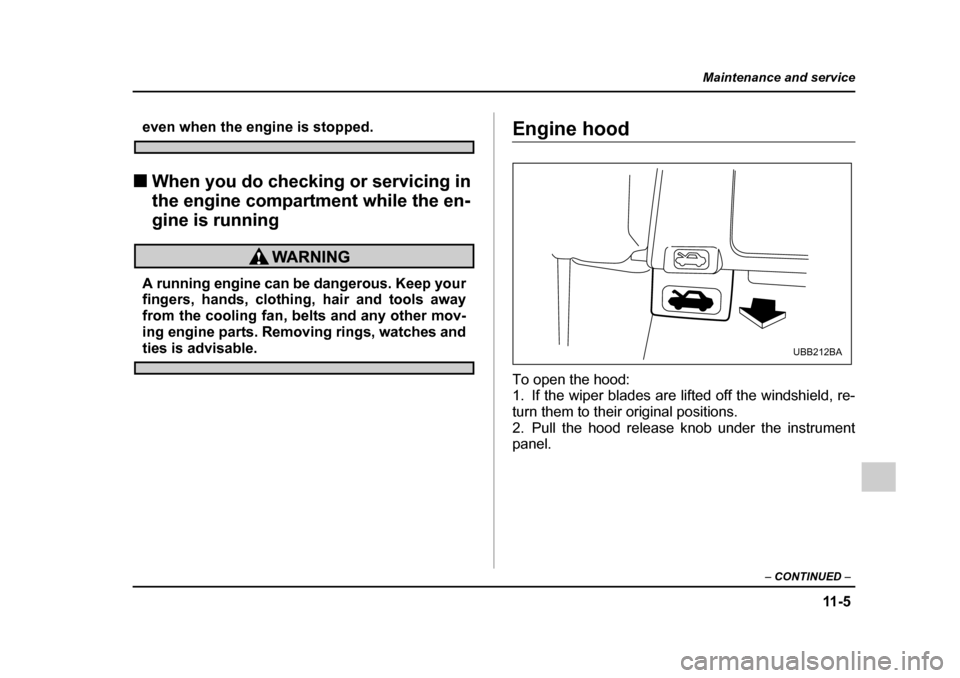
To open the hood:
1. If the wiper blades are lifted off the windshield, re-
turn them to their original positions.
2. Pull the hood release knob under the instrument
panel.
UBB212BA
Page 529 of 627
11 - 3 0
Maintenance and service
Drive belts
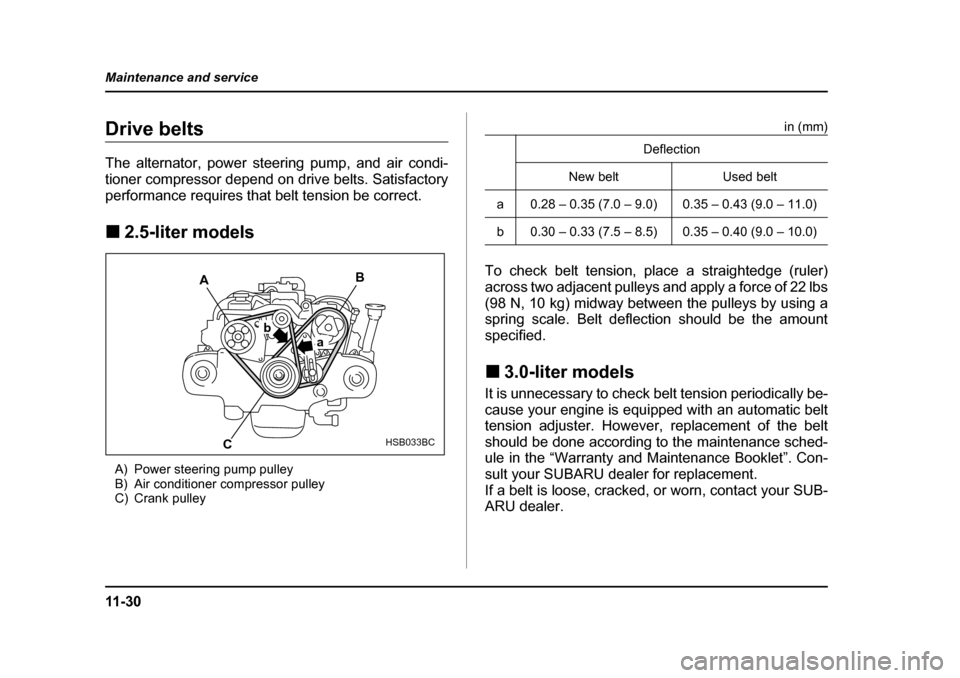
The alternator, power steering pump, and air condi-
tioner compressor depend on drive belts. Satisfactory
performance requires that belt tension be correct. !
2.5-liter models
A) Power steering pump pulley
B) Air conditioner compressor pulley
C) Crank pulley in (mm)
To check belt tension, place a straightedge (ruler)
across two adjacent pulleys and apply a force of 22 lbs
(98 N, 10 kg) midway between the pulleys by using a
spring scale. Belt deflection should be the amount
specified. ! 3.0-liter models
It is unnecessary to check belt tension periodically be-
cause your engine is equipped with an automatic belt
tension adjuster. However, replacement of the belt
should be done according to the maintenance sched-
ule in the “Warranty and Maintenance Booklet”. Con-
sult your SUBARU dealer for replacement.
If a belt is loose, cracked, or worn, contact your SUB-
ARU dealer.
B
C a
b
A
HSB033BC
Deflection
New belt Used belt
a 0.28 – 0.35 (7.0 – 9.0) 0.35 – 0.43 (9.0 – 11.0)
b 0.30 – 0.33 (7.5 – 8.5) 0.35 – 0.40 (9.0 – 10.0)
Page 555 of 627
11 - 5 6
Maintenance and service
Tire wear varies from wheel to wheel. To maximize the
life of each tire and ensure that the tires wear uniform-
ly, it is best to rotate the tires every 7,500 miles
(12,500 km). Rotating the tires involves switching the
front and rear tires on the right hand side of the vehicle
and similarly switching the front and rear tires on the
left hand side of the vehicle. (Each tire must be kept on
its original side of the vehicle.)
Replace any damaged or unevenly worn tire at the
time of rotation. After tire rotation, adjust the tire pres-
sures and make sure the wheel nuts are correctly
tightened.
After driving approximately 600 miles (1,000 km),
check the wheel nuts again and retighten any nut that
has become loose. !
Tire replacement
The wheels and tires are important and integral parts
of your vehicle’s design; they cannot be changed arbi-
trarily. The tires fitted as standard equipment are opti-
mally matched to the characteristics of the vehicle and
were selected to give the best possible combination of
running performance, ride comfort, and service life. It
is essential for every tire to have a size and construc-
tion matching those shown on the tire placard and to
have a speed symbol and load index matching those shown on the tire placard.
Using tires of a non-specified size detracts from con-
trollability, ride comfort, braking performance, speed-
ometer accuracy and odometer accuracy. It also cre-
ates incorrect body-to-tire clearances and inappropri-
ately changes the vehicle’s ground clearance.
All four tires must be the same in terms of manufactur-
er, brand (tread pattern), construction, and size. You
are advised to replace the tires with new ones that are
identical to those fitted as standard equipment.
For safe vehicle operation, SUBARU recommends re-
placing all four tires at the same time.
"
All four tires must be the same in terms of
manufacturer, brand (tread pattern), construc-
tion, degree of wear, speed symbol, load index
and size. Mixing tires of different types, sizes or
degrees of wear can result in damage to the ve-
hicle’s power train. Use of different types or siz-
es of tires can also dangerously reduce control-
lability and braking performance and can lead
to an accident. " Use only radial tires. Do not use radial tires
together with belted bias tires and/or bias-ply