light SUBARU OUTBACK 2005 4.G Owners Manual
[x] Cancel search | Manufacturer: SUBARU, Model Year: 2005, Model line: OUTBACK, Model: SUBARU OUTBACK 2005 4.GPages: 627, PDF Size: 6.42 MB
Page 358 of 627
7-3
Starting and operating
– CONTINUED –
Standards as indicated on the underhood tune-up la-
bel. It is designed to optimize engine and emission
control system performance with gasoline that meets
the clean burning low-sulfur California gasoline speci-
fications. If you live in any other state than California,
your vehicle will operate on gasoline meeting Federal
specifications. Gasoline sold outside California is per-
mitted to have higher sulfur levels, which may affect
the performance of your vehicle’s catalytic converter
and may produce a sulfur exhaust odor or smell. SUB-
ARU recommends that you try a different brand of un-
leaded gasoline having lower sulfur to determine if the
problem is fuel related before returning your vehicle to
an authorized dealer for service. The CHECK EN-
GINE warning light/Malfunction indicator lamp may
also turn on. If this occurs, return to your authorized
SUBARU dealer for diagnosis. If it is determined that
the condition is caused by the type of fuel used, re-
pairs may not be covered by your warranty. !MMT
Some gasoline contains an octane-enhancing additive
called MMT (Methylcyclopentadienyl Manganese Tri-
carbonyl). If you use such fuels, your emission control
system performance may deteriorate and the CHECK
ENGINE warning light/Malfunction indicator lamp may
turn on. If this happens, return to your authorized
SUBARU Dealer for service. If it is determined that the condition is caused by the type of fuel used, repairs
may not be covered by your warranty. !
Gasoline for cleaner air
Do not let fuel spill on the exterior surfaces of
the vehicle. Fuels containing alcohol may
cause paint damage, which is not covered un-
der the SUBARU Limited Warranty.
Your use of gasoline with detergent additives will help
prevent deposits from forming in your engine and fuel
system. This helps keep your engine in tune and your
emission control system working properly, and is a
way of doing your part for cleaner air. If you continu-
ously use a high quality fuel with the proper detergent
and other additives, you should never need to add any
fuel system cleaning agents to your fuel tank.
Many gasolines are now blended with materials called
oxygenates. Use of these fuels can also help keep the
air cleaner. Oxygenated blend fuels, such as MTBE
(Methyl Tertiary Butyl ether) or ethanol (ethyl or grain
alcohol) may be used in your vehicle, but should con-
tain no more than 15% MTBE or 10% ethanol for the
proper operation of your SUBARU.
Page 361 of 627
7-6
Starting and operating
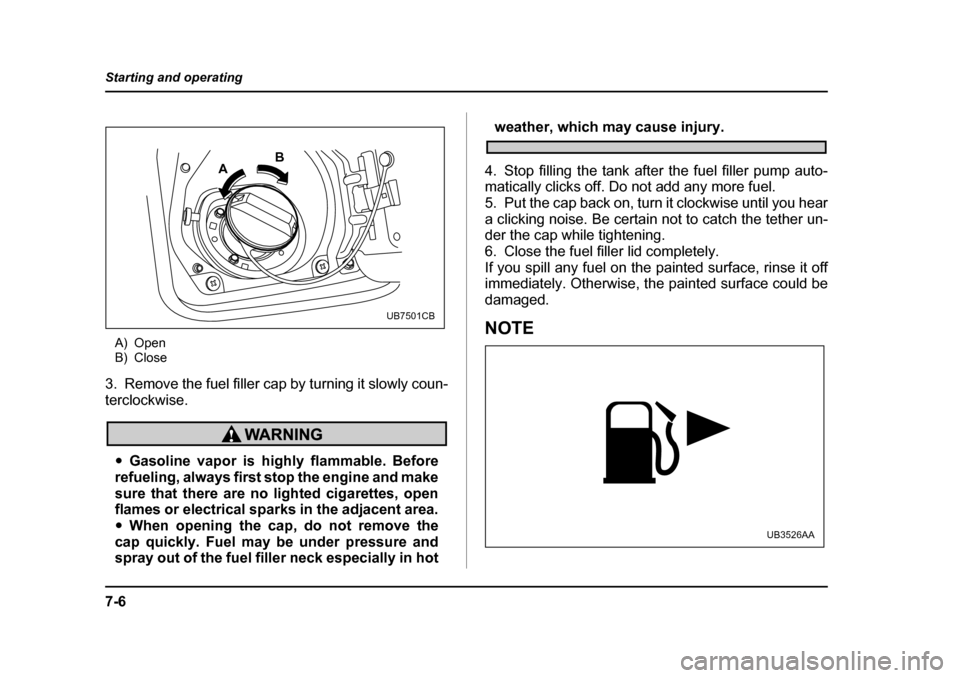
A) Open
B) Close
3. Remove the fuel filler cap by turning it slowly coun-
terclockwise.
" Gasoline vapor is highly flammable. Before
refueling, always first stop the engine and make
sure that there are no lighted cigarettes, open
flames or electrical sparks in the adjacent area. " When opening the cap, do not remove the
cap quickly. Fuel may be under pressure and
spray out of the fuel filler neck especially in hot
weather, which may cause injury.
4. Stop filling the tank after the fuel filler pump auto-
matically clicks off. Do not add any more fuel.
5. Put the cap back on, turn it clockwise until you hear
a clicking noise. Be certain not to catch the tether un-
der the cap while tightening.
6. Close the fuel filler lid completely.
If you spill any fuel on the painted surface, rinse it off
immediately. Otherwise, the painted surface could be
damaged.
NOTE
A B
UB7501CB
UB3526AA
Page 362 of 627
7-7
Starting and operating
– CONTINUED –
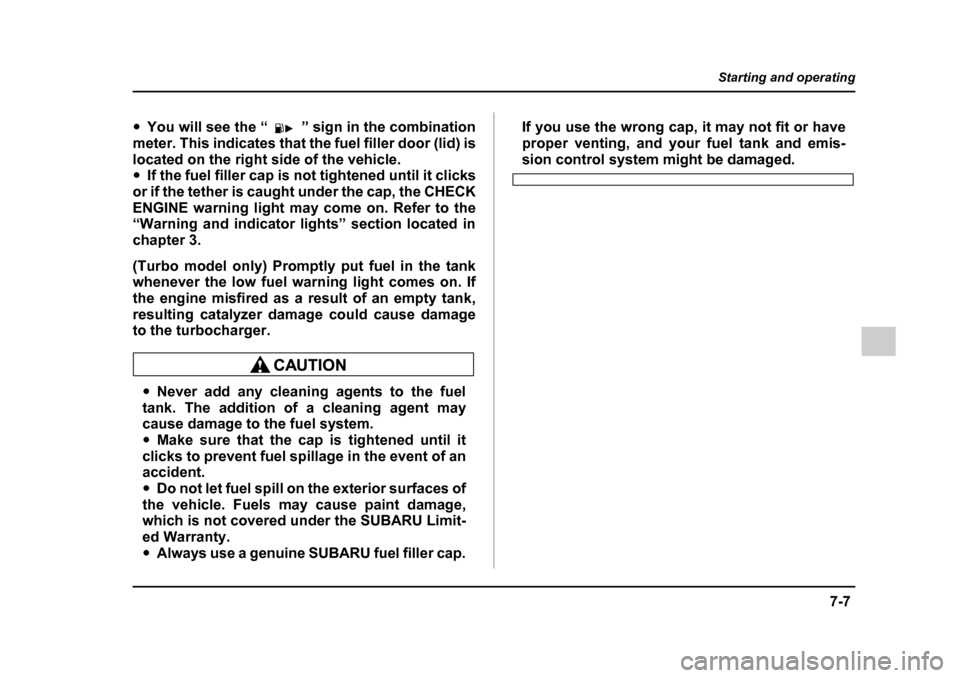
"You will see the “ ” sign in the combination
meter. This indicates that the fuel filler door (lid) is
located on the right side of the vehicle. " If the fuel filler cap is not tightened until it clicks
or if the tether is caught under the cap, the CHECK
ENGINE warning light may come on. Refer to the
“Warning and indicator lights” section located in
chapter 3.
(Turbo model only) Promptly put fuel in the tank
whenever the low fuel warning light comes on. If
the engine misfired as a result of an empty tank,
resulting catalyzer damage could cause damage
to the turbocharger.
" Never add any cleaning agents to the fuel
tank. The addition of a cleaning agent may
cause damage to the fuel system. " Make sure that the cap is tightened until it
clicks to prevent fuel spillage in the event of an
accident. " Do not let fuel spill on the exterior surfaces of
the vehicle. Fuels may cause paint damage,
which is not covered under the SUBARU Limit-
ed Warranty." Always use a genuine SUBARU fuel filler cap. If you use the wrong cap, it may not fit or have
proper venting, and your fuel tank and emis-
sion control system might be damaged.
Page 364 of 627

7-9
Starting and operating
– CONTINUED –
jacked off the ground, nor should the driveshaft be dis-
connected for state emission testing.
The EPA has issued regulations for inspecting the On-
Board Diagnostic (OBD) system as part of the state
emissions inspection. The OBD system is designed to
detect engine and transmission problems that might
cause vehicle emissions to exceed allowable limits.
These inspections apply to all 1996 model year and
newer passenger cars and light trucks. About 30
states plus the District of Columbia have implemented
the OBD system inspection. "The inspection of the OBD system consists of a vi-
sual operational check of the “ CHECK ENGINE” warn-
ing light/malfunction indicator lamp (MIL) and an ex-
amination of the OBD system with an electronic scan
tool while the engine is running. " A vehicle passes
the OBD system inspection if
proper the “ CHECK ENGINE ” warning light/MIL illumi-
nation is observed, there is no stored diagnostic trou-
ble codes, and the OBD system readiness monitors
are complete. " A vehicle fails
the OBD inspection if the “ CHECK
ENGINE ” warning light/MIL is not properly operating
or there is one or more diagnostic trouble codes stored
in vehicle’s computer with the “ CHECK ENGINE”
warning light/MIL illuminated. "
A state emission inspection may reject (not pass or
fail) a vehicle if the number of OBD system readiness monitors “ Not Ready ” is greater than three. Under this
condition, the vehicle operator should be instructed to
drive his/her vehicle for a few days to set the monitors
and return for an emission re-inspection. " Owners of rejected or failing vehicles should contact
their SUBARU Dealer for service.
Page 365 of 627
7-10
Starting and operating
Preparing to drive
You should perform the following checks and adjust-
ments every day before you start driving.
1. Check that all windows, mirrors, and lights are
clean and unobstructed.
2. Check the appearance and condition of the tires.
Also check tires for proper inflation.
3. Look under the vehicle for any sign of leaks.
4. Check that the hood, trunk and rear gate are fullyclosed.
5. Check the adjustment of the seat.
6. Check the adjustment of the inside and outside mir-rors.
7. Fasten your seatbelt. Check that your passengers
have fastened their seatbelts.
8. Check the operation of the warning and indicator
lights when the ignition switch is turned to the “ON” po- sition.
9. Check the gauges, indicator and warning lights af-
ter starting the engine.
NOTE
Engine oil, engine coolant, brake fluid, washer flu-
id and other fluid levels should be checked daily,
weekly or at fuel stops.
Starting the engine
Do not operate the starter motor continuously
for more than ten seconds. If the engine fails to
start after operating the starter for five to ten
seconds, wait for ten seconds or more before
trying again.
! Manual transmission vehicle
1. Apply the parking brake.
2. Turn off unnecessary lights and accessories.
3. Press the clutch pedal to the floor and shift the shift
lever into neutral.
Hold the clutch pedal to the floor while starting the en-
gine. The starter motor will only operate when the
clutch pedal is pressed fully to the floor.
4. Turn the ignition switch to the “ON” position and
check the operation of the warning and indicator lights.
Refer to the “Warning and indicator lights” section
(chapter 3).
5. Turn the ignition switch to the “START” position
without depressing the accelerator pedal. Release
the key immediately after the engine has started.
Page 366 of 627
7-11
Starting and operating
– CONTINUED –
If the engine does not start, try the following:
1) Turn the ignition switch to the “OFF” position and
wait for at least 10 seconds. After checking that the
parking brake is firmly set, turn the ignition switch to
the “START” position while depressing the acceler-
ator pedal slightly (about a quarter of the full stroke).
Release the accelerator pedal as soon as the en-
gine starts.
2) If this fails to start the engine, turn the ignition
switch back to the “OFF” position and wait for at
least 10 seconds. Then fully depress the accelerator
pedal and turn the ignition switch to the “START”
position. If the engine starts, quickly release the ac-
celerator pedal.
3) If this fails to start the engine, turn the ignition
switch again to the “OFF” position. After waiting for
10 seconds or longer, turn the ignition switch to the
“START” position without depressing the accelera-
tor pedal.
4) If the engine still refuses to start, contact your
nearest SUBARU dealer for assistance.
6. Confirm that all warning and indicator lights have
gone off after the engine has started. The fuel injection
system automatically lowers the idle speed as the en-
gine warms up. !
Automatic transmission vehicle
If you restart the engine while the vehicle is
moving, shift the selector lever into the “N” po-
sition. Do not attempt to place the selector lever
of a moving vehicle into the “P” position.
1. Apply the parking brake.
2. Turn off unnecessary lights and accessories.
3. Shift the selector lever to the “P” or “N” position
(preferably “P” position). The starter will only operate
when the select lever is at the “P” or “N” position.
4. Turn the ignition switch to the “ON” position and
check the operation of the warning and indicator lights.
Refer to the “Warning and indicator lights” section (chapter 3).
5. Turn the ignition switch to the “START” position
without depressing the accelerator pedal. Release
the key immediately after the engine has started.
If the engine does not start, try the following: 1) Turn the ignition switch to the “OFF” position and
wait for at least 10 seconds. After checking that the
parking brake is firmly set, turn the ignition switch to
the “START” position while depressing the acceler-
ator pedal slightly (about a quarter of the full stroke).
Page 367 of 627
7-12
Starting and operating
Release the accelerator pedal as soon as the en-
gine starts.
2) If this fails to start the engine, turn the ignition
switch back to the “OFF” position and wait for at
least 10 seconds. Then fully depress the accelerator
pedal and turn the ignition switch to the “START”
position. If the engine starts, quickly release the ac-
celerator pedal.
3) If this fails to start the engine, turn the ignition
switch again to the “OFF” position. After waiting for
10 seconds or longer, turn the ignition switch to the
“START” position without depressing the accelera-
tor pedal.
4) If the engine still refuses to start, contact your
nearest SUBARU dealer for assistance.
6. Confirm that all warning and indicator lights have
gone out after the engine has started. The fuel injec-
tion system automatically lowers the idle speed as the
engine warms up.
While the engine is warming up, make sure that the
selector lever is at the “P” or “N” position and that the
parking brake is applied.Stopping the engine
Do not stop the engine when the vehicle is mov-
ing. This will cause loss of power to the power
steering and the brake booster, making steer-
ing and braking more difficult. It could also re-
sult in accidental activation of the “LOCK” po-
sition on the ignition switch, causing the steer-
ing wheel to lock.
The ignition switch should be turned off only when the
engine is idling.
Page 370 of 627

7-15
Starting and operating
– CONTINUED –
Turbo models
mph (km/h)
Never exceed posted speed limits.
! Driving tips
Do not drive with your foot resting on the clutch pedal
and do not use the clutch to hold your vehicle at a
standstill on an upgrade. Either of those actions may
cause clutch damage.
Do not drive with your hand resting on the shift lever.
This may cause wear on the transmission compo-
nents.
When it is necessary to reduce vehicle speed due to
slow traffic, turning corners, or driving up steep hills,
downshift to a lower gear before the engine starts to
labor.
On steep downgrades, downshift the transmission to 4th, 3rd or 2nd gear as necessary; this helps to main-
tain a safe speed and to extend brake pad life.
In this way, the engine provides a braking effect. Re-
member, if you “ride” (over use) the brakes while de-
scending a hill, they may overheat and not work prop-erly.
The engine may, on rare occasions, knock when the
vehicle rapidly accelerates or rapidly pulls away from
a standstill. This phenomenon does not indicate a
fault.
A slight reduction in output torque may occur in the
models with a 3.0-liter or 2.5-liter turbo engine before
the engine warms up.
Gear Except
OUTBACKOUTBACK
1st 32 (52) 32 (52)
2nd 54 (88) 54 (88)
3rd 80 (129) 78 (127)
Page 372 of 627
7-17
Starting and operating
– CONTINUED –
!Selector lever
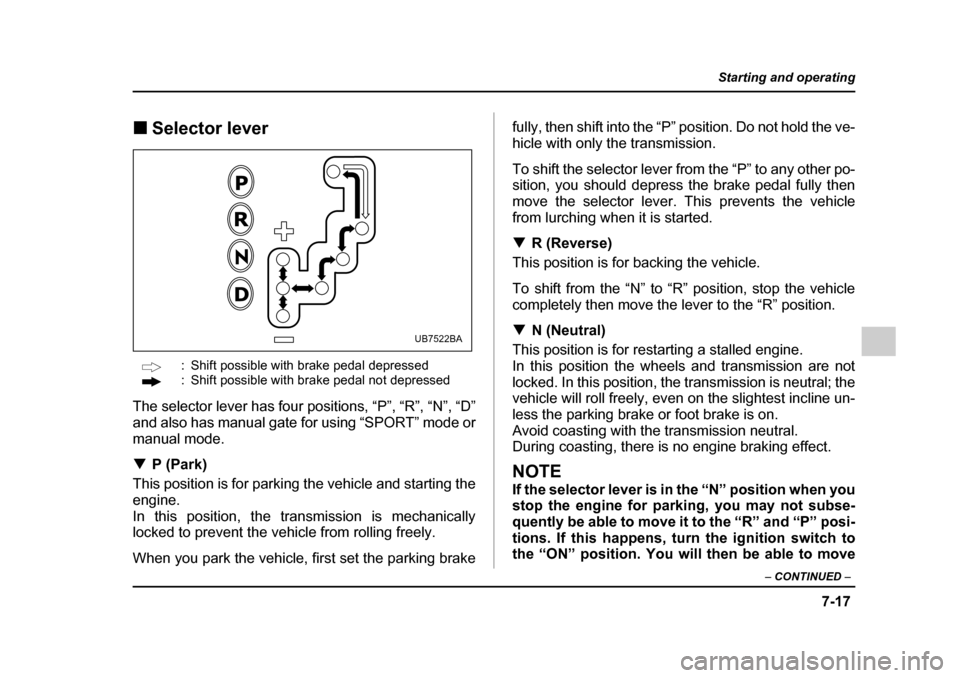
: Shift possible with brake pedal depressed
: Shift possible with brake pedal not depressed
The selector lever has four positions, “P”, “R”, “N”, “D”
and also has manual gate for using “SPORT” mode or
manual mode. ! P (Park)
This position is for parking the vehicle and starting the
engine.
In this position, the transmission is mechanically
locked to prevent the vehicle from rolling freely.
When you park the vehicle, first set the parking brake fully, then shift into the “P” position. Do not hold the ve-
hicle with only the transmission.
To shift the selector lever from the “P” to any other po-
sition, you should depress the brake pedal fully then
move the selector lever. This prevents the vehicle
from lurching when it is started. !
R (Reverse)
This position is for backing the vehicle.
To shift from the “N” to “R” position, stop the vehicle
completely then move the lever to the “R” position. ! N (Neutral)
This position is for restarting a stalled engine.
In this position the wheels and transmission are not
locked. In this position, the transmission is neutral; the
vehicle will roll freely, even on the slightest incline un-
less the parking brake or foot brake is on.
Avoid coasting with the transmission neutral.
During coasting, there is no engine braking effect.
NOTE
If the selector lever is in the “N” position when you
stop the engine for parking, you may not subse-
quently be able to move it to the “R” and “P” posi-tions. If this happens, turn the ignition switch to
the “ON” position. You will then be able to move
UB7522BA
Page 376 of 627
7-21
Starting and operating
– CONTINUED –
goes off.
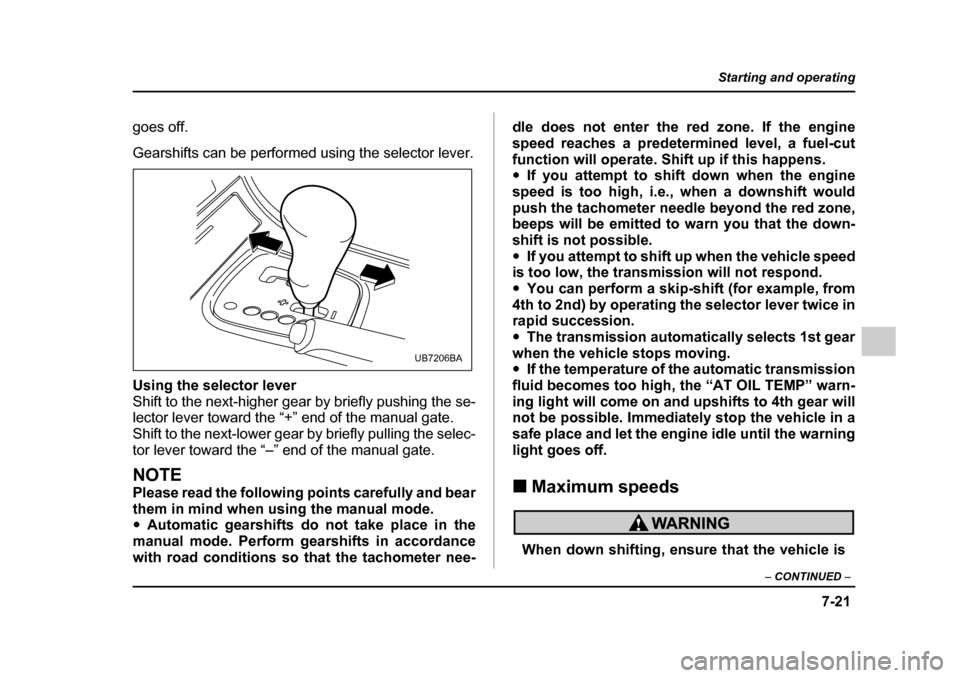
Gearshifts can be performed using the selector lever.
Using the selector lever
Shift to the next-higher gear by briefly pushing the se-
lector lever toward the “+” end of the manual gate.
Shift to the next-lower gear by briefly pulling the selec-
tor lever toward the “–” end of the manual gate.
NOTE
Please read the following points carefully and bear
them in mind when using the manual mode. "Automatic gearshifts do not take place in the
manual mode. Perform gearshifts in accordance
with road conditions so that the tachometer nee- dle does not enter the red zone. If the engine
speed reaches a predetermined level, a fuel-cut
function will operate. Shift up if this happens. "
If you attempt to shift down when the engine
speed is too high, i.e., when a downshift would
push the tachometer needle beyond the red zone,
beeps will be emitted to warn you that the down-
shift is not possible." If you attempt to shift up when the vehicle speed
is too low, the transmission will not respond." You can perform a skip-shift (for example, from
4th to 2nd) by operating the selector lever twice in
rapid succession. " The transmission automatically selects 1st gear
when the vehicle stops moving. " If the temperature of the automatic transmission
fluid becomes too high, the “AT OIL TEMP” warn-
ing light will come on and upshifts to 4th gear will
not be possible. Immediately stop the vehicle in a
safe place and let the engine idle until the warning
light goes off. ! Maximum speeds
When down shifting, ensure that the vehicle is
UB7206BA