lights SUBARU OUTBACK 2005 4.G User Guide
[x] Cancel search | Manufacturer: SUBARU, Model Year: 2005, Model line: OUTBACK, Model: SUBARU OUTBACK 2005 4.GPages: 627, PDF Size: 6.42 MB
Page 141 of 627
2-16
Keys and doors
sired, you may turn the audible signal off.
To turn the audible signal off, unlock the doors by
pushing “ ” button and then simultaneously de-
press “ ” and “ ” buttons for more than two sec-
onds. An electronic chirp will sound twice and the turn
signal lights will flash twice to inform you that the audi-
ble signal has been turned off.
To turn the audible signal on, unlock the doors by
pushing “ ” button and then simultaneously de-
press “ ” and “ ” buttons for more than two sec-
onds. An electronic chirp will sound once and the turn
signal lights will flash once to inform you that the audi-
ble signal has been turned on.
You may have the above settings done by your SUB-
ARU dealer. !
Replacing the battery
Do not let dust, oil or water get on or in the
transmitter when replacing the battery.
When the transmitter battery begins to get weak,
transmitter range will begin to decrease and the LED
will not illuminate. Replace the battery as soon as pos- sible.
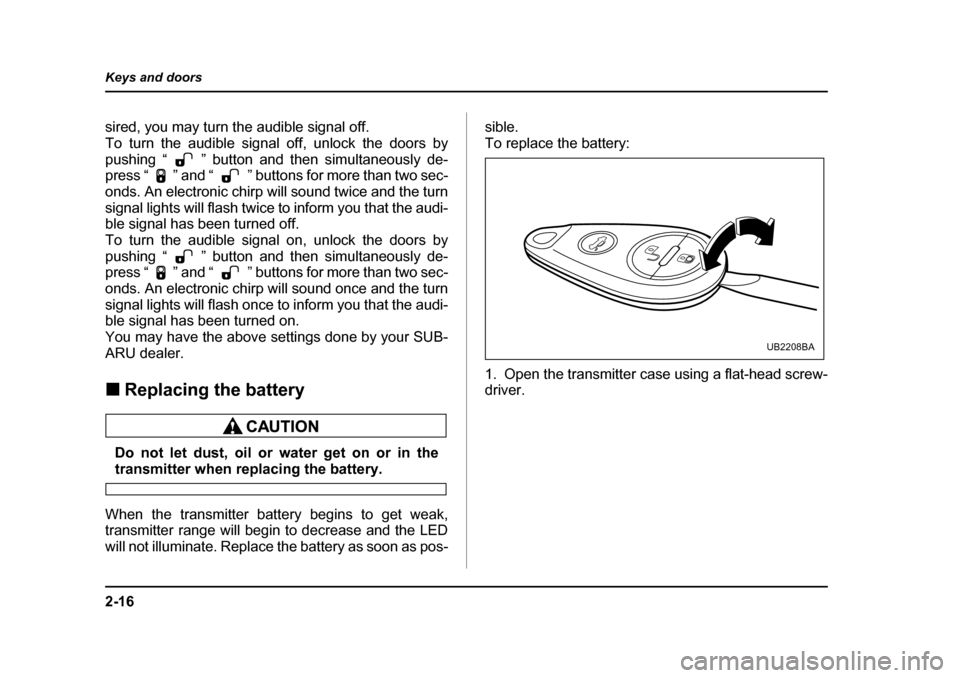
To replace the battery:
1. Open the transmitter case using a flat-head screw-
driver.
UB2208BA
Page 148 of 627

2-23
Keys and doors
– CONTINUED –
Alarm system
The alarm system helps to protect your vehicle and
valuables from theft. The horn sounds and the turn
signal lights flash if someone attempts to break into your vehicle.
The system can be armed and disarmed with the re-
mote transmitter.
The system does not operate when the key is inserted
into the ignition switch.
Your vehicle’s alarm system has been set for activa-
tion at the time of shipment from the factory. You can
set the system for deactivation yourself or have it done
by your SUBARU dealer. !System alarm operation
The alarm system will give the following alarms when
triggered: " The vehicle’s horn will sound and the turn signal
lights will flash for 30 seconds. " If any door (or the rear gate/trunk lid) remains open
after the 30-second period, the horn will continue to
sound for a maximum of 3 minutes. If the door (or the
rear gate/trunk lid) is closed while the horn is sound-
ing, the horn will stop sounding with a delay of up to 30 seconds.
The alarm is triggered by: "
Opening a door, the rear gate or trunk lid
" Physical impact to the vehicle, such as forced entry
(only vehicles with shock sensors (dealer option)) ! Activating and deactivating the alarm
system
To change the setting of your vehicle’s alarm system
for activation or deactivation, do the following.
1. Disarm the alarm system (see “Disarming the sys-
tem” in this section).
2. Sit in the driver’s seat and shut all doors (and the
rear gate if your vehicle is a Station wagon).
3. Cycle the ignition switch from “LOCK” to “ON” three
times within 10 seconds, finally placing it in the “ON”
position.
4. Within 10 seconds after step 3, open the driver’s
door and then close it. The current setting will be dis-
played on the odometer/trip meter screen.
5. Within 10 seconds after step 4, operate the driver’s
door locking switch as follows:
To deactivate:
Move the door locking switch to the unlock position
(toward the rear) three times. The odometer/trip meter
screen will display “AL OF”.
Page 150 of 627
2-25
Keys and doors
– CONTINUED –
6. Briefly press the “ ” button (for less than two sec-
onds). All doors (and the rear gate on the Station wag-
on) will lock, an electronic chirp will sound one time,
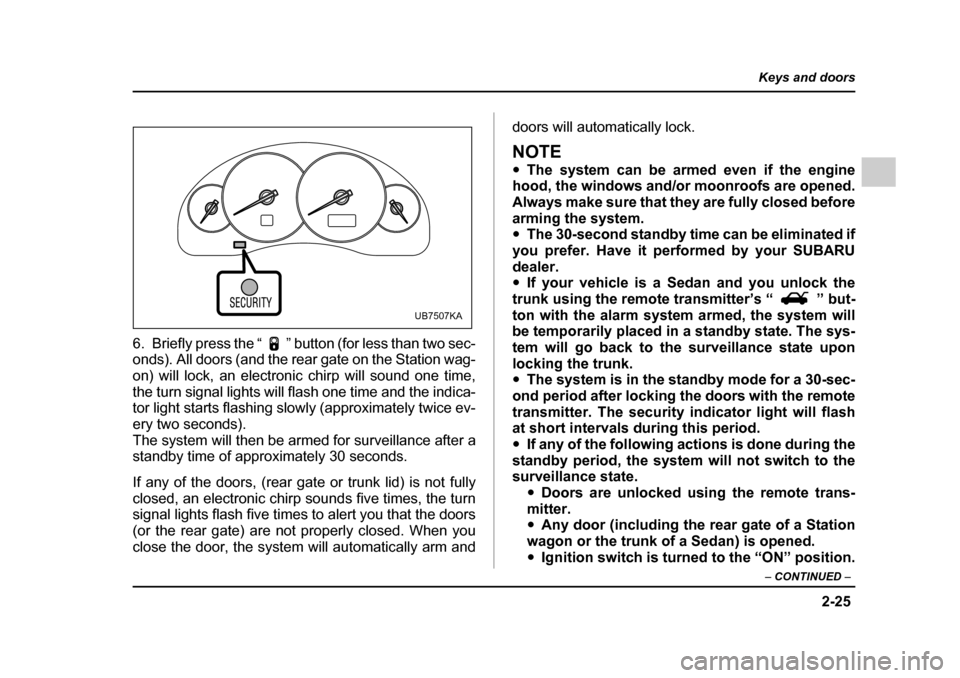
the turn signal lights will flash one time and the indica-
tor light starts flashing slowly (approximately twice ev-
ery two seconds).
The system will then be armed for surveillance after a
standby time of approximately 30 seconds.
If any of the doors, (rear gate or trunk lid) is not fully
closed, an electronic chirp sounds five times, the turn
signal lights flash five times to alert you that the doors
(or the rear gate) are not properly closed. When you
close the door, the system will automatically arm and doors will automatically lock.
NOTE "
The system can be armed even if the engine
hood, the windows and/or moonroofs are opened.
Always make sure that they are fully closed before
arming the system. " The 30-second standby time can be eliminated if
you prefer. Have it performed by your SUBARU
dealer. " If your vehicle is a Sedan and you unlock the
trunk using the remote transmitter’s “ ” but-
ton with the alarm system armed, the system will
be temporarily placed in a standby state. The sys-
tem will go back to the surveillance state upon
locking the trunk. " The system is in the standby mode for a 30-sec-
ond period after locking the doors with the remote
transmitter. The security indicator light will flash
at short intervals during this period. " If any of the following actions is done during the
standby period, the system will not switch to the
surveillance state. "Doors are unlocked using the remote trans-
mitter." Any door (including the rear gate of a Station
wagon or the trunk of a Sedan) is opened. " Ignition switch is turned to the “ON” position.
UB7507KA
Page 151 of 627
2-26
Keys and doors
"
The alarm system is triggered when the ignition
switch is turned to the “ON” position during sur-
veillance. However, this does not occur if the vehi-
cle is equipped with an immobilizer and the key
used for turning the ignition switch has been reg-
istered. " If your vehicle is not equipped with an immobi-
lizer, the engine does not start even when the igni- tion switch is turned to the “START” position once
the alarm system has been triggered. ! Disarming the system
Briefly press the “ ” button (for less than two sec-
onds) on the remote transmitter. The driver’s door will
unlock, an electronic chirp will sound twice, the turn
signal lights will flash twice and the indicator light will
go off.
To unlock all other doors and the rear gate (Station
wagon), briefly press the “ ” button a second time.
NOTE
If the interval between the first and second press-
es of the “ ” button (for unlocking of all of the
doors and the rear gate) is extremely short, the
system may not respond.
Or the system can be disarmed by the following method, too. "
Insert the key in the door lock of the driver’s
door and turn it to the unlock position." Cycle the ignition switch from the “LOCK” to the
“ON” position three times within 5 seconds (only
vehicle without immobilizer). ! Emergency disarming
If you cannot disarm the system using the transmitter
(i.e. the transmitter is lost, broken or the transmitter
battery is too weak), you can disarm the system with-
out using the transmitter.
Vehicle with immobilizer
The system can be disarmed if you turn the ignition
switch from the “LOCK” to the “ON” position with a reg-
istered key.
Vehicle without immobilizer
1. Unlock the door with the key and then open the
door.
2. Insert the key into the ignition switch and cycle it
from the “LOCK” to the “ON” position three times with-
in 5 seconds .
All models
Insert the key in the door lock of the driver’s door and
turn it to the unlock position.
Page 154 of 627
2-29
Keys and doors
– CONTINUED –
!Tripped sensor identification
The security indicator light flashes when the alarm
system has been triggered. Also, the number of flash-
es indicates the location of unauthorized intrusion or
the severity of impact on the vehicle. " When the ignition switch is turned to the “ON” posi-
tion, the indicator light will light for 1 second and then
flash as follows: When a door or rear gate (Station wagon) was
opened: 5 times
When the trunk (Sedan) was opened: 4 times
When a strong impact or multiple impacts were
sensed: twice (only vehicles with shock sensors
(dealer option))
When a light impact was sensed: once (only vehi-
cles with shock sensors (dealer option))
! Shock sensors (dealer option)
The shock sensors trigger the alarm system when
they sense impacts applied to the vehicle and when
any of their electric wires is cut. The alarm system
causes the horn to sound and the turn signal lights to
flash for a short time when the sensed impact is weak,
but it warns of a strong impact or multiple impacts by
sounding the horn and flashing the turn signal lights,
both lasting approximately 30 seconds. If you desire, your SUBARU dealer can connect them
and set them for activation or deactivation.
NOTE "
The shock sensors are not always able to sense
impacts caused by breaking in, and cannot sense
an impact that does not cause vibration (such as
breaking the glass using a rescue hammer). " The shock sensors may sense vibration like
those shown below and trigger the alarm system.
Select the settings of the alarm system and shock
sensors appropriately depending on where you
usually park your vehicle.
Example: Vibration from construction site
Vibration in multistory car park
Vibration from trains
" You can have the sensitivity of the shock sen-
sors adjusted to your preference by your SUBARU
dealer.
Page 172 of 627

3-1
3
Instruments and controls
Ignition switch .............................................. 3-3 LOCK .................................................................. 3-4
ACC .................................................................... 3-4
ON ....................................................................... 3-4
START ................................................................ 3-5
Key reminder chime .......................................... 3-6
Ignition switch light .......................................... 3-6
Hazard warning flasher ................................ 3-7
Meters and gauges (Turbo models) ............ 3-7 Combination meter illumination ...................... 3-7
Canceling the function for meter/gauge needle movement and combination meter
sequential illumination upon turning on the
ignition switch ................................................ 3-8
Speedometer ..................................................... 3-9
Odometer ........................................................... 3-9
Double trip meter .............................................. 3-10
Tachometer ........................................................ 3-11
Fuel gauge ......................................................... 3-11
Temperature gauge ........................................... 3-13
Meters and gauges (Non-turbo models) ..... 3-14 Combination meter illumination ...................... 3-14
Canceling the function for meter/gauge needle movement upon turning on the
ignition switch ................................................ 3-15
Speedometer ..................................................... 3-15
Odometer ........................................................... 3-16
Double trip meter .............................................. 3-16
Tachometer ........................................................ 3-17
Fuel gauge ......................................................... 3-18
Temperature gauge ........................................... 3-19 Warning and indicator lights ....................... 3-20
Seatbelt warning light and chime .................... 3-21
SRS airbag system warning light .................... 3-24
Front passenger’s frontal airbag ON and OFF indicators ........................................................ 3-24
CHECK ENGINE warning light/Malfunction indicator lamp ................................................. 3-25
Charge warning light ........................................ 3-26
Oil pressure warning light ............................... 3-26
AT OIL TEMPerature warning light (AT vehicles) ................................................... 3-27
Low tire pressure warning light (if equipped) .................................................... 3-27
ABS warning light ............................................. 3-28
Brake system warning light ............................. 3-29
Low fuel warning light ...................................... 3-30
Door open warning light .................................. 3-31
All-wheel drive warning light (AT vehicles) .... 3-31
Vehicle Dynamics Control operation indicator light (if equipped) ........................................... 3-31
Vehicle Dynamics Control warning light (if equipped)/Vehicle Dynamics Control OFF
indicator light (if equipped) ........................... 3-32
Security indicator light ..................................... 3-33
SPORT mode indicator light (AT vehicles) ..... 3-34
Selector lever position indicator (AT vehicles) ................................................... 3-34
Gear position indicator (AT vehicles) ............. 3-34
Turn signal indicator lights .............................. 3-34
High beam indicator light ................................. 3-35
Cruise control indicator light ........................... 3-35
Cruise control set indicator light .................... 3-35
Page 173 of 627

3-2
Instruments and controls
Headlight indicator light .................................. 3-35
Front fog light indicator light .......................... 3-35
Clock ............................................................. 3-36
Information display (if equipped) ................ 3-37 Outside temperature indicator ........................ 3-37
Current fuel consumption ................................ 3-39
Average fuel consumption .............................. 3-40
Driving range on remaining fuel ..................... 3-41
Journey time ..................................................... 3-43
Light control switch ..................................... 3-44 Headlights ......................................................... 3-45
High/low beam change (dimmer) .................... 3-45
Headlight flasher .............................................. 3-46
Daytime running light system ......................... 3-46
Turn signal lever ........................................... 3-47
Illumination brightness control ................... 3-47
Bright switch (Night illumination dimness cancellation) .............................................. 3-48
Parking light switch ..................................... 3-49
Fog light switch (if equipped) ..................... 3-50
Wiper and washer ......................................... 3-51 Windshield wiper and washer switches ......... 3-52
Rear window wiper and washer switch (Station wagon) .............................................. 3-55
Windshield wiper deicer (if equipped) ........ 3-56
Rear window defogger button ..................... 3-57
Mirrors ........................................................... 3-59 Inside mirror ...................................................... 3-59
Auto-dimming mirror/compass (if equipped) ................................................... 3-59
Outside mirrors ................................................. 3-61 Tilt steering wheel ........................................ 3-63
Horn ............................................................... 3-64
Page 178 of 627
3-7
Instruments and controls
– CONTINUED –
Hazard warning flasher
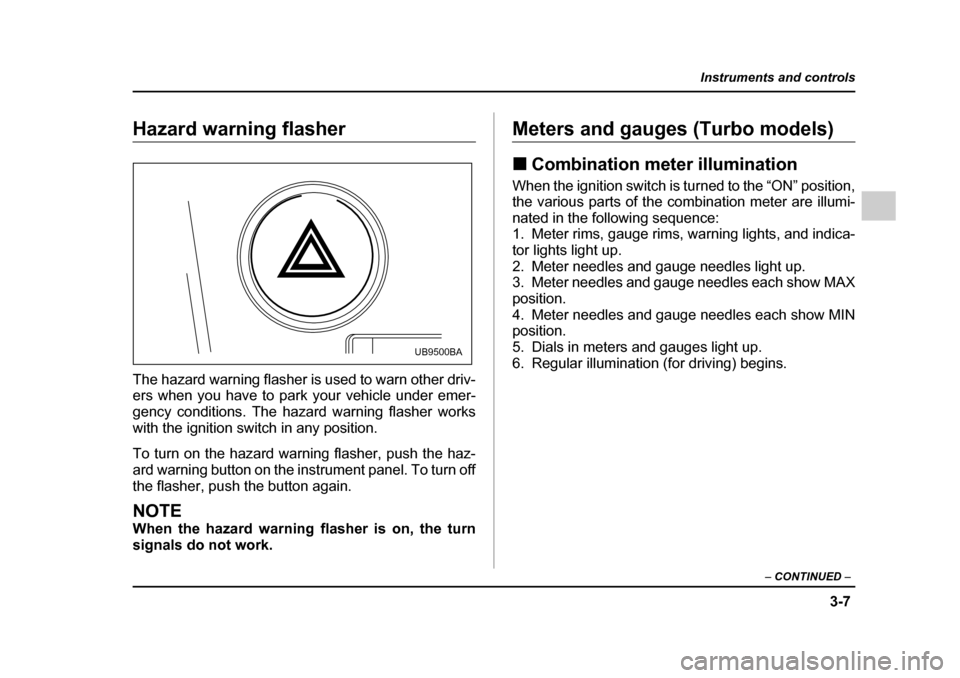
The hazard warning flasher is used to warn other driv-
ers when you have to park your vehicle under emer-
gency conditions. The hazard warning flasher works
with the ignition switch in any position.
To turn on the hazard warning flasher, push the haz-
ard warning button on the instrument panel. To turn off
the flasher, push the button again.
NOTE
When the hazard warning flasher is on, the turn
signals do not work.
Meters and gauges (Turbo models) !Combination meter illumination
When the ignition switch is turned to the “ON” position,
the various parts of the combination meter are illumi-
nated in the following sequence:
1. Meter rims, gauge rims, warning lights, and indica-
tor lights light up.
2. Meter needles and gauge needles light up.
3. Meter needles and gauge needles each show MAX
position.
4. Meter needles and gauge needles each show MIN
position.
5. Dials in meters and gauges light up.
6. Regular illumination (for driving) begins.
UB9500BA
Page 191 of 627
3-20
Instruments and controls
We recommend that you drive moderately until the
pointer of the temperature gauge reaches near the
middle of the range. Engine operation is optimum with
the engine coolant at this temperature range and high
revving operation when the engine is not warmed up
enough should be avoided.
If the pointer exceeds the normal operating
range, safely stop the vehicle as soon as possi-
ble.
See the “In case of emergency” in chapter 9.
Warning and indicator lights
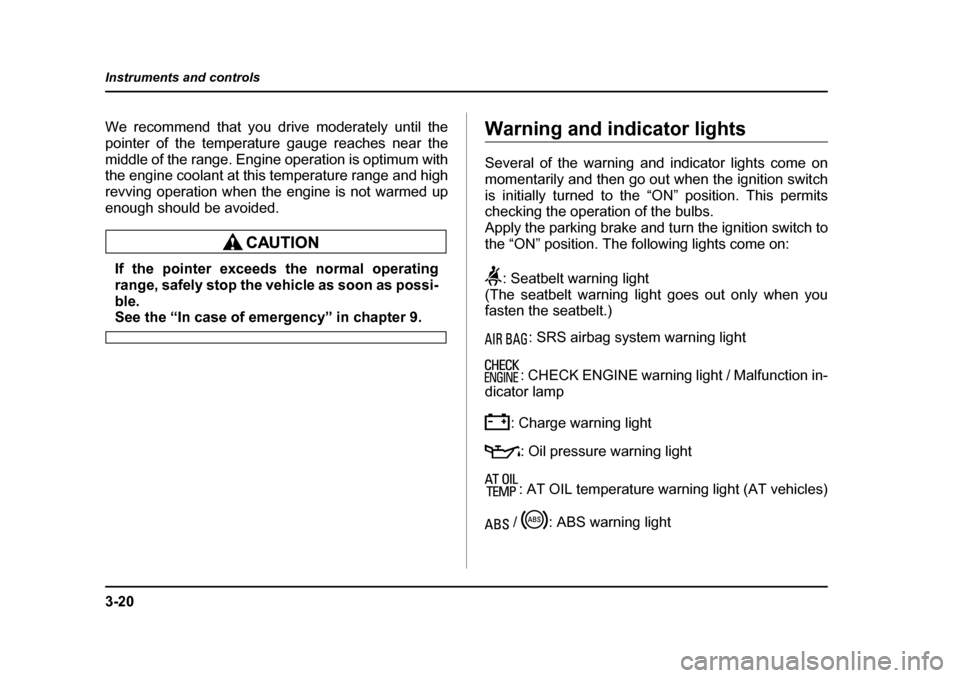
Several of the warning and indicator lights come on
momentarily and then go out when the ignition switch
is initially turned to the “ON” position. This permits
checking the operation of the bulbs.
Apply the parking brake and turn the ignition switch to
the “ON” position. The following lights come on:
: Seatbelt warning light
(The seatbelt warning light goes out only when you
fasten the seatbelt.)
: SRS airbag system warning light
: CHECK ENGINE warning light / Malfunction in-
dicator lamp
: Charge warning light: Oil pressure warning light
: AT OIL temperature warning light (AT vehicles)
/ : ABS warning light
Page 192 of 627
3-21
Instruments and controls
– CONTINUED –
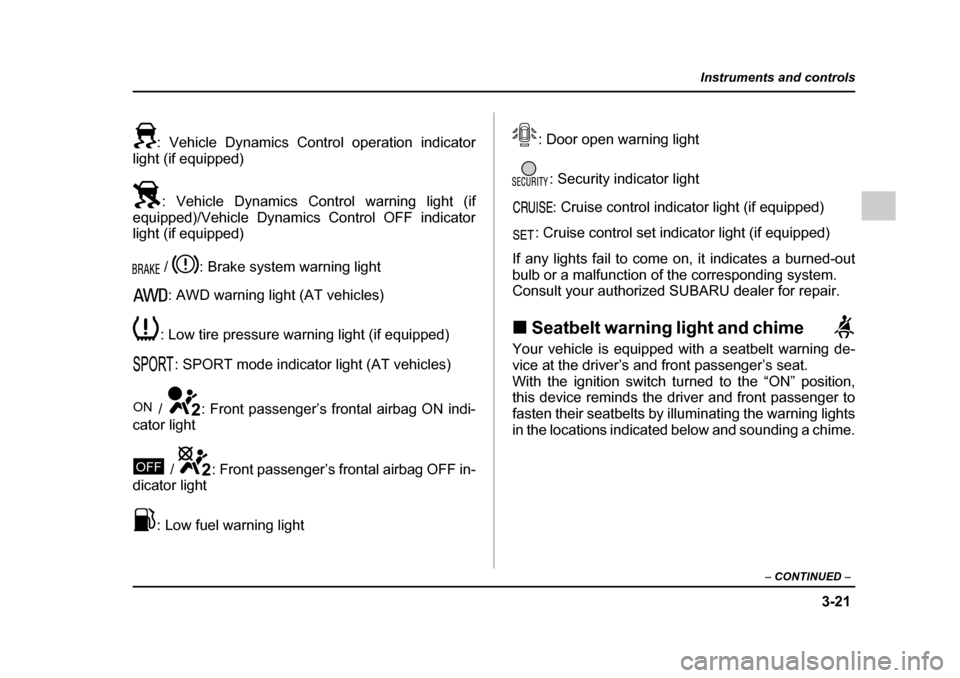
: Vehicle Dynamics Control operation indicator
light (if equipped)
: Vehicle Dynamics Control warning light (if
equipped)/Vehicle Dynamics Control OFF indicator
light (if equipped)
/ : Brake system warning light: AWD warning light (AT vehicles)
: Low tire pressure warning light (if equipped) : SPORT mode indicator light (AT vehicles)
/ : Front passenger’s frontal airbag ON indi-
cator light
/ : Front passenger’s frontal airbag OFF in-
dicator light
: Low fuel warning light : Door open warning light
: Security indicator light: Cruise control indicator light (if equipped)
: Cruise control set indicator light (if equipped)
If any lights fail to come on, it indicates a burned-out
bulb or a malfunction of the corresponding system.
Consult your authorized SUBARU dealer for repair. ! Seatbelt warning light and chime
Your vehicle is equipped with a seatbelt warning de-
vice at the driver’s and front passenger’s seat.
With the ignition switch turned to the “ON” position,
this device reminds the driver and front passenger to
fasten their seatbelts by illuminating the warning lights
in the locations indicated below and sounding a chime.
ON
OFF