tire type SUBARU OUTBACK 2005 4.G User Guide
[x] Cancel search | Manufacturer: SUBARU, Model Year: 2005, Model line: OUTBACK, Model: SUBARU OUTBACK 2005 4.GPages: 627, PDF Size: 6.42 MB
Page 555 of 627
11 - 5 6
Maintenance and service
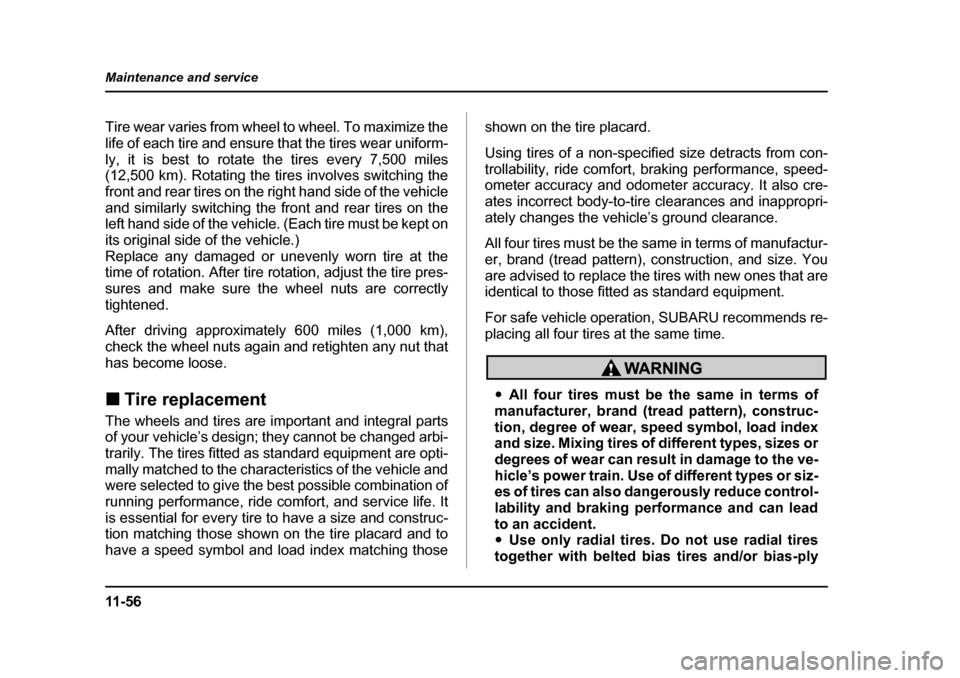
Tire wear varies from wheel to wheel. To maximize the
life of each tire and ensure that the tires wear uniform-
ly, it is best to rotate the tires every 7,500 miles
(12,500 km). Rotating the tires involves switching the
front and rear tires on the right hand side of the vehicle
and similarly switching the front and rear tires on the
left hand side of the vehicle. (Each tire must be kept on
its original side of the vehicle.)
Replace any damaged or unevenly worn tire at the
time of rotation. After tire rotation, adjust the tire pres-
sures and make sure the wheel nuts are correctly
tightened.
After driving approximately 600 miles (1,000 km),
check the wheel nuts again and retighten any nut that
has become loose. !
Tire replacement
The wheels and tires are important and integral parts
of your vehicle’s design; they cannot be changed arbi-
trarily. The tires fitted as standard equipment are opti-
mally matched to the characteristics of the vehicle and
were selected to give the best possible combination of
running performance, ride comfort, and service life. It
is essential for every tire to have a size and construc-
tion matching those shown on the tire placard and to
have a speed symbol and load index matching those shown on the tire placard.
Using tires of a non-specified size detracts from con-
trollability, ride comfort, braking performance, speed-
ometer accuracy and odometer accuracy. It also cre-
ates incorrect body-to-tire clearances and inappropri-
ately changes the vehicle’s ground clearance.
All four tires must be the same in terms of manufactur-
er, brand (tread pattern), construction, and size. You
are advised to replace the tires with new ones that are
identical to those fitted as standard equipment.
For safe vehicle operation, SUBARU recommends re-
placing all four tires at the same time.
"
All four tires must be the same in terms of
manufacturer, brand (tread pattern), construc-
tion, degree of wear, speed symbol, load index
and size. Mixing tires of different types, sizes or
degrees of wear can result in damage to the ve-
hicle’s power train. Use of different types or siz-
es of tires can also dangerously reduce control-
lability and braking performance and can lead
to an accident. " Use only radial tires. Do not use radial tires
together with belted bias tires and/or bias-ply
Page 599 of 627
13-2
Consumer information and Reporting safety defects
Consumer information and Reporting safety defectsFor U.S.A.
The following information has been compiled accord-
ing to Code of Federal Regulations “Title 49, Part
575”.
Tire information !
Tire labeling
Many markings (e.g. Tire size, Tire Identification
Number or TIN) are placed on the sidewall of a
tire by tire manufacturers. These marking can
provide you with useful information on the tire. ! Tire size
Your vehicle comes equipped with P-Metric tire
size. It is important to understand the sizing sys-
tem in selecting the proper tire for your vehicles.
Here is a brief review of the tire sizing system
with a breakdown of its individual elements. " P Metric
With the P-Metric system, Section Width is mea-
sured in millimeters. To convert millimeters into
inches, divide by 25.4. The Aspect Ratio (Sec-
tion Height divided by Section Width) helps pro- vide more dimensional information about the tire
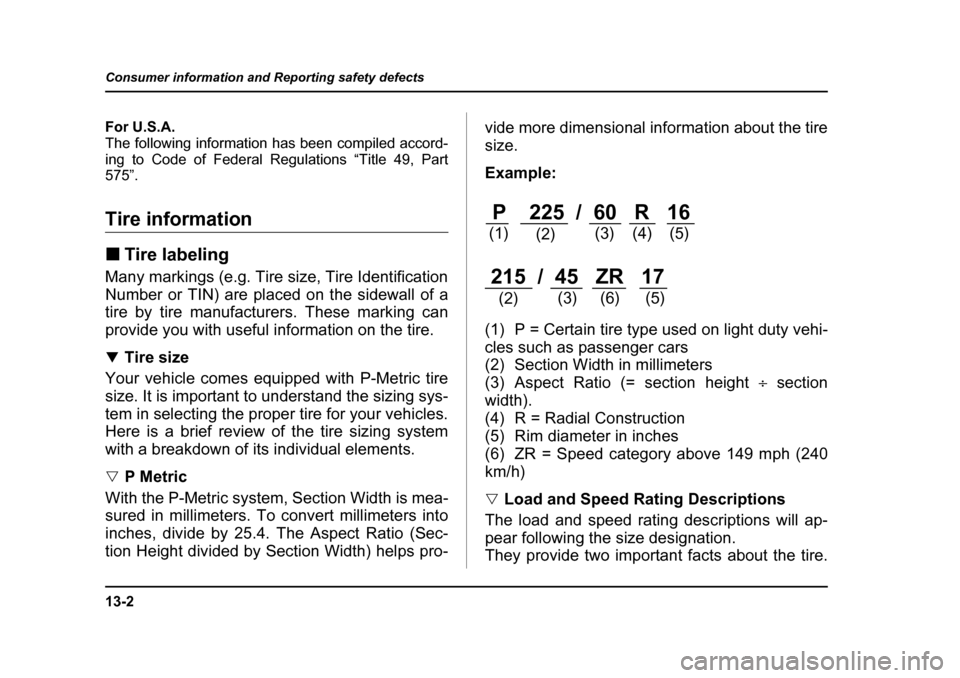
size. Example:
(1) P = Certain tire type used on light duty vehi-
cles such as passenger cars
(2) Section Width in millimeters
(3) Aspect Ratio (= section height
÷ section
width).
(4) R = Radial Construction
(5) Rim diameter in inches
(6) ZR = Speed category above 149 mph (240
km/h) " Load and Speed Rating Descriptions
The load and speed rating descriptions will ap-
pear following the size designation.
They provide two important facts about the tire.P 225 / 60 R 16
(1) (2) (3) (4) (5)
215 / 45 ZR 17
(2) (3) (6) (5)
Page 601 of 627
13-4
Consumer information and Reporting safety defects
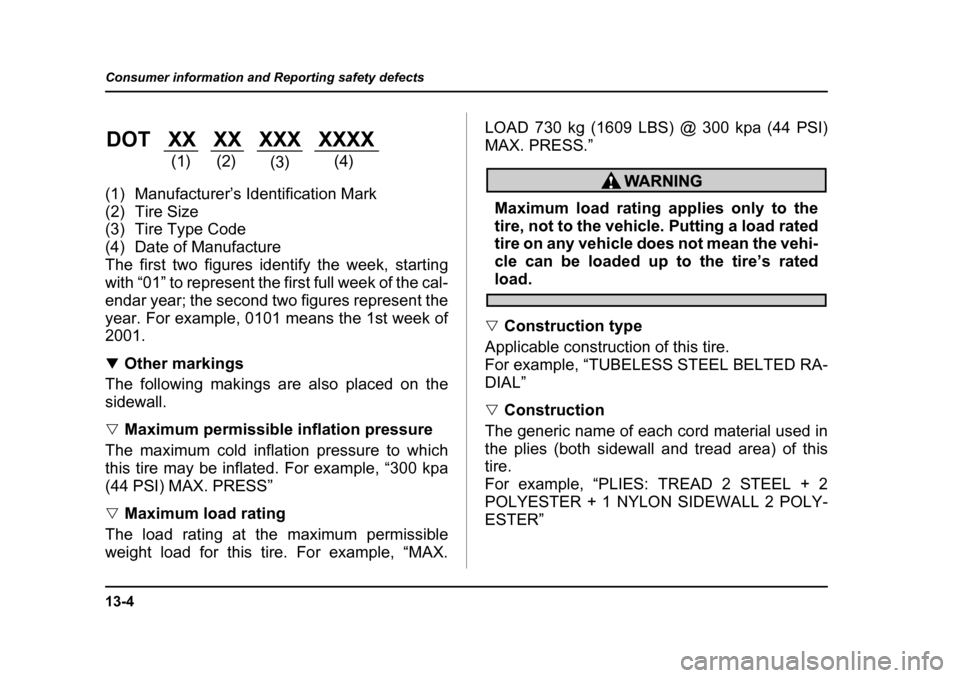
(1) Manufacturer’s Identification Mark
(2) Tire Size
(3) Tire Type Code
(4) Date of Manufacture
The first two figures identify the week, starting
with “01” to represent the first full week of the cal-
endar year; the second two figures represent the
year. For example, 0101 means the 1st week of
2001. !
Other markings
The following makings are also placed on the
sidewall. " Maximum permissible inflation pressure
The maximum cold inflation pressure to which
this tire may be inflated. For example, “300 kpa
(44 PSI) MAX. PRESS” " Maximum load rating
The load rating at the maximum permissible
weight load for this tire. For example, “MAX. LOAD 730 kg (1609 LBS) @ 300 kpa (44 PSI)
MAX. PRESS.”Maximum load rating applies only to the
tire, not to the vehicle. Putting a load rated
tire on any vehicle does not mean the vehi-
cle can be loaded up to the tire’s rated
load.
" Construction type
Applicable construction of this tire.
For example, “TUBELESS STEEL BELTED RA-
DIAL” " Construction
The generic name of each cord material used in
the plies (both sidewall and tread area) of this
tire.
For example, “PLIES: TREAD 2 STEEL + 2
POLYESTER + 1 NYLON SIDEWALL 2 POLY-
ESTER”
DOT XX XX XXX XXXX (1) (2) (3)(4)
Page 613 of 627
13-16
Consumer information and Reporting safety defects
Uniform tire quality grading stan-
dards
This information indicates the relative perfor-
mance of passenger car tires in the area of
treadwear, traction, and temperature resistance.
This is to aid the consumer in making an in-
formed choice in the purchase of tires.
Quality grades can be found where applicable on
the tire sidewall between tread shoulder and
maximum section width. For example:
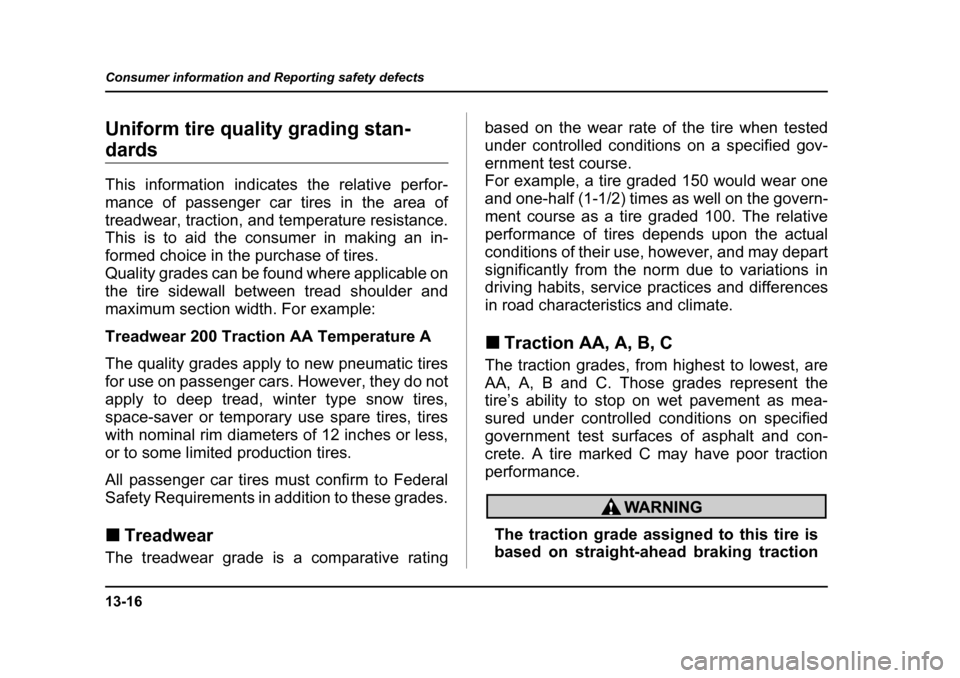
Treadwear 200 Traction AA Temperature A
The quality grades apply to new pneumatic tires
for use on passenger cars. However, they do not
apply to deep tread, winter type snow tires,
space-saver or temporary use spare tires, tires
with nominal rim diameters of 12 inches or less,
or to some limited production tires.
All passenger car tires must confirm to Federal
Safety Requirements in addition to these grades. !
Treadwear
The treadwear grade is a comparative rating based on the wear rate of the tire when tested
under controlled conditions on a specified gov- ernment test course.
For example, a tire graded 150 would wear one
and one-half (1-1/2) times as well on the govern-
ment course as a tire graded 100. The relative
performance of tires depends upon the actual
conditions of their use, however, and may depart
significantly from the norm due to variations in
driving habits, service practices and differences
in road characteristics and climate. !
Traction AA, A, B, C
The traction grades, from highest to lowest, are
AA, A, B and C. Those grades represent the
tire’s ability to stop on wet pavement as mea-
sured under controlled conditions on specified
government test surfaces of asphalt and con-
crete. A tire marked C may have poor traction
performance.
The traction grade assigned to this tire is
based on straight-ahead braking traction
Page 624 of 627

14-9
Index
Tilt steering wheel ............................................. 3-63 Tire
Chains .......................................................... 8-17
Inspection ................................................... 11-51
Pressures and wear .................................... 11-52
Replacement .............................................. 11-56
Rotation ...................................................... 11-55
Tires .................................................................. 12-5
Types .......................................................... 11-49
Tires and wheels ............................................. 11-49
Top tether anchorages ...................................... 1-55
Towing ............................................................... 9-21 All wheels on the ground .............................. 9-28
Flat-bed truck ................................................ 9-27
Tie-down hooks ............................................ 9-22
Weight .......................................................... 8-31
Trailer
Hitch ............................................................. 8-27
Hitches .......................................................... 8-37
Towing .......................................................... 8-31
Towing tips ................................................... 8-40
Trip meter ................................................. 3-10, 3-16
Trunk lid ............................................................. 2-35
Release handle ............................................. 2-37
Trunk light ........................................................ 11-86
Turn signal
Indicator lights .............................................. 3-34 Lever ............................................................. 3-47
U
Under-floor storage compartment ..................... 6-30 V
Valet mode ........................................................ 2-27
Vanity mirror ........................................................ 6-6
Vehicle Capacity weight ............................................ 8-19
Identification ............................................... 12-11
Vehicle Dynamics Control
OFF indicator light ........................................ 3-32
OFF switch ................................................... 7-48
Operation indicator light ................................ 3-31
System .......................................................... 7-43
Warning light ................................................. 3-32
Ventilator ............................................................. 4-2 W
Warning and indicator lights .............................. 3-20
Warning lights ABS .............................................................. 3-28
All-wheel drive .............................................. 3-31
Anti-lock Brake system ................................. 3-28
AT OIL TEMPerature .................................... 3-27