light SUBARU OUTBACK 2005 4.G Owners Manual
[x] Cancel search | Manufacturer: SUBARU, Model Year: 2005, Model line: OUTBACK, Model: SUBARU OUTBACK 2005 4.GPages: 627, PDF Size: 6.42 MB
Page 494 of 627
10-3
Appearance care
– CONTINUED –
the mud and sand off the underbody.
Carefully flush the suspension and axle parts, as they
are particularly prone to mud and sand buildup. Do not
use a sharp-edged tool to remove caked mud.
NOTE
Be careful not to damage brake hoses, sensor har-
nesses, and other parts when washing suspen-
sion components. !Using a warm water washer
" Keep a good distance of 12 in (30 cm) or more be-
tween the washer nozzle and the vehicle. " Do not wash the same area continuously.
" If a stain will not come out easily, wash by hand.
Some warm water washers are of the high tempera-
ture, high pressure type, and they can damage or de-
form the resin parts such as mouldings, or cause wa-
ter to leak into the vehicle. ! Waxing and polishing
Always wash and dry the vehicle before waxing and
polishing.
Use a good quality polish and wax and apply them ac-
cording to the manufacturer’s instructions. Wax or pol-
ish when the painted surface is cool.
Be sure to polish and wax the chrome trim, as well as the painted surfaces. Loss of wax on a painted surface
leads to loss of the original luster and also quickens
the deterioration of the surface. It is recommended
that a coat of wax be applied at least once a month, or
whenever the surface no longer repels water.
If the appearance of the paint has diminished to the
point where the luster or tone cannot be restored,
lightly polish the surface with a fine-grained com-
pound. Never polish just the affected area, but include
the surrounding area as well. Always polish in only
one direction. A No. 2000 grain compound is recom-
mended. Never use a coarse-grained compound.
Coarser grained compounds have a smaller grain-size
number and could damage the paint. After polishing
with a compound, coat with wax to restore the original
luster. Frequent polishing with a compound or an in-
correct polishing technique will result in removing the
paint layer and exposing the undercoat. When in
doubt, it is always best to contact your SUBARU deal-
er or an auto paint specialist.
NOTE
Be careful not to block the windshield washer noz-
zles with wax when waxing the vehicle.
Page 497 of 627

10-6
Appearance care
Cleaning the interior
Use a vacuum cleaner to get rid of the dust and dirt.
Wipe the vinyl areas with a clean, damp cloth. !
Seat fabric
Remove loose dirt, dust or debris with a vacuum
cleaner. If the dirt is caked on the fabric or hard to re-
move with a vacuum cleaner, use a soft blush then
vacuum it.
Wipe the fabric surface with a tightly wrung cloth and
dry the seat fabric thoroughly. If the fabric is still dirty,
wipe using a solution of mild soap and lukewarm water
then dry thoroughly.
If the stain does not come out, try a commercially-
available fabric cleaner. Use the cleaner on a hidden
place and make sure it does not affect the fabric ad-
versely. Use the cleaner according to its instructions. ! Leather seat materials
The leather used by SUBARU is a high quality natural
product which will retain its distinctive appearance and
feel for many years with proper care.
Allowing dust or road dirt to build up on the surface can
cause the material to become brittle and to wear pre- maturely. Regular cleaning with a soft, moist, natural
fiber cloth should be performed monthly, taking care
not to soak the leather or allow water to penetrate the
stitched seams.
A mild detergent suitable for cleaning woolen fabrics
may be used to remove difficult dirt spots, rubbing with
a soft, dry cloth afterwards to restore the luster. If your
SUBARU is to be parked for a long time in bright sun-
light, it is recommended that the seats and headrests
be covered, or the windows shaded, to prevent fading
or shrinkage.
Minor surface blemishes or bald patches may be treat-
ed with a commercial leather spray lacquer. You will discover that each leather seat section will develop
soft folds or wrinkles, which is characteristic of genu-
ine leather. !
Synthetic leather upholstery
The synthetic leather material used on the SUBARU
may be cleaned using mild soap or detergent and wa-
ter, after first vacuuming or brushing away loose dirt.
Allow the soap to soak in for a few minutes and wipe
off with a clean, damp cloth. Commercial foam-type
cleaners suitable for synthetic leather materials may
be used when necessary.
Page 501 of 627

11 - 2
Maintenance and service
Breaking-in of new brake pads and linings ... 11-47
Parking brake stroke .................................... 11-48
Tires and wheels .......................................... 11-49 Types of tires .................................................... 11-49
Tire pressure monitoring system (TPMS) (if equipped) ................................................... 11-49
Tire inspection .................................................. 11-51
Tire pressures and wear .................................. 11-52
Wheel balance ................................................... 11-54
Wear indicators ................................................. 11-55
Tire rotation ....................................................... 11-55
Tire replacement ............................................... 11-56
Wheel replacement ........................................... 11-57
Aluminum wheels ......................................... 11-57
Windshield washer fluid .............................. 11-58
Replacement of wiper blades ...................... 11-60 Windshield wiper blades assembly ................ 11-60
Windshield wiper blade rubber ....................... 11-61
Rear window wiper blade assembly ............... 11-63
Rear window wiper blade rubber .................... 11-64
Battery ........................................................... 11-67
Fuses ............................................................. 11-68
Main fuse ....................................................... 11-71
Installation of accessories .......................... 11-72
Replacing bulbs ............................................ 11-73 Headlight ........................................................... 11-74
Parking light ...................................................... 11-76
Front turn signal light ...................................... 11-76
Front fog light (if equipped) ............................. 11-76
Rear combination lights ................................... 11-76
Backup light (Station wagon) .......................... 11-79
License plate light ............................................ 11-80 Dome light ......................................................... 11-82
Map light ............................................................ 11-83
Door step light .................................................. 11-84
Cargo area light ................................................ 11-85
Trunk light ......................................................... 11-86
High mount stop light ...................................... 11-86
Page 505 of 627
11 - 6
Maintenance and service
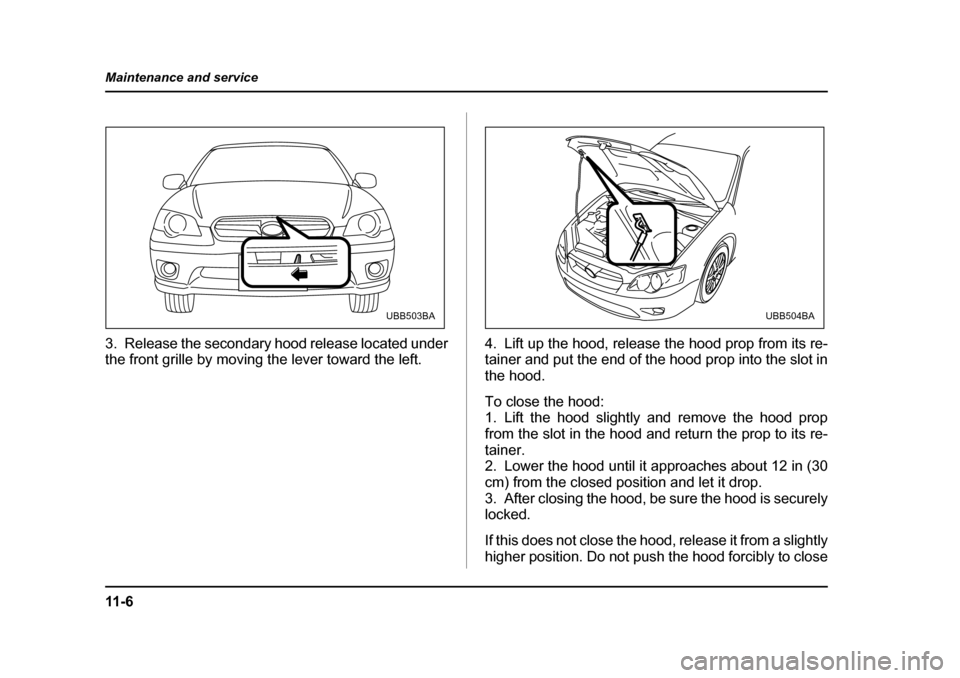
3. Release the secondary hood release located under
the front grille by moving the lever toward the left.
4. Lift up the hood, release the hood prop from its re-
tainer and put the end of the hood prop into the slot in
the hood.
To close the hood:
1. Lift the hood slightly and remove the hood prop
from the slot in the hood and return the prop to its re-
tainer.
2. Lower the hood until it approaches about 12 in (30
cm) from the closed position and let it drop.
3. After closing the hood, be sure the hood is securely
locked.
If this does not close the hood, release it from a slightly
higher position. Do not push the hood forcibly to close
UBB503BAUBB504BA
Page 514 of 627
11 -1 5
Maintenance and service
– CONTINUED –
washer after the oil has completely drained out.
6. Remove the under cover.
7. Remove the oil filter with an oil filter wrench.
8. Before installing a new oil filter, apply a thin coat of
engine oil to the seal.
9. Clean the rubber seal seating area of the bottom of
engine and install the oil filter by hand turning. Be
careful not to twist or damage the seal.
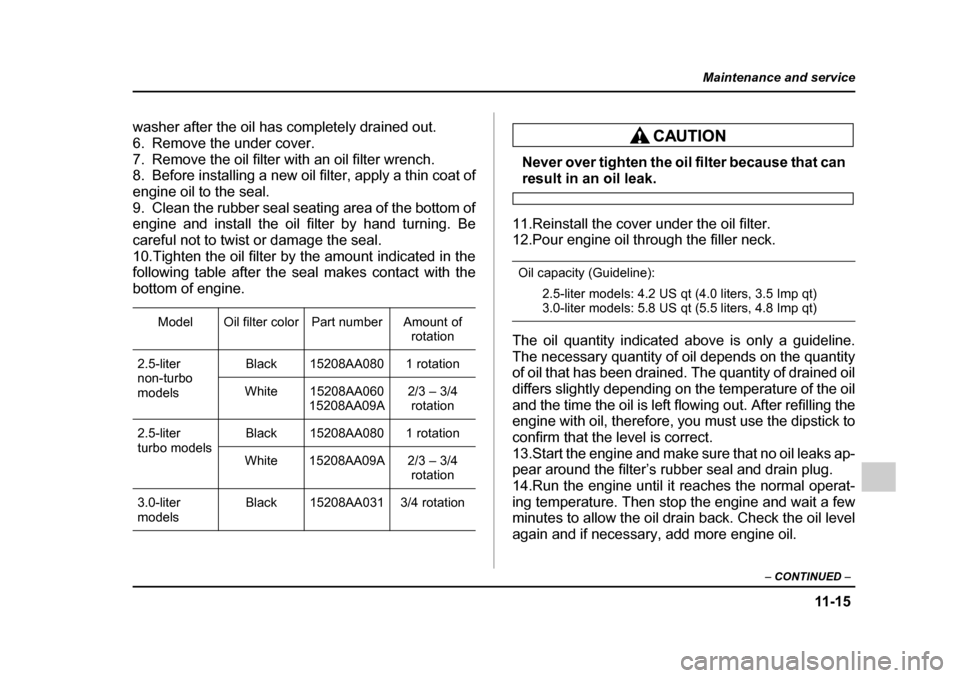
10.Tighten the oil filter by the amount indicated in the
following table after the seal makes contact with the
bottom of engine.
Never over tighten the oil filter because that can
result in an oil leak.
11.Reinstall the cover under the oil filter.
12.Pour engine oil through the filler neck.
Oil capacity (Guideline): 2.5-liter models: 4.2 US qt (4.0 liters, 3.5 Imp qt)
3.0-liter models: 5.8 US qt (5.5 liters, 4.8 Imp qt)
The oil quantity indicated above is only a guideline.
The necessary quantity of oil depends on the quantity
of oil that has been drained. The quantity of drained oil
differs slightly depending on the temperature of the oil
and the time the oil is left flowing out. After refilling the
engine with oil, therefore, you must use the dipstick to
confirm that the level is correct.
13.Start the engine and make sure that no oil leaks ap-
pear around the filter’s rubber seal and drain plug.
14.Run the engine until it reaches the normal operat-
ing temperature. Then stop the engine and wait a few
minutes to allow the oil drain back. Check the oil level
again and if necessary, add more engine oil.
Model Oil filter color Part number Amount of
rotation
2.5-liter
non-turbo
models Black 15208AA080 1 rotation
White 15208AA060 15208AA09A 2/3 – 3/4
rotation
2.5-liter
turbo models Black 15208AA080 1 rotation
White 15208AA09A 2/3 – 3/4 rotation
3.0-liter
models Black 15208AA031 3/4 rotation
Page 543 of 627
11 - 4 4
Maintenance and service
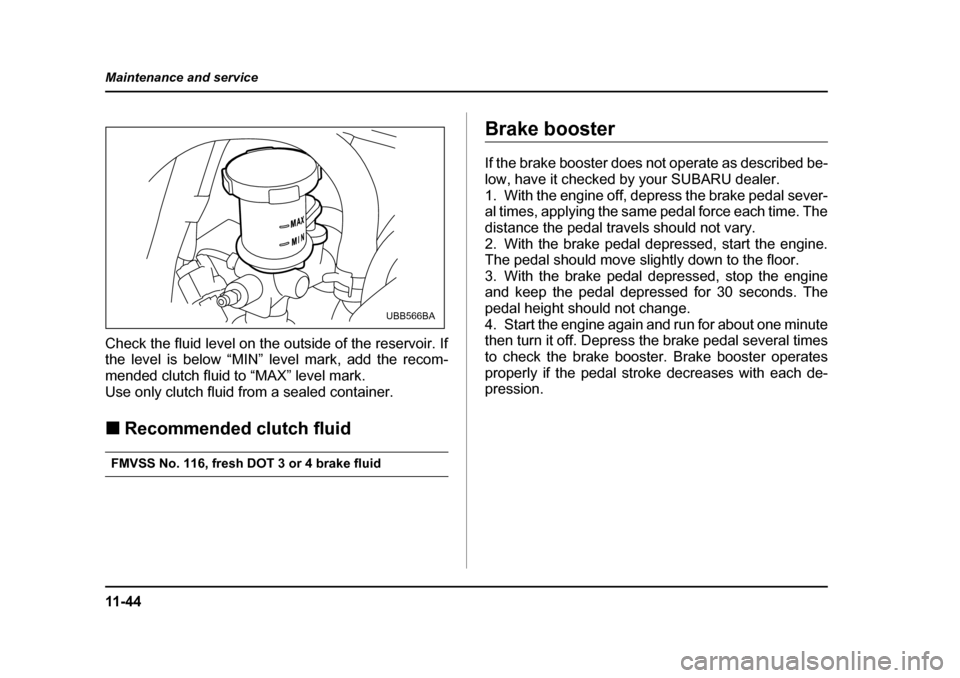
Check the fluid level on the outside of the reservoir. If
the level is below “MIN” level mark, add the recom-
mended clutch fluid to “MAX” level mark.
Use only clutch fluid from a sealed container. !
Recommended clutch fluid
FMVSS No. 116, fresh DOT 3 or 4 brake fluid
Brake booster
If the brake booster does not operate as described be-
low, have it checked by your SUBARU dealer.
1. With the engine off, depress the brake pedal sever-
al times, applying the same pedal force each time. The
distance the pedal travels should not vary.
2. With the brake pedal depressed, start the engine.
The pedal should move slightly down to the floor.
3. With the brake pedal depressed, stop the engine
and keep the pedal depressed for 30 seconds. The
pedal height should not change.
4. Start the engine again and run for about one minute
then turn it off. Depress the brake pedal several times
to check the brake booster. Brake booster operates
properly if the pedal stroke decreases with each de-
pression.
UBB566BA
Page 544 of 627
11 -4 5
Maintenance and service
– CONTINUED –
Brake pedal
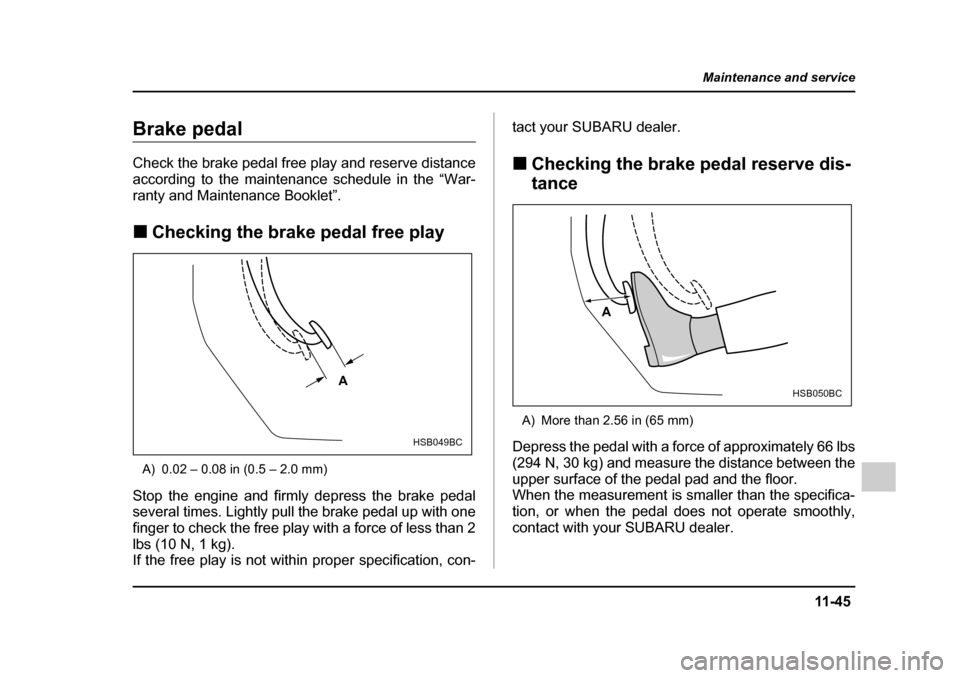
Check the brake pedal free play and reserve distance
according to the maintenance schedule in the “War-
ranty and Maintenance Booklet”. !Checking the brake pedal free play
A) 0.02 – 0.08 in (0.5 – 2.0 mm)
Stop the engine and firmly depress the brake pedal
several times. Lightly pull the brake pedal up with one
finger to check the free play with a force of less than 2
lbs (10 N, 1 kg).
If the free play is not within proper specification, con- tact your SUBARU dealer. !
Checking the brake pedal reserve dis-
tance
A) More than 2.56 in (65 mm)
Depress the pedal with a force of approximately 66 lbs
(294 N, 30 kg) and measure the distance between the
upper surface of the pedal pad and the floor.
When the measurement is smaller than the specifica-
tion, or when the pedal does not operate smoothly,
contact with your SUBARU dealer.
A
HSB049BC
A
HSB050BC
Page 545 of 627
11 - 4 6
Maintenance and service
Clutch pedal (Manual transmission
vehicles)
Check the clutch pedal free play and reserve distance
according to the maintenance schedule in the “War-
ranty and Maintenance Booklet”. !
Checking the clutch function
Check the clutch engagement and disengagement.
1. With the engine idling, check that there are no ab-
normal noises when the clutch pedal is depressed,
and that shifting into 1st or reverse feels smooth.
2. Start the vehicle by releasing the pedal slowly to
check that the engine and transmission smoothly cou-
ple without any sign of slippage. !
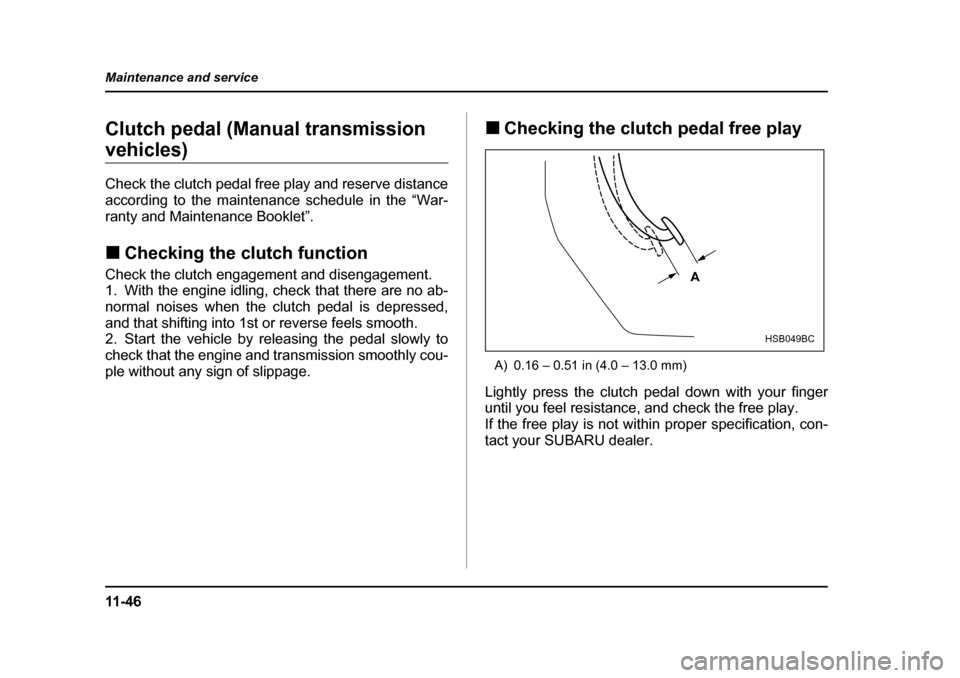
Checking the clutch pedal free play
A) 0.16 – 0.51 in (4.0 – 13.0 mm)
Lightly press the clutch pedal down with your finger
until you feel resistance, and check the free play.
If the free play is not within proper specification, con-
tact your SUBARU dealer.
A
HSB049BC
Page 546 of 627
11 -4 7
Maintenance and service
– CONTINUED –
Replacement of brake pad and lining
If you continue to drive despite the scraping
noise from the audible brake pad wear indica-
tor, it will result in the need for costly brake ro-
tor repair or replacement.
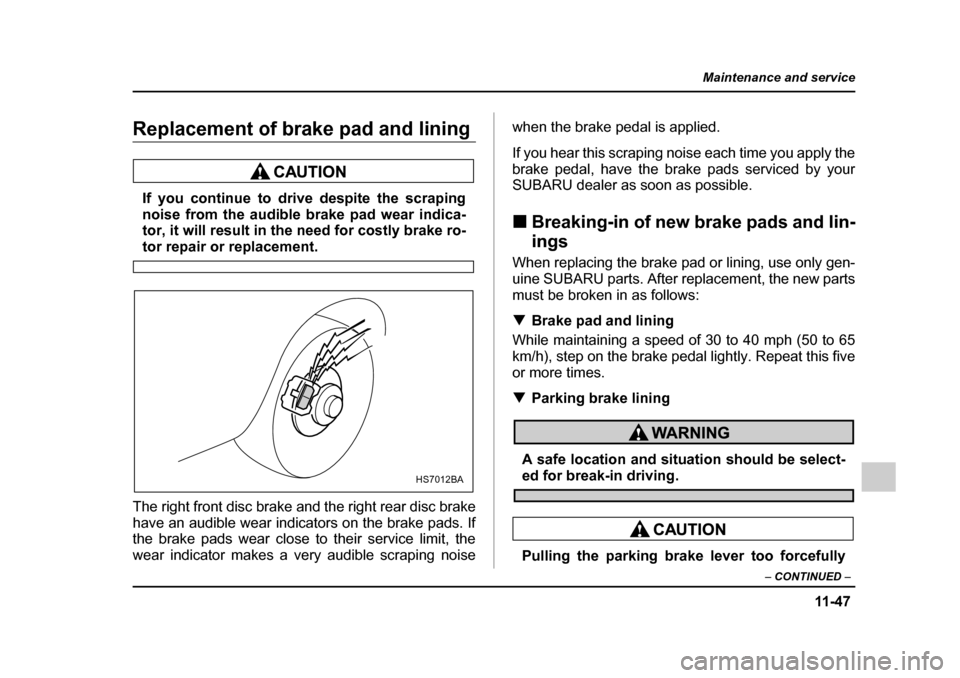
The right front disc brake and the right rear disc brake
have an audible wear indicators on the brake pads. If
the brake pads wear close to their service limit, the
wear indicator makes a very audible scraping noise when the brake pedal is applied.
If you hear this scraping noise each time you apply the
brake pedal, have the brake pads serviced by your
SUBARU dealer as soon as possible. !
Breaking-in of new brake pads and lin- ings
When replacing the brake pad or lining, use only gen-
uine SUBARU parts. After replacement, the new parts
must be broken in as follows: ! Brake pad and lining
While maintaining a speed of 30 to 40 mph (50 to 65
km/h), step on the brake pedal lightly. Repeat this five
or more times. ! Parking brake lining
A safe location and situation should be select-
ed for break-in driving.
Pulling the parking brake lever too forcefully
HS7012BA
Page 548 of 627

11 -4 9
Maintenance and service
– CONTINUED –
Tires and wheels !Types of tires
You should be familiar with type of tires present on your vehicle. ! All season tires
The factory-installed tires on your new vehicle are all
season tires.
All season tires are designed to provide an adequate
measure of traction, handling and braking perfor-
mance in year-round driving including snowy and icy
road conditions. However all season tires do not offer
as much traction performance as winter (snow) tires in
heavy or loose snow or on icy roads.
All season tires are identified by “ALL SEASON” and/
or “M+S” (Mud & Snow) on the tire sidewall. ! Summer tires
Summer tires are high-speed capability tires best suit-
ed for highway driving under dry conditions.
Summer tires are inadequate for driving on slippery
roads such as on snow-covered or icy roads.
If you drive your vehicle on snow-covered or icy roads,
we strongly recommend the use of winter (snow) tires.
When installing winter tires, be sure to replace all four
tires. !
Winter (snow) tires
Winter tires are best suited for driving on snow-cov-
ered and icy roads. However winter tires do not per-
form as well as summer tires and all season tires on
roads other than snow-covered and icy roads. ! Tire pressure monitoring system
(TPMS) (if equipped)
The tire pressure monitoring system provides the driv-
er with a warning message indicating by sending a sig-
nal from a sensor that is installed in each wheel when
tire pressure is severely low. The tire pressure moni-
toring system will activate only when the vehicle is
driven. Also, this system may not react immediately to
a sudden drop in tire pressure (for example, a blow-
out caused by running over a sharp object).
If you adjust the tire pressures in a warm garage and
will then drive the vehicle in cold outside air, the result-
ing drop in tire pressures may cause the low tire pres-
sure warning light to come on. To avoid this problem
when adjusting the tire pressures in a warm garage,
inflate the tires to pressures higher than those shown
on the tire placard. Specifically, inflate them by an ex-
tra 1 psi (6.9 kPa, 0.07 kgf/cm 2
) for every difference of
10 °F (5.6 °C) between the temperature in the garage
and the temperature outside. By way of example, the