brake light SUBARU OUTBACK 2005 4.G Owner's Manual
[x] Cancel search | Manufacturer: SUBARU, Model Year: 2005, Model line: OUTBACK, Model: SUBARU OUTBACK 2005 4.GPages: 627, PDF Size: 6.42 MB
Page 394 of 627
7-39
Starting and operating
– CONTINUED –
The ABS system prevents the lock-up of wheels which
may occur during sudden braking or braking on slip-
pery road surfaces. This helps prevent the loss of
steering control and directional stability caused by
wheel lock-up.
When the ABS system is operating, you may hear a
chattering noise or feel a slight vibration in the brake
pedal. This is normal when the ABS operates.
The ABS system will not operate when the vehicle
speed is below approximately 6 mph (10 km/h). !ABS system self-check
You may feel a slight shock in the brake pedal and hear the operating sound of ABS from the engine com-
partment just after the vehicle is started. This is
caused by an automatic functional test of the ABS sys-
tem being carried out and does not indicate any abnor-
mal condition. !
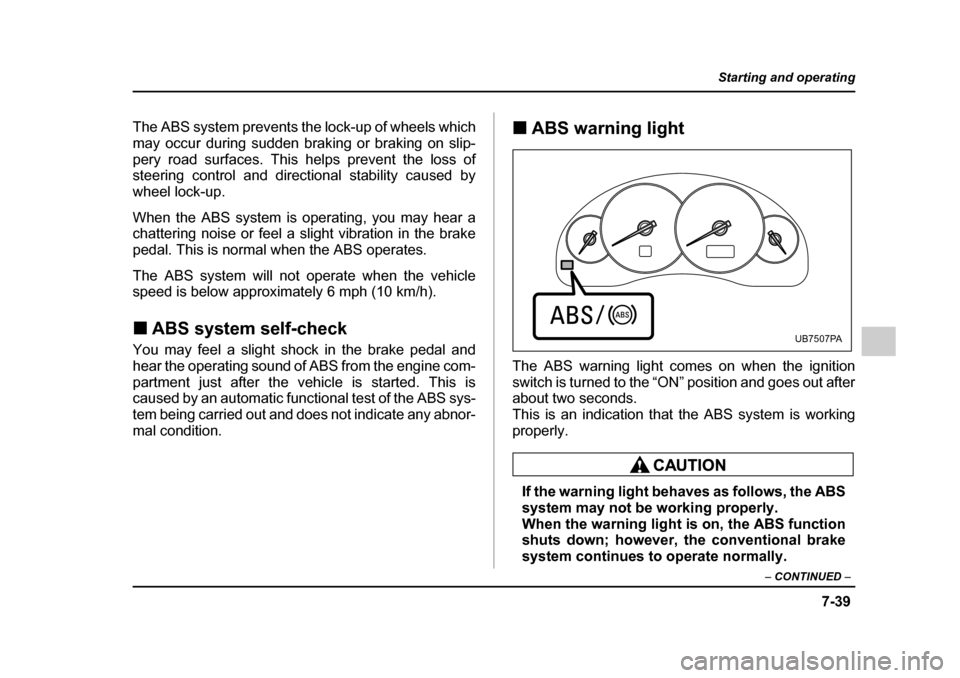
ABS warning light
The ABS warning light comes on when the ignition
switch is turned to the “ON” position and goes out after
about two seconds.
This is an indication that the ABS system is working
properly.
If the warning light behaves as follows, the ABS
system may not be working properly.
When the warning light is on, the ABS function
shuts down; however, the conventional brake
system continues to operate normally.
UB7507PA
Page 396 of 627
7-41
Starting and operating
– CONTINUED –
Electronic Brake Force Distribution
(EBD) system
The EBD system maximizes the effectiveness of the
brakes by allowing the rear brakes to supply a greater
proportion of the braking force. It functions by adjust-
ing the distribution of braking force to the rear wheels
in accordance with the vehicle’s loading condition and
speed.
The EBD system is an integral part of the ABS system
and uses some of the ABS system’s components to
perform its function of optimizing the distribution of
braking force. If any of the ABS components used by
the EBD function fails, the EBD system also stops
working.
When the EBD system is operating, you may hear a
chattering noise or feel a slight vibration in the brake
pedal. This is normal and does not indicate a malfunc- tion. !
Steps to take if EBD system fails
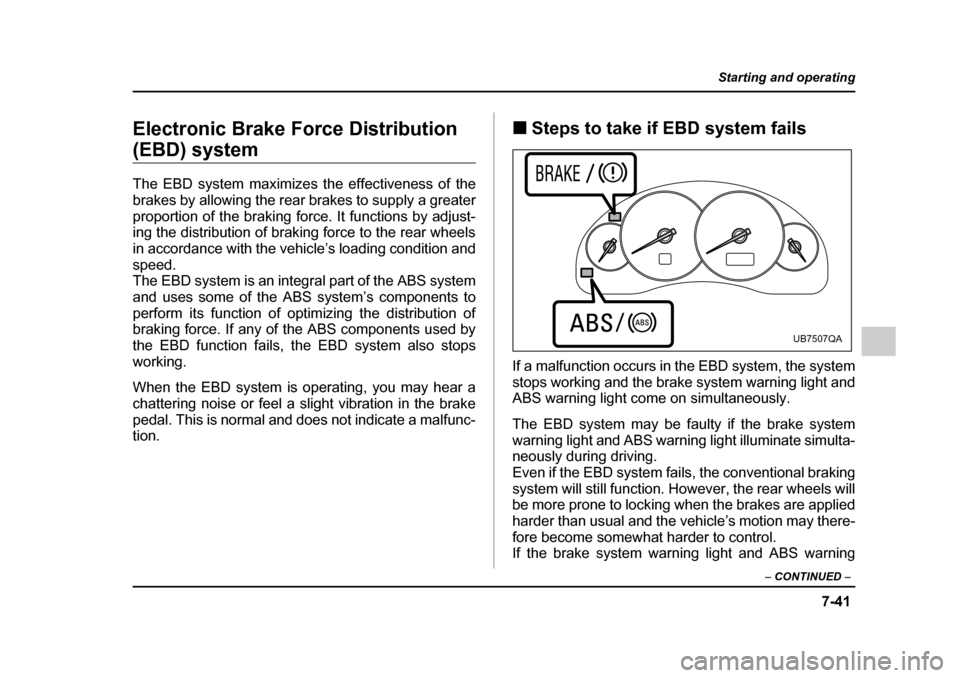
If a malfunction occurs in the EBD system, the system
stops working and the brake system warning light and
ABS warning light come on simultaneously.
The EBD system may be faulty if the brake system
warning light and ABS warning light illuminate simulta-
neously during driving.
Even if the EBD system fails, the conventional braking
system will still function. However, the rear wheels will
be more prone to locking when the brakes are applied
harder than usual and the vehicle’s motion may there-
fore become somewhat harder to control.
If the brake system warning light and ABS warning
UB7507QA
Page 397 of 627
7-42
Starting and operating
light illuminate simultaneously, take the following steps:
1. Stop the vehicle in the nearest safe, flat place.
2. Shut down the engine, then restart it.
3. Release the parking brake. If both warning lights go
out, the EBD system may be faulty.
Drive carefully to the nearest SUBARU dealer and
have the system inspected.
4. If both warning lights come on again and stay illu-
minated after the engine has been restarted, shut
down the engine again, apply the parking brake, and
check the brake fluid level.
5. If the brake fluid level is not below the “MIN” mark,
the EBD system may be faulty. Drive carefully to the
nearest SUBARU dealer and have the system inspect-
ed.
6. If the brake fluid level is below the “MIN” mark, DO
NOT drive the vehicle. Instead, have the vehicle towed
to the nearest SUBARU dealer for repair.
"
Driving with the brake system warning light
on is dangerous. This indicates your brake sys-
tem may not be working properly. If the light re-
mains on, have the brakes inspected by a SUB-
ARU dealer immediately. " If at all in doubt about whether the brakes are operating properly, do not drive the vehicle.
Have your vehicle towed to the nearest SUBA-
RU dealer for repair.
Page 399 of 627
7-44
Starting and operating
spinning of the driving wheels on slippery road surfac-
es, thereby helping to maintain traction and directional
control. Activation of this function is shown by steady
illumination of the Vehicle Dynamics Control operation
indicator light. "
Skid Suppression Function
The skid suppression function is designed to help
maintain directional stability by suppressing the
wheels’ tendency to slide sideways during steering op-
erations. Activation of this function is shown by flash-
ing of the Vehicle Dynamics Control operation indica-
tor light.
NOTE " Slight twitching of the brake pedal may be felt
when the Vehicle Dynamics Control system oper-
ates; a small degree of vehicle or steering wheel
shaking may also be noticed in this situation.
These are normal characteristics of Vehicle Dy-
namics Control operation and are no cause for
alarm. " When driving off immediately after starting the
engine, a short-lived operation noise may be no-
ticed coming from the engine compartment. This
noise is generated as a result of a check being per-
formed on the Vehicle Dynamics Control system
and is normal. "
Depending on the timing of activation of the
brakes, certain situations may occur just after
driving off where the brake pedal seems to exhibit
a jolting motion. This too is a consequence of the
Vehicle Dynamics Control operational check and
is normal. " In the circumstances listed below, the vehicle
may be more unstable than it feels to the driver.
The Vehicle Dynamics Control System may there-
fore operate. Such operation does not indicate a
system fault. "on gravel-covered or rutted roads
" on unfinished roads
" when the vehicle is towing a trailer
" when the vehicle is fitted with snow tires or
winter tires
" Activation of the Vehicle Dynamics Control sys-
tem will cause operation of the steering wheel to
feel slightly different compared to that for normal
conditions." Even if the vehicle is equipped with a Vehicle
Dynamics Control system, it is important that win-
ter tires be used when driving on snow-covered or
icy roads. (All four wheels should be fitted with
tires of the same size and brand). Furthermore, if
snow chains are to be used, they should be fitted
on the front wheels. When a vehicle is fitted with
Page 402 of 627
7-47
Starting and operating
– CONTINUED –
trols each brake through the ABS, whenever the ABS
stops operating due to a malfunction in that electrical
system, the Vehicle Dynamics Control will also be-
come unable to control all four brakes. Thus Vehicle
Dynamics Control system operation halts and the
warning light turns on. Although both the Vehicle Dy-
namics Control system and the ABS will be inoperable
in this situation, it will still be possible to stop the vehi-
cle using normal braking. The Vehicle Dynamics Con-
trol system and the ABS do not adversely affect oper-
ation of the vehicle in any way when they are inopera-
ble; however should such a situation occur, drive with
care and have an authorized SUBARU dealer carry
out an inspection of those systems at the first available
opportunity.
NOTE
When the warning light turns on and off in the fol-
lowing way, it indicates that the Vehicle Dynamics
Control system is operating normally. "Although turning on after the engine has been
started, the warning light quickly turns off and
stays off. " The warning light turns on when the vehicle is
being driven; it then turns off and stays off. " Vehicle Dynamics Control OFF indicator light
This light comes on to indicate that the Vehicle Dy- namics Control system is in non-operation mode. This
does not constitute failure of the Vehicle DynamicsControl system.
NOTE "
The indicator light may stay on for a while after
the engine has been started, especially in cold
weather. This occurs because the engine has not
yet warmed up and is completely normal. The light
will turn off when the engine has reached a suit-
able operating temperature. " When an engine problem occurs and the mal-
function indicator lamp turns on, the indicator
light will also come on.
The following two situations could indicate malfunction
of the Vehicle Dynamics Control system; if either
should occur, have an authorized SUBARU dealer
carry out an inspection of that system at the first avail-
able opportunity. " The indicator light does not turn on when the ignition
key is turned to the ON position. " The indicator light fails to turn off after the engine is
started, even when several minutes have passed to al-
low the engine to heat up sufficiently.
Page 404 of 627
7-49
Starting and operating
– CONTINUED –
Tire pressure monitoring system
(TPMS) (if equipped)
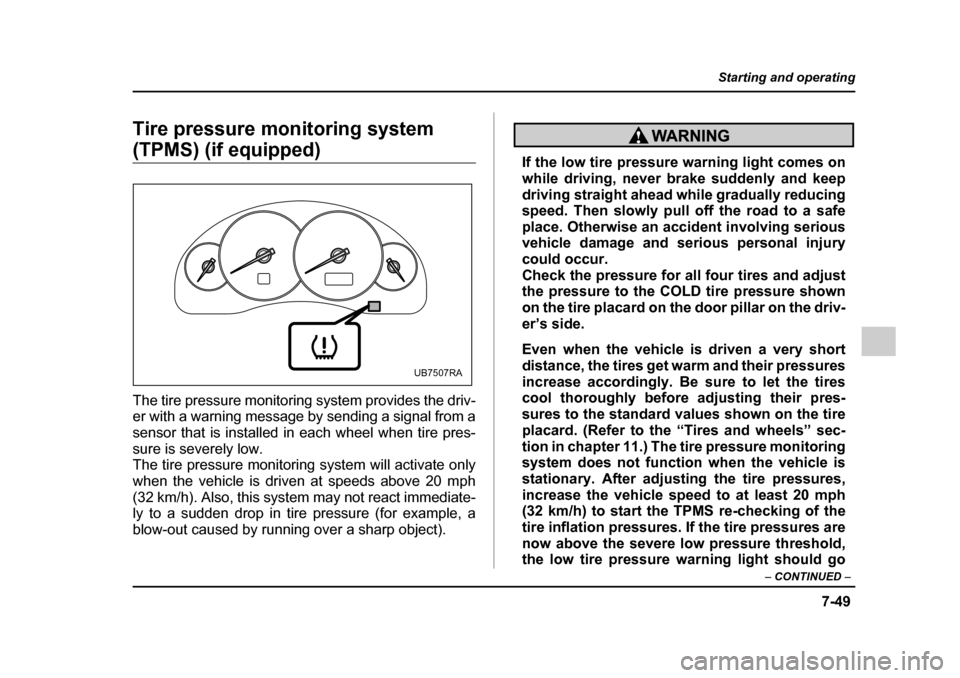
The tire pressure monitoring system provides the driv-
er with a warning message by sending a signal from a
sensor that is installed in each wheel when tire pres-
sure is severely low.
The tire pressure monitoring system will activate only
when the vehicle is driven at speeds above 20 mph
(32 km/h). Also, this system may not react immediate-
ly to a sudden drop in tire pressure (for example, a
blow-out caused by running over a sharp object).If the low tire pressure warning light comes on
while driving, never brake suddenly and keep
driving straight ahead while gradually reducing
speed. Then slowly pull off the road to a safe
place. Otherwise an accident involving serious
vehicle damage and serious personal injury
could occur.
Check the pressure for all four tires and adjust
the pressure to the COLD tire pressure shown
on the tire placard on the door pillar on the driv-
er’s side.
Even when the vehicle is driven a very short
distance, the tires get warm and their pressures
increase accordingly. Be sure to let the tires
cool thoroughly before adjusting their pres-
sures to the standard values shown on the tire
placard. (Refer to the “Tires and wheels” sec-
tion in chapter 11.) The tire pressure monitoring
system does not function when the vehicle is
stationary. After adjusting the tire pressures,
increase the vehicle speed to at least 20 mph
(32 km/h) to start the TPMS re-checking of the
tire inflation pressures. If the tire pressures are
now above the severe low pressure threshold,
the low tire pressure warning light should go
UB7507RA
Page 406 of 627
7-51
Starting and operating
– CONTINUED –
Parking your vehicle
"Never leave unattended children or pets in
the vehicle. They could accidentally injure
themselves or others through inadvertent oper-
ation of the vehicle. Also, on hot or sunny days,
the temperature in a closed vehicle could
quickly become high enough to cause severe
or possibly fatal injuries to them. " Do not park the vehicle over flammable mate-
rials such as dry grass, waste paper or rags, as
they may burn easily if they come near hot en-
gine or exhaust system parts." Be sure to stop the engine if you take a nap in
the vehicle. If engine exhaust gas enters the
passenger compartment, occupants in the ve-
hicle could die from carbon monoxide (CO)
contained in the exhaust gas.
Never drive while the parking brake is set be-
cause this will cause unnecessary wear on the
brake linings. Before starting to drive, always make sure that the parking brake has been fully
released.
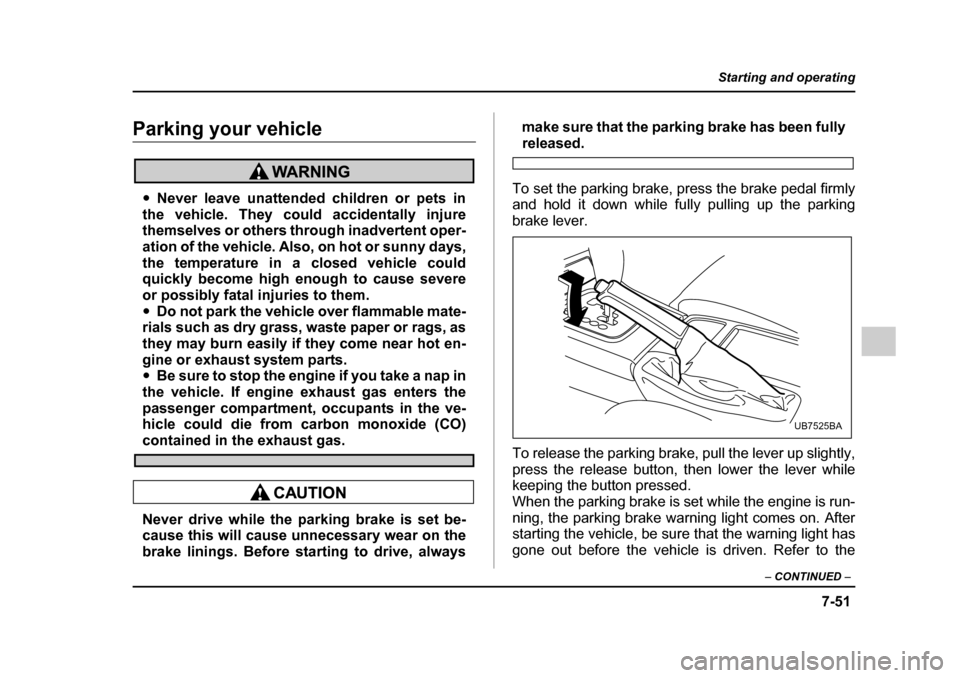
To set the parking brake, press the brake pedal firmly
and hold it down while fully pulling up the parking
brake lever.
To release the parking brake, pull the lever up slightly,
press the release button, then lower the lever while
keeping the button pressed.
When the parking brake is set while the engine is run-
ning, the parking brake warning light comes on. After
starting the vehicle, be sure that the warning light has
gone out before the vehicle is driven. Refer to the
UB7525BA
Page 407 of 627
7-52
Starting and operating
“Warning and indicator lights” section (chapter 3).
When parking your vehicle, always set the parking
brake firmly and put the shift lever in the “1” (1st) for an
upgrade or “R” (Reverse) for a downgrade for manual
transmission vehicles, or in the “P” (Park) position for
automatic transmission vehicles. Always set the park-
ing brake firmly when parking your vehicle. Never rely
on the transmission alone to hold the vehicle.
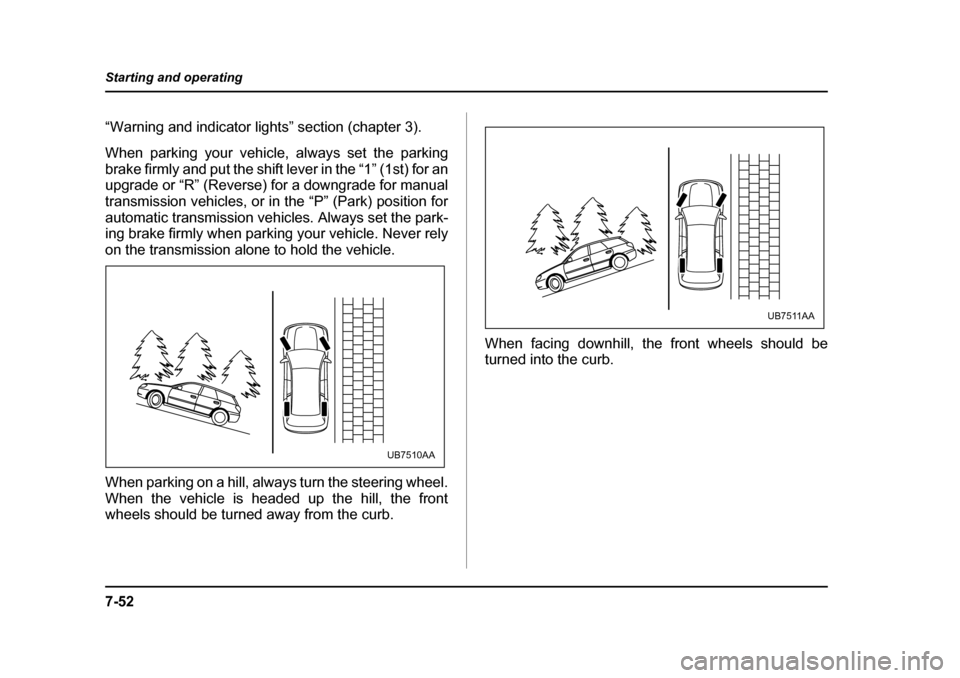
When parking on a hill, always turn the steering wheel.
When the vehicle is headed up the hill, the front
wheels should be turned away from the curb.
When facing downhill, the front wheels should be
turned into the curb.
UB7510AA
UB7511AA
Page 410 of 627

7-55
Starting and operating
– CONTINUED –
At this time, the “ ” indicator light is illuminated in the combination meter.
The vehicle will maintain the desired speed.
Vehicle speed can be temporarily increased while
driving with the cruise control activated. Simply de-
press the accelerator pedal to accelerate the vehicle.
When the accelerator pedal is released, the vehicle
will return to and maintain the previous cruising speed. !To temporarily cancel the cruise con- trol
There are four ways to cancel the cruise control tem-
porarily: "
Pull the control lever in the “CANCEL” direction (if
so equipped). " Depress the brake pedal.
" Depress the clutch pedal (manual transmission ve-
hicles only)." Shift the selector lever into the “N” position (auto-
matic transmission vehicles only).
The “ ” indicator light in the combination meter
goes off when the cruise control is cancelled.
To resume the cruise control after it has been tempo-
rarily canceled and with vehicle speed of about 20
mph (32 km/h) or more, push the control lever upward
in the “RES/ACC” direction to return to the original
UB7507IAUB7204BA
Page 412 of 627

7-57
Starting and operating
– CONTINUED –
!To decrease the speed (by control lever)
Push the control lever downward in the “SET/COAST”
direction and hold it until the vehicle reaches the de-
sired speed. Then, release the control lever. The vehi-
cle speed at that moment will be memorized and treat-
ed as the new set speed.
When the difference between the actual vehicle speed
and the set speed is less than 4 mph (6.8 km/h), the
set speed can be lowered 1 mph (1.6 km/h) each time
by pressing the control lever downward in the “SET/
COAST” direction quickly within 0.25 second. !
To decrease the speed (by brake pedal)
1. Depress the brake pedal to release cruise control
temporarily.
2. When the speed decreases to the desired speed,
press the control lever downward in the “SET/COAST”
direction once. Now the desired speed is set and the
vehicle will keep running at that speed without de-
pressing the accelerator pedal. ! Cruise control indicator light
The cruise control indicator light comes on when the
ignition switch is turned to the “ON” position and goes
out after about three seconds.
UB7203BA
UB7507HA