warning SUBARU OUTBACK 2005 4.G Service Manual
[x] Cancel search | Manufacturer: SUBARU, Model Year: 2005, Model line: OUTBACK, Model: SUBARU OUTBACK 2005 4.GPages: 627, PDF Size: 6.42 MB
Page 210 of 627
3-39
Instruments and controls
– CONTINUED –
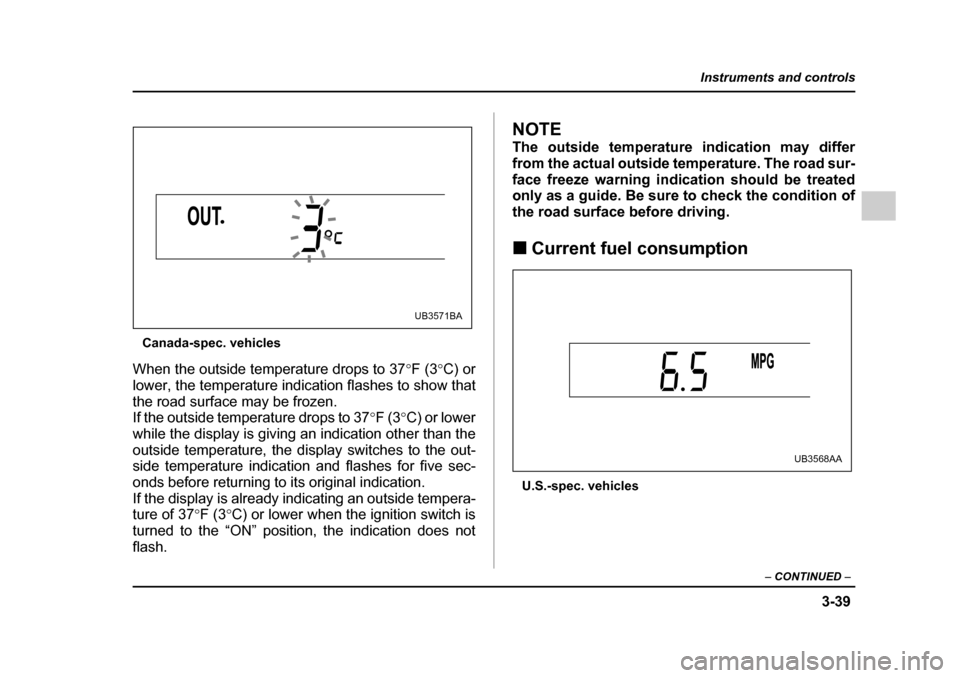
Canada-spec. vehicles
When the outside temperature drops to 37 °F (3 °C) or
lower, the temperature indication flashes to show that
the road surface may be frozen.
If the outside temperature drops to 37 °F (3 °C) or lower
while the display is giving an indication other than the
outside temperature, the display switches to the out-
side temperature indication and flashes for five sec-
onds before returning to its original indication.
If the display is already indicating an outside tempera-
ture of 37 °F (3 °C) or lower when the ignition switch is
turned to the “ON” position, the indication does not flash.
NOTE
The outside temperature indication may differ
from the actual outside temperature. The road sur-
face freeze warning indication should be treated
only as a guide. Be sure to check the condition of
the road surface before driving. ! Current fuel consumption
U.S.-spec. vehicles
UB3571BA
UB3568AA
Page 213 of 627
3-42
Instruments and controls
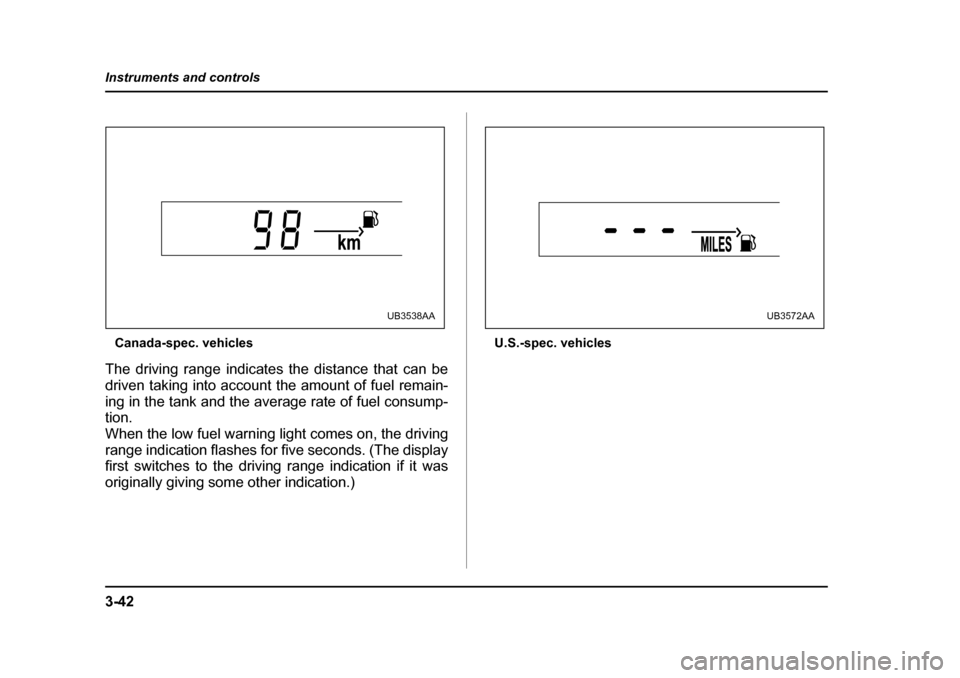
Canada-spec. vehicles
The driving range indicates the distance that can be
driven taking into account the amount of fuel remain-
ing in the tank and the average rate of fuel consump- tion.
When the low fuel warning light comes on, the driving
range indication flashes for five seconds. (The display
first switches to the driving range indication if it was
originally giving some other indication.) U.S.-spec. vehicles
UB3538AAUB3572AA
Page 214 of 627
3-43
Instruments and controls
– CONTINUED –
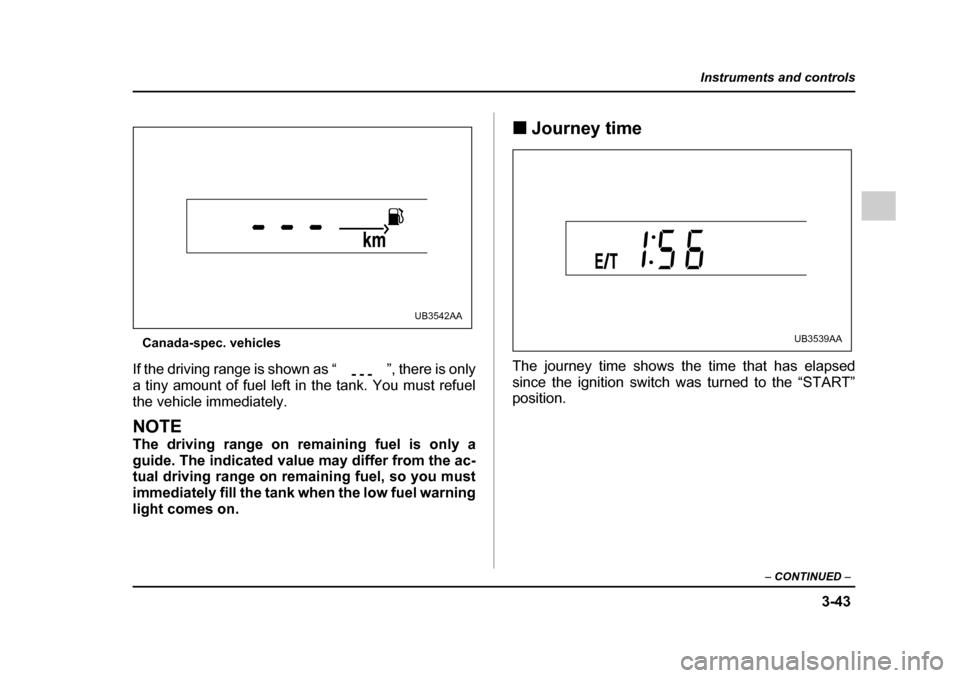
Canada-spec. vehicles
If the driving range is shown as “ ”, there is only
a tiny amount of fuel left in the tank. You must refuel
the vehicle immediately.
NOTE
The driving range on remaining fuel is only a
guide. The indicated value may differ from the ac-
tual driving range on remaining fuel, so you must
immediately fill the tank when the low fuel warning
light comes on. !
Journey time
The journey time shows the time that has elapsed
since the ignition switch was turned to the “START”
position.
UB3542AA
UB3539AA
Page 215 of 627
3-44
Instruments and controls
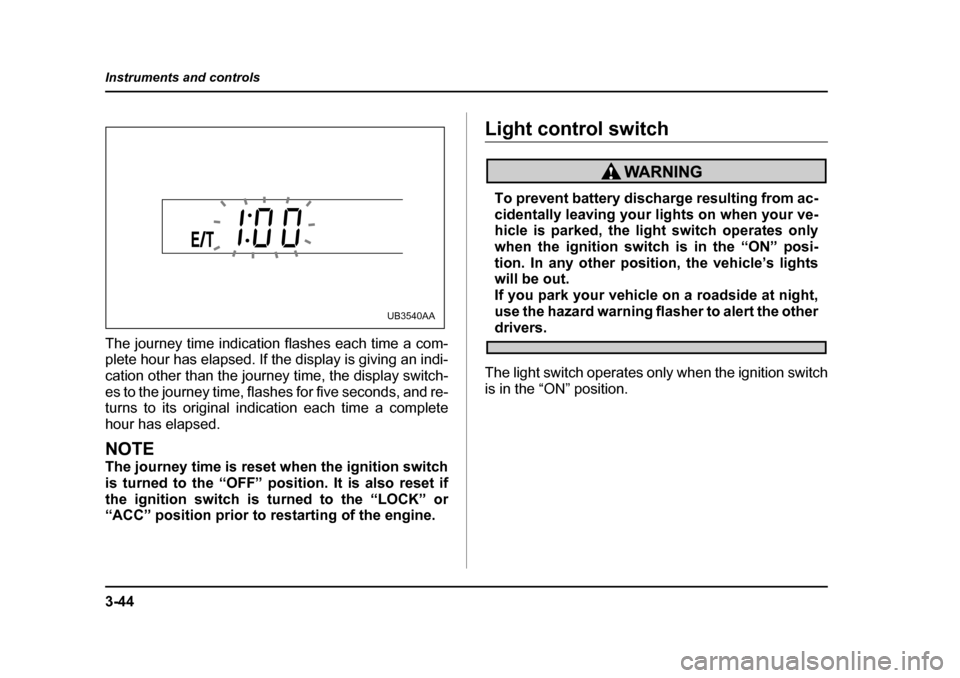
The journey time indication flashes each time a com-
plete hour has elapsed. If the display is giving an indi-
cation other than the journey time, the display switch-
es to the journey time, flashes for five seconds, and re-
turns to its original indication each time a complete
hour has elapsed.
NOTE
The journey time is reset when the ignition switch
is turned to the “OFF” position. It is also reset if
the ignition switch is turned to the “LOCK” or
“ACC” position prior to restarting of the engine.
Light control switch
To prevent battery discharge resulting from ac-
cidentally leaving your lights on when your ve-
hicle is parked, the light switch operates only
when the ignition switch is in the “ON” posi-
tion. In any other position, the vehicle’s lights
will be out.
If you park your vehicle on a roadside at night,
use the hazard warning flasher to alert the other
drivers.
The light switch operates only when the ignition switch
is in the “ON” position.UB3540AA
Page 356 of 627

7-1
7
Starting and operating
Fuel ................................................................ 7-2 Fuel requirements ............................................. 7-2
Fuel filler lid and cap ........................................ 7-4
State emission testing (U.S. only) ............... 7-8
Preparing to drive ......................................... 7-10
Starting the engine ....................................... 7-10 Manual transmission vehicle ........................... 7-10
Automatic transmission vehicle ...................... 7-11
Stopping the engine ..................................... 7-12
Manual transmission .................................... 7-13 Shifting speeds ................................................. 7-14
Driving tips ........................................................ 7-15
Automatic transmission – 4 speed ............. 7-16 Selector lever .................................................... 7-17
Selector lever reverse inhibiting function ...... 7-19
Selection of manual mode ............................... 7-20
Maximum speeds .............................................. 7-21
Driving tips ........................................................ 7-23
SPORT mode ..................................................... 7-23
Shift lock release .............................................. 7-24
Automatic transmission – 5 speed ............. 7-25 Selector lever .................................................... 7-26
Selector lever reverse inhibiting function ...... 7-28
Selection of manual mode ............................... 7-30
Maximum speeds .............................................. 7-32
Driving tips ........................................................ 7-33
SPORT mode ..................................................... 7-34
Shift lock release .............................................. 7-35
Rear viscous limited slip differential (LSD) (if equipped) .............................................. 7-36 Power steering .............................................. 7-36
Braking ........................................................... 7-37
Braking tips ....................................................... 7-37
Brake system .................................................... 7-37
Disc brake pad wear warning indicators ........ 7-38
ABS (Anti-lock Brake System) ..................... 7-38 ABS system self-check .................................... 7-39
ABS warning light ............................................. 7-39
Electronic Brake Force Distribution (EBD) system ........................................................ 7-41Steps to take if EBD system fails .................... 7-41
Vehicle Dynamics Control system (if equipped) ............................................... 7-43Vehicle Dynamics Control system monitor .... 7-45
Vehicle Dynamics Control OFF switch ........... 7-48
Tire pressure monitoring system (TPMS) (if equipped) ............................................... 7-49
Parking your vehicle ..................................... 7-51
Cruise control ................................................ 7-53 To set cruise control ........................................ 7-53
To temporarily cancel the cruise control ....... 7-55
To turn off the cruise control ........................... 7-56
To change the cruising speed ......................... 7-56
Cruise control indicator light ........................... 7-57
Cruise control set indicator light .................... 7-58
Page 358 of 627
7-3
Starting and operating
– CONTINUED –
Standards as indicated on the underhood tune-up la-
bel. It is designed to optimize engine and emission
control system performance with gasoline that meets
the clean burning low-sulfur California gasoline speci-
fications. If you live in any other state than California,
your vehicle will operate on gasoline meeting Federal
specifications. Gasoline sold outside California is per-
mitted to have higher sulfur levels, which may affect
the performance of your vehicle’s catalytic converter
and may produce a sulfur exhaust odor or smell. SUB-
ARU recommends that you try a different brand of un-
leaded gasoline having lower sulfur to determine if the
problem is fuel related before returning your vehicle to
an authorized dealer for service. The CHECK EN-
GINE warning light/Malfunction indicator lamp may
also turn on. If this occurs, return to your authorized
SUBARU dealer for diagnosis. If it is determined that
the condition is caused by the type of fuel used, re-
pairs may not be covered by your warranty. !MMT
Some gasoline contains an octane-enhancing additive
called MMT (Methylcyclopentadienyl Manganese Tri-
carbonyl). If you use such fuels, your emission control
system performance may deteriorate and the CHECK
ENGINE warning light/Malfunction indicator lamp may
turn on. If this happens, return to your authorized
SUBARU Dealer for service. If it is determined that the condition is caused by the type of fuel used, repairs
may not be covered by your warranty. !
Gasoline for cleaner air
Do not let fuel spill on the exterior surfaces of
the vehicle. Fuels containing alcohol may
cause paint damage, which is not covered un-
der the SUBARU Limited Warranty.
Your use of gasoline with detergent additives will help
prevent deposits from forming in your engine and fuel
system. This helps keep your engine in tune and your
emission control system working properly, and is a
way of doing your part for cleaner air. If you continu-
ously use a high quality fuel with the proper detergent
and other additives, you should never need to add any
fuel system cleaning agents to your fuel tank.
Many gasolines are now blended with materials called
oxygenates. Use of these fuels can also help keep the
air cleaner. Oxygenated blend fuels, such as MTBE
(Methyl Tertiary Butyl ether) or ethanol (ethyl or grain
alcohol) may be used in your vehicle, but should con-
tain no more than 15% MTBE or 10% ethanol for the
proper operation of your SUBARU.
Page 362 of 627
7-7
Starting and operating
– CONTINUED –
"You will see the “ ” sign in the combination
meter. This indicates that the fuel filler door (lid) is
located on the right side of the vehicle. " If the fuel filler cap is not tightened until it clicks
or if the tether is caught under the cap, the CHECK
ENGINE warning light may come on. Refer to the
“Warning and indicator lights” section located in
chapter 3.
(Turbo model only) Promptly put fuel in the tank
whenever the low fuel warning light comes on. If
the engine misfired as a result of an empty tank,
resulting catalyzer damage could cause damage
to the turbocharger.
" Never add any cleaning agents to the fuel
tank. The addition of a cleaning agent may
cause damage to the fuel system. " Make sure that the cap is tightened until it
clicks to prevent fuel spillage in the event of an
accident. " Do not let fuel spill on the exterior surfaces of
the vehicle. Fuels may cause paint damage,
which is not covered under the SUBARU Limit-
ed Warranty." Always use a genuine SUBARU fuel filler cap. If you use the wrong cap, it may not fit or have
proper venting, and your fuel tank and emis-
sion control system might be damaged.
Page 364 of 627

7-9
Starting and operating
– CONTINUED –
jacked off the ground, nor should the driveshaft be dis-
connected for state emission testing.
The EPA has issued regulations for inspecting the On-
Board Diagnostic (OBD) system as part of the state
emissions inspection. The OBD system is designed to
detect engine and transmission problems that might
cause vehicle emissions to exceed allowable limits.
These inspections apply to all 1996 model year and
newer passenger cars and light trucks. About 30
states plus the District of Columbia have implemented
the OBD system inspection. "The inspection of the OBD system consists of a vi-
sual operational check of the “ CHECK ENGINE” warn-
ing light/malfunction indicator lamp (MIL) and an ex-
amination of the OBD system with an electronic scan
tool while the engine is running. " A vehicle passes
the OBD system inspection if
proper the “ CHECK ENGINE ” warning light/MIL illumi-
nation is observed, there is no stored diagnostic trou-
ble codes, and the OBD system readiness monitors
are complete. " A vehicle fails
the OBD inspection if the “ CHECK
ENGINE ” warning light/MIL is not properly operating
or there is one or more diagnostic trouble codes stored
in vehicle’s computer with the “ CHECK ENGINE”
warning light/MIL illuminated. "
A state emission inspection may reject (not pass or
fail) a vehicle if the number of OBD system readiness monitors “ Not Ready ” is greater than three. Under this
condition, the vehicle operator should be instructed to
drive his/her vehicle for a few days to set the monitors
and return for an emission re-inspection. " Owners of rejected or failing vehicles should contact
their SUBARU Dealer for service.
Page 365 of 627
7-10
Starting and operating
Preparing to drive
You should perform the following checks and adjust-
ments every day before you start driving.
1. Check that all windows, mirrors, and lights are
clean and unobstructed.
2. Check the appearance and condition of the tires.
Also check tires for proper inflation.
3. Look under the vehicle for any sign of leaks.
4. Check that the hood, trunk and rear gate are fullyclosed.
5. Check the adjustment of the seat.
6. Check the adjustment of the inside and outside mir-rors.
7. Fasten your seatbelt. Check that your passengers
have fastened their seatbelts.
8. Check the operation of the warning and indicator
lights when the ignition switch is turned to the “ON” po- sition.
9. Check the gauges, indicator and warning lights af-
ter starting the engine.
NOTE
Engine oil, engine coolant, brake fluid, washer flu-
id and other fluid levels should be checked daily,
weekly or at fuel stops.
Starting the engine
Do not operate the starter motor continuously
for more than ten seconds. If the engine fails to
start after operating the starter for five to ten
seconds, wait for ten seconds or more before
trying again.
! Manual transmission vehicle
1. Apply the parking brake.
2. Turn off unnecessary lights and accessories.
3. Press the clutch pedal to the floor and shift the shift
lever into neutral.
Hold the clutch pedal to the floor while starting the en-
gine. The starter motor will only operate when the
clutch pedal is pressed fully to the floor.
4. Turn the ignition switch to the “ON” position and
check the operation of the warning and indicator lights.
Refer to the “Warning and indicator lights” section
(chapter 3).
5. Turn the ignition switch to the “START” position
without depressing the accelerator pedal. Release
the key immediately after the engine has started.
Page 366 of 627
7-11
Starting and operating
– CONTINUED –
If the engine does not start, try the following:
1) Turn the ignition switch to the “OFF” position and
wait for at least 10 seconds. After checking that the
parking brake is firmly set, turn the ignition switch to
the “START” position while depressing the acceler-
ator pedal slightly (about a quarter of the full stroke).
Release the accelerator pedal as soon as the en-
gine starts.
2) If this fails to start the engine, turn the ignition
switch back to the “OFF” position and wait for at
least 10 seconds. Then fully depress the accelerator
pedal and turn the ignition switch to the “START”
position. If the engine starts, quickly release the ac-
celerator pedal.
3) If this fails to start the engine, turn the ignition
switch again to the “OFF” position. After waiting for
10 seconds or longer, turn the ignition switch to the
“START” position without depressing the accelera-
tor pedal.
4) If the engine still refuses to start, contact your
nearest SUBARU dealer for assistance.
6. Confirm that all warning and indicator lights have
gone off after the engine has started. The fuel injection
system automatically lowers the idle speed as the en-
gine warms up. !
Automatic transmission vehicle
If you restart the engine while the vehicle is
moving, shift the selector lever into the “N” po-
sition. Do not attempt to place the selector lever
of a moving vehicle into the “P” position.
1. Apply the parking brake.
2. Turn off unnecessary lights and accessories.
3. Shift the selector lever to the “P” or “N” position
(preferably “P” position). The starter will only operate
when the select lever is at the “P” or “N” position.
4. Turn the ignition switch to the “ON” position and
check the operation of the warning and indicator lights.
Refer to the “Warning and indicator lights” section (chapter 3).
5. Turn the ignition switch to the “START” position
without depressing the accelerator pedal. Release
the key immediately after the engine has started.
If the engine does not start, try the following: 1) Turn the ignition switch to the “OFF” position and
wait for at least 10 seconds. After checking that the
parking brake is firmly set, turn the ignition switch to
the “START” position while depressing the acceler-
ator pedal slightly (about a quarter of the full stroke).