warning SUBARU OUTBACK 2005 4.G Workshop Manual
[x] Cancel search | Manufacturer: SUBARU, Model Year: 2005, Model line: OUTBACK, Model: SUBARU OUTBACK 2005 4.GPages: 627, PDF Size: 6.42 MB
Page 367 of 627
7-12
Starting and operating
Release the accelerator pedal as soon as the en-
gine starts.
2) If this fails to start the engine, turn the ignition
switch back to the “OFF” position and wait for at
least 10 seconds. Then fully depress the accelerator
pedal and turn the ignition switch to the “START”
position. If the engine starts, quickly release the ac-
celerator pedal.
3) If this fails to start the engine, turn the ignition
switch again to the “OFF” position. After waiting for
10 seconds or longer, turn the ignition switch to the
“START” position without depressing the accelera-
tor pedal.
4) If the engine still refuses to start, contact your
nearest SUBARU dealer for assistance.
6. Confirm that all warning and indicator lights have
gone out after the engine has started. The fuel injec-
tion system automatically lowers the idle speed as the
engine warms up.
While the engine is warming up, make sure that the
selector lever is at the “P” or “N” position and that the
parking brake is applied.Stopping the engine
Do not stop the engine when the vehicle is mov-
ing. This will cause loss of power to the power
steering and the brake booster, making steer-
ing and braking more difficult. It could also re-
sult in accidental activation of the “LOCK” po-
sition on the ignition switch, causing the steer-
ing wheel to lock.
The ignition switch should be turned off only when the
engine is idling.
Page 376 of 627
7-21
Starting and operating
– CONTINUED –
goes off.
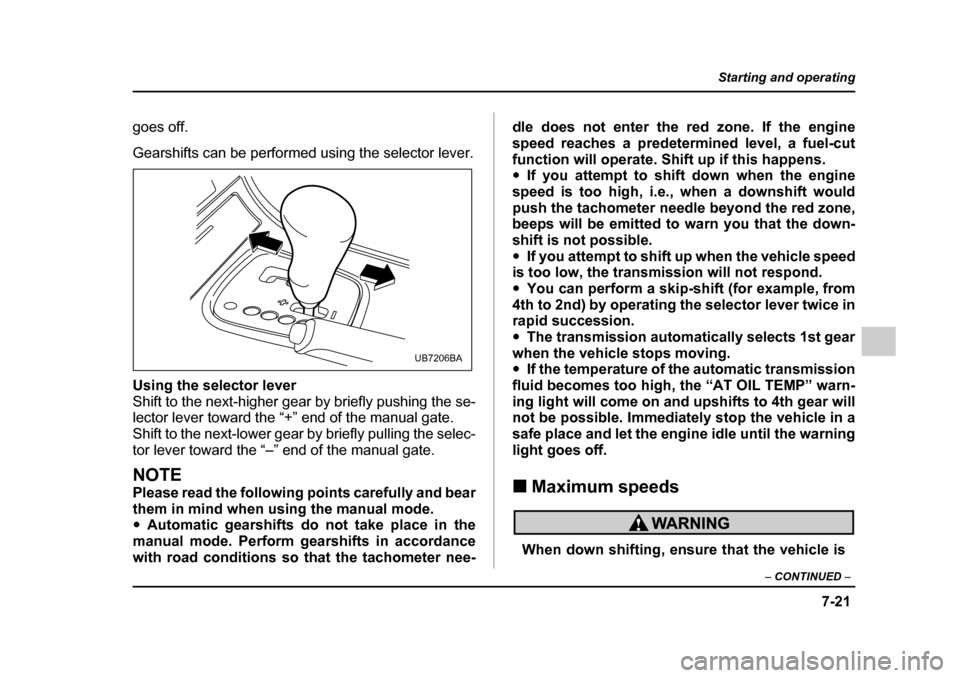
Gearshifts can be performed using the selector lever.
Using the selector lever
Shift to the next-higher gear by briefly pushing the se-
lector lever toward the “+” end of the manual gate.
Shift to the next-lower gear by briefly pulling the selec-
tor lever toward the “–” end of the manual gate.
NOTE
Please read the following points carefully and bear
them in mind when using the manual mode. "Automatic gearshifts do not take place in the
manual mode. Perform gearshifts in accordance
with road conditions so that the tachometer nee- dle does not enter the red zone. If the engine
speed reaches a predetermined level, a fuel-cut
function will operate. Shift up if this happens. "
If you attempt to shift down when the engine
speed is too high, i.e., when a downshift would
push the tachometer needle beyond the red zone,
beeps will be emitted to warn you that the down-
shift is not possible." If you attempt to shift up when the vehicle speed
is too low, the transmission will not respond." You can perform a skip-shift (for example, from
4th to 2nd) by operating the selector lever twice in
rapid succession. " The transmission automatically selects 1st gear
when the vehicle stops moving. " If the temperature of the automatic transmission
fluid becomes too high, the “AT OIL TEMP” warn-
ing light will come on and upshifts to 4th gear will
not be possible. Immediately stop the vehicle in a
safe place and let the engine idle until the warning
light goes off. ! Maximum speeds
When down shifting, ensure that the vehicle is
UB7206BA
Page 387 of 627
7-32
Starting and operating
If you subsequently ease off the accelerator pedal and
then accelerate again, the transmission will automati-
cally switch back from manual mode to normal mode.
NOTE
Please read the following points carefully and bear
them in mind when using the manual mode. "
When the temperature of the automatic trans-
mission fluid is higher than normal, warning
beeps are emitted and the shift position indicator
shows “–”. If these warnings are issued, deselect
the manual mode to protect the automatic trans-
mission from damage. " When the temperature of the engine oil is higher
than normal, warning beeps are emitted and the
shift position indicator shows “–”. If these warn-
ings are issued, deselect the manual mode to pro-
tect the engine from damage. (3.0-liter models
only) " Automatic gearshifts do not take place in the
manual mode. Perform gearshifts in accordance
with road conditions so that the tachometer nee-
dle does not enter the red zone. If the engine
speed reaches a predetermined level, a fuel-cut
function will operate. Shift up if this happens. " If you attempt to shift down when the engine
speed is too high, i.e., when a downshift would
push the tachometer needle beyond the red zone, beeps will be emitted to warn you that the down-
shift is not possible."
If you attempt to shift up when the vehicle speed
is too low, the transmission will not respond." You can perform a skip-shift (for example, from
4th to 2nd) by operating the selector lever or a
steering-wheel switch twice in rapid succession. " The transmission automatically selects 1st gear
when the vehicle stops moving. " If the temperature of the automatic transmission
fluid becomes too high, the “AT OIL TEMP” warn-
ing light will come on and upshifts to 5th gear will
not be possible. Immediately stop the vehicle in a
safe place and let the engine idle until the warning
light goes off. ! Maximum speeds
When down shifting, ensure that the vehicle is
not travelling at a speed exceeding the Maxi-
mum Allowable Speed for the gear which is
about to be selected. Failure to observe this
precaution can lead to engine over-revving and
this in turn can result in engine damage.
In addition, sudden application of engine brak-
Page 393 of 627
7-38
Starting and operating
than normal and the braking distance will increase. !
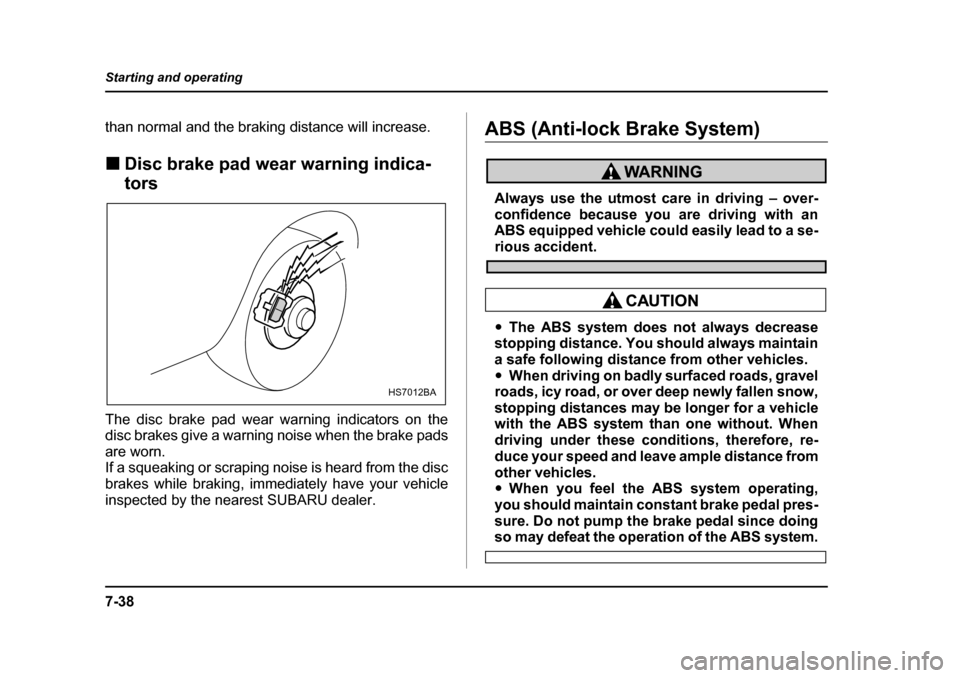
Disc brake pad wear warning indica- tors
The disc brake pad wear warning indicators on the
disc brakes give a warning noise when the brake pads
are worn.
If a squeaking or scraping noise is heard from the disc
brakes while braking, immediately have your vehicle
inspected by the nearest SUBARU dealer.ABS (Anti-lock Brake System)
Always use the utmost care in driving – over-
confidence because you are driving with an
ABS equipped vehicle could easily lead to a se-
rious accident.
" The ABS system does not always decrease
stopping distance. You should always maintain
a safe following distance from other vehicles. " When driving on badly surfaced roads, gravel
roads, icy road, or over deep newly fallen snow,
stopping distances may be longer for a vehicle
with the ABS system than one without. When
driving under these conditions, therefore, re-
duce your speed and leave ample distance from
other vehicles. " When you feel the ABS system operating,
you should maintain constant brake pedal pres-
sure. Do not pump the brake pedal since doing
so may defeat the operation of the ABS system.
HS7012BA
Page 394 of 627
7-39
Starting and operating
– CONTINUED –
The ABS system prevents the lock-up of wheels which
may occur during sudden braking or braking on slip-
pery road surfaces. This helps prevent the loss of
steering control and directional stability caused by
wheel lock-up.
When the ABS system is operating, you may hear a
chattering noise or feel a slight vibration in the brake
pedal. This is normal when the ABS operates.
The ABS system will not operate when the vehicle
speed is below approximately 6 mph (10 km/h). !ABS system self-check
You may feel a slight shock in the brake pedal and hear the operating sound of ABS from the engine com-
partment just after the vehicle is started. This is
caused by an automatic functional test of the ABS sys-
tem being carried out and does not indicate any abnor-
mal condition. !
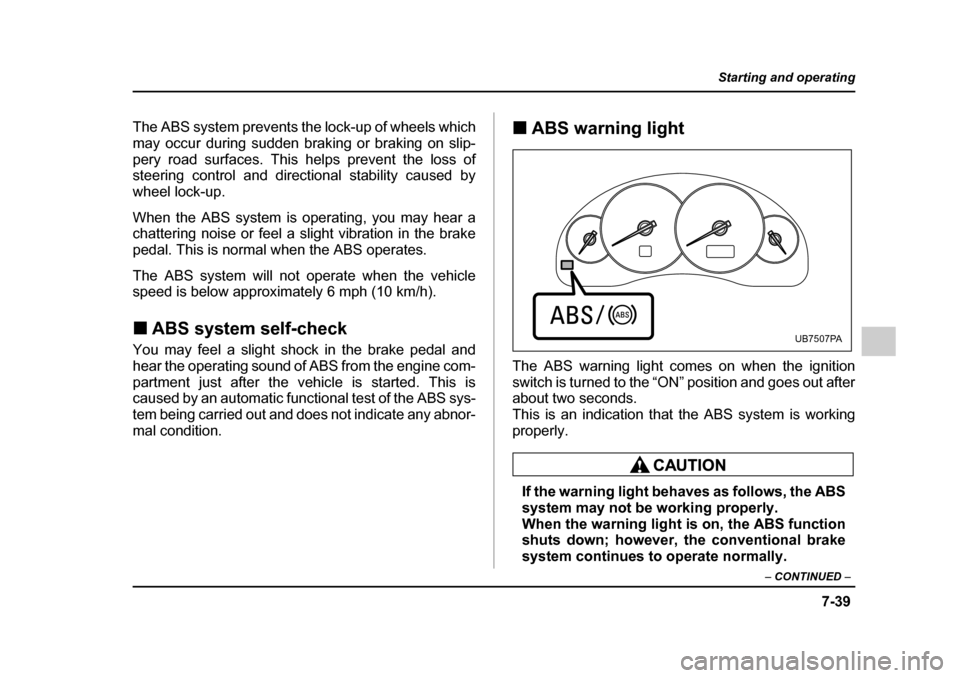
ABS warning light
The ABS warning light comes on when the ignition
switch is turned to the “ON” position and goes out after
about two seconds.
This is an indication that the ABS system is working
properly.
If the warning light behaves as follows, the ABS
system may not be working properly.
When the warning light is on, the ABS function
shuts down; however, the conventional brake
system continues to operate normally.
UB7507PA
Page 395 of 627
7-40
Starting and operating
"
The warning light does not come on when the
ignition switch is turned to the “ON” position. " The warning light comes on when the ignition
switch is turned to the “ON” position, but it
does not go out even when the vehicle speed
exceeds approximately 8 mph (12 km/h). " The warning light comes on during driving.
If these occur, have the ABS system repaired at
the first available opportunity by your SUBARU
dealer.
NOTE
If the warning light behavior is as described be-
low, the ABS system may be considered normal. " The warning light comes on right after the en-
gine is started but goes out immediately, remain-
ing off. " The warning light remains on after the engine
has been started, but it goes out when the vehicle
speed reaches about 8 mph (12 km/h). " The warning light comes on during driving, but
it goes out immediately and remains off.
When driving with an insufficient battery voltage such
as when the engine is jump started, the ABS warning
light may come on. This is due to the low battery volt- age and does not indicate a malfunction. When the
battery becomes fully charged, the light will go out.
Page 396 of 627
7-41
Starting and operating
– CONTINUED –
Electronic Brake Force Distribution
(EBD) system
The EBD system maximizes the effectiveness of the
brakes by allowing the rear brakes to supply a greater
proportion of the braking force. It functions by adjust-
ing the distribution of braking force to the rear wheels
in accordance with the vehicle’s loading condition and
speed.
The EBD system is an integral part of the ABS system
and uses some of the ABS system’s components to
perform its function of optimizing the distribution of
braking force. If any of the ABS components used by
the EBD function fails, the EBD system also stops
working.
When the EBD system is operating, you may hear a
chattering noise or feel a slight vibration in the brake
pedal. This is normal and does not indicate a malfunc- tion. !
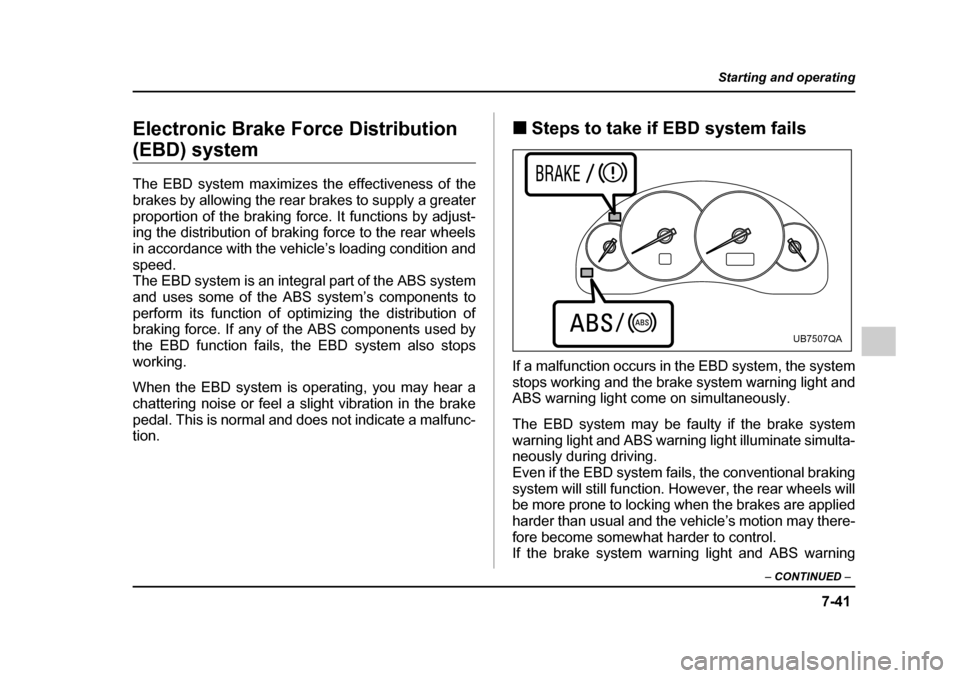
Steps to take if EBD system fails
If a malfunction occurs in the EBD system, the system
stops working and the brake system warning light and
ABS warning light come on simultaneously.
The EBD system may be faulty if the brake system
warning light and ABS warning light illuminate simulta-
neously during driving.
Even if the EBD system fails, the conventional braking
system will still function. However, the rear wheels will
be more prone to locking when the brakes are applied
harder than usual and the vehicle’s motion may there-
fore become somewhat harder to control.
If the brake system warning light and ABS warning
UB7507QA
Page 397 of 627
7-42
Starting and operating
light illuminate simultaneously, take the following steps:
1. Stop the vehicle in the nearest safe, flat place.
2. Shut down the engine, then restart it.
3. Release the parking brake. If both warning lights go
out, the EBD system may be faulty.
Drive carefully to the nearest SUBARU dealer and
have the system inspected.
4. If both warning lights come on again and stay illu-
minated after the engine has been restarted, shut
down the engine again, apply the parking brake, and
check the brake fluid level.
5. If the brake fluid level is not below the “MIN” mark,
the EBD system may be faulty. Drive carefully to the
nearest SUBARU dealer and have the system inspect-
ed.
6. If the brake fluid level is below the “MIN” mark, DO
NOT drive the vehicle. Instead, have the vehicle towed
to the nearest SUBARU dealer for repair.
"
Driving with the brake system warning light
on is dangerous. This indicates your brake sys-
tem may not be working properly. If the light re-
mains on, have the brakes inspected by a SUB-
ARU dealer immediately. " If at all in doubt about whether the brakes are operating properly, do not drive the vehicle.
Have your vehicle towed to the nearest SUBA-
RU dealer for repair.
Page 401 of 627
7-46
Starting and operating
should occur, have an authorized SUBARU dealer
carry out an inspection of that system at the first avail-
able opportunity. "
The indicator light does not turn on when the ignition
key is turned to the ON position. " The indicator light does not turn off approximately
two seconds after the ignition key has been turned to
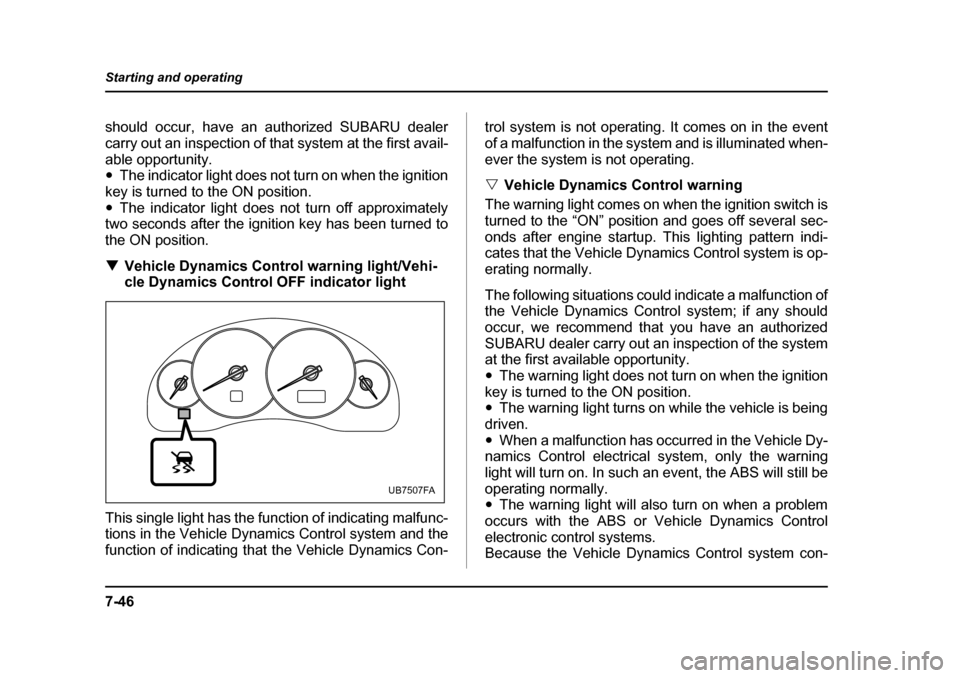
the ON position. ! Vehicle Dynamics Control warning light/Vehi-
cle Dynamics Control OFF indicator light
This single light has the function of indicating malfunc-
tions in the Vehicle Dynamics Control system and the
function of indicating that the Vehicle Dynamics Con- trol system is not operating. It comes on in the event
of a malfunction in the system and is illuminated when-
ever the system is not operating. "
Vehicle Dynamics Control warning
The warning light comes on when the ignition switch is
turned to the “ON” position and goes off several sec-
onds after engine startup. This lighting pattern indi-
cates that the Vehicle Dynamics Control system is op-
erating normally.
The following situations could indicate a malfunction of
the Vehicle Dynamics Control system; if any should
occur, we recommend that you have an authorized
SUBARU dealer carry out an inspection of the system
at the first available opportunity. " The warning light does not turn on when the ignition
key is turned to the ON position. " The warning light turns on while the vehicle is being
driven. " When a malfunction has occurred in the Vehicle Dy-
namics Control electrical system, only the warninglight will turn on. In such an event, the ABS will still be
operating normally. " The warning light will also turn on when a problem
occurs with the ABS or Vehicle Dynamics Control
electronic control systems.
Because the Vehicle Dynamics Control system con-
UB7507FA
Page 402 of 627
7-47
Starting and operating
– CONTINUED –
trols each brake through the ABS, whenever the ABS
stops operating due to a malfunction in that electrical
system, the Vehicle Dynamics Control will also be-
come unable to control all four brakes. Thus Vehicle
Dynamics Control system operation halts and the
warning light turns on. Although both the Vehicle Dy-
namics Control system and the ABS will be inoperable
in this situation, it will still be possible to stop the vehi-
cle using normal braking. The Vehicle Dynamics Con-
trol system and the ABS do not adversely affect oper-
ation of the vehicle in any way when they are inopera-
ble; however should such a situation occur, drive with
care and have an authorized SUBARU dealer carry
out an inspection of those systems at the first available
opportunity.
NOTE
When the warning light turns on and off in the fol-
lowing way, it indicates that the Vehicle Dynamics
Control system is operating normally. "Although turning on after the engine has been
started, the warning light quickly turns off and
stays off. " The warning light turns on when the vehicle is
being driven; it then turns off and stays off. " Vehicle Dynamics Control OFF indicator light
This light comes on to indicate that the Vehicle Dy- namics Control system is in non-operation mode. This
does not constitute failure of the Vehicle DynamicsControl system.
NOTE "
The indicator light may stay on for a while after
the engine has been started, especially in cold
weather. This occurs because the engine has not
yet warmed up and is completely normal. The light
will turn off when the engine has reached a suit-
able operating temperature. " When an engine problem occurs and the mal-
function indicator lamp turns on, the indicator
light will also come on.
The following two situations could indicate malfunction
of the Vehicle Dynamics Control system; if either
should occur, have an authorized SUBARU dealer
carry out an inspection of that system at the first avail-
able opportunity. " The indicator light does not turn on when the ignition
key is turned to the ON position. " The indicator light fails to turn off after the engine is
started, even when several minutes have passed to al-
low the engine to heat up sufficiently.