brake SUBARU OUTBACK 2006 Service Manual
[x] Cancel search | Manufacturer: SUBARU, Model Year: 2006, Model line: OUTBACK, Model: SUBARU OUTBACK 2006Pages: 425, PDF Size: 10.36 MB
Page 287 of 425
8-8 Driving tips
squirting them with deicer or glycerin.
Forcing a frozen door open may damage
or separate the ru bber weather strips
around the door. If the door is frozen, use
hot water to melt the ice, and afterwards
thoroughly wipe the water away.
Use a windshield washer fluid that con-
tains an antifreeze solution. Do not use
engine antifreeze or other substitutes be-
cause they may damage the paint of the
vehicle.
SUBARU Windshield Washer Fluid con-
tains 58.5% methyl alcohol and 41.5%
surfactant, by volume. Its freezing temper-
ature varies according to how much it is di-
luted, as indicated in the following table.
In order to prevent freezing of washer flu-
id, check the freezing temperatures in the
table above when adjusting the fluid con-
centration to the outside temperature.
If you fill the reservoir tank with a fluid with
a different concentration from the one
used previously, purge the old fluid from the piping between the reservoir tank and
washer nozzles by operating the washer
for a certain period of time. Otherwise, if
the concentration of the fluid remaining in
the piping is too low for the outside tem-
perature, it may freeze and block the noz-
zles.
T Before driving your vehicle
Before entering the vehicle, remove any
snow or ice from your shoes because that
could make the pedals slippery and dan-
gerous.
While warming up the vehicle before driv-
ing, check that the accelerator pedal,
brake pedal, and all other controls operate
smoothly.
Clear away ice and snow that has accu-
mulated under the fenders to avoid mak-
ing steering difficult. During severe winter
driving, stop when and where it is safe to do so and check under the fenders period-
ically.
T Parking in cold weather
Do not use the parking brake when park-
ing for long periods in cold weather since
it could freeze in that position. Instead, ob-
serve the following.
1. Place the shift lever in “1” or “R” for
manual transmission vehicles, and in “P”
for automatic trans mission vehicles.
2. Use tire stops under the tires to prevent
the vehicle from moving.
When the vehicle is parked in snow or
when it snows, raise the wiper blades off
the glass to prevent damage to them.
When the vehicle has been left parked af-
ter use on roads heavily covered with
snow, or has been left parked during a
snowstorm, icing may develop on the
brake system, which could cause poor
braking action. Check for snow or iceWasher Fluid
Concentration Freezing
Temperature
30% 10.4 ° F (–12 ° C)
50% –4 ° F (–20 ° C)
100% –49 ° F (–45 ° C) Adjust the washer fluid concentra-
tion appropriately for the outside
temperature. If the concentration is
inappropriate, sprayed washer fluid
may freeze on the windshield and
obstruct your view, and the fluid
may freeze in the reservoir tank. Snow can trap dangerous exhaust
gases under your vehicle. Keep
snow clear of the exhaust pipe and
from around your vehicle if you park
the vehicle in snow with the engine
running.
Page 288 of 425
Driving tips
8-9
– CONTINUED –buildup on the suspension, disc brakes
and brake hoses underneath the vehicle.
If there is caked snow or ice, remove it,
being careful not to damage the disc
brakes and brake hoses and ABS har-
ness.
T Refueling in cold weather
To help prevent moisture from forming in
the fuel system and t he risk of its freezing,
use of an antifreeze additive in the fuel
tank is recommended during cold weath-
er.
Use only additives that are specifically de-
signed for this purpose. When an anti-
freeze additive is used, its effect lasts
longer if the tank is refilled whenever the
fuel level reaches half empty.
If your SUBARU is not going to be used for
an extended period, it is best to have the
fuel tank filled to capacity.
„ Driving on snowy and icy
roads To prevent skidding and slipping, avoid
sudden braking, abrupt acceleration, high-
speed driving, and sharp turning when
driving on snowy or icy roads.
Always maintain ample distance between
your vehicle and the vehicle ahead of you
to avoid the need for sudden braking.
To supplement the foot brake, use the en-
gine brake effectively to control the vehi-
cle speed. (Shift into a lower gear when
necessary.)
Avoid shifting down abruptly. Such behav-
ior can cause the wheels to lock, possibly
leading to loss of vehicle control.
An anti-lock brake system (ABS) enhanc-
es your vehicle’s braking performance on
snowy and icy roads. Refer to the “ABS
(Anti-lock Brake System)” and “Vehicle
Dynamics Control system (if equipped)”
section in chapter 7 for information on
braking on slippery surfaces. T Wiper operation when snowing
Before driving in cold weather, make sure
the wiper blades are not frozen to the
windshield or rear window. If the wiper
blades are frozen to the windshield or rear
window, use the defroster with the airflow
control button/dial in the “ ” position
and the temperature control dial set for
maximum warmth until the wiper blades
are completely thawed out. If your vehicle
is equipped with a wiper deicer, it is helpful
to thaw the windshield wiper blades. To
thaw out the rear wiper blade, use the rear
window defogger.
When driving in snow, if frozen snow
starts to stick on th e surface of the wind-
shield despite wiper operation, use the de-
froster with the airflow control button/dial
in “ ” and the temperature control dial
set for maximum warmth. After the wind-
shield gets warmed enough to melt the
frozen snow on it, wash it away using the
windshield washer.
Snow stuck on the wiper arm prevents the
wiper from working effe ctively. If snow is
stuck on the wiper arm, pull off the road to
a safe place, then remove it. If you stop
the vehicle at road side, use the hazard
warning flasher to alert other drivers.
We recommend use of non-freezing typeDo not use the cruise control on
slippery roads such as snowy or icy
roads. This may cause loss of vehi-
cle control. Avoid prolonged continuous driving
in snowstorms. Snow will enter the
engine’s intake system and may
hinder the air flow, which could re-
sult in engine shutdown or even
breakdown.
Page 297 of 425
8-18 Driving tips
NOTE Before each use of the roof crossbar,
make sure the four T-30 crossbar
clamp screws have been checked, and
retightened if necessary to 35 lbf·in (4.0
N·m, 0.41 kgf·m), as outlined in Step #5
above.
Trailer hitch (if equipped)
The trailer hitch is designed to tow a Class
1 rated load. The maximum gross trailer
weight and maximum gross tongue weight
are indicated in the following table.
When you tow a trailer, follow the instruc-
tions in the next section “Trailer towing”.y Never exceed the maximum
weight specified for the trailer
hitch. Exceeding the maximum
weight could cause an accident
resulting in serious personal inju-
ries. Permissible trailer weight
changes depending on the situa-
tion. Refer to th e next section
“Trailer towing” for possible rec-
ommendations and limitations.
y Trailer brakes are required when
the towing load exceeds 1,000 lbs
(453 kg). Be sure your trailer has
safety chains and that each chain
will hold the trailer’s maximum
gross weight. Towing trailers
without safety chains could create
a traffic safety haza rd if the trailer
separates from the hitch due to
coupling damage or hitch ball
damage. y Be sure to check the hitch pin and
safety pin for positive locking
placement before towing a trailer.
If the ball moun t comes off the
hitch receiver, the trailer could get
loose and create a traffic safety
hazard.
y Use only the ball mount supplied
with this hitch. Use the hitch only
as a weight carrying hitch. Do not
use with any type of weight dis-
tributing hitch.
Maximum
gross trailer
weight Maximum
gross tongue
weight
3.0-liter
models 3,000 lbs
(1,360 kg)
200 lbs
(90 kg)All models
other than
3.0-liter
models 2,700 lbs
(1,224 kg)
Page 299 of 425
8-20 Driving tips
Hitch harness connector
8. Connect the hitch wire harness’s black
four-pin wire connector to the towing trail-
er’s wire harness.
9. Confirm proper function of the hitch
wire harness by individually activating the
brake, right turn signal, left turn signal,
stop, and parking lights on the trailer.
NOTE Always disconnect the trailer wire har-
ness before launching or retrieving a
watercraft. „ When you do not tow a trailer y Remove the ball mount from the hitch
receiver tube and insert the receiver cover
onto the hitch receiver tube.
y Place the dust cap over the four-pin
connector of the hitch wire harness to pro-
tect against possible damage.
y Occasionally lubricate terminals of the
four-pin connector using the terminal
grease. Trailer towing Your vehicle is designed and intended to
be used primarily as a passenger-carrying
vehicle. Towing a trailer puts additional
loads on your vehicle’s engine, drivetrain,
brakes, tires and suspension and has an
adverse effect on fuel economy.
If you do decide to tow a trailer, your safe-
ty and satisfaction depend upon proper
use of correct equipment and cautious op-
eration of your vehicle. Seek the advice of
your SUBARU dealer to assist you in pur-
chasing a hitch and other necessary tow-
ing equipment appropriate for your vehi-
cle. In addition, be sure to follow the in-
structions on correct installation and use
provided by the trailer and other towing
equipment manufacturers.
SUBARU assumes no responsibility for in-
juries or vehicle damage that result from
trailer towing equipment, or from any er-
rors or omissions in the instructions ac-
companying such equipment or for your
failure to follow the proper instructions.
„ Warranties and maintenance SUBARU warranties do not apply to vehi-
cle damage or malfunction caused by trail-
er towing. If you use your vehicle to tow a
trailer, more frequent maintenance will beDo not connect safety chains to part
of the vehicle other than the safety
chain hooks.
800210
Page 300 of 425
Driving tips
8-21
– CONTINUED –required due to the additional load. (Refer
to “Maintenance schedule under severe
driving conditions” in the “Warranty and
Maintenance Booklet”.)
Under no circumstances should a trailer
be towed with a new vehicle or a vehicle
with any new powertrain component (en-
gine, transmission, differential, wheel
bearings, etc.) for the first 1,000 miles
(1,600 km) of driving.
„ Maximum load limits T Total trailer weight
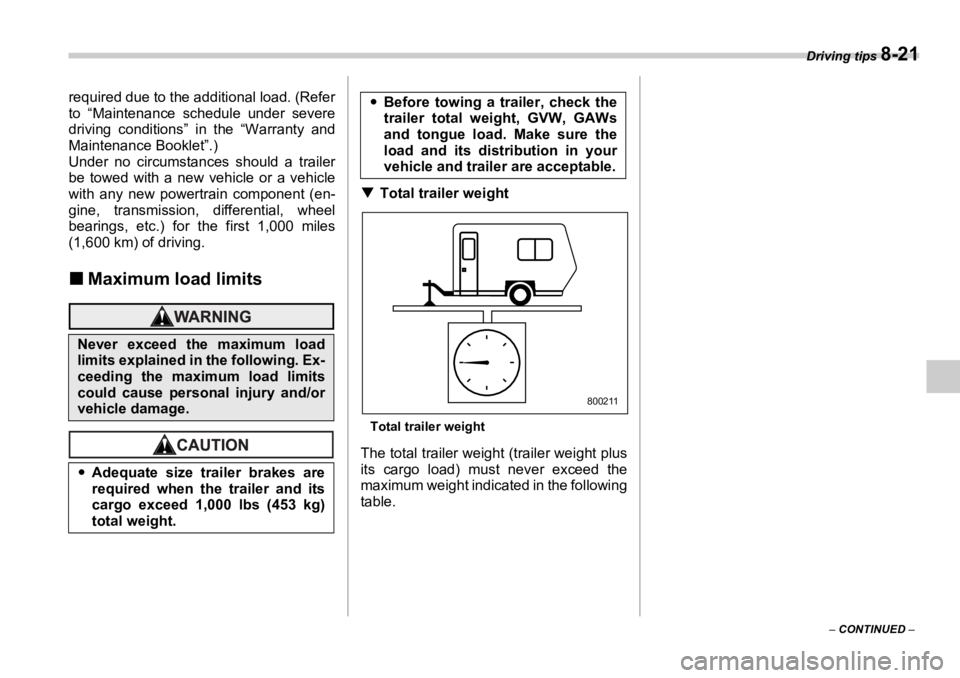
Total trailer weight
The total trailer weight (trailer weight plus
its cargo load) must never exceed the
maximum weight indicated in the following
table.Never exceed the maximum load
limits explained in the following. Ex-
ceeding the maximum load limits
could cause personal injury and/or
vehicle damage.
y Adequate size trailer brakes are
required when the trailer and its
cargo exceed 1,000 lbs (453 kg)
total weight. y Before towing a trailer, check the
trailer total weight, GVW, GAWs
and tongue load. Make sure the
load and its distribution in your
vehicle and trailer are acceptable.
800211
Page 301 of 425
8-22 Driving tips
3,0-liter models
All models other than 3.0-liter models Conditions Maximum total trailer weight
When towing a trailer without brakes. 1,000 lbs (453 kg)
When towing a trailer with brakes. 3,000 lbs (1,360 kg)
When towing a trailer on a long uphill grade con-
tinuously for over 5 miles (8 km) with an outside
temperature of 104 ° F (40 ° C) or above. 1,500 lbs (680 kg)
Model Conditions Maximum total trailer
weight
MT models When towing a trailer without brakes. 1,000 lbs (453 kg)
When towing a trailer with brakes. 2,700 lbs (1,224 kg)
AT models When towing a trailer without brakes. 1,000 lbs (453 kg)
When towing a trailer with brakes. 2,700 lbs (1,224 kg)
When towing a trailer on a long uphill
grade continuously for over 5 miles (8
km) with an outside temperature of
104 ° F (40 ° C) or above. 1,350 lbs (612 kg) T Gross Vehicle Weight (GVW) and
Gross Vehicle Weight Rating
(GVWR)
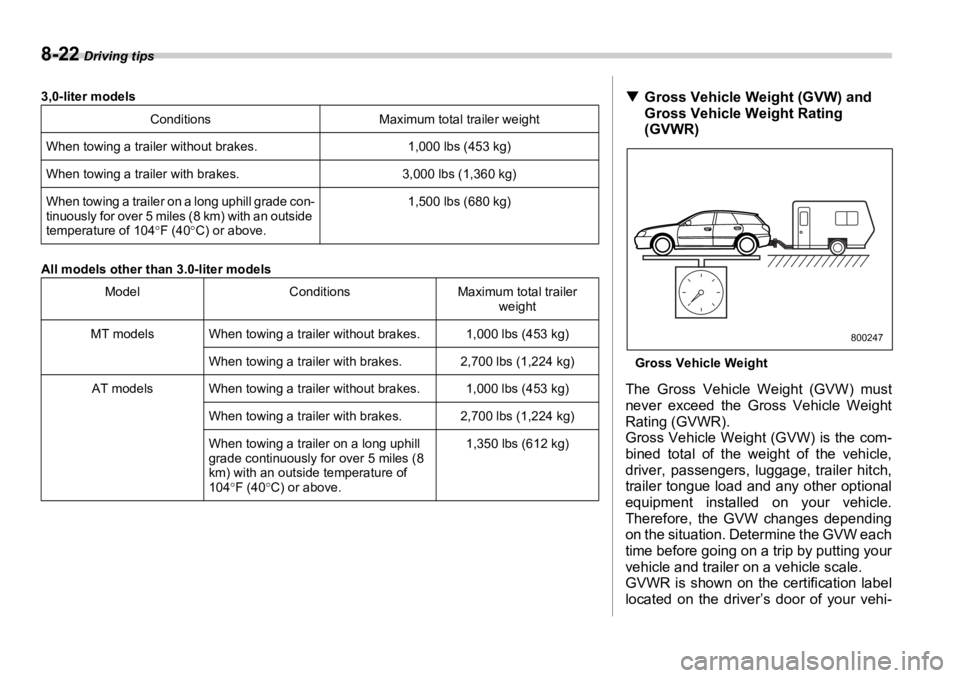
Gross Vehicle Weight
The Gross Vehicle Weight (GVW) must
never exceed the Gross Vehicle Weight
Rating (GVWR).
Gross Vehicle Weight (GVW) is the com-
bined total of the weight of the vehicle,
driver, passengers, luggage, trailer hitch,
trailer tongue load and any other optional
equipment installed on your vehicle.
Therefore, the GVW changes depending
on the situation. Determine the GVW each
time before going on a trip by putting your
vehicle and trailer on a vehicle scale.
GVWR is shown on t he certification label
located on the driver’s door of your vehi- 800247
Page 303 of 425
8-24 Driving tips
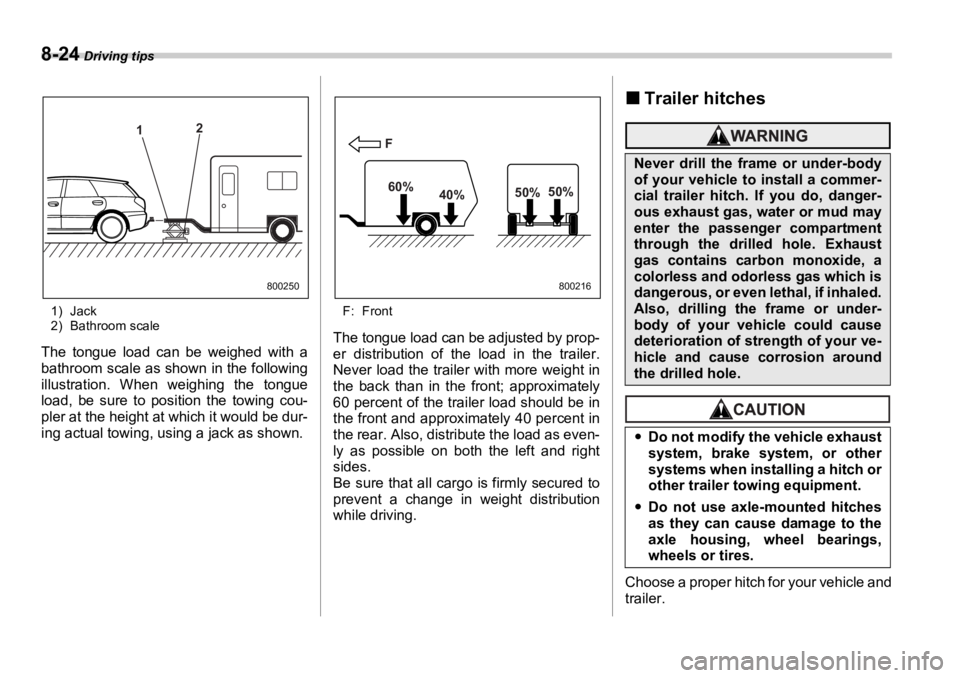
1) Jack
2) Bathroom scale
The tongue load can be weighed with a
bathroom scale as shown in the following
illustration. When weighing the tongue
load, be sure to position the towing cou-
pler at the height at which it would be dur-
ing actual towing, using a jack as shown. F: Front
The tongue load can be adjusted by prop-
er distribution of the load in the trailer.
Never load the trailer with more weight in
the back than in the front; approximately
60 percent of the trailer load should be in
the front and approx imately 40 percent in
the rear. Also, distribute the load as even-
ly as possible on both the left and right
sides.
Be sure that all cargo is firmly secured to
prevent a change in weight distribution
while driving. „ Trailer hitches
Choose a proper hitch for your vehicle and
trailer.1 2
800250 F
60%
40% 50% 50% 800216
Never drill the frame or under-body
of your vehicle to install a commer-
cial trailer hitch. If you do, danger-
ous exhaust gas, water or mud may
enter the passenger compartment
through the drilled hole. Exhaust
gas contains carbon monoxide, a
colorless and odorless gas which is
dangerous, or even lethal, if inhaled.
Also, drilling the frame or under-
body of your vehicle could cause
deterioration of strength of your ve-
hicle and cause corrosion around
the drilled hole.
y Do not modify th e vehicle exhaust
system, brake system, or other
systems when installing a hitch or
other trailer towing equipment.
y Do not use axle-mounted hitches
as they can cause damage to the
axle housing, wheel bearings,
wheels or tires.
Page 304 of 425
Driving tips
8-25
– CONTINUED –T OUTBACK wagon
The use of a genuine SUBARU trailer
hitch is recommended. A genuine
SUBARU hitch is available from your
SUBARU dealer.
If use of a non-genuine hitch is unavoid-
able, be sure the hitch is suited to your ve-
hicle and trailer. Consult with a profes-
sional hitch supplier to assist you in
choosing an appropriate hitch for your ve-
hicle. Be sure to follow all of the hitch man-
ufacturer’s instructions for installation and
use.
Never use a hitch that mounts only to the
rear bumper. The bumper is not designed
to handle that type of load.
For all types of hitches, regularly check
that the hitch mounting bolts and nuts are
tight.
T All vehicles except OUTBACK wag-
on
SUBARU does not offer accessory trailer
hitches. Consult with a professional hitch
supplier to assist you in choosing an ap-
propriate hitch for your vehicle. Be sure to
follow all of the hitch manufacturer’s in-
structions for installation and use.
Never use a hitch that mounts only to the
rear bumper. The bumper is not designed
to handle that type of load.
Regularly check that the hitch mounting bolts and nuts are tight.
„ Connecting a trailer T Trailer brakes
If your trailer’s total weight (trailer weight
plus its cargo weight) exceeds 1,000 lbs
(453 kg), the trailer is required to be
equipped with its ow n brake system. Elec-
tric brakes or surge brakes are recom-
mended, and must be installed properly.
Check that your trailer’s brakes conform
with Federal, state/province and/or other
applicable regulations. Your SUBARU’s
brake system is not designed to be tapped
into the trailer’s hydraulic brake system.
Please ask your SUBARU dealer and pro- fessional trailer supplier for more informa-
tion about the trailer’s brake system.
T Trailer safety chains
In case the trailer hitch connector or hitch
ball should break or become disconnect-
ed, the trailer could get loose and create a
traffic safety hazard.
For safety, always connect the towing ve-
hicle and trailer with trailer safety chains.
Pass the chains crossing each other un-
der the trailer tongue to prevent the trailer
from dropping onto the ground in case the
trailer tongue should disconnect from the
hitch ball. Allow sufficient slack in the
chains taking tight-turn situations into ac-
count; however, be ca reful not to let them
drag on the ground.
For more information about the safety
chain connection, refer to the instructions
for your hitch and trailer.y Adequate size trailer brakes are
required when the trailer and its
cargo exceed 1,000 lbs (453 kg)
total weight.
y Do not directly connect your trail-
er’s hydraulic brake system to the
hydraulic brake system in your
vehicle. Direct connection would
cause the vehicle’s brake perfor-
mance to deteriorate and could
lead to an accident. Always use safety chains between
your vehicle and the trailer. Towing
trailer without safe ty chains could
create a traffic safety hazard if the
trailer separates fr om the hitch due
to coupling damage or hitch ball
damage.
Page 305 of 425
8-26 Driving tips
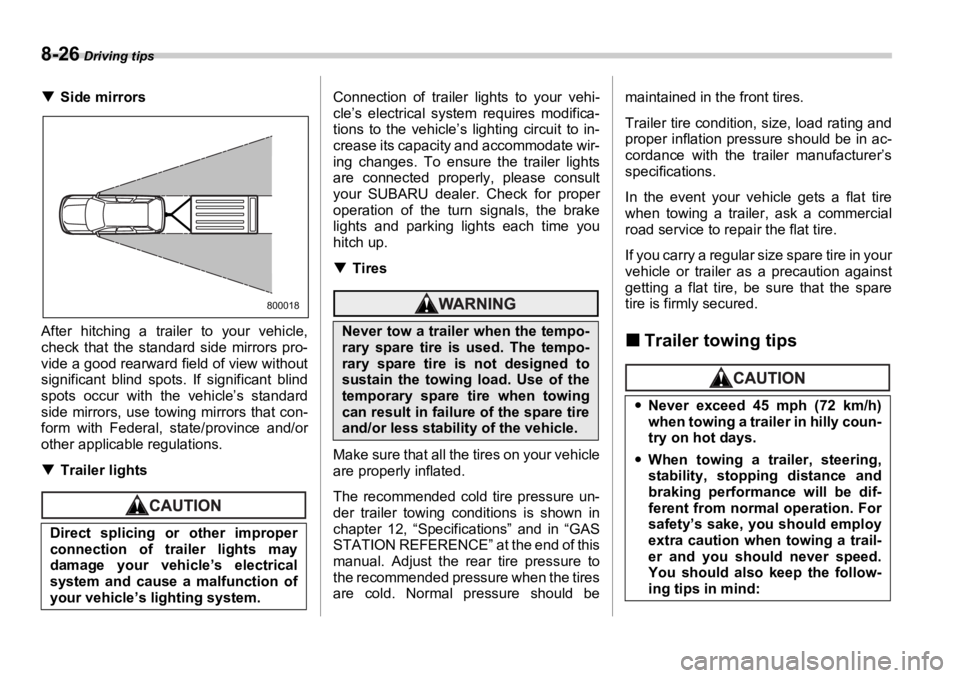
T Side mirrors
After hitching a trailer to your vehicle,
check that the standard side mirrors pro-
vide a good rearward field of view without
significant blind spots. If significant blind
spots occur with the vehicle’s standard
side mirrors, use towing mirrors that con-
form with Federal, state/province and/or
other applicable regulations.
T Trailer lights Connection of trailer lights to your vehi-
cle’s electrical system requires modifica-
tions to the vehicle’s lighting circuit to in-
crease its capacity and accommodate wir-
ing changes. To ensure the trailer lights
are connected properly, please consult
your SUBARU dealer. Check for proper
operation of the turn signals, the brake
lights and parking lights each time you
hitch up.
T Tires
Make sure that all the tires on your vehicle
are properly inflated.
The recommended cold tire pressure un-
der trailer towing conditions is shown in
chapter 12, “Specifications” and in “GAS
STATION REFERENCE” at the end of this
manual. Adjust the rear tire pressure to
the recommended pressure when the tires
are cold. Normal pressure should be maintained in the front tires.
Trailer tire condition, size, load rating and
proper inflation pressure should be in ac-
cordance with the trailer manufacturer’s
specifications.
In the event your v ehicle gets a flat tire
when towing a trailer, ask a commercial
road service to repair the flat tire.
If you carry a regular size spare tire in your
vehicle or trailer as a precaution against
getting a flat tire, be sure that the spare
tire is firmly secured.
„ Trailer towing tips
Direct splicing or other improper
connection of trailer lights may
damage your vehicle’s electrical
system and cause a malfunction of
your vehicle’s lighting system. 800018
Never tow a trailer when the tempo-
rary spare tire is used. The tempo-
rary spare tire is not designed to
sustain the towing load. Use of the
temporary spare tire when towing
can result in failure of the spare tire
and/or less stability of the vehicle. y Never exceed 45 mph (72 km/h)
when towing a trailer in hilly coun-
try on hot days.
y When towing a trailer, steering,
stability, stopping distance and
braking performance will be dif-
ferent from normal operation. For
safety’s sake, you should employ
extra caution when towing a trail-
er and you should never speed.
You should also keep the follow-
ing tips in mind:
Page 306 of 425
Driving tips
8-27
– CONTINUED –T Before starting out on a trip
y Check that the vehicle and vehicle-to-
hitch mounting are in good condition. If
any problems are apparent, do not tow the
trailer.
y Check that the vehicle sits horizontally
with the trailer attached. If the vehicle is
tipped sharply up at the front and down at
the rear, check the total trailer weight,
GVW, GAWs and tongue load again, then
confirm that the load and its distribution
are acceptable.
y Check that the tire pressures are cor-
rect.
y Check that the vehicle and trailer are
connected properly. Confirm that
– the trailer tongue is connected prop-
erly to the hitch ball.
– the trailer lights connector is connect-
ed properly and trailer’s brake lights illu-
minate when the vehicle’s brake pedal
is pressed, and that the trailer’s turn sig-
nal lights flash when the vehicle’s turn
signal lever is operated.
– the safety chains are connected prop-
erly.
– all cargo in the trailer is secured safe-
ty in position.
– the side mirrors provide a good rear-
ward field of view without a significant
blind spot.
y Sufficient time should be taken to learn the “feel” of the vehicle/trailer combination
before starting out on a trip. In an area free
of traffic, practice turning, stopping and
backing up.
T Driving with a trailer
y You should allow for considerably more
stopping distance when towing a trailer.
Avoid sudden braking because it may re-
sult in skidding or jackknifing and loss of
control.
y Avoid abrupt starts and sudden acceler-
ations. If your vehicle has a manual trans-
mission, always start out in first gear and
release the clutch at moderate engine rev-
olution.
y Avoid uneven steering, sharp turns and
rapid lane changes.
y Slow down before turning. Make a long-
er than normal turning radius because the
trailer wheels will be closer than the vehi-
cle wheels to the inside of the turn. In a
tight turn, the trailer could hit your vehicle.
y Crosswinds will adversely affect the
handling of your vehicle and trailer, caus-
ing sway. Crosswinds can be due to
weather conditions or the passing of large
trucks or buses. If swaying occurs, firmly
grip the steering wheel and slow down im-
mediately but gradually.
y When passing other vehicles, consider-
able distance is required because of the added weight and length caused by at-
taching the trailer to your vehicle.
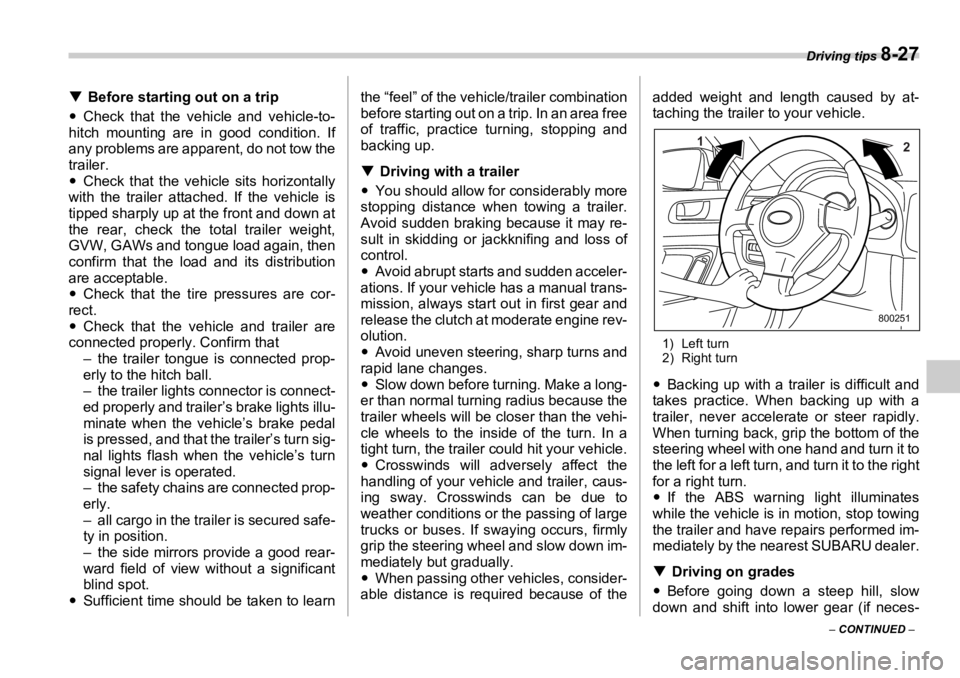
1) Left turn
2) Right turn
y Backing up with a trailer is difficult and
takes practice. When backing up with a
trailer, never accelerate or steer rapidly.
When turning back, grip the bottom of the
steering wheel with one hand and turn it to
the left for a left turn, and turn it to the right
for a right turn.
y If the ABS warning light illuminates
while the vehicle is in motion, stop towing
the trailer and have repairs performed im-
mediately by the nearest SUBARU dealer.
T Driving on grades
y Before going down a steep hill, slow
down and shift into lower gear (if neces- 1
2
800251