weight SUBARU OUTBACK 2008 4.G Owner's Guide
[x] Cancel search | Manufacturer: SUBARU, Model Year: 2008, Model line: OUTBACK, Model: SUBARU OUTBACK 2008 4.GPages: 444, PDF Size: 14.1 MB
Page 426 of 444
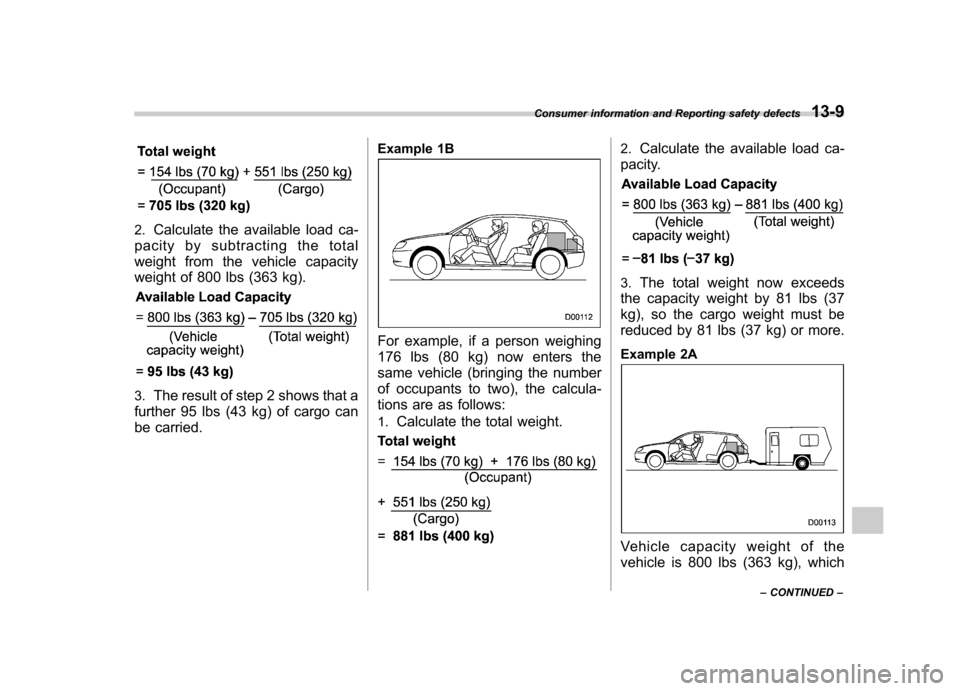
2.Calculate the available load ca-
pacity by subtracting the total
weight from the vehicle capacity
weight of 800 lbs (363 kg).
3. The result of step 2 shows that a
further 95 lbs (43 kg) of cargo can
be carried. Example 1B
For example, if a person weighing
176 lbs (80 kg) now enters the
same vehicle (bringing the number
of occupants to two), the calcula-
tions are as follows: 1.
Calculate the total weight.
2.Calculate the available load ca-
pacity.
3. The total weight now exceeds
the capacity weight by 81 lbs (37
kg), so the cargo weight must be
reduced by 81 lbs (37 kg) or more.
Example 2A
Vehicle capacity weight of the
vehicle is 800 lbs (363 kg), which
Consumer information and Reporting safety defects
13-9
– CONTINUED –
Page 427 of 444
13-10Consumer information and Reporting safety defects
is indicated on the vehicle placard
with the statement “The combined
weight of occupants and cargo
should never exceed 363 kg or
800 lbs ”.
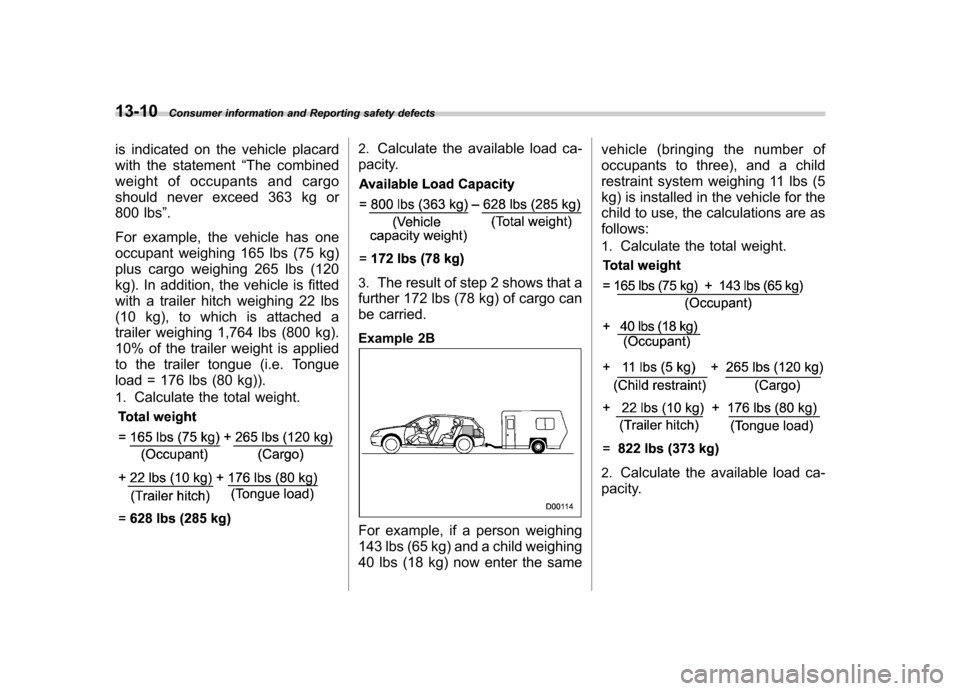
For example, the vehicle has one
occupant weighing 165 lbs (75 kg)
plus cargo weighing 265 lbs (120
kg). In addition, the vehicle is fitted
with a trailer hitch weighing 22 lbs
(10 kg), to which is attached a
trailer weighing 1,764 lbs (800 kg).
10% of the trailer weight is applied
to the trailer tongue (i.e. Tongue
load = 176 lbs (80 kg)). 1. Calculate the total weight.
2.Calculate the available load ca-
pacity.
3. The result of step 2 shows that a
further 172 lbs (78 kg) of cargo can
be carried.
Example 2B
For example, if a person weighing
143 lbs (65 kg) and a child weighing
40 lbs (18 kg) now enter the same vehicle (bringing the number of
occupants to three), and a child
restraint system weighing 11 lbs (5
kg) is installed in the vehicle for the
child to use, the calculations are asfollows: 1.
Calculate the total weight.
2.Calculate the available load ca-
pacity.
Page 428 of 444

3.The total weight now exceeds
the capacity weight by 22 lbs (10
kg), so the cargo weight must be
reduced by 22 lbs (10 kg) or more. & Determining compatibility of
tire and vehicle load capaci-ties
The sum of four tires ’maximum
load ratings must exceed the max-
imum loaded vehicle weight( “GVWR ”). In addition, sum of the
maximum load ratings of two front
tires and of two rear tires must
exceed each axle ’s maximum
loaded capacity ( “GAWR ”). Original
equipment tires are designed to
fulfill those conditions.
The maximum loaded vehicle
weight is referred to Gross Vehicle
Weight Rating (GVWR). And each axle
’s maximum loaded capacity is
referred to Gross Axle Weight Rat-
ing (GAWR). The GVWR and each axle ’s GAWR are shown on the
vehicle certification label affixed to
the driver ’s door.
The GVWR and front and rear
GAWRs are determined by not only
the maximum load rating of tires but
also loaded capacities of the vehi-cle ’s suspension, axles and other
parts of the body.
Therefore, this means that the
vehicle cannot necessarily be
loaded up to the tire ’s maximum
load rating on the tire sidewall.
& Adverse safety conse-
quences of overloading on
handling and stopping and
on tires
Overloading could affect vehicle
handling, stopping distance, vehicle
and tire as shown in the following.
This could lead to an accident and
possibly result in severe personal
injury. .
Vehicle stability will deteriorate.
. Heavy and/or high-mounted
loads could increase the risk of
rollover.. Stopping distance will increase.
. Brakes could overheat and fail.
. Suspension, bearings, axles and
other parts of the body could break
or experience accelerated wear
that will shorten vehicle life. . Tires could fail.
. Tread separation could occur.
. Tire could separate from its rim.
& Steps for Determining Cor-
rect Load Limit
1. Locate the statement “The com-
bined weight of occupants and
cargo should never exceed XXXpounds ”on your vehicle ’s placard.
2. Determine the combined weight
of the driver and passengers that
will be riding in your vehicle. 3. Subtract the combined weight of
the driver and passengers from
XXX kilograms or XXX pounds. 4. The resulting figure equals the
Consumer information and Reporting safety defects
13-11
– CONTINUED –
Page 429 of 444

13-12Consumer information and Reporting safety defects
available amount of cargo and
luggage load capacity. For exam-
ple, if the “XXX ”amount equals
1,400 lbs (635kg). and there will be
five- 150 lbs (68 kg) passengers in
your vehicle, the amount of avail-
able cargo and luggage load capa-
city is 650 lbs. (1,400 750 (5 6
150) = 650 lbs.)
5. Determine the combined weight
of luggage and cargo being loaded
on the vehicle. That weight may not
safely exceed the available cargo
and luggage load capacity calcu-
lated in Step 4. 6. If your vehicle will be towing a
trailer, load from your trailer will be
transferred to your vehicle. Consult
this manual to determine how this
reduces the available cargo and
luggage load capacity of your ve-hicle. Uniform tire quality grading standards
This information indicates the rela-
tive performance of passenger car
tires in the area of treadwear,
traction, and temperature resis-
tance. This is to aid the consumer
in making an informed choice in the
purchase of tires.
Quality grades can be found where
applicable on the tire sidewall be-
tween tread shoulder and maxi-
mum section width. For example:
Treadwear 200 Traction AA Tem-
perature A
The quality grades apply to new
pneumatic tires for use on passen-
ger cars. However, they do not
apply to deep tread, winter type
snow tires, space-saver or tempor-
ary use spare tires, tires with
nominal rim diameters of 12 inches
or less, or to some limited produc-
tion tires.
All passenger car tires must con-form to Federal Safety Require-
ments in addition to these grades. &
Treadwear
The treadwear grade is a compara-
tive rating based on the wear rate of
the tire when tested under con-
trolled conditions on a specified
government test course.
For example, a tire graded 150
would wear one and one-half (1-1/
2) times as well on the government
course as a tire graded 100. The
relative performance of tires de-
pends upon the actual conditions
of their use, however, and may
depart significantly from the norm
due to variations in driving habits,
service practices and differences in
road characteristics and climate. & Traction AA, A, B, C
The traction grades, from highest to
lowest, are AA, A, B and C. Those
grades represent the tire ’s ability to
stop on wet pavement as measured
under controlled conditions on spe-
Page 435 of 444

14-4Index
Door Locks ..................................................................... 2-5
Open warning light ................................................. 3-36
Drive belts. ............................................................... 11-21
Driving All-Wheel Drive vehicle ........................................... 3-36
Car phone/cell phone .................................................. 7
Drinking ..................................................................... 6
Drugs ........................................................................ 6
Foreign countries ..................................................... 8-5
Pets .......................................................................... 7
Snowy and icy roads ................................................ 8-9
Tips....................................... 7-15, 7-17, 7-22, 7-29, 8-5
Tired or sleepy. ........................................................... 7
E
ECO gauge ................................................................. 3-8
Electrical system ........................................................ 12-3
Electronic Brake Force Distribution (EBD) system ........................................................... 3-35, 7-36
Emergency Locking Retractor (ELR) ............................. 1-14
Engine Compartment overview ........................................... 11-6
Coolant ................................................................ 11-14
Exhaust gas (Carbon monoxide) ............................ 6, 8-3
Hood .................................................................... 11-4
Oil........................................................................ 11-9Overheating .......................................................... 9-13
Starting ................................................................... 7-9
Stopping ............................................................... 7-10
Exterior care .............................................................. 10-2 F
Flat tires
..................................................................... 9-4
Floor mat ................................................................... 6-12
Fluid level Automatic transmission ......................................... 11-23
Brake .................................................................. 11-29
Clutch ................................................................. 11-30
Power steering ..................................................... 11-28
Fog light switch .......................................................... 3-48
Front Differential gear oil ................................................ 11-24
Fog light .............................................................. 11-54
Seatbelt pretensioners ............................................ 1-24
Seats ..................................................................... 1-2
Front seats Fore and aft adjustment ..................................... 1-3, 1-4
Reclining .......................................................... 1-3, 1-4
Fuel ........................................................................... 7-3
Economy hints ........................................................ 8-2
Filler lid and cap ...................................................... 7-5
Gauge ............................................................ 3-6, 3-26
Requirements ......................................................... 7-3
Fuses ..................................................................... 11-48
Fuses and circuits ...................................................... 12-6
G
GAWR (Gross Axle Weight Rating) ............................... 8-15
Gear position indicator ................................................ 3-39
Glove box ................................................................... 6-5
GVWR (Gross Vehicle Weight Rating) ... ........................ 8-15
Page 440 of 444

Pressures and wear.............................................. 11-36
Replacement ........................................................ 11-40
Rotation ............................................................... 11-39
Types .................................................................. 11-34
Tire pressure monitoring system (TPMS) .......................................... 3-32, 7-43, 9-9, 11-34
Tires ......................................................................... 12-5
Tires and wheels. ...................................................... 11-34
Top tether anchorages ................................................ 1-37
Towing ...................................................................... 9-14
All wheels on the ground ........................................ 9-17
Flat-bed truck ........................................................ 9-17
Tie-down hooks ..................................................... 9-14
Weight.................................................................. 8-22
Trailer Connecting ............................................................ 8-20
Hitch .................................................................... 8-19
Hitches ................................................................. 8-25
Towing .................................................................. 8-21
Towing tips ............................................................ 8-27
Trip meter ................................................................. 3-25
Trunk lid ................................................................... 2-23
Release handle ..................................................... 2-24
Trunk light ................................................................ 11-60
Turn signal Indicator lights ....................................................... 3-39
Lever .................................................................... 3-47
U
Under-floor storage compartment ................................. 6-16 V
Valet mode
................................................................ 2-18
Vanity mirror ............................................................... 6-4
Vehicle Capacity weight ...................................................... 8-14
Identification ........................................................ 12-11
Symbols .................................................................... 3
Vehicle Dynamics Control
OFF indicator light .................................................. 3-37
OFF switch ............................................................ 7-42
Operation indicator light ........................................... 3-36
System .................................................................. 7-38
Warning light .................................................. 3-37, 7-40
Ventilator .................................................................... 4-2
W
Warning and indicator lights ......................................... 3-28
Warning light ABS...................................................................... 3-34
All-Wheel Drive ...................................................... 3-36
Anti-lock Brake System ........................................... 3-34
AT OIL TEMPerature ............................................... 3-32
Brake system ......................................................... 3-35
Charge .................................................................. 3-32
CHECK ENGINE .................................................... 3-31
Door open ............................................................. 3-36
Low fuel ................................................. 3-7, 3-27, 3-35
Low tire pressure .................................................... 3-32
Oil pressure ........................................................... 3-32
Seatbelt. ................................................................ 3-29
SRS airbag system ................................................. 3-30 Index
14-9