fuel SUBARU OUTBACK 2009 5.G Workshop Manual
[x] Cancel search | Manufacturer: SUBARU, Model Year: 2009, Model line: OUTBACK, Model: SUBARU OUTBACK 2009 5.GPages: 447, PDF Size: 14.26 MB
Page 363 of 447
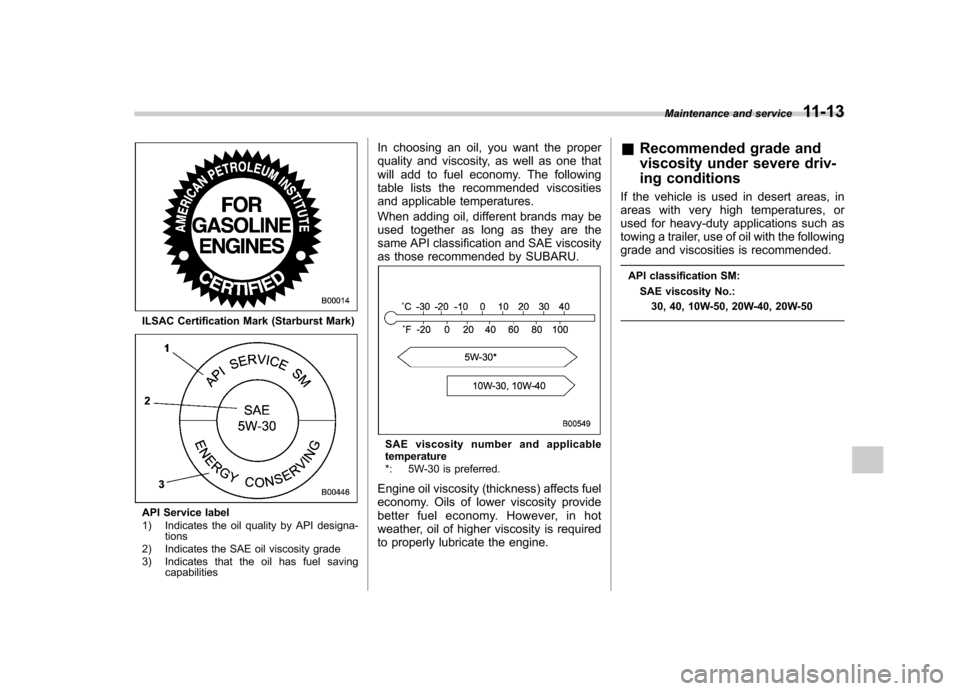
ILSAC Certification Mark (Starburst Mark)
API Service label
1) Indicates the oil quality by API designa-tions
2) Indicates the SAE oil viscosity grade
3) Indicates that the oil has fuel saving capabilities In choosing an oil, you want the proper
quality and viscosity, as well as one that
will add to fuel economy. The following
table lists the recommended viscosities
and applicable temperatures.
When adding oil, different brands may be
used together as long as they are the
same API classification and SAE viscosity
as those recommended by SUBARU.
SAE viscosity number and applicable
temperature
*: 5W-30 is preferred.
Engine oil viscosity (thickness) affects fuel
economy. Oils of lower viscosity provide
better fuel economy. However, in hot
weather, oil of higher viscosity is required
to properly lubricate the engine. &
Recommended grade and
viscosity under severe driv-
ing conditions
If the vehicle is used in desert areas, in
areas with very high temperatures, or
used for heavy-duty applications such as
towing a trailer, use of oil with the following
grade and viscosities is recommended.
API classification SM: SAE viscosity No.:30, 40, 10W-50, 20W-40, 20W-50 Maintenance and service
11-13
Page 364 of 447
11-14Maintenance and service
Cooling system
WARNING
Never attempt to remove the radia-
tor cap until the engine has been
shut off and has cooled down
completely. Since the coolant is
under pressure, you may suffer
serious burns from a spray of boil-
ing hot coolant when the cap isremoved.
CAUTION
. Vehicles are filled at the factory
with SUBARU Super Coolant that
does not require the first change
for 11 years/137,500 miles (11
years/220,000 km). This coolant
should not be mixed with any
other brand or type of coolant
during this period. Mixing with a
different coolant will reduce the
life of the coolant. Should it be
necessary to top off the coolant
for any reason, use only
SUBARU Super Coolant.
If the SUBARU Super Coolant is
diluted with another brand or
type, the maintenance interval is shortened to that of the mixingcoolant.
. Do not splash the engine coolant
over painted parts. The alcohol
contained in the engine coolant
may damage the paint surface.
& Cooling fan, hose and con- nections
Your vehicle employs an electric cooling
fan which is thermostatically controlled to
operate when the engine coolant reaches
a specific temperature.
If the radiator cooling fan does not operate
even when the engine coolant tempera-
ture gauge exceeds the normal operating
range, the cooling fan circuit may be
defective. Check the fuse and replace it
if necessary. If the fuse is not blown, have
the cooling system checked by your
SUBARU dealer.
If frequent addition of coolant is neces-
sary, there may be a leak in the engine
cooling system. It is recommended that
the cooling system and connections be
checked for leaks, damage, or looseness. &
Engine coolant
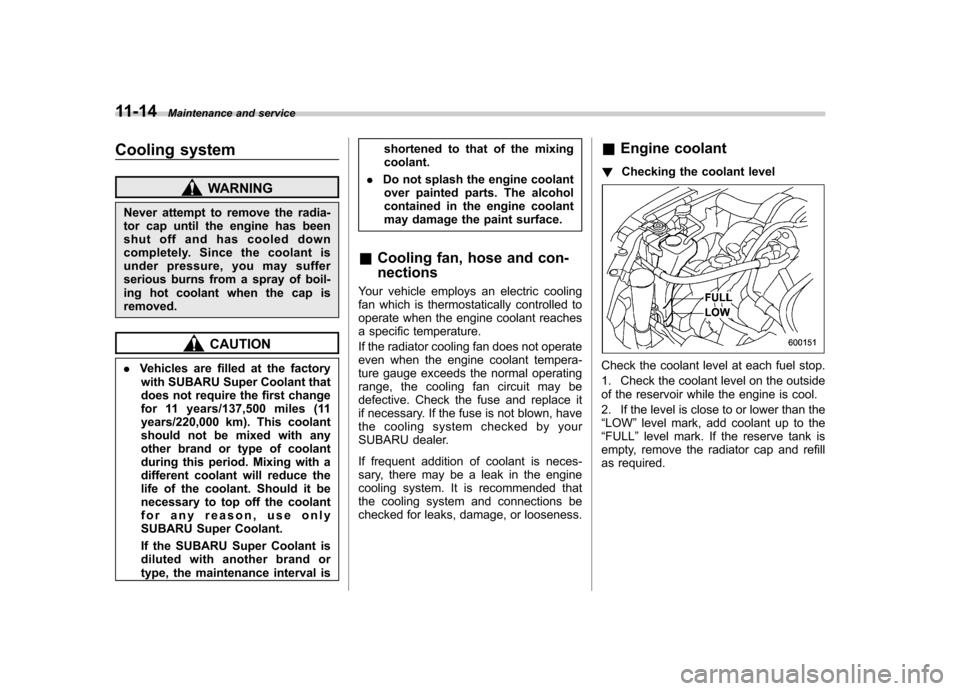
! Checking the coolant level
Check the coolant level at each fuel stop.
1. Check the coolant level on the outside
of the reservoir while the engine is cool.
2. If the level is close to or lower than the “LOW ”level mark, add coolant up to the
“ FULL ”level mark. If the reserve tank is
empty, remove the radiator cap and refill
as required.
Page 386 of 447
11-36Maintenance and service
for abnormal wear.
Contact your SUBARU dealer immedi-
ately if you find any problem. NOTE .When the wheels and tires strike
curbs or are subjected to harsh treat-
ment as when the vehicle is driven on a
rough surface, they can suffer damage
that cannot be seen with the naked eye.
This type of damage does not become
evident until time has passed. Try not
to drive over curbs, potholes or on
other rough surfaces. If doing so is
unavoidable, keep the vehicle ’s speed
down to a walking pace or less, and
approach the curbs as squarely as
possible. Also, make sure the tires are
not pressed against the curb when you
park the vehicle.. If you feel unusual vibration while
driving or find it difficult to steer the
vehicle in a straight line, one of the
tires and/or wheels may be damaged.
Drive slowly to the nearest authorized
SUBARU dealer and have the vehicleinspected.
& Tire pressures and wear
Maintaining the correct tire pressures
helps to maximize the tires ’service lives
and is essential for good running perfor- mance. Check and, if necessary, adjust
the pressure of each tire (including the
spare) at least once a month (for example,
during a fuel stop) and before any long
journey.
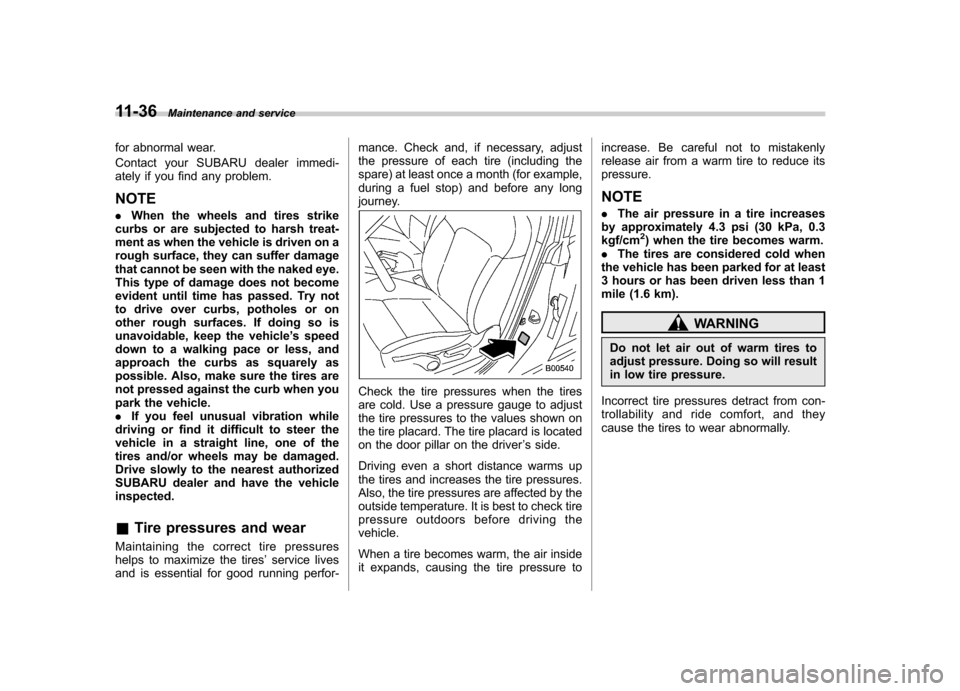
Check the tire pressures when the tires
are cold. Use a pressure gauge to adjust
the tire pressures to the values shown on
the tire placard. The tire placard is located
on the door pillar on the driver
’s side.
Driving even a short distance warms up
the tires and increases the tire pressures.
Also, the tire pressures are affected by the
outside temperature. It is best to check tire
pressure outdoors before driving thevehicle.
When a tire becomes warm, the air inside
it expands, causing the tire pressure to increase. Be careful not to mistakenly
release air from a warm tire to reduce itspressure.
NOTE . The air pressure in a tire increases
by approximately 4.3 psi (30 kPa, 0.3 kgf/cm
2) when the tire becomes warm.
. The tires are considered cold when
the vehicle has been parked for at least
3 hours or has been driven less than 1
mile (1.6 km).
WARNING
Do not let air out of warm tires to
adjust pressure. Doing so will result
in low tire pressure.
Incorrect tire pressures detract from con-
trollability and ride comfort, and they
cause the tires to wear abnormally.
Page 387 of 447
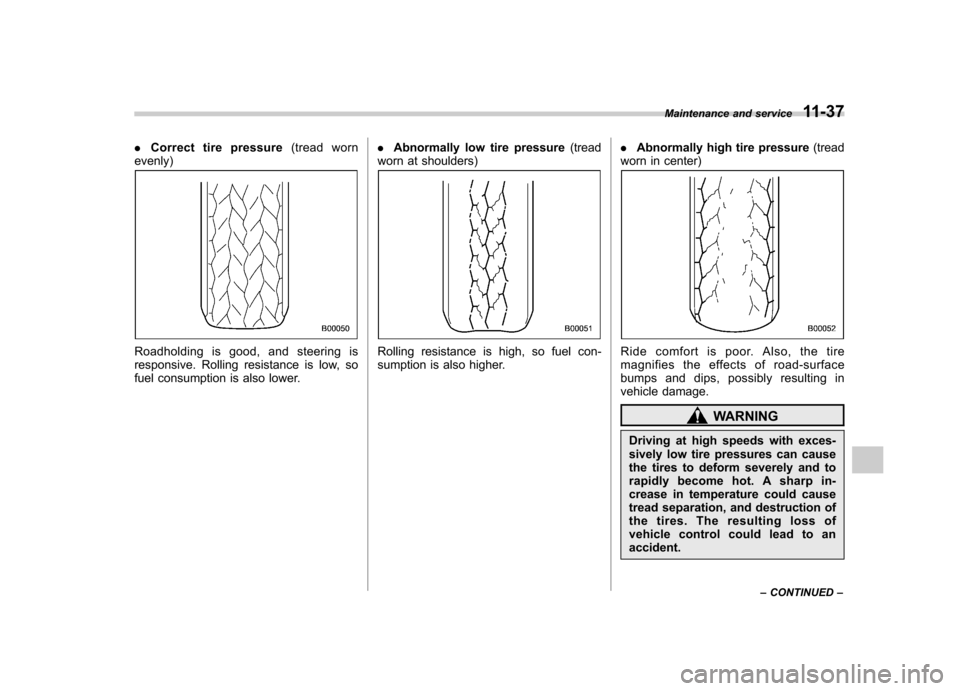
.Correct tire pressure (tread worn
evenly)
Roadholding is good, and steering is
responsive. Rolling resistance is low, so
fuel consumption is also lower. .
Abnormally low tire pressure (tread
worn at shoulders)Rolling resistance is high, so fuel con-
sumption is also higher. .
Abnormally high tire pressure (tread
worn in center)Ride comfort is poor. Also, the tire
magnifies the effects of road-surface
bumps and dips, possibly resulting in
vehicle damage.
WARNING
Driving at high speeds with exces-
sively low tire pressures can cause
the tires to deform severely and to
rapidly become hot. A sharp in-
crease in temperature could cause
tread separation, and destruction of
the tires. The resulting loss of
vehicle control could lead to anaccident. Maintenance and service
11-37
– CONTINUED –
Page 413 of 447

12-4Specifications
&Capacities
Fuel tank 16.9 US gal (64 liters, 14.1 Imp gal)
Engine oil 2.5 L models 4.2 US qt (4.0 liters, 3.5 Imp qt)
3.0 L models 5.8 US qt (5.5 liters, 4.8 Imp qt)
Transmission oil (MT) 5-speeds 3.7 US qt (3.5 liters, 3.1 Imp qt)
6-speeds 4.3 US qt (4.1 liters, 3.6 Imp qt)
Transmission fluid (AT) 2.5 L non-turbo models 9.8 US qt (9.3 liters, 8.2 Imp qt)
2.5 L turbo and 3.0 L models 10.4 US qt (9.8 liters, 8.6 Imp qt)
AT differential gear oil 2.5 L non-turbo models 1.3 US qt (1.2 liters, 1.1 Imp qt)
2.5 L turbo and 3.0 L models 1.5 US qt (1.4 liters, 1.2 Imp qt)
Rear differential gear oil Turbo 6-speeds MT models 1.1 US qt (1.0 liter, 0.9 Imp qt)
Other models 0.8 US qt (0.8 liter, 0.7 Imp qt)
Power steering fluid 0.7 US qt (0.7 liter, 0.6 Imp qt)
Engine coolant 2.5 L non-turbo models MT6.8 US qt (6.4 liters, 5.6 Imp qt)
AT 6.7 US qt (6.3 liters, 5.5 Imp qt)
2.5 L turbo models MT 7.7 US qt (7.3 liters, 6.4 Imp qt)
AT 7.6 US qt (7.2 liters, 6.3 Imp qt)
3.0 L models 7.6 US qt (7.2 liters, 6.3 Imp qt)
Page 417 of 447
12-8Specifications
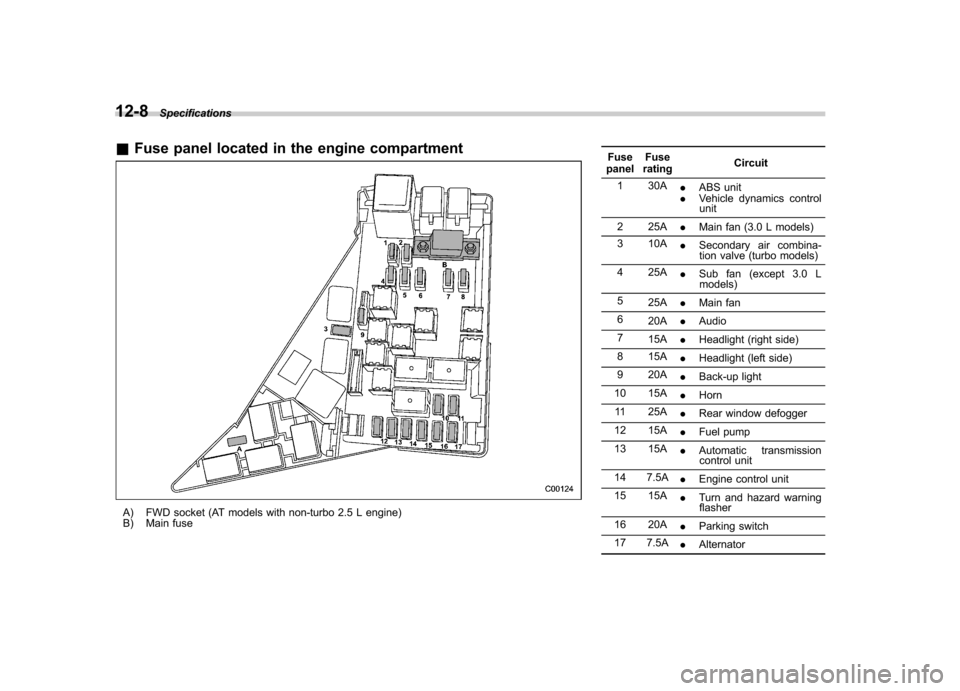
&Fuse panel located in the engine compartment
A) FWD socket (AT models with non-turbo 2.5 L engine)
B) Main fuse Fuse
panel Fuse
rating Circuit
1 30A .ABS unit
. Vehicle dynamics control
unit
2 25A .Main fan (3.0 L models)
3 10A .Secondary air combina-
tion valve (turbo models)
4 25A .Sub fan (except 3.0 L
models)
5 25A .Main fan
6 20A .Audio
7 15A .Headlight (right side)
8 15A .Headlight (left side)
9 20A .Back-up light
10 15A .Horn
11 25A .Rear window defogger
12 15A .Fuel pump
13 15A .Automatic transmission
control unit
14 7.5A .Engine control unit
15 15A .Turn and hazard warning
flasher
16 20A .Parking switch
17 7.5A .Alternator
Page 420 of 447
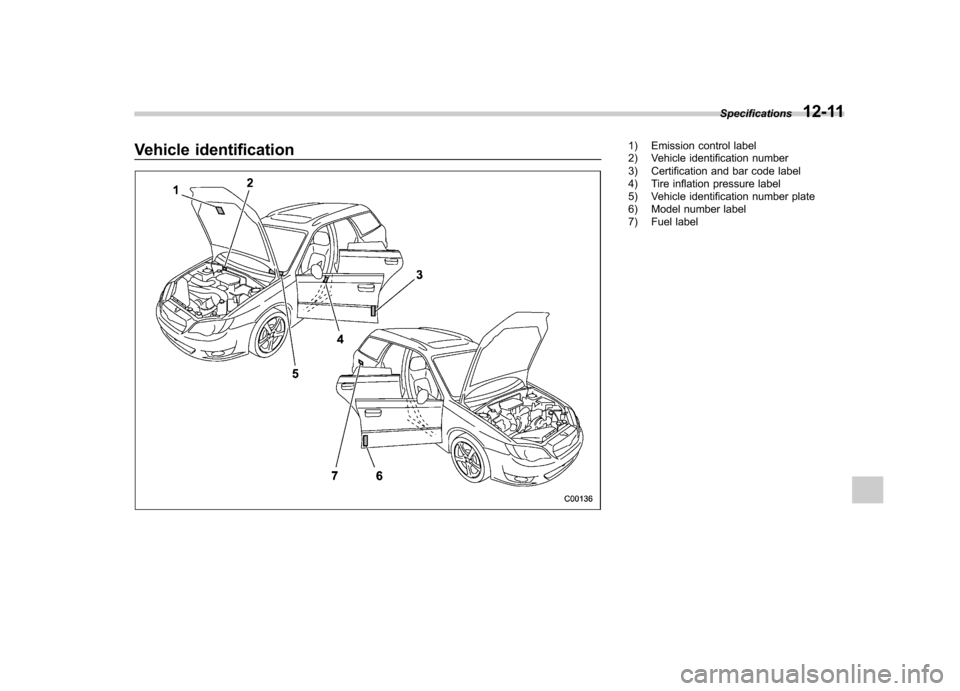
Vehicle identification1) Emission control label
2) Vehicle identification number
3) Certification and bar code label
4) Tire inflation pressure label
5) Vehicle identification number plate
6) Model number label
7) Fuel labelSpecifications
12-11
Page 427 of 447

whitewall, bears white lettering
or bears manufacturer, brand,
and/or model name molding that
is higher or deeper than the
same molding on the other side-
wall of the tire, or (2)The outward facing sidewall
of an asymmetrical tire that has
a particular side that must al-
ways face outward when mount-
ing on a vehicle.
. Accessory weight
The combined weight (in excess of
those standard items which may be
replaced) of floor mats, leather
seats and cross bars to the extent
that these items are available as
factory-installed equipment
(whether installed or not). . Curb weight
The weight of a motor vehicle with
standard equipment including the
maximum capacity of fuel, oil, and
coolant and air conditioning. . Maximum loaded vehicle weight
The sum of curb weight, accessory
weight, vehicle capacity weight and production options weight.
. Normal occupant weight
150 lbs (68 kg) times the number of
occupants (3 occupants). . Occupant distribution
Distribution of occupants in a vehi-
cle, 2 in front, 1 in rear seat.. Production options weight
The combined weight of those
installed regular production options
weighing over 5.1 lbs (2.3 kg) in
excess of those standards items
which they replace, not previously
considered in curb weight or acces-
sory weight. . Vehicle capacity weight
The total weight of cargo, luggage
and occupants that can be added to
the vehicle. . Vehicle maximum load on a tire
Load on an individual tire that is
determined by distributing to each
axle its share of the maximum
loaded vehicle weight and dividing
by two. . Vehicle normal load on a tire
Load on an individual tire that is determined by distributing to each
axle its share of the curb weight,
accessory weight, and normal oc-
cupant weight and dividing by two. &
Tire care –maintenance and
safety practices
. Check on a daily basis that the
tires are free from serious damage,
nails, and stones. At the same time,
check the tires for abnormal wear.. Inspect the tire tread regularly
and replace the tires before their
tread wear indicators become visi-
ble. When a tire ’s tread wear
indicator becomes visible, the tire
is worn beyond the acceptable limit
and must be replaced immediately.
With a tire in this condition, driving
at even low speeds in wet weather
can cause the vehicle to hydro-
plane. Possible resulting loss of
vehicle control can lead to anaccident. . To maximize the life of each tire
and ensure that the tires wear
uniformly, it is best to rotate the
Consumer information and Reporting safety defects
13-7
– CONTINUED –
Page 439 of 447

Front turn signal/Parking and front side marker ............. 11-53
Fuel ........................................................................... 7-3
Economy hints ......................................................... 8-2
Filler lid and cap ...................................................... 7-5
Gauge ............................................................ 3-6, 3-26
Requirements .......................................................... 7-3
Fuses ...................................................................... 11-47
Fuses and circuits ...................................................... 12-6
G
GAWR (Gross Axle Weight Rating) .............................. 8-15
Gear position indicator ................................................ 3-39
Glove box ................................................................... 6-5
GVWR (Gross Vehicle Weight Rating) .......................... 8-15
H
Hazard warning flasher ........................................... 3-5, 9-2
Head restraint adjustment Front seat ............................................................... 1-7
Rearseat ............................................................... 1-10
Headlight Flasher ................................................................. 3-47
Indicator light ......................................................... 3-40
Headlights ........................................................ 3-46, 11-51
Heater operation (manual climate control system) ............ 4-5
High beam indicator light ............................................ 3-40
High mount stop light ................................................. 11-59
High/low beam change (dimmer) .................................. 3-46
Horn ......................................................................... 3-59
Hose and connections ............................................... 11-14 I
Ignition switch
............................................................. 3-3
Light ...................................................................... 3-5
Illumination brightness control ...................................... 3-48
Immobilizer ................................................................. 2-3
Indicator light (security indicator light) ................. 2-4, 3-38
Indicator light
Cruise control ................................................ 3-40, 7-49
Cruise control set ........................................... 3-40, 7-50
Front fog light ......................................................... 3-40
Headlight ............................................................... 3-40
High beam ............................................................. 3-40
Immobilizer ............................................................. 2-4
S# PREP .............................................................. 3-39
Security .......................................................... 2-4, 3-38
Selector lever position ............................................. 3-39
Selector lever/Gear position ..................................... 3-40
Shift-up ................................................................. 3-38
SPORT mode ........................................................ 3-38
Traction control system OFF .................................... 3-37
Turn signal ............................................................ 3-40
Vehicle Dynamics Control OFF ......................... 3-38, 7-40
Vehicle Dynamics Control operation .................. 3-37, 7-40
Information display ...................................................... 3-41
Inside mirror .............................................................. 3-56
Interior lights ............................................................... 6-2
Internal trunk lid release handle .................................... 2-25
JJack. ......................................................................... 9-18
Jack handle ............................................................... 9-19 Index
14-5
Page 440 of 447

14-6Index
Jump starting. ............................................................ 9-10
K Key Number .................................................................. 2-2
Reminder chime. ...................................................... 3-5
Replacement ........................................................... 2-4
Keyless entry system ................................................... 2-8
Keys .......................................................................... 2-2
L
Leather seat materials ................................................ 10-5
License plate light ..................................................... 11-56
Light Back-up (Sedan) ................................................... 11-53
Back-up (Station wagon) ........................................ 11-56
Brake/Tail (Station wagon) ...................................... 11-54
Brake/Tail and rear side marker (Sedan) .................. 11-53
Cargo area .................................................... 6-2, 11-59
Control switch ........................................................ 3-46
Dome ........................................................... 6-2, 11-57
Door step ............................................................. 11-58
Front fog ............................................................... 3-49
High mount stop ................................................... 11-59
Ignition switch .......................................................... 3-5
License plate ........................................................ 11-56
Map ............................................................. 6-3, 11-57
Rear combination .................................................. 11-53
Rear side marker (Station wagon) ........................... 11-54
Trunk ................................................................... 11-59
Vanity mirror .................................................. 6-5, 11-58 Limited slip differential (LSD).
....................................... 7-33
Loading your vehicle ................................................... 8-13
Low fuel warning light .................................. 3-7, 3-27, 3-36
Low tire pressure warning light ..................................... 3-33
Lower and tether anchorage ........................................ 1-35
LSD (Limited slip differential) ........................................ 7-33
Lumbar support ........................................................... 1-8
M
Main fuse ................................................................ 11-49
Maintenance
Precautions ........................................................... 11-3
Schedule ............................................................... 11-3
Seatbelt. ................................................................ 1-23
Tools ..................................................................... 9-18
Malfunction indicator lamp (check engine warning light)... 3-31Manual
Climate control system ............................................. 4-3
Mode ............................................................ 7-21, 7-27
Seat ....................................................................... 1-3
Transmission oil ................................................... 11-21
Transmission-5 speeds ........................................... 7-15
Transmission-6 speeds ........................................... 7-17
Map light ........................................................... 6-3, 11-57
Maximum load limits ................................................... 8-22
Meters and gauges .............................................. 3-5, 3-24
Mirrors ...................................................................... 3-56
Moonroof ................................................................... 2-28
Multi-information display ............................................... 3-9