ECO mode SUBARU OUTBACK 2010 5.G Repair Manual
[x] Cancel search | Manufacturer: SUBARU, Model Year: 2010, Model line: OUTBACK, Model: SUBARU OUTBACK 2010 5.GPages: 448, PDF Size: 7.36 MB
Page 295 of 448
train of your vehicle and may
affect ride, handling, braking and
speedometer/odometer calibra-
tion. It also may be dangerous
and lead to loss of vehicle con-trol.
. Do not use a combination of
radial, belted bias or bias tires
since it may cause dangerous
handling characteristics and lead
to an accident.
! Except 2.5 L turbo models
Your vehicle is equipped with “all season
tires ”which are designed to provide an
adequate measure of traction, handling
and braking performance in year-round
driving. In winter, it may be possible to
enhance performance through use of tires
designed specifically for winter drivingconditions.
If you choose to install winter tires on your
vehicle, be sure to use the correct tire size
and type. You must install four winter tires
that are of the same size, construction,
brand and load range and you should
never mix radial, belted bias or bias tires
since this may result in dangerous hand-
ling characteristics. When you choose a
tire, make sure that there is enough
clearance between the tire and vehicle body.
Remember to drive with care at all times
regardless of the type of tires on yourvehicle. !
2.5 L turbo models
Your vehicle is equipped with “summer
tires ”as original equipment, which are
inadequate for driving on slippery roads
such as on snow-covered or icy roads.
Compared with winter and all-season
tires, summer tires give significantly less
grip on snowy and icy road surfaces.
Therefore, use of winter tires is strongly
recommended when driving with such
road conditions.
When you choose to install winter tires on
your vehicle, be sure to use the correct tire
size and type. You must install four winter
tires that are of the same size, construc-
tion, brand and load range and you should
never mix radial, belted bias or bias tires
since this may result in dangerous hand-
ling characteristics. When you choose a
tire, make sure that there is enough
clearance between the tire and vehicle
body.
Remember to drive with care at all times
regardless of the type of tires on yourvehicle. &
Tire chains
CAUTION
Tire chains cannot be used on any
tires for your Legacy and Outback
because of lack of clearance be-
tween the tires and vehicle body.
& Rocking the vehicle
If you must rock the vehicle to free it from
snow, sand, or mud, depress the accel-
erator pedal slightly and move the shift
lever/select lever back and forth between“ 1 ”/“ D ”and “R ”repeatedly. Do not race the
engine. For the best possible traction,
avoid spinning the wheels when trying to
free the vehicle.
When the road surface is extremely
slippery, you can obtain better traction by
starting the vehicle with the transmission
in 2nd than 1st (for MT, AT and CVT).
For information on holding the transmis-
sion in 2nd position, refer to “Selection of
manual mode ”F 7-21. Driving tips
8-11
Page 337 of 448

Maintenance schedule....................................... 11-3
Maintenance precautions ................................... 11-3
Before checking or servicing in the engine compartment .................................................... 11-4
When checking or servicing in the engine compartment (2.5 L non-turbo models) .. ........... 11-4
When checking or servicing in the engine compartment while the engine is running .......... 11-5
Maintenance tips ................................................ 11-5
Removing and reinstalling clips .......................... 11-5
Removing air intake duct .................................... 11-7
Pulling off the fender lining ................................ 11-7
Engine hood ....................................................... 11-7
Engine compartment overview .......................... 11-9
2.5 L non-turbo models ...................................... 11-9
2.5 L turbo models ........................................... 11-10
3.6 L models .................................................... 11-11
Engine oil .......................................................... 11-12
Checking the oil level ....................................... 11-12
Changing the oil and oil filter ............................ 11-14
Recommended grade and viscosity .................. 11-16
Recommended grade and viscosity under severe driving conditions .......................................... 11-17
Cooling system ................................................ 11-17
Cooling fan, hose and connections ................... 11-17
Engine coolant ................................................. 11-18
Air cleaner element .......................................... 11-20
Replacing the air cleaner element ..................... 11-21
Spark plugs ...................................................... 11-22
Recommended spark plugs .............................. 11-22 Drive belts
........................................................ 11-23
Manual transmission oil .................................. 11-23
Checking the oil level ...................................... 11-23
Recommended grade and viscosity .................. 11-24
Automatic transmission fluid .......................... 11-24
Checking the fluid level .................................... 11-24
Recommended fluid ......................................... 11-25
Continuously variable transmission fluid ...... 11-26
Front differential gear oil (AT and CVT models) .......................................................... 11-26
Checking the oil level ...................................... 11-26
Recommended grade and viscosity .................. 11-27
Rear differential gear oil .................................. 11-27
Checking the gear oil level ............................... 11-27
Recommended grade and viscosity .................. 11-28
Power steering fluid ........................................ 11-29
Checking the fluid level .................................... 11-29
Recommended fluid ......................................... 11-30
Brake fluid ........................................................ 11-30
Checking the fluid level .................................... 11-30
Recommended brake fluid ............................... 11-31
Clutch fluid (MT models) ................................. 11-31
Checking the fluid level .................................... 11-31
Recommended clutch fluid ............................... 11-32
Brake booster .................................................. 11-32
Brake pedal ...................................................... 11-33
Checking the brake pedal free play .................. 11-33
Checking the brake pedal reserve distance....... 11-33 Maintenance and service
11
Page 340 of 448
11-4Maintenance and service
guard against getting oil or fluids
in your eyes. If something does
get in your eyes, thoroughly
wash them out with clean water.
. Do not tamper with the wiring of
the SRS airbag system or seat-
belt pretensioner system, or at-
tempt to take its connectors
apart, as that may activate the
system or it can render it inop-
erative. NEVER use a circuit
tester for these wiring. If your
SRS airbag or seatbelt preten-
sioner needs service, consult
your nearest SUBARU dealer. &
Before checking or servicing
in the engine compartment
WARNING
. Always stop the engine and set
the parking brake firmly to pre-
vent the vehicle from moving.
. Always let the engine cool down.
Engine parts become very hot
when the engine is running and
remain hot for some time after
the engine is stopped.
. Do not spill engine oil, engine
coolant, brake fluid or any other
fluid on hot engine components.
This may cause a fire.
. Always remove the key from the
ignition switch. When the ignition
switch is in the “ON ”position,
thecoolingfanmayoperate
suddenly even when the engine
is stopped.
. Before performing any servicing
on a vehicle equipped with a
remote engine start system tem-
porarily place that system in the
service mode to prevent it from
unexpectedly starting the engine. &
When checking or servicing
in the engine compartment
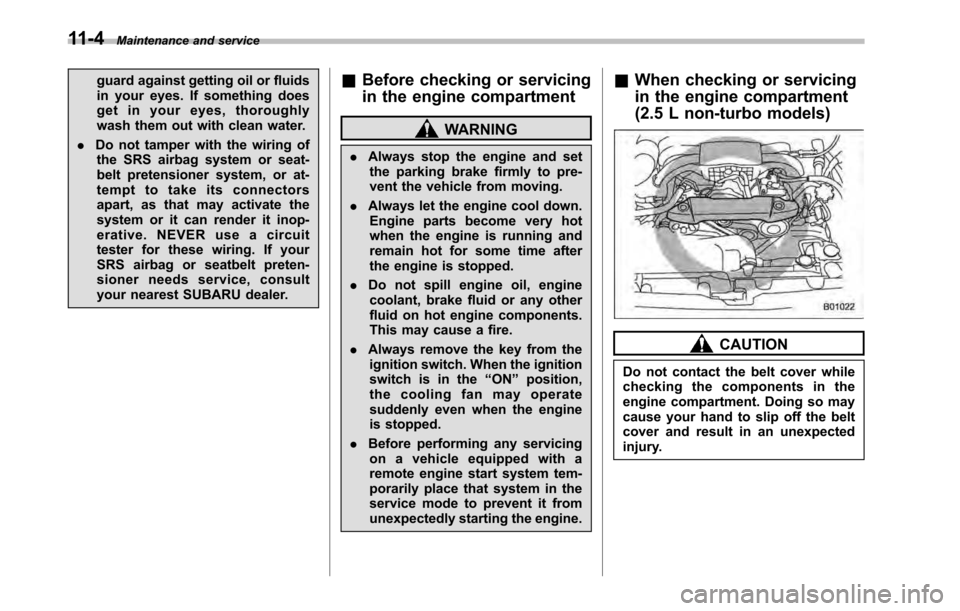
(2.5 L non-turbo models)
CAUTION
Do not contact the belt cover while
checking the components in the
engine compartment. Doing so may
cause your hand to slip off the belt
cover and result in an unexpected
injury.
Page 349 of 448
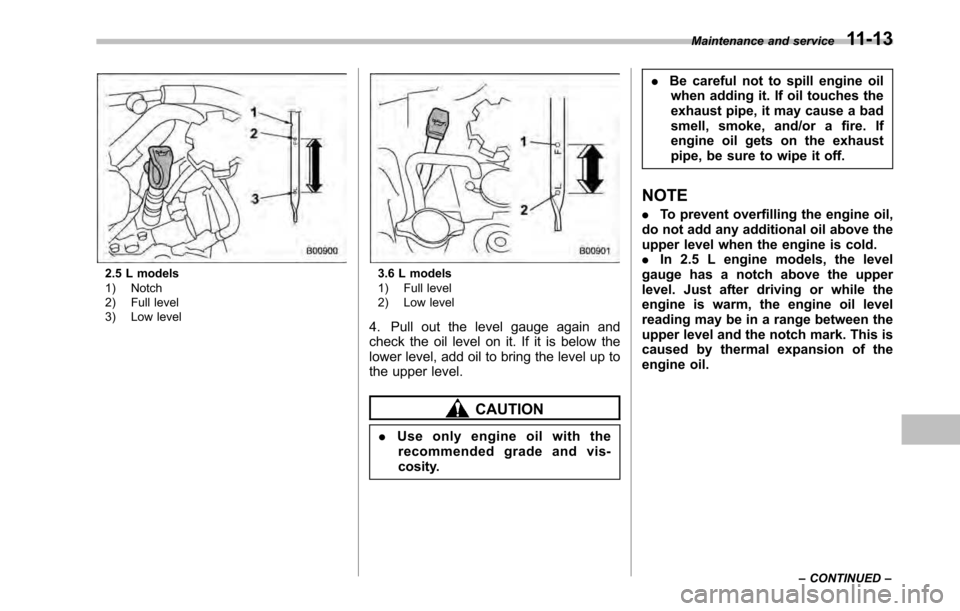
2.5 L models
1) Notch
2) Full level
3) Low level3.6 L models
1) Full level
2) Low level
4. Pull out the level gauge again and
check the oil level on it. If it is below the
lower level, add oil to bring the level up to
the upper level.
CAUTION
. Use only engine oil with the
recommended grade and vis-
cosity. .
Be careful not to spill engine oil
when adding it. If oil touches the
exhaust pipe, it may cause a bad
smell, smoke, and/or a fire. If
engine oil gets on the exhaust
pipe, be sure to wipe it off.
NOTE . To prevent overfilling the engine oil,
do not add any additional oil above the
upper level when the engine is cold.. In 2.5 L engine models, the level
gauge has a notch above the upper
level. Just after driving or while the
engine is warm, the engine oil level
reading may be in a range between the
upper level and the notch mark. This is
caused by thermal expansion of the
engine oil. Maintenance and service
11-13
– CONTINUED –
Page 357 of 448
&Replacing the air cleaner element
Replace the air cleaner element according
to the maintenance schedule in the“ Warranty and Maintenance Booklet ”. Un-
der extremely dusty conditions, replace it
more frequently. It is recommended that
you always use genuine SUBARU parts. ! Non-turbo models
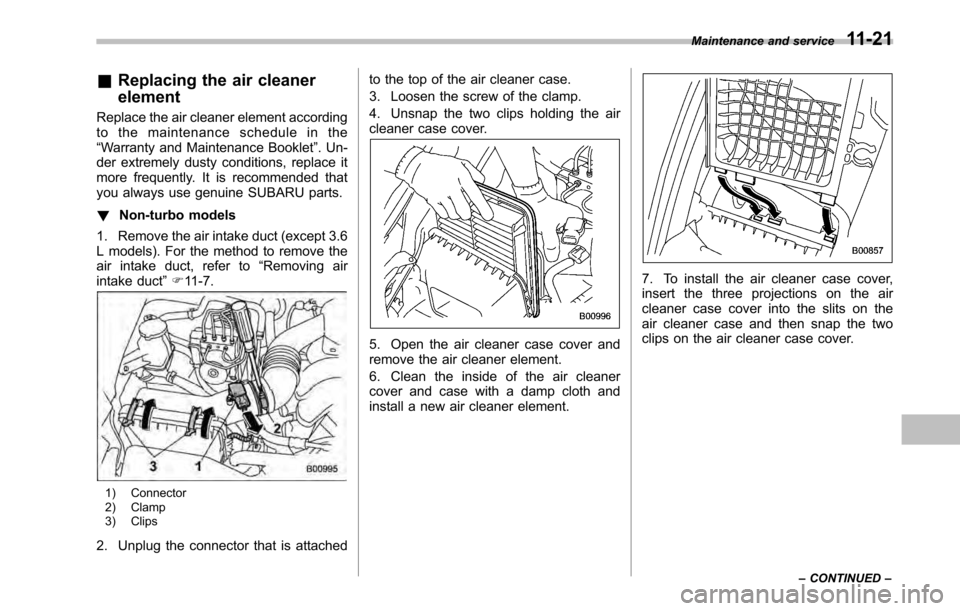
1. Remove the air intake duct (except 3.6
L models). For the method to remove the
air intake duct, refer to “Removing air
intake duct ”F 11-7.
1) Connector
2) Clamp
3) Clips
2. Unplug the connector that is attached to the top of the air cleaner case.
3. Loosen the screw of the clamp.
4. Unsnap the two clips holding the air
cleaner case cover.
5. Open the air cleaner case cover and
remove the air cleaner element.
6. Clean the inside of the air cleaner
cover and case with a damp cloth and
install a new air cleaner element.
7. To install the air cleaner case cover,
insert the three projections on the air
cleaner case cover into the slits on the
air cleaner case and then snap the two
clips on the air cleaner case cover.
Maintenance and service
11-21
– CONTINUED –
Page 358 of 448
11-22Maintenance and service
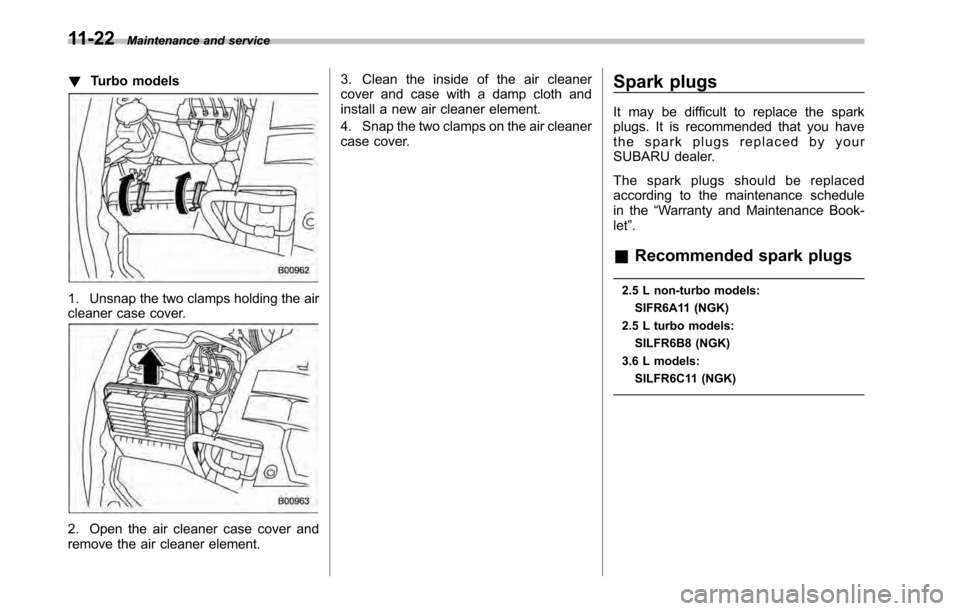
!Turbo models
1. Unsnap the two clamps holding the air
cleaner case cover.
2. Open the air cleaner case cover and
remove the air cleaner element. 3. Clean the inside of the air cleaner
cover and case with a damp cloth and
install a new air cleaner element.
4. Snap the two clamps on the air cleaner
case cover.
Spark plugs
It may be difficult to replace the spark
plugs. It is recommended that you have
the spark plugs replaced by your
SUBARU dealer.
The spark plugs should be replaced
according to the maintenance schedule
in the
“Warranty and Maintenance Book-
let ”.
& Recommended spark plugs
2.5 L non-turbo models: SIFR6A11 (NGK)
2.5 L turbo models: SILFR6B8 (NGK)
3.6 L models: SILFR6C11 (NGK)
Page 362 of 448

11-26Maintenance and service
Continuously variable trans-
mission fluid
There is no continuously variable trans-
mission fluid level gauge. It is unneces-
sary to check the continuously variable
transmission fluid level. However, if ne-
cessary, we recommend that you consult
your SUBARU dealer for inspection. Front differential gear oil
(AT and CVT models) &
Checking the oil level
NOTE
There are no differential oil level
gauges for CVT models.
1) Yellow handle
1. Park the vehicle on a level surface and
stop the engine.
2. Pull out the level gauge, wipe it clean,
and insert it again.
1) Upper level
2) Lower level
3. Pull out the level gauge again and
check the oil level on it. If it is below the
lower level, add oil to bring the level up to
the upper level.
CAUTION
Be careful not to spill front differ-
ential gear oil when adding it. If oil
touches the exhaust pipe, it may
cause a bad smell, smoke, and/or a
fire. If oil gets on the exhaust pipe,
be sure to wipe it off.
Page 363 of 448
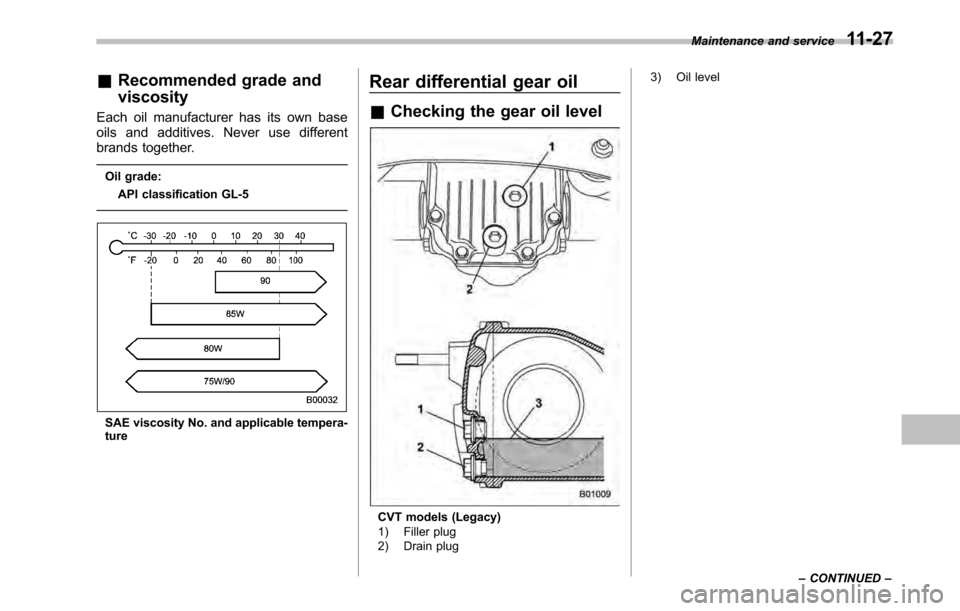
&Recommended grade and viscosity
Each oil manufacturer has its own base
oils and additives. Never use different
brands together.
Oil grade: API classification GL-5
SAE viscosity No. and applicable tempera- ture Rear differential gear oil &
Checking the gear oil level
CVT models (Legacy)
1) Filler plug
2) Drain plug 3) Oil level
Maintenance and service
11-27
– CONTINUED –
Page 364 of 448
11-28Maintenance and service
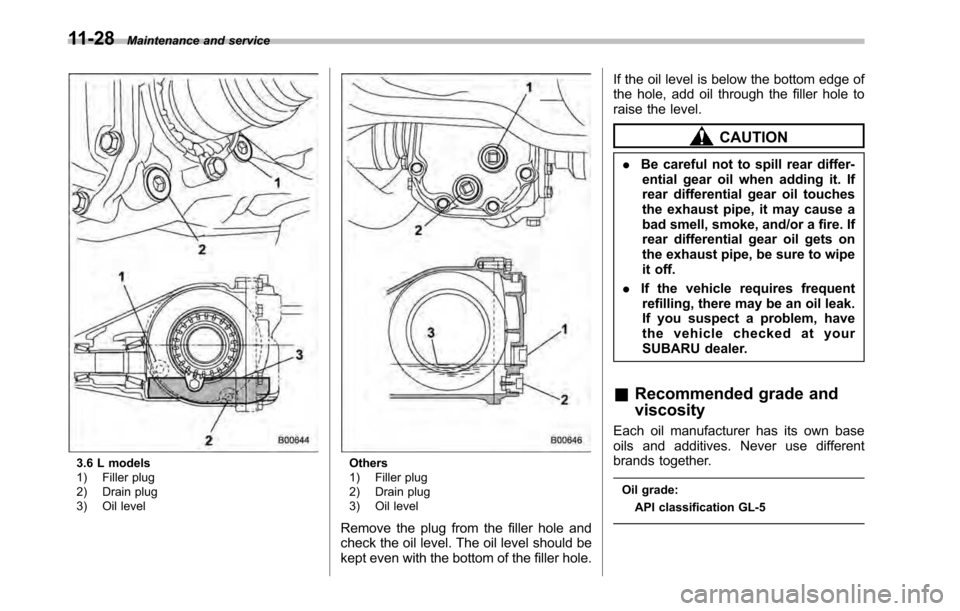
3.6 L models
1) Filler plug
2) Drain plug
3) Oil levelOthers
1) Filler plug
2) Drain plug
3) Oil level
Remove the plug from the filler hole and
check the oil level. The oil level should be
kept even with the bottom of the filler hole. If the oil level is below the bottom edge of
the hole, add oil through the filler hole to
raise the level.
CAUTION
. Be careful not to spill rear differ-
ential gear oil when adding it. If
rear differential gear oil touches
the exhaust pipe, it may cause a
bad smell, smoke, and/or a fire. If
rear differential gear oil gets on
the exhaust pipe, be sure to wipe
it off.
. If the vehicle requires frequent
refilling, there may be an oil leak.
If you suspect a problem, have
the vehicle checked at your
SUBARU dealer.
& Recommended grade and viscosity
Each oil manufacturer has its own base
oils and additives. Never use different
brands together.
Oil grade: API classification GL-5
Page 367 of 448
Check the fluid level on the outside of the
reservoir. If the level is below“MIN ”, add
the recommended brake fluid to “MAX ”.
Use only brake fluid from a sealed
container.
& Recommended brake fluid
FMVSS No. 116, fresh DOT 3 or 4 brake fluid
CAUTION
Never use different brands of brake
fluid together. Also, avoid mixing
DOT 3 and DOT 4 brake fluids even if
they are the same brand. Clutch fluid (MT models) &
Checking the fluid level
WARNING
Never let clutch fluid contact your
eyes because clutch fluid can be
harmful to your eyes. If clutch fluid
gets in your eyes, immediately flush
them thoroughly with clean water.
For safety, when performing this
work, wearing eye protection isadvisable.
CAUTION
. Clutch fluid absorbs moisture
from the air. Any absorbed moist-
ure can cause improper clutchoperation.
. If the vehicle requires frequent
refilling, there may be a leak. If
you suspect a problem, have the
vehicle checked at your SUBARU
dealer.
. Never use different brands of
clutch fluid together.
. When clutch fluid is added, be
careful not to allow any dirt into
the tank. .
Never splash the clutch fluid over
painted surfaces or rubber parts.
Alcohol contained in the clutch
fluid may damage them.
. Be careful not to spill clutch fluid
when adding it. If clutch fluid
touches the exhaust pipe, it may
cause a bad smell, smoke, and/or
a fire. If clutch fluid gets on the
exhaust pipe, be sure to wipe itoff.
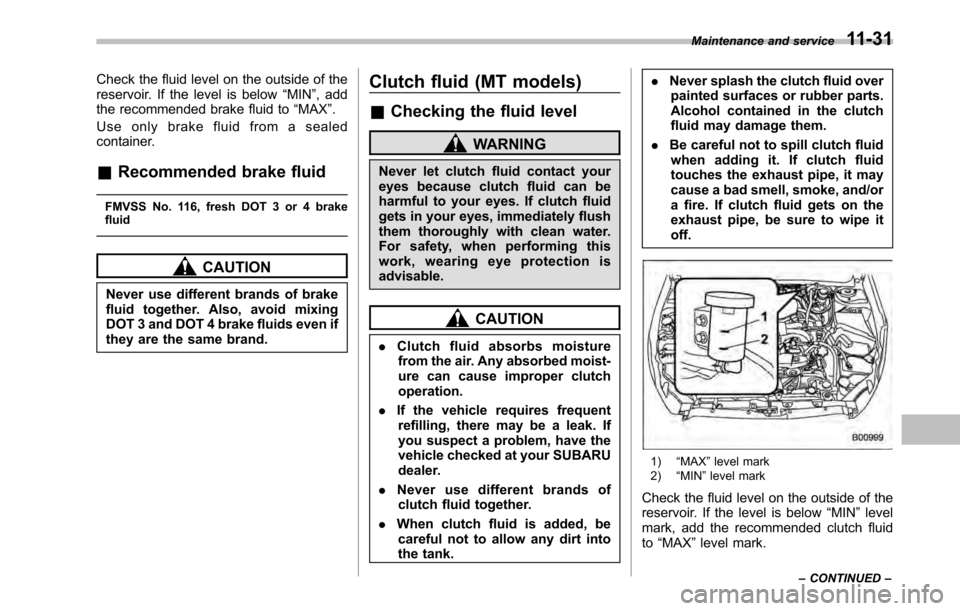
1) “MAX ”level mark
2) “MIN ”level mark
Check the fluid level on the outside of the
reservoir. If the level is below “MIN ”level
mark, add the recommended clutch fluidto “MAX ”level mark.
Maintenance and service
11-31
– CONTINUED –