Head rest SUBARU OUTBACK 2016 6.G User Guide
[x] Cancel search | Manufacturer: SUBARU, Model Year: 2016, Model line: OUTBACK, Model: SUBARU OUTBACK 2016 6.GPages: 572, PDF Size: 21.79 MB
Page 60 of 572
Seat, seatbelt and SRS airbags/Child restraint systems
THE CHILD BY PLACING THE
CHILD’SHEADTOOCLOSETO
THE SRS AIRBAG.
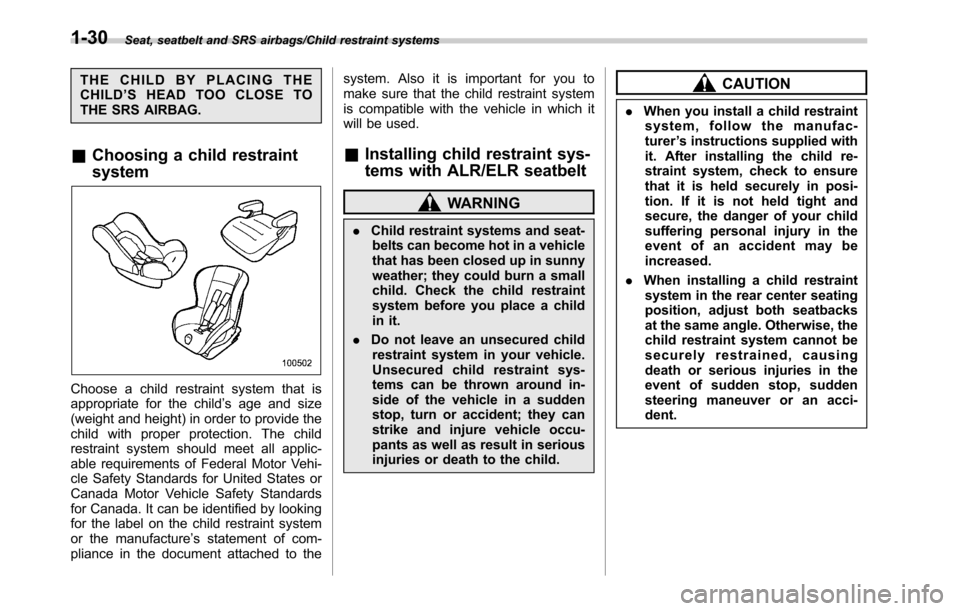
&Choosing a child restraint
system
Choose a child restraint system that is
appropriate for the child’s age and size
(weight and height) in order to provide the
child with proper protection. The child
restraint system should meet all applic-
able requirements of Federal Motor Vehi-
cle Safety Standards for United States or
Canada Motor Vehicle Safety Standards
for Canada. It can be identified by looking
for the label on the child restraint system
or the manufacture’s statement of com-
pliance in the document attached to thesystem. Also it is important for you to
make sure that the child restraint system
is compatible with the vehicle in which it
will be used.
&Installing child restraint sys-
tems with ALR/ELR seatbelt
WARNING
.Child restraint systems and seat-
belts can become hot in a vehicle
that has been closed up in sunny
weather; they could burn a small
child. Check the child restraint
system before you place a child
in it.
.Do not leave an unsecured child
restraint system in your vehicle.
Unsecured child restraint sys-
tems can be thrown around in-
side of the vehicle in a sudden
stop, turn or accident; they can
strike and injure vehicle occu-
pants as well as result in serious
injuries or death to the child.
CAUTION
.When you install a child restraint
system, follow the manufac-
turer’s instructions supplied with
it. After installing the child re-
straint system, check to ensure
that it is held securely in posi-
tion. If it is not held tight and
secure, the danger of your child
suffering personal injury in the
event of an accident may be
increased.
.When installing a child restraint
system in the rear center seating
position, adjust both seatbacks
at the same angle. Otherwise, the
child restraint system cannot be
securely restrained, causing
death or serious injuries in the
event of sudden stop, sudden
steering maneuver or an acci-
dent.
1-30
Page 62 of 572
Seat, seatbelt and SRS airbags/Child restraint systems
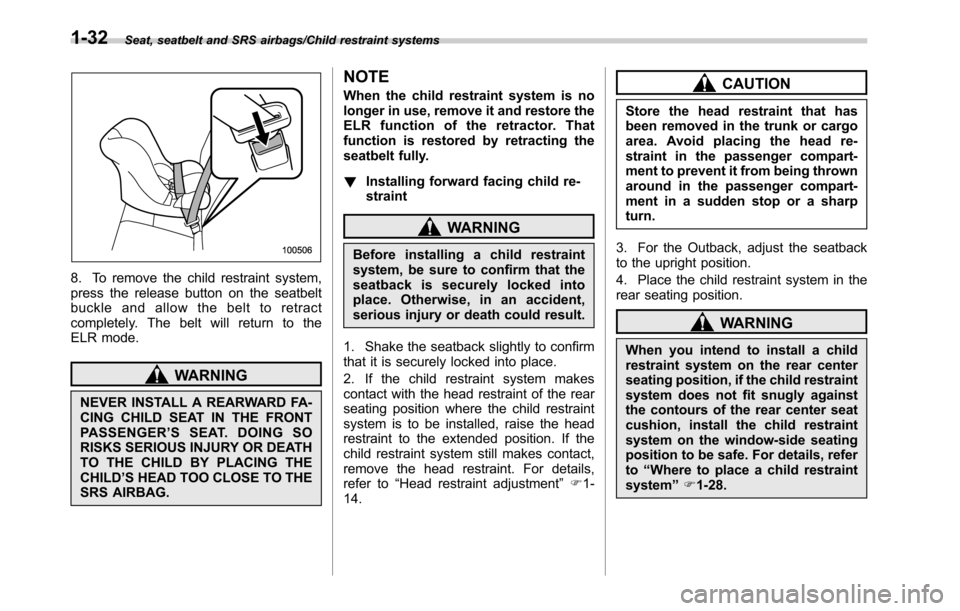
8. To remove the child restraint system,
press the release button on the seatbelt
buckle and allow the belt to retract
completely. The belt will return to the
ELR mode.
WARNING
NEVER INSTALL A REARWARD FA-
CING CHILD SEAT IN THE FRONT
PASSENGER’SSEAT.DOINGSO
RISKS SERIOUS INJURY OR DEATH
TO THE CHILD BY PLACING THE
CHILD’S HEAD TOO CLOSE TO THE
SRS AIRBAG.
NOTE
When the child restraint system is no
longer in use, remove it and restore the
ELR function of the retractor. That
function is restored by retracting the
seatbelt fully.
!Installing forward facing child re-
straint
WARNING
Before installing a child restraint
system, be sure to confirm that the
seatback is securely locked into
place. Otherwise, in an accident,
serious injury or death could result.
1. Shake the seatback slightly to confirm
that it is securely locked into place.
2. If the child restraint system makes
contact with the head restraint of the rear
seating position where the child restraint
system is to be installed, raise the head
restraint to the extended position. If the
child restraint system still makes contact,
remove the head restraint. For details,
refer to“Head restraint adjustment”F1-
14.
CAUTION
Store the head restraint that has
been removed in the trunk or cargo
area. Avoid placing the head re-
straint in the passenger compart-
ment to prevent it from being thrown
around in the passenger compart-
ment in a sudden stop or a sharp
turn.
3. For the Outback, adjust the seatback
to the upright position.
4. Place the child restraint system in the
rear seating position.
WARNING
When you intend to install a child
restraint system on the rear center
seating position, if the child restraint
system does not fit snugly against
the contours of the rear center seat
cushion, install the child restraint
system on the window-side seating
position to be safe. For details, refer
to“Where to place a child restraint
system”F1-28.
1-32
Page 69 of 572
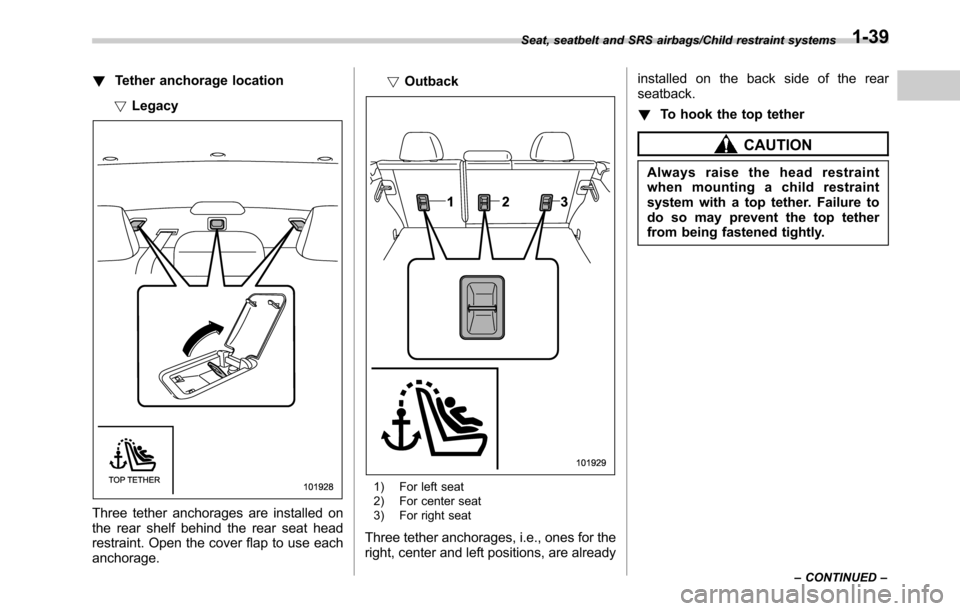
!Tether anchorage location
!Legacy
Three tether anchorages are installed on
the rear shelf behind the rear seat head
restraint. Open the cover flap to use each
anchorage.!Outback
1) For left seat
2) For center seat
3) For right seat
Three tether anchorages, i.e., ones for the
right, center and left positions, are alreadyinstalled on the back side of the rear
seatback.
!To hook the top tether
CAUTION
Always raise the head restraint
when mounting a child restraint
system with a top tether. Failure to
do so may prevent the top tether
from being fastened tightly.
Seat, seatbelt and SRS airbags/Child restraint systems
–CONTINUED–1-39
Page 70 of 572
Seat, seatbelt and SRS airbags/Child restraint systems
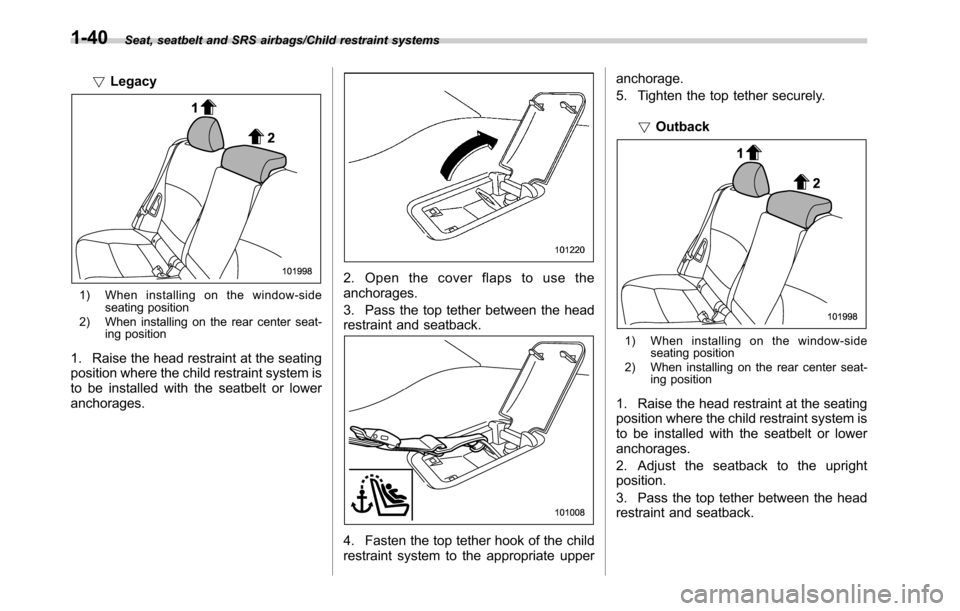
!Legacy
1) When installing on the window-side
seating position
2) When installing on the rear center seat-
ing position
1. Raise the head restraint at the seating
position where the child restraint system is
to be installed with the seatbelt or lower
anchorages.
2. Open the cover flaps to use the
anchorages.
3. Pass the top tether between the head
restraint and seatback.
4. Fasten the top tether hook of the child
restraint system to the appropriate upperanchorage.
5. Tighten the top tether securely.
!Outback
1) When installing on the window-side
seating position
2) When installing on the rear center seat-
ing position
1. Raise the head restraint at the seating
position where the child restraint system is
to be installed with the seatbelt or lower
anchorages.
2. Adjust the seatback to the upright
position.
3. Pass the top tether between the head
restraint and seatback.
1-40
Page 72 of 572
Seat, seatbelt and SRS airbags/*SRS airbag (Supplemental Restraint System airbag)
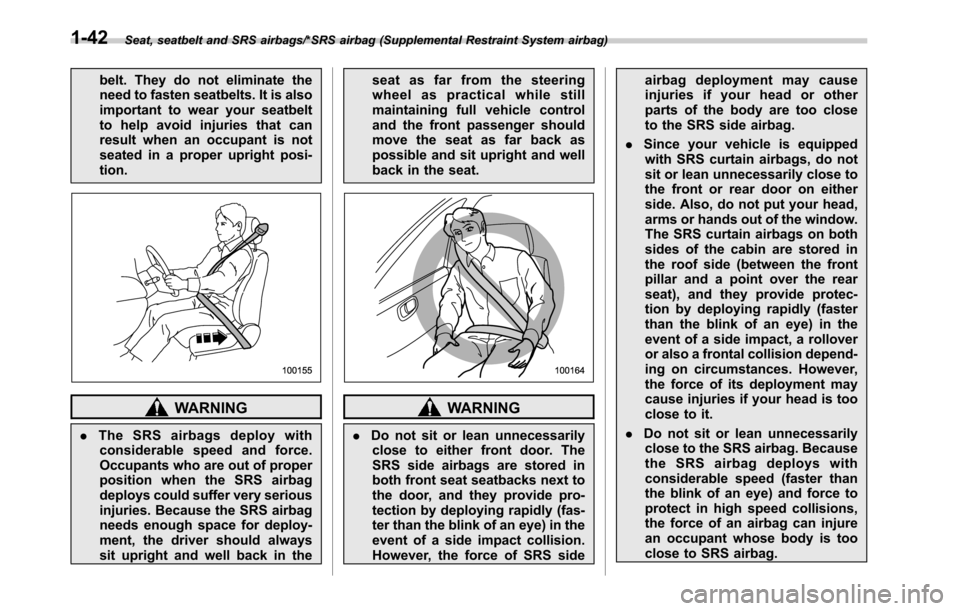
belt. They do not eliminate the
need to fasten seatbelts. It is also
important to wear your seatbelt
to help avoid injuries that can
result when an occupant is not
seated in a proper upright posi-
tion.
WARNING
.The SRS airbags deploy with
considerable speed and force.
Occupants who are out of proper
position when the SRS airbag
deploys could suffer very serious
injuries. Because the SRS airbag
needs enough space for deploy-
ment, the driver should always
sit upright and well back in theseat as far from the steering
wheel as practical while still
maintaining full vehicle control
and the front passenger should
move the seat as far back as
possible and sit upright and well
back in the seat.
WARNING
.Do not sit or lean unnecessarily
close to either front door. The
SRS side airbags are stored in
both front seat seatbacks next to
the door, and they provide pro-
tection by deploying rapidly (fas-
ter than the blink of an eye) in the
event of a side impact collision.
However, the force of SRS sideairbag deployment may cause
injuries if your head or other
parts of the body are too close
to the SRS side airbag.
.Since your vehicle is equipped
with SRS curtain airbags, do not
sit or lean unnecessarily close to
the front or rear door on either
side. Also, do not put your head,
arms or hands out of the window.
The SRS curtain airbags on both
sides of the cabin are stored in
the roof side (between the front
pillar and a point over the rear
seat), and they provide protec-
tion by deploying rapidly (faster
than the blink of an eye) in the
event of a side impact, a rollover
or also a frontal collision depend-
ing on circumstances. However,
the force of its deployment may
cause injuries if your head is too
close to it.
.Do not sit or lean unnecessarily
close to the SRS airbag. Because
the SRS airbag deploys with
considerable speed (faster than
the blink of an eye) and force to
protect in high speed collisions,
the force of an airbag can injure
an occupant whose body is too
close to SRS airbag.
1-42
Page 75 of 572
WARNING
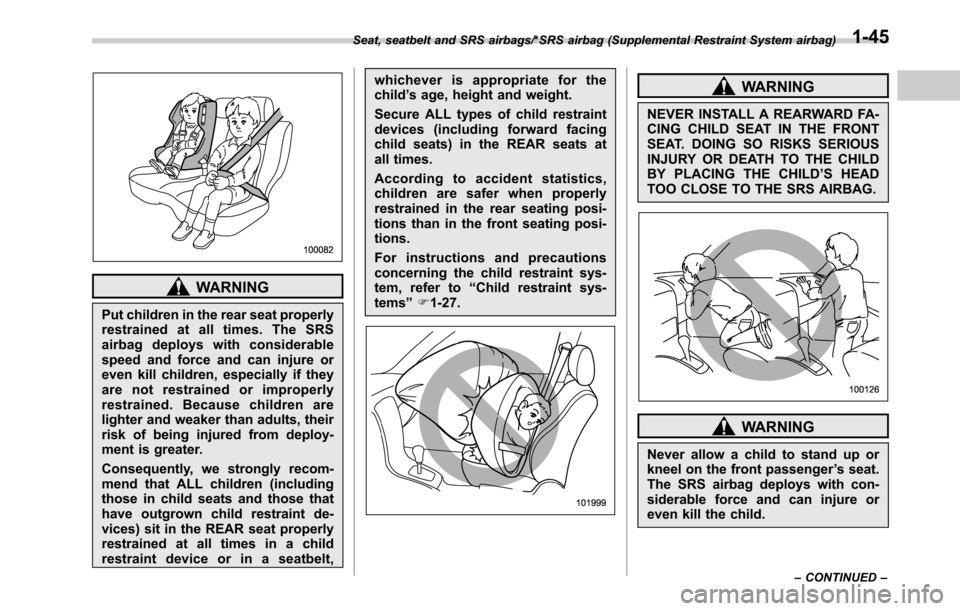
Put children in the rear seat properly
restrained at all times. The SRS
airbag deploys with considerable
speed and force and can injure or
even kill children, especially if they
are not restrained or improperly
restrained. Because children are
lighter and weaker than adults, their
risk of being injured from deploy-
ment is greater.
Consequently, we strongly recom-
mend that ALL children (including
those in child seats and those that
have outgrown child restraint de-
vices) sit in the REAR seat properly
restrained at all times in a child
restraint device or in a seatbelt,whichever is appropriate for the
child’s age, height and weight.
Secure ALL types of child restraint
devices (including forward facing
child seats) in the REAR seats at
all times.
According to accident statistics,
children are safer when properly
restrained in the rear seating posi-
tions than in the front seating posi-
tions.
For instructions and precautions
concerning the child restraint sys-
tem, refer to“Child restraint sys-
tems”F1-27.
WARNING
NEVER INSTALL A REARWARD FA-
CING CHILD SEAT IN THE FRONT
SEAT. DOING SO RISKS SERIOUS
INJURY OR DEATH TO THE CHILD
BY PLACING THE CHILD’S HEAD
TOO CLOSE TO THE SRS AIRBAG.
WARNING
Never allow a child to stand up or
kneel on the front passenger’s seat.
The SRS airbag deploys with con-
siderable force and can injure or
even kill the child.
Seat, seatbelt and SRS airbags/*SRS airbag (Supplemental Restraint System airbag)
–CONTINUED–1-45
Page 76 of 572
Seat, seatbelt and SRS airbags/*SRS airbag (Supplemental Restraint System airbag)
WARNING
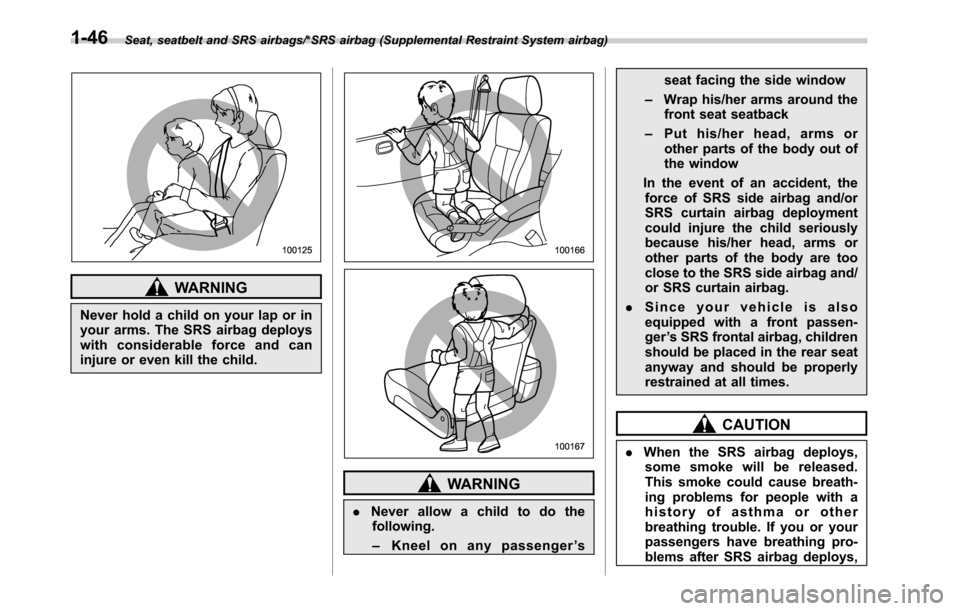
Never hold a child on your lap or in
your arms. The SRS airbag deploys
with considerable force and can
injure or even kill the child.
WARNING
.Never allow a child to do the
following.
–Kneel on any passenger’sseat facing the side window
–Wrap his/her arms around the
front seat seatback
–Put his/her head, arms or
other parts of the body out of
the window
In the event of an accident, the
force of SRS side airbag and/or
SRS curtain airbag deployment
could injure the child seriously
because his/her head, arms or
other parts of the body are too
close to the SRS side airbag and/
or SRS curtain airbag.
.Since your vehicle is also
equipped with a front passen-
ger’s SRS frontal airbag, children
should be placed in the rear seat
anyway and should be properly
restrained at all times.
CAUTION
.When the SRS airbag deploys,
some smoke will be released.
This smoke could cause breath-
ing problems for people with a
history of asthma or other
breathing trouble. If you or your
passengers have breathing pro-
blems after SRS airbag deploys,
1-46
Page 81 of 572

1) Curtain airbag sensor (rear wheel house
left-hand side)
2) Curtain airbag module (left-hand side)
3) Front door impact sensor (left-hand side)
4) Seatcushionairbagmodule(driver’s
side)
5) Curtain airbag module (right-hand side)
6) Seat cushion airbag module (front pas-
senger’s side)
7) Side airbag sensor (center pillar left-hand
side)
8) Seatbelt pretensioner (left-hand side)
9) Side airbag module (left-hand side)
10) Seatbelt buckle switch (left-hand side)
11) Seatbelt buckle switch (right-hand side)
12) Curtain airbag sensor (rear wheel house
right-hand side)
13) Side airbag module (right-hand side)
14) Seatbelt pretensioner (right-hand side)
15) Side airbag sensor (center pillar right-
hand side)
16) Front passenger’s occupant detection
system sensor and control module
17) Front door impact sensor (right-hand
side)
18) Front passenger’s seatbelt tension sen-
sor&SUBARU advanced frontal
airbag system, SRS seat
cushion airbag, SRS side
airbag and SRS curtain air-
bag
Your vehicle is equipped with a SUBARU
advanced frontal airbag system that com-
plies with the new advanced frontal airbag
requirements in the amended Federal
Motor Vehicle Safety Standard (FMVSS)
No. 208.
The SUBARU advanced frontal airbag
system automatically determines the de-
ployment force of the driver’s SRS frontal
airbag at the time of deployment as well as
whether or not to activate the front
passenger’s SRS frontal airbag and, if
activated, the deployment force of the
SRS frontal airbag at the time of deploy-
ment.
Your vehicle has warning labels on the
driver’s and front passenger’s sun visors
beginning with the phrase“EVEN WITH
ADVANCED AIR BAGS”and a tag
attached to the glove box lid beginning
with the phrase“Even with Advanced Air
Bags”. Make sure that you carefully read
the instructions on the warning labels and
tag.
Always wear your seatbelt. The SUBARU
advanced frontal airbag system is asupplemental restraint system and must
be used in combination with a seatbelt. All
occupants should wear a seatbelt or be
seated in an appropriate child restraint
system.
Your vehicle is equipped with a SUBARU
SRS curtain airbag system that complies
with the Federal Motor Vehicle Safety
Standard (FMVSS) No. 226.
For the locations of the SRS airbags, refer
to“Components”F1-48.
In a moderate to severe frontal collision,
the following components deploy.
.SRS frontal airbag for driver
.SRS frontal airbag for front passenger
.SRS seat cushion airbags
.SRS curtain airbag*
1
*1: When an offset frontal collision that is severe
enough to deploy the front airbag occurs.
These components supplement the seat-
belts by reducing the impact to the
occupant’s head and chest.
Inamoderatetoseveresideimpact
collision, the SRS side airbag on the
impacted side of the vehicle deploys
between the occupant and the door panel
and supplements the seatbelt by reducing
the impact to the occupant’s chest and
Seat, seatbelt and SRS airbags/*SRS airbag (Supplemental Restraint System airbag)
–CONTINUED–1-51
Page 82 of 572

Seat, seatbelt and SRS airbags/*SRS airbag (Supplemental Restraint System airbag)
waist.
In a moderate to severe side impact
collision, the SRS curtain airbag on the
impacted side of the vehicle deploys
between the occupant and the side
window and supplements the seatbelt by
reducing the impact to the occupant’s
head.
NOTE
The SRS side airbag and seatbelt
pretensioner are not controlled by the
SUBARU advanced frontal airbag sys-
tem.
!Driver’s SRS frontal airbag
The driver’s SRS frontal airbag uses a
dual stage inflator. The inflator operates in
different ways depending on the severity
of impact.
Have the system inspected by your
SUBARU dealer immediately if the SRS
airbag system warning light illuminates.
!Front passenger’s SRS frontal air-
bag
The front passenger’s SRS frontal airbag
uses a dual stage inflator. The inflator
operates in different ways depending on
the severity of impact.
The total load on the seat is monitored by
the passenger’s occupant detection sys-tem sensor located under the seat.
The system has another sensor that
monitors the tension of the front passen-
ger’s seatbelt. Using the total seat load
and seatbelt tension data from the sen-
sors, the occupant detection system de-
termines whether the front passenger’s
SRS frontal airbag should or should not be
inflated.
The occupant detection system may not
inflate the front passenger’s SRS frontal
airbag even when the driver’s SRS frontal
airbag deploys. This is normal.
CAUTION
Observe the following precautions.
Failure to do so may prevent the
SUBARU advanced frontal airbag
system from functioning correctly
or cause the system to fail.
.Do not apply any strong impact
to the front passenger’sseat
such as by kicking.
.Do not let rear passengers rest
their feet between the front seat-
back and seat cushion.
.Do not spill liquid on the front
passenger’s seat. If liquid is
spilled, wipe it off immediately.
.Do not remove or disassemblethe front passenger’s seat.
.Do not install any accessory
(such as an audio amplifier) other
than a genuine SUBARU acces-
sory under the front passenger’s
seat.
.Do not place anything (shoes,
umbrella, etc.) under the front
passenger’s seat.
.Do not use the front passenger’s
seat with the head restraint re-
moved.
.Do not leave any articles on the
front passenger’s seat or the
seatbelt tongue and buckle en-
gaged when you leave your ve-
hicle.
.Do not place a magnet near the
seatbelt buckle and the seatbelt
retractor.
.Do not use front seats with their
backward-forward position and
seatback not being locked into
place securely. If any of them are
not locked securely, adjust them
again. For adjusting procedure,
refer to“Manual seat”F1-4
(models equipped with manual
seats only).
If the seatbelt buckle switch and/or front
1-52
Page 88 of 572

Seat, seatbelt and SRS airbags/*SRS airbag (Supplemental Restraint System airbag)
the visible damage done to the vehicle
itself.
!Examples of accident in which
the driver’s/driver’s and front
passenger’s SRS frontal
airbag(s) will most likely deploy
A head-on collision against a thick con-
crete wall at a vehicle speed of 12 to 19
mph (20 to 30 km/h) or higher activates
only the driver’s SRS frontal airbag or both
driver’s and front passenger’s SRS frontal
airbags. The airbag(s) will also be acti-
vated when the vehicle is exposed to a
frontal impact similar in fashion and
magnitude to the collision described
above.!Examples of the types of acci-
dents in which it is possible that
the driver’s/driver’s and front
passenger’s SRS frontal
airbag(s) will deploy
Only the driver’s SRS frontal airbag orboth driver’s and front passenger’s SRS
frontal airbags may be activated when the
vehicle sustains a hard impact in the
undercarriage area from the road surface
(such as when the vehicle plunges into a
deep ditch, is severely impacted or
knocked hard against an obstacle on the
road such as a curb).
1-58