service indicator SUBARU OUTBACK 2016 6.G User Guide
[x] Cancel search | Manufacturer: SUBARU, Model Year: 2016, Model line: OUTBACK, Model: SUBARU OUTBACK 2016 6.GPages: 572, PDF Size: 21.79 MB
Page 469 of 572

Maintenance schedule....................................... 11-3
Maintenance precautions................................... 11-3
Before checking or servicing in the engine
compartment.................................................... 11-4
When checking or servicing in the engine
compartment (2.5 L models)............................. 11-5
When checking or servicing in the engine
compartment while the engine is running.......... 11-5
Maintenance tips................................................ 11-5Removing and reinstalling clips.......................... 11-5
Engine hood....................................................... 11-7
Engine compartment overview.......................... 11-9
2.5 L models...................................................... 11-9
3.6 L models.................................................... 11-10
Engine oil.......................................................... 11-11Engine oil consumption.................................... 11-11
Checking the oil level....................................... 11-11
Changing the oil and oil filter............................ 11-13
Recommended grade and viscosity.................. 11-13
Synthetic oil..................................................... 11-13
Cooling system................................................ 11-14
Cooling fan, hose and connections................... 11-14
Engine coolant................................................. 11-14
Air cleaner element.......................................... 11-15Replacing the air cleaner element..................... 11-15
Spark plugs...................................................... 11-18Recommended spark plugs.............................. 11-18
Drive belts........................................................ 11-18
Manual transmission oil.................................. 11-18
Recommended grade and viscosity.................. 11-18
Continuously variable transmission fluid...... 11-19
Front differential gear oil (CVT models) and
rear differential gear oil................................ 11-19
Recommended grade and viscosity.................. 11-19
Brake fluid........................................................ 11-19Checking the fluid level.................................... 11-19
Recommended brake fluid............................... 11-21
Clutch fluid (MT models)................................. 11-21Checking the fluid level.................................... 11-21
Recommended clutch fluid............................... 11-22
Brake booster.................................................. 11-22
Brake pedal...................................................... 11-22
Checking the brake pedal free play.................. 11-22
Checking the brake pedal reserve distance....... 11-23
Clutch pedal (MT models)............................... 11-23Checking the clutch function............................ 11-23
Checking the clutch pedal free play.................. 11-23
Replacement of brake pad.............................. 11-24Breaking-in of new brake pads ......................... 11-24
Tires and wheels.............................................. 11-24Types of tires................................................... 11-24
Tire pressure monitoring system (TPMS) (if
equipped)...................................................... 11-25
Tire inspection................................................. 11-26
Tire pressures and wear.................................. 11-27
Wheel balance................................................. 11-28
Wear indicators............................................... 11-29
Tire rotation direction mark.............................. 11-29
Tire rotation..................................................... 11-29
Tire replacement.............................................. 11-30
Maintenance and service
11
Page 472 of 572
Maintenance and service/Maintenance precautions
guard against getting oil or fluids
in your eyes. If something does
get in your eyes, thoroughly
wash them out with clean water.
.Do not tamper with the wiring of
the SRS airbag system or seat-
belt pretensioner system, or at-
tempt to take its connectors
apart, as that may activate the
system or it can render it inop-
erative. NEVER use a circuit
tester for these wiring. If your
SRS airbag or seatbelt preten-
sioner needs service, consult
your nearest SUBARU dealer.
NOTE
SUBARU does not endorse the use of
non-SUBARU approved flushing sys-
tems and strongly advises against
performing these services on a
SUBARU vehicle. Non-SUBARU ap-
proved flushing systems use chemi-
cals and/or solvents which have not
been tested or approved by SUBARU.
SUBARU warranties do not cover any
part of the vehicle which is damaged by
adding or applying chemicals and/or
solvents other than those approved or
recommended by SUBARU.
&Before checking or servicing
in the engine compartment
WARNING
.Always stop the engine and apply
the parking brake to prevent the
vehicle from moving.
.Always let the engine cool down.
Engine parts become very hot
when the engine is running and
remain hot for some time after
the engine is stopped.
.Do not spill engine oil, engine
coolant, brake fluid or any other
fluid on hot engine components.
This may cause a fire.
.When the ignition switch is in the
“ON”position, the cooling fan
may operate suddenly even
when the engine is stopped. If
your body or clothes come into
contact with a rotating fan, that
could result in serious injury. To
avoid risk of injury, perform the
following precautions.
–Models with push-button start
system:
Always turn the push-button
ignition switch to the“OFF”
position and confirm that theoperation indicator on the
switch is turned off. Then take
the access key out from the
vehicle.
–Models without push-button
start system:
Always remove the key from
the ignition switch.
.Before performing any servicing
on a vehicle equipped with a
remote engine start system tem-
porarily place that system in the
service mode to prevent it from
unexpectedly starting the engine.
11-4
Page 492 of 572
Maintenance and service/Replacement of brake pad
Replacement of brake pad
CAUTION
.If you continue to drive despite
the scraping noise from the audi-
ble brake pad wear indicator, it
will result in the need for costly
brake rotor repair or replace-
ment.
.It is recommended that you dis-
connect the vehicle battery be-
fore replacing the brake pad.
However, it is dangerous to dis-
connect the vehicle battery. We
recommend that you have your
SUBARU dealer replace the
brake pad.
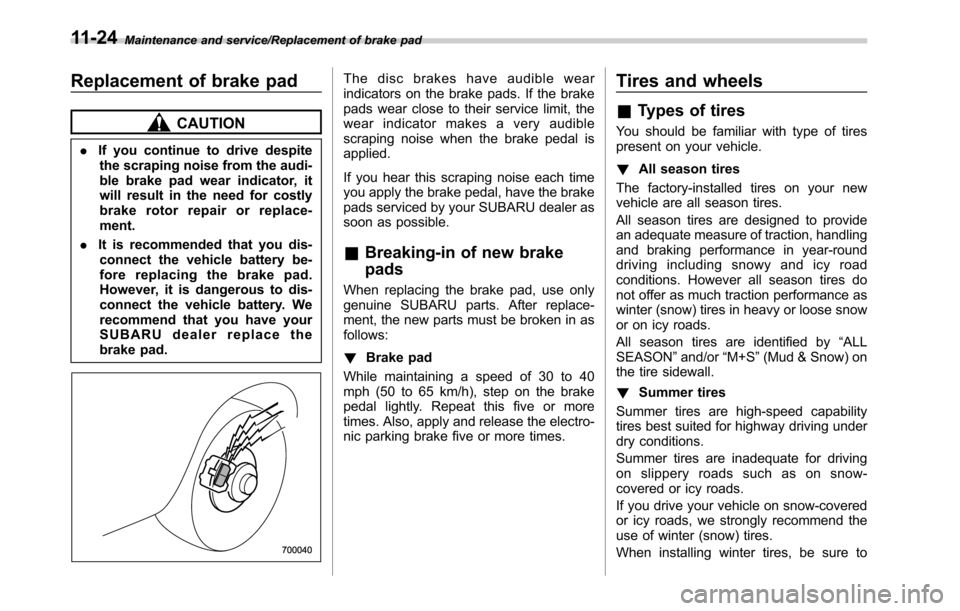
The disc brakes have audible wear
indicators on the brake pads. If the brake
pads wear close to their service limit, the
wear indicator makes a very audible
scraping noise when the brake pedal is
applied.
If you hear this scraping noise each time
you apply the brake pedal, have the brake
pads serviced by your SUBARU dealer as
soon as possible.
&Breaking-in of new brake
pads
When replacing the brake pad, use only
genuine SUBARU parts. After replace-
ment, the new parts must be broken in as
follows:
!Brake pad
While maintaining a speed of 30 to 40
mph (50 to 65 km/h), step on the brake
pedal lightly. Repeat this five or more
times. Also, apply and release the electro-
nic parking brake five or more times.
Tires and wheels
&Types of tires
You should be familiar with type of tires
present on your vehicle.
!All season tires
The factory-installed tires on your new
vehicle are all season tires.
All season tires are designed to provide
an adequate measure of traction, handling
and braking performance in year-round
driving including snowy and icy road
conditions. However all season tires do
not offer as much traction performance as
winter (snow) tires in heavy or loose snow
or on icy roads.
All season tires are identified by“ALL
SEASON”and/or“M+S”(Mud & Snow) on
the tire sidewall.
!Summer tires
Summer tires are high-speed capability
tires best suited for highway driving under
dry conditions.
Summer tires are inadequate for driving
on slippery roads such as on snow-
covered or icy roads.
If you drive your vehicle on snow-covered
or icy roads, we strongly recommend the
use of winter (snow) tires.
When installing winter tires, be sure to
11-24
Page 497 of 572
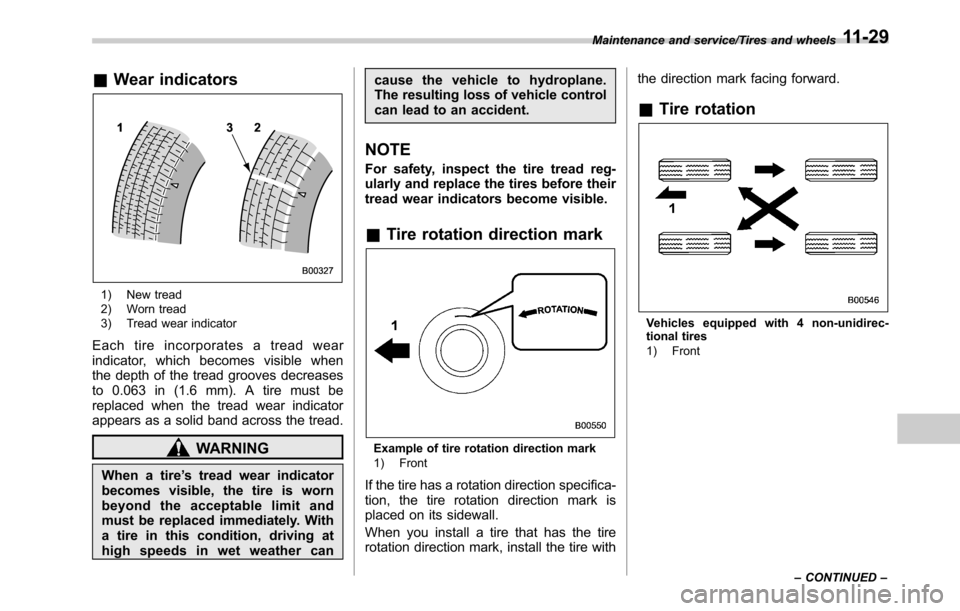
&Wear indicators
1) New tread
2) Worn tread
3) Tread wear indicator
Each tire incorporates a tread wear
indicator, which becomes visible when
the depth of the tread grooves decreases
to 0.063 in (1.6 mm). A tire must be
replaced when the tread wear indicator
appears as a solid band across the tread.
WARNING
When a tire’s tread wear indicator
becomes visible, the tire is worn
beyond the acceptable limit and
must be replaced immediately. With
a tire in this condition, driving at
high speeds in wet weather cancause the vehicle to hydroplane.
The resulting loss of vehicle control
can lead to an accident.
NOTE
For safety, inspect the tire tread reg-
ularly and replace the tires before their
tread wear indicators become visible.
&Tire rotation direction mark
Example of tire rotation direction mark
1) Front
If the tire has a rotation direction specifica-
tion, the tire rotation direction mark is
placed on its sidewall.
When you install a tire that has the tire
rotation direction mark, install the tire withthe direction mark facing forward.
&Tire rotation
Vehicles equipped with 4 non-unidirec-
tional tires
1) Front Maintenance and service/Tires and wheels
–CONTINUED–
11-29
Page 500 of 572
Maintenance and service/Windshield washer fluid
Windshield washer fluid
CAUTION
Never use engine coolant as washer
fluid because it could cause paint
damage.
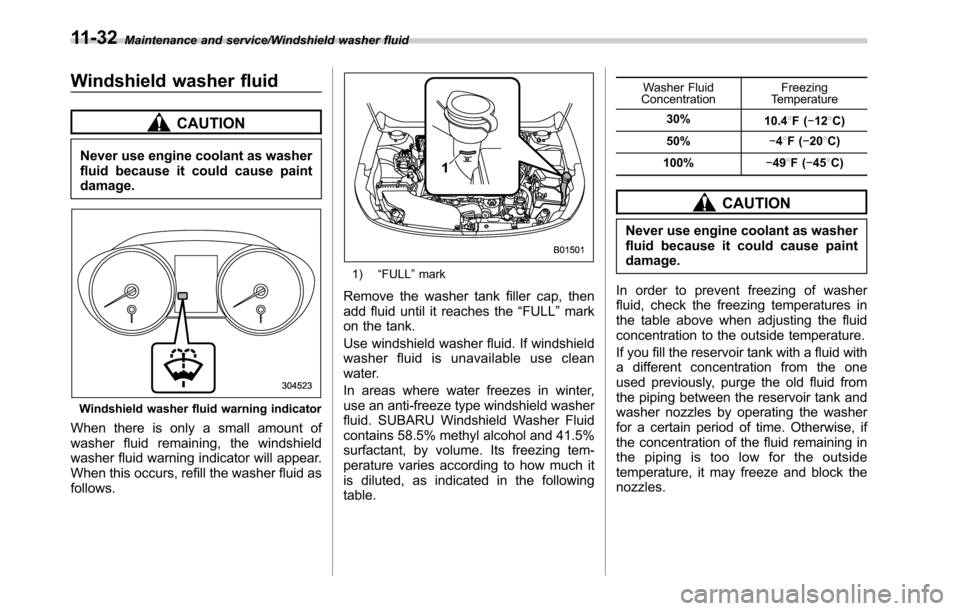
Windshield washer fluid warning indicator
When there is only a small amount of
washer fluid remaining, the windshield
washer fluid warning indicator will appear.
When this occurs, refill the washer fluid as
follows.
1)“FULL”mark
Remove the washer tank filler cap, then
add fluid until it reaches the“FULL”mark
on the tank.
Use windshield washer fluid. If windshield
washer fluid is unavailable use clean
water.
In areas where water freezes in winter,
use an anti-freeze type windshield washer
fluid. SUBARU Windshield Washer Fluid
contains 58.5% methyl alcohol and 41.5%
surfactant, by volume. Its freezing tem-
perature varies according to how much it
is diluted, as indicated in the following
table.
Washer Fluid
ConcentrationFreezing
Temperature
30%
10.48F(−128C)
50%−48F(−208C)
100%−498F(−458C)
CAUTION
Never use engine coolant as washer
fluid because it could cause paint
damage.
In order to prevent freezing of washer
fluid, check the freezing temperatures in
the table above when adjusting the fluid
concentration to the outside temperature.
If you fill the reservoir tank with a fluid with
a different concentration from the one
used previously, purge the old fluid from
the piping between the reservoir tank and
washer nozzles by operating the washer
for a certain period of time. Otherwise, if
the concentration of the fluid remaining in
the piping is too low for the outside
temperature, it may freeze and block the
nozzles.
11-32