Roof SUBARU OUTBACK 2016 6.G Owner's Manual
[x] Cancel search | Manufacturer: SUBARU, Model Year: 2016, Model line: OUTBACK, Model: SUBARU OUTBACK 2016 6.GPages: 572, PDF Size: 21.79 MB
Page 309 of 572
transferring contact data.Voice command system
The voice command system enables the
audio, hands-free phone system, etc. to
be operated using voice commands.
Refer to the“Command list”F5-84 for
samples of voice commands.
Voice commands can be used even when
you set the system to another language.
For details about setting language, refer to
“General settings”F5-20.
&Using the voice command
system
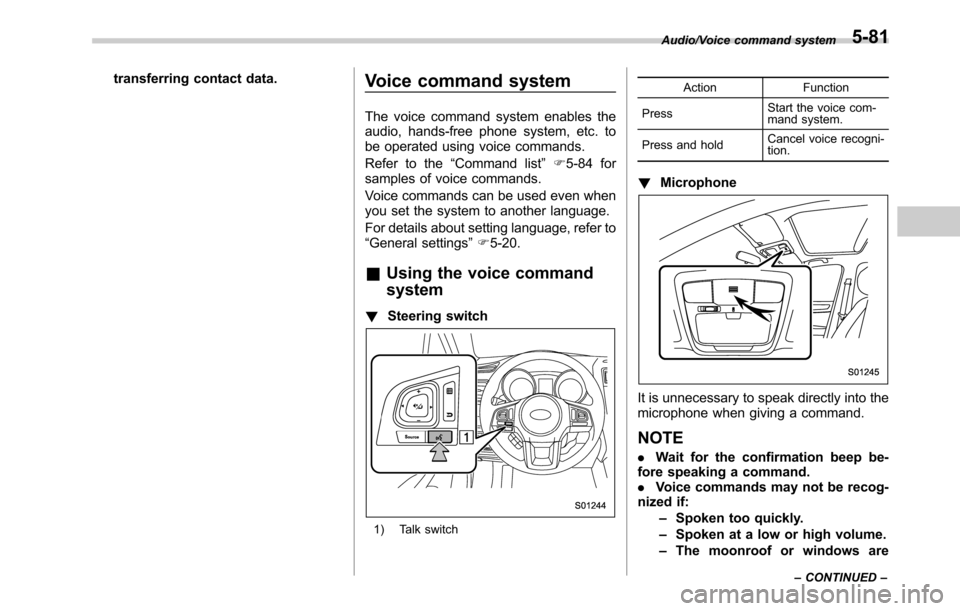
!Steering switch
1) Talk switchAction Function
PressStart the voice com-
mand system.
Press and holdCancel voice recogni-
tion.
!Microphone
It is unnecessary to speak directly into the
microphone when giving a command.
NOTE
.Wait for the confirmation beep be-
fore speaking a command.
.Voice commands may not be recog-
nized if:
–Spoken too quickly.
–Spoken at a low or high volume.
–The moonroof or windows are
Audio/Voice command system
–CONTINUED–5-81
Page 340 of 572
Interior equipment/Cargo area cover (Outback–if equipped)
&Stowage of the cargo area
cover
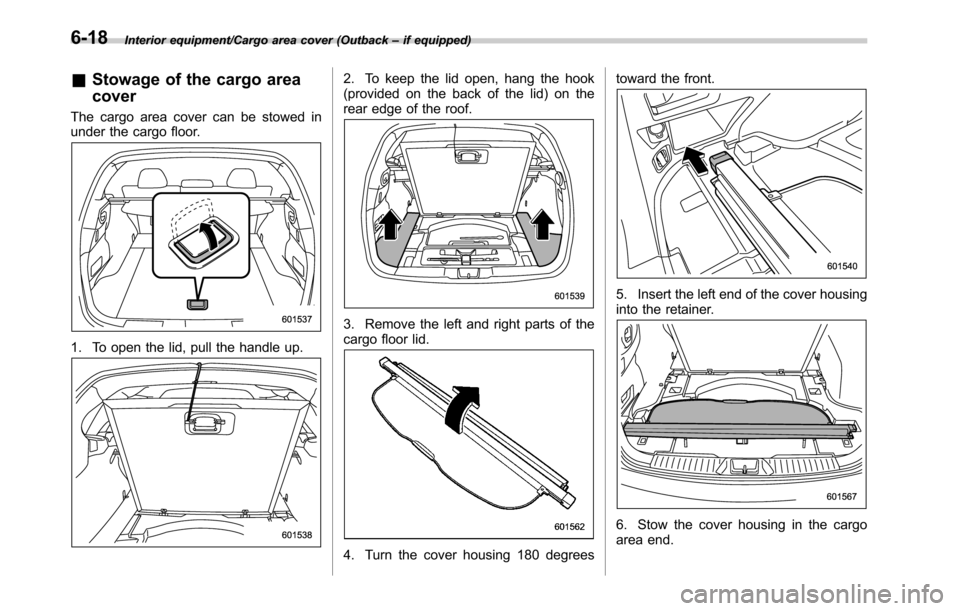
The cargo area cover can be stowed in
under the cargo floor.
1. To open the lid, pull the handle up.
2. To keep the lid open, hang the hook
(provided on the back of the lid) on the
rear edge of the roof.
3. Remove the left and right parts of the
cargo floor lid.
4. Turn the cover housing 180 degreestoward the front.
5. Insert the left end of the cover housing
into the retainer.
6. Stow the cover housing in the cargo
area end.
6-18
Page 342 of 572
Interior equipment/Under–floor storage compartment
storing recesses.Under-floor storage compart-
ment
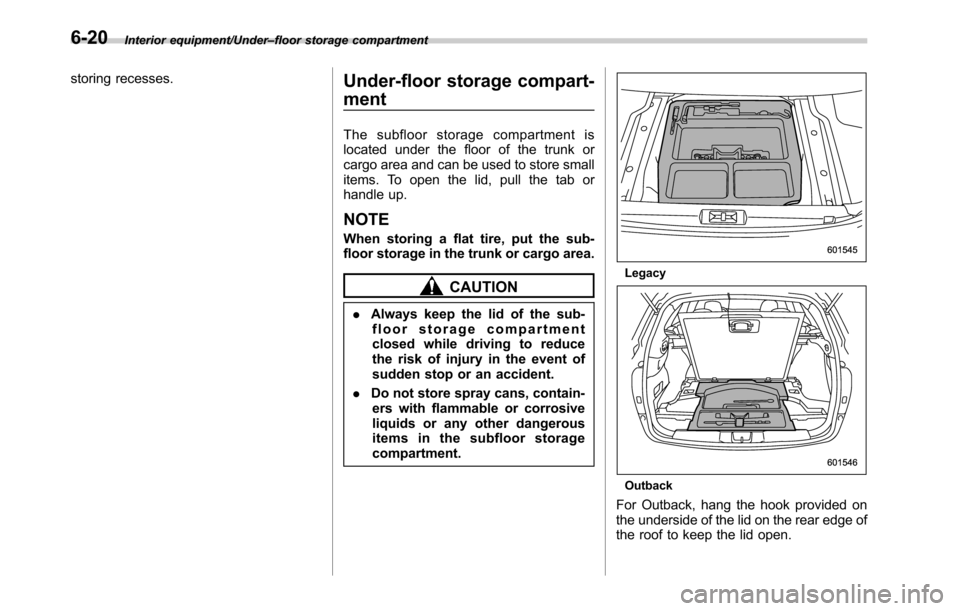
The subfloor storage compartment is
located under the floor of the trunk or
cargo area and can be used to store small
items. To open the lid, pull the tab or
handle up.
NOTE
When storing a flat tire, put the sub-
floor storage in the trunk or cargo area.
CAUTION
.Always keep the lid of the sub-
floor storage compartment
closed while driving to reduce
the risk of injury in the event of
sudden stop or an accident.
.Do not store spray cans, contain-
ers with flammable or corrosive
liquids or any other dangerous
items in the subfloor storage
compartment.
Legacy
Outback
For Outback, hang the hook provided on
the underside of the lid on the rear edge of
the roof to keep the lid open.
6-20
Page 411 of 572

New vehicle break-in driving–the first
1,000 miles (1,600 km)..................................... 8-2
Fuel economy hints............................................ 8-2
Engine exhaust gas (carbon monoxide)............ 8-2
Catalytic converter.............................................. 8-3
Periodic inspections........................................... 8-4
Driving in foreign countries............................... 8-4
Driving tips for AWD vehicles............................ 8-5
Off road driving................................................... 8-6
Legacy................................................................ 8-6
Outback.............................................................. 8-6
Winter driving...................................................... 8-8Operation during cold weather............................. 8-8
Driving on snowy and icy roads......................... 8-10
Corrosion protection.......................................... 8-11
Snow tires......................................................... 8-11
Tire chains......................................................... 8-12Rocking the vehicle........................................... 8-12
Loading your vehicle......................................... 8-12Vehicle capacity weight...................................... 8-13
GVWR and GAWR (Gross Vehicle Weight Rating
and Gross Axle Weight Rating)........................ 8-14
Roof rails with integrated crossbars
(Outback)........................................................ 8-14
Trailer hitch (Outback—if equipped).............. 8-18Connecting a trailer........................................... 8-19
If not towing a trailer.......................................... 8-20
Trailer towing (Legacy)...................................... 8-21
Trailer towing (Outback).................................... 8-21
Warranties and maintenance.............................. 8-21
Maximum load limits.......................................... 8-21
Trailer Hitches................................................... 8-25
Connecting a trailer........................................... 8-25
Trailer towing tips.............................................. 8-26
Driving tips
8
Page 417 of 572

.Continuously variable transmis-
sion fluid (CVT models)
.Front differential gear oil (CVT
models)
Remember that damage done to
your SUBARU while operating it
off-road and not using common
sense precautions such as those
listed above is not eligible for war-
ranty coverage.
Because of the AWD feature and higher
ground clearance, you can drive your
SUBARU on ordinary roads or off-road.
But please keep in mind that an AWD
SUBARU is a passenger car and is
neither a conventional off-road vehicle
nor an all-terrain vehicle. If you do take
your SUBARU off-road, certain common
sense precautions such as those in the
following list should be taken.
!Before driving
.Make certain that you and all of your
passengers are wearing seatbelts.
.Carry some emergency equipment,
such as a towing rope or chain, a shovel,
wheel blocks, first aid kit and cell phone or
citizens band radio.
.Secure all cargo carried inside the
vehicle and make certain that it is not
piled higher than the seatbacks. Duringsudden stops or jolts, unsecured cargo
could be thrown around in the vehicle and
cause injury. Do not pile heavy loads on
the roof. Those loads raise the vehicle’s
center of gravity and make it more prone
to tip over.
.Never equip your vehicle with tires
larger than those specified in this manual.
!During driving
General precautions:
.Drive carefully. Do not take unneces-
sary risks by driving in dangerous areas or
over rough terrain.
.Slow down and employ extra caution at
all times. When driving off-road, you will
not have the benefit of marked traffic
lanes, banked curves, traffic signs and
the like.
.Do not drive across steep slopes.
Instead, drive either straight up or straight
down the slopes. A vehicle can much
more easily tip over sideways than it can
end over end. Avoid driving straight up or
down slopes that are too steep.
.Avoid sharp turning maneuvers, espe-
cially at higher speeds.
.Do not grip the inside or spokes of the
steering wheel. A bad bump could jerk the
wheel and injure your hands. Instead,
drive with your fingers and thumbs on
the outside of the rim..Do not drive or park over or near
flammable materials such as dry grass or
fallen leaves, as they may burn easily. The
exhaust system is very hot while the
engine is running and right after the
engine stops. This could create a fire
hazard.
Precautions when driving under espe-
cially dangerous situations:
.If driving through water, such as when
crossing shallow streams, first check the
depth of the water and the bottom of the
stream bed for firmness and ensure that
the bed of the stream is flat. Drive slowly
and completely through the stream. The
water should be shallow enough that it
does not reach the vehicle’s undercar-
riage. Water entering the engine air intake
or the exhaust pipe or water splashing
onto electrical parts may damage your
vehicle and may cause it to stall. Never
attempt to drive through rushing water;
regardless of its depth, it can wash away
the ground from under your tires, resulting
in possible loss of traction and even
vehicle rollover.
.If you must rock the vehicle to free it
from sand or mud, depress the accelerator
pedal slightly and move the shift lever/
select lever back and forth between“1”/
“D”and“R”repeatedly. Do not race the
engine. For the best possible traction,
Driving tips/Off road driving
–CONTINUED–8-7
Page 423 of 572
possible.
.When you carry something inside
the vehicle, secure it whenever
you can to prevent it from being
thrown around inside the vehicle
during sudden stops, sharp turns
or in an accident.
.Do not pile heavy loads on the
roof. These loads raise the vehi-
cle’s center of gravity and make it
more prone to tip over.
.Secure long items properly to
prevent them from shooting for-
ward and causing serious injury
during a sudden stop.
.Never exceed the maximum load
limit. If you do, some parts on
your vehicle can break, or it can
change the way your vehicle
handles. This could result in loss
of control and cause personal
injury. Also, overloading can
shorten the life of your vehicle..Do not place anything on the rear
shelf behind the rear seatback
(Legacy) or the extended cargo
area cover (Outback–if
equipped). Such items could
tumble forward in the event of a
sudden stop or a collision. This
could cause serious injury.
CAUTION
Do not carry spray cans, containers
with flammable or corrosive liquids
or any other dangerous items inside
the vehicle.
NOTE
For better fuel economy, do not carry
unneeded cargo.
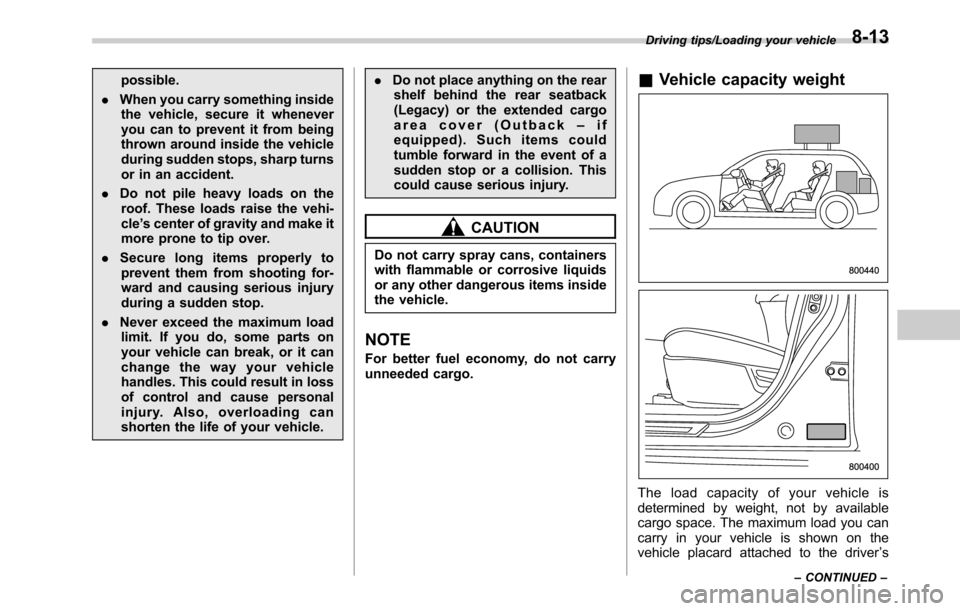
&Vehicle capacity weight
The load capacity of your vehicle is
determined by weight, not by available
cargo space. The maximum load you can
carry in your vehicle is shown on the
vehicle placard attached to the driver’s
Driving tips/Loading your vehicle
–CONTINUED–8-13
Page 424 of 572
Driving tips/Loading your vehicle
side door pillar. It includes the total weight
of the driver and all passengers and their
belongings, any optional equipment such
as a trailer hitch, roof rack or bike carrier,
etc., and the tongue load of a trailer.
&GVWR and GAWR (Gross
Vehicle Weight Rating and
Gross Axle Weight Rating)
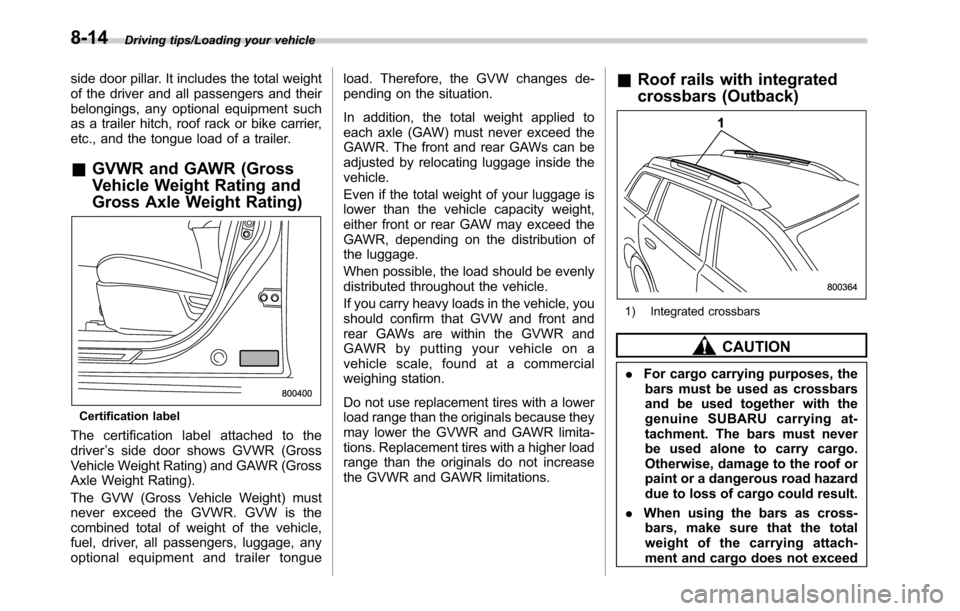
Certification label
The certification label attached to the
driver’s side door shows GVWR (Gross
Vehicle Weight Rating) and GAWR (Gross
Axle Weight Rating).
The GVW (Gross Vehicle Weight) must
never exceed the GVWR. GVW is the
combined total of weight of the vehicle,
fuel, driver, all passengers, luggage, any
optional equipment and trailer tongueload. Therefore, the GVW changes de-
pending on the situation.
In addition, the total weight applied to
each axle (GAW) must never exceed the
GAWR. The front and rear GAWs can be
adjusted by relocating luggage inside the
vehicle.
Even if the total weight of your luggage is
lower than the vehicle capacity weight,
either front or rear GAW may exceed the
GAWR, depending on the distribution of
the luggage.
When possible, the load should be evenly
distributed throughout the vehicle.
If you carry heavy loads in the vehicle, you
should confirm that GVW and front and
rear GAWs are within the GVWR and
GAWR by putting your vehicle on a
vehicle scale, found at a commercial
weighing station.
Do not use replacement tires with a lower
load range than the originals because they
may lower the GVWR and GAWR limita-
tions. Replacement tires with a higher load
range than the originals do not increase
the GVWR and GAWR limitations.
&Roof rails with integrated
crossbars (Outback)
1) Integrated crossbars
CAUTION
.For cargo carrying purposes, the
bars must be used as crossbars
and be used together with the
genuine SUBARU carrying at-
tachment. The bars must never
be used alone to carry cargo.
Otherwise, damage to the roof or
paint or a dangerous road hazard
due to loss of cargo could result.
.When using the bars as cross-
bars, make sure that the total
weight of the carrying attach-
ment and cargo does not exceed
8-14
Page 425 of 572

the maximum load limit. Over-
loading may cause damage to
the vehicle and create a safety
hazard.
The bars can be used as crossbars.
Cargo can be carried after setting the
bars as crossbarsand installing the
genuine SUBARU carrying attachment.
When you carry cargo on the roof using
the crossbars and a carrying attachment,
never exceed the maximum load limit
explained in the following. You should
also be careful that your vehicle does not
exceed the Gross Vehicle Weight Rating
(GVWR) and front and rear Gross Axle
Weight Rating (GAWR). For information
on loading cargo into or onto your vehicle,
refer to“Loading your vehicle”F8-12. The
maximum load limit of the cargo and
carrying attachment must not exceed the
allowable load limit described in the Own-
er’s Manual of a genuine SUBARU carry-
ing attachment. Place the heaviest load at
the bottom, nearest the roof, and evenly
distribute the cargo. Always properly
secure all cargo.!Installing carrying attachments on
the crossbars
When installing any carrying attachment
such as a bike carrier, ski carrier, kayak
carrier, cargo basket, etc. on the cross-
bars, follow the manufacturer’s instruc-
tions and make sure that the attachment is
securely fixed to the crossbars. Use only
attachments designed specifically for the
crossbars. A set of the crossbars is
designed to carry loads (cargo and attach-
ment) of not more than the allowable load
limit described in the Owner’s Manual of a
genuine SUBARU carrying attachment.
Before operating the vehicle, make sure
that the cargo is properly secured on the
attachment.
NOTE
.Remember that the vehicle’s center
of gravity is altered with the weight of
the load on the roof, thus affecting the
driving characteristics. Drive carefully,
avoid rapid starts, hard cornering and
abrupt stops. Crosswind effects will be
increased.
.Restore the bars to the original
position when the bars are not used
as crossbars.!How to use as crossbars
CAUTION
.Do not raise the bar higher than
necessary. The base of the bar
may be damaged.
.Be careful not to contact the bars
while sliding them. Otherwise,
the bars may be scratched or
the latch portions may be da-
maged.
.Do not slide the bar more than
necessary when sliding the bar.
The base of the bar may be
damaged.
.Do not allow the bar to fall on or
contact the roof panel or the
moonroof when sliding the bar.
Otherwise the roof panel may be
dented or the glass of the moon-
roof may be damaged.
Driving tips/Loading your vehicle
–CONTINUED–8-15
Page 426 of 572
Driving tips/Loading your vehicle
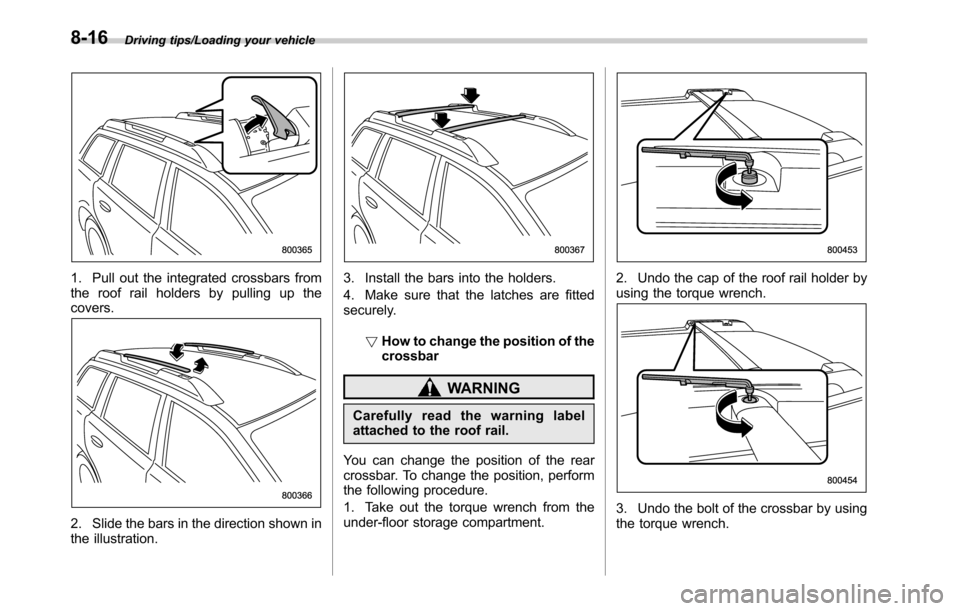
1. Pull out the integrated crossbars from
the roof rail holders by pulling up the
covers.
2. Slide the bars in the direction shown in
the illustration.
3. Install the bars into the holders.
4. Make sure that the latches are fitted
securely.
!How to change the position of the
crossbar
WARNING
Carefully read the warning label
attached to the roof rail.
You can change the position of the rear
crossbar. To change the position, perform
the following procedure.
1. Take out the torque wrench from the
under-floor storage compartment.
2. Undo the cap of the roof rail holder by
using the torque wrench.
3. Undo the bolt of the crossbar by using
the torque wrench.
8-16
Page 427 of 572
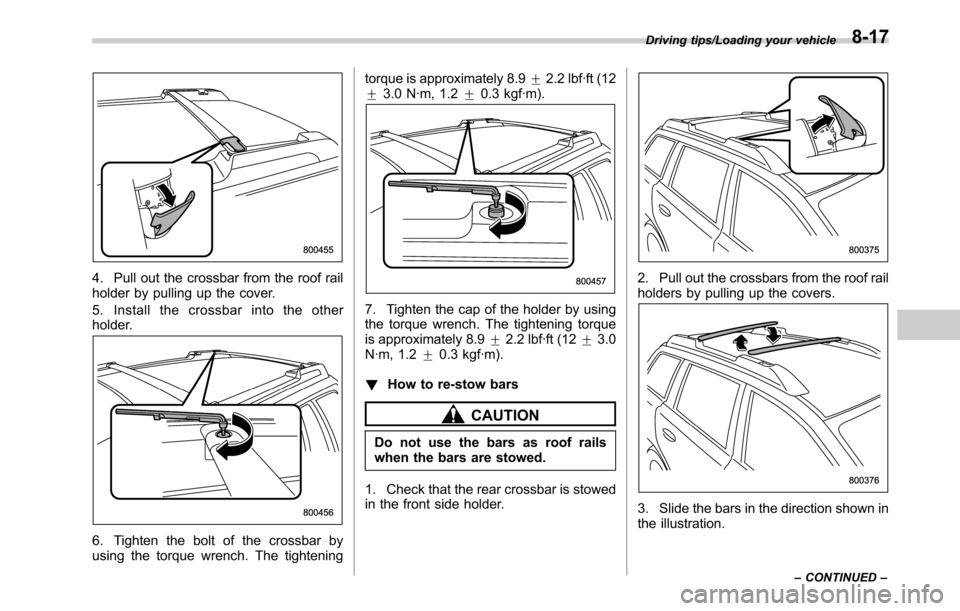
4. Pull out the crossbar from the roof rail
holder by pulling up the cover.
5. Install the crossbar into the other
holder.
6. Tighten the bolt of the crossbar by
using the torque wrench. The tighteningtorque is approximately 8.9+2.2 lbf·ft (12
+3.0 N·m, 1.2+0.3 kgf·m).
7. Tighten the cap of the holder by using
the torque wrench. The tightening torque
is approximately 8.9+2.2 lbf·ft (12+3.0
N·m, 1.2+0.3 kgf·m).
!How to re-stow bars
CAUTION
Do not use the bars as roof rails
when the bars are stowed.
1. Check that the rear crossbar is stowed
in the front side holder.
2. Pull out the crossbars from the roof rail
holders by pulling up the covers.
3. Slide the bars in the direction shown in
the illustration.
Driving tips/Loading your vehicle
–CONTINUED–8-17