check engine SUBARU OUTBACK 2016 6.G Service Manual
[x] Cancel search | Manufacturer: SUBARU, Model Year: 2016, Model line: OUTBACK, Model: SUBARU OUTBACK 2016 6.GPages: 572, PDF Size: 21.79 MB
Page 469 of 572
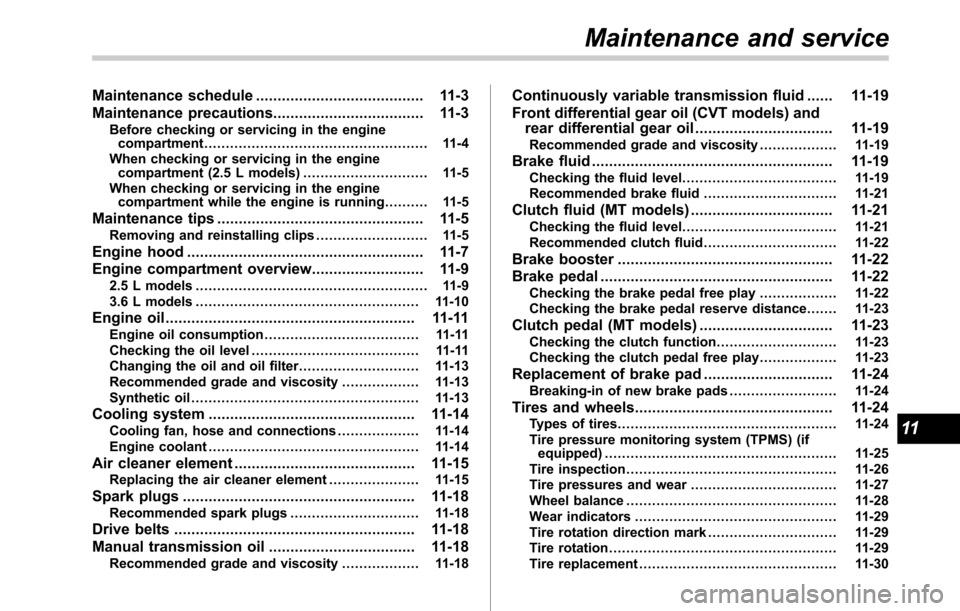
Maintenance schedule....................................... 11-3
Maintenance precautions................................... 11-3
Before checking or servicing in the engine
compartment.................................................... 11-4
When checking or servicing in the engine
compartment (2.5 L models)............................. 11-5
When checking or servicing in the engine
compartment while the engine is running.......... 11-5
Maintenance tips................................................ 11-5Removing and reinstalling clips.......................... 11-5
Engine hood....................................................... 11-7
Engine compartment overview.......................... 11-9
2.5 L models...................................................... 11-9
3.6 L models.................................................... 11-10
Engine oil.......................................................... 11-11Engine oil consumption.................................... 11-11
Checking the oil level....................................... 11-11
Changing the oil and oil filter............................ 11-13
Recommended grade and viscosity.................. 11-13
Synthetic oil..................................................... 11-13
Cooling system................................................ 11-14
Cooling fan, hose and connections................... 11-14
Engine coolant................................................. 11-14
Air cleaner element.......................................... 11-15Replacing the air cleaner element..................... 11-15
Spark plugs...................................................... 11-18Recommended spark plugs.............................. 11-18
Drive belts........................................................ 11-18
Manual transmission oil.................................. 11-18
Recommended grade and viscosity.................. 11-18
Continuously variable transmission fluid...... 11-19
Front differential gear oil (CVT models) and
rear differential gear oil................................ 11-19
Recommended grade and viscosity.................. 11-19
Brake fluid........................................................ 11-19Checking the fluid level.................................... 11-19
Recommended brake fluid............................... 11-21
Clutch fluid (MT models)................................. 11-21Checking the fluid level.................................... 11-21
Recommended clutch fluid............................... 11-22
Brake booster.................................................. 11-22
Brake pedal...................................................... 11-22
Checking the brake pedal free play.................. 11-22
Checking the brake pedal reserve distance....... 11-23
Clutch pedal (MT models)............................... 11-23Checking the clutch function............................ 11-23
Checking the clutch pedal free play.................. 11-23
Replacement of brake pad.............................. 11-24Breaking-in of new brake pads ......................... 11-24
Tires and wheels.............................................. 11-24Types of tires................................................... 11-24
Tire pressure monitoring system (TPMS) (if
equipped)...................................................... 11-25
Tire inspection................................................. 11-26
Tire pressures and wear.................................. 11-27
Wheel balance................................................. 11-28
Wear indicators............................................... 11-29
Tire rotation direction mark.............................. 11-29
Tire rotation..................................................... 11-29
Tire replacement.............................................. 11-30
Maintenance and service
11
Page 472 of 572
Maintenance and service/Maintenance precautions
guard against getting oil or fluids
in your eyes. If something does
get in your eyes, thoroughly
wash them out with clean water.
.Do not tamper with the wiring of
the SRS airbag system or seat-
belt pretensioner system, or at-
tempt to take its connectors
apart, as that may activate the
system or it can render it inop-
erative. NEVER use a circuit
tester for these wiring. If your
SRS airbag or seatbelt preten-
sioner needs service, consult
your nearest SUBARU dealer.
NOTE
SUBARU does not endorse the use of
non-SUBARU approved flushing sys-
tems and strongly advises against
performing these services on a
SUBARU vehicle. Non-SUBARU ap-
proved flushing systems use chemi-
cals and/or solvents which have not
been tested or approved by SUBARU.
SUBARU warranties do not cover any
part of the vehicle which is damaged by
adding or applying chemicals and/or
solvents other than those approved or
recommended by SUBARU.
&Before checking or servicing
in the engine compartment
WARNING
.Always stop the engine and apply
the parking brake to prevent the
vehicle from moving.
.Always let the engine cool down.
Engine parts become very hot
when the engine is running and
remain hot for some time after
the engine is stopped.
.Do not spill engine oil, engine
coolant, brake fluid or any other
fluid on hot engine components.
This may cause a fire.
.When the ignition switch is in the
“ON”position, the cooling fan
may operate suddenly even
when the engine is stopped. If
your body or clothes come into
contact with a rotating fan, that
could result in serious injury. To
avoid risk of injury, perform the
following precautions.
–Models with push-button start
system:
Always turn the push-button
ignition switch to the“OFF”
position and confirm that theoperation indicator on the
switch is turned off. Then take
the access key out from the
vehicle.
–Models without push-button
start system:
Always remove the key from
the ignition switch.
.Before performing any servicing
on a vehicle equipped with a
remote engine start system tem-
porarily place that system in the
service mode to prevent it from
unexpectedly starting the engine.
11-4
Page 473 of 572
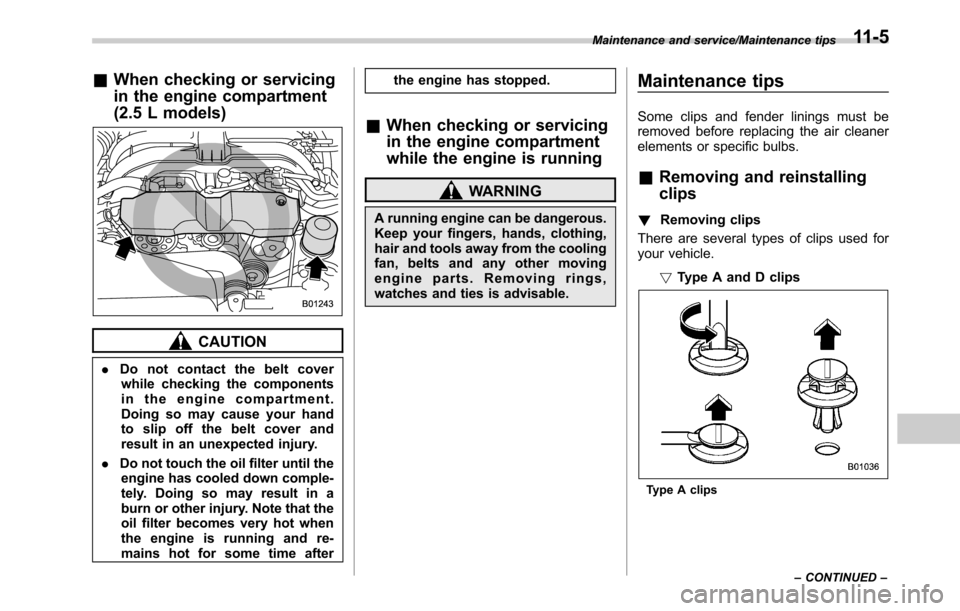
&When checking or servicing
in the engine compartment
(2.5 L models)
CAUTION
.Do not contact the belt cover
while checking the components
in the engine compartment.
Doing so may cause your hand
to slip off the belt cover and
result in an unexpected injury.
.Do not touch the oil filter until the
engine has cooled down comple-
tely. Doing so may result in a
burn or other injury. Note that the
oil filter becomes very hot when
the engine is running and re-
mains hot for some time afterthe engine has stopped.
&When checking or servicing
in the engine compartment
while the engine is running
WARNING
A running engine can be dangerous.
Keep your fingers, hands, clothing,
hair and tools away from the cooling
fan, belts and any other moving
engine parts. Removing rings,
watches and ties is advisable.
Maintenance tips
Some clips and fender linings must be
removed before replacing the air cleaner
elements or specific bulbs.
&Removing and reinstalling
clips
!Removing clips
There are several types of clips used for
your vehicle.
!Type A and D clips
Type A clips Maintenance and service/Maintenance tips
–CONTINUED–
11-5
Page 476 of 572
Maintenance and service/Engine hood
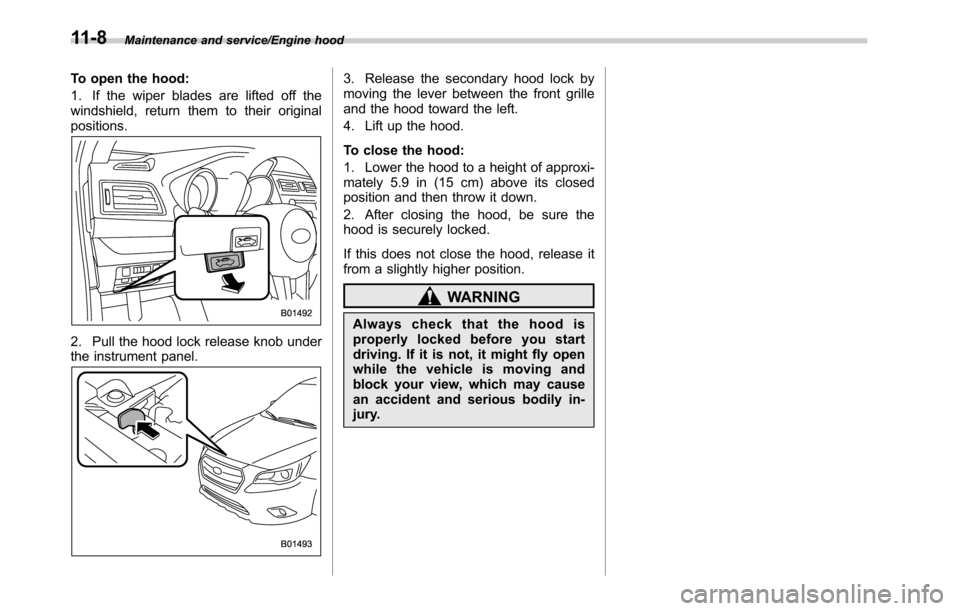
To open the hood:
1. If the wiper blades are lifted off the
windshield, return them to their original
positions.
2. Pull the hood lock release knob under
the instrument panel.
3. Release the secondary hood lock by
moving the lever between the front grille
and the hood toward the left.
4. Lift up the hood.
To close the hood:
1. Lower the hood to a height of approxi-
mately 5.9 in (15 cm) above its closed
position and then throw it down.
2. After closing the hood, be sure the
hood is securely locked.
If this does not close the hood, release it
from a slightly higher position.
WARNING
Always check that the hood is
properly locked before you start
driving. If it is not, it might fly open
while the vehicle is moving and
block your view, which may cause
an accident and serious bodily in-
jury.
11-8
Page 479 of 572
Engine oil
CAUTION
.If the level gauge is not pulled out
easily, twist the level gauge right
and left, then pull it out. Other-
wise, you may be injured acci-
dentally straining yourself.
.Use only engine oil with the
recommended grade and vis-
cosity.
.Be careful not to spill engine oil
when adding it. If oil touches the
exhaust pipe, it may cause a bad
smell, smoke, and/or a fire. If
engine oil gets on the exhaust
pipe, be sure to wipe it off.
&Engine oil consumption
Some engine oil will be consumed while
driving. Under the following conditions, oil
consumption can be increased and thus
require refilling between maintenance
intervals:
.When the engine is new and within the
break-in period
.When the engine oil is of lower quality
.When the incorrect oil viscosity is used.When engine braking is employed
.When the engine is operated at high
engine speeds
.When the engine is operated under
heavy loads
.When towing a trailer
.When the engine idles for long periods
of time
.When the vehicle is operated in stop
and go and/or heavy traffic situations
.When the vehicle is used under severe
thermal conditions
.When the vehicle accelerates and
decelerates frequently
Under these or similar conditions, you
should check your oil at least every 2nd
fuel fill-up and change your engine oil
more frequently. If your oil consumption
rate is greater than 1 quart every 1,200
miles or 1 liter every 2,000 kilometers,
contact your SUBARU dealer who may
perform a test under controlled conditions.
&Checking the oil level
1. Park the vehicle on a level surface and
stop the engine. If you check the oil level
just after stopping the engine, wait a few
minutes for the oil to drain back into the oil
pan before checking the level.
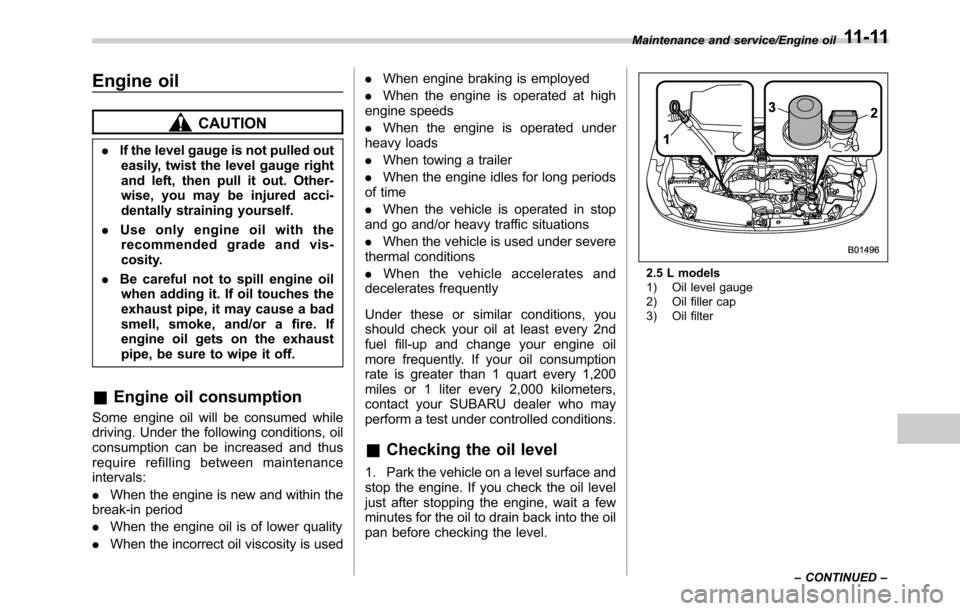
2.5 L models
1) Oil level gauge
2) Oil filler cap
3) Oil filter Maintenance and service/Engine oil
–CONTINUED–
11-11
Page 480 of 572
Maintenance and service/Engine oil
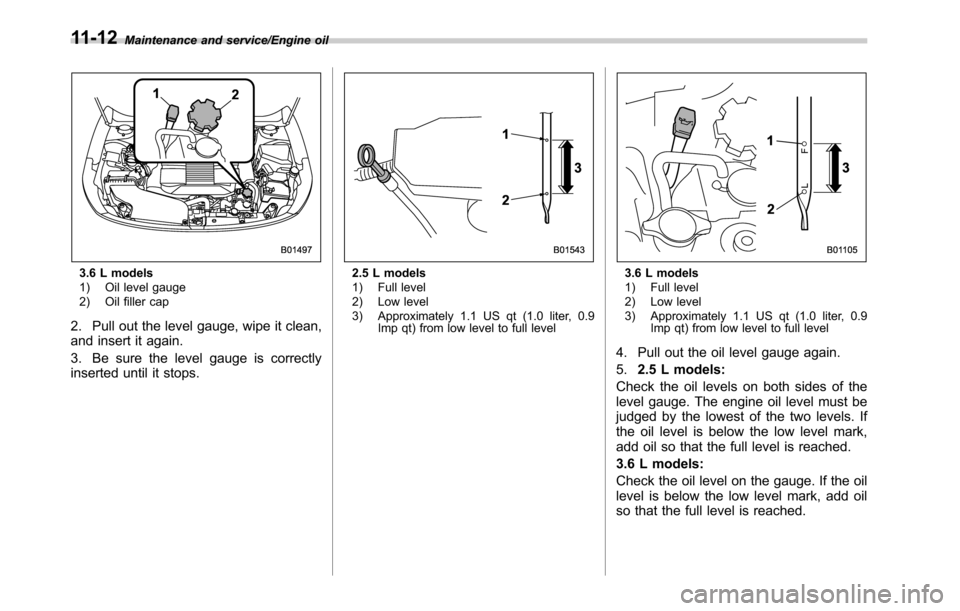
3.6 L models
1) Oil level gauge
2) Oil filler cap
2. Pull out the level gauge, wipe it clean,
and insert it again.
3. Be sure the level gauge is correctly
inserted until it stops.
2.5 L models
1) Full level
2) Low level
3) Approximately 1.1 US qt (1.0 liter, 0.9
Imp qt) from low level to full level3.6 L models
1) Full level
2) Low level
3) Approximately 1.1 US qt (1.0 liter, 0.9
Imp qt) from low level to full level
4. Pull out the oil level gauge again.
5.2.5 L models:
Check the oil levels on both sides of the
level gauge. The engine oil level must be
judged by the lowest of the two levels. If
the oil level is below the low level mark,
add oil so that the full level is reached.
3.6 L models:
Check the oil level on the gauge. If the oil
level is below the low level mark, add oil
so that the full level is reached.
11-12
Page 482 of 572
Maintenance and service/Cooling system
Cooling system
WARNING
Never attempt to remove the radia-
tor cap until the engine has been
shut off and has cooled down
completely. Since the coolant is
under pressure, you may suffer
serious burns from a spray of boil-
ing hot coolant when the cap is
removed.
CAUTION
.Vehicles are filled at the factory
with SUBARU Super Coolant that
does not require the first change
for 11 years/137,500 miles (11
years/220,000 km). This coolant
should not be mixed with any
other brand or type of coolant
during this period. Mixing with a
different coolant will reduce the
life of the coolant. Should it be
necessary to top off the coolant
for any reason, use only
SUBARU Super Coolant.
If the SUBARU Super Coolant is
diluted with another brand ortype, the maintenance interval is
shortened to that of the mixing
coolant.
.Do not splash the engine coolant
over painted parts. The alcohol
contained in the engine coolant
may damage the paint surface.
&Cooling fan, hose and con-
nections
Your vehicle employs an electric cooling
fan which is thermostatically controlled to
operate when the engine coolant reaches
a specific temperature.
If the radiator cooling fan does not operate
even when the engine coolant tempera-
ture gauge exceeds the normal operating
range, the cooling fan circuit may be
defective. Refer to“Temperature gauge”
F3-11.
Check the fuse and replace it if necessary.
Refer to“Fuses”F11-38 and“Fuses and
circuits”F12-10. If the fuse is not blown,
have the cooling system checked by your
SUBARU dealer.
If frequent addition of coolant is neces-
sary, there may be a leak in the engine
cooling system. It is recommended that
the cooling system and connections bechecked for leaks, damage, or looseness.
&Engine coolant
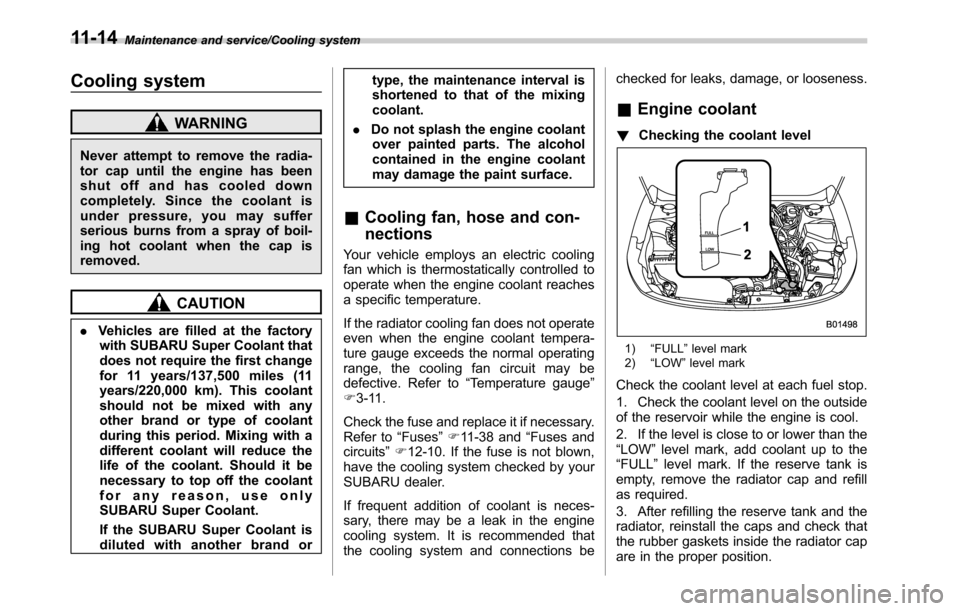
!Checking the coolant level
1)“FULL”level mark
2)“LOW”level mark
Check the coolant level at each fuel stop.
1. Check the coolant level on the outside
of the reservoir while the engine is cool.
2. If the level is close to or lower than the
“LOW”level mark, add coolant up to the
“FULL”level mark. If the reserve tank is
empty, remove the radiator cap and refill
as required.
3. After refilling the reserve tank and the
radiator, reinstall the caps and check that
the rubber gaskets inside the radiator cap
are in the proper position.
11-14
Page 486 of 572
Maintenance and service/Spark plugs
Spark plugs
It may be difficult to replace the spark
plugs. It is recommended that you have
the spark plugs replaced by your
SUBARU dealer.
The spark plugs should be replaced
according to the maintenance schedule
in the“Warranty and Maintenance Book-
let”.
&Recommended spark plugs
Refer to“Electrical system”F12-9.
Drive belts
It is unnecessary to check the deflection of
the drive belt periodically because your
engine is equipped with an automatic belt
tension adjuster. However, replacement of
the belt should be done according to the
maintenance schedule in the“Warranty
and Maintenance Booklet”. Consult your
SUBARU dealer for replacement.
If the belt is loose, cracked or worn,
contact your SUBARU dealer.
Manual transmission oil
It is unnecessary to check the manual
transmission oil level. However, if neces-
sary, consult your SUBARU dealer for
inspection.
&Recommended grade and
viscosity
Each oil manufacturer has its own base
oils and additives. Never use different
brands together. For details, refer to
“Manual transmission, front differential
and rear differential gear oil”F12-7.
11-18
Page 490 of 572
Maintenance and service/Brake booster
Check the fluid level monthly.
Check the fluid level on the outside of the
reservoir. Because this reservoir is used
for both the brake and clutch systems and
has chambers for each system, be sure to
check the fluid level for the clutch system
at theinboard side of the reservoir
(shaded area in the illustration). If the fluid
level is below“MIN”, add the recom-
mended clutch fluid to“MAX”.
Use only clutch fluid from a sealed
container.
&Recommended clutch fluid
Refer to“Fluids”F12-8.
CAUTION
Never use different brands of clutch
fluid together. Also, avoid mixing
DOT 3 and DOT 4 brake fluids even if
they are the same brand.
Brake booster
If the brake booster does not operate as
described in the following procedure, have
it checked by your SUBARU dealer.
1. With the engine off, depress the brake
pedal several times, applying the same
pedal force each time. The distance the
pedal travels should not vary.
2. With the brake pedal depressed, start
the engine. The pedal should move
slightly down to the floor.
3. With the brake pedal depressed, stop
the engine and keep the pedal depressed
for 30 seconds. The pedal height should
not change.
4. Start the engine again and run for
approximately 1 minute then turn it off.
Depress the brake pedal several times to
check the brake booster. The brake
booster operates properly if the pedal
stroke decreases with each depression.
Brake pedal
Check the brake pedal free play and
reserve distance according to the main-
tenance schedule in the“Warranty and
Maintenance Booklet”.
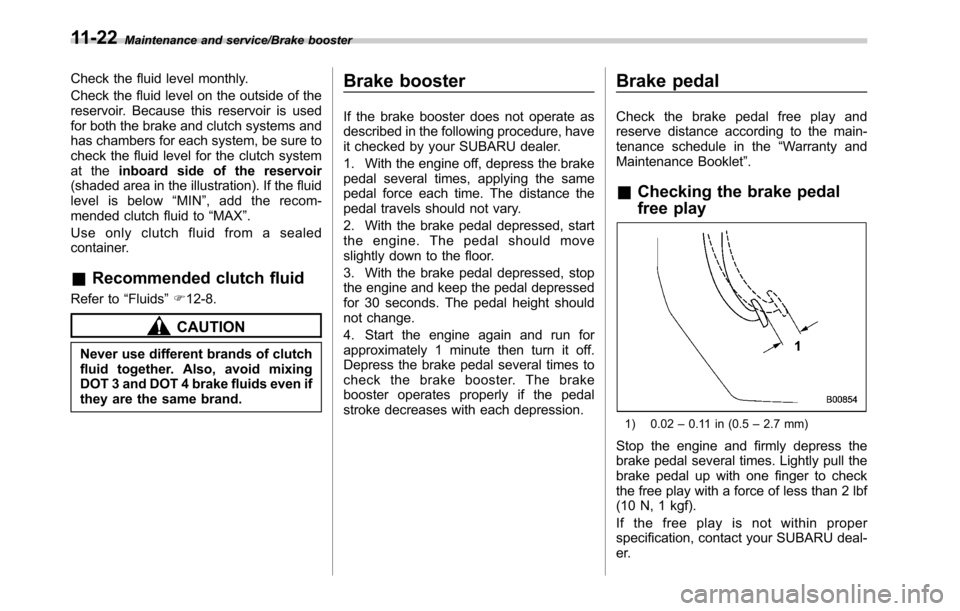
&Checking the brake pedal
free play
1) 0.02–0.11 in (0.5–2.7 mm)
Stop the engine and firmly depress the
brake pedal several times. Lightly pull the
brake pedal up with one finger to check
the free play with a force of less than 2 lbf
(10 N, 1 kgf).
If the free play is not within proper
specification, contact your SUBARU deal-
er.
11-22
Page 491 of 572
&Checking the brake pedal
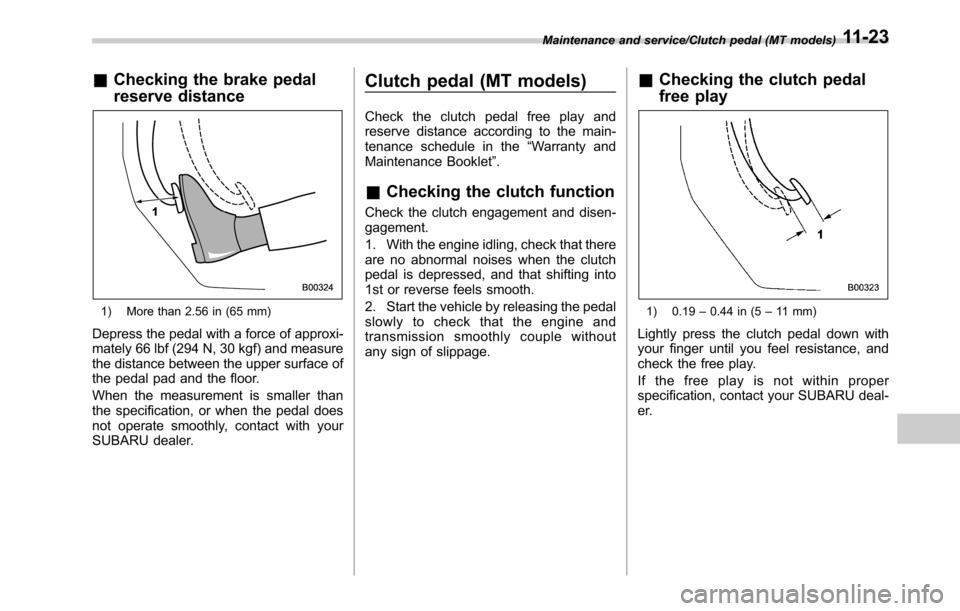
reserve distance
1) More than 2.56 in (65 mm)
Depress the pedal with a force of approxi-
mately 66 lbf (294 N, 30 kgf) and measure
the distance between the upper surface of
the pedal pad and the floor.
When the measurement is smaller than
the specification, or when the pedal does
not operate smoothly, contact with your
SUBARU dealer.
Clutch pedal (MT models)
Check the clutch pedal free play and
reserve distance according to the main-
tenance schedule in the“Warranty and
Maintenance Booklet”.
&Checking the clutch function
Check the clutch engagement and disen-
gagement.
1. With the engine idling, check that there
are no abnormal noises when the clutch
pedal is depressed, and that shifting into
1st or reverse feels smooth.
2. Start the vehicle by releasing the pedal
slowly to check that the engine and
transmission smoothly couple without
any sign of slippage.
&Checking the clutch pedal
free play
1) 0.19–0.44 in (5–11 mm)
Lightly press the clutch pedal down with
your finger until you feel resistance, and
check the free play.
If the free play is not within proper
specification, contact your SUBARU deal-
er.
Maintenance and service/Clutch pedal (MT models)11-23