gear oil SUBARU OUTBACK 2016 6.G Owners Manual
[x] Cancel search | Manufacturer: SUBARU, Model Year: 2016, Model line: OUTBACK, Model: SUBARU OUTBACK 2016 6.GPages: 572, PDF Size: 21.79 MB
Page 153 of 572
Ignition switch (models without push-
button start system)......................................... 3-3
LOCK.................................................................. 3-3
ACC.................................................................... 3-4
ON...................................................................... 3-4
START ................................................................ 3-4
Key reminder chime............................................ 3-4
Ignition switch light............................................. 3-4
Push-button ignition switch (models with
push-button start system)............................... 3-5
Safety precautions.............................................. 3-5
Operating range for push-button start system...... 3-5
Switching power................................................. 3-6
When access key does not operate properly........ 3-7
Hazard warning flasher....................................... 3-7
Meters and gauges.............................................. 3-7
Combination meter illumination........................... 3-7
Canceling the function for meter/gauge needle
movement upon turning on the ignition
switch............................................................... 3-8
Speedometer....................................................... 3-8
Odometer............................................................ 3-8
Double trip meter................................................ 3-9
Tachometer......................................................... 3-9
Fuel gauge......................................................... 3-10
Temperature gauge............................................ 3-11
ECO gauge........................................................ 3-11
Warning and indicator lights............................. 3-12
Seatbelt warning light and chime........................ 3-12
SRS airbag system warning light........................ 3-14Front passenger’s frontal airbag ON and OFF
indicators........................................................ 3-14
CHECK ENGINE warning light/Malfunction
indicator light.................................................. 3-15
Charge warning light.......................................... 3-15
Oil pressure warning light.................................. 3-15
Engine low oil level warning indicator................ 3-16
AT OIL TEMP warning light (CVT models)........... 3-16
Low tire pressure warning light (U.S. spec.
models)........................................................... 3-16
ABS warning light.............................................. 3-18
Brake system warning light................................ 3-18
Electronic parking brake indicator light.............. 3-20
Hill Holder indicator light................................... 3-21
Low fuel warning light....................................... 3-21
Door open indicator........................................... 3-22
Windshield washer fluid warning indicator.......... 3-22
All-Wheel Drive warning light (CVT models) ........ 3-22
Power steering warning light.............................. 3-22
Vehicle Dynamics Control warning light/Vehicle
Dynamics Control operation indicator light ....... 3-23
Vehicle Dynamics Control OFF indicator light..... 3-24
Warning chimes and warning indicator of the
keyless access with push-button start system (if
equipped)........................................................ 3-24
Security indicator light....................................... 3-29
Select lever/gear position indicator..................... 3-30
Turn signal indicator lights................................. 3-30
High beam indicator light................................... 3-30
Cruise control indicator..................................... 3-30
Cruise control set indicator................................ 3-30
Instruments and controls
3
Page 333 of 572
CAUTION
.Do not attempt to use a cigarette
lighter in the accessory power
outlet.
.Do not place any foreign objects,
especially metal ones such as
coins or aluminum foil, into the
accessory power outlet. That
could cause a short circuit. Al-
ways put the cap on the acces-
sory power outlet when it is not
in use.
.Use only electrical appliances
which are designed for 12V DC.
The maximum power rating of an
appliance that can be connected
is 120W. Do not use an appliance
which exceeds the indicated wat-
tage for each outlet.
When using appliances con-
nected to two or more outlets
simultaneously, the total power
consumed by them must not
exceed 120W. Overloading the
accessory power outlet can
cause a short circuit. Do not use
double adapters or more than
one electrical appliance.
.If the plug on your electric appli-
ance is either too loose or tootight for the accessory power
outlet, this can result in a poor
contact or cause the plug to get
stuck. Only use plugs that fit
properly.
.Use of an electric appliance in the
accessory power outlet for a long
period of time while the engine is
not running can cause battery
discharge.
.Before driving your vehicle, make
sure that the plug and the cord
on your electrical appliance will
not interfere with your shifting
gears and operating the accel-
erator and brake pedals. If they
do, do not use the electrical
appliance while driving.
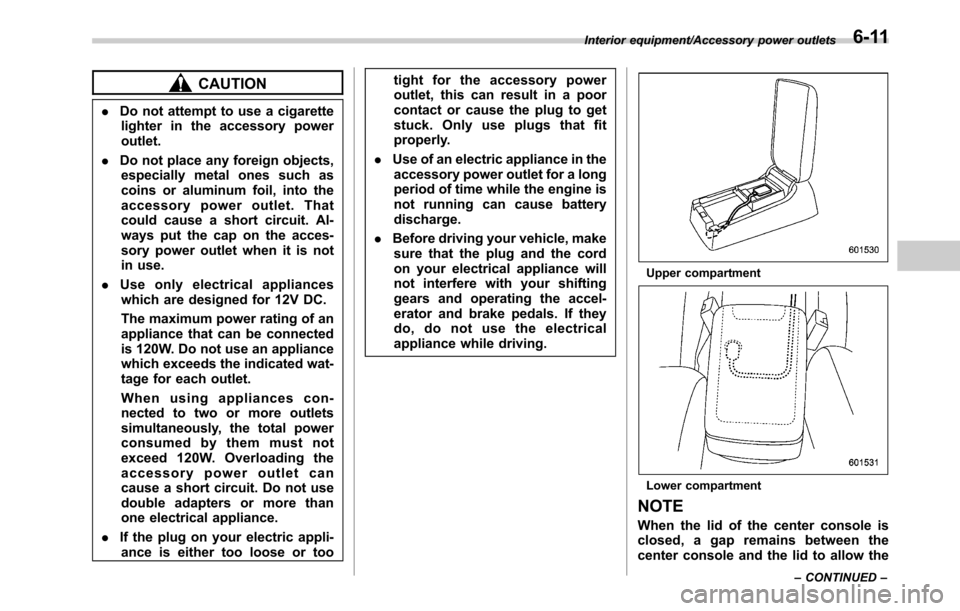
Upper compartment
Lower compartment
NOTE
When the lid of the center console is
closed, a gap remains between the
center console and the lid to allow the
Interior equipment/Accessory power outlets
–CONTINUED–6-11
Page 378 of 572
Starting and operating/Continuously variable transmission
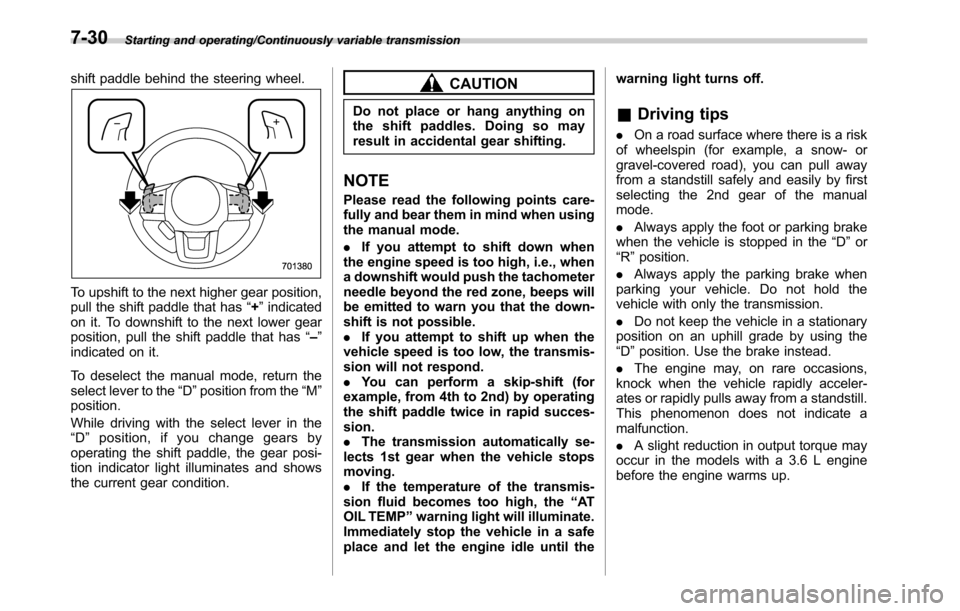
shift paddle behind the steering wheel.
To upshift to the next higher gear position,
pull the shift paddle that has“+”indicated
on it. To downshift to the next lower gear
position, pull the shift paddle that has“–”
indicated on it.
To deselect the manual mode, return the
select lever to the“D”position from the“M”
position.
While driving with the select lever in the
“D”position, if you change gears by
operating the shift paddle, the gear posi-
tion indicator light illuminates and shows
the current gear condition.
CAUTION
Do not place or hang anything on
the shift paddles. Doing so may
result in accidental gear shifting.
NOTE
Please read the following points care-
fully and bear them in mind when using
the manual mode.
.If you attempt to shift down when
the engine speed is too high, i.e., when
a downshift would push the tachometer
needle beyond the red zone, beeps will
be emitted to warn you that the down-
shift is not possible.
.If you attempt to shift up when the
vehicle speed is too low, the transmis-
sion will not respond.
.You can perform a skip-shift (for
example, from 4th to 2nd) by operating
the shift paddle twice in rapid succes-
sion.
.The transmission automatically se-
lects 1st gear when the vehicle stops
moving.
.If the temperature of the transmis-
sion fluid becomes too high, the“AT
OIL TEMP”warning light will illuminate.
Immediately stop the vehicle in a safe
place and let the engine idle until thewarning light turns off.
&Driving tips
.On a road surface where there is a risk
of wheelspin (for example, a snow- or
gravel-covered road), you can pull away
from a standstill safely and easily by first
selecting the 2nd gear of the manual
mode.
.Always apply the foot or parking brake
when the vehicle is stopped in the“D”or
“R”position.
.Always apply the parking brake when
parking your vehicle. Do not hold the
vehicle with only the transmission.
.Do not keep the vehicle in a stationary
position on an uphill grade by using the
“D”position. Use the brake instead.
.The engine may, on rare occasions,
knock when the vehicle rapidly acceler-
ates or rapidly pulls away from a standstill.
This phenomenon does not indicate a
malfunction.
.A slight reduction in output torque may
occur in the models with a 3.6 L engine
before the engine warms up.
7-30
Page 417 of 572
.Continuously variable transmis-
sion fluid (CVT models)
.Front differential gear oil (CVT
models)
Remember that damage done to
your SUBARU while operating it
off-road and not using common
sense precautions such as those
listed above is not eligible for war-
ranty coverage.
Because of the AWD feature and higher
ground clearance, you can drive your
SUBARU on ordinary roads or off-road.
But please keep in mind that an AWD
SUBARU is a passenger car and is
neither a conventional off-road vehicle
nor an all-terrain vehicle. If you do take
your SUBARU off-road, certain common
sense precautions such as those in the
following list should be taken.
!Before driving
.Make certain that you and all of your
passengers are wearing seatbelts.
.Carry some emergency equipment,
such as a towing rope or chain, a shovel,
wheel blocks, first aid kit and cell phone or
citizens band radio.
.Secure all cargo carried inside the
vehicle and make certain that it is not
piled higher than the seatbacks. Duringsudden stops or jolts, unsecured cargo
could be thrown around in the vehicle and
cause injury. Do not pile heavy loads on
the roof. Those loads raise the vehicle’s
center of gravity and make it more prone
to tip over.
.Never equip your vehicle with tires
larger than those specified in this manual.
!During driving
General precautions:
.Drive carefully. Do not take unneces-
sary risks by driving in dangerous areas or
over rough terrain.
.Slow down and employ extra caution at
all times. When driving off-road, you will
not have the benefit of marked traffic
lanes, banked curves, traffic signs and
the like.
.Do not drive across steep slopes.
Instead, drive either straight up or straight
down the slopes. A vehicle can much
more easily tip over sideways than it can
end over end. Avoid driving straight up or
down slopes that are too steep.
.Avoid sharp turning maneuvers, espe-
cially at higher speeds.
.Do not grip the inside or spokes of the
steering wheel. A bad bump could jerk the
wheel and injure your hands. Instead,
drive with your fingers and thumbs on
the outside of the rim..Do not drive or park over or near
flammable materials such as dry grass or
fallen leaves, as they may burn easily. The
exhaust system is very hot while the
engine is running and right after the
engine stops. This could create a fire
hazard.
Precautions when driving under espe-
cially dangerous situations:
.If driving through water, such as when
crossing shallow streams, first check the
depth of the water and the bottom of the
stream bed for firmness and ensure that
the bed of the stream is flat. Drive slowly
and completely through the stream. The
water should be shallow enough that it
does not reach the vehicle’s undercar-
riage. Water entering the engine air intake
or the exhaust pipe or water splashing
onto electrical parts may damage your
vehicle and may cause it to stall. Never
attempt to drive through rushing water;
regardless of its depth, it can wash away
the ground from under your tires, resulting
in possible loss of traction and even
vehicle rollover.
.If you must rock the vehicle to free it
from sand or mud, depress the accelerator
pedal slightly and move the shift lever/
select lever back and forth between“1”/
“D”and“R”repeatedly. Do not race the
engine. For the best possible traction,
Driving tips/Off road driving
–CONTINUED–8-7
Page 438 of 572
Driving tips/Trailer towing (Outback)
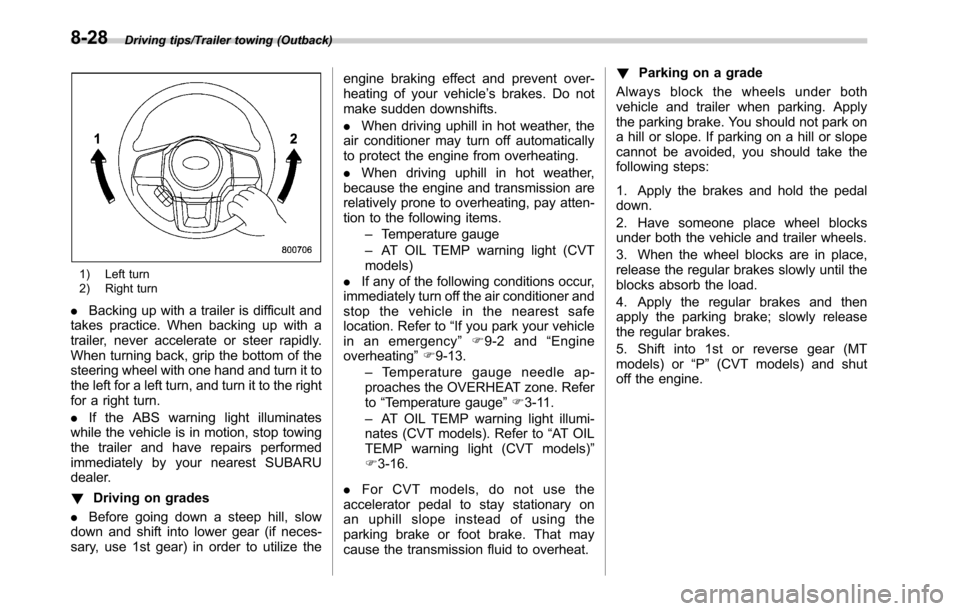
1) Left turn
2) Right turn
.Backing up with a trailer is difficult and
takes practice. When backing up with a
trailer, never accelerate or steer rapidly.
When turning back, grip the bottom of the
steering wheel with one hand and turn it to
the left for a left turn, and turn it to the right
for a right turn.
.If the ABS warning light illuminates
while the vehicle is in motion, stop towing
the trailer and have repairs performed
immediately by your nearest SUBARU
dealer.
!Driving on grades
.Before going down a steep hill, slow
down and shift into lower gear (if neces-
sary, use 1st gear) in order to utilize theengine braking effect and prevent over-
heating of your vehicle’s brakes. Do not
make sudden downshifts.
.When driving uphill in hot weather, the
air conditioner may turn off automatically
to protect the engine from overheating.
.When driving uphill in hot weather,
because the engine and transmission are
relatively prone to overheating, pay atten-
tion to the following items.
–Temperature gauge
–AT OIL TEMP warning light (CVT
models)
.If any of the following conditions occur,
immediately turn off the air conditioner and
stop the vehicle in the nearest safe
location. Refer to“If you park your vehicle
in an emergency”F9-2 and“Engine
overheating”F9-13.
–Temperature gauge needle ap-
proaches the OVERHEAT zone. Refer
to“Temperature gauge”F3-11.
–AT OIL TEMP warning light illumi-
nates (CVT models). Refer to“AT OIL
TEMP warning light (CVT models)”
F3-16.
.For CVT models, do not use the
accelerator pedal to stay stationary on
an uphill slope instead of using the
parking brake or foot brake. That may
cause the transmission fluid to overheat.!Parking on a grade
Always block the wheels under both
vehicle and trailer when parking. Apply
the parking brake. You should not park on
a hill or slope. If parking on a hill or slope
cannot be avoided, you should take the
following steps:
1. Apply the brakes and hold the pedal
down.
2. Have someone place wheel blocks
under both the vehicle and trailer wheels.
3. When the wheel blocks are in place,
release the regular brakes slowly until the
blocks absorb the load.
4. Apply the regular brakes and then
apply the parking brake; slowly release
the regular brakes.
5. Shift into 1st or reverse gear (MT
models) or“P”(CVT models) and shut
off the engine.
8-28
Page 469 of 572
Maintenance schedule....................................... 11-3
Maintenance precautions................................... 11-3
Before checking or servicing in the engine
compartment.................................................... 11-4
When checking or servicing in the engine
compartment (2.5 L models)............................. 11-5
When checking or servicing in the engine
compartment while the engine is running.......... 11-5
Maintenance tips................................................ 11-5Removing and reinstalling clips.......................... 11-5
Engine hood....................................................... 11-7
Engine compartment overview.......................... 11-9
2.5 L models...................................................... 11-9
3.6 L models.................................................... 11-10
Engine oil.......................................................... 11-11Engine oil consumption.................................... 11-11
Checking the oil level....................................... 11-11
Changing the oil and oil filter............................ 11-13
Recommended grade and viscosity.................. 11-13
Synthetic oil..................................................... 11-13
Cooling system................................................ 11-14
Cooling fan, hose and connections................... 11-14
Engine coolant................................................. 11-14
Air cleaner element.......................................... 11-15Replacing the air cleaner element..................... 11-15
Spark plugs...................................................... 11-18Recommended spark plugs.............................. 11-18
Drive belts........................................................ 11-18
Manual transmission oil.................................. 11-18
Recommended grade and viscosity.................. 11-18
Continuously variable transmission fluid...... 11-19
Front differential gear oil (CVT models) and
rear differential gear oil................................ 11-19
Recommended grade and viscosity.................. 11-19
Brake fluid........................................................ 11-19Checking the fluid level.................................... 11-19
Recommended brake fluid............................... 11-21
Clutch fluid (MT models)................................. 11-21Checking the fluid level.................................... 11-21
Recommended clutch fluid............................... 11-22
Brake booster.................................................. 11-22
Brake pedal...................................................... 11-22
Checking the brake pedal free play.................. 11-22
Checking the brake pedal reserve distance....... 11-23
Clutch pedal (MT models)............................... 11-23Checking the clutch function............................ 11-23
Checking the clutch pedal free play.................. 11-23
Replacement of brake pad.............................. 11-24Breaking-in of new brake pads ......................... 11-24
Tires and wheels.............................................. 11-24Types of tires................................................... 11-24
Tire pressure monitoring system (TPMS) (if
equipped)...................................................... 11-25
Tire inspection................................................. 11-26
Tire pressures and wear.................................. 11-27
Wheel balance................................................. 11-28
Wear indicators............................................... 11-29
Tire rotation direction mark.............................. 11-29
Tire rotation..................................................... 11-29
Tire replacement.............................................. 11-30
Maintenance and service
11
Page 486 of 572
Maintenance and service/Spark plugs
Spark plugs
It may be difficult to replace the spark
plugs. It is recommended that you have
the spark plugs replaced by your
SUBARU dealer.
The spark plugs should be replaced
according to the maintenance schedule
in the“Warranty and Maintenance Book-
let”.
&Recommended spark plugs
Refer to“Electrical system”F12-9.
Drive belts
It is unnecessary to check the deflection of
the drive belt periodically because your
engine is equipped with an automatic belt
tension adjuster. However, replacement of
the belt should be done according to the
maintenance schedule in the“Warranty
and Maintenance Booklet”. Consult your
SUBARU dealer for replacement.
If the belt is loose, cracked or worn,
contact your SUBARU dealer.
Manual transmission oil
It is unnecessary to check the manual
transmission oil level. However, if neces-
sary, consult your SUBARU dealer for
inspection.
&Recommended grade and
viscosity
Each oil manufacturer has its own base
oils and additives. Never use different
brands together. For details, refer to
“Manual transmission, front differential
and rear differential gear oil”F12-7.
11-18
Page 487 of 572
Continuously variable trans-
mission fluid
There is no fluid level gauge. It is
unnecessary to check the continuously
variable transmission fluid level. However,
if necessary, consult your SUBARU dealer
for inspection.
Front differential gear oil
(CVT models) and rear differ-
ential gear oil
It is not necessary to check the gear oil
level. Check that there are no cracks,
damage or leakage. However, the oil
inspection should be performed according
to the maintenance schedule in the
“Warranty and Maintenance Booklet”.
Consult your SUBARU dealer for details.
&Recommended grade and
viscosity
Each oil manufacturer has its own base
oils and additives. Never use different
brands together. For details, refer to
“Manual transmission, front differential
and rear differential gear oil”F12-7.
CAUTION
Using a differential gear oil other
than the specified oil may cause a
decline in vehicle performance.
Brake fluid
&Checking the fluid level
WARNING
.Never let brake fluid contact your
eyes because brake fluid can be
harmful to your eyes. If brake
fluid gets in your eyes, immedi-
ately flush them thoroughly with
clean water. For safety, when
performing this work, wearing
eye protection is advisable.
.Brake fluid absorbs moisture
from the air. Any absorbed moist-
ure can cause a dangerous loss
of braking performance.
.If the vehicle requires frequent
refilling, there may be a leak. If
you suspect a problem, have the
vehicle checked at your SUBARU
dealer.
CAUTION
.When adding brake fluid, be care-
ful not to allow any dirt into the
reservoir.
.Never splash the brake fluid over
painted surfaces or rubber parts.
Maintenance and service/Continuously variable transmission fluid
–CONTINUED–11-19
Page 521 of 572
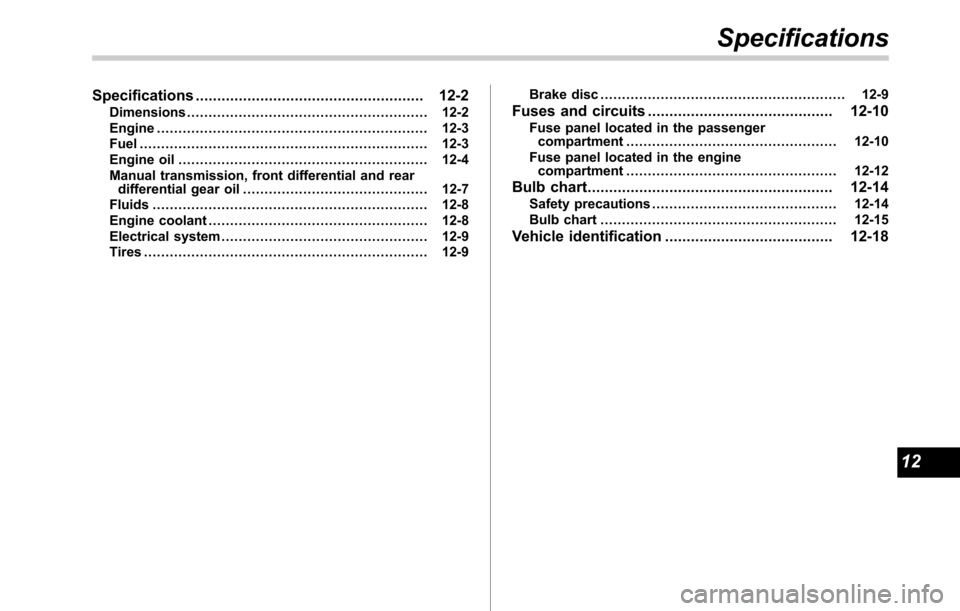
Specifications..................................................... 12-2
Dimensions........................................................ 12-2
Engine............................................................... 12-3
Fuel................................................................... 12-3
Engine oil.......................................................... 12-4
Manual transmission, front differential and rear
differential gear oil........................................... 12-7
Fluids................................................................ 12-8
Engine coolant................................................... 12-8
Electrical system................................................ 12-9
Tires.................................................................. 12-9Brake disc......................................................... 12-9Fuses and circuits........................................... 12-10
Fuse panel located in the passenger
compartment................................................. 12-10
Fuse panel located in the engine
compartment................................................. 12-12
Bulb chart......................................................... 12-14Safety precautions........................................... 12-14
Bulb chart....................................................... 12-15
Vehicle identification....................................... 12-18
Specifications
12
Page 527 of 572
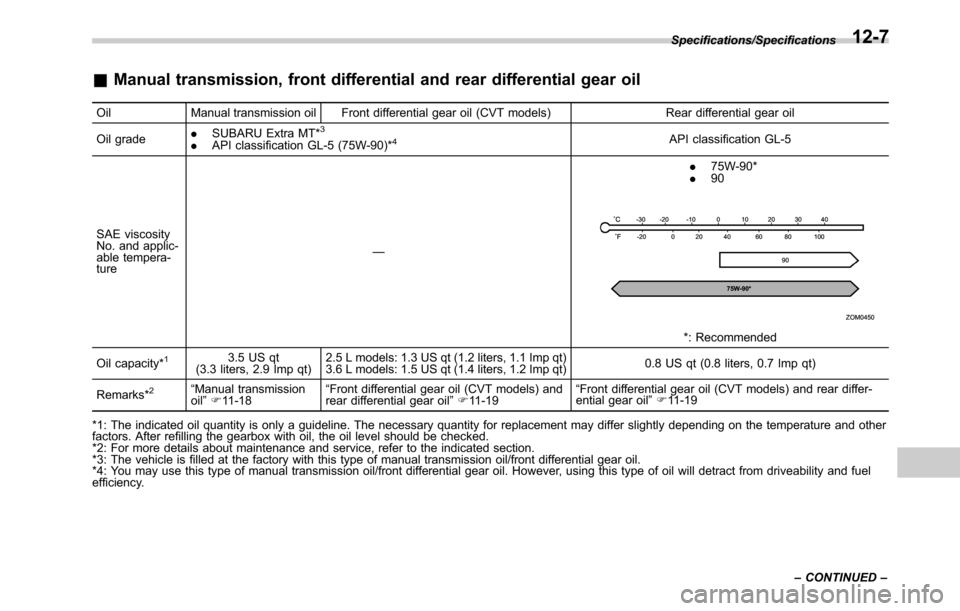
&Manual transmission, front differential and rear differential gear oil
Oil Manual transmission oil Front differential gear oil (CVT models) Rear differential gear oil
Oil grade.SUBARU Extra MT*3
.API classification GL-5 (75W-90)*4API classification GL-5
SAE viscosity
No. and applic-
able tempera-
ture—.75W-90*
.90
*: Recommended
Oil capacity*
13.5 US qt
(3.3 liters, 2.9 Imp qt)2.5 L models: 1.3 US qt (1.2 liters, 1.1 Imp qt)
3.6 L models: 1.5 US qt (1.4 liters, 1.2 Imp qt)0.8 US qt (0.8 liters, 0.7 Imp qt)
Remarks*
2“Manual transmission
oil”F11-18“Front differential gear oil (CVT models) and
rear differential gear oil”F11-19“Front differential gear oil (CVT models) and rear differ-
ential gear oil”F11-19
*1: The indicated oil quantity is only a guideline. The necessary quantity for replacement may differ slightly depending on the temperature and other
factors. After refilling the gearbox with oil, the oil level should be checked.
*2: For more details about maintenance and service, refer to the indicated section.
*3: The vehicle is filled at the factory with this type of manual transmission oil/front differential gear oil.
*4: You may use this type of manual transmission oil/front differential gear oil. However, using this type of oil will detract from driveability and fuel
efficiency.Specifications/Specifications
–CONTINUED–
12-7