weight SUBARU OUTBACK 2016 6.G Owners Manual
[x] Cancel search | Manufacturer: SUBARU, Model Year: 2016, Model line: OUTBACK, Model: SUBARU OUTBACK 2016 6.GPages: 572, PDF Size: 21.79 MB
Page 7 of 572
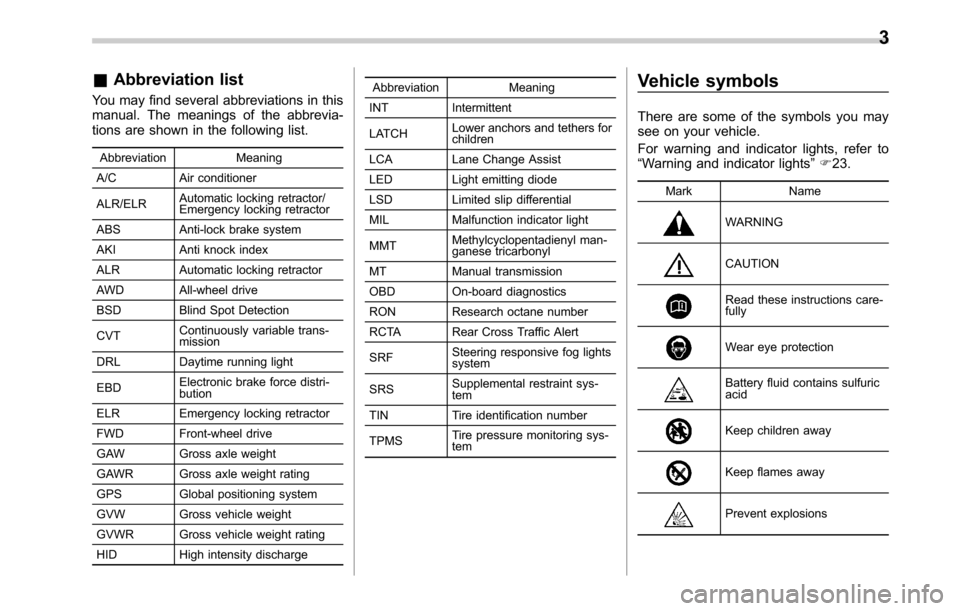
&Abbreviation list
You may find several abbreviations in this
manual. The meanings of the abbrevia-
tions are shown in the following list.
Abbreviation Meaning
A/C Air conditioner
ALR/ELRAutomatic locking retractor/
Emergency locking retractor
ABS Anti-lock brake system
AKI Anti knock index
ALR Automatic locking retractor
AWD All-wheel drive
BSD Blind Spot Detection
CVTContinuously variable trans-
mission
DRL Daytime running light
EBDElectronic brake force distri-
bution
ELR Emergency locking retractor
FWD Front-wheel drive
GAW Gross axle weight
GAWR Gross axle weight rating
GPS Global positioning system
GVW Gross vehicle weight
GVWR Gross vehicle weight rating
HID High intensity dischargeAbbreviation Meaning
INT Intermittent
LATCHLower anchors and tethers for
children
LCA Lane Change Assist
LED Light emitting diode
LSD Limited slip differential
MIL Malfunction indicator light
MMTMethylcyclopentadienyl man-
ganese tricarbonyl
MT Manual transmission
OBD On-board diagnostics
RON Research octane number
RCTA Rear Cross Traffic Alert
SRFSteering responsive fog lights
system
SRSSupplemental restraint sys-
tem
TIN Tire identification number
TPMSTire pressure monitoring sys-
tem
Vehicle symbols
There are some of the symbols you may
see on your vehicle.
For warning and indicator lights, refer to
“Warning and indicator lights”F23.
Mark Name
WARNING
CAUTION
Read these instructions care-
fully
Wear eye protection
Battery fluid contains sulfuric
acid
Keep children away
Keep flames away
Prevent explosions
3
Page 8 of 572
Safety precautions when
driving
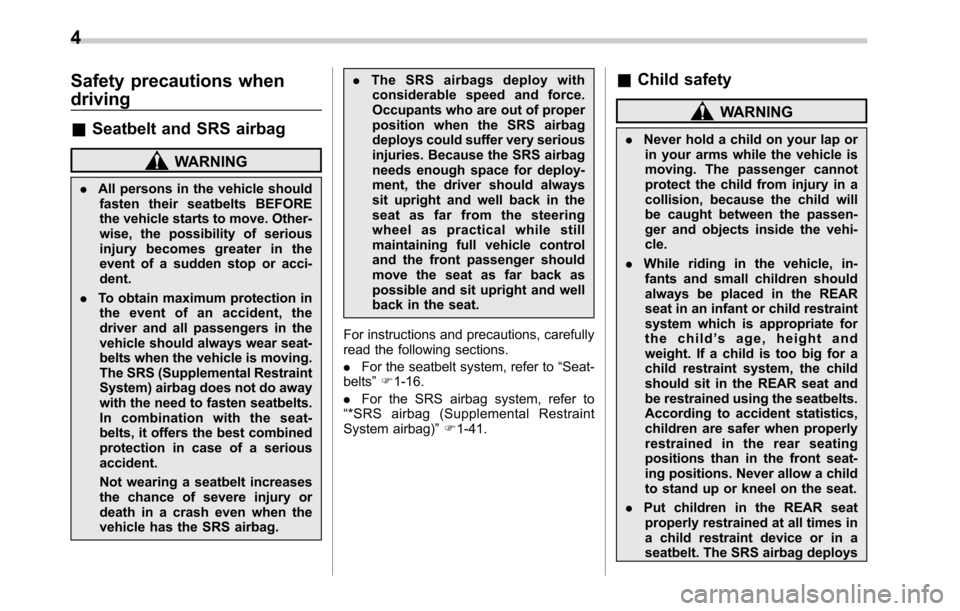
&Seatbelt and SRS airbag
WARNING
.All persons in the vehicle should
fasten their seatbelts BEFORE
the vehicle starts to move. Other-
wise, the possibility of serious
injury becomes greater in the
event of a sudden stop or acci-
dent.
.To obtain maximum protection in
the event of an accident, the
driver and all passengers in the
vehicle should always wear seat-
belts when the vehicle is moving.
The SRS (Supplemental Restraint
System) airbag does not do away
with the need to fasten seatbelts.
In combination with the seat-
belts, it offers the best combined
protection in case of a serious
accident.
Not wearing a seatbelt increases
the chance of severe injury or
death in a crash even when the
vehicle has the SRS airbag..The SRS airbags deploy with
considerable speed and force.
Occupants who are out of proper
position when the SRS airbag
deploys could suffer very serious
injuries. Because the SRS airbag
needs enough space for deploy-
ment, the driver should always
sit upright and well back in the
seat as far from the steering
wheel as practical while still
maintaining full vehicle control
and the front passenger should
move the seat as far back as
possible and sit upright and well
back in the seat.
For instructions and precautions, carefully
read the following sections.
.For the seatbelt system, refer to“Seat-
belts”F1-16.
.For the SRS airbag system, refer to
“*SRS airbag (Supplemental Restraint
System airbag)”F1-41.
&Child safety
WARNING
.Never hold a child on your lap or
in your arms while the vehicle is
moving. The passenger cannot
protect the child from injury in a
collision, because the child will
be caught between the passen-
ger and objects inside the vehi-
cle.
.While riding in the vehicle, in-
fants and small children should
always be placed in the REAR
seat in an infant or child restraint
system which is appropriate for
the child’s age, height and
weight. If a child is too big for a
child restraint system, the child
should sit in the REAR seat and
be restrained using the seatbelts.
According to accident statistics,
children are safer when properly
restrained in the rear seating
positions than in the front seat-
ing positions. Never allow a child
to stand up or kneel on the seat.
.Put children in the REAR seat
properly restrained at all times in
a child restraint device or in a
seatbelt. The SRS airbag deploys
4
Page 33 of 572
for the child’s age, height and
weight.
Secure ALL types of child restraint
devices (including forward facing
child seats) in the REAR seats at
all times.
NEVER INSTALL A REARWARD FA-
CING CHILD SEAT IN THE FRONT
SEAT. DOING SO RISKS SERIOUS
INJURY OR DEATH TO THE CHILD
BY PLACING THE CHILD’S HEAD
TOO CLOSE TO THE SRS AIRBAG.
According to accident statistics,
children are safer when properly
restrained in the rear seating posi-
tions than in the front seating posi-
tions. For instructions and precau-
tions concerning child restraint sys-
tems, refer to“Child restraint sys-
tems”F1-27.
WARNING
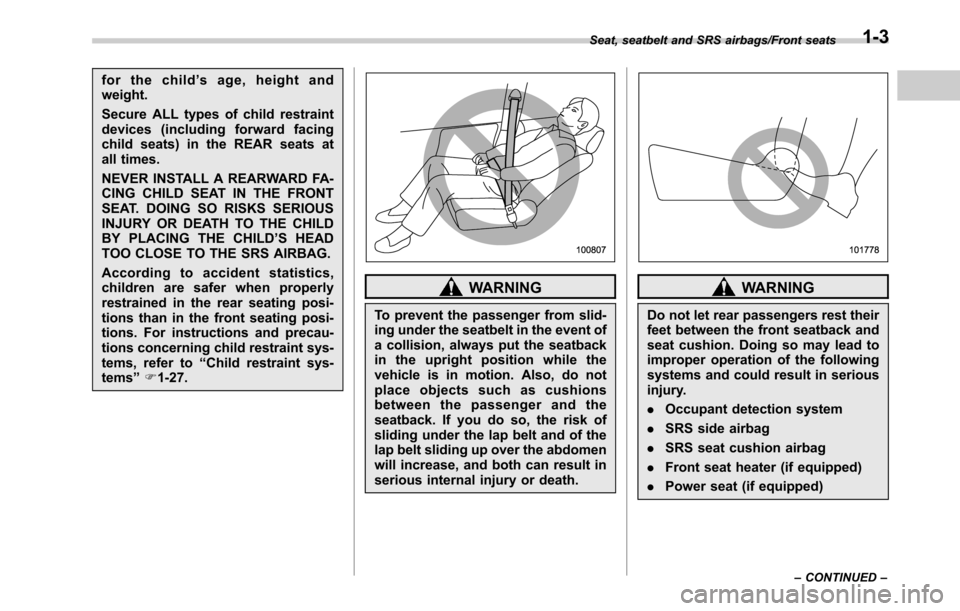
To prevent the passenger from slid-
ing under the seatbelt in the event of
a collision, always put the seatback
in the upright position while the
vehicle is in motion. Also, do not
place objects such as cushions
between the passenger and the
seatback. If you do so, the risk of
sliding under the lap belt and of the
lap belt sliding up over the abdomen
will increase, and both can result in
serious internal injury or death.
WARNING
Do not let rear passengers rest their
feet between the front seatback and
seat cushion. Doing so may lead to
improper operation of the following
systems and could result in serious
injury.
.Occupant detection system
.SRS side airbag
.SRS seat cushion airbag
.Front seat heater (if equipped)
.Power seat (if equipped)
Seat, seatbelt and SRS airbags/Front seats
–CONTINUED–1-3
Page 46 of 572
Seat, seatbelt and SRS airbags/Seatbelts
Seatbelts
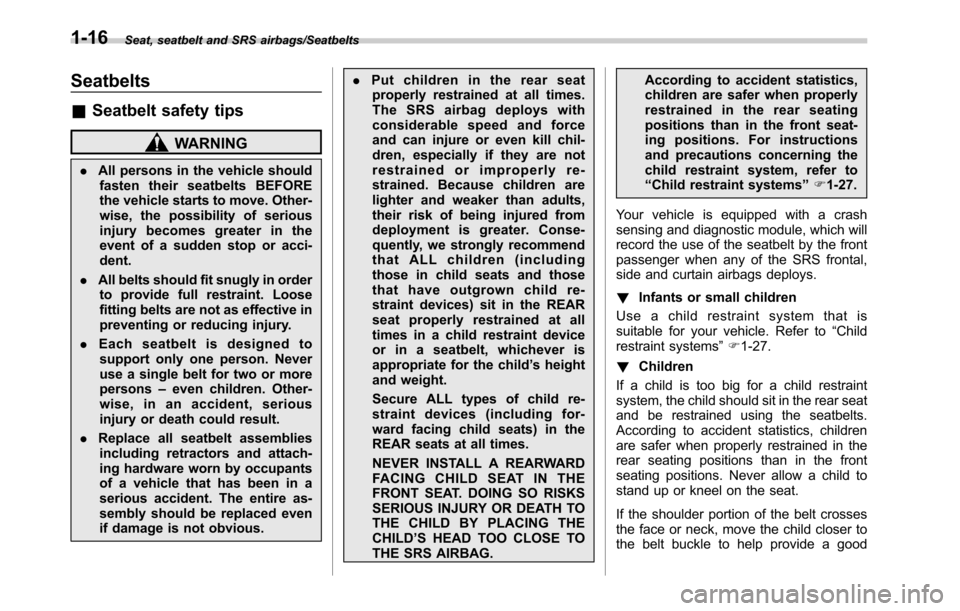
&Seatbelt safety tips
WARNING
.All persons in the vehicle should
fasten their seatbelts BEFORE
the vehicle starts to move. Other-
wise, the possibility of serious
injury becomes greater in the
event of a sudden stop or acci-
dent.
.All belts should fit snugly in order
to provide full restraint. Loose
fitting belts are not as effective in
preventing or reducing injury.
.Each seatbelt is designed to
support only one person. Never
use a single belt for two or more
persons–even children. Other-
wise, in an accident, serious
injury or death could result.
.Replace all seatbelt assemblies
including retractors and attach-
ing hardware worn by occupants
of a vehicle that has been in a
serious accident. The entire as-
sembly should be replaced even
if damage is not obvious..Putchildrenintherearseat
properly restrained at all times.
The SRS airbag deploys with
considerable speed and force
and can injure or even kill chil-
dren, especially if they are not
restrained or improperly re-
strained. Because children are
lighter and weaker than adults,
their risk of being injured from
deployment is greater. Conse-
quently, we strongly recommend
that ALL children (including
those in child seats and those
that have outgrown child re-
straint devices) sit in the REAR
seat properly restrained at all
times in a child restraint device
or in a seatbelt, whichever is
appropriate for the child’s height
and weight.
Secure ALL types of child re-
straint devices (including for-
ward facing child seats) in the
REAR seats at all times.
NEVER INSTALL A REARWARD
FACING CHILD SEAT IN THE
FRONT SEAT. DOING SO RISKS
SERIOUS INJURY OR DEATH TO
THE CHILD BY PLACING THE
CHILD’S HEAD TOO CLOSE TO
THE SRS AIRBAG.According to accident statistics,
children are safer when properly
restrained in the rear seating
positions than in the front seat-
ing positions. For instructions
and precautions concerning the
child restraint system, refer to
“Child restraint systems”F1-27.
Your vehicle is equipped with a crash
sensing and diagnostic module, which will
record the use of the seatbelt by the front
passenger when any of the SRS frontal,
side and curtain airbags deploys.
!Infants or small children
Use a child restraint system that is
suitable for your vehicle. Refer to“Child
restraint systems”F1-27.
!Children
If a child is too big for a child restraint
system, the child should sit in the rear seat
and be restrained using the seatbelts.
According to accident statistics, children
are safer when properly restrained in the
rear seating positions than in the front
seating positions. Never allow a child to
stand up or kneel on the seat.
If the shoulder portion of the belt crosses
the face or neck, move the child closer to
the belt buckle to help provide a good
1-16
Page 59 of 572
chorages (bars) are provided for installing
a child restraint system.
Some types of child restraints might not be
able to be secured firmly due to projection
of the seat cushion.
In this seating position, you should use
only a child restraint system that has a
bottom base that fits snugly against the
contours of the seat cushion and can be
securely retained using the seatbelt.
C: Rear seat, center seating position
The ALR/ELR seatbelt and an upper
anchorage (tether anchorage, if equipped)
are provided in this position.
Some types of child restraints might not be
able to be secured firmly due to projection
of the seat cushion.
In this seating position, you should use
only a child restraint system that has a
bottom base that fits snugly against the
contours of the seat cushion and can be
securely retained using the seatbelt.
When you install a child restraint system in
the rear seat’s center seating position,
raise the center head restraint.
Lower anchorages (bars) for window-side
seating positions may be used for a seat
in the center seating position if a child
restraint system manufacturer’s instruc-
tions permit and specify using anchors as
far apart as those in this vehicle.If a child restraint system is not correctly
fixed in place (for example, if a child
restraint system can be moved more than
1 inch (2.5 cm) from side to side), you
should install the child restraint system in
a rear seat, window-side seating position.
WARNING
.Even with advanced airbags, chil-
dren can be seriously injured by
the airbag. Put children in the
rear seat properly restrained at
all times. The SRS airbag de-
ploys with considerable speed
and force and can injure or even
kill children, especially if they are
not restrained or improperly re-
strained. Because children are
lighter and weaker than adults,
their risk of being injured from
deployment is greater.
For that reason, be sure to se-
cure ALL types of child restraint
devices (including forward facing
child seats) in the REAR seats at
all times. You should choose a
restraint device which is appro-
priate for the child’s age, height
and weight. According to acci-
dent statistics, children are safer
when properly restrained in the
rear seating positions than in thefront seating positions.
.Do not use lower anchorages
(bars) for a seat in the center
seating position unless a child
restraint system manufacturer’s
instructions permit and specify
using anchors spaced as far
apart as those in this vehicle.
WARNING
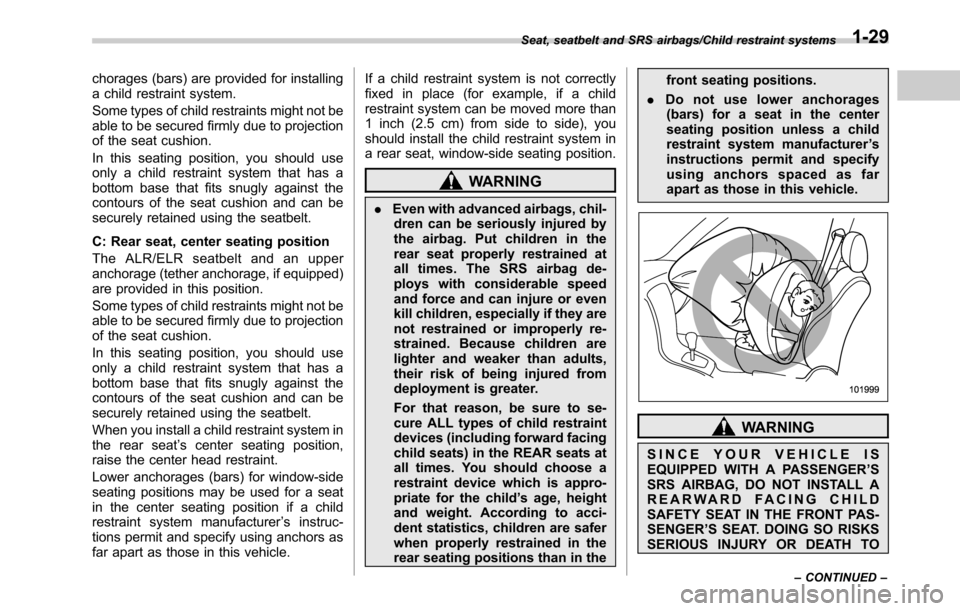
SINCE YOUR VEHICLE IS
EQUIPPED WITH A PASSENGER’S
SRS AIRBAG, DO NOT INSTALL A
REARWARD FACING CHILD
SAFETY SEAT IN THE FRONT PAS-
SENGER’S SEAT. DOING SO RISKS
SERIOUS INJURY OR DEATH TO
Seat, seatbelt and SRS airbags/Child restraint systems
–CONTINUED–1-29
Page 60 of 572
Seat, seatbelt and SRS airbags/Child restraint systems
THE CHILD BY PLACING THE
CHILD’SHEADTOOCLOSETO
THE SRS AIRBAG.
&Choosing a child restraint
system
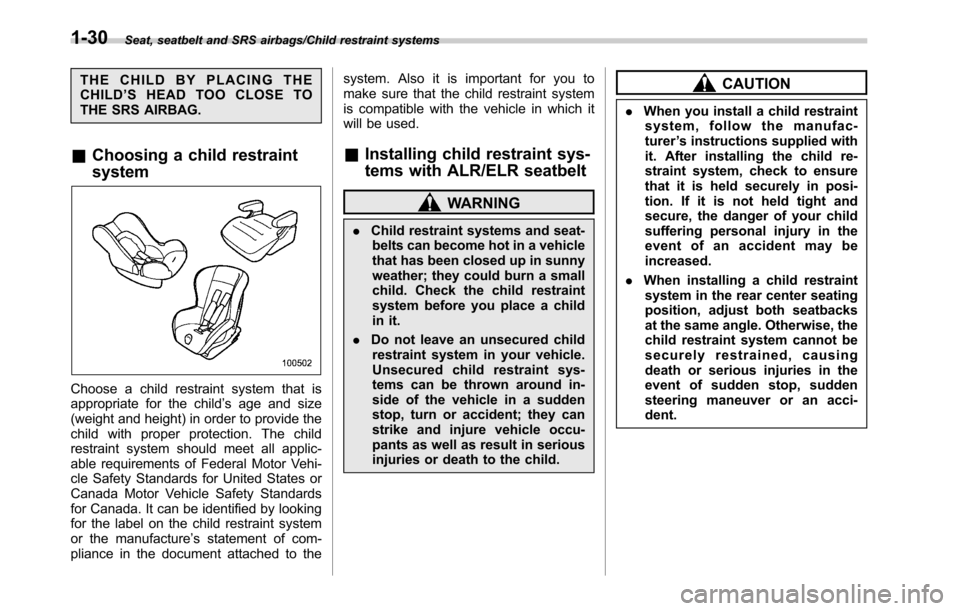
Choose a child restraint system that is
appropriate for the child’s age and size
(weight and height) in order to provide the
child with proper protection. The child
restraint system should meet all applic-
able requirements of Federal Motor Vehi-
cle Safety Standards for United States or
Canada Motor Vehicle Safety Standards
for Canada. It can be identified by looking
for the label on the child restraint system
or the manufacture’s statement of com-
pliance in the document attached to thesystem. Also it is important for you to
make sure that the child restraint system
is compatible with the vehicle in which it
will be used.
&Installing child restraint sys-
tems with ALR/ELR seatbelt
WARNING
.Child restraint systems and seat-
belts can become hot in a vehicle
that has been closed up in sunny
weather; they could burn a small
child. Check the child restraint
system before you place a child
in it.
.Do not leave an unsecured child
restraint system in your vehicle.
Unsecured child restraint sys-
tems can be thrown around in-
side of the vehicle in a sudden
stop, turn or accident; they can
strike and injure vehicle occu-
pants as well as result in serious
injuries or death to the child.
CAUTION
.When you install a child restraint
system, follow the manufac-
turer’s instructions supplied with
it. After installing the child re-
straint system, check to ensure
that it is held securely in posi-
tion. If it is not held tight and
secure, the danger of your child
suffering personal injury in the
event of an accident may be
increased.
.When installing a child restraint
system in the rear center seating
position, adjust both seatbacks
at the same angle. Otherwise, the
child restraint system cannot be
securely restrained, causing
death or serious injuries in the
event of sudden stop, sudden
steering maneuver or an acci-
dent.
1-30
Page 75 of 572
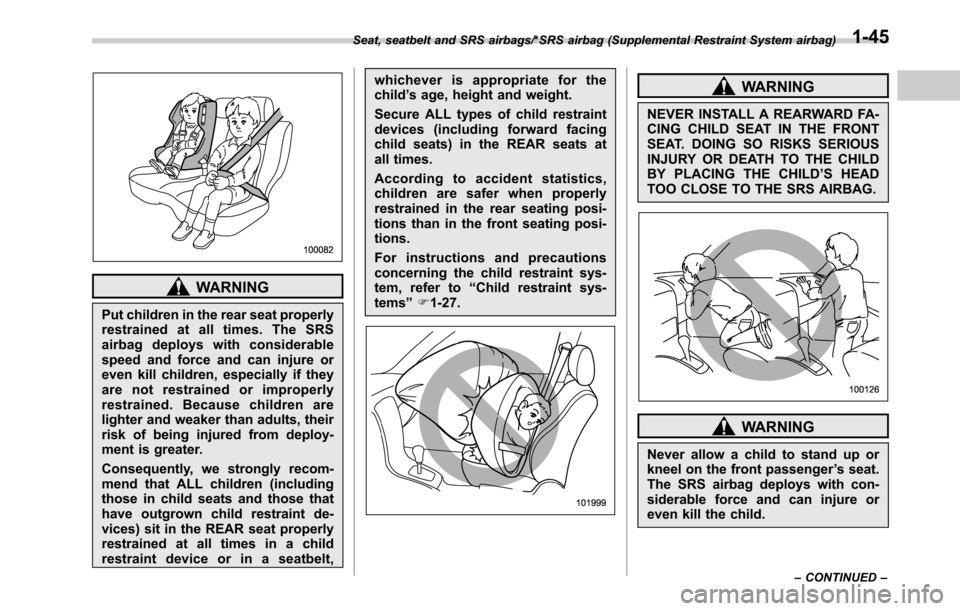
WARNING
Put children in the rear seat properly
restrained at all times. The SRS
airbag deploys with considerable
speed and force and can injure or
even kill children, especially if they
are not restrained or improperly
restrained. Because children are
lighter and weaker than adults, their
risk of being injured from deploy-
ment is greater.
Consequently, we strongly recom-
mend that ALL children (including
those in child seats and those that
have outgrown child restraint de-
vices) sit in the REAR seat properly
restrained at all times in a child
restraint device or in a seatbelt,whichever is appropriate for the
child’s age, height and weight.
Secure ALL types of child restraint
devices (including forward facing
child seats) in the REAR seats at
all times.
According to accident statistics,
children are safer when properly
restrained in the rear seating posi-
tions than in the front seating posi-
tions.
For instructions and precautions
concerning the child restraint sys-
tem, refer to“Child restraint sys-
tems”F1-27.
WARNING
NEVER INSTALL A REARWARD FA-
CING CHILD SEAT IN THE FRONT
SEAT. DOING SO RISKS SERIOUS
INJURY OR DEATH TO THE CHILD
BY PLACING THE CHILD’S HEAD
TOO CLOSE TO THE SRS AIRBAG.
WARNING
Never allow a child to stand up or
kneel on the front passenger’s seat.
The SRS airbag deploys with con-
siderable force and can injure or
even kill the child.
Seat, seatbelt and SRS airbags/*SRS airbag (Supplemental Restraint System airbag)
–CONTINUED–1-45
Page 87 of 572
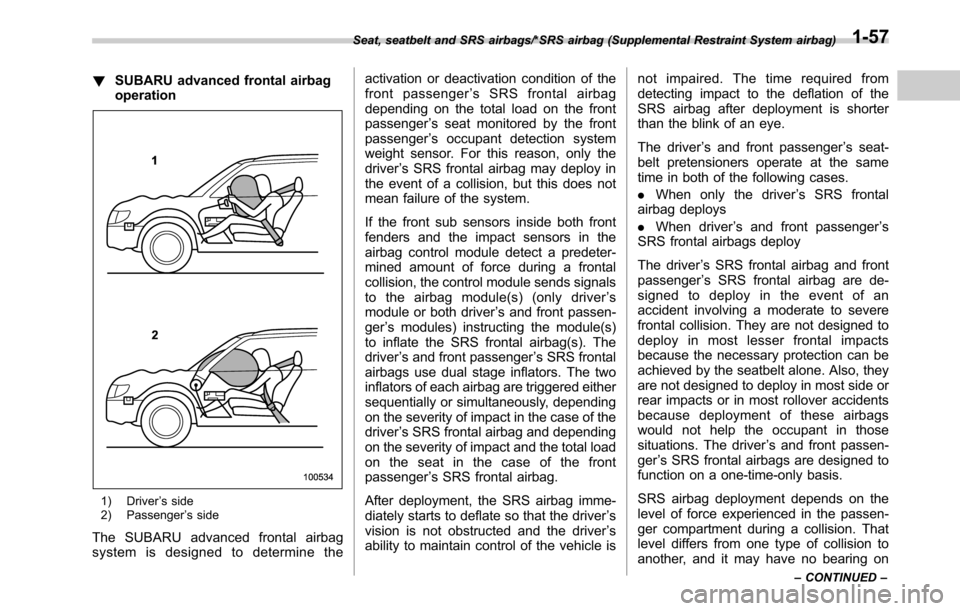
!SUBARU advanced frontal airbag
operation
1) Driver’s side
2) Passenger’s side
The SUBARU advanced frontal airbag
system is designed to determine theactivation or deactivation condition of the
front passenger’s SRS frontal airbag
depending on the total load on the front
passenger’s seat monitored by the front
passenger’s occupant detection system
weight sensor. For this reason, only the
driver’s SRS frontal airbag may deploy in
the event of a collision, but this does not
mean failure of the system.
If the front sub sensors inside both front
fenders and the impact sensors in the
airbag control module detect a predeter-
mined amount of force during a frontal
collision, the control module sends signals
to the airbag module(s) (only driver’s
module or both driver’s and front passen-
ger’s modules) instructing the module(s)
to inflate the SRS frontal airbag(s). The
driver’s and front passenger’s SRS frontal
airbags use dual stage inflators. The two
inflators of each airbag are triggered either
sequentially or simultaneously, depending
on the severity of impact in the case of the
driver’s SRS frontal airbag and depending
on the severity of impact and the total load
on the seat in the case of the front
passenger’s SRS frontal airbag.
After deployment, the SRS airbag imme-
diately starts to deflate so that the driver’s
vision is not obstructed and the driver’s
ability to maintain control of the vehicle isnot impaired. The time required from
detecting impact to the deflation of the
SRS airbag after deployment is shorter
than the blink of an eye.
The driver’s and front passenger’s seat-
belt pretensioners operate at the same
time in both of the following cases.
.When only the driver’s SRS frontal
airbag deploys
.When driver’s and front passenger’s
SRS frontal airbags deploy
The driver’s SRS frontal airbag and front
passenger’s SRS frontal airbag are de-
signed to deploy in the event of an
accident involving a moderate to severe
frontal collision. They are not designed to
deploy in most lesser frontal impacts
because the necessary protection can be
achieved by the seatbelt alone. Also, they
are not designed to deploy in most side or
rear impacts or in most rollover accidents
because deployment of these airbags
would not help the occupant in those
situations. The driver’s and front passen-
ger’s SRS frontal airbags are designed to
function on a one-time-only basis.
SRS airbag deployment depends on the
level of force experienced in the passen-
ger compartment during a collision. That
level differs from one type of collision to
another, and it may have no bearing on
Seat, seatbelt and SRS airbags/*SRS airbag (Supplemental Restraint System airbag)
–CONTINUED–1-57
Page 144 of 572
Keys and doors/Rear gate (Outback)
gate has stopped completely
after opening it.
.Before leaving the vehicle, al-
ways remove the key from the
ignition switch for safety (models
without“keyless access with
push-button start system”) and
never allow an unattended child
to remain in the vehicle. Failure
to follow this procedure could
result in injury to a child operat-
ing the power rear gate.
.The driver should be aware of
and pay careful attention to his/
her responsibilities.
.The power rear gate button
should only be used to open
and close the rear gate when
the area around the rear gate is
clearly visible and when you
have checked that there is no
danger of people being caught in
the gate.
CAUTION
.When closing the rear gate after
opening it, make sure to use the
power rear gate. If you close the
rear gate manually with extra
force, the power rear gate maybe damaged.
.Do not install any accessories
other than genuine SUBARU
parts on the rear gate. If the
weight of rear gate increases
excessively, the rear gate stay
cannot support the rear gate
sufficiently when opening the
rear gate. Also, the power rear
gate may not function properly or
may malfunction.
.Do not touch the driving rod
while the power rear gate oper-
ates or stops. Doing so may
result in injury or damage.
The power rear gate operates only when
all of the following conditions are satisfied.
.The vehicle is stopped completely.
.The outside temperature is within a
range from−228F to 1408F (from−308Cto
608C).
.The ignition switch is in the“LOCK”/
“OFF”or“ACC”position. Or, the ignition
switch is in the“ON”position and the
parking brake is applied (MT models)/the
select lever is in the“P”position (CVT
models).
We recommend using the power rear gate
function in most circumstances instead of
manual operation.
NOTE
.If the power rear gate button is
pressed repeatedly while the power
rear gate is operating, the system may
ignore the button operation in order to
avoid being damaged. Do not press the
button unnecessarily.
.It is not possible to stop the rear
gate temporarily while opening be-
tween the completely closed position
and approximately 12 in (30 cm) open.
If you press one of the power rear gate
buttons briefly during this range, the
rear gate will be closed.
.If the vehicle starts to move while
the power rear gate is operating, the
system sounds a buzzer and closes the
rear gate automatically. At this time, if
the system detects jamming, it will
deactivate the power rear gate and the
rear gate will not be closed. If this
occurs, close the rear gate manually.
.If you try to open the rear gate using
the power rear gate function immedi-
ately after closing the rear gate using
the power rear gate function, an elec-
tronic chirp will sound and the rear
gate will not open. Wait for a while
before trying to open the rear gate via
the power rear gate function.
2-42
Page 149 of 572
CAUTION
.If the reverse function is operated
3 times consecutively, automatic
opening and closing of the power
rear gate function will be can-
celed and the rear gate will stop
opening or closing suddenly.
Whether the rear gate opens or
closes depends on the rear gate
height when automatic operation
is ceased. Be careful that the rear
gate does not hit anyone’s head
or face, etc. and that fingers and
baggage, etc. are not caught in it.
.Take care not to damage the
touch sensors. Otherwise, the
reverse function may cease to
operate.
If, while opening or closing using power
rear gate, the rear gate catches persons
or baggage or hits an obstacle, an
electronic chirp will sound 3 times and
the rear gate will operate as follows.
When opening the rear gate:The rear
gate will automatically close.
When closing the rear gate:The rear
gate will automatically open.
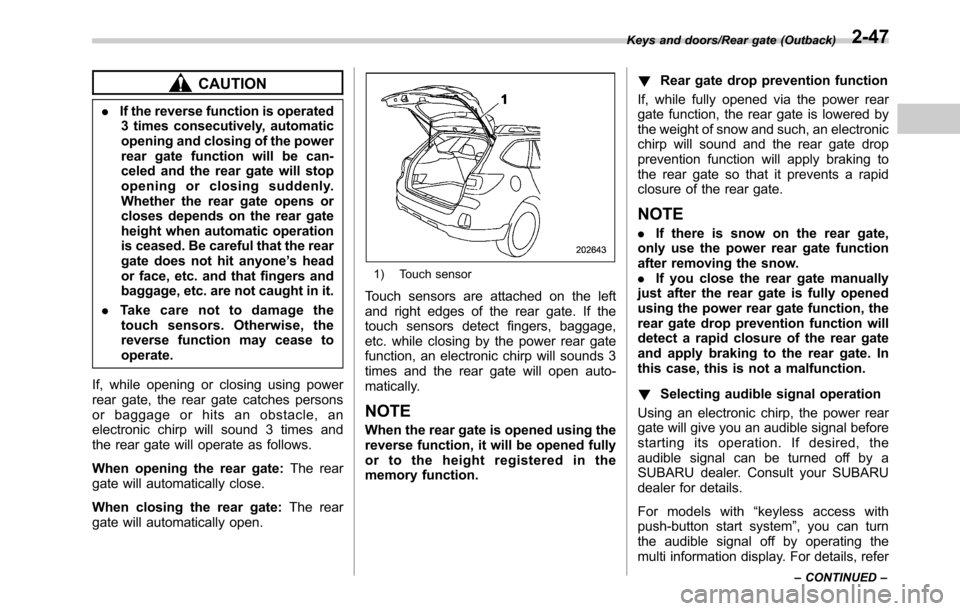
1) Touch sensor
Touch sensors are attached on the left
and right edges of the rear gate. If the
touch sensors detect fingers, baggage,
etc. while closing by the power rear gate
function, an electronic chirp will sounds 3
times and the rear gate will open auto-
matically.
NOTE
When the rear gate is opened using the
reverse function, it will be opened fully
or to the height registered in the
memory function.!Rear gate drop prevention function
If, while fully opened via the power rear
gate function, the rear gate is lowered by
the weight of snow and such, an electronic
chirp will sound and the rear gate drop
prevention function will apply braking to
the rear gate so that it prevents a rapid
closure of the rear gate.
NOTE
.If there is snow on the rear gate,
only use the power rear gate function
after removing the snow.
.If you close the rear gate manually
just after the rear gate is fully opened
using the power rear gate function, the
rear gate drop prevention function will
detect a rapid closure of the rear gate
and apply braking to the rear gate. In
this case, this is not a malfunction.
!Selecting audible signal operation
Using an electronic chirp, the power rear
gate will give you an audible signal before
starting its operation. If desired, the
audible signal can be turned off by a
SUBARU dealer. Consult your SUBARU
dealer for details.
For models with“keyless access with
push-button start system”, you can turn
the audible signal off by operating the
multi information display. For details, refer
Keys and doors/Rear gate (Outback)
–CONTINUED–2-47