steering SUBARU OUTBACK 2017 6.G User Guide
[x] Cancel search | Manufacturer: SUBARU, Model Year: 2017, Model line: OUTBACK, Model: SUBARU OUTBACK 2017 6.GPages: 610, PDF Size: 10.28 MB
Page 76 of 610
airbag deployment may cause
injuries if your head or other
parts of the body are too close
to the SRS side airbag.
. Since your vehicle is equipped
with SRS curtain airbags, do not
sit or lean unnecessarily close to
the front or rear door on either
side. Also, do not put your head,
arms or hands out of the window.
The SRS curtain airbags on both
sides of the cabin are stored in
the roof side (between the front
pillar and a point over the rear
seat), and they provide protec-
tion by deploying rapidly (faster
than the blink of an eye) in the
event of a side impact, a rollover
or also a frontal collision depend-
ing on circumstances. However,
the force of its deployment may
cause injuries if your head is too
close to it.
. Do not sit or lean unnecessarily
close to the SRS airbag. Because
the SRS airbag deploys with
considerable speed (faster than
the blink of an eye) and force to
protect in high speed collisions,
the force of an airbag can injure
an occupant whose body is too
close to SRS airbag. It is also important to wear your
seatbelt to help avoid injuries
that can result when the SRS
airbag contacts an occupant not
in proper position such as one
thrown forward during pre-acci-
dent braking.
Even when properly positioned,
there remains a possibility that
an occupant may suffer minor
injury such as abrasions and
bruises to the face or arms
because of the SRS airbag de-
ployment force.
WARNING
.
Do not rest your arm on either front door or its internal trim. You
could be injured in the event of
SRS side airbag deployment.
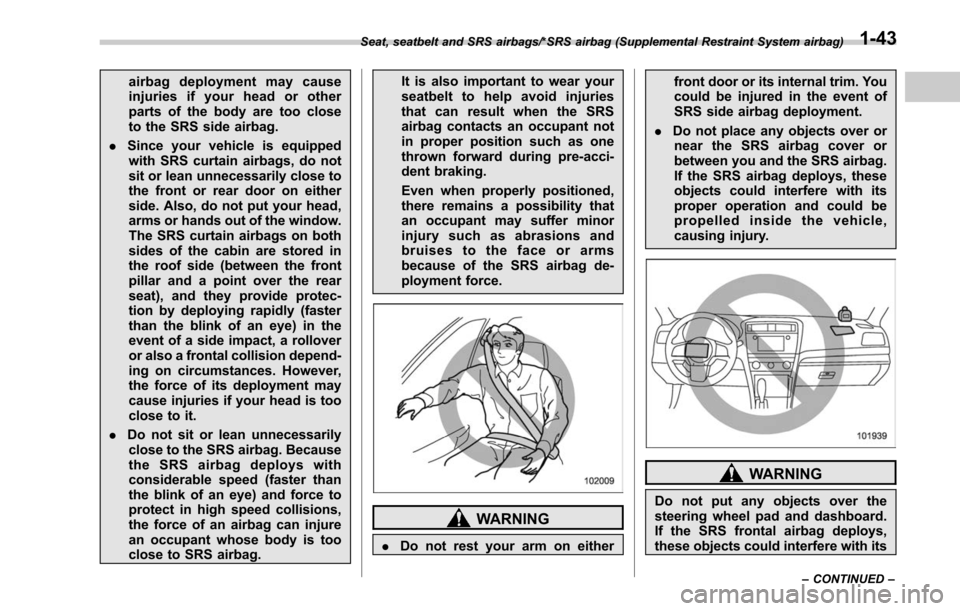
. Do not place any objects over or
near the SRS airbag cover or
between you and the SRS airbag.
If the SRS airbag deploys, these
objects could interfere with its
proper operation and could be
propelled inside the vehicle,
causing injury.
WARNING
Do not put any objects over the
steering wheel pad and dashboard.
If the SRS frontal airbag deploys,
these objects could interfere with its
Seat, seatbelt and SRS airbags/*SRS airbag (Supplemental Restraint System airbag)
–CONTINUED –1-43
Page 81 of 610
Seat, seatbelt and SRS airbags/*SRS airbag (Supplemental Restraint System airbag)
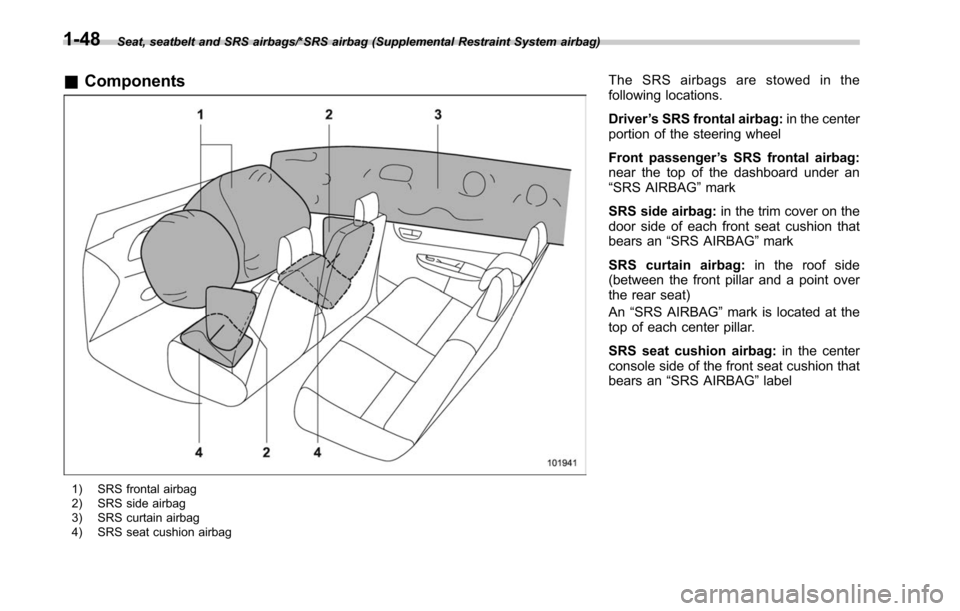
&Components
1) SRS frontal airbag
2) SRS side airbag
3) SRS curtain airbag
4) SRS seat cushion airbag
The SRS airbags are stowed in the
following locations.
Driver ’s SRS frontal airbag: in the center
portion of the steering wheel
Front passenger ’s SRS frontal airbag:
near the top of the dashboard under an
“SRS AIRBAG” mark
SRS side airbag: in the trim cover on the
door side of each front seat cushion that
bears an “SRS AIRBAG” mark
SRS curtain airbag: in the roof side
(between the front pillar and a point over
the rear seat)
An “SRS AIRBAG” mark is located at the
top of each center pillar.
SRS seat cushion airbag: in the center
console side of the front seat cushion that
bears an “SRS AIRBAG” label
1-48
Page 89 of 610
Seat, seatbelt and SRS airbags/*SRS airbag (Supplemental Restraint System airbag)
!How to contact the vehicle manu-
facturer concerning modifications
for persons with disabilities that
may affect the advanced airbag
system
Changing or moving any parts of the front
seats, seatbelts, front bumper, front side
frame, instrument panel, combination me-
ter, steering wheel, steering column, tire,
suspension or floor panel can affect the
operation of the SUBARU advanced air-
bag system. If you have any questions,
you may contact the following SUBARU
distributors:
Subaru of America, Inc.
Customer Dealer Services Department
P.O. Box 6000
Cherry Hill, NJ 08034-6000
1-800-SUBARU3 (1-800-782-2783)
Subaru Hawaii
2850 Pukoloa Street, Suite 202,
Honolulu, HI 96819-4467
808-839-2273
Shen
’s Corporation dba Prestige Automo-
bile
491, East Marine Corps Drive, Route 1
Dededo, Guam 96921-6255
671-633-2698
Trebol Motors
P.O. Box 11204, San Juan, Puerto Rico
00910
787-793-2828
Subaru Canada, Inc.
Consumer Support Department
560 Suffork Court, Mississauga, Ontario
L5R 4J7
1-800-894-4212
There are currently no SUBARU distribu-
tors in any other U.S. territories. If you are
in such an area, please contact the
SUBARU distributor or dealer from which
you bought your vehicle.& System operation
CAUTION
Do not touch the SRS airbag system
components with bare hands right
after deployment. Doing so can
cause burns because the compo-
nents can be very hot as a result of
deployment.
The SRS airbags can function only when
the ignition switch is in the “ON”position.
When the SRS airbag(s) deploy(s), a
sudden, fairly loud inflation noise will be
heard and some smoke will be released.
These occurrences are a normal result of
the deployment. This smoke does not
indicate a fire in the vehicle.
1-56
Page 95 of 610
Seat, seatbelt and SRS airbags/*SRS airbag (Supplemental Restraint System airbag)
deploys independently of the driver’s and
front passenger ’s SRS frontal airbags in
the steering wheel and instrument panel.
An impact sensor, which senses impact
force, is located in each of the following
locations.
. In the left and right front doors
. In the left and right center pillars
. In the left and right rear wheel houses
. In the airbag control module
. In the left and right front fenders (only
SRS curtain airbags are designed to
deploy when the front sub sensors sense
a severe impact.)
A rollover sensor is also located inside the
airbag control module.
If both of the following sensors together
sense an impact force above a predeter-
mined level in a side collision, the control
module causes both the SRS side airbag
and curtain airbag on the impacted side
to inflate regardless of whether the rear
wheel house impact sensor on the same
side senses an impact.
. the impact sensor that is located in the
airbag control module
. one of the center pillar impact sensors
or front door impact sensors
If both of the following sensors together sense an impact force above a predeter-
mined level in a side collision, the control
module causes
only the SRS curtain
airbag on the impacted side to inflate.
. the impact sensor that is located in the
airbag control module
. one of the rear wheel house impact
sensors
Even if a frontal collision occurs, both right
and left SRS curtain airbags will deploy
when the front sensor and the control unit
determine that the impact results from an
offset frontal collision.
The SRS curtain airbags are designed to
deploy under the following conditions.
. The driver ’s SRS frontal airbag deploys
or the driver ’s and passenger ’sSRS
frontal airbags deploy in a frontal collision.
. The system determines that the colli-
sion is an offset frontal collision.
. The vehicle is in an extremely inclined
state such as during a rollover.
The SRS curtain airbags are basically not
designed to deploy in the following cases.
. In a frontal collision when the SRS
frontal airbags do not deploy or the system
determines that the collision is other than
an offset frontal collision
. In most lesser inclined states If the rollover sensor detects rollover of the
vehicle, the control module inflates the
SRS curtain airbags
. At this time, the
driver ’s and front passenger ’s seatbelt
pretensioners also operate at the same
time.
After the deployment, the SRS side airbag
immediately starts to deflate. The time
required from detection of an impact to
deflation of an SRS side airbag after
deployment is shorter than the blink of
an eye.
The SRS curtain airbag remains inflated
for a while following deployment then
slowly deflates.
The SRS side airbag and SRS curtain
airbag deploy even when no one occupies
the seat on the side on which an impact is
applied.
The SRS side airbag and SRS curtain
airbag are designed as follows:
. to deploy in the event of an accident
involvingamoderatetosevereside
impact collision
. to function on a one-time-only basis.
The SRS side airbag and SRS curtain
airbag are not designed to deploy in the
following cases:
. in most lesser side impacts
1-62
Page 103 of 610
Seat, seatbelt and SRS airbags/*SRS airbag (Supplemental Restraint System airbag)
CAUTION
If you need service or repair in areas
indicated in the following list, have
the work performed by an author-
ized SUBARU dealer. The SRS air-
bag control module, impact sensors
and airbag modules are stored in
these areas.
.Under the center console
. Inside each front fender
. Steering wheel and column and
nearby areas
. Top of the dashboard on front
passenger ’ssideandnearby
areas
. Each front seat and nearby area
. Inside each center pillar
. Inside each front door
. In each roof side (from the front
pillar to a point over the rear seat)
. Between the rear seat cushion
and rear wheel house on each
side
. Under the rear center seat
In the event that the SRS airbag is
deployed, replacement of the system
should be performed only by an author-
ized SUBARU dealer. When the compo- nents of the SRS airbag system are
replaced, use only genuine SUBARU
parts.
NOTE
In the following cases, contact your
SUBARU dealer as soon as possible.
.
The front part of the vehicle was
involved in an accident in which only
the driver ’s SRS frontal airbag or both
driver ’s and front passenger ’sSRS
frontal airbags did not deploy.
. The pad of the steering wheel, the
cover over the front passenger ’s SRS
frontal airbag, or either roof side (from
the front pillar to a point over the rear
seat) is scratched, cracked, or other-
wise damaged.
. The center pillar, front door, rear
wheel house or rear sub frame, or an
area near these parts, was involved in
an accident in which the SRS side
airbag and SRS curtain airbag did not
deploy.
. The fabric or leather of either front
seatback and seat cushion is cut,
frayed, or otherwise damaged.
. The rear part of the vehicle was
involved in an accident.
& Precautions against vehicle
modification
WARNING
. To avoid accidental activation of
the system or rendering the sys-
tem inoperative, which may re-
sult in serious injury, no modifi-
cations should be made to any
components or wiring of the SRS
airbag system.
This includes the following mod-
ifications.
– Installation of custom steering
wheels
– Attachment of additional trim
materials to the dashboard
– Installation of custom seats
– Replacement of seat fabric or
leather
– Installation of additional fabric
or leather on the front seat
– Attachment of a hands-free
microphone or any other ac-
cessory to a front pillar, a
center pillar, a rear pillar, the
windshield, a side window, an
assist grip, or any other cabin
surface that would be near a
1-70
Page 117 of 610
Keys and doors/Keyless access with push–button start system
following precautions to prevent
malfunctions or battery dis-
charge.
– Although you can replace the
battery of the access key by
yourself, it is recommended
that the battery be replaced by
a SUBARU dealer to avoid the
risk of damage at the time of
replacement.
– Do not get the access key wet.
If the access key gets wet,
wipe it off immediately and let
it dry completely.
– Do not apply strong impacts
to the access key.
– Keep the access key away
from magnetic sources.
– Never leave the access key in
direct sunlight or anywhere
that may become hot, such
as on the dashboard. It may
damage the battery or cause
circuit malfunctions.
– Do not wash the access key in
an ultrasonic washer.
– Do not leave the access key in
humid or dusty locations, or
near personal computers or
home electric appliances.NOTE
After the vehicle battery is discharged
or replaced, initialization of the steering
lock system may be required to start
the engine. In this case, perform the
following procedure to initialize the
steering lock.
1) Turn the push-button ignition
switch to the “OFF ”position. For de-
tails, refer to “Switching power status ”
F 3-7.
2) Open and close the driver ’s door.
3) Wait for approximately 10 seconds.
When the steering is locked, the initi-
alization is completed.
! Regarding access key
CAUTION
If the access key is dropped, the
integrated mechanical key inside
may become loose. Be careful not
to lose the mechanical key.
NOTE
.The access key is always commu-
nicating with the vehicle and is con-
tinuously using the battery. Although
the life of the battery varies depending
on the operating conditions, it is ap- proximately 1 to 2 years. If the battery
becomes fully discharged, replace it
with a new one.
.
If an access key is lost, it is
recommended that the access key be
reregistered. For reregistration of an
access key, contact a SUBARU dealer.
. Up to 7 access keys can be regis-
tered for one vehicle. For a spare
access key, contact a SUBARU dealer.
. Carefully store the key number plate
supplied with the access key. It is
necessary for vehicle repair and addi-
tional registration of access keys.
. Do not leave the access key in the
storage spaces inside the vehicle.
Vibrations may damage the key or turn
on the switch, possibly resulting in a
lockout.
! Regarding setting
NOTE
.The operational/non-operational
setting for the keyless access function
can be changed. For the setting proce-
dure, refer to “Disabling keyless ac-
cess function” F2-18. The setting can
also be changed by a SUBARU dealer.
For more details, contact a SUBARU
dealer.
. For detailed information about the
operation method for the push-button
2-12
Page 156 of 610
Ignition switch (models without push-button start system) ......................................... 3-4
LOCK.................................................................. 3-4
ACC.................................................................... 3-5
ON...................................................................... 3-5
START ................................................................ 3-5
Key reminder chime ............................................ 3-5
Ignition switch light ............................................. 3-5
Push-button ignition switch (models with
push-button start system) ............................... 3-6
Safety precautions.............................................. 3-6
Operating range for push-button start system ...... 3-6
Switching power status ....................................... 3-7
When access key does not operate properly ........ 3-8
Hazard warning flasher....................................... 3-8
Meters and gauges. ............................................. 3-8
Combination meter illumination ........................... 3-8
Canceling the function for meter/gauge needle movement upon turning on the ignition
switch ............................................................... 3-9
Speedometer ....................................................... 3-9
Odometer ............................................................ 3-9
Double trip meter ............................................... 3-10
Tachometer ........................................................ 3-10
Fuel gauge ......................................................... 3-11
Temperature gauge ............................................ 3-12
ECO gauge ........................................................ 3-12
Warning and indicator lights ............................. 3-13
Seatbelt warning light and chime ........................ 3-13
SRS airbag system warning light ........................ 3-15Front passenger
’s frontal airbag ON and OFF
indicators ........................................................ 3-15
CHECK ENGINE warning light/Malfunction indicator light .................................................. 3-16
Charge warning light .......................................... 3-16
Oil pressure warning light .................................. 3-16
Engine low oil level warning indicator ................ 3-17
AT OIL TEMP warning light (CVT models) ........... 3-17
Low tire pressure warning light (U.S. spec. models) ........................................................... 3-17
ABS warning light .............................................. 3-19
Brake system warning light ................................ 3-19
Electronic parking brake indicator light .............. 3-21
Hill Holder indicator light ................................... 3-22
Low fuel warning light ....................................... 3-22
Door open indicator ........................................... 3-23
Windshield washer fluid warning indicator .......... 3-23
All-Wheel Drive warning light (CVT models) ... ..... 3-23
Power steering warning light .............................. 3-23
Vehicle Dynamics Control warning light/Vehicle Dynamics Control operation indicator light .. ..... 3-24
Vehicle Dynamics Control OFF indicator light ..... 3-25
Warning chimes and warning indicator of the keyless access with push-button start system (if
equipped) ........................................................ 3-25
Security indicator light ....................................... 3-30
Select lever/gear position indicator ..................... 3-31
Turn signal indicator lights ................................. 3-31
High beam indicator light ................................... 3-31
High beam assist indicator (green) (if equipped) ........................................................ 3-31
Instruments and controls
3
Page 157 of 610
Instruments and controls
High beam assist warning indicator (yellow) (ifequipped) ......................................................... 3-31
Cruise control indicator ...................................... 3-31
Cruise control set indicator ................................ 3-32
Automatic headlight beam leveler warning light (models with HID headlights) ............................ 3-32
Headlight indicator light ..................................... 3-32
Front fog light indicator light (if equipped) .......... 3-32
X-mode indicator (if equipped) ............................ 3-32
Hill descent control indicator (if equipped) .......... 3-32
Steering responsive fog lights OFF indicator (models with EyeSight system) ......................... 3-32
BSD/RCTA warning indicator (if equipped) .......... 3-32
BSD/RCTA OFF indicator (if equipped) ................ 3-32
Icy road surface warning indicator ...................... 3-32
RAB warning indicator (if equipped) ................... 3-33
RAB OFF indicator (if equipped) ......................... 3-33
Sonar audible alarm OFF indicator (if equipped) ......................................................... 3-33
Information display ............................................ 3-33Clock................................................................. 3-34
Climate control mode indicators ......................... 3-35
Outside temperature indicator ............................ 3-35
Multi information display................................... 3-36Basic operation.................................................. 3-36
Welcome screen and Good-bye screen ............... 3-37
Warning screen .................................................. 3-37
Basic screens .................................................... 3-38
Telltale screen .................................................... 3-40
Menu screens .................................................... 3-41
Light control switch ........................................... 3-46
Headlights......................................................... 3-47
High/low beam change (dimmer) ... ..................... 3-49
Headlight flasher ............................................... 3-53
Daytime running light system ............................. 3-53
Headlight beam leveler (models with HID
headlights) ...................................................... 3-54
Turn signal lever ................................................ 3-54
One-touch lane changer ..................................... 3-55
Illumination brightness control ......................... 3-55Auto dimmer cancel function............................. 3-55
Front fog light switch (if equipped) .................. 3-56
Steering responsive fog lights system (models
with EyeSight system) ..................................... 3-56
Wiper and washer.............................................. 3-57Windshield wiper and washer switches .............. 3-59
Rear window wiper and washer switch (Outback) ........................................................ 3-60
Defogger and deicer .......................................... 3-61
Mirrors ................................................................ 3-63
Inside mirror (without auto-dimming function) (if
equipped) ........................................................ 3-63
Auto-dimming mirror/compass with HomeLink
®(U.S.-spec. models without EyeSight system - if
equipped) ........................................................ 3-63
Auto-dimming mirror with HomeLink
®(except
U.S.-spec. models - if equipped) .. ..................... 3-69
Auto-dimming mirror/compass with HomeLink
®(models with EyeSight system) ... ..................... 3-74
Outside mirrors ................................................. 3-81
Page 158 of 610
Instruments and controls
Tilt/telescopic steering wheel............................ 3-82
Horn .................................................................... 3-83 Heated Steering Wheel system (if
equipped) ........................................................ 3-83
Page 159 of 610
Instruments and controls/Ignition switch (models without push–button start system)
Ignition switch (models with-
out push-button start sys-
tem)
WARNING
. Never turn the ignition switch to
“ LOCK” while the vehicle is
being driven or towed because
that will lock the steering wheel,
preventing steering control. And
when the engine is turned off, it
takes a much greater effort than
usual to steer.
. Before leaving the vehicle, al-
ways remove the key from the
ignition switch for safety and
never allow an unattended child
to remain in the vehicle. Failure
to follow this procedure could
result in injury to a child or
others. Children could operate
the power windows, the moon-
roof or other controls or even
make the vehicle move.
CAUTION
Do not attach a large key holder or
key case to either key. If it banged against your knees or hands while
you are driving, it could turn the
ignition switch from the
“ON ”posi-
tion to the “ACC ”or “LOCK ”posi-
tion, thereby stopping the engine.
Also, if the key is attached to a
keyholder or to a large bunch of
other keys, centrifugal force may act
on it as the vehicle moves, resulting
in unwanted turning of the ignition
switch.
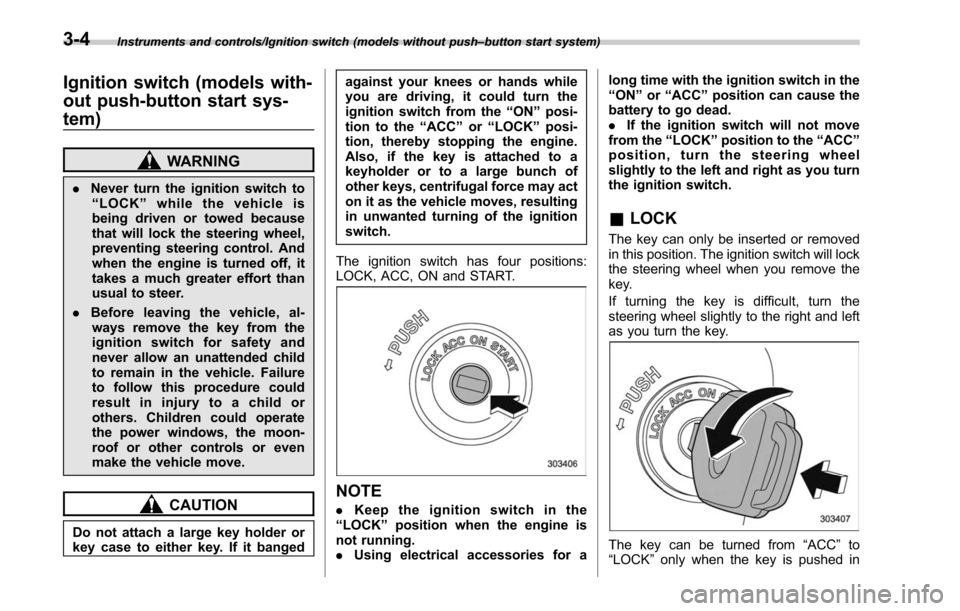
The ignition switch has four positions:
LOCK, ACC, ON and START.
NOTE
. Keep the ignition switch in the
“ LOCK ”position when the engine is
not running.
. Using electrical accessories for a long time with the ignition switch in the
“
ON ”or “ACC ”position can cause the
battery to go dead.
. If the ignition switch will not move
from the “LOCK ”position to the “ACC ”
position, turn the steering wheel
slightly to the left and right as you turn
the ignition switch.
& LOCK
The key can only be inserted or removed
in this position. The ignition switch will lock
the steering wheel when you remove the
key.
If turning the key is difficult, turn the
steering wheel slightly to the right and left
as you turn the key.
The key can be turned from “ACC”to
“LOCK ”only when the key is pushed in
3-4