fog light SUBARU OUTBACK 2017 6.G Owner's Manual
[x] Cancel search | Manufacturer: SUBARU, Model Year: 2017, Model line: OUTBACK, Model: SUBARU OUTBACK 2017 6.GPages: 610, PDF Size: 10.28 MB
Page 248 of 610
WARNING
Continued operation in the ON posi-
tion may fog up the windows. Switch
to the OFF position as soon as the
outside dusty condition clears.
Defrosting
Select the desired“”mode or “”mode
to defrost or dehumidify the windshield
and front door windows by performing the
following procedures.
. To select the “
”mode, press the
defroster button.
. To select the “
”mode, press the
airflow mode selection button and select
the “
”mode.
NOTE
. When the “”mode or “”mode
is selected, the air conditioner com-
pressor automatically operates to more
quickly defog the windshield. (The air
conditioner indicator light does not
illuminate in this case.) At the same
time, the air inlet selection is automa-
tically set to the outside air mode. For
details, refer to “Airflow mode selec-
tion ”F 4-6.
. If the defroster button is pressed
while the “
”mode is selected, it will
return to the previous mode before
selecting the “
”mode.
Operating tips for heater and
air conditioner
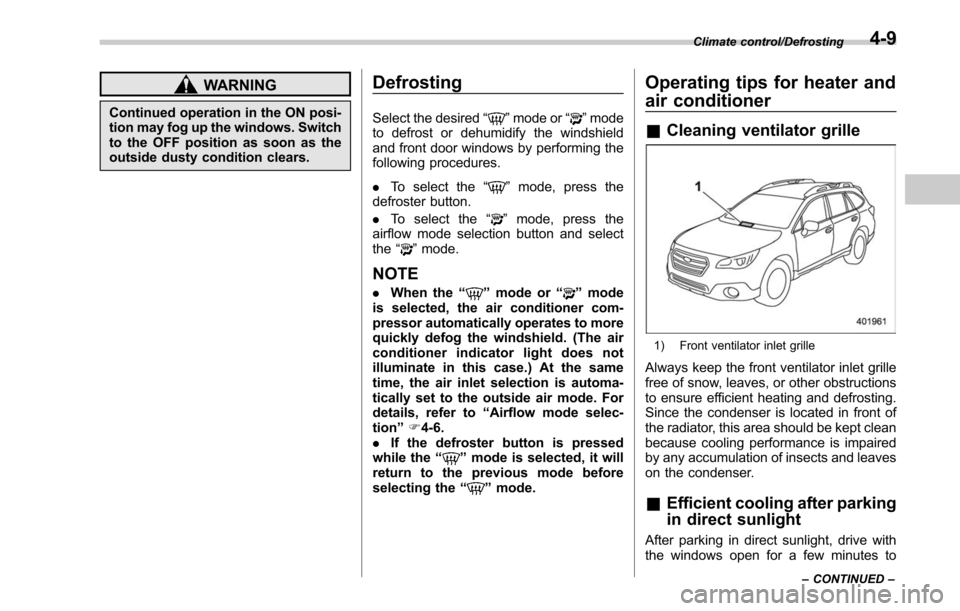
& Cleaning ventilator grille
1) Front ventilator inlet grille
Always keep the front ventilator inlet grille
free of snow, leaves, or other obstructions
to ensure efficient heating and defrosting.
Since the condenser is located in front of
the radiator, this area should be kept clean
because cooling performance is impaired
by any accumulation of insects and leaves
on the condenser.
&Efficient cooling after parking
in direct sunlight
After parking in direct sunlight, drive with
the windows open for a few minutes to
Climate control/Defrosting
–CONTINUED –4-9
Page 380 of 610
CAUTION
Trapping small animals in the cool-
ing fan and belts of the engine may
result in a malfunction. Check that
no small animal enters the engine
compartment and under the vehicle
before starting the engine.
NOTE
.Engine oil, engine coolant, brake
fluid, washer fluid and other fluid levels
should be checked daily, weekly or at
fuel stops.
. When towing a trailer, refer to “Trai-
ler hitch (Outback —if equipped) ”F 8-
19.
Starting and stopping the
engine (models without
push-button ignition switch)
& General precautions when
starting/stopping engine
WARNING
. Never start the engine from out-
side the vehicle (except when
using the remote engine start
system). It may result in an
accident.
. Do not leave the engine running
in locations with poor ventilation,
such as a garage and indoors.
The exhaust gas may enter the
vehicle or indoors, and it may
result in carbon monoxide poi-
soning.
. Do not start the engine near dry
foliage, paper, or other flam-
mable substances. The exhaust
pipe and exhaust emissions can
create a fire hazard at high
temperatures.
CAUTION
. If the engine is stopped during driving, the catalyst may over-
heat and burn.
. When starting the engine, be sure
to sit in the driver ’s seat (except
when using the remote engine
start system).
NOTE
. Avoid rapid racing and rapid accel-
eration immediately after the engine
has started.
. For a short time after the engine has
started, the engine speed is kept high.
When the warm-up is completed, the
engine speed lowers automatically.
. On rare occasions, it may be difficult
to start the engine depending on the
fuel and the usage condition (repeated
driving of a distance in which the
engine has not warmed up sufficiently).
In such a case, it is recommended that
you change to a different brand of fuel.
. On rare occasions, transient knock-
ing may be heard from the engine when
the accelerator is operated rapidly
such as a rapid start-up and a rapid
acceleration. This is not a malfunction.
. The engine starts more easily when
the headlights, air conditioner and rear
window defogger are turned off.
Starting and operating/Starting and stopping the engine (models without push –button ignition switch)
–CONTINUED –7-9
Page 428 of 610
The BSD/RCTA will resume operation
once these conditions are corrected,
and the BSD/RCTA warning indicator
will disappear. However, if the BSD/
RCTA warning indicator appears for a
prolonged period of time, have the
system inspected at a SUBARU dealer
as soon as possible.
.The detectability of the radar sen-
sors is restricted. The BSD/RCTA de-
tection may be impaired and the sys-
tem may not operate properly under the
following conditions.
–When the rear bumper around
the radar sensors is distorted
– When ice, snow or mud adheres
to the rear bumper surface around
the radar sensors
– When stickers, etc. are affixed on
the areas of the radar sensors on
the rear bumper
– During adverse weather condi-
tions such as rain, snow or fog
– When driving on wet roads such
as snow-covered roads and
through puddles
. The radar sensors may not detect or
may have difficulty detecting the fol-
lowing vehicles and objects.
–Small motorcycles, bicycles, pe-
destrians, stationary objects on the
road or road side, etc. –
Vehicles with body shapes that
the radar may not reflect (vehicles
with lower body height such as a
trailer with no cargo and sports
cars)
– Vehicles that are not approach-
ing your vehicle even though they
are in the detection area (either on a
neighboring lane to the rear or
beside your vehicle when rever-
sing) (The system determines the
presence of approaching vehicles
based on data detected by the radar
sensors.)
– Vehicles traveling at significantly
different speeds
– Vehicles driving in parallel at
almost the same speed as your
vehicle for a prolonged time
– Oncoming vehicles
– Vehicles in a lane beyond the
neighboring lane
– Vehicles travelling at a signifi-
cantly lower speed that you are
trying to overtake
. On a road with extremely narrow
lanes, the system may detect vehicles
driving in a lane next to the neighbor-
ing lane.& BSD/RCTA approach indica-
tor light/warning buzzer
While the BSD/RCTA is active, the follow-
ing item(s) will operate to alert the driver:
. The BSD/RCTA approach indicator
light (when there are vehicles in the
neighboring lanes).
. The BSD/RCTA approach indicator
light and warning buzzer (when a vehicle
is approaching from the left or right side
while your vehicle is reversing)
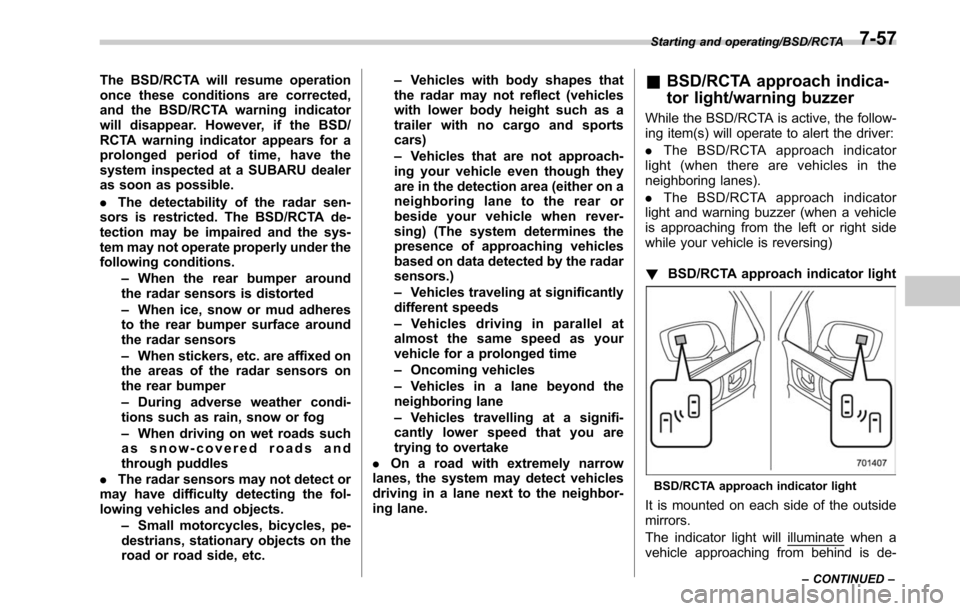
! BSD/RCTA approach indicator light
BSD/RCTA approach indicator light
It is mounted on each side of the outside
mirrors.
The indicator light will
illuminate when a
vehicle approaching from behind is de-
Starting and operating/BSD/RCTA
–CONTINUED –7-57
Page 437 of 610
Starting and operating/Reverse Automatic Braking System
near the sonar sensor
–Commercial electronic parts
(fog light, fender pole, radio
antenna) or commercial at-
tachment parts (trailer hitch,
bicycle carrier, bumper guard)
are attached
– Parts that emit high frequency
sound, such as a horn or
speaker, are attached
Vehicle conditions – The vehicle is significantly
inclined
– The ground clearance is sig-
nificantly reduced due to the
vehicle’ s loading condition,
etc.
– When the sonar sensor is
misaligned due to a collision
or an accident
Surrounding environment – A cloth banner, flag, hanging
branch or railroad crossing
bars are present in the rever-
sing direction
– When reversing on a gravel or
grassy area
– When reversing in an area
where objects or walls are
adjacent to the vehicle such as narrow tunnels, narrow
bridges, narrow roads or nar-
row garages
– Wheel track or hole is present
in the ground of the reversing
direction
– When reversing over a drai-
nage cover (grating cover)
– The path of the reversing
direction is inclined such as
on a steep uphill
– A curb is present in the rever-
sing direction
– When reversing downhill
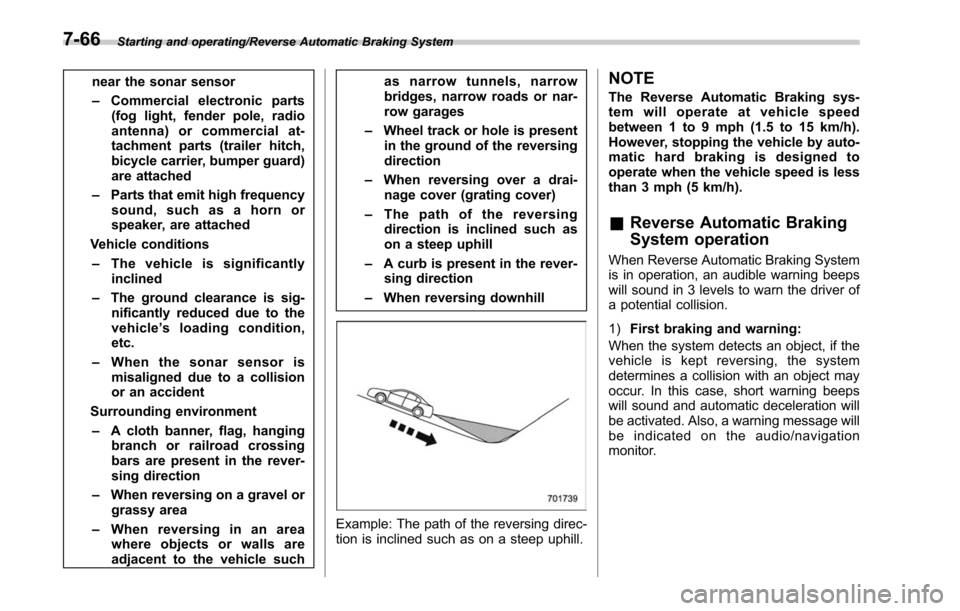
Example: The path of the reversing direc-
tion is inclined such as on a steep uphill.
NOTE
The Reverse Automatic Braking sys-
tem will operate at vehicle speed
between 1 to 9 mph (1.5 to 15 km/h).
However, stopping the vehicle by auto-
matic hard braking is designed to
operate when the vehicle speed is less
than 3 mph (5 km/h).
&Reverse Automatic Braking
System operation
When Reverse Automatic Braking System
is in operation, an audible warning beeps
will sound in 3 levels to warn the driver of
a potential collision.
1) First braking and warning:
When the system detects an object, if the
vehicle is kept reversing, the system
determines a collision with an object may
occur. In this case, short warning beeps
will sound and automatic deceleration will
be activated. Also, a warning message will
be indicated on the audio/navigation
monitor.
7-66
Page 505 of 610
Maintenance and service
Wheel replacement........................................... 11-31
Aluminum wheels............................................. 11-32
Windshield washer fluid .................................. 11-32
Replacement of wiper blades .......................... 11-33
Windshield wiper blade assembly ..................... 11-34
Windshield wiper blade rubber ......................... 11-34
Rear window wiper blade assembly (Outback) ....................................................... 11-35
Rear window wiper blade rubber (Outback) ... .... 11-36
Battery............................................................... 11-37
Fuses ................................................................ 11-38
Installation of accessories ............................... 11-40
Replacing bulbs ............................................... 11-40
HID headlights (if equipped) ............................. 11-40
Halogen headlights .......................................... 11-41 Front turn signal light
...................................... 11-42
Front side marker light ..................................... 11-42
Front fog light (if equipped) .............................. 11-42
Rear combination lights ................................... 11-44
Backup light .................................................... 11-46
License plate light ........................................... 11-47
Dome light ....................................................... 11-48
Map light ......................................................... 11-48
Door step light ................................................. 11-49
Cargo area light (Outback) ............................... 11-49
Trunk light (Legacy) ......................................... 11-49
Other bulbs ..................................................... 11-49
Replacing battery ............................................. 11-50Replacing battery of access key ....................... 11-50
Replacing battery of transmitter ....................... 11-51
Page 543 of 610
Maintenance and service/Installation of accessories
Contact your SUBARU dealer for repairs.Installation of accessories
Always consult your SUBARU dealer
before installing fog lights or any other
electrical equipment in your vehicle. Such
accessories may cause the electronic
system to malfunction if they are incor-
rectly installed or if they are not suited for
the vehicle. We recommend that you
install only genuine SUBARU accessories
on your vehicle.
Replacing bulbs
WARNING
Bulbs may become very hot while
illuminated. Before replacing bulbs,
turn off the lights and wait until the
bulbs cool down, Otherwise, there is
the risk of sustaining a burn injury.
CAUTION
Replace any bulb only with a new
bulb of the specified wattage. Using
a bulb of different wattage could
result in a fire. For the specified
wattage of each bulb, refer to“Bulb
chart ”F12-14. For replacement,
contact your SUBARU dealer.
& HID headlights (if equipped)
WARNING
High-intensity-discharge (HID) bulbs
are used for the low beams of the
headlights. These HID bulbs use an
extremely high voltage. To avoid the
risk of an electric shock that could
result in serious injury, observe the
11-40
Page 545 of 610
Maintenance and service/Replacing bulbs
Low beam headlight (if equipped)
High beam headlight
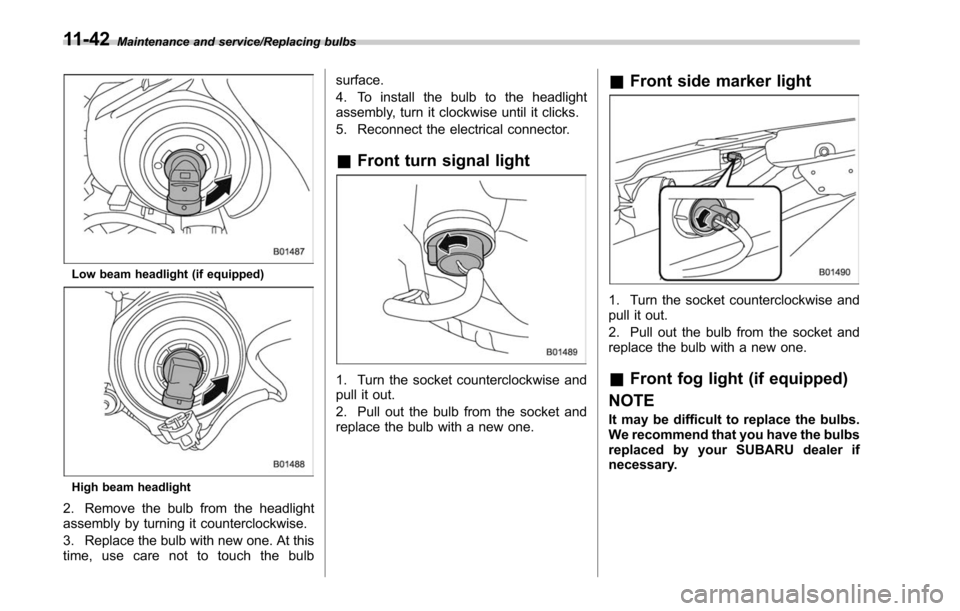
2. Remove the bulb from the headlight
assembly by turning it counterclockwise.
3. Replace the bulb with new one. At this
time, use care not to touch the bulbsurface.
4. To install the bulb to the headlight
assembly, turn it clockwise until it clicks.
5. Reconnect the electrical connector.
&
Front turn signal light
1. Turn the socket counterclockwise and
pull it out.
2. Pull out the bulb from the socket and
replace the bulb with a new one.
&Front side marker light
1. Turn the socket counterclockwise and
pull it out.
2. Pull out the bulb from the socket and
replace the bulb with a new one.
&Front fog light (if equipped)
NOTE
It may be difficult to replace the bulbs.
We recommend that you have the bulbs
replaced by your SUBARU dealer if
necessary.
11-42
Page 571 of 610
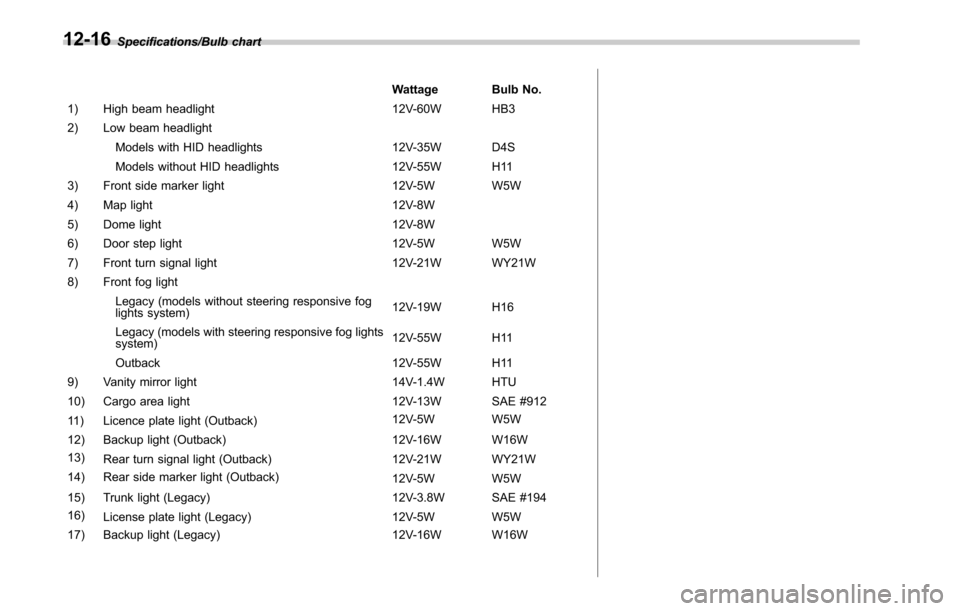
Specifications/Bulb chartWattage Bulb No.
1) High beam headlight 12V-60W HB3
2) Low beam headlight Models with HID headlights 12V-35W D4S
Models without HID headlights 12V-55W H11
3) Front side marker light 12V-5W W5W
4) Map light 12V-8W
5) Dome light 12V-8W
6) Door step light 12V-5W W5W
7) Front turn signal light 12V-21W WY21W
8) Front fog light
Legacy (models without steering responsive fog
lights system) 12V-19W H16
Legacy (models with steering responsive fog lights
system) 12V-55W H11
Outback 12V-55W H11
9) Vanity mirror light 14V-1.4W HTU
10) Cargo area light 12V-13W SAE #912
11) Licence plate light (Outback) 12V-5W W5W
12) Backup light (Outback) 12V-16W W16W
13) Rear turn signal light (Outback) 12V-21W WY21W
14) Rear side marker light (Outback) 12V-5W W5W
15) Trunk light (Legacy) 12V-3.8W SAE #194
16) License plate light (Legacy) 12V-5W W5W
17) Backup light (Legacy) 12V-16W W16W12-16
Page 593 of 610

14-4Index
Locks................................................................... 2-34
Chime Key ........................................................................\
3-5
Light ..................................................................... 3-46
Seatbelt ................................................................ 3-13
Cleaning Aluminum wheels ................................................... 10-3
Interior .................................................................. 10-5
Ventilation grille ....................................................... 4-9
Climate control system ................................................. 4-3
Automatic ................................................................ 4-5
Manual ................................................................... 4-6
Clock ........................................................................\
3-34
Clutch Fluid ............................................................ 11-21, 12-8
Pedal .................................................................. 11-23
Coat hook ................................................................. 6-12
Console ...................................................................... 6-6
Continuously variable transmission (CVT) ..................... 7-25
Fluid ............................................................ 11-19, 12-8
Oil temperature warning light (AT OIL TEMP) ............ 3-17
Coolant ............................................................ 11-15, 12-8
Cooling system ......................................................... 11-14
Corrosion protection ................................................... 10-4
Crossbars ................................................................. 8-15
Cruise control ............................................................ 7-50
Indicator. ............................................................... 3-31
Set indicator .......................................................... 3-32
Cup holder .................................................................. 6-8
Front passenger ’s .................................................... 6-8
Rear passenger ’s..................................................... 6-9 D
Daytime running light system
....................................... 3-53
Defogger ................................................................... 3-61
Defrosting ................................................................... 4-9
Deicer ....................................................................... 3-61
Differential gear oil Front ........................................................... 11-19, 12-7
Rear ........................................................... 11-19, 12-7
Dimensions ................................................................ 12-2
Disarming the alarm system ......................................... 2-32
Disc brake pad wear warning indicators ........................ 7-33
Dome light ......................................................... 6-2, 11-48
Door Locks ..................................................................... 2-6
Open indicator light ................................................. 3-23
Step light ............................................................. 11-49
Unlock selection function ................................. 2-18, 3-45
Double trip meter ........................................................ 3-10
Drive belts ............................................................... 11-18
Driving All-Wheel Drive warning light ................................... 3-23
AWD vehicles ......................................................... 8-5
Car phone/cell phone .................................................. 7
Drinking. ....................................................................
6
Drugs ........................................................................\
6
Foreign countries ..................................................... 8-4
Off road .................................................................. 8-6
Pets ........................................................................\
.. 7
Snowy and icy roads .............................................. 8-10
Tips ................................................. 7-24, 7-31, 8-2, 8-5
Tired or sleepy ........................................................... 7
Page 594 of 610
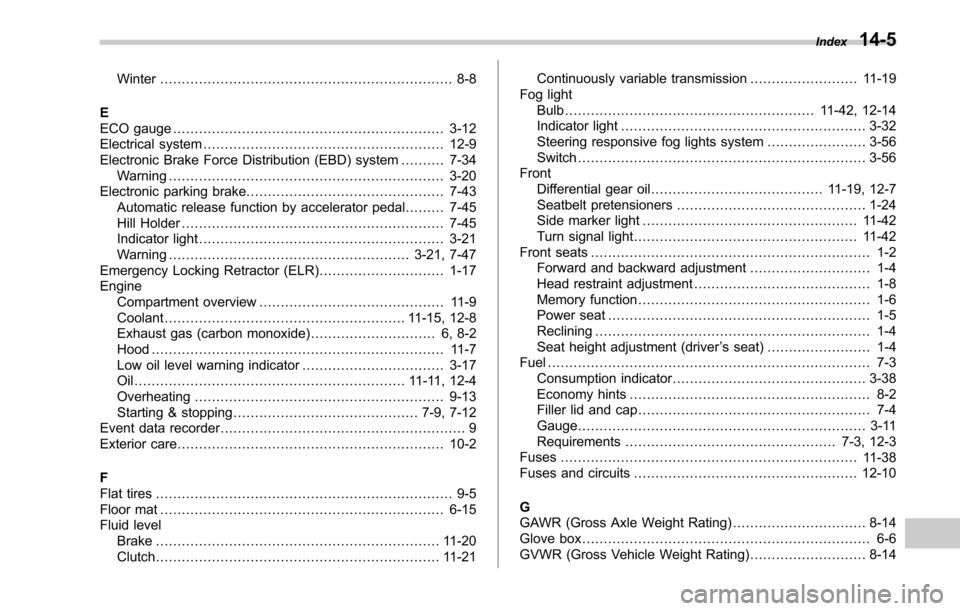
Winter.................................................................... 8-8
E
ECO gauge ............................................................... 3-12
Electrical system ........................................................ 12-9
Electronic Brake Force Distribution (EBD) system .......... 7-34
Warning ................................................................ 3-20
Electronic parking brake. ............................................. 7-43
Automatic release function by accelerator pedal ......... 7-45
Hill Holder ............................................................. 7-45
Indicator light ......................................................... 3-21
Warning ........................................................ 3-21, 7-47
Emergency Locking Retractor (ELR) ............................. 1-17
Engine Compartment overview ........................................... 11-9
Coolant ........................................................ 11-15, 12-8
Exhaust gas (carbon monoxide) ............................. 6, 8-2
Hood .................................................................... 11-7
Low oil level warning indicator ................................. 3-17
Oil............................................................... 11-11, 12-4
Overheating .......................................................... 9-13
Starting & stopping ........................................... 7-9, 7-12
Event data recorder ......................................................... 9
Exterior care .............................................................. 10-2
F
Flat tires ..................................................................... 9-5
Floor mat .................................................................. 6-15
Fluid level Brake .................................................................. 11-20
Clutch .................................................................. 11-21 Continuously variable transmission
......................... 11-19
Fog light Bulb .......................................................... 11-42, 12-14
Indicator light ......................................................... 3-32
Steering responsive fog lights system ....................... 3-56
Switch ................................................................... 3-56
Front Differential gear oil ........................................ 11-19, 12-7
Seatbelt pretensioners ............................................ 1-24
Side marker light .................................................. 11-42
Turn signal light .................................................... 11-42
Front seats ................................................................. 1-2
Forward and backward adjustment ............................ 1-4
Head restraint adjustment ......................................... 1-8
Memory function ...................................................... 1-6
Power seat ............................................................. 1-5
Reclining ................................................................ 1-4
Seat height adjustment (driver ’s seat) ........................ 1-4
Fuel ........................................................................\
... 7-3
Consumption indicator ............................................. 3-38
Economy hints ........................................................ 8-2
Filler lid and cap ...................................................... 7-4
Gauge ................................................................... 3-11
Requirements ................................................. 7-3, 12-3
Fuses .....................................................................
11-38
Fuses and circuits .................................................... 12-10
G
GAWR (Gross Axle Weight Rating) .. ............................. 8-14
Glove box ................................................................... 6-6
GVWR (Gross Vehicle Weight Rating) ........................... 8-14
Index14-5