wheel SUBARU SOLTERRA 2023 Owners Manual
[x] Cancel search | Manufacturer: SUBARU, Model Year: 2023, Model line: SOLTERRA, Model: SUBARU SOLTERRA 2023Pages: 628, PDF Size: 11.91 MB
Page 483 of 628
4837-3. Do-it-yourself maintenance
Owners Manual_USA_M42C01_en
7
Maintenance and care
• Vehicle is driven on unpaved roads
• Vehicle is driven near other vehi-
cles and system cannot recog-
nize tire pressure warning valves
and transmitters of your vehicle
over those of other vehicles
• Wheel with tire p ressure warning
valve and transmitter installed is
inside or near the vehicle
●If the vehicle is reversed during
registration, all da ta collected until
then will be cleared. Perform driv-
ing again.
●If registration doe s not complete
after driving for 1 hour or more,
perform the ID c ode registration
procedure again from the begin-
ning.
●If the tire pressure warning light
does not blink 3 times when start-
ing ID code registration proce-
dure, the procedure may not have
started. Perform the procedure
again from the beginning.
●If ID codes cannot be registered
even when perfor ming the above
procedure, contact your Toyota
dealer.
To cancel ID code registration
after it has been started, select
“Register New Valve / ID” again
on the multi-information display.
If ID code registration has been
canceled, the tire pressure
warning light will turn off.
If the warning light does not turn
off, ID code registration may not
have been cancelled correctly.
To cancel registration, select
“Register New Valve / ID” again
on the multi-information display. Your vehicle is equipped with a
tire pressure warning system
with a function to register two
sets of ID codes. This allows for
registration of a second wheel
set, for example a winter set.
The wheel set can be
changed only if a second
wheel set has been registered
to the system. If a second
wheel set has not been regis-
tered, message will be dis-
played and it will not be
possible to change to the
selected wheel set.
ID codes can be registered by
yourself.
Only a change between both
registered wheel set is possi-
ble, mixing between these
wheel sets is not supported.
While registering ID codes, it
may not be possible to
change between wheel sets
normally. Cancel registration
before changing between
wheel sets.
■How to change between
wheel sets
1 Install the desired wheel set.
2 Start the EV system.
( P.231)
The ID code selecting procedure
cannot be performed while the
vehicle is moving.
Canceling ID code regis-
tration
Selecting wheel set
Page 484 of 628
4847-3. Do-it-yourself maintenance
Owners Manual_USA_M42C01_en
3Press or of the meter
control switches and select
.
4 Press or of the meter
control switches and select
“Vehicle Settings”, and then
press and hold the “OK”.
5 Press or of the meter
control switches and select
“TPWS Setting”, and then
press “OK”.
6 Press or of the meter
control switches and select
“Tire Set Switching”, and then
press “OK”.
7 Press or of the meter
control switches and select
“Register Valve/ID” and then
press “OK”.
8 Press or of the meter
control switches and wheel
set (“Tire Set 1” or “Tire Set
2”) is selected.
9 Press or of the meter
control switches and select
“OK” and then press “OK”.
The tire pressure warning
light will slowly blink 3 times,
a message indicating that
change is occurring will be
displayed, and the wheel set
change will begin.Wheel set change will begin and
the tire pressure warning light will
blink for 1 minute and then illumi-
nate. Also, while the change is
being performed, “--” will be dis-
played for the tire inflation pressure
of each tire on the multi-information
display.
After approximatel y 2 minutes, the
wheel set change will complete, the
tire pressure warn ing light will turn
off, and a completion message will
be displayed on the multi-informa-
tion display.
If changing does not complete after
approximately 4 minutes, a mes-
sage indicating that the change
could not be completed will be dis-
played.
Check which wheel set is installed
and perform the change procedure
again from the beginning.
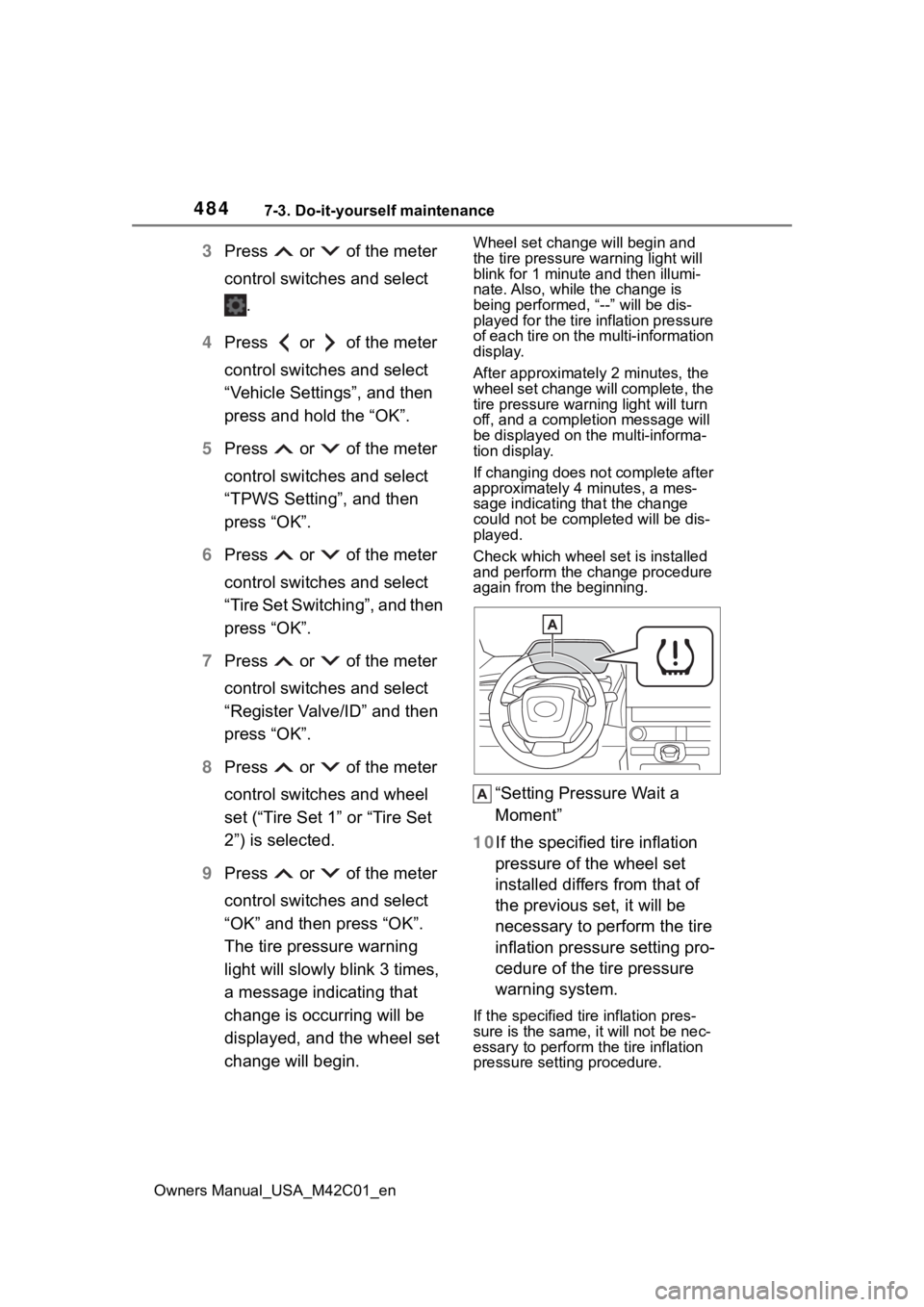
“Setting Pressure Wait a
Moment”
10If the specified tire inflation pressure of the wheel set
installed differs from that of
the previous set, it will be
necessary to perform the tire
inflation pressure setting pro-
cedure of the tire pressure
warning system.
If the specified tire inflation pres-
sure is the same, it will not be nec-
essary to per form the tire inflation
pressure setting procedure.
Page 485 of 628
4857-3. Do-it-yourself maintenance
Owners Manual_USA_M42C01_en
7
Maintenance and care
11 Register the position of each
wheel.
Stop the vehicle in a safe
place on a hard, flat surface.
Set the parking brake.
Shift the shift position to P.
Stop the EV system.
Vehicles with power back
door: Turn off the power back
door system. ( P.185)
■Tools
As your vehicle is equipped with an
emergency tire puncture repair kit,
the following tools for replacing a
tire are not include d with your vehi-
cle. They can be purchased your
Toyota dealer.
●Jack
●Jack handle
Replacing the tire
When raising your vehicle
with a jack, position the jack
correctly.
Improper placement may
damage your vehicle or
cause injury.
If necessary tire replace-
ment seems difficult to per-
form, contact your Toyota
dealer.
Before jacking up the
vehicle
Page 486 of 628
4867-3. Do-it-yourself maintenance
Owners Manual_USA_M42C01_en
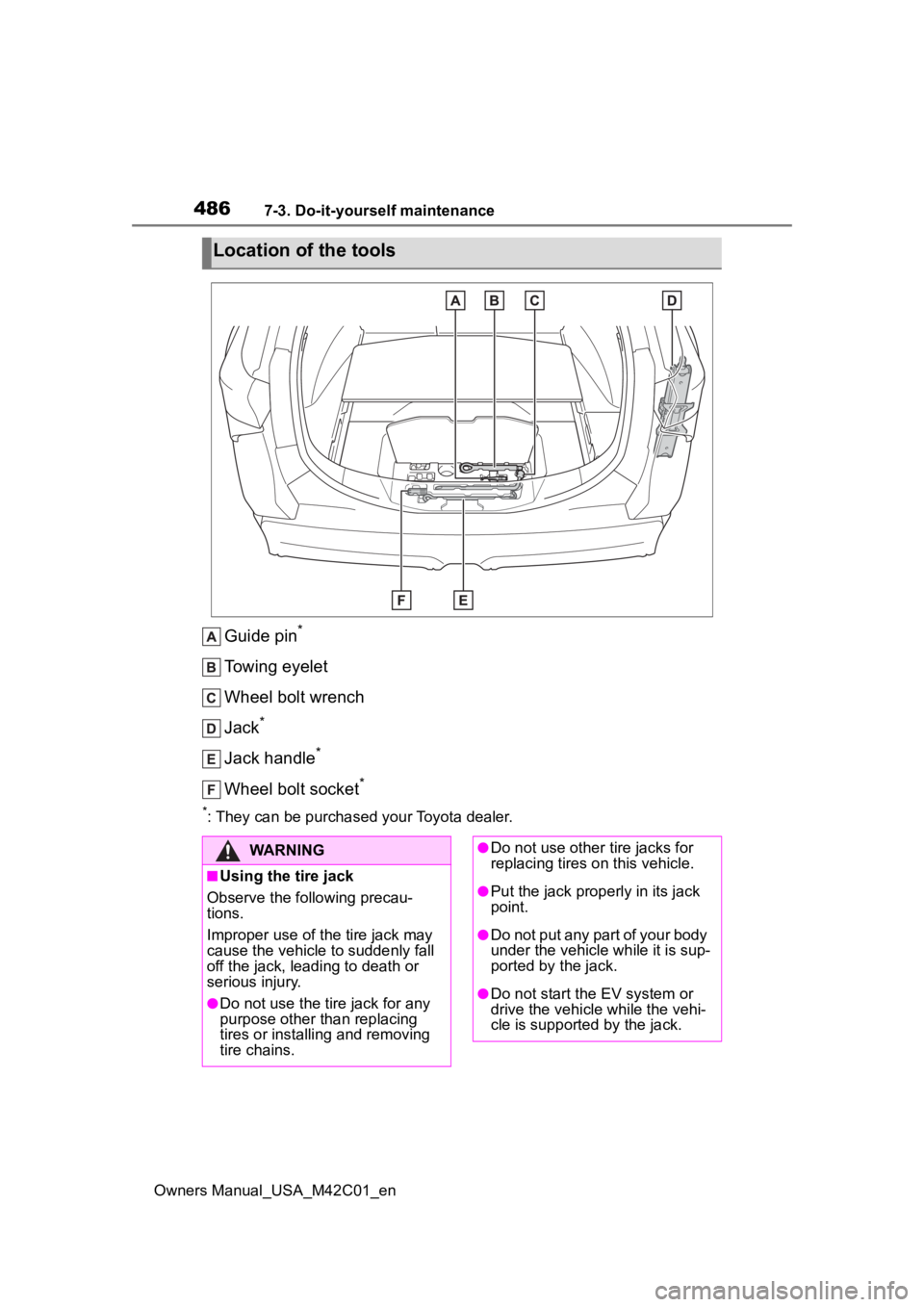
Guide pin*
Towing eyelet
Wheel bolt wrench
Jack
*
Jack handle*
Wheel bolt socket*
*: They can be purchased your Toyota dealer.
Location of the tools
WARNING
■Using the tire jack
Observe the following precau-
tions.
Improper use of the tire jack may
cause the vehicle to suddenly fall
off the jack, leading to death or
serious injury.
●Do not use the tire jack for any
purpose other than replacing
tires or installing and removing
tire chains.
●Do not use other tire jacks for
replacing tires on this vehicle.
●Put the jack properly in its jack
point.
●Do not put any part of your body
under the vehicle while it is sup-
ported by the jack.
●Do not start the EV system or
drive the vehicl e while the vehi-
cle is supported by the jack.
Page 487 of 628
4877-3. Do-it-yourself maintenance
Owners Manual_USA_M42C01_en
7
Maintenance and care
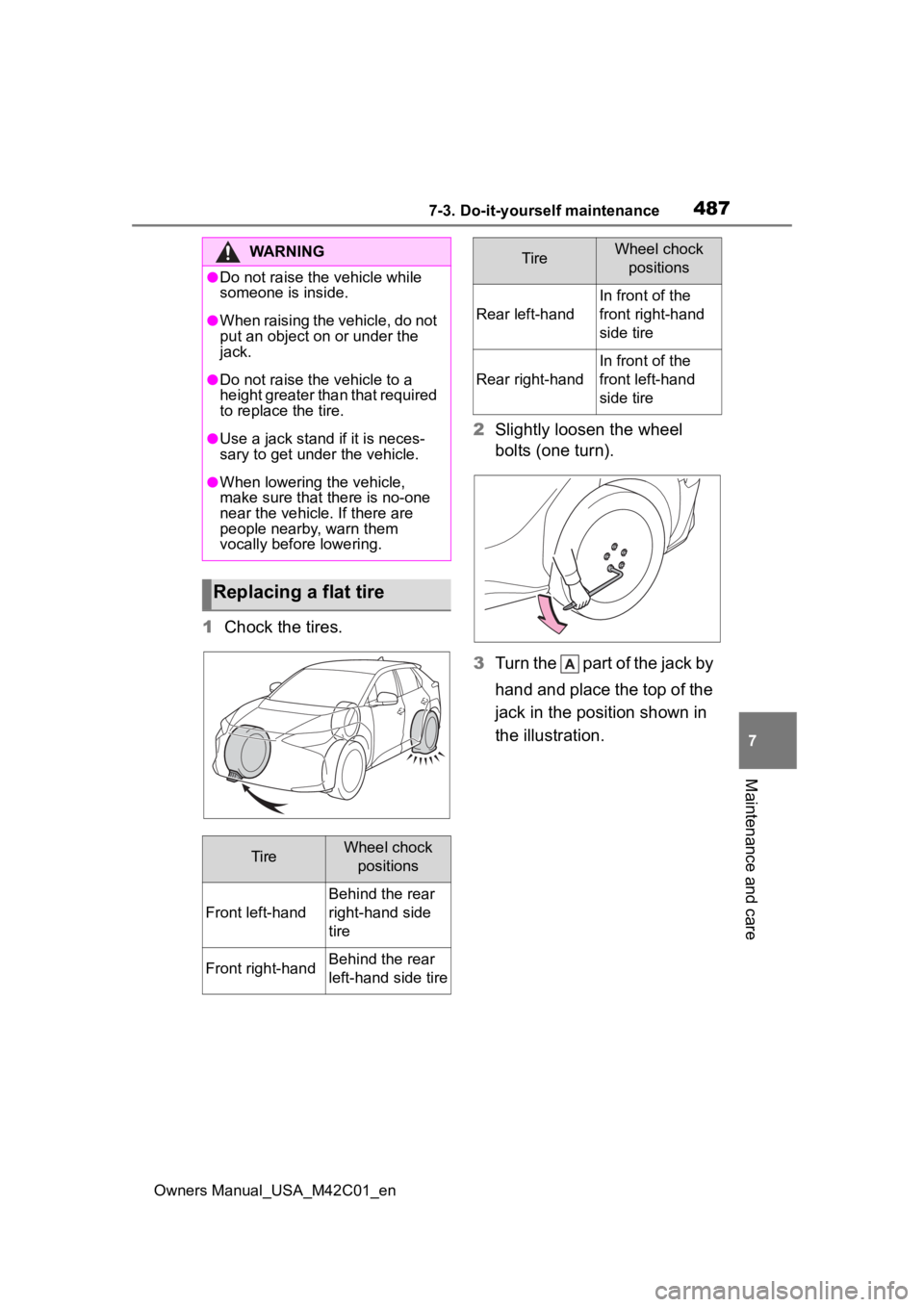
1 Chock the tires. 2
Slightly loosen the wheel
bolts (one turn).
3 Turn the part of the jack by
hand and place the top of the
jack in the position shown in
the illustration.
WARNING
●Do not raise the vehicle while
someone is inside.
●When raising the vehicle, do not
put an object on or under the
jack.
●Do not raise the vehicle to a
height greater than that required
to replace the tire.
●Use a jack stand if it is neces-
sary to get under the vehicle.
●When lowering the vehicle,
make sure that there is no-one
near the vehicle. If there are
people nearby, warn them
vocally before lowering.
Replacing a flat tire
TireWheel chock
positions
Front left-hand
Behind the rear
right-hand side
tire
Front right-handBehind the rear
left-hand side tire
Rear left-hand
In front of the
front right-hand
side tire
Rear right-hand
In front of the
front left-hand
side tire
TireWheel chock positions
Page 488 of 628
4887-3. Do-it-yourself maintenance
Owners Manual_USA_M42C01_en
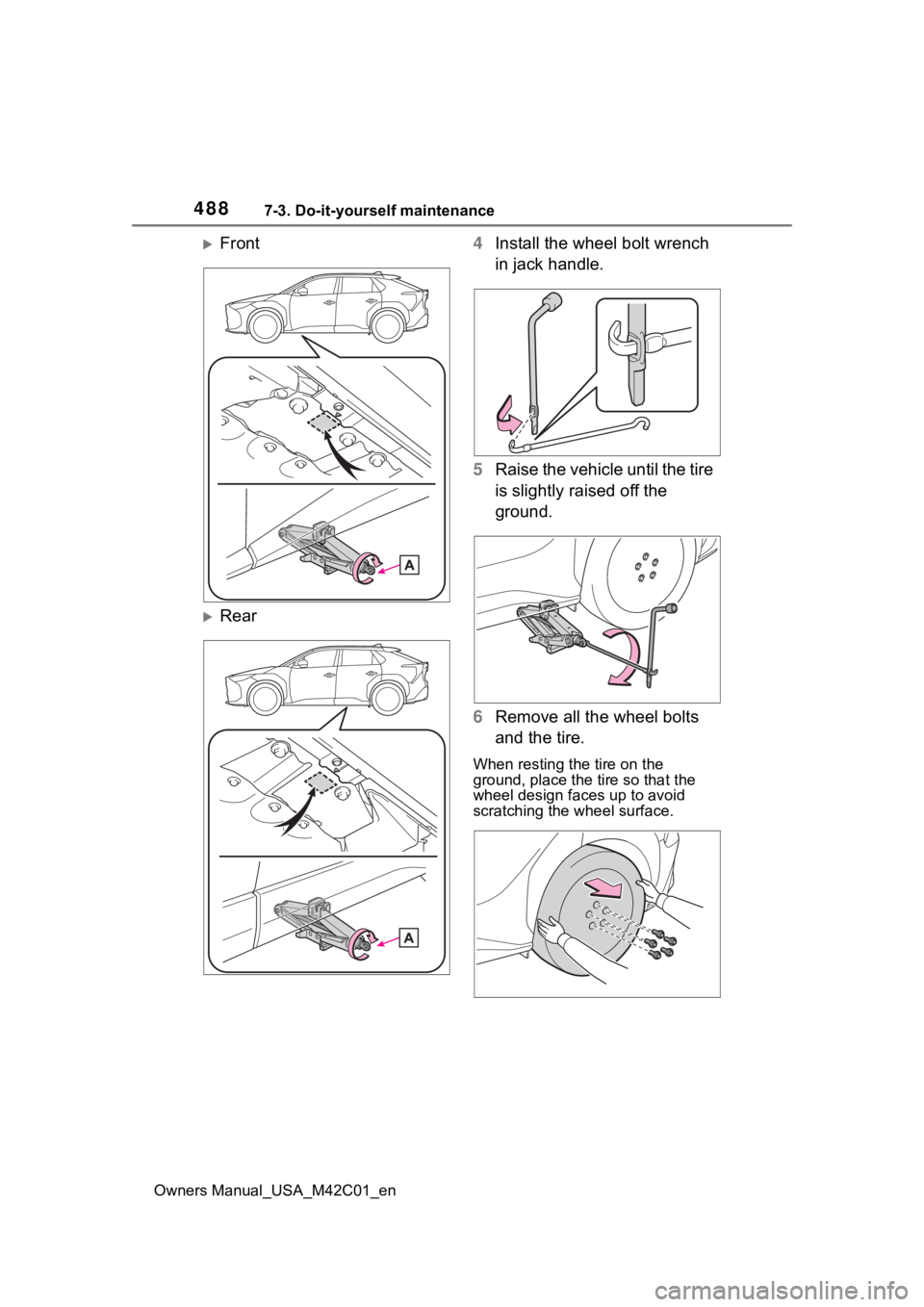
Front
Rear 4
Install the wheel bolt wrench
in jack handle.
5 Raise the vehicle until the tire
is slightly raised off the
ground.
6 Remove all the wheel bolts
and the tire.
When resting the tire on the
ground, place the tire so that the
wheel design faces up to avoid
scratching the wheel surface.
Page 489 of 628
4897-3. Do-it-yourself maintenance
Owners Manual_USA_M42C01_en
7
Maintenance and care
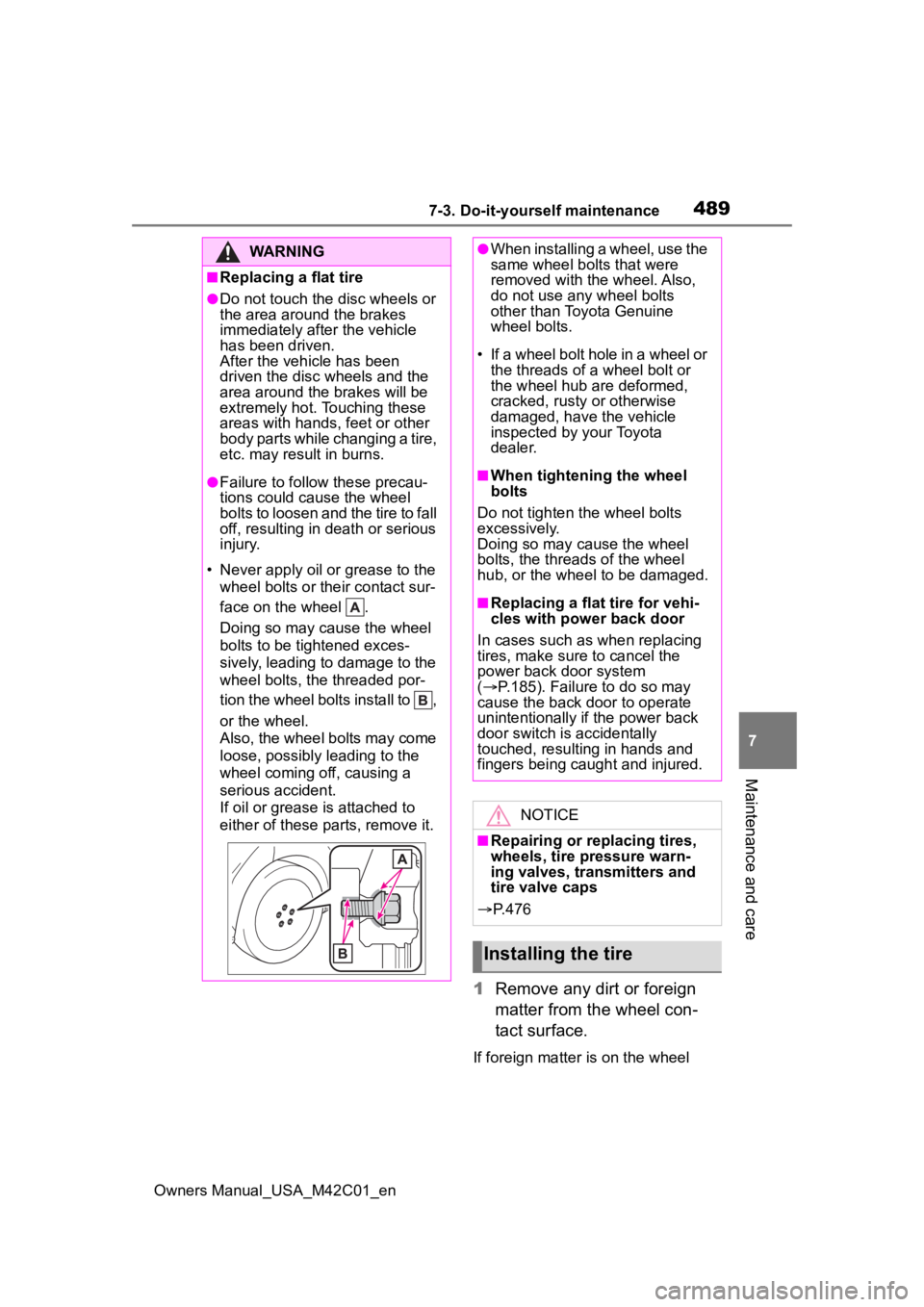
1 Remove any dirt or foreign
matter from the wheel con-
tact surface.
If foreign matter is on the wheel
WARNING
■Replacing a flat tire
●Do not touch the disc wheels or
the area around the brakes
immediately after the vehicle
has been driven.
After the vehicle has been
driven the disc wheels and the
area around the brakes will be
extremely hot. Touching these
areas with hands , feet or other
body parts while changing a tire,
etc. may result in burns.
●Failure to follow these precau-
tions could cause the wheel
bolts to loosen and the tire to fall
off, resulting in death or serious
injury.
• Never apply oil or grease to the wheel bolts or their contact sur-
face on the wheel .
Doing so may cause the wheel
bolts to be tightened exces-
sively, leading to damage to the
wheel bolts, the threaded por-
tion the wheel bolts install to ,
or the wheel.
Also, the wheel bolts may come
loose, possibly leading to the
wheel coming off, causing a
serious accident.
If oil or grease is attached to
either of these parts, remove it.
●When installing a wheel, use the
same wheel bolts that were
removed with the wheel. Also,
do not use any wheel bolts
other than Toyota Genuine
wheel bolts.
• If a wheel bolt hole in a wheel or the threads of a wheel bolt or
the wheel hub are deformed,
cracked, rusty or otherwise
damaged, have the vehicle
inspected by your Toyota
dealer.
■When tightening the wheel
bolts
Do not tighten the wheel bolts
excessively.
Doing so may cause the wheel
bolts, the threads of the wheel
hub, or the wheel to be damaged.
■Replacing a flat tire for vehi-
cles with power back door
In cases such as when replacing
tires, make sure to cancel the
power back door system
( P.185). Failure to do so may
cause the back d oor to operate
unintentionally if the power back
door switch is accidentally
touched, resulti ng in hands and
fingers being caught and injured.
NOTICE
■Repairing or replacing tires,
wheels, tire pressure warn-
ing valves, transmitters and
tire valve caps
P. 4 7 6
Installing the tire
Page 490 of 628
4907-3. Do-it-yourself maintenance
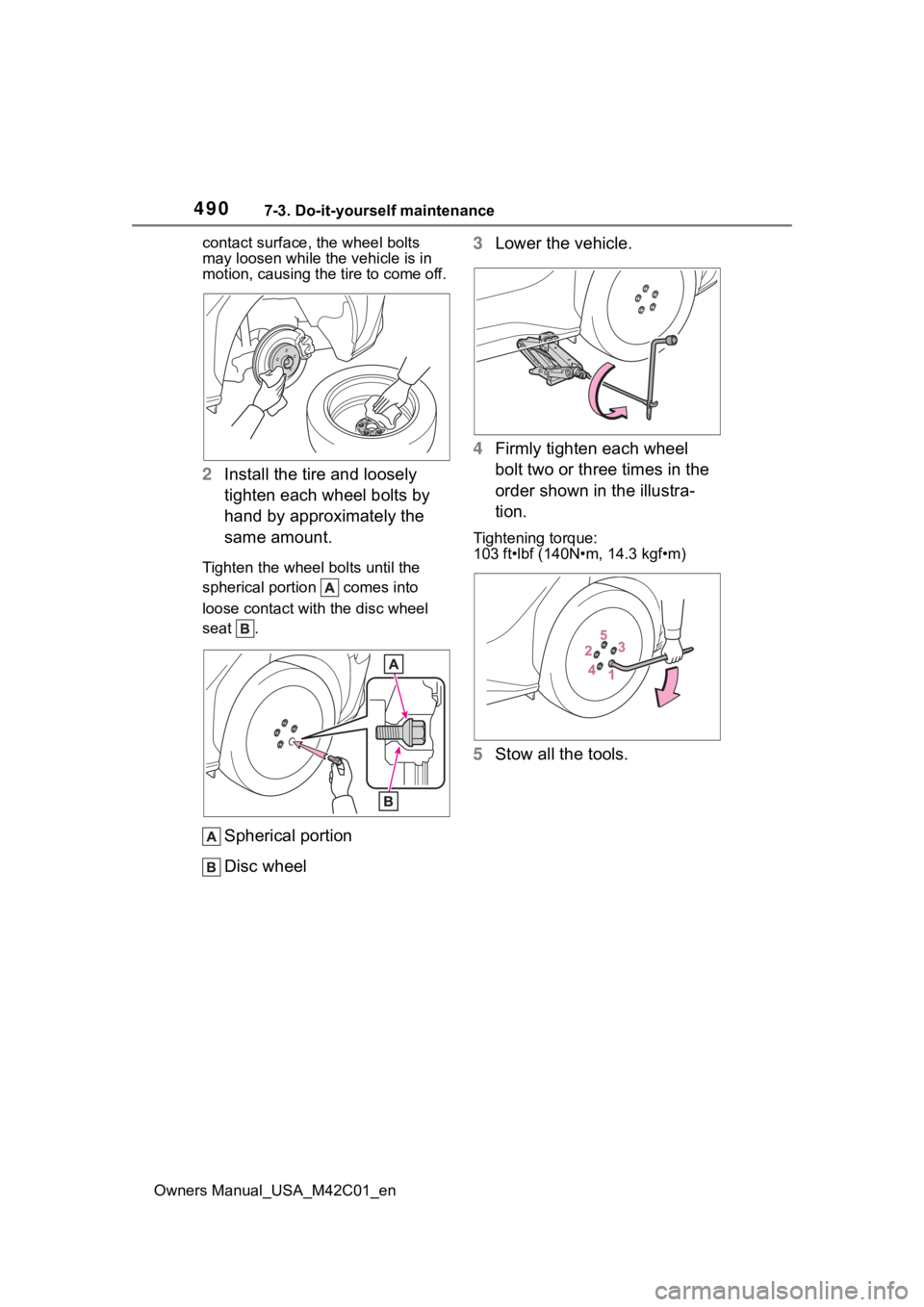
Owners Manual_USA_M42C01_encontact surface, t
he wheel bolts
may loosen while the vehicle is in
motion, causing the tire to come off.
2 Install the tire and loosely
tighten each wheel bolts by
hand by approximately the
same amount.
Tighten the whee l bolts until the
spherical portion comes into
loose contact with the disc wheel
seat .
Spherical portion
Disc wheel 3
Lower the vehicle.
4 Firmly tighten each wheel
bolt two or three times in the
order shown in the illustra-
tion.
Tightening torque:
103 ft•lbf (140N•m, 14.3 kgf•m)
5Stow all the tools.
Page 492 of 628
4927-3. Do-it-yourself maintenance
Owners Manual_USA_M42C01_en
■Effects of incorrect tire inflation
pressure
Driving with incorrect tire inflation
pressure may result in the following:
●Reduced electricity consumption
●Reduced driving comfort and poor
handling
●Reduced tire life due to wear
●Reduced safety
●Damage to the drive train
If a tire needs frequent inflating,
have it checked by your Toyota
dealer.
■Instructions for checking tire
inflation pressure
When checking tire inflation pres-
sure, observe the following:
●Check only when the tires are
cold.
If your vehicle has been parked for
at least 3 hours or has not been
driven for more tha n 1 mile or 1.5
km, you will get an accurate cold
tire inflation pressure reading.
●Always use a tire pressure gauge.
It is difficult to judge if a tire is
properly inflated based only on its
appearance.
●It is normal for the tire inflation
pressure to be higher after driving
as heat is generated in the tire. Do
not reduce tire inflation pressure
after driving.
●Never exceed the vehicle capacity
weight. Passengers and luggage
weight should be placed so that
the vehicle is balanced.
WARNING
■Proper inflation is critical to
save tire performance
Keep your tires properly inflated.
If the tires are not properly
inflated, the following conditions
may occur which could lead to an
accident resulting in death or seri-
ous injury:
●Excessive wear
●Uneven wear
●Poor handling
●Possibility of blowouts resulting
from overheated tires
●Air leaking from between tire
and wheel
●Wheel deformation and/or tire
damage
●Greater possibi lity of tire dam-
age while driving (due to road
hazards, expansion joints,
sharp edges in the road, etc.)
NOTICE
■When inspecting and adjust-
ing tire inflation pressure
Be sure to put the tire valve caps
back on.
If a valve cap is no t installed, dirt
or moisture may get into the valve
and cause an air leak, resulting in
decreased tire inflation pressure.
Page 493 of 628
4937-3. Do-it-yourself maintenance
Owners Manual_USA_M42C01_en
7
Maintenance and care
When replacing wheels, care
should be taken to ensure that
they are equivalent to those
removed in load capacity, diam-
eter, rim width and inset
*.
Replacement wheels are avail-
able at your Toyota dealer.
*: Conventionally referred to as off- set.
Toyota does not recommend
using the following:
Wheels of different sizes or
types
Used wheels
Bent wheels that have been
straightened
■When replacing wheels
The wheels of your vehicle are
equipped with tire pressure warning
valves and transmitters that allow
the tire pressure warning system to
provide advance warning in the
event of a loss in tire inflation pres-
sure. Whenever wheels are
replaced, tire pressure warning
valves and transmitters must be
installed. ( P.476)
Wheels
If a wheel is bent, cracked
or heavily corroded, it
should be replaced. Other-
wise, the tire may separate
from the wheel or cause a
loss of handling control.
Wheel selection
WARNING
■When replacing wheels
●Do not use wheels that are a dif-
ferent size from those recom-
mended in the Owner’s Manual,
as this may result in a loss of
handling control.
●Never use an inner tube in a
leaking wheel which is designed
for a tubeless tire. Doing so may
result in an accident, causing
death or serious injury.
■Wheel bolts
Observe the following precautions
to reduce the risk of death or seri-
ous injury:
●Do not over tighten.
●Never use oil or grease on the
wheel bolts. Oil and grease may
cause the wheel bolts to be
excessively tightened, leading
to bolt or disc wheel damage. In
addition, the oil or grease can
cause the wheel bolts to loosen
and the wheel may fall off, caus-
ing a serious accident. Remove
any oil or grease from the wheel
bolts.
●If there are any cracks or defor-
mations in the wheel bolts, or if
the surface treatment becomes
worn, have the wheel bolts
replaced at your Toyota dealer.
Failure to follow these precau-
tions could cause the wheel
bolts to loosen and the tire to fall
off, resulting in death or serious
injury.
■Use of defective wheels pro-
hibited
Do not use cracke d or deformed
wheels.
Doing so could cause the tire to
leak air during driving, possibly
causing an accident.