brake SUBARU SOLTERRA 2023 Owners Manual
[x] Cancel search | Manufacturer: SUBARU, Model Year: 2023, Model line: SOLTERRA, Model: SUBARU SOLTERRA 2023Pages: 628, PDF Size: 11.91 MB
Page 535 of 628
5358-2. Steps to take in an emergency
Owners Manual_USA_M42C01_en
8
When trouble arises
the vehicle ma y get dirty.
24Store the bottle in the lug-
gage compartment while it is
connected to the compres-
sor.
25 Taking precautions to avoid
sudden braking, sudden
acceleration and sharp turns,
drive carefully at under 50
mph (80 km/h) to the nearest
Toyota dealer that is less
than 62 miles (100 km) away
for tire repair or replacement.
For repair and replacement of a tire
or disposal of the tire puncture
repair kit, contact your Toyota
dealer.
When having the tire repaired or
replaced, make sure to tell the Toy-
ota dealer that the sealant is
injected.
■If the tire is i nflated to more
than the specified air pressure
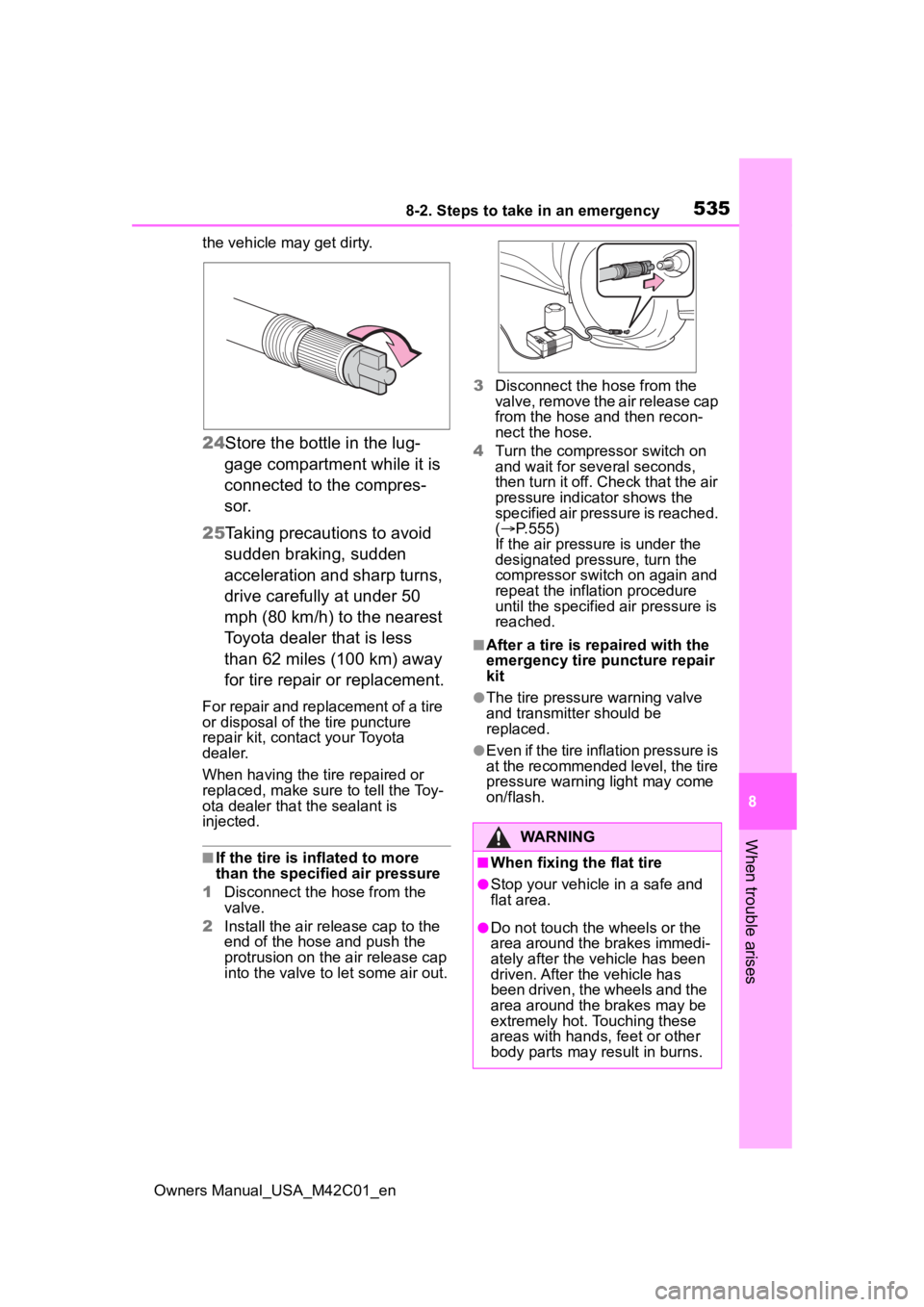
1 Disconnect the hose from the
valve.
2 Install the air release cap to the
end of the hose and push the
protrusion on the air release cap
into the valve to let some air out. 3
Disconnect the hose from the
valve, remove the air release cap
from the hose and then recon-
nect the hose.
4 Turn the compressor switch on
and wait for seve ral seconds,
then turn it off. Check that the air
pressure indicator shows the
specified air pressure is reached.
( P.555)
If the air pressure is under the
designated pressure, turn the
compressor switch on again and
repeat the inflation procedure
until the specified air pressure is
reached.
■After a tire is re paired with the
emergency tire puncture repair
kit
●The tire pressure warning valve
and transmitter should be
replaced.
●Even if the tire inflation pressure is
at the recommended level, the tire
pressure warning light may come
on/flash.
WARNING
■When fixing the flat tire
●Stop your vehicle in a safe and
flat area.
●Do not touch the wheels or the
area around the brakes immedi-
ately after the vehicle has been
driven. After the vehicle has
been driven, the wheels and the
area around the brakes may be
extremely hot. Touching these
areas with hands, feet or other
body parts may result in burns.
Page 538 of 628
5388-2. Steps to take in an emergency
Owners Manual_USA_M42C01_en
depending on the type of mal-
function, an interim measure
is available to start the EV
system. (P.538)
There is a possibility that the
temperature of the traction
battery is extremely low
(approximately below -22°F [-
30°C]). ( P.77, 232)
*: It may not be possible to shift the
shift position from P
One of the following may be the
cause of the problem:
The 12-volt battery may be
discharged. ( P.541)
The 12-volt battery terminal
connections may be loose or
corroded. ( P.468)
One of the following may be the
cause of the problem:
The 12-volt battery may be
discharged. ( P.541)
One or both of the 12-volt bat-
tery terminals may be discon-
nected. ( P.468)
Contact your Toyota dealer if the problem cannot be repaired, or if
repair procedures are unknown.
When the EV system does not
start, the following steps can be
used as an interim measure to
start the EV system if the power
switch is functioning normally.
Do not use this starting proce-
dure except in cases of emer-
gency.
1
Set the parking brake.
2 Turn the power switch to
ACC.
*
3Press and hold the power
switch for about 15 seconds
while depressing the brake
pedal firmly.
After pressing the power switch for
a while, a message regarding 12-
volt battery control will be dis-
played, however continuing press-
ing the switch.
Even if the EV system can be
started using the above steps,
the system may be malfunction-
ing. Have the vehicle inspected
by your Toyota dealer.
*: Setting can be customized.
( P.571)
The interior lights and
headlights are dim, or the
horn does not sound or
sounds at a low volume
The interior lights and
headlights do not turn on,
or the horn does not
sound
Starting the EV system in
an emergency
Page 540 of 628
5408-2. Steps to take in an emergency
Owners Manual_USA_M42C01_en
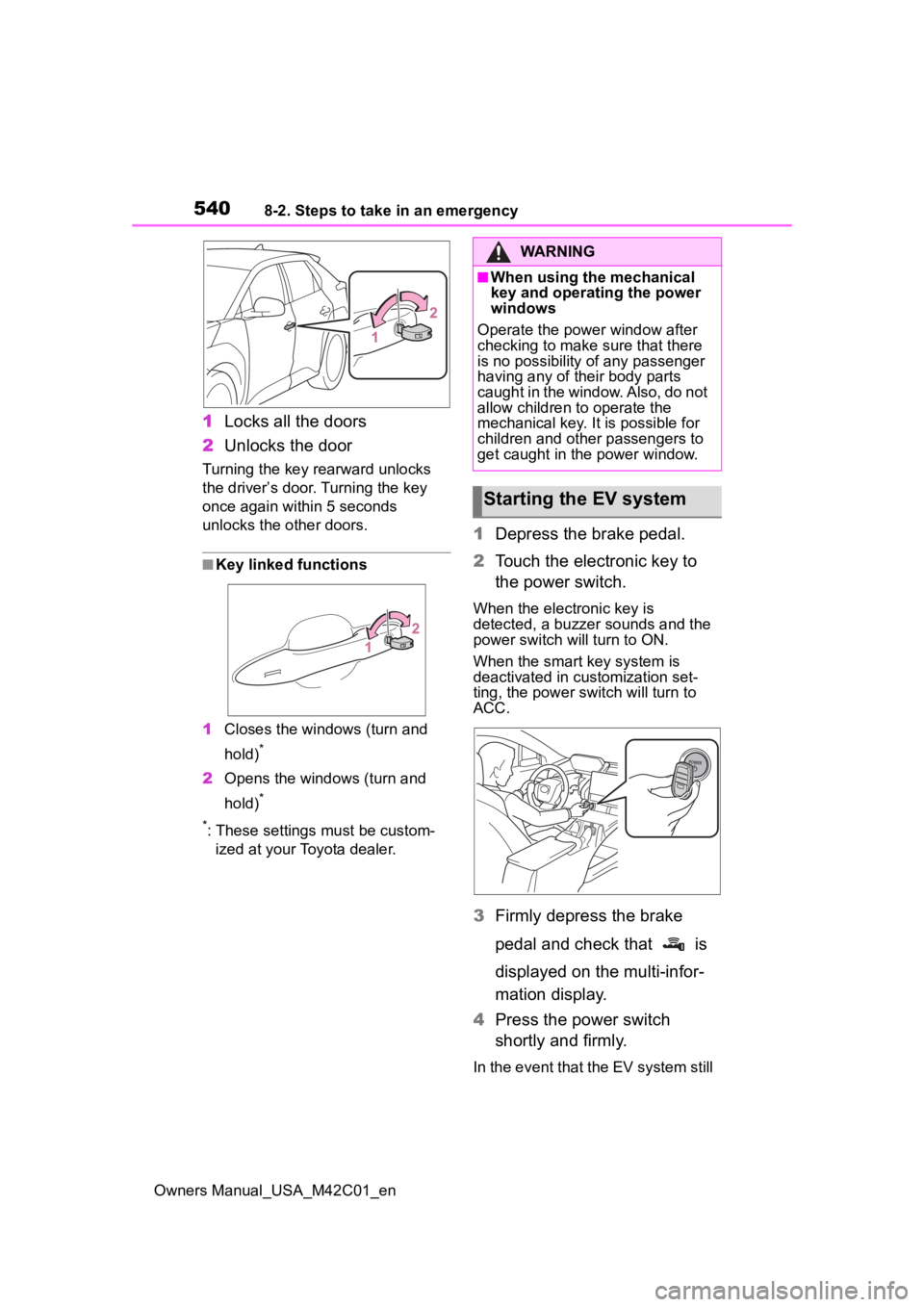
1Locks all the doors
2 Unlocks the door
Turning the key rearward unlocks
the driver’s door. Turning the key
once again within 5 seconds
unlocks the other doors.
■Key linked functions
1 Closes the windo ws (turn and
hold)
*
2 Opens the windows (turn and
hold)
*
*
: These settings must be custom- ized at your Toyota dealer.
1 Depress the brake pedal.
2 Touch the electronic key to
the power switch.
When the electronic key is
detected, a buzzer sounds and the
power switch will turn to ON.
When the smart key system is
deactivated in customization set-
ting, the power switch will turn to
ACC.
3Firmly depress the brake
pedal and check that is
displayed on the multi-infor-
mation display.
4 Press the power switch
shortly and firmly.
In the event that the EV system still
WARNING
■When using the mechanical
key and operating the power
windows
Operate the power window after
checking to make sure that there
is no possibility of any passenger
having any of their body parts
caught in the window. Also, do not
allow children to operate the
mechanical key. It is possible for
children and other passengers to
get caught in the power window.
Starting the EV system
Page 541 of 628
5418-2. Steps to take in an emergency
Owners Manual_USA_M42C01_en
8
When trouble arises
cannot be started, contact your Toy-
ota dealer.
■Stopping the EV system
Shift the shift position to P, set the
parking brake and press the power
switch as you no rmally do when
stopping the EV system.
■Replacing the key battery
As the above proc edure is a tempo-
rary measure, it is recommended
that the electronic key battery be
replaced immediate ly when the bat-
tery is depleted. ( P.497)
■Alarm
If a door is unlocked using the
mechanical key when the alarm sys-
tem is set, the alarm may be trig-
gered. ( P. 6 9 )
■Changing power switch modes
Release the brake pedal and press
the power switch in step 3 above.
The EV system does not start and
modes will be cha nged each time
the switch is pressed. ( P.234)
If you have a set of jumper (or
booster) cables and a second
vehicle with a 12-volt battery,
you can jump start your vehicle
by following the steps below.
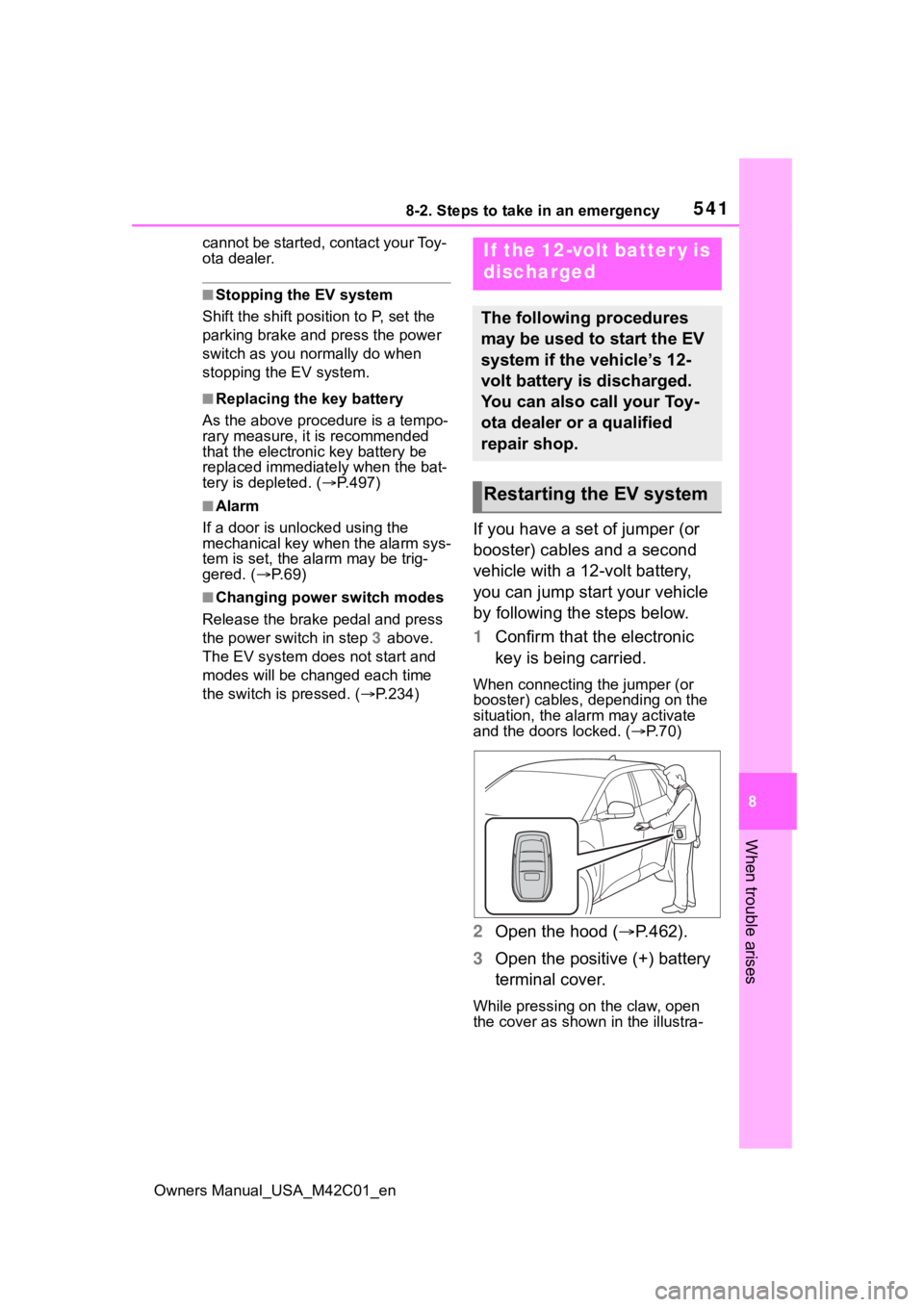
1Confirm that the electronic
key is being carried.
When connecting the jumper (or
booster) cables, depending on the
situation, the alarm may activate
and the doors locked. ( P. 7 0 )
2 Open the hood ( P.462).
3 Open the positive (+) battery
terminal cover.
While pressing on the claw, open
the cover as shown in the illustra-
If the 12-volt batter y is
discharged
The following procedures
may be used to start the EV
system if the vehicle’s 12-
volt battery is discharged.
You can also call your Toy-
ota dealer or a qualified
repair shop.
Restarting the EV system
Page 547 of 628
5478-2. Steps to take in an emergency
Owners Manual_USA_M42C01_en
8
When trouble arises
1 Stop the EV system. Set the
parking brake and shift the
shift position to P.
2 Remove the mud, snow or
sand from around the stuck
tire.
3 Place wood, stones or some
other material under the front
wheels to help provide trac-
tion.
4 Restart the EV system
5 Shift the shift position to D or
R and release the parking
brake. Then, while exercising
caution, depress the acceler-
ator pedal.
■When it is difficult to free the
vehicle
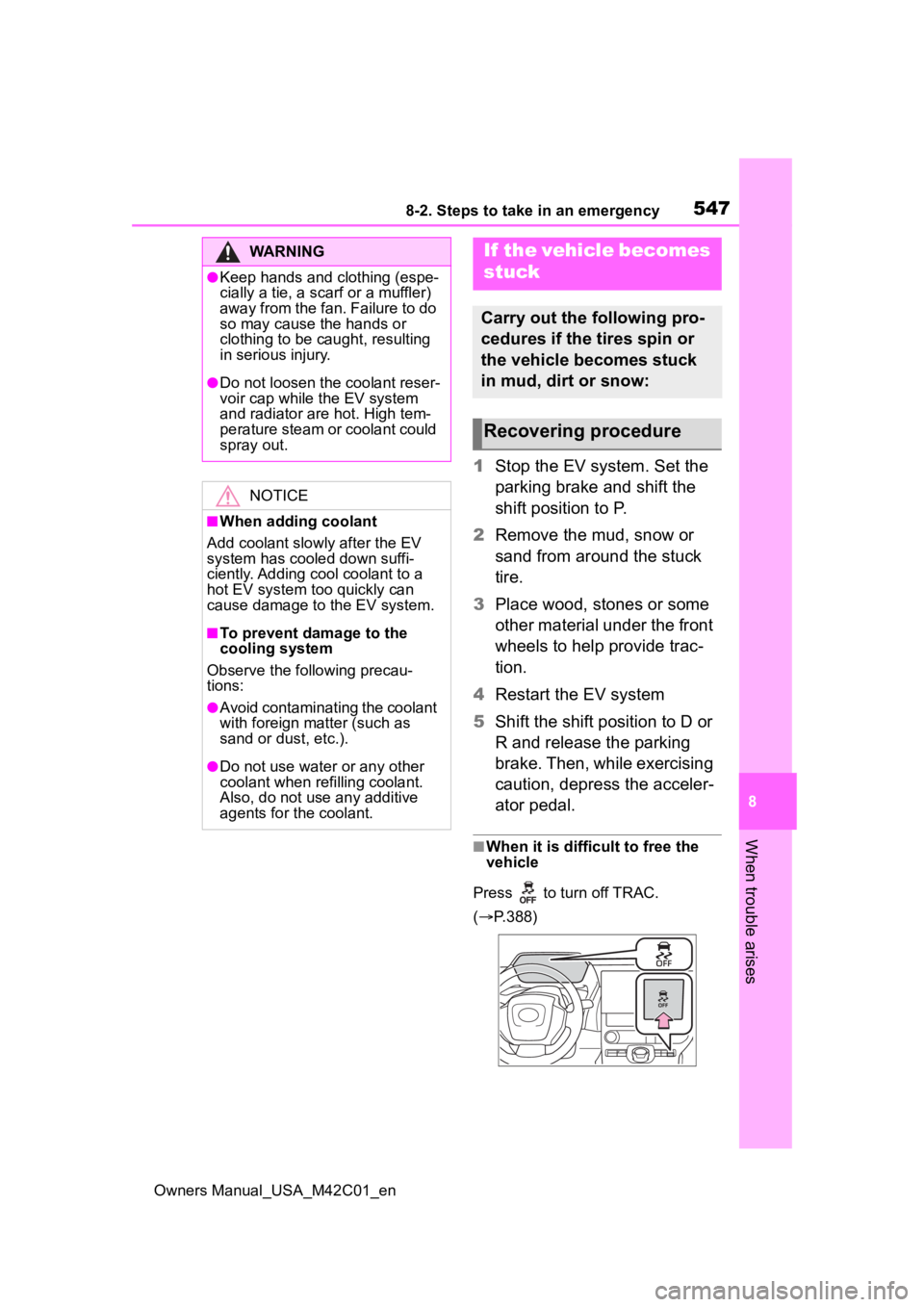
Press to turn off TRAC.
( P.388)
WARNING
●Keep hands and clothing (espe-
cially a tie, a scarf or a muffler)
away from the fan. Failure to do
so may cause the hands or
clothing to be caught, resulting
in serious injury.
●Do not loosen the coolant reser-
voir cap while the EV system
and radiator are hot. High tem-
perature steam or coolant could
spray out.
NOTICE
■When adding coolant
Add coolant slowly after the EV
system has cooled down suffi-
ciently. Adding cool coolant to a
hot EV system too quickly can
cause damage to the EV system.
■To prevent damage to the
cooling system
Observe the following precau-
tions:
●Avoid contaminating the coolant
with foreign matter (such as
sand or dust, etc.).
●Do not use water or any other
coolant when refilling coolant.
Also, do not use any additive
agents for the coolant.
If the vehicle becomes
stuck
Carry out the following pro-
cedures if the tires spin or
the vehicle becomes stuck
in mud, dirt or snow:
Recovering procedure
Page 554 of 628
5549-1. Specifications
Owners Manual_USA_M42C01_en
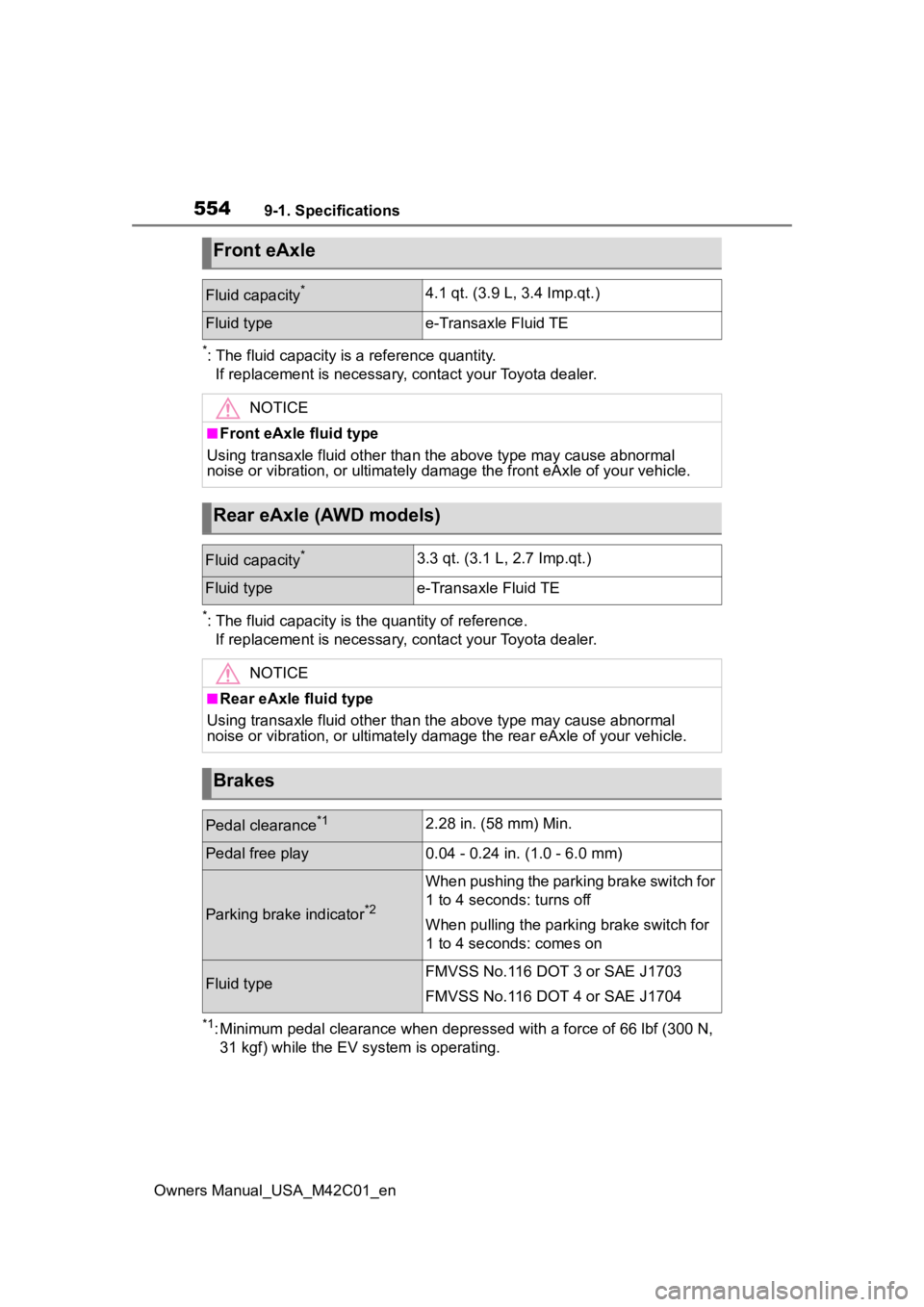
*: The fluid capacity is a reference quantity.If replacement is necessary, contact your Toyota dealer.
*: The fluid capacity is the quantity of reference.If replacement is necessary, contact your Toyota dealer.
*1: Minimum pedal clearance when depressed with a force of 66 lbf (300 N, 31 kgf) while the EV system is operating.
Front eAxle
Fluid capacity*4.1 qt. (3.9 L, 3.4 Imp.qt.)
Fluid typee-Transaxle Fluid TE
NOTICE
■Front eAxle fluid type
Using transaxle fluid other than the above type may cause abnor mal
noise or vibration, or ultimately damage the front eAxle of you r vehicle.
Rear eAxle (AWD models)
Fluid capacity*3.3 qt. (3.1 L, 2.7 Imp.qt.)
Fluid typee-Transaxle Fluid TE
NOTICE
■Rear eAxle fluid type
Using transaxle fluid other than the above type may cause abnor mal
noise or vibration, or ultimatel y damage the rear eAxle of your vehicle.
Brakes
Pedal clearance*12.28 in. (58 mm) Min.
Pedal free play0.04 - 0.24 in. (1.0 - 6.0 mm)
Parking brake indicator*2
When pushing the parking brake switch for
1 to 4 seconds: turns off
When pulling the parking brake switch for
1 to 4 seconds: comes on
Fluid typeFMVSS No.116 DOT 3 or SAE J1703
FMVSS No.116 DOT 4 or SAE J1704
Page 555 of 628
5559-1. Specifications
Owners Manual_USA_M42C01_en
9
Vehicle specifications
*2: Make sure to confirm that the brake system warning light (yell ow) does
not illuminate. (If th e brake system warning light illuminates, refer to
P.513)
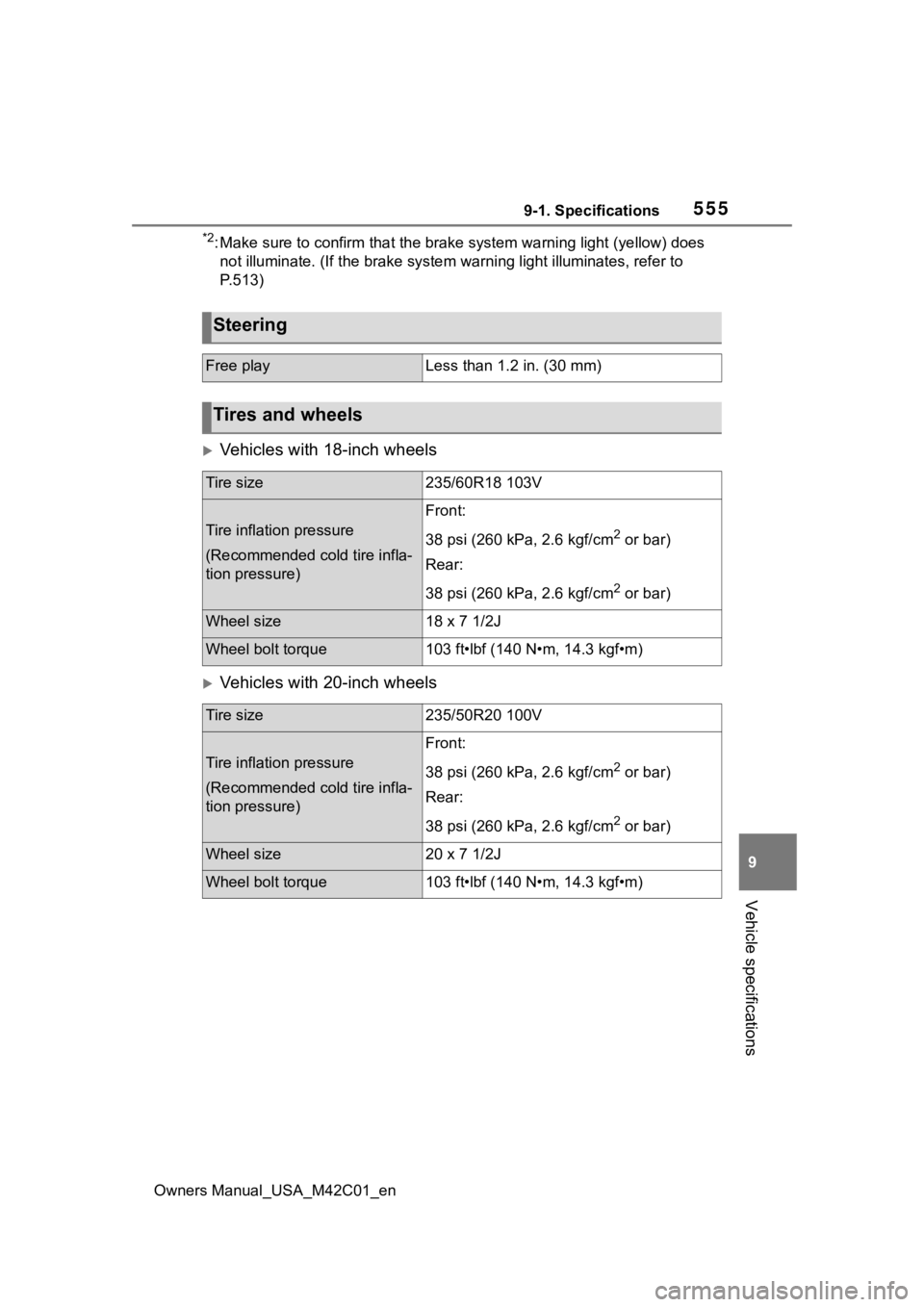
Vehicles with 18-inch wheels
Vehicles with 20-inch wheels
Steering
Free playLess than 1.2 in. (30 mm)
Tires and wheels
Tire size235/60R18 103V
Tire inflation pressure
(Recommended cold tire infla-
tion pressure)
Front:
38 psi (260 kPa, 2.6 kgf/cm
2 or bar)
Rear:
38 psi (260 kPa, 2.6 kgf/cm
2 or bar)
Wheel size18 x 7 1/2J
Wheel bolt torque103 ft•lbf (140 N•m, 14.3 kgf•m)
Tire size235/50R20 100V
Tire inflation pressure
(Recommended cold tire infla-
tion pressure)
Front:
38 psi (260 kPa, 2.6 kgf/cm
2 or bar)
Rear:
38 psi (260 kPa, 2.6 kgf/cm
2 or bar)
Wheel size20 x 7 1/2J
Wheel bolt torque103 ft•lbf (140 N•m, 14.3 kgf•m)
Page 560 of 628
5609-1. Specifications
Owners Manual_USA_M42C01_enheat buildup and possible tire fail- ure.
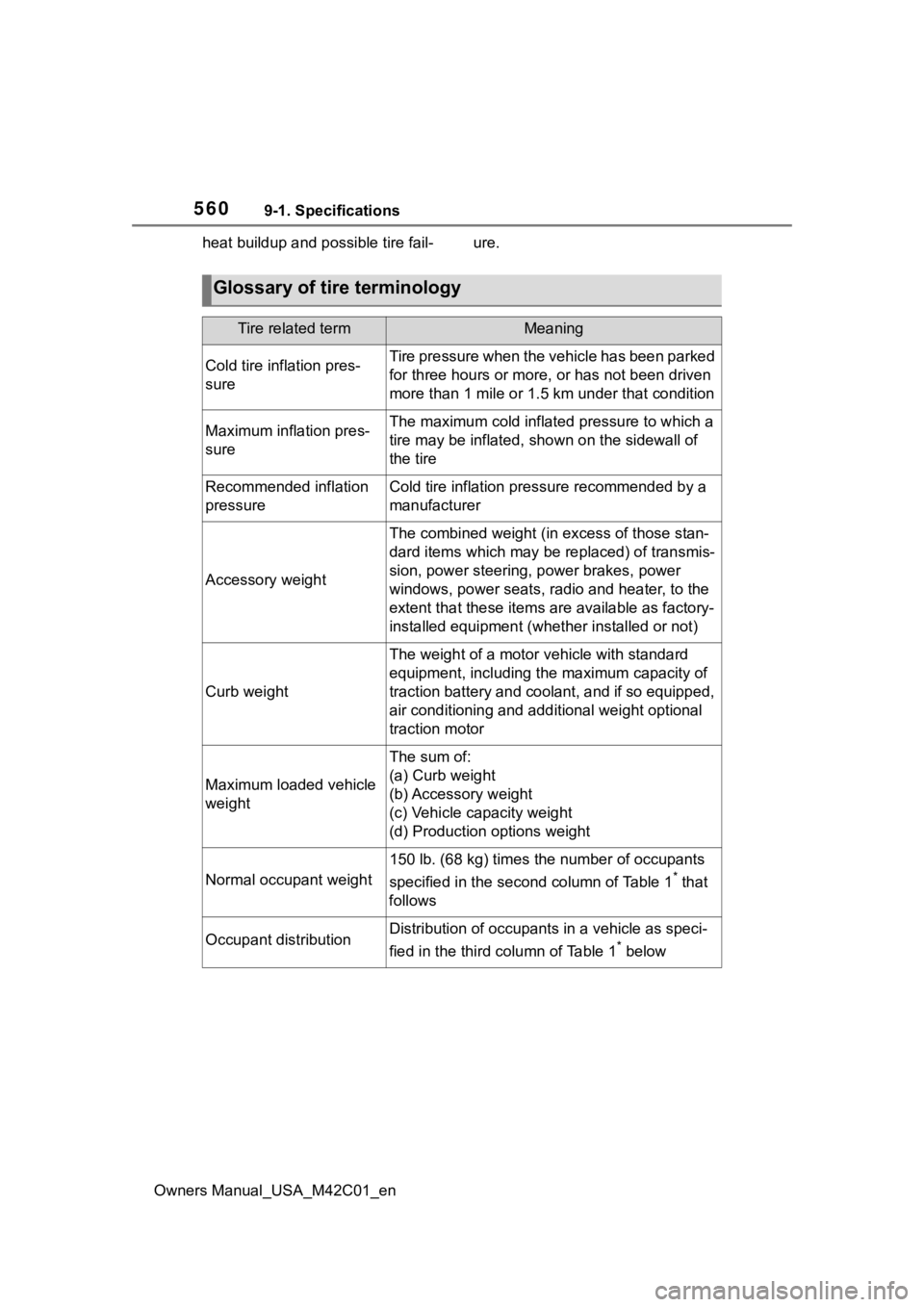
Glossary of tire terminology
Tire related termMeaning
Cold tire inflation pres-
sureTire pressure when the vehicle has been parked
for three hours or more, or has not been driven
more than 1 mile or 1.5 km under that condition
Maximum inflation pres-
sureThe maximum cold inflated pressure to which a
tire may be inflated, shown on the sidewall of
the tire
Recommended inflation
pressureCold tire inflation pressure recommended by a
manufacturer
Accessory weight
The combined weight (in
excess of those stan-
dard items which may be replaced) of transmis-
sion, power steering, power brakes, power
windows, power seats, radio and heater, to the
extent that these items are available as factory-
installed equipment (whether installed or not)
Curb weight
The weight of a motor vehicle with standard
equipment, including th e maximum capacity of
traction battery and coolant, and if so equipped,
air conditioning and additional weight optional
traction motor
Maximum loaded vehicle
weight
The sum of:
(a) Curb weight
(b) Accessory weight
(c) Vehicle capacity weight
(d) Production options weight
Normal occupant weight
150 lb. (68 kg) times the number of occupants
specified in the second column of Table 1
* that
follows
Occupant distributionDistribution of occupant s in a vehicle as speci-
fied in the third column of Table 1
* below
Page 561 of 628
5619-1. Specifications
Owners Manual_USA_M42C01_en
9
Vehicle specifications
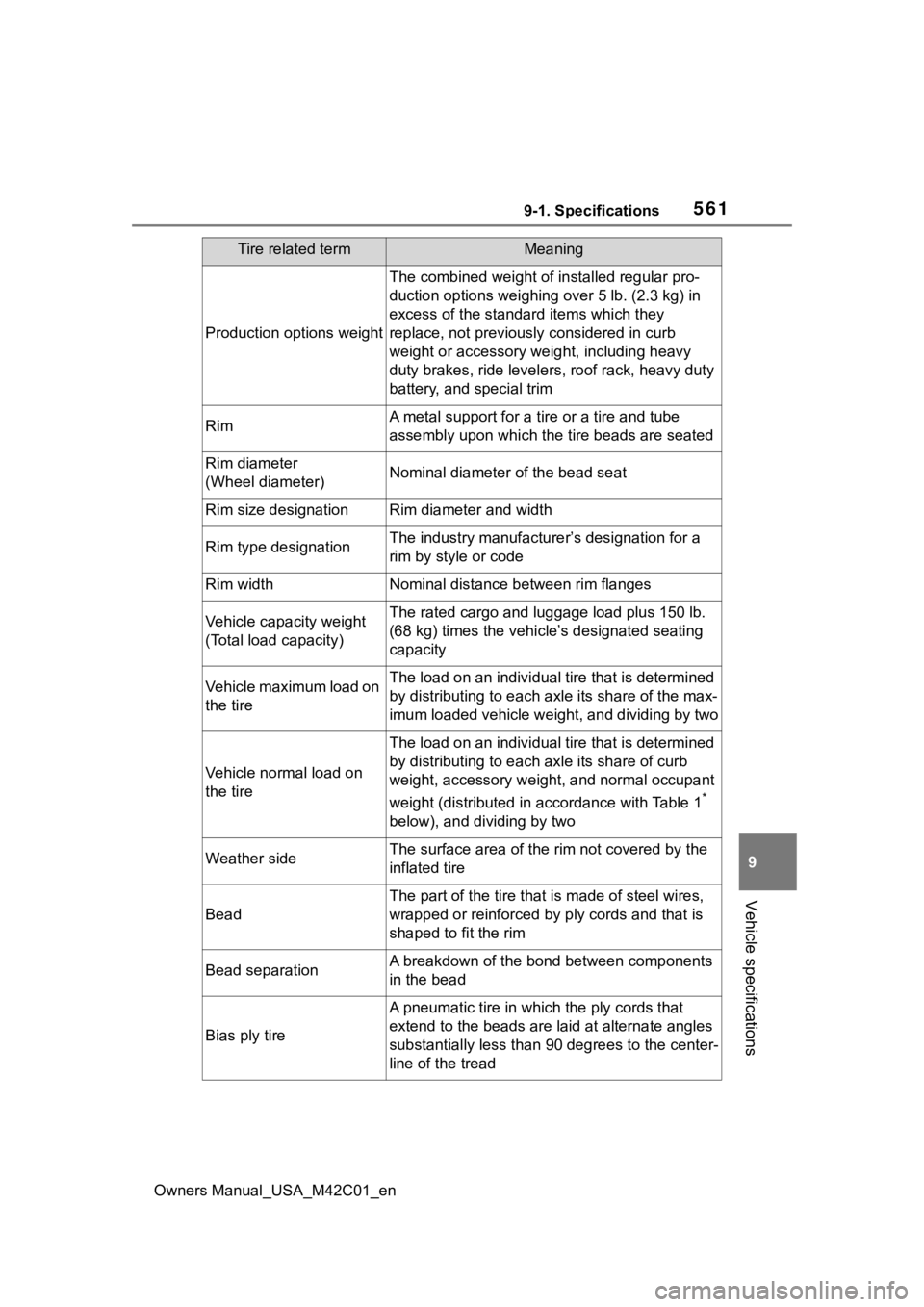
Production options weight
The combined weight of installed regular pro-
duction options weighing over 5 lb. (2.3 kg) in
excess of the standard items which they
replace, not previously considered in curb
weight or accessory weight, including heavy
duty brakes, ride leveler s, roof rack, heavy duty
battery, and special trim
RimA metal support for a ti re or a tire and tube
assembly upon which the tire beads are seated
Rim diameter
(Wheel diameter)Nominal diameter o f the bead seat
Rim size designationRim diameter and width
Rim type designationThe industry manufacture r’s designation for a
rim by style or code
Rim widthNominal distance between rim flanges
Vehicle capacity weight
(Total load capacity)The rated cargo and luggage load plus 150 lb.
(68 kg) times the vehicl e’s designated seating
capacity
Vehicle maximum load on
the tireThe load on an individual tire that is determined
by distributing to each ax le its share of the max-
imum loaded vehicle weight, and dividing by two
Vehicle normal load on
the tire
The load on an individual tire that is determined
by distributing to each axle its share of curb
weight, accessory weight, and normal occupant
weight (distributed in accordance with Table 1
*
below), and dividing by two
Weather sideThe surface area of the rim not covered by the
inflated tire
Bead
The part of the tire that is made of steel wires,
wrapped or reinforced by ply cords and that is
shaped to fit the rim
Bead separationA breakdown of the bond between components
in the bead
Bias ply tire
A pneumatic tire in which the ply cords that
extend to the beads are la id at alternate angles
substantially less than 9 0 degrees to the center-
line of the tread
Tire related termMeaning
Page 566 of 628
5669-2. Customization
Owners Manual_USA_M42C01_en
9-2.Customization
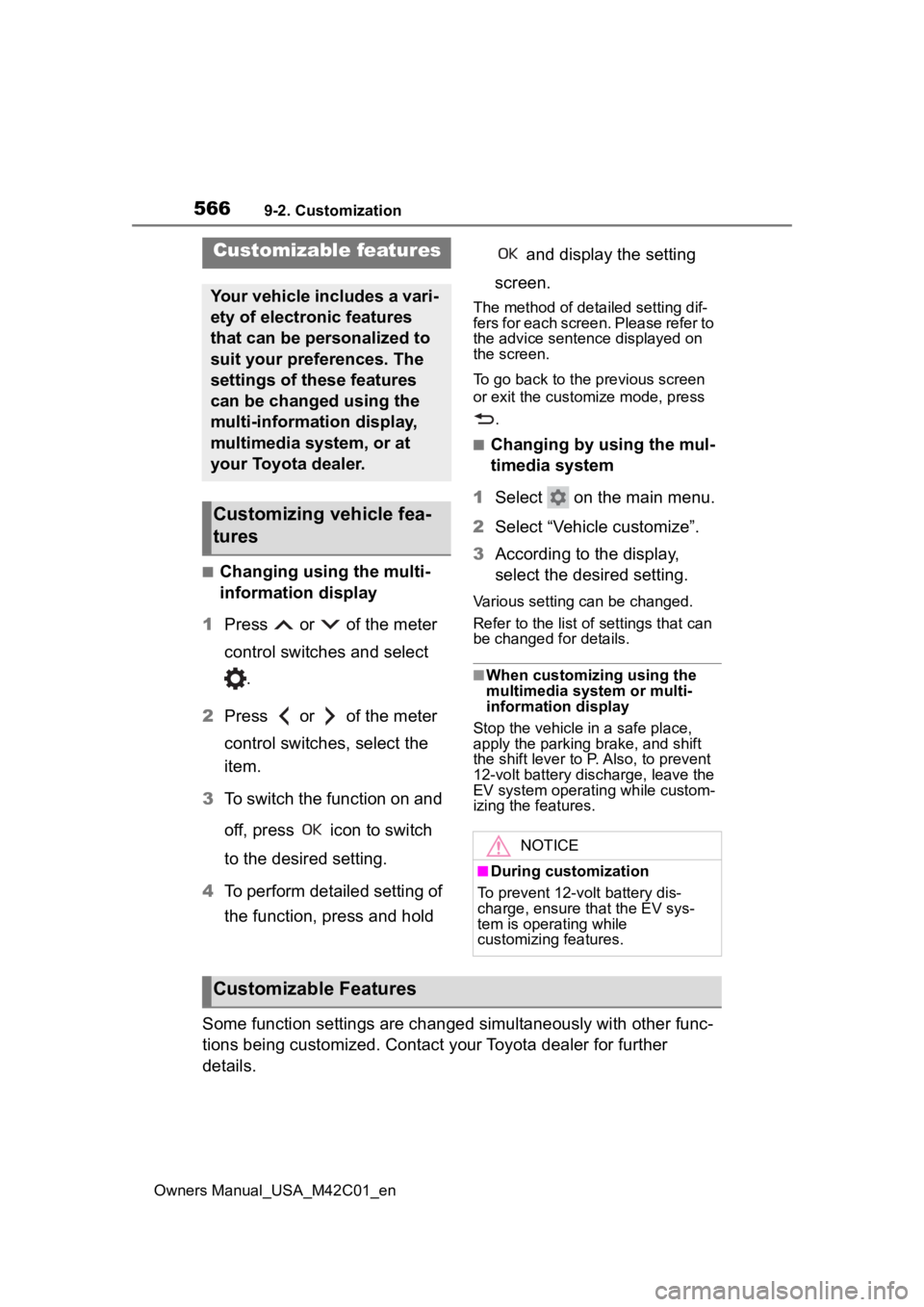
■Changing using the multi-
information display
1 Press or of the meter
control switches and select
.
2 Press or of the meter
control switches, select the
item.
3 To switch the function on and
off, press icon to switch
to the desired setting.
4 To perform detailed setting of
the function, press and hold and display the setting
screen.
The method of deta iled setting dif-
fers for each screen. Please refer to
the advice sentenc e displayed on
the screen.
To go back to the previous screen
or exit the customize mode, press
.
■Changing by using the mul-
timedia system
1 Select on the main menu.
2 Select “Vehicle customize”.
3 According to the display,
select the desired setting.
Various setting can be changed.
Refer to the list of settings that can
be changed for details.
■When customizing using the
multimedia system or multi-
information display
Stop the vehicle in a safe place,
apply the parking brake, and shift
the shift lever to P. Also, to prevent
12-volt battery discharge, leave the
EV system operating while custom-
izing the features.
Some function settings are changed simultaneously with other fu nc-
tions being customized. Contact y our Toyota dealer for further
details.
Customizable features
Your vehicle includes a vari-
ety of electronic features
that can be personalized to
suit your preferences. The
settings of these features
can be changed using the
multi-information display,
multimedia system, or at
your Toyota dealer.
Customizing vehicle fea-
tures
NOTICE
■During customization
To prevent 12-volt battery dis-
charge, ensure that the EV sys-
tem is operating while
customizing features.
Customizable Features