brake SUBARU SOLTERRA 2023 Owners Manual
[x] Cancel search | Manufacturer: SUBARU, Model Year: 2023, Model line: SOLTERRA, Model: SUBARU SOLTERRA 2023Pages: 628, PDF Size: 11.91 MB
Page 465 of 628
4657-3. Do-it-yourself maintenance
Owners Manual_USA_M42C01_en
7
Maintenance and care
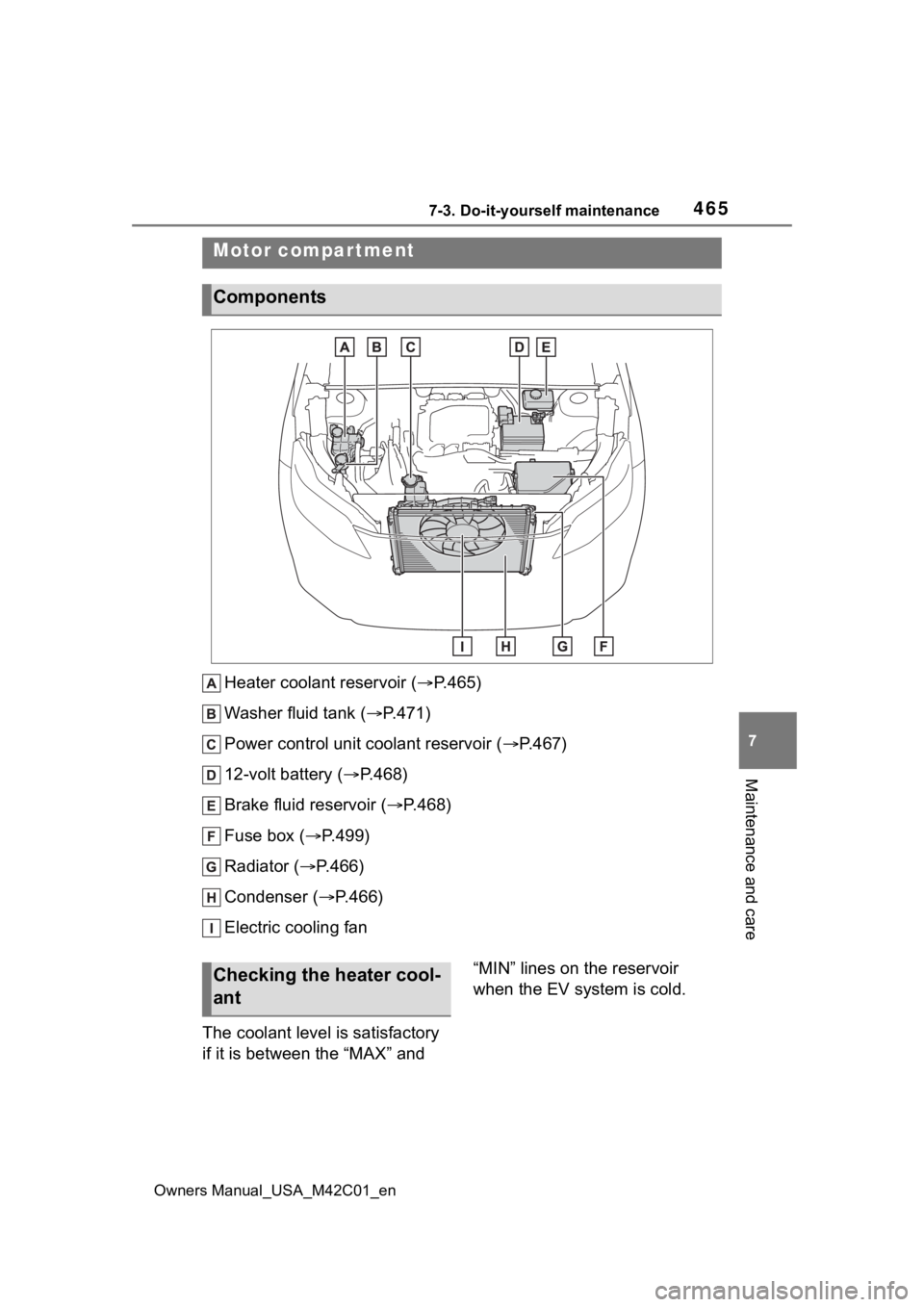
Heater coolant reservoir ( P.465)
Washer fluid tank ( P.471)
Power control unit coolant reservoir ( P.467)
12-volt battery ( P.468)
Brake fluid reservoir ( P.468)
Fuse box ( P.499)
Radiator ( P.466)
Condenser ( P.466)
Electric cooling fan
The coolant level is satisfactory
if it is between the “MAX” and “MIN” lines on the reservoir
when the EV system is cold.
Motor compar tment
Components
Checking the heater cool-
ant
Page 468 of 628
4687-3. Do-it-yourself maintenance
Owners Manual_USA_M42C01_en
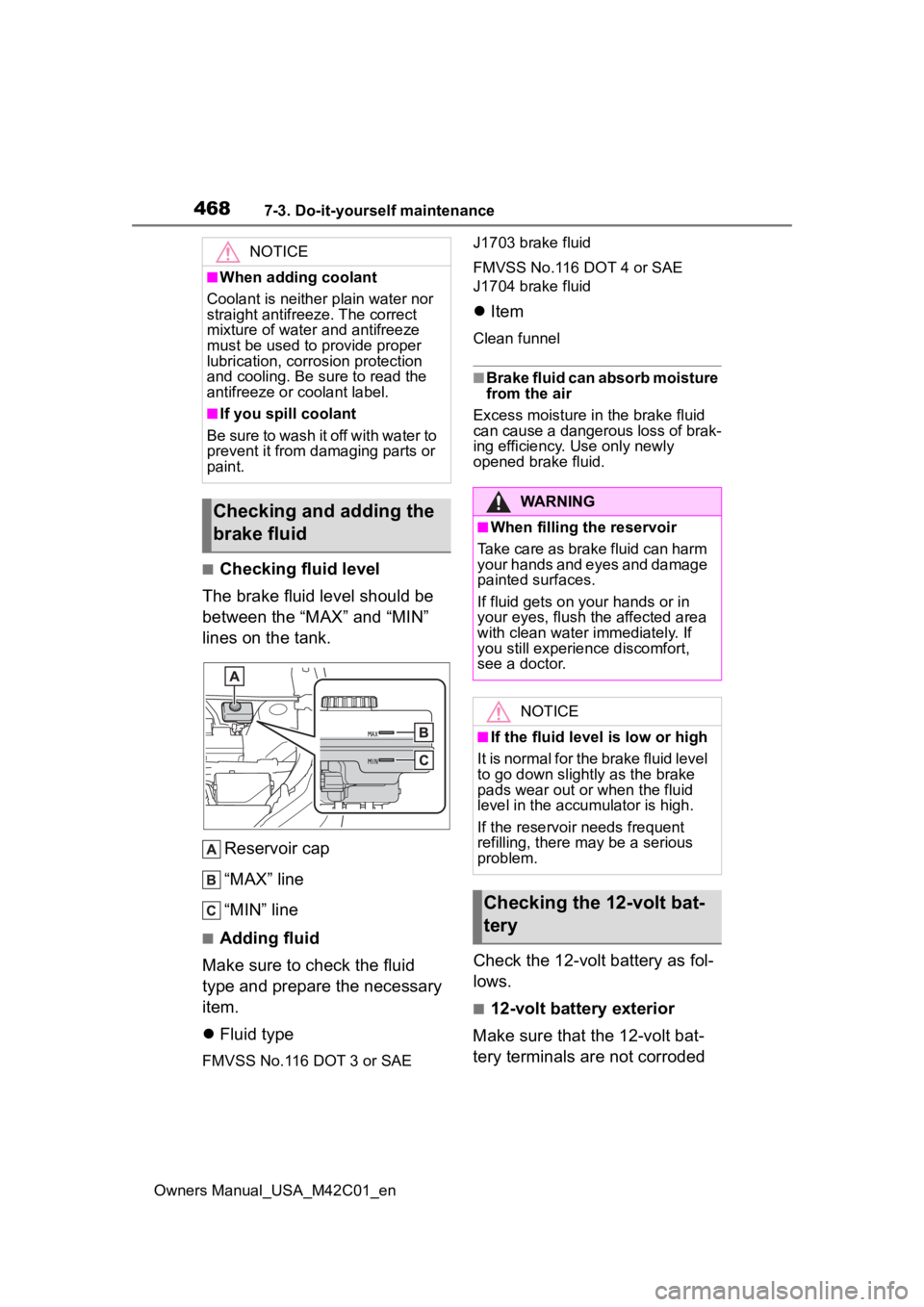
■Checking fluid level
The brake fluid level should be
between the “MAX” and “MIN”
lines on the tank.
Reservoir cap
“MAX” line
“MIN” line
■Adding fluid
Make sure to check the fluid
type and prepare the necessary
item.
Fluid type
FMVSS No.116 DOT 3 or SAE J1703 brake fluid
FMVSS No.116 DOT 4 or SAE
J1704 brake fluid
Item
Clean funnel
■Brake fluid can absorb moisture
from the air
Excess moisture in the brake fluid
can cause a dangerous loss of brak-
ing efficiency. Use only newly
opened brake fluid.
Check the 12-volt battery as fol-
lows.
■12-volt battery exterior
Make sure that the 12-volt bat-
tery terminals are not corroded
NOTICE
■When adding coolant
Coolant is neither plain water nor
straight antifreeze. The correct
mixture of water and antifreeze
must be used to provide proper
lubrication, corrosion protection
and cooling. Be sure to read the
antifreeze or coolant label.
■If you spill coolant
Be sure to wash it off with water to
prevent it from d amaging parts or
paint.
Checking and adding the
brake fluidWARNING
■When filling the reservoir
Take care as brake fluid can harm
your hands and eyes and damage
painted surfaces.
If fluid gets on your hands or in
your eyes, flush the affected area
with clean water immediately. If
you still experience discomfort,
see a doctor.
NOTICE
■If the fluid level is low or high
It is normal for the brake fluid level
to go down slight ly as the brake
pads wear out or when the fluid
level in the accumulator is high.
If the reservoir needs frequent
refilling, there m ay be a serious
problem.
Checking the 12-volt bat-
tery
Page 485 of 628
4857-3. Do-it-yourself maintenance
Owners Manual_USA_M42C01_en
7
Maintenance and care
11 Register the position of each
wheel.
Stop the vehicle in a safe
place on a hard, flat surface.
Set the parking brake.
Shift the shift position to P.
Stop the EV system.
Vehicles with power back
door: Turn off the power back
door system. ( P.185)
■Tools
As your vehicle is equipped with an
emergency tire puncture repair kit,
the following tools for replacing a
tire are not include d with your vehi-
cle. They can be purchased your
Toyota dealer.
●Jack
●Jack handle
Replacing the tire
When raising your vehicle
with a jack, position the jack
correctly.
Improper placement may
damage your vehicle or
cause injury.
If necessary tire replace-
ment seems difficult to per-
form, contact your Toyota
dealer.
Before jacking up the
vehicle
Page 489 of 628
4897-3. Do-it-yourself maintenance
Owners Manual_USA_M42C01_en
7
Maintenance and care
1 Remove any dirt or foreign
matter from the wheel con-
tact surface.
If foreign matter is on the wheel
WARNING
■Replacing a flat tire
●Do not touch the disc wheels or
the area around the brakes
immediately after the vehicle
has been driven.
After the vehicle has been
driven the disc wheels and the
area around the brakes will be
extremely hot. Touching these
areas with hands , feet or other
body parts while changing a tire,
etc. may result in burns.
●Failure to follow these precau-
tions could cause the wheel
bolts to loosen and the tire to fall
off, resulting in death or serious
injury.
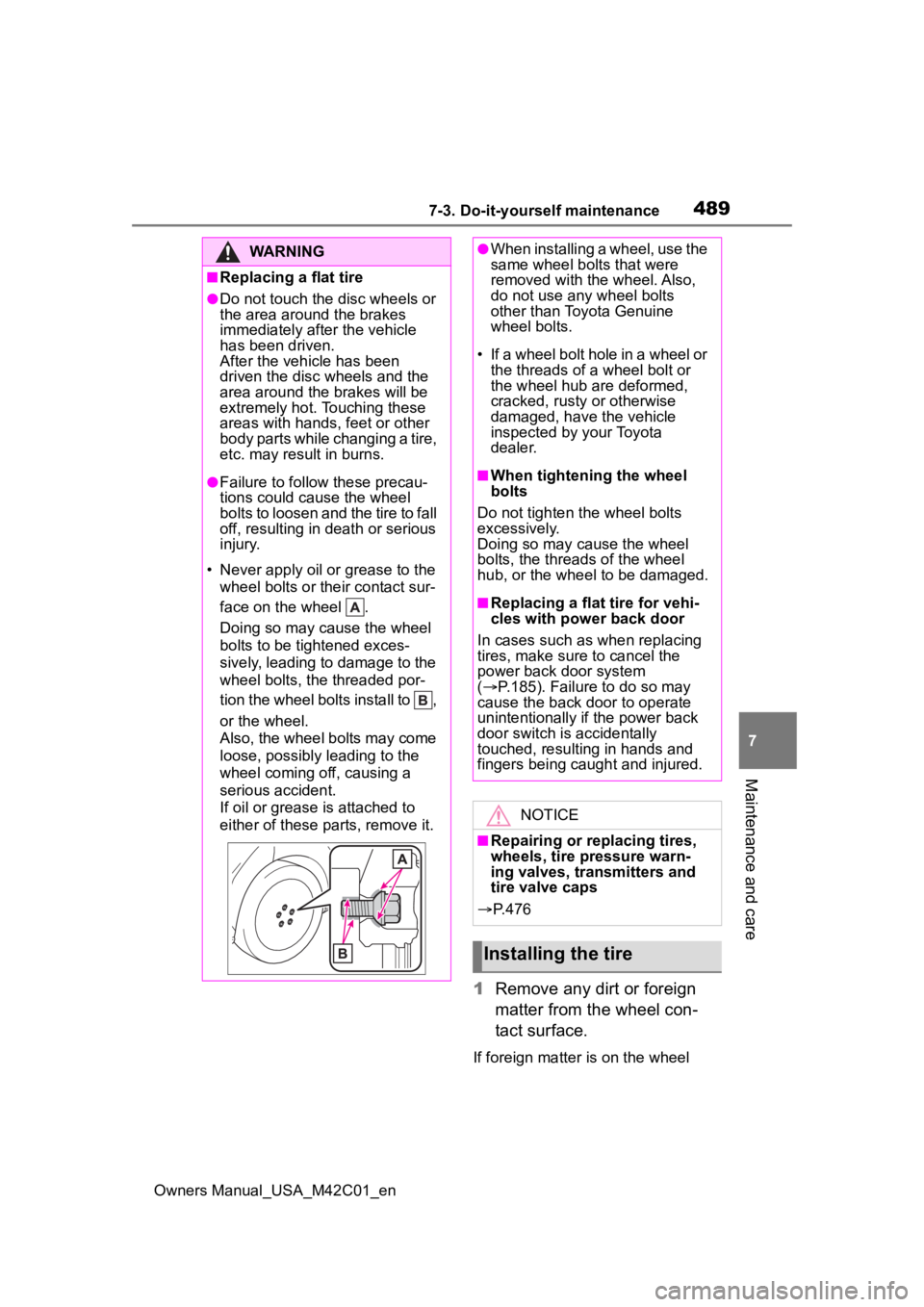
• Never apply oil or grease to the wheel bolts or their contact sur-
face on the wheel .
Doing so may cause the wheel
bolts to be tightened exces-
sively, leading to damage to the
wheel bolts, the threaded por-
tion the wheel bolts install to ,
or the wheel.
Also, the wheel bolts may come
loose, possibly leading to the
wheel coming off, causing a
serious accident.
If oil or grease is attached to
either of these parts, remove it.
●When installing a wheel, use the
same wheel bolts that were
removed with the wheel. Also,
do not use any wheel bolts
other than Toyota Genuine
wheel bolts.
• If a wheel bolt hole in a wheel or the threads of a wheel bolt or
the wheel hub are deformed,
cracked, rusty or otherwise
damaged, have the vehicle
inspected by your Toyota
dealer.
■When tightening the wheel
bolts
Do not tighten the wheel bolts
excessively.
Doing so may cause the wheel
bolts, the threads of the wheel
hub, or the wheel to be damaged.
■Replacing a flat tire for vehi-
cles with power back door
In cases such as when replacing
tires, make sure to cancel the
power back door system
( P.185). Failure to do so may
cause the back d oor to operate
unintentionally if the power back
door switch is accidentally
touched, resulti ng in hands and
fingers being caught and injured.
NOTICE
■Repairing or replacing tires,
wheels, tire pressure warn-
ing valves, transmitters and
tire valve caps
P. 4 7 6
Installing the tire
Page 505 of 628
5058-1. Essential information
Owners Manual_USA_M42C01_en
8
When trouble arises
1 Steadily step on the brake
pedal with both feet and
firmly depress it.
Do not pump the brake pedal
repeatedly as this will increase the
effort required to slow the vehicle.
2Shift the shift position to N.
If the shift position is shifted to
N
3 After slowing down, stop the
vehicle in a safe place by the
road.
4 Stop the EV system.
If the shift position cannot be
shifted to N
3 Keep depressing the brake
pedal with both feet to reduce
vehicle speed as much as
possible.
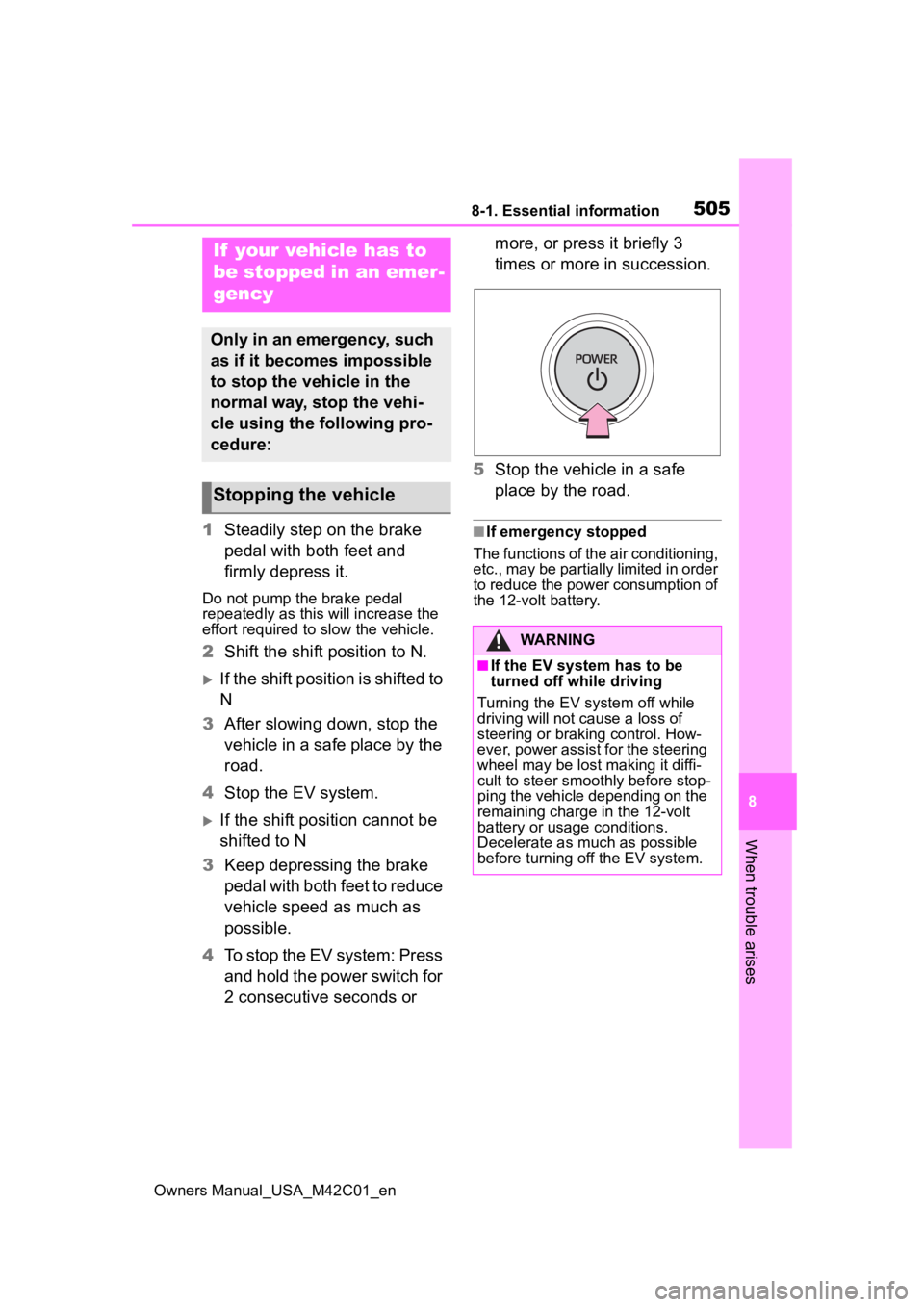
4 To stop the EV system: Press
and hold the power switch for
2 consecutive seconds or more, or press it briefly 3
times or more in succession.
5 Stop the vehicle in a safe
place by the road.
■If emergency stopped
The functions of the air conditioning,
etc., may be partially limited in order
to reduce the power consumption of
the 12-volt battery.
If your vehicle has to
be stopped in an emer-
gency
Only in an emergency, such
as if it becomes impossible
to stop the vehicle in the
normal way, stop the vehi-
cle using the following pro-
cedure:
Stopping the vehicle
WARNING
■If the EV system has to be
turned off while driving
Turning the EV system off while
driving will not cause a loss of
steering or braking control. How-
ever, power assist for the steering
wheel may be lost making it diffi-
cult to steer smoothly before stop-
ping the vehicle depending on the
remaining charge in the 12-volt
battery or usage conditions.
Decelerate as mu ch as possible
before turning off the EV system.
Page 507 of 628
5078-2. Steps to take in an emergency
Owners Manual_USA_M42C01_en
8
When trouble arises
8-2.Steps to take in an emergency
In the following situations, it is
not possible to be towed by
another vehicle using cables or
chains, as the front wheels may
be locked due to the parking
lock. Contact your Toyota dealer
or commercial towing service.
There is a malfunction in the
shift control system. ( P.233,
525)
There is a malfunction in the
immobilizer system. ( P. 6 8 )
There is a malfunction in the
smart key system. ( P.539)
The 12-volt battery is dis-
charged. ( P.541) The following may indicate a
problem with your transmission.
Contact your Toyota dealer or
commercial towing service
before towing.
The EV system warning mes-
sage is shown on the multi-
information display and the
vehicle does not move.
The vehicle makes an abnor-
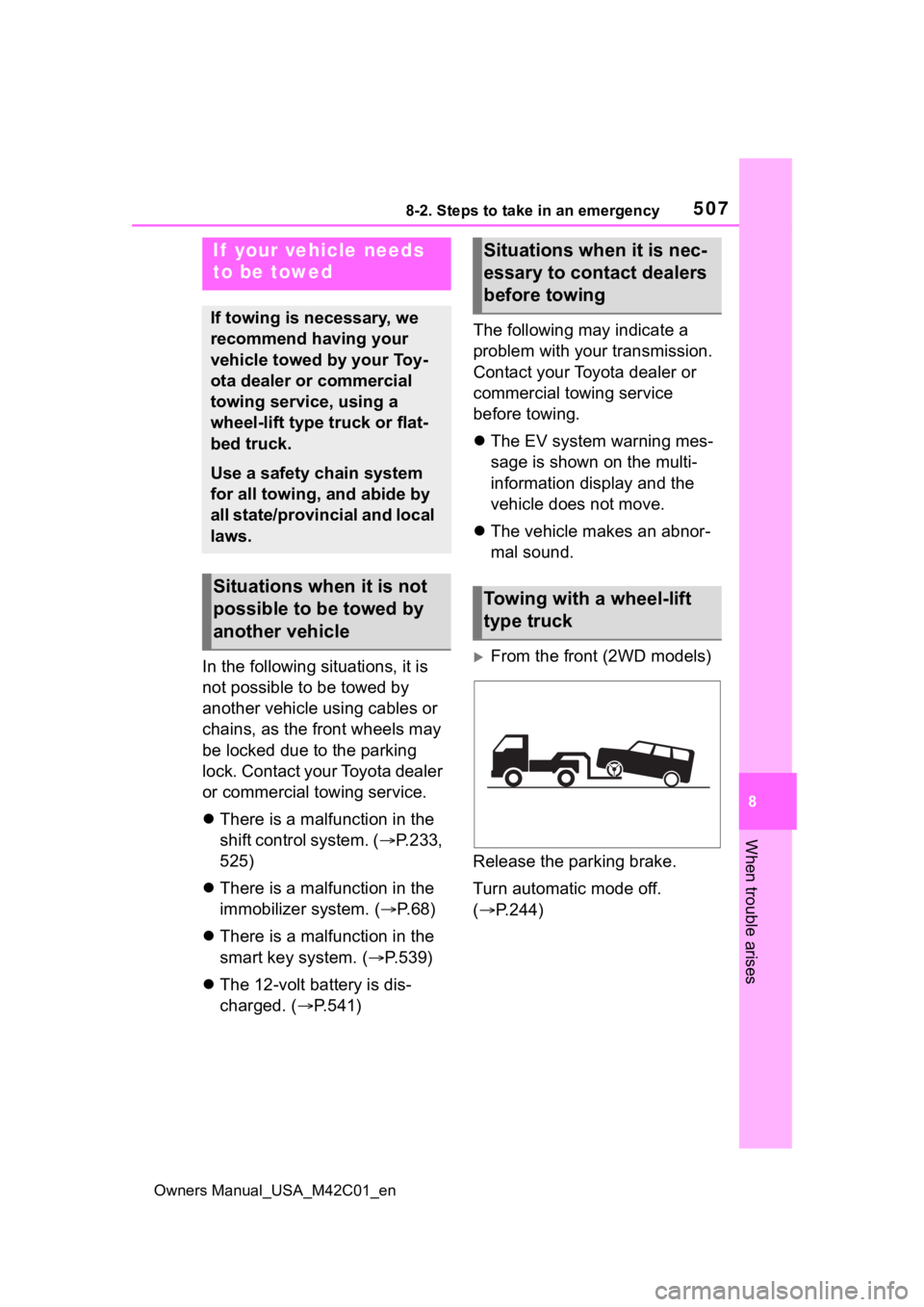
mal sound.From the front (2WD models)
Release the parking brake.
Turn automatic mode off.
( P.244)
If your vehicle needs
to be towed
If towing is necessary, we
recommend having your
vehicle towed by your Toy-
ota dealer or commercial
towing service, using a
wheel-lift type truck or flat-
bed truck.
Use a safety chain system
for all towing, and abide by
all state/provincial and local
laws.
Situations when it is not
possible to be towed by
another vehicle
Situations when it is nec-
essary to contact dealers
before towing
Towing with a wheel-lift
type truck
Page 509 of 628
5098-2. Steps to take in an emergency
Owners Manual_USA_M42C01_en
8
When trouble arises
When using a flat-bed truck to
transport the vehicle, use tire
strapping belts. Refer to the
owner’s manual of the flat-bed
truck for the tire strapping
method.
In order to suppress vehicle
movement during transporta-
tion, set the parking brake and
turn the power switch off.
If a tow truck is not available in
an emergency, your vehicle may
be temporarily towed using
cables or chains secured to the
emergency towing eyelets. This
should only be attempted on
hard surfaced roads for short
distances at under 18 mph (30
km/h).
A driver must be in the vehicle to
steer and operate the brakes.
The vehicle’s wheels, drive train,
axles, steering and brakes must
be in good condition.
WARNING
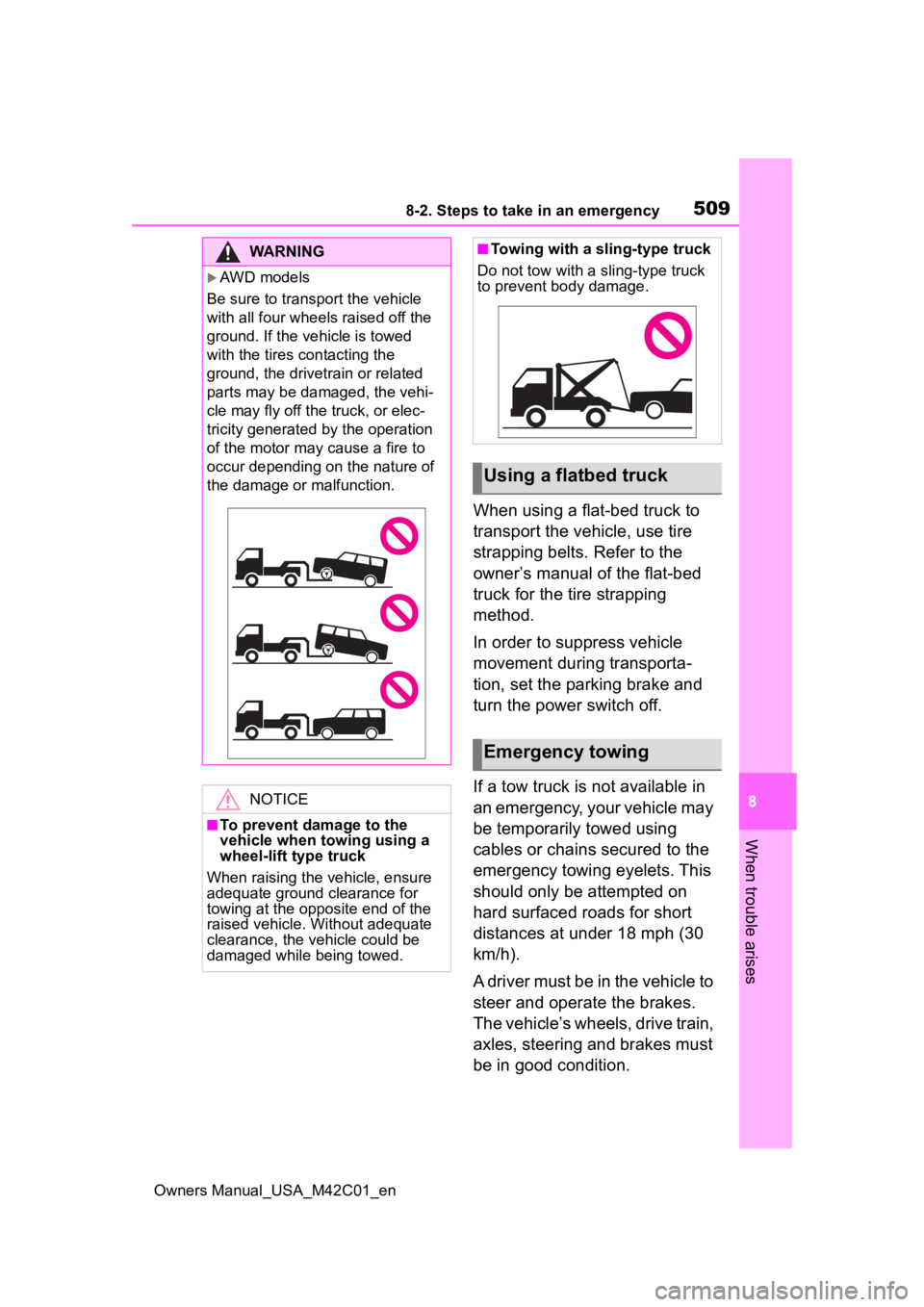
AWD models
Be sure to transport the vehicle
with all four wheels raised off the
ground. If the vehicle is towed
with the tires contacting the
ground, the drivetrain or related
parts may be damaged, the vehi-
cle may fly off the truck, or elec-
tricity generated by the operation
of the motor may cause a fire to
occur depending on the nature of
the damage or malfunction.
NOTICE
■To prevent damage to the
vehicle when towing using a
wheel-lift type truck
When raising the vehicle, ensure
adequate ground clearance for
towing at the opposite end of the
raised vehicle. Without adequate
clearance, the vehicle could be
damaged while being towed.
■Towing with a sling-type truck
Do not tow with a sling-type truck
to prevent body damage.
Using a flatbed truck
Emergency towing
Page 510 of 628
5108-2. Steps to take in an emergency
Owners Manual_USA_M42C01_en
To have your vehicle towed by
another vehicle, the towing eye-
let must be installed to your
vehicle. Install the towing eyelet
using the following procedure.
1Take out the wheel bolt
wrench and towing eyelet.
( P.486, 528)
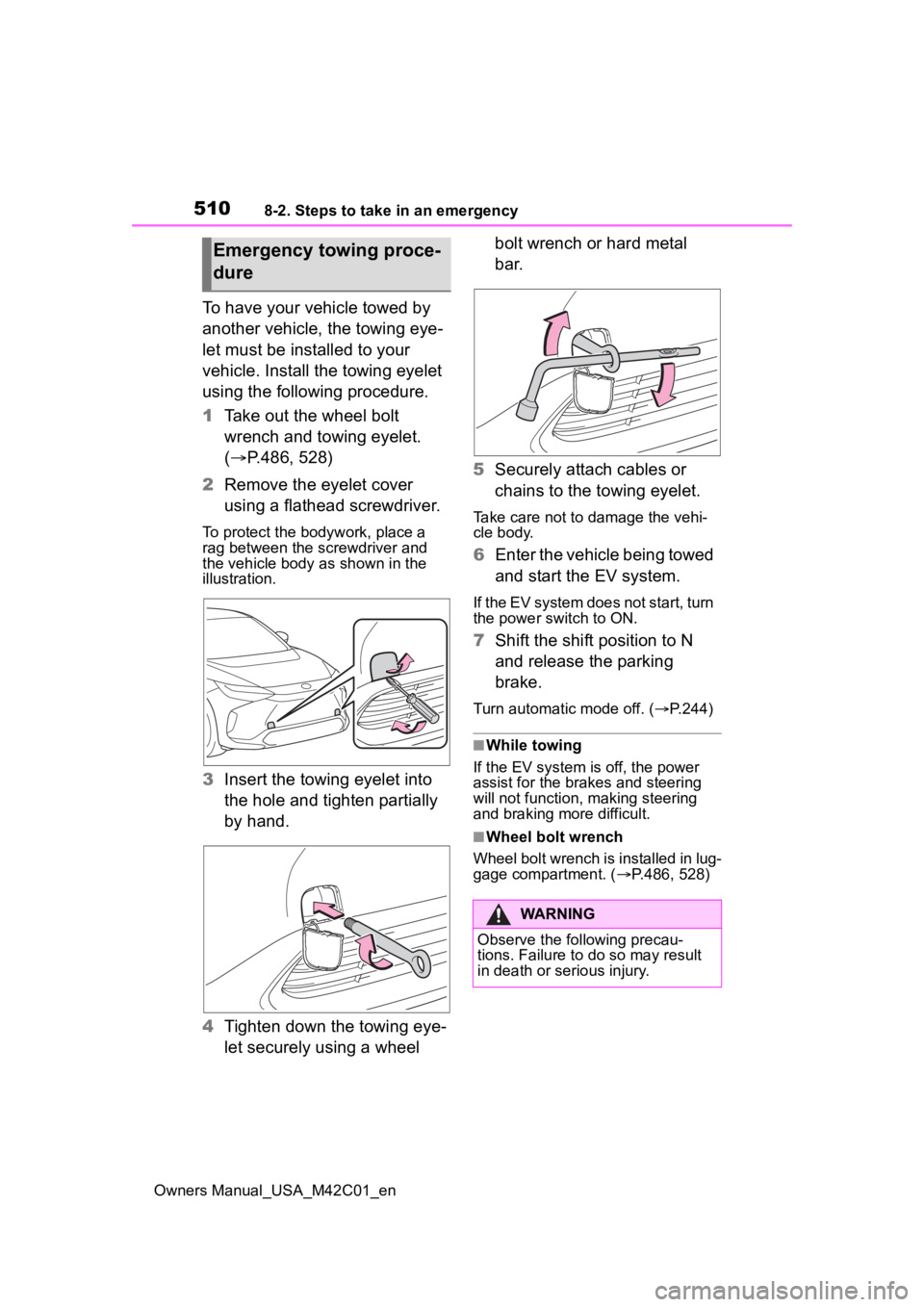
2 Remove the eyelet cover
using a flathead screwdriver.
To protect the bod ywork, place a
rag between the screwdriver and
the vehicle body as shown in the
illustration.
3 Insert the towing eyelet into
the hole and tighten partially
by hand.
4 Tighten down the towing eye-
let securely using a wheel bolt wrench or hard metal
bar.
5 Securely attach cables or
chains to the towing eyelet.
Take care not to damage the vehi-
cle body.
6Enter the vehicle being towed
and start the EV system.
If the EV system does not start, turn
the power switch to ON.
7Shift the shift position to N
and release the parking
brake.
Turn automatic mode off. ( P.244)
■While towing
If the EV system is off, the power
assist for the brakes and steering
will not functio n, making steering
and braking more difficult.
■Wheel bolt wrench
Wheel bolt wrench is installed in lug-
gage compartment. ( P.486, 528)
Emergency towing proce-
dure
WARNING
Observe the following precau-
tions. Failure to do so may result
in death or serious injury.
Page 511 of 628
5118-2. Steps to take in an emergency
Owners Manual_USA_M42C01_en
8
When trouble arises
Fluid leaks under the vehicle
(Water dripping from the air
conditioning after use is nor-
mal.)
Flat-looking tires or uneven
tire wear
Excessive tire squeal when
cornering
Strange noises related to the
suspension system
Other noises related to the EV
system
Stumbling or running roughly
Appreciable loss of power
Vehicle pulls heavily to one
side when braking
Vehicle pulls heavily to one
side when driving on a level
road
Loss of brake effectiveness,
WARNING
■While towing
●When towing using cables or
chains, avoid sudden starts,
etc., which place excessive
stress on the towing eyelets,
cables or chains. The towing
eyelets, cables or chains may
become damaged, broken
debris may hit people, and
cause serious damage.
●Do not perform any of the fol-
lowing as doing so may cause
the parking lock mechanism to
engage, locking the front
wheels and possibly leading to
an accident resulting in death or
serious injury:
• Unfasten the driver’s seat belt and open the driver’s door.
• Turn the power switch off.
■Installing towi ng eyelets to
the vehicle
Make sure that towing eyelets are
installed securely. If not securely
installed, towing eyelets may
come loose during towing.
NOTICE
■To prevent damage to the
vehicle during emergency
towing
Do not secure cables or chains to
the suspension components.
If you think something
is wrong
If you notice any of the fol-
lowing symptoms, your
vehicle probably needs
adjustment or repair. Con-
tact your Toyota dealer as
soon as possible.
Visible symptoms
Audible symptoms
Operational symptoms
Page 513 of 628
5138-2. Steps to take in an emergency
Owners Manual_USA_M42C01_en
8
When trouble arises
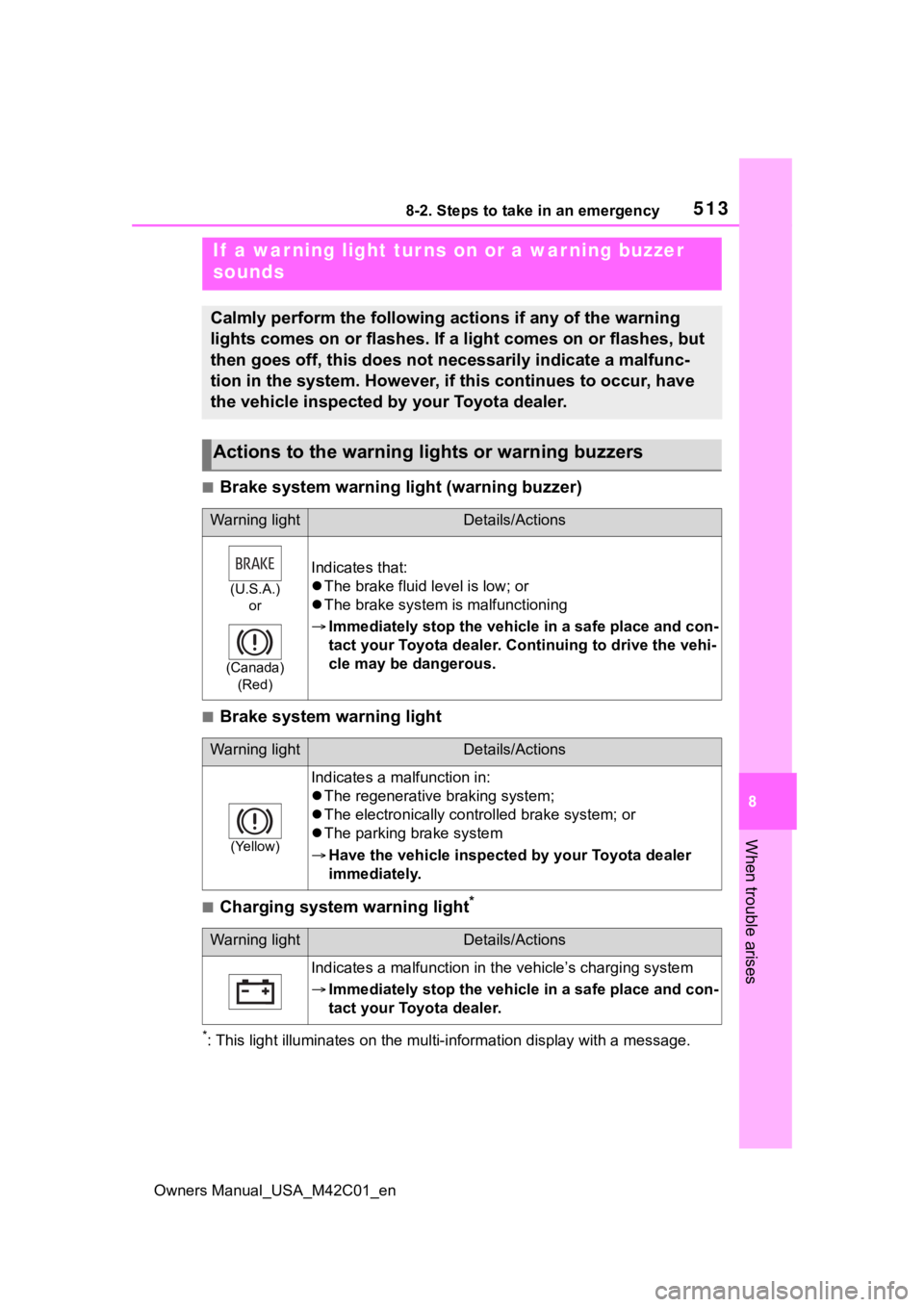
■Brake system warning light (warning buzzer)
■Brake system warning light
■Charging system warning light*
*: This light illuminates on the mu lti-information display with a message.
If a war ning light tur ns on or a war ning buzzer
sounds
Calmly perform the following actions if any of the warning
lights comes on or flashes. If a light comes on or flashes, but
then goes off, this does not necessarily indicate a malfunc-
tion in the system. However, if this continues to occur, have
the vehicle inspected by your Toyota dealer.
Actions to the warning lights or warning buzzers
Warning lightDetails/Actions
(U.S.A.) or
(Canada) (Red)
Indicates that:
The brake fluid level is low; or
The brake system is malfunctioning
Immediately stop the vehicle in a safe place and con-
tact your Toyota dealer. C ontinuing to drive the vehi-
cle may be dangerous.
Warning lightDetails/Actions
(Yellow)
Indicates a malfunction in:
The regenerative braking system;
The electronically contr olled brake system; or
The parking brake system
Have the vehicle inspecte d by your Toyota dealer
immediately.
Warning lightDetails/Actions
Indicates a malfunction in t he vehicle’s charging system
Immediately stop the vehicle in a safe place and con-
tact your Toyota dealer.