light SUBARU SOLTERRA 2023 User Guide
[x] Cancel search | Manufacturer: SUBARU, Model Year: 2023, Model line: SOLTERRA, Model: SUBARU SOLTERRA 2023Pages: 628, PDF Size: 11.91 MB
Page 20 of 628
20Pictorial index
Owners Manual_USA_M42C01_en
“X-MODE” switch*1............................................................ P.3 82
“SNOW” switch
*1............................................................... P. 3 8 2
“ODO TRIP” switch .............................................. .............. P.154
Instrument panel light control switches ........................ .. P.155
*1: If equipped
*2: Refer to “MULTIMEDIA OWNER’S MANUAL”.
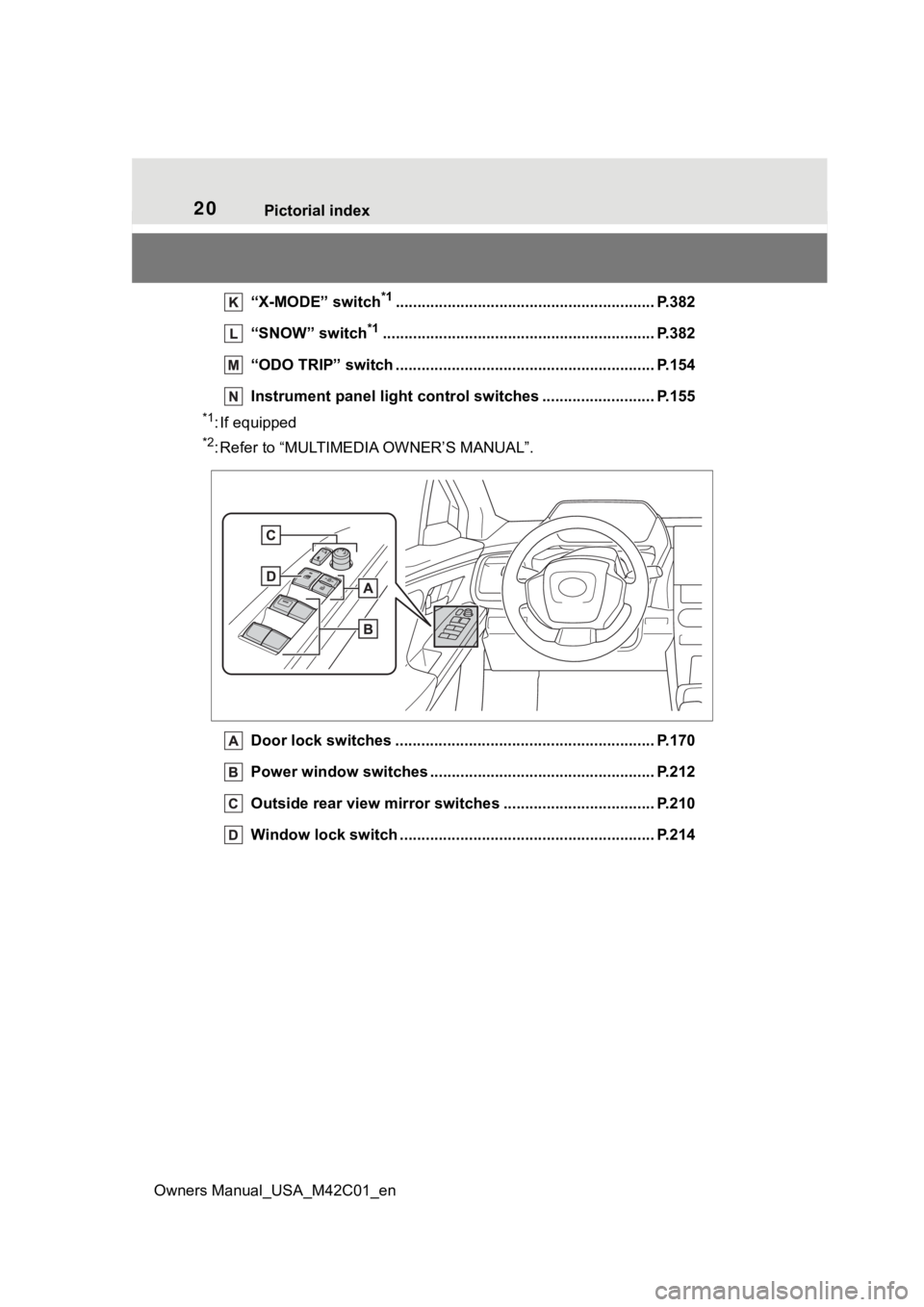
Door lock switches ............................................................ P.170
Power window switches ....... ............................................. P.212
Outside rear view mirror swi tches ................................... P.210
Window lock switch ............................................. .............. P.214
Page 23 of 628
23Pictorial index
Owners Manual_USA_M42C01_en
■ Ceiling
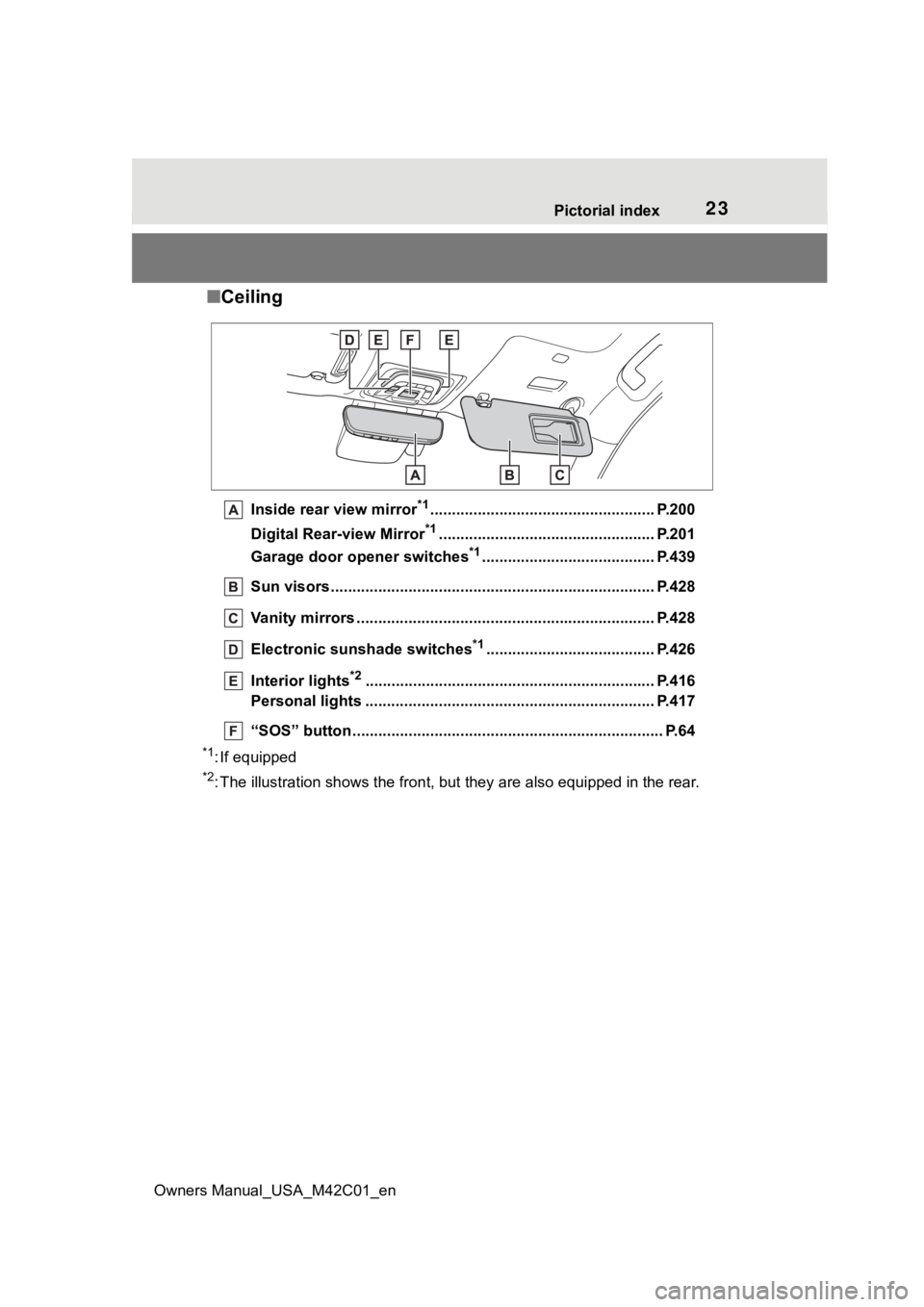
Inside rear view mirror*1.................................................... P.200
Digital Rear-view Mirror
*1.................................................. P.201
Garage door opener switches
*1........................................ P.439
Sun visors..................................................... ...................... P.428
Vanity mirrors ................................................. .................... P.428
Electronic sunshade switches
*1....................................... P.426
Interior lights
*2............................................................... .... P.416
Personal lights ................................................ ................... P.417
“SOS” button ................................................... ..................... P.64
*1: If equipped
*2: The illustration shows the front, but they are also equipped i n the rear.
Page 27 of 628
271-1. For safe use
Owners Manual_USA_M42C01_en
1
For safety and security
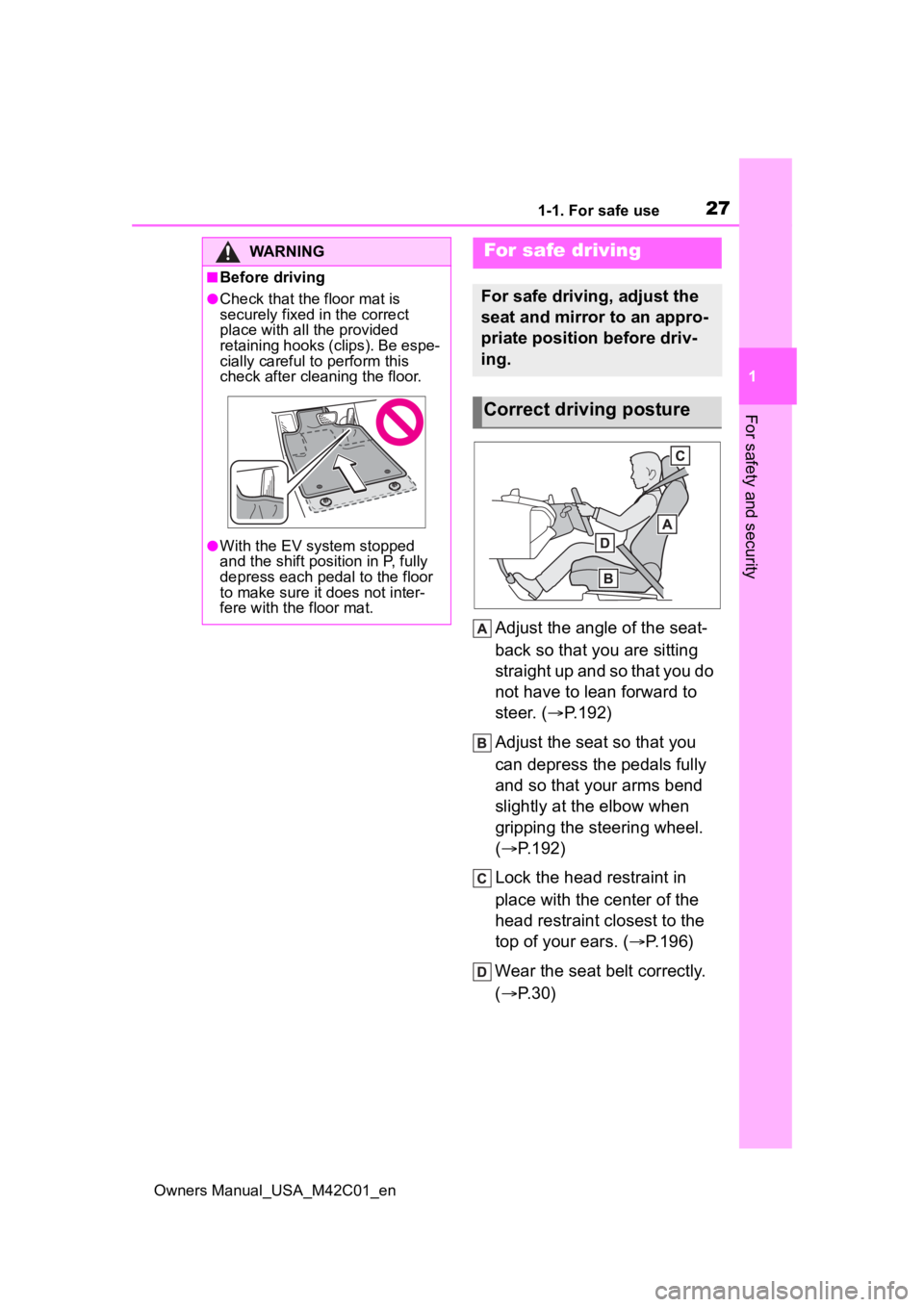
Adjust the angle of the seat-
back so that you are sitting
straight up and so that you do
not have to lean forward to
steer. ( P.192)
Adjust the seat so that you
can depress the pedals fully
and so that your arms bend
slightly at the elbow when
gripping the steering wheel.
( P.192)
Lock the head restraint in
place with the center of the
head restraint closest to the
top of your ears. ( P.196)
Wear the seat belt correctly.
( P.30)
WARNING
■Before driving
●Check that the floor mat is
securely fixed in the correct
place with all the provided
retaining hooks (clips). Be espe-
cially careful to perform this
check after cleaning the floor.
●With the EV system stopped
and the shift posit ion in P, fully
depress each pedal to the floor
to make sure it does not inter-
fere with the floor mat.
For safe driving
For safe driving, adjust the
seat and mirror to an appro-
priate position before driv-
ing.
Correct driving posture
Page 31 of 628
311-1. For safe use
Owners Manual_USA_M42C01_en
1
For safety and security
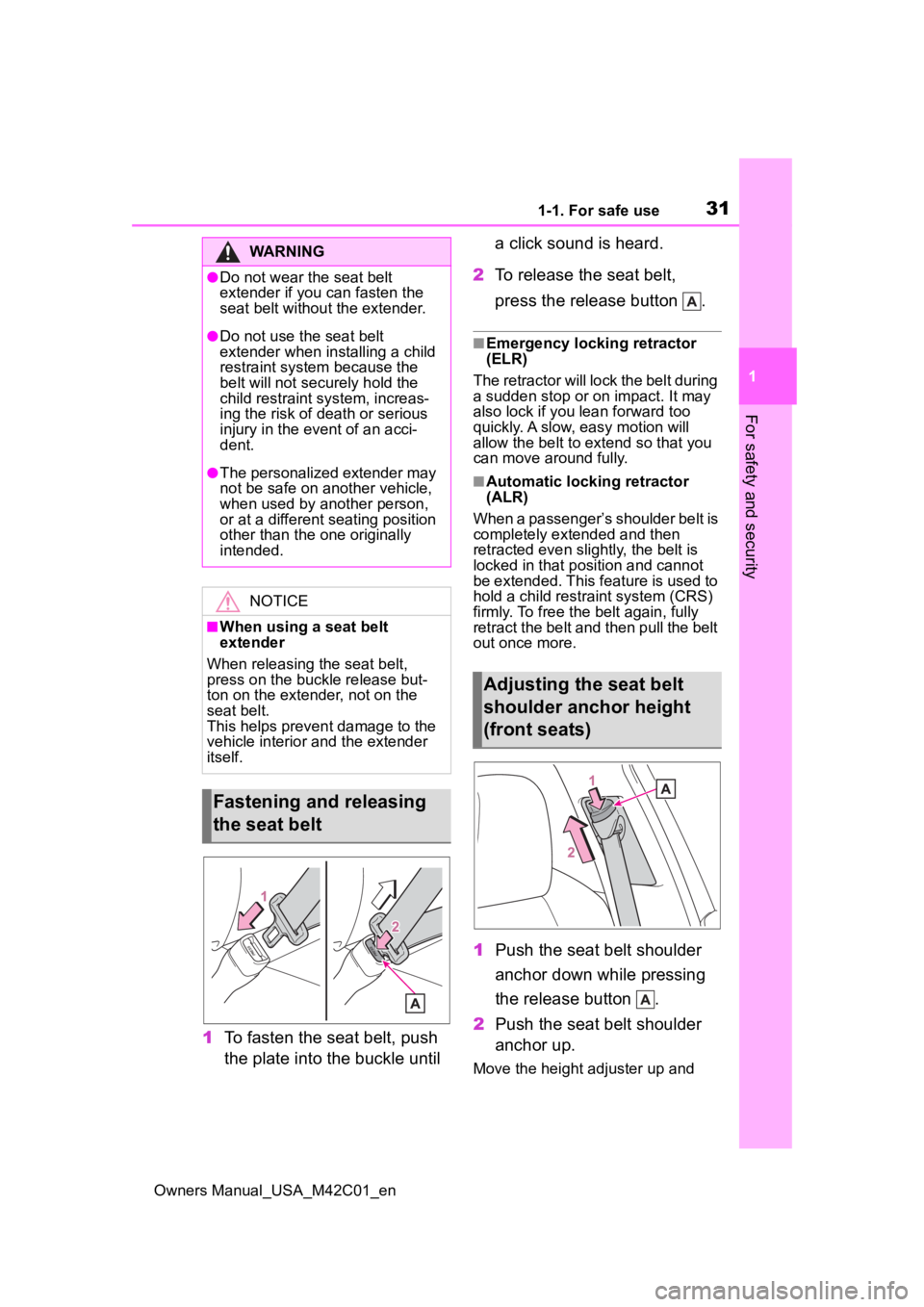
1 To fasten the seat belt, push
the plate into the buckle until a click sound is heard.
2 To release the seat belt,
press the release button .
■Emergency locking retractor
(ELR)
The retractor will lock the belt during
a sudden stop or on impact. It may
also lock if you lean forward too
quickly. A slow, easy motion will
allow the belt to extend so that you
can move around fully.
■Automatic locking retractor
(ALR)
When a passenger’s shoulder belt is
completely extended and then
retracted even slightly, the belt is
locked in that position and cannot
be extended. This feature is used to
hold a child restraint system (CRS)
firmly. To free the belt again, fully
retract the belt and then pull the belt
out once more.
1 Push the seat belt shoulder
anchor down while pressing
the release button .
2 Push the seat belt shoulder
anchor up.
Move the height adjuster up and
WARNING
●Do not wear the seat belt
extender if you can fasten the
seat belt without the extender.
●Do not use the seat belt
extender when installing a child
restraint system because the
belt will not securely hold the
child restraint system, increas-
ing the risk of death or serious
injury in the event of an acci-
dent.
●The personalized extender may
not be safe on another vehicle,
when used by another person,
or at a different seating position
other than the one originally
intended.
NOTICE
■When using a seat belt
extender
When releasing the seat belt,
press on the buckle release but-
ton on the extender, not on the
seat belt.
This helps prevent damage to the
vehicle interior and the extender
itself.
Fastening and releasing
the seat belt
Adjusting the seat belt
shoulder anchor height
(front seats)
Page 33 of 628
331-1. For safe use
Owners Manual_USA_M42C01_en
1
For safety and security
WARNING
●If the pretensioner has acti-
vated, the SRS warning light will
come on. In that case, the seat
belt cannot be used again and
must be replaced at your Toyota
dealer.
Page 35 of 628
351-1. For safe use
Owners Manual_USA_M42C01_en
1
For safety and security
• Can help prevent the occupants from being thrown from the vehi cle in the
event of vehicle rollover
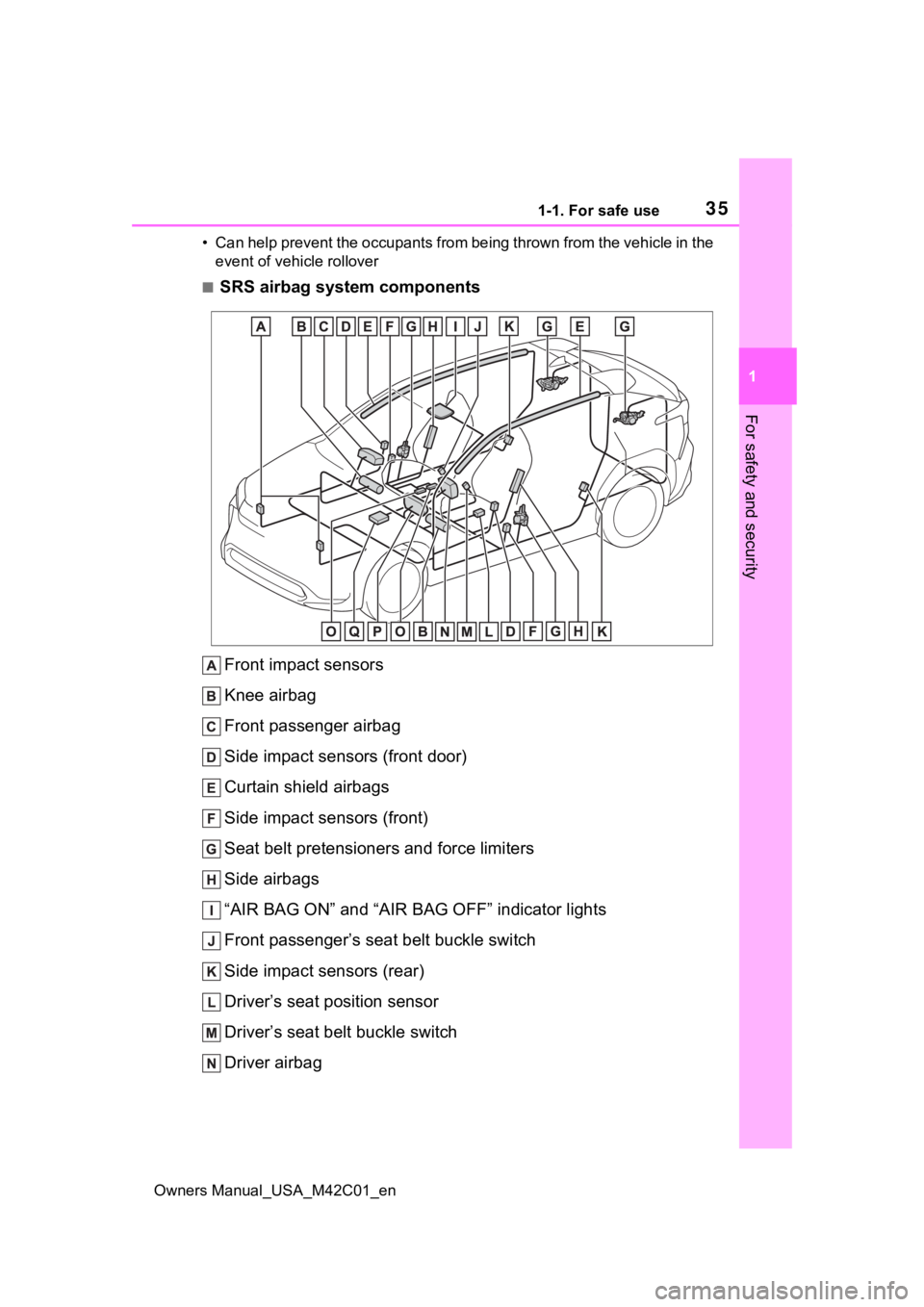
■SRS airbag system components
Front impact sensors
Knee airbag
Front passenger airbag
Side impact sensors (front door)
Curtain shield airbags
Side impact sensors (front)
Seat belt pretensioners and force limiters
Side airbags
“AIR BAG ON” and “AIR BAG OFF” indicator lights
Front passenger’s seat belt buckle switch
Side impact sensors (rear)
Driver’s seat position sensor
Driver’s seat bel t buckle switch
Driver airbag
Page 36 of 628
361-1. For safe use
Owners Manual_USA_M42C01_en
Front passenger occupant classification sensors
SRS warning light
Airbag sensor assembly
Your vehicle is equipped with ADVANCED AIRBAGS designed
based on the US motor vehicle safety standards (FMVSS208). The
airbag sensor assembly (ECU) cont rols airbag deployment based on
information obtained from the sensors etc. shown in the system
components diagram above. This in formation includes crash sever-
ity and occupant information. As the airbags deploy, a chemical
reaction in the inflators quickly fills the airbags with non-toxic gas to
help restrain the motion of the occupants.
■If the SRS airbags deploy
(inflate)
●Slight abrasions, burns, bruising
etc., may be sustained from SRS
airbags, due to the extremely high
speed deployment (inflation) by
hot gases.
●A loud noise and white powder will
be emitted.
●Parts of the airbag module (steer-
ing wheel hub, airbag cover and
inflator) as well as the front seats,
parts of the front and rear pillars,
and roof side rails, may be hot for
several minutes. T he airbag itself
may also be hot.
●The windshield may crack.
●The EV system will be stopped.
( P. 8 0 )
●All of the doors will be unlocked.
( P.168)
●The brakes and st op lights will be
controlled automatically. ( P.388)
●The interior lights will turn on auto-
matically. ( P.416)
●The emergency flashers will turn
on automatically. ( P.504)
●For Safety Connect subscribers, if
any of the following situations
occur, the system is designed to
send an emergency call to the
response center, notifying them of the vehicle’s location (without
needing to push the “SOS” button)
and an agent will attempt to speak
with the occupants to ascertain
the level of emergency and assis-
tance required. If the occupants
are unable to communicate, the
agent automatically treats the call
as an emergency and helps to dis-
patch the necessary emergency
services. (
P. 6 4 )
• An SRS airbag is deployed.
• A seat belt pretensioner is acti- vated.
• The vehicle is involved in a severe rear-end collision.
■SRS airbag deployment condi-
tions (SRS front airbags)
●The SRS front airbags will deploy
in the event of an impact that
exceeds the set threshold level
(the level of forc e corresponding
to an approximately 12 - 18 mph
[20 - 30 km/h] frontal collision with
a fixed wall that does not move or
deform).
However, this threshold velocity will
be considerably higher in the follow-
ing situations:
• If the vehicle strikes an object, such as a parked vehicle or sign
pole, which can move or deform
on impact
• If the vehicle is involved in an underride collision, such as a colli-
Page 44 of 628
441-1. For safe use
Owners Manual_USA_M42C01_en
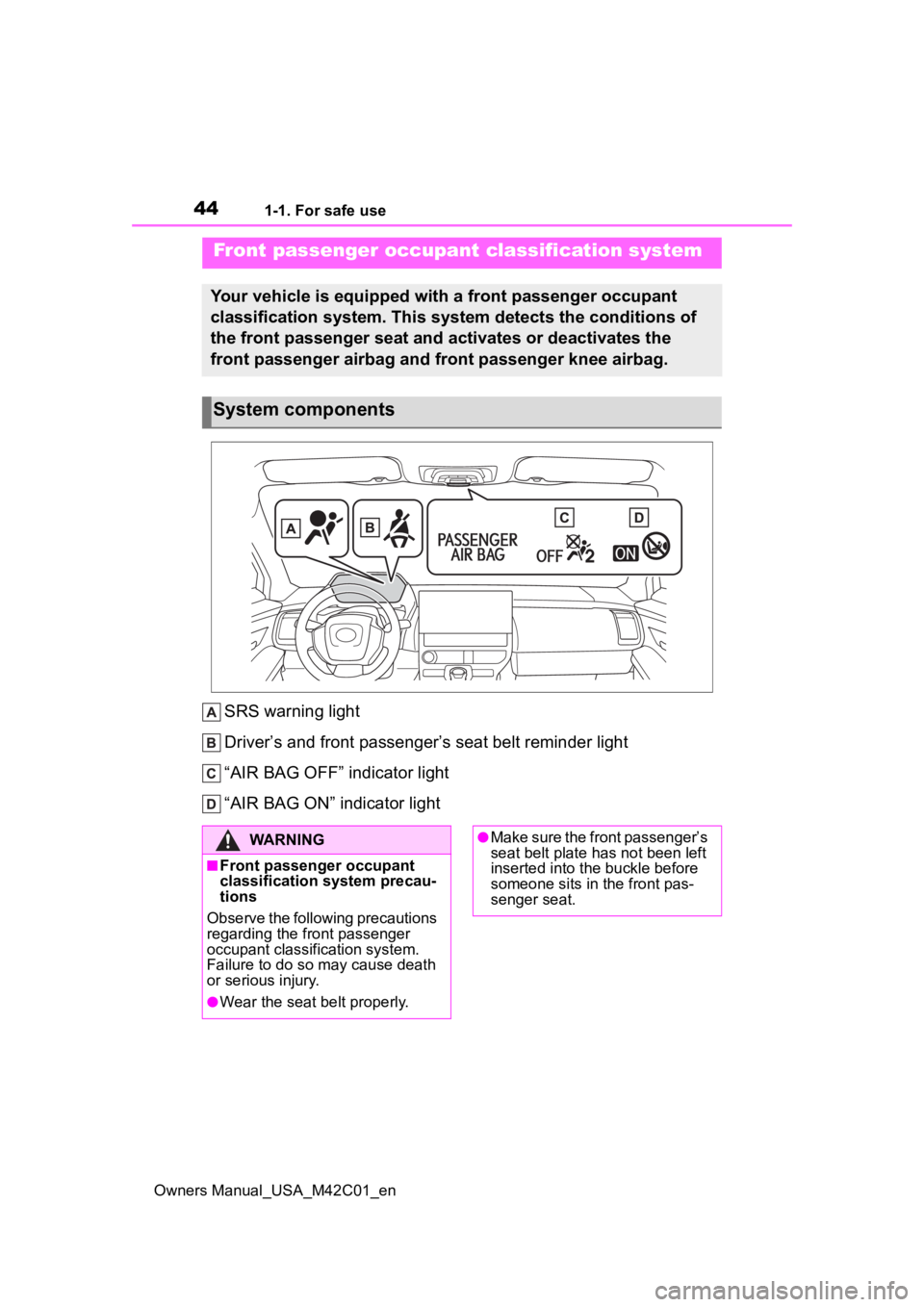
SRS warning light
Driver’s and front passenger’s seat belt reminder light
“AIR BAG OFF” indicator light
“AIR BAG ON” indicator light
Front passenger occupant classification system
Your vehicle is equipped with a front passenger occupant
classification system. This system detects the conditions of
the front passenger seat and activates or deactivates the
front passenger airbag and front passenger knee airbag.
System components
WARNING
■Front passenger occupant
classification system precau-
tions
Observe the following precautions
regarding the front passenger
occupant classification system.
Failure to do so may cause death
or serious injury.
●Wear the seat belt properly.
●Make sure the front passenger’s
seat belt plate has not been left
inserted into the buckle before
someone sits in the front pas-
senger seat.
Page 45 of 628
451-1. For safe use
Owners Manual_USA_M42C01_en
1
For safety and security
WARNING
●Make sure the “AIR BAG OFF”
indicator light is not illuminated
when using the seat belt
extender for the front passenger
seat. If the “AIR BAG OFF” indi-
cator light is illuminated, discon-
nect the extender tongue from
the seat belt buckle, and recon-
nect the seat belt. Reconnect
the seat belt extender after
making sure the “AIR BAG ON”
indicator light is illuminated. If
you use the seat belt extender
while the “AIR BAG OFF” indi-
cator light is illuminated, the
SRS airbags for the front pas-
senger will not activate, which
could cause death or serious
injury in the ev ent of a collision.
●Do not apply a heavy load to the
front passenger seat or equip-
ment (e.g. seatback pocket).
●Do not put weight on the front
passenger seat by putting your
hands or feet on the front pas-
senger seat seatback from the
rear passenger seat.
●Do not let a rea r passenger lift
the front passenger seat with
their feet or press on the seat-
back with their legs.
●Do not put objects under the
front passenger seat.
●Do not recline t he front passen-
ger seatback so far that it
touches a rear seat. This may
cause the “AIR BAG OFF” indi-
cator light to be illuminated,
which indicates that the SRS
airbags for the front passenger
will not activate in the event of a
severe accident. If the seatback
touches the rear seat, return the
seatback to a position where it
does not touch the rear seat.
Keep the front passenger seat-
back as upright as possible
when the vehicle is moving.
Reclining the seatback exces-
sively may lessen the effective-
ness of the seat belt system.
●If an adult sits i n the front pas-
senger seat, the “AIR BAG ON”
indicator light i s illuminated. If
the “AIR BAG OFF” indicator is
illuminated, ask the passenger
to sit up straight, well back in
the seat, feet on the floor, and
with the seat belt worn correctly.
If the “AIR BAG OFF” indicator
still remains illumi nated, either
ask the passenger to move to
the rear seat, or if that is not
possible, move the front pas-
senger seat fully rearward.
●When it is unavoidable to install
a forward-facing child restraint
system on the front passenger
seat, install the child restraint
system on the front passenger
seat in the proper order.
( P. 5 2 )
●Do not modify or remove the
front seats.
Page 46 of 628
461-1. For safe use
Owners Manual_USA_M42C01_en
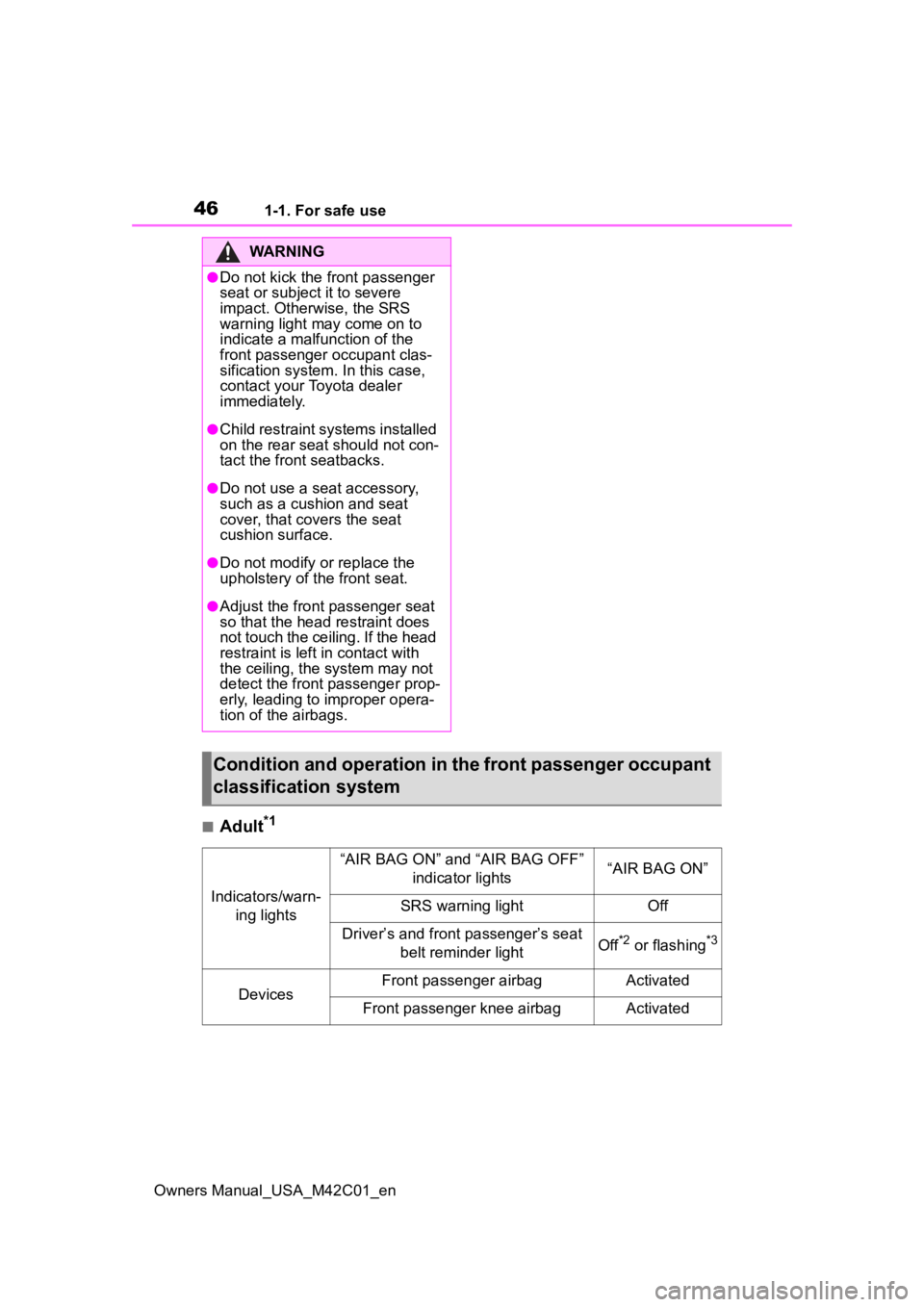
■Adult*1
WARNING
●Do not kick the front passenger
seat or subject it to severe
impact. Otherwise, the SRS
warning light may come on to
indicate a malfunction of the
front passenger occupant clas-
sification system. In this case,
contact your Toyota dealer
immediately.
●Child restraint systems installed
on the rear seat should not con-
tact the front seatbacks.
●Do not use a seat accessory,
such as a cushion and seat
cover, that covers the seat
cushion surface.
●Do not modify or replace the
upholstery of the front seat.
●Adjust the front passenger seat
so that the head restraint does
not touch the ceiling. If the head
restraint is left in contact with
the ceiling, the system may not
detect the front passenger prop-
erly, leading to improper opera-
tion of the airbags.
Condition and operation in the front passenger occupant
classification system
Indicators/warn- ing lights
“AIR BAG ON” and “AIR BAG OFF” indicator lights“AIR BAG ON”
SRS warning lightOff
Driver’s and front passenger’s seat belt reminder lightOff*2 or flashing*3
DevicesFront passenger airbagActivated
Front passenger knee airbagActivated