engine SUBARU TRIBECA 2008 Owners Manual
[x] Cancel search | Manufacturer: SUBARU, Model Year: 2008, Model line: TRIBECA, Model: SUBARU TRIBECA 2008Pages: 409, PDF Size: 5.75 MB
Page 335 of 409
just below the filler neck, allowing enough
room to add genuine Subaru cooling
system conditioner in the radiator. Add
genuine Subaru cooling system condi-
tioner until the coolant level reaches the
filler neck. Do not pour the coolant too
quickly, as this may lead to insufficient air
bleeding and trapped air in the system.Coolant capacity (Guideline):8.0 US qt (7.6 liters, 6.7 Imp qt)
CAUTION
. Be careful not to spill engine
coolant when adding it. If coolant
touches the exhaust pipe, it may
cause a bad smell, smoke, and/or
a fire. If engine coolant gets on
the exhaust pipe, be sure to wipe
it off.
. Do not splash the engine coolant
over painted parts. The alcohol
contained in the engine coolant
may damage the paint surface.
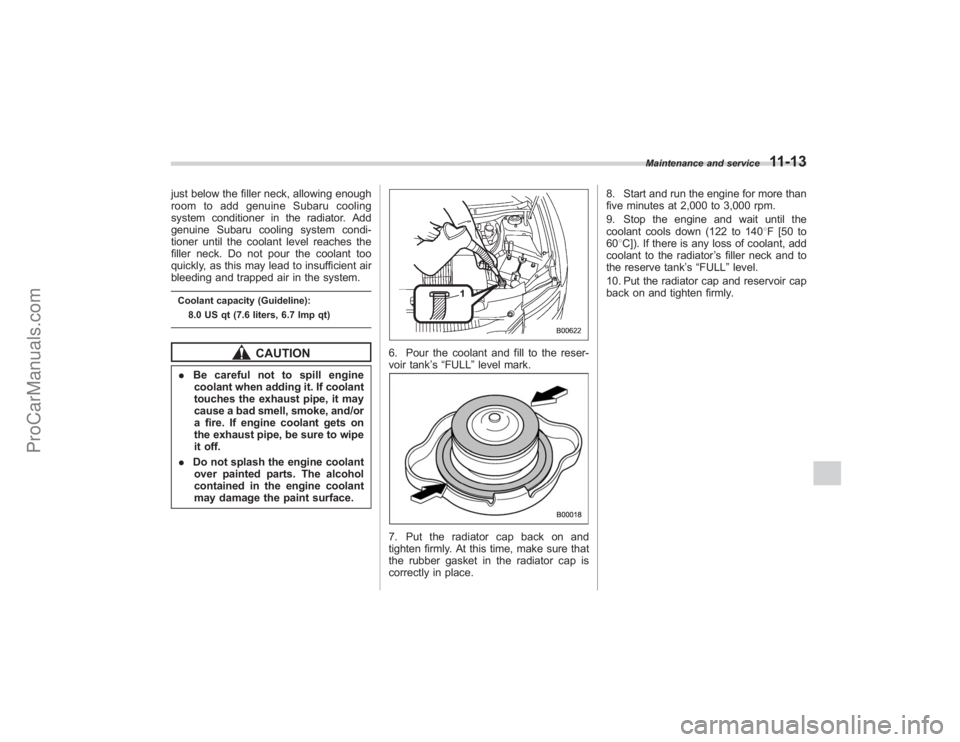
6. Pour the coolant and fill to the reser-
voir tank ’s “FULL ”level mark.7. Put the radiator cap back on and
tighten firmly. At this time, make sure that
the rubber gasket in the radiator cap is
correctly in place. 8. Start and run the engine for more than
five minutes at 2,000 to 3,000 rpm.
9. Stop the engine and wait until the
coolant cools down (122 to 140
8F [50 to
60 8C]). If there is any loss of coolant, add
coolant to the radiator ’s filler neck and to
the reserve tank ’s “FULL ”level.
10. Put the radiator cap and reservoir cap
back on and tighten firmly.
Maintenance and service
11-13
ProCarManuals.com
Page 336 of 409
11-14
Maintenance and service
Air cleaner element
WARNING
Do not operate the engine with the
air cleaner element removed. The air
cleaner element not only filters
intake air but also stops flames if
the engine backfires. If the air
cleaner element is not installed
when the engine backfires, you
could be burned.
CAUTION
When replacing the air cleaner ele-
ment, use a genuine SUBARU air
cleaner element. If it is not used,
there is the possibility of causing a
negative effect to the engine.
The air cleaner element functions as a
filter screen. When the element is perfo-
rated or removed, engine wear will be
excessive and engine life shortened.
The air cleaner element is a dry type. It is
unnecessary to clean or wash the ele-
ment.
& Replacing the air cleaner
elementReplace the air cleaner element according
to the maintenance schedule in the
“Warranty and Maintenance Booklet ”. Un-
der extremely dusty conditions, replace it
more frequently. It is recommended that
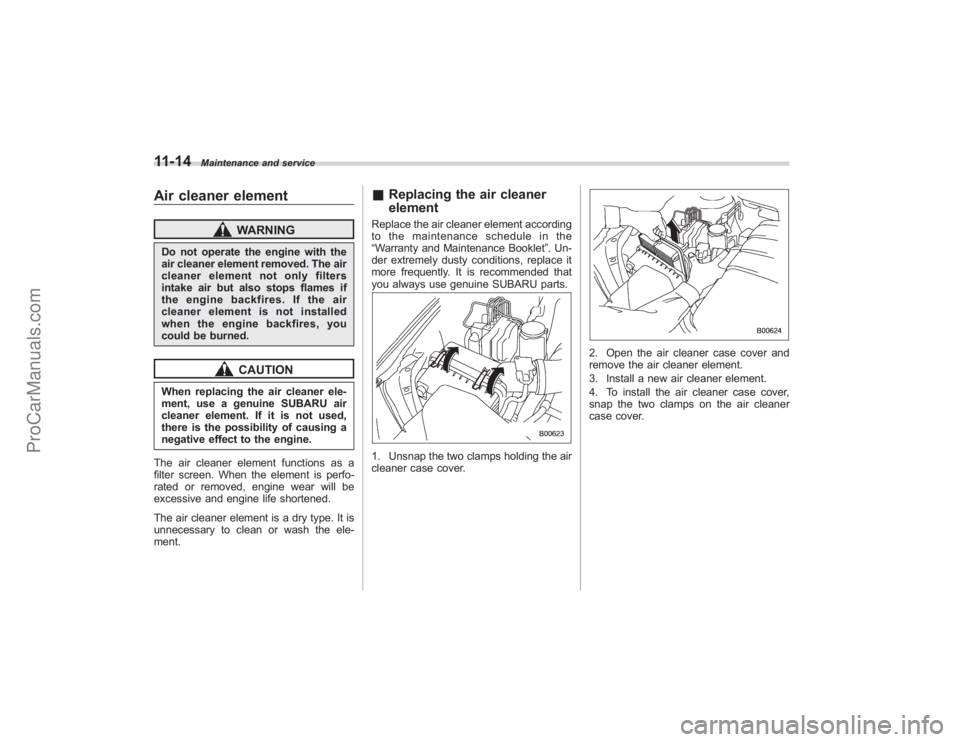
you always use genuine SUBARU parts.1. Unsnap the two clamps holding the air
cleaner case cover.
2. Open the air cleaner case cover and
remove the air cleaner element.
3. Install a new air cleaner element.
4. To install the air cleaner case cover,
snap the two clamps on the air cleaner
case cover.
ProCarManuals.com
Page 337 of 409
Spark plugsIt may be difficult to replace the spark
plugs. It is recommended that you have
the spark plugs replaced by your
SUBARU dealer.
The spark plugs should be replaced
according to the maintenance schedule
in the“Warranty and Maintenance Book-
let ”.& Recommended spark plugsSILFR6A (NGK)
Drive beltsThe alternator, power steering pump, and
air conditioner compressor depend on
drive belts. Satisfactory performance re-
quires that belt tension be correct.
It is unnecessary to check belt tension
periodically because your engine is
equipped with an automatic belt tension
adjuster. However, replacement of the belt
should be done according to the main-
tenance schedule in the “Warranty and
Maintenance Booklet ”. Consult your
SUBARU dealer for replacement.
If a belt is loose, cracked, or worn, contact
your SUBARU dealer.
Automatic transmission fluid& Checking the fluid levelThe automatic transmission fluid expands
largely as its temperature rises; the fluid
level differs according to fluid temperature.
Therefore, there are two different scales
for checking the level of hot fluid and cold
fluid on the dipstick.
Though the fluid level can be checked
without warming up the fluid on the
“COLD ”range, we recommend checking
the fluid level when the fluid is at operating
temperature.
! Checking the fluid level when the
fluid is hot
Check the fluid level monthly.
1. Drive the vehicle several miles to raise
the temperature of the transmission fluid
up to normal operating temperature; 158
to 1768 F (70 to 80 8C) is normal.
2. Park the vehicle on a level surface and
set the parking brake.
3. First shift the selector lever in each
position. Then shift it in the “P ” position,
and run the engine at idling speed.
Maintenance and service
11-15
– CONTINUED –
ProCarManuals.com
Page 339 of 409
Front differential gear oil&Checking the oil level1) Yellow handle1. Park the vehicle on a level surface and
stop the engine.
2. Pull out the dipstick, wipe it clean, and
insert it again.
1) Upper level
2) Lower level3. Pull out the dipstick again and check
the oil level on it. If it is below the lower
level, add oil to bring the level up to the
upper level.
CAUTION
Be careful not to spill front differ-
ential gear oil when adding it. If oil
touches the exhaust pipe, it may
cause a bad smell, smoke, and/or a
fire. If oil gets on the exhaust pipe,
be sure to wipe it off.
&Recommended grade and
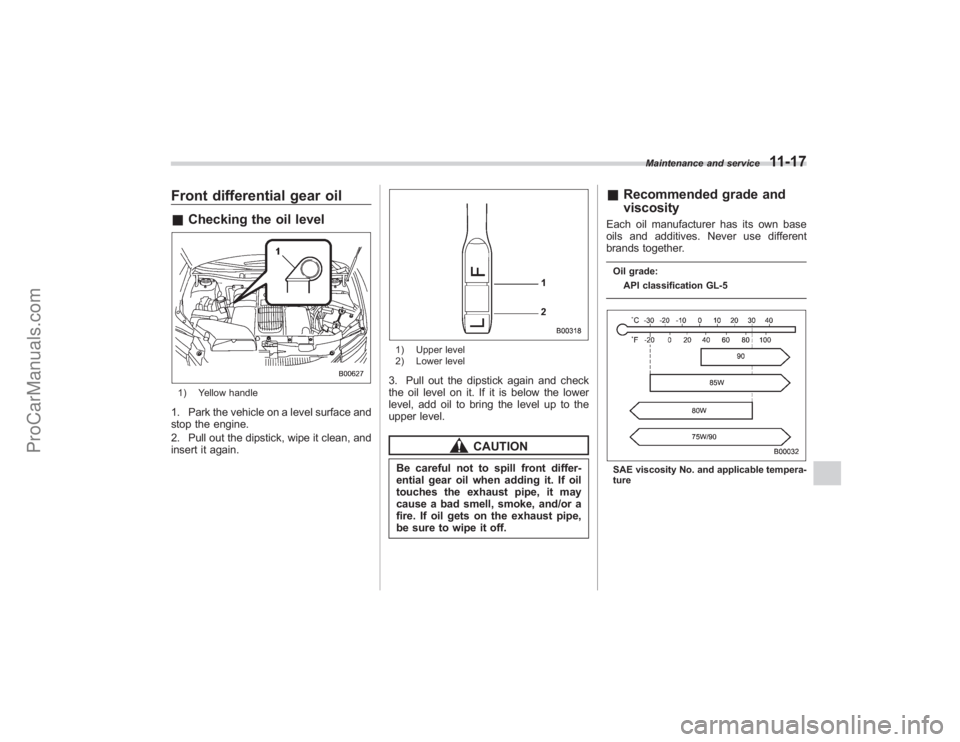
viscosityEach oil manufacturer has its own base
oils and additives. Never use different
brands together.Oil grade:
API classification GL-5SAE viscosity No. and applicable tempera-
ture Maintenance and service
11-17
ProCarManuals.com
Page 341 of 409
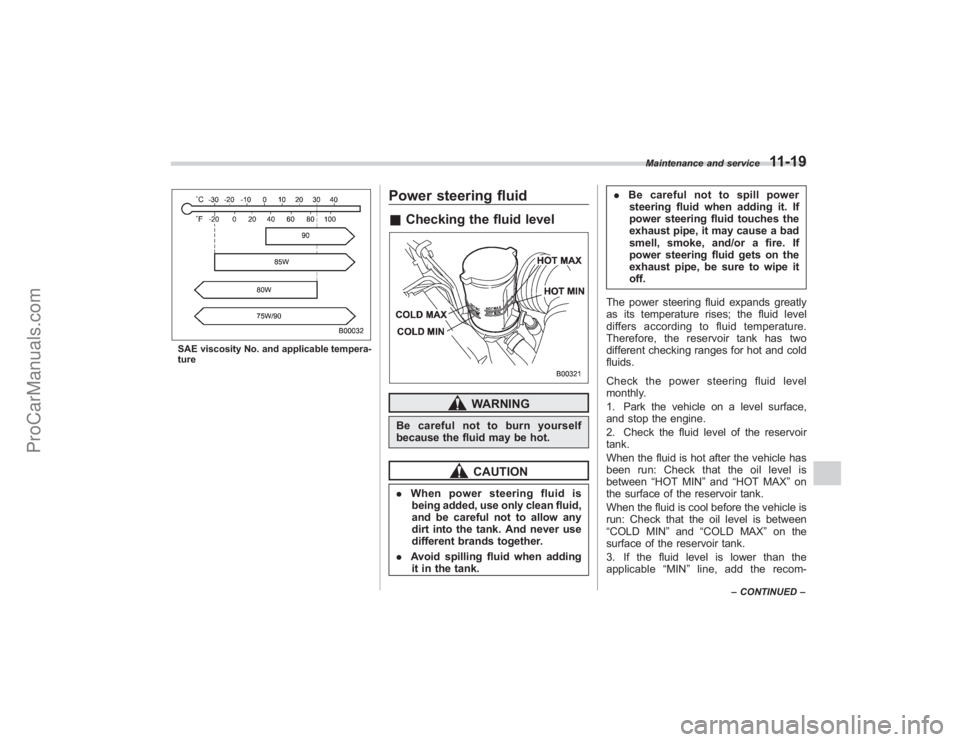
SAE viscosity No. and applicable tempera-
ture
Power steering fluid&Checking the fluid level
WARNING
Be careful not to burn yourself
because the fluid may be hot.
CAUTION
. When power steering fluid is
being added, use only clean fluid,
and be careful not to allow any
dirt into the tank. And never use
different brands together.
. Avoid spilling fluid when adding
it in the tank. .
Be careful not to spill power
steering fluid when adding it. If
power steering fluid touches the
exhaust pipe, it may cause a bad
smell, smoke, and/or a fire. If
power steering fluid gets on the
exhaust pipe, be sure to wipe it
off.
The power steering fluid expands greatly
as its temperature rises; the fluid level
differs according to fluid temperature.
Therefore, the reservoir tank has two
different checking ranges for hot and cold
fluids.
Check the power steering fluid level
monthly.
1. Park the vehicle on a level surface,
and stop the engine.
2. Check the fluid level of the reservoir
tank.
When the fluid is hot after the vehicle has
been run: Check that the oil level is
between “HOT MIN ”and “HOT MAX ”on
the surface of the reservoir tank.
When the fluid is cool before the vehicle is
run: Check that the oil level is between
“COLD MIN ”and “COLD MAX ”on the
surface of the reservoir tank.
3. If the fluid level is lower than the
applicable “MIN ”line, add the recom-
Maintenance and service
11-19
–CONTINUED –
ProCarManuals.com
Page 343 of 409
Use only brake fluid from a sealed
container.&Recommended brake fluidFMVSS No. 116, fresh DOT 3 or 4 brake
fluid
Brake boosterIf the brake booster does not operate as
described in the following, have it checked
by your SUBARU dealer.
1. With the engine off, depress the brake
pedal several times, applying the same
pedal force each time. The distance the
pedal travels should not vary.
2. With the brake pedal depressed, start
the engine. The pedal should move
slightly down to the floor.
3. With the brake pedal depressed, stop
the engine and keep the pedal depressed
for 30 seconds. The pedal height should
not change.
4. Start the engine again and run for
approximately one minute then turn it off.
Depress the brake pedal several times to
check the brake booster. The brake
booster operates properly if the pedal
stroke decreases with each depression.
Brake pedalCheck the brake pedal free play and
reserve distance according to the main-
tenance schedule in the “Warranty and
Maintenance Booklet ”.&Checking the brake pedal
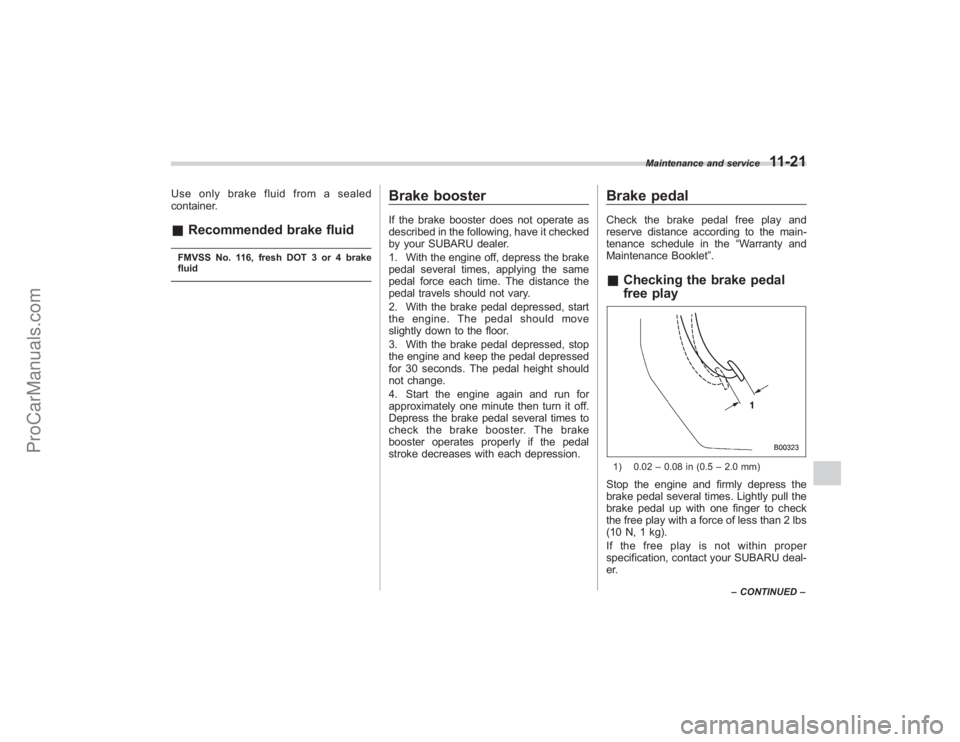
free play1) 0.02 –0.08 in (0.5 –2.0 mm)Stop the engine and firmly depress the
brake pedal several times. Lightly pull the
brake pedal up with one finger to check
the free play with a force of less than 2 lbs
(10 N, 1 kg).
If the free play is not within proper
specification, contact your SUBARU deal-
er.
Maintenance and service
11-21
–CONTINUED –
ProCarManuals.com
Page 354 of 409
11-32
Maintenance and service
Windshield washer fluid
CAUTION
Never use engine coolant as washer
fluid because it could cause paint
damage.If you spray washer fluid on the windshield
but the windshield washer fluid warning
light comes on or the supply of washer
fluid drops, check the level of washer fluid
in the tank.
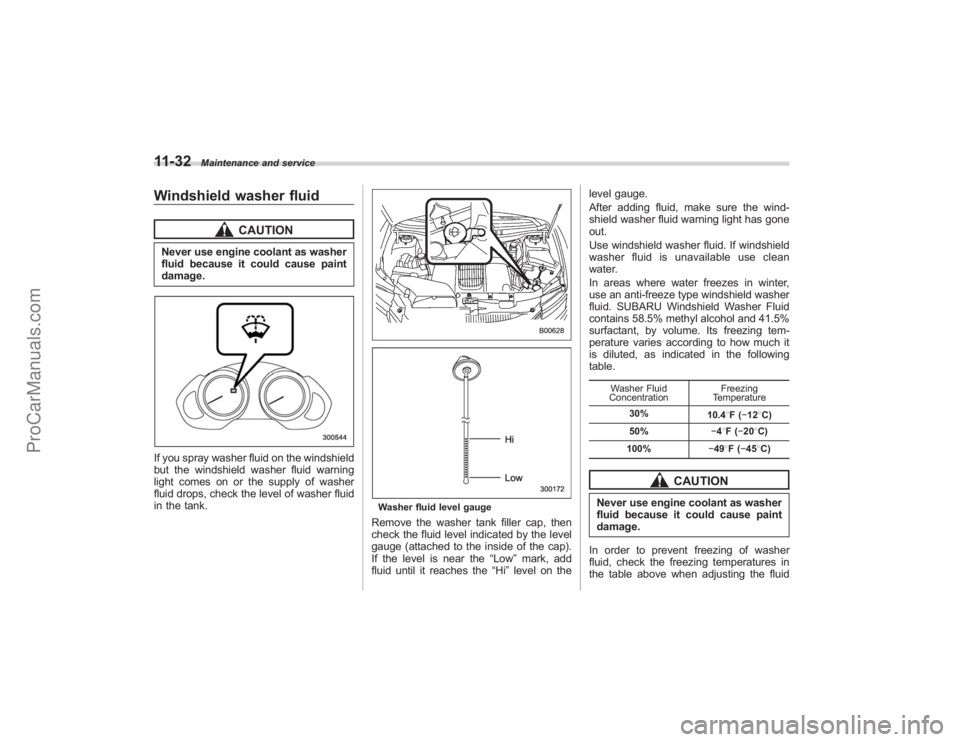
Washer fluid level gaugeRemove the washer tank filler cap, then
check the fluid level indicated by the level
gauge (attached to the inside of the cap).
If the level is near the“Low”mark, add
fluid until it reaches the “Hi”level on the level gauge.
After adding fluid, make sure the wind-
shield washer fluid warning light has gone
out.
Use windshield washer fluid. If windshield
washer fluid is unavailable use clean
water.
In areas where water freezes in winter,
use an anti-freeze type windshield washer
fluid. SUBARU Windshield Washer Fluid
contains 58.5% methyl alcohol and 41.5%
surfactant, by volume. Its freezing tem-
perature varies according to how much it
is diluted, as indicated in the following
table.
Washer Fluid
Concentration Freezing
Temperature
30% 10.48F( −12 8C)
50% −48F( −20 8C)
100% −498F( −45 8C)
CAUTION
Never use engine coolant as washer
fluid because it could cause paint
damage.
In order to prevent freezing of washer
fluid, check the freezing temperatures in
the table above when adjusting the fluid
ProCarManuals.com
Page 360 of 409
11-38
Maintenance and service
Fuses
CAUTION
Never replace a fuse with one hav-
ing a higher rating or with material
other than a fuse because serious
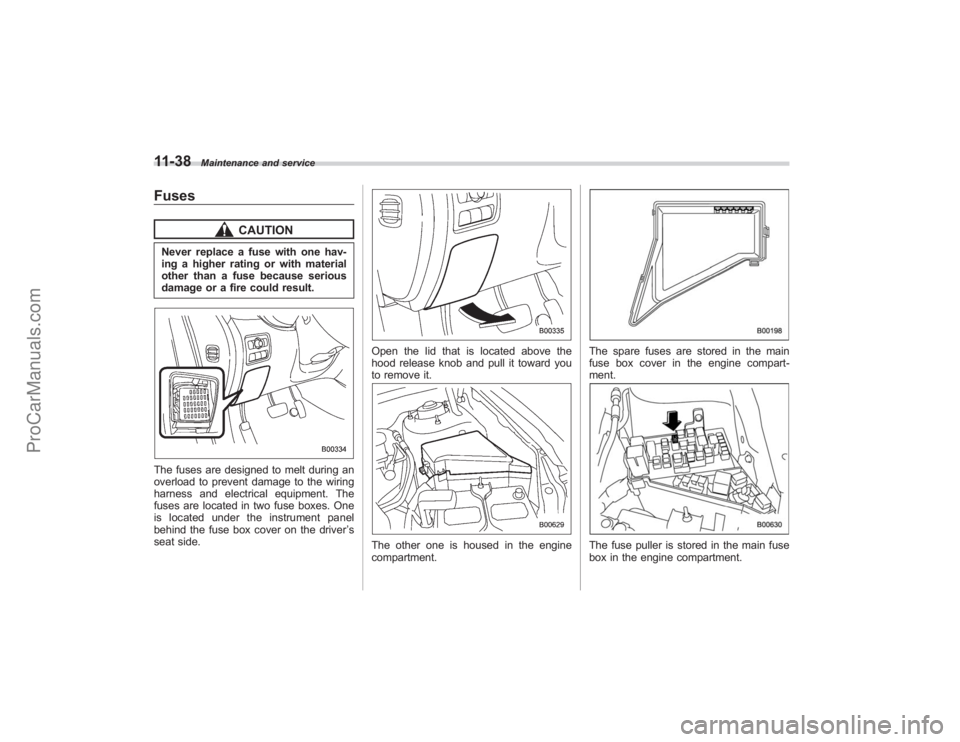
damage or a fire could result.The fuses are designed to melt during an
overload to prevent damage to the wiring
harness and electrical equipment. The
fuses are located in two fuse boxes. One
is located under the instrument panel
behind the fuse box cover on the driver’s
seat side.
Open the lid that is located above the
hood release knob and pull it toward you
to remove it.The other one is housed in the engine
compartment.
The spare fuses are stored in the main
fuse box cover in the engine compart-
ment.The fuse puller is stored in the main fuse
box in the engine compartment.
ProCarManuals.com
Page 373 of 409
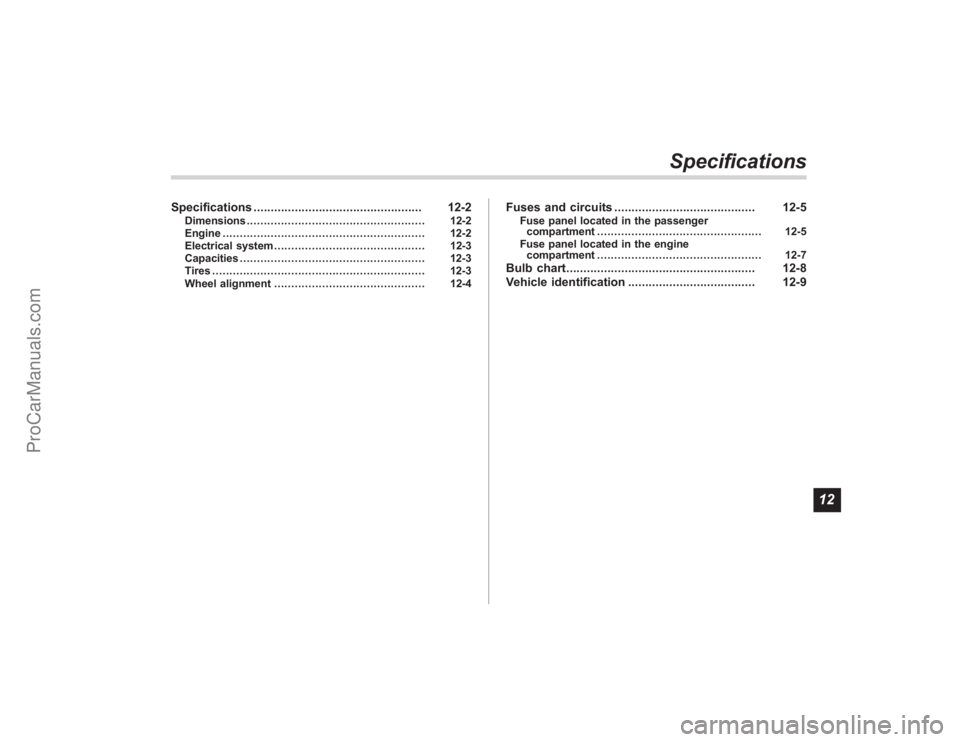
Specifications................................................. 12-2
Dimensions.................................................... 12-2
Engine ........................................................... 12-2
Electrical system ............................................ 12-3
Capacities ...................................................... 12-3
Tires .............................................................. 12-3
Wheel alignment ............................................ 12-4
Fuses and circuits ......................................... 12-5
Fuse panel located in the passenger
compartment ................................................ 12-5
Fuse panel located in the engine compartment ................................................ 12-7
Bulb chart....................................................... 12-8
Vehicle identification ..................................... 12-9
Specifications
12
ProCarManuals.com
Page 374 of 409
12-2
Specifications
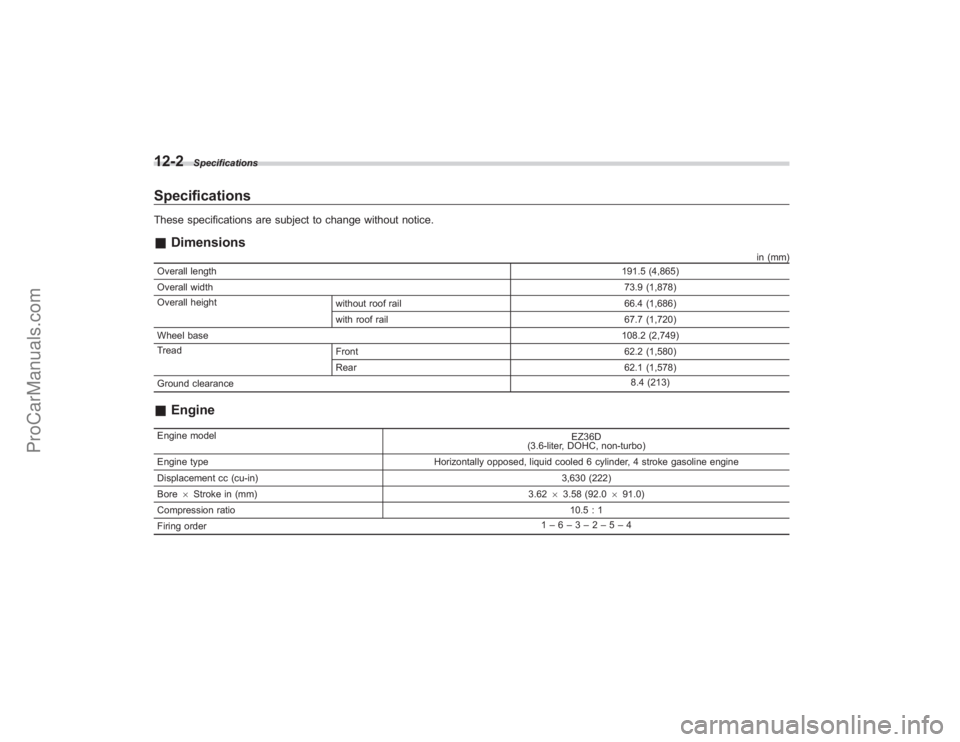
SpecificationsThese specifications are subject to change without notice.&Dimensions
in (mm)
Overall length 191.5 (4,865)
Overall width 73.9 (1,878)
Overall height without roof rail 66.4 (1,686)
with roof rail 67.7 (1,720)
Wheel base 108.2 (2,749)
Tread Front 62.2 (1,580)
Rear 62.1 (1,578)
Ground clearance 8.4 (213)
&
EngineEngine model
EZ36D
(3.6-liter, DOHC, non-turbo)
Engine type Horizontally opposed, liquid cooled 6 cylinder, 4 stroke gasoline engine
Displacement cc (cu-in) 3,630 (222)
Bore 6Stroke in (mm) 3.62 63.58 (92.0 691.0)
Compression ratio 10.5 : 1
Firing order 1
–6 –3–2 –5–4
ProCarManuals.com