seats SUBARU TRIBECA 2008 User Guide
[x] Cancel search | Manufacturer: SUBARU, Model Year: 2008, Model line: TRIBECA, Model: SUBARU TRIBECA 2008Pages: 409, PDF Size: 5.75 MB
Page 54 of 409
1-30
Seat, seatbelt and SRS airbags
&Precautions against vehicle
modificationAlways consult your SUBARU dealer if
you want to install any accessory parts to
your vehicle.
CAUTION
Do not perform any of the following
modifications. Such modifications
can interfere with proper operation
of the seatbelt pretensioners.
. Attachment of any equipment
(bush bar, winches, snow plow,
skid plate, etc.) other than genu-
ine SUBARU accessory parts to
the front end.
. Modification of the suspension
system or front end structure.
. Installation of a tire of different
size and construction from the
tires specified on the vehicle
placard attached to the door
pillar or specified for individual
vehicle models in this Owner ’s
Manual.
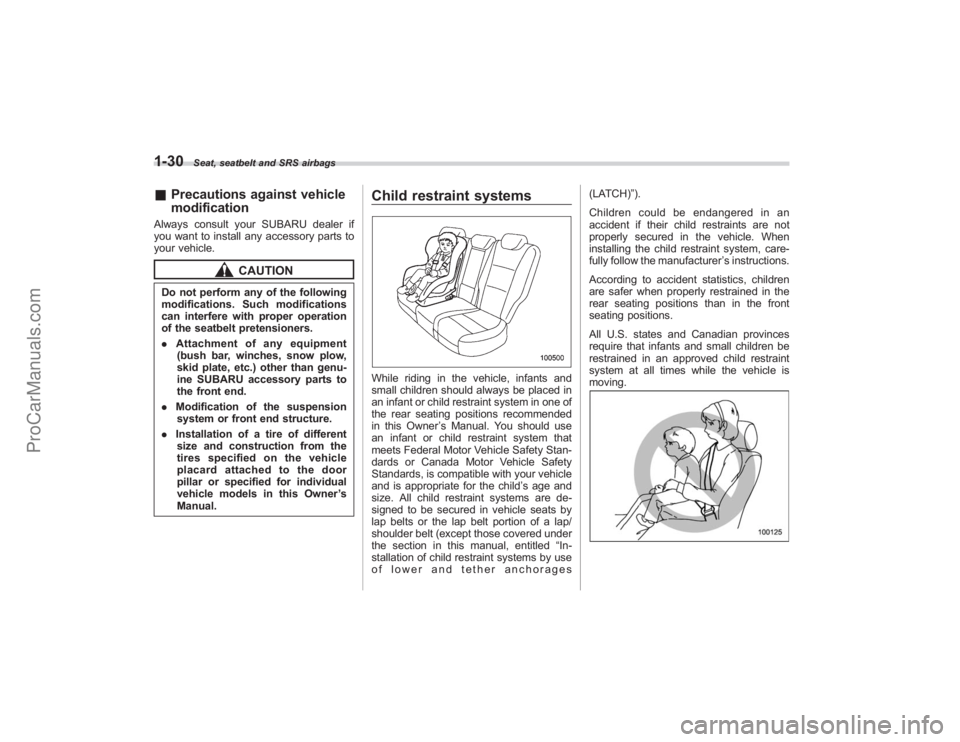
Child restraint systemsWhile riding in the vehicle, infants and
small children should always be placed in
an infant or child restraint system in one of
the rear seating positions recommended
in this Owner ’s Manual. You should use
an infant or child restraint system that
meets Federal Motor Vehicle Safety Stan-
dards or Canada Motor Vehicle Safety
Standards, is compatible with your vehicle
and is appropriate for the child ’s age and
size. All child restraint systems are de-
signed to be secured in vehicle seats by
lap belts or the lap belt portion of a lap/
shoulder belt (except those covered under
the section in this manual, entitled “In-
stallation of child restraint systems by use
of lower and tether anchorages (LATCH)
”).
Children could be endangered in an
accident if their child restraints are not
properly secured in the vehicle. When
installing the child restraint system, care-
fully follow the manufacturer ’s instructions.
According to accident statistics, children
are safer when properly restrained in the
rear seating positions than in the front
seating positions.
All U.S. states and Canadian provinces
require that infants and small children be
restrained in an approved child restraint
system at all times while the vehicle is
moving.
ProCarManuals.com
Page 55 of 409
WARNING
Never let a passenger hold a child
on his or her lap while the vehicle is
moving. The passenger cannot pro-
tect the child from injury in a colli-
sion, because the child will be
caught between the passenger and
objects inside the vehicle. Addition-
ally, holding a child in your lap or
arms in the front seat exposes that
child to another serious danger.
Since the SRS airbag deploys with
considerable speed and force, the
child could be injured or even killed.
WARNING
Children should be properly re-
strained at all times. Never allow a
child to stand up, or to kneel on any
seat. Unrestrained children will be
thrown forward during sudden stop
or in an accident and can be injured
seriously.
Additionally, children standing up or
kneeling on or in front of the front
seat are exposed another serious
danger. Since the SRS airbag de-
ploys with considerable speed and
force, the child could be injured or
even killed.&Where to place a child re-
straint systemThe following are SUBARU ’s recommen-
dations on where to place a child restraint
system in your vehicle.
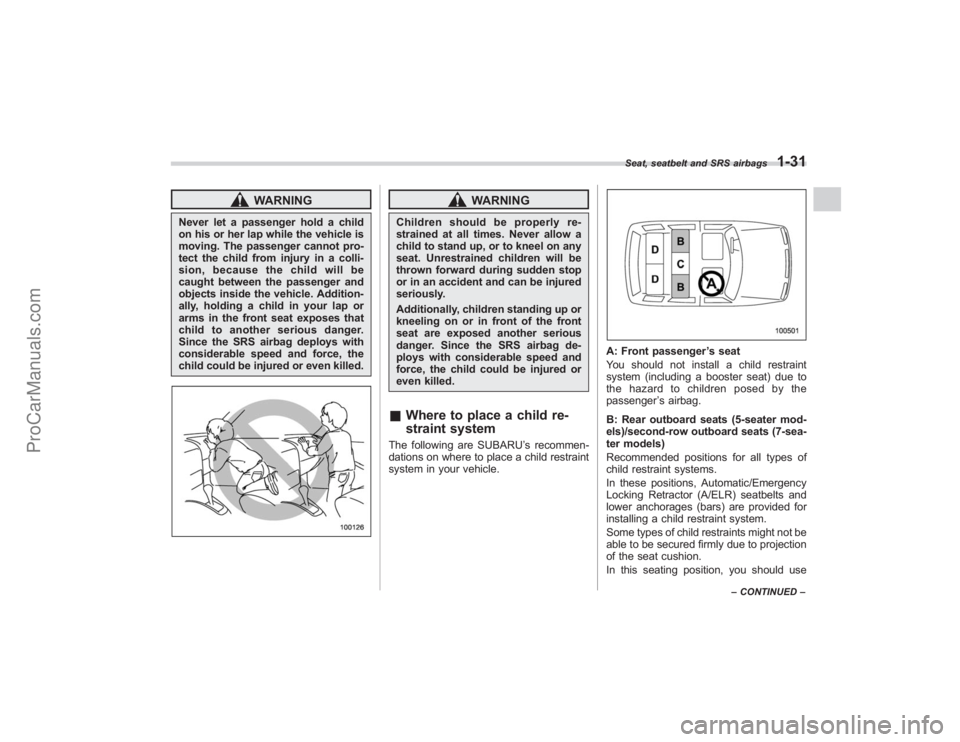
A: Front passenger ’s seat
You should not install a child restraint
system (including a booster seat) due to
the hazard to children posed by the
passenger ’s airbag.
B: Rear outboard seats (5-seater mod-
els)/second-row outboard seats (7-sea-
ter models)
Recommended positions for all types of
child restraint systems.
In these positions, Automatic/Emergency
Locking Retractor (A/ELR) seatbelts and
lower anchorages (bars) are provided for
installing a child restraint system.
Some types of child restraints might not be
able to be secured firmly due to projection
of the seat cushion.
In this seating position, you should use
Seat, seatbelt and SRS airbags
1-31
– CONTINUED –
ProCarManuals.com
Page 56 of 409
1-32
Seat, seatbelt and SRS airbags
only a child restraint system that has a
bottom base that fits snugly against the
contours of the seat cushion and can be
securely retained using the seatbelt.
C: Rear center seat (5-seater models)/
second-row center seat (7-seater mod-
els)
Installing a child restraint system is not
recommended, although the A/ELR seat-
belt and an upper anchorage (tether
anchorage) are provided in this position.
Some types of child restraints might not be
able to be secured firmly due to projection
of the seat cushion.
In this seating position, you should use
only a child restraint system that has a
bottom base that fits snugly against the
contours of the seat cushion and can be
securely retained using the seatbelt.
D: Third-row seat (7-seater models)
Installing a child restraint system is not
recommended, although the A/ELR seat-
belt and two upper anchorages (tether
anchorages) are provided in these posi-
tions.
These seating positions are not equipped
with lower anchorages (bars) for installing
LATCH system-type child restraints. How-
ever, child restraint devices can be used in
these position using the A/ELR seatbelts
and upper anchorages (tether an-chorages) provided.
Some types of child restraints might not be
able to be secured firmly due to projection
of the seat cushion.
In this seating position, you should use
only a child restraint system that has a
bottom base that fits snugly against the
contours of the seat cushion and can be
securely retained using the seatbelt.
WARNING
Put children aged 12 and under in
the rear seat properly restrained at
all times. The SRS airbag deploys
with considerable speed and force
and can injure or even kill children,
especially if they are 12 years of age
and under and are not restrained or
improperly restrained. Because chil-
dren are lighter and weaker than
adults, their risk of being injured
from deployment is greater.
Consequently, be sure to secure
ALL types of child restraint devices
(including forward facing child
seats) in the REAR seats at all times.
You should choose a restraint de-
vice which is appropriate for the
child
’s age, height and weight. Ac-
cording to accident statistics, chil-
dren are safer when properly re- strained in the rear seating posi-
tions than in the front seating posi-
tions.
WARNING
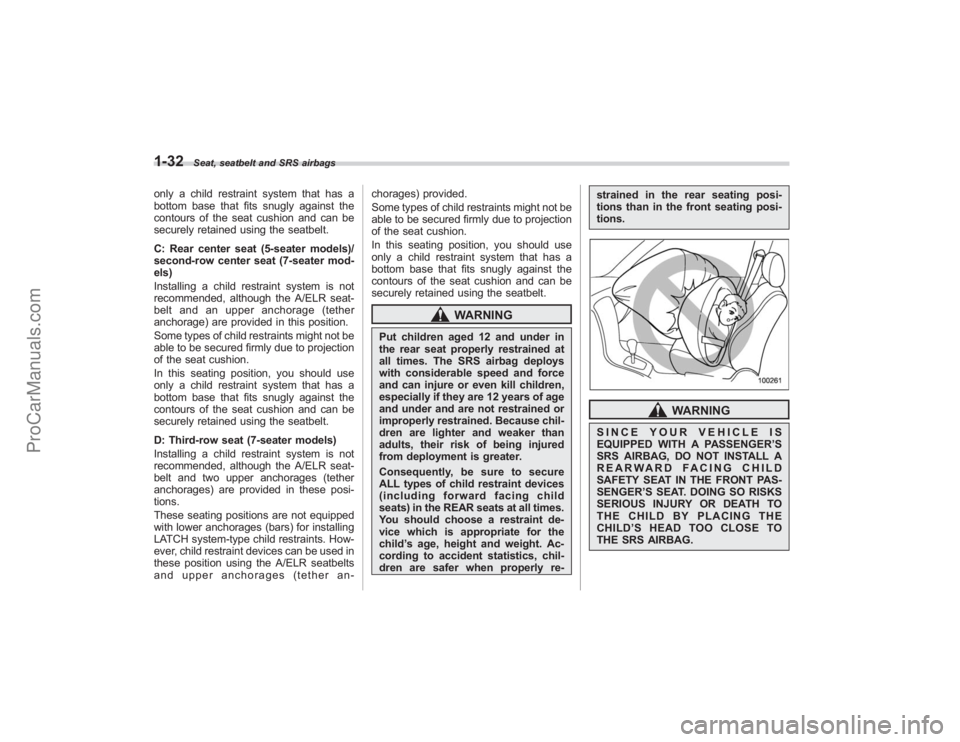
SINCE YOUR VEHICLE IS
EQUIPPED WITH A PASSENGER
’S
SRS AIRBAG, DO NOT INSTALL A
REARWARD FACING CHILD
SAFETY SEAT IN THE FRONT PAS-
SENGER ’S SEAT. DOING SO RISKS
SERIOUS INJURY OR DEATH TO
THE CHILD BY PLACING THE
CHILD’ S HEAD TOO CLOSE TO
THE SRS AIRBAG.
ProCarManuals.com
Page 62 of 409
1-38
Seat, seatbelt and SRS airbags
restraint system in your vehicle.
Unsecured child restraint sys-
tems can be thrown around in-
side of the vehicle in a sudden
stop, turn or accident; they can
strike and injure vehicle occu-
pants as well as result in serious
injuries or death to the child.
CAUTION
When you install a child restraint
system, follow the manufacturer’s
instructions supplied with it. After
installing the child restraint system,
check to ensure that it is held
securely in position. If it is not held
tight and secure, the danger of your
child suffering personal injury in the
event of an accident may be in-
creased.
Some types of child restraint systems can
be installed in a rear seating position of
your vehicle without use of the seatbelts.
Such child restraint systems are secured
to the dedicated anchorages provided on
the vehicle body.
The lower and tether anchorages are
sometimes referred to as the LATCH
system (L owerAnchors and Tethers for
CH ildren).
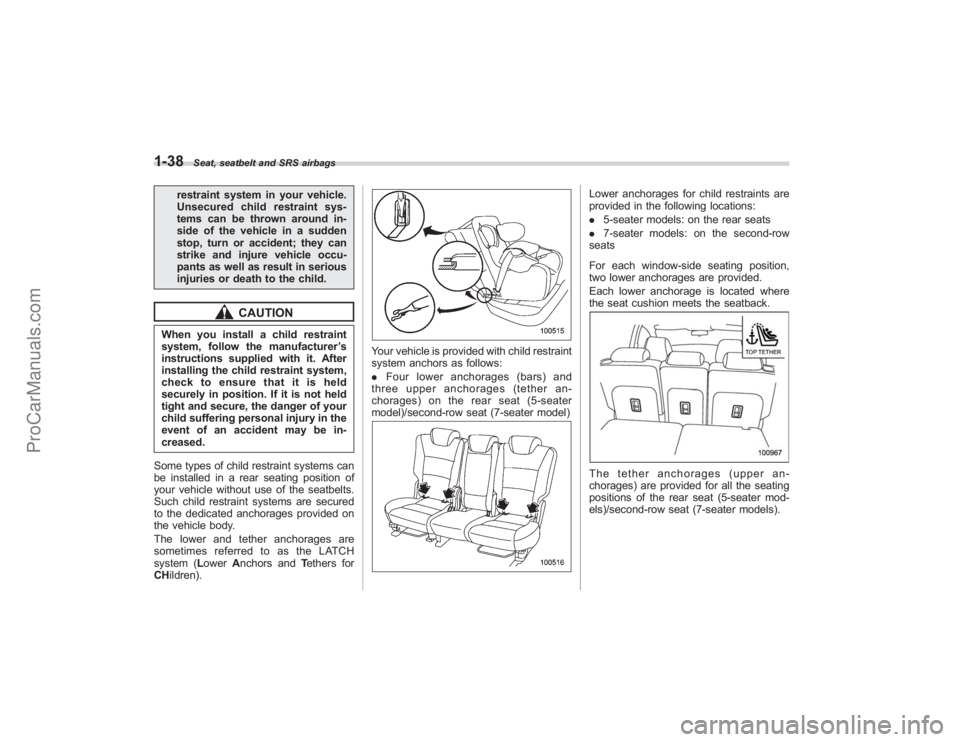
Your vehicle is provided with child restraint
system anchors as follows:
.Four lower anchorages (bars) and
three upper anchorages (tether an-
chorages) on the rear seat (5-seater
model)/second-row seat (7-seater model)
Lower anchorages for child restraints are
provided in the following locations:
. 5-seater models: on the rear seats
. 7-seater models: on the second-row
seats
For each window-side seating position,
two lower anchorages are provided.
Each lower anchorage is located where
the seat cushion meets the seatback.The tether anchorages (upper an-
chorages) are provided for all the seating
positions of the rear seat (5-seater mod-
els)/second-row seat (7-seater models).
ProCarManuals.com
Page 64 of 409
1-40
Seat, seatbelt and SRS airbags
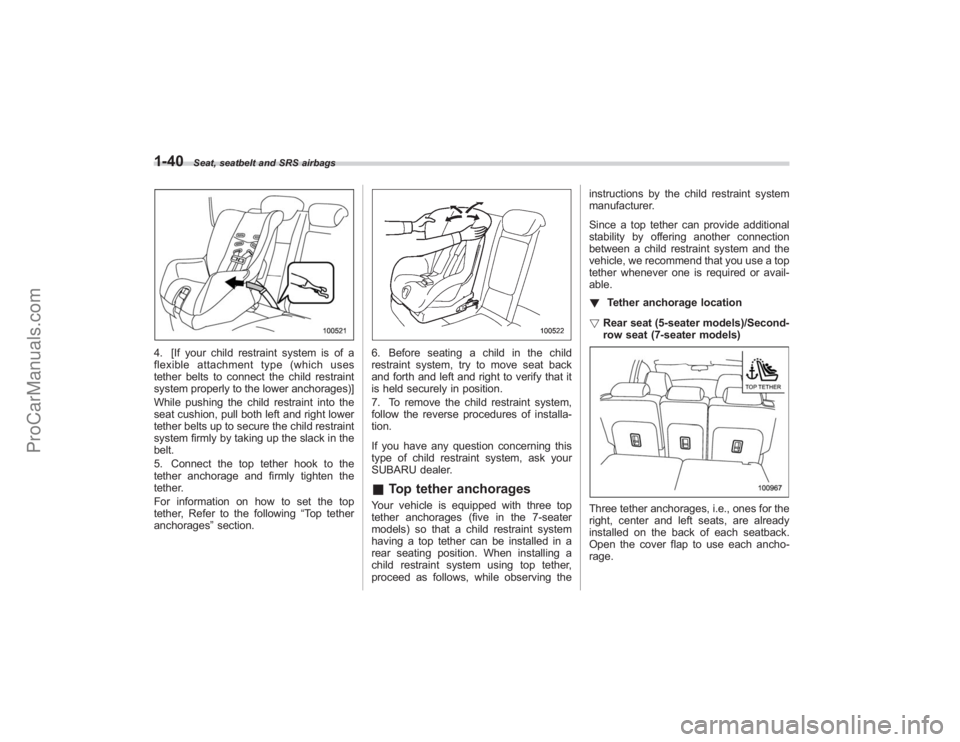
4. [If your child restraint system is of a
flexible attachment type (which uses
tether belts to connect the child restraint
system properly to the lower anchorages)]
While pushing the child restraint into the
seat cushion, pull both left and right lower
tether belts up to secure the child restraint
system firmly by taking up the slack in the
belt.
5. Connect the top tether hook to the
tether anchorage and firmly tighten the
tether.
For information on how to set the top
tether, Refer to the following“Top tether
anchorages ”section.
6. Before seating a child in the child
restraint system, try to move seat back
and forth and left and right to verify that it
is held securely in position.
7. To remove the child restraint system,
follow the reverse procedures of installa-
tion.
If you have any question concerning this
type of child restraint system, ask your
SUBARU dealer.& Top tether anchoragesYour vehicle is equipped with three top
tether anchorages (five in the 7-seater
models) so that a child restraint system
having a top tether can be installed in a
rear seating position. When installing a
child restraint system using top tether,
proceed as follows, while observing the instructions by the child restraint system
manufacturer.
Since a top tether can provide additional
stability by offering another connection
between a child restraint system and the
vehicle, we recommend that you use a top
tether whenever one is required or avail-
able.
!
Tether anchorage location
! Rear seat (5-seater models)/Second-
row seat (7-seater models)
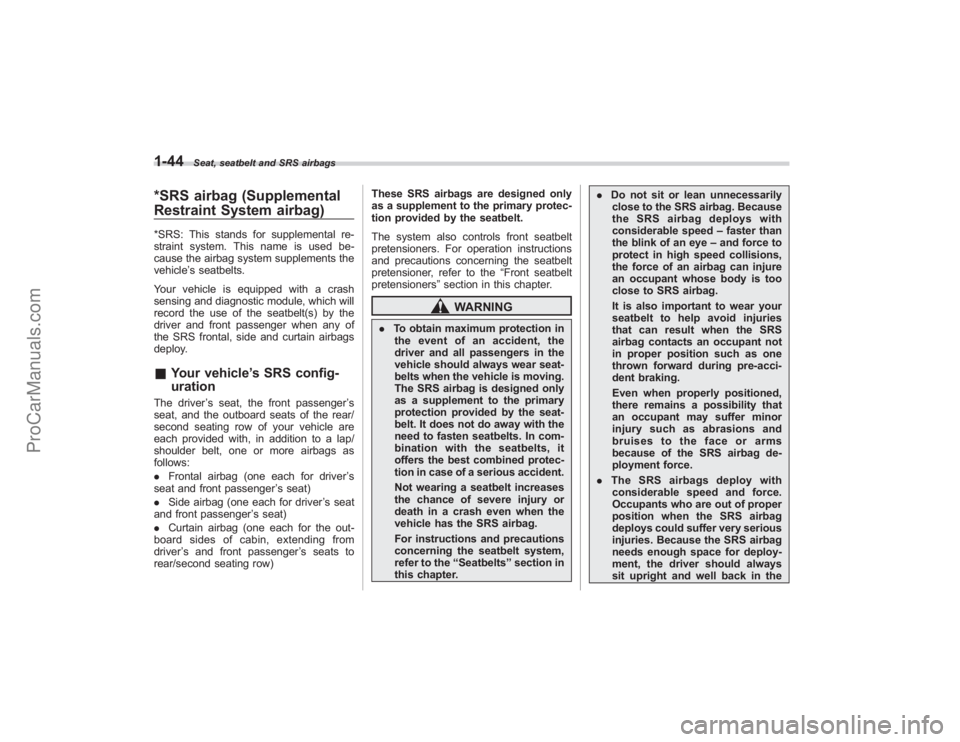
Three tether anchorages, i.e., ones for the
right, center and left seats, are already
installed on the back of each seatback.
Open the cover flap to use each ancho-
rage.
ProCarManuals.com
Page 68 of 409
1-44
Seat, seatbelt and SRS airbags
*SRS airbag (Supplemental
Restraint System airbag)*SRS: This stands for supplemental re-
straint system. This name is used be-
cause the airbag system supplements the
vehicle’s seatbelts.
Your vehicle is equipped with a crash
sensing and diagnostic module, which will
record the use of the seatbelt(s) by the
driver and front passenger when any of
the SRS frontal, side and curtain airbags
deploy.& Your vehicle ’s SRS config-
urationThe driver ’s seat, the front passenger ’s
seat, and the outboard seats of the rear/
second seating row of your vehicle are
each provided with, in addition to a lap/
shoulder belt, one or more airbags as
follows:
. Frontal airbag (one each for driver ’s
seat and front passenger ’s seat)
. Side airbag (one each for driver ’s seat
and front passenger ’s seat)
. Curtain airbag (one each for the out-
board sides of cabin, extending from
driver ’s and front passenger ’s seats to
rear/second seating row) These SRS airbags are designed only
as a supplement to the primary protec-
tion provided by the seatbelt.
The system also controls front seatbelt
pretensioners. For operation instructions
and precautions concerning the seatbelt
pretensioner, refer to the
“Front seatbelt
pretensioners ”section in this chapter.
WARNING
. To obtain maximum protection in
the event of an accident, the
driver and all passengers in the
vehicle should always wear seat-
belts when the vehicle is moving.
The SRS airbag is designed only
as a supplement to the primary
protection provided by the seat-
belt. It does not do away with the
need to fasten seatbelts. In com-
bination with the seatbelts, it
offers the best combined protec-
tion in case of a serious accident.
Not wearing a seatbelt increases
the chance of severe injury or
death in a crash even when the
vehicle has the SRS airbag.
For instructions and precautions
concerning the seatbelt system,
refer to the “Seatbelts ”section in
this chapter. .
Do not sit or lean unnecessarily
close to the SRS airbag. Because
the SRS airbag deploys with
considerable speed –faster than
the blink of an eye –and force to
protect in high speed collisions,
the force of an airbag can injure
an occupant whose body is too
close to SRS airbag.
It is also important to wear your
seatbelt to help avoid injuries
that can result when the SRS
airbag contacts an occupant not
in proper position such as one
thrown forward during pre-acci-
dent braking.
Even when properly positioned,
there remains a possibility that
an occupant may suffer minor
injury such as abrasions and
bruises to the face or arms
because of the SRS airbag de-
ployment force.
. The SRS airbags deploy with
considerable speed and force.
Occupants who are out of proper
position when the SRS airbag
deploys could suffer very serious
injuries. Because the SRS airbag
needs enough space for deploy-
ment, the driver should always
sit upright and well back in the
ProCarManuals.com
Page 69 of 409
seat as far from the steering
wheel as practical while still
maintaining full vehicle control
and the front passenger should
move the seat as far back as
possible and sit upright and well
back in the seat.
. Do not place any objects over or
near the SRS airbag cover or
between you and the SRS airbag.
If the SRS airbag deploys, those
objects could interfere with its
proper operation and could be
propelled inside the vehicle and
cause injury.
WARNING
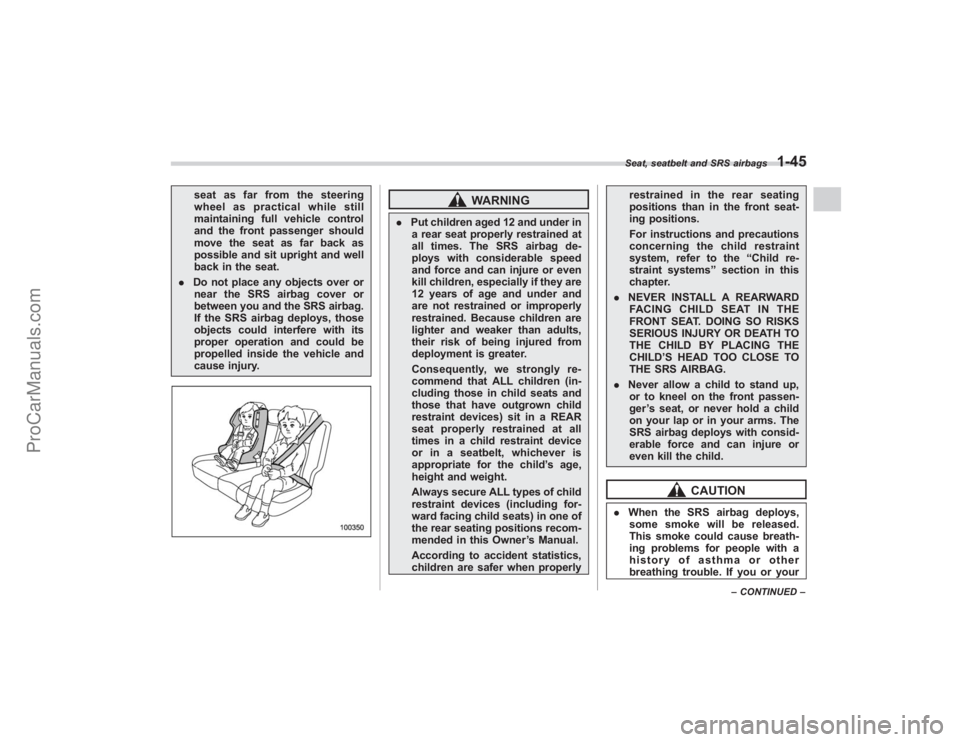
. Put children aged 12 and under in
a rear seat properly restrained at
all times. The SRS airbag de-
ploys with considerable speed
and force and can injure or even
kill children, especially if they are
12 years of age and under and
are not restrained or improperly
restrained. Because children are
lighter and weaker than adults,
their risk of being injured from
deployment is greater.
Consequently, we strongly re-
commend that ALL children (in-
cluding those in child seats and
those that have outgrown child
restraint devices) sit in a REAR
seat properly restrained at all
times in a child restraint device
or in a seatbelt, whichever is
appropriate for the child ’s age,
height and weight.
Always secure ALL types of child
restraint devices (including for-
ward facing child seats) in one of
the rear seating positions recom-
mended in this Owner ’s Manual.
According to accident statistics,
children are safer when properly restrained in the rear seating
positions than in the front seat-
ing positions.
For instructions and precautions
concerning the child restraint
system, refer to the
“Child re-
straint systems ”section in this
chapter.
. NEVER INSTALL A REARWARD
FACING CHILD SEAT IN THE
FRONT SEAT. DOING SO RISKS
SERIOUS INJURY OR DEATH TO
THE CHILD BY PLACING THE
CHILD ’S HEAD TOO CLOSE TO
THE SRS AIRBAG.
. Never allow a child to stand up,
or to kneel on the front passen-
ger ’s seat, or never hold a child
on your lap or in your arms. The
SRS airbag deploys with consid-
erable force and can injure or
even kill the child.
CAUTION
. When the SRS airbag deploys,
some smoke will be released.
This smoke could cause breath-
ing problems for people with a
history of asthma or other
breathing trouble. If you or yourSeat, seatbelt and SRS airbags
1-45
– CONTINUED –
ProCarManuals.com
Page 76 of 409
1-52
Seat, seatbelt and SRS airbags
!Conditions in which front passen-
ger’s SRS frontal airbag is not
activated
The front passenger ’s SRS frontal airbag
will not be activated when any of the
following conditions are met regarding the
front passenger ’s seat:
. The seat is empty.
. The seat is equipped with a rearward
facing child restraint system and an infant
is restrained with it. (See WARNING that
follows.)
. The seat is equipped with a forward
facing child restraint system and a small
child is restrained with it. (See WARNING
that follows.)
. The seat is equipped with a booster
seat and a small child is in the booster
seat. (See WARNING that follows.)
. The seat is relieved of the occupant
load for a time exceeding the predeter-
mined monitoring time period.
. The seat is occupied by a child who
has outgrown a child restraint system
(See WARNING that follows.) or by a
small adult.
. The front passenger ’s occupant detec-
tion system is faulty.
WARNING
NEVER INSTALL A REARWARD FA-
CING CHILD SEAT IN THE FRONT
PASSENGER ’S SEAT EVEN IF THE
FRONT PASSENGER ’S SRS FRON-
TAL AIRBAG IS DEACTIVATED. Be
sure to install it in one of the rear
seating positions recommended in
this Owner ’s Manual in a correct
manner. Also, it is strongly recom-
mended that any forward facing
child seat or booster seat be in-
stalled in one of the rear seating
positions recommended in this
Owner ’s Manual, and that even
children who have outgrown a child
restraint system be also seated in a
REAR seat. This is because children
sitting in the front passenger ’s seat
may be killed or severely injured
should the front passenger ’s SRS
frontal airbag deploy. REAR seats
are the safest place for children.
When the front passenger ’s seat is occu-
pied by a child, observe the following
precautions. Failure to do so may increase
the load on the front passenger ’s seat,
activating the front passenger ’sSRS
frontal airbag even though that seat is
occupied by a child. .
Do not place any article on the seat
other than the child occupant and a child
restraint system.
. Do not place more than one child on
the seat.
. Do not install any accessory such as a
table or TV onto the seatback.
. Do not store a heavy load in the
seatback pocket.
. Do not allow the rear/second-row seat
occupant to place his/her hands or legs on
the front passenger ’s seatback, or allow
him/her to pull the seatback.
! If the front passenger ’s frontal air-
bag ON indicator illuminates and the
OFF indicator extinguishes even
when an infant or a small child is in
a child restraint system (including
booster seat)
Turn the ignition switch to the “LOCK”
position if the front passenger ’s frontal
airbag ON indicator illuminates and the
OFF indicator extinguishes even when an
infant or a small child is in a child restraint
system (including booster seat). Remove
the child restraint system from the seat. By
referring to the child restraint manufac-
turer ’s recommendations as well as the
child restraint system installation proce-
dures in the “Child restraint systems ”
section in this chapter, correctly install
ProCarManuals.com
Page 78 of 409
1-54
Seat, seatbelt and SRS airbags
straight in the center of the seat cushion,
correctly fasten the seatbelt, position his/
her legs out forward, and adjust the seat to
the rearmost position. Turn the ignition
switch to the“ON”position. If the OFF
indicator remains illuminated while the ON
indicator remains extinguished, take the
following actions.
. Turn the ignition switch to the “LOCK”
position.
. Ensure that there are no articles,
books, shoes, or other objects trapped
under the seat, at the rear of the seat, or
on the side of the seat.
. Next, turn the ignition switch to the
“ON ”position and wait 6 seconds to allow
the system to complete self-checking.
Following the system check, both indica-
tors extinguish for 2 seconds. Now, the
ON indicator should illuminate while the
OFF indicator remains extinguished.
If the OFF indicator still illuminates while
the ON indicator remains extinguished,
ask the occupant to move to the rear seat
and immediately contact your SUBARU
dealer for an inspection.
! Effect vehicle modifications made
for persons with disabilities may
have on Subaru advanced frontal
airbag system operation (U.S. only)
Changing or moving any parts of the front seats, seatbelts, front bumper, front side
frame, instrument panel, combination me-
ter, steering wheel, steering column, tire,
suspension or floor panel can affect the
operation of the Subaru advanced airbag
system. If you have any questions, you
may contact the following Subaru distribu-
tors:
Subaru of America, Inc.
Customer Dealer Services Department
P.O. Box 6000
Cherry Hill, NJ 08034-6000
1-800-SUBARU3 (1-800-782-2783)
Servco Subaru Inc., dba Subaru Hawaii
2850 Pukoloa Street, Suite 202, Honolulu,
HI 96819
808-839-2273
Trebol Motors
P.O. Box 11204, San Juan, Puerto Rico
00910
787-793-2828
There are currently no Subaru distributors
in any other U.S. territories. If you are in
such an area, please contact the Subaru
distributor or dealer from which youbought your vehicle.
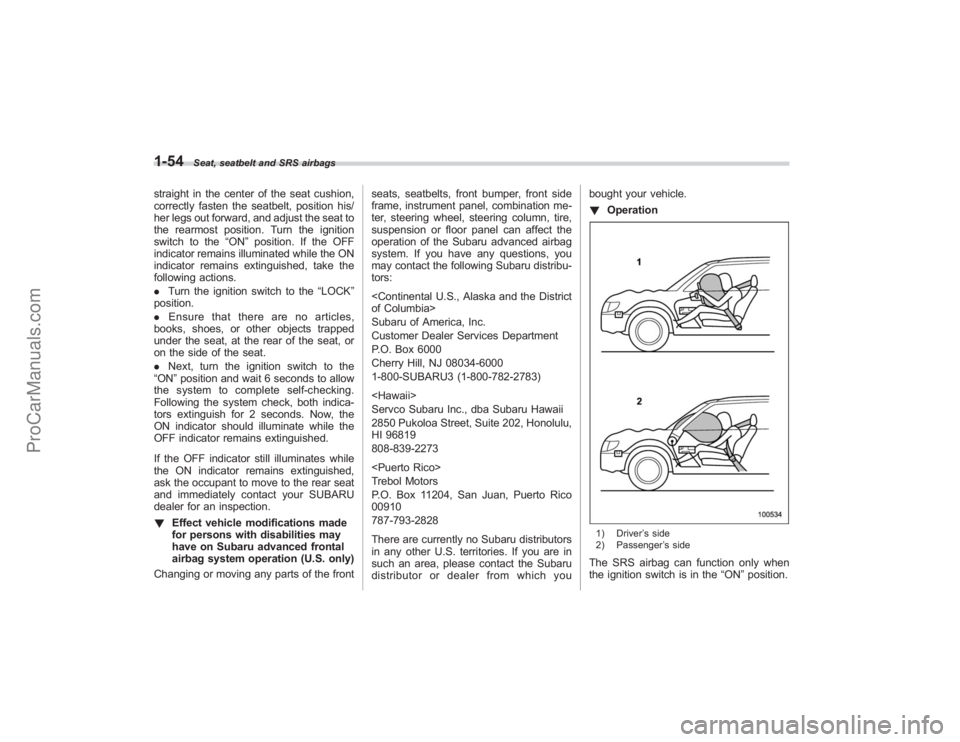
!
Operation
1) Driver ’s side
2) Passenger ’s sideThe SRS airbag can function only when
the ignition switch is in the “ON”position.
ProCarManuals.com
Page 83 of 409
close to either front door. The
SRS side airbag is stored in both
front seat seatbacks next to the
door, and it provides protection
by deploying rapidly (faster than
the blink of an eye) in the event of
a side impact collision. However,
theforceofSRSsideairbag
deployment may cause injuries
if your head or other parts of the
body are too close to the SRS
side airbag.
. Since your vehicle is equipped
with SRS curtain airbags, do not
sit or lean unnecessarily close to
the front or rear door on either
side. Also, do not put your head,
arms and hands out of the win-
dow. The SRS curtain airbag on
each side of the cabin is stored in
the roof side (between the front
pillar and a point over the rear
seat), and it provides protection
by deploying rapidly (faster than
the blink of an eye) in the event of
a side impact or a rollover. How-
ever, the force of its deployment
may cause injuries if your head is
too close to it.
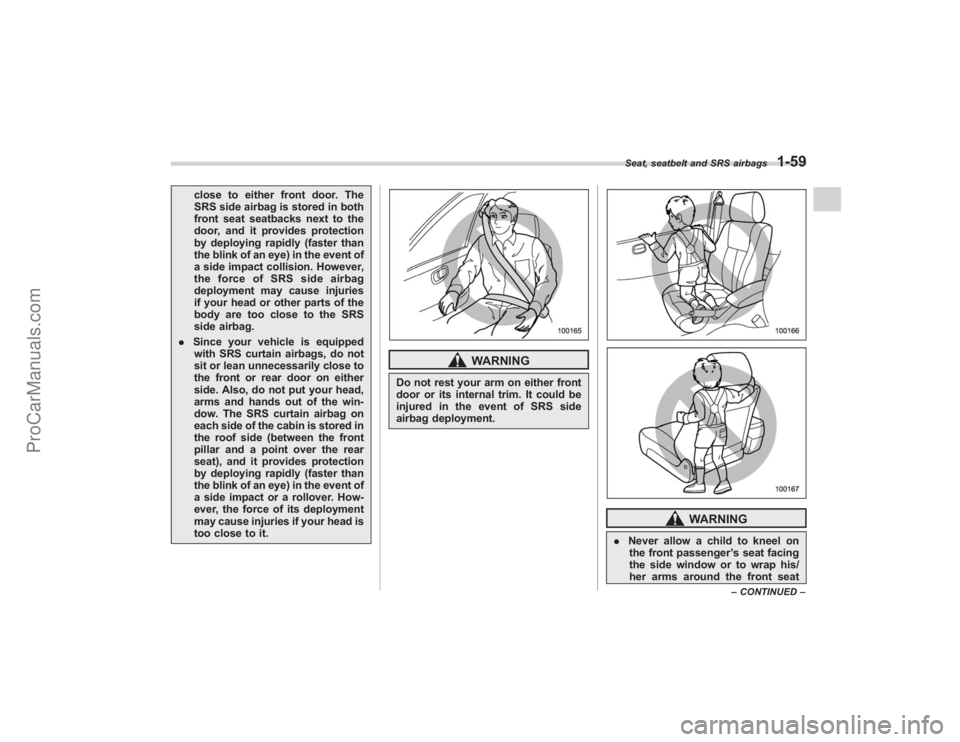
WARNING
Do not rest your arm on either front
door or its internal trim. It could be
injured in the event of SRS side
airbag deployment.
WARNING
. Never allow a child to kneel on
the front passenger ’s seat facing
the side window or to wrap his/
her arms around the front seatSeat, seatbelt and SRS airbags
1-59
– CONTINUED –
ProCarManuals.com