engine oil SUBARU TRIBECA 2008 Owner's Manual
[x] Cancel search | Manufacturer: SUBARU, Model Year: 2008, Model line: TRIBECA, Model: SUBARU TRIBECA 2008Pages: 409, PDF Size: 5.75 MB
Page 330 of 409
11-8
Maintenance and service
.Be careful not to spill engine oil
when adding it. If oil touches the
exhaust pipe, it may cause a bad
smell, smoke, and/or a fire. If
engine oil gets on the exhaust
pipe, be sure to wipe it off.
If you check the oil level just after stopping
the engine, wait a few minutes for the oil to
drain back into the oil pan before checking
the level.
To prevent overfilling the engine oil, do not
add any additional oil above the upper
level when the engine is cold.& Changing the oil and oil filterChange the oil and oil filter according to
the maintenance schedule in the “War-
ranty and Maintenance Booklet ”.
The engine oil and oil filter must be
changed more frequently than listed in
the maintenance schedule when driving
on dusty roads, when short trips are
frequently made, or when driving in
extremely cold whether.
1. Warm up the engine by letting the
engine idle for approximately 10 minutes
to ease draining the engine oil.
2. Park the vehicle on a level surface and
stop the engine.
3. Remove the oil filler cap.
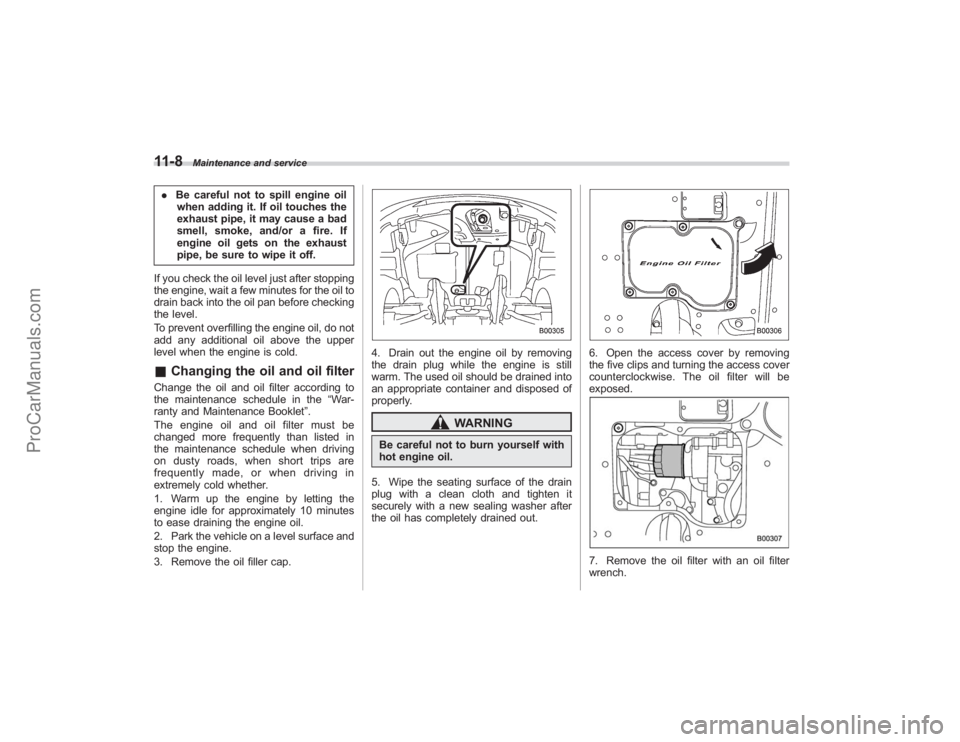
4. Drain out the engine oil by removing
the drain plug while the engine is still
warm. The used oil should be drained into
an appropriate container and disposed of
properly.
WARNING
Be careful not to burn yourself with
hot engine oil.
5. Wipe the seating surface of the drain
plug with a clean cloth and tighten it
securely with a new sealing washer after
the oil has completely drained out.
6. Open the access cover by removing
the five clips and turning the access cover
counterclockwise. The oil filter will be
exposed.7. Remove the oil filter with an oil filter
wrench.
ProCarManuals.com
Page 331 of 409
8. Clean the rubber seal seating area of
the bottom of engine and install the oil
filter by hand turning. Be careful not to
twist or damage the seal.
9. Tighten the oil filter by the amount
indicated in the following table after the
seal makes contact with the bottom of
engine.Oil filter color Part numberAmount of ro-
tation
Black 15208AA031 3/4 rotation
CAUTION
.Never over tighten the oil filter
because that can result in an oil
leak.
. Thoroughly wipe off any engine
oil that has spilled over the
exhaust pipe and/or under-cover.
If left unremoved, the oil could
catch fire.
10. Reinstall the cover under the oil filter.
11. Pour engine oil through the filler neck.
Oil capacity (Guideline): 6.7 US qt (6.3 liters, 5.5 Imp qt)The oil quantity indicated above is only a
guideline. The necessary quantity of oil
depends on the quantity of oil that has
been drained. The quantity of drained oil
differs slightly depending on the tempera-
ture of the oil and the time the oil is left
flowing out. After refilling the engine with
oil, therefore, you must use the dipstick to
confirm that the level is correct.
12. Start the engine and make sure that no
oil leaks appear around the filter ’s rubber
seal and drain plug.
13. Run the engine until it reaches the
normal operating temperature. Then stop
the engine and wait a few minutes to allow
the oil drain back. Check the oil level
again and if necessary, add more engine
oil.& Recommended grade and
viscosity
CAUTION
Use only engine oil with the recom-
mended grade and viscosity.
Oil grade:
ILSAC GF-4, which can be identified with
the ILSAC certification mark (Starburst
mark)
or API classification SM with the words
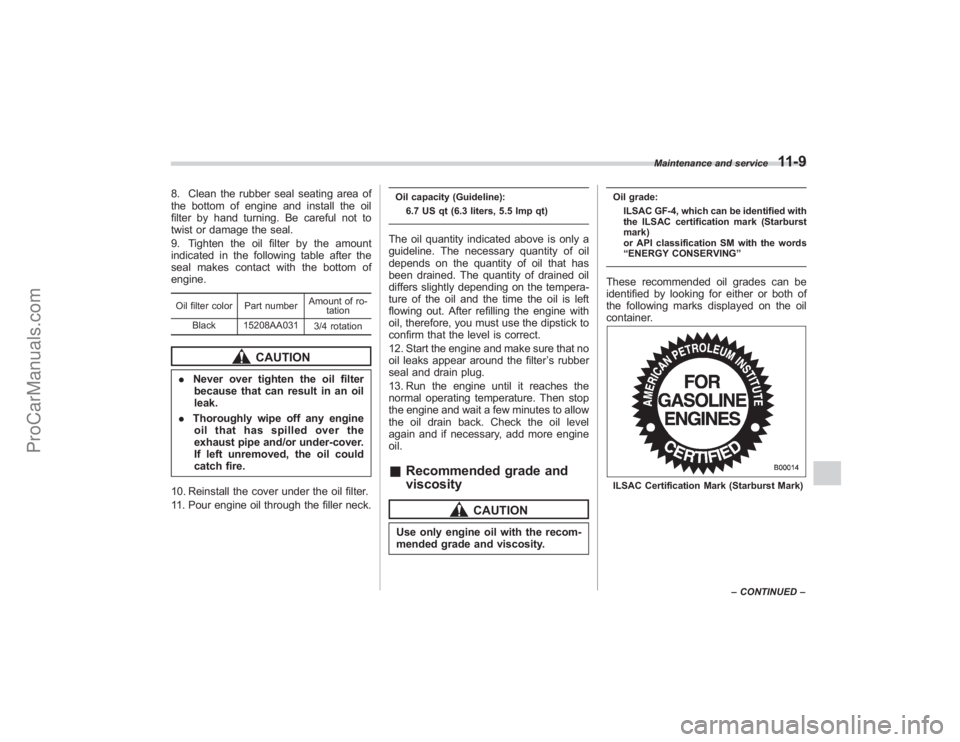
“ENERGY CONSERVING ”These recommended oil grades can be
identified by looking for either or both of
the following marks displayed on the oil
container.ILSAC Certification Mark (Starburst Mark)Maintenance and service
11-9
–
CONTINUED –
ProCarManuals.com
Page 332 of 409
11-10
Maintenance and service
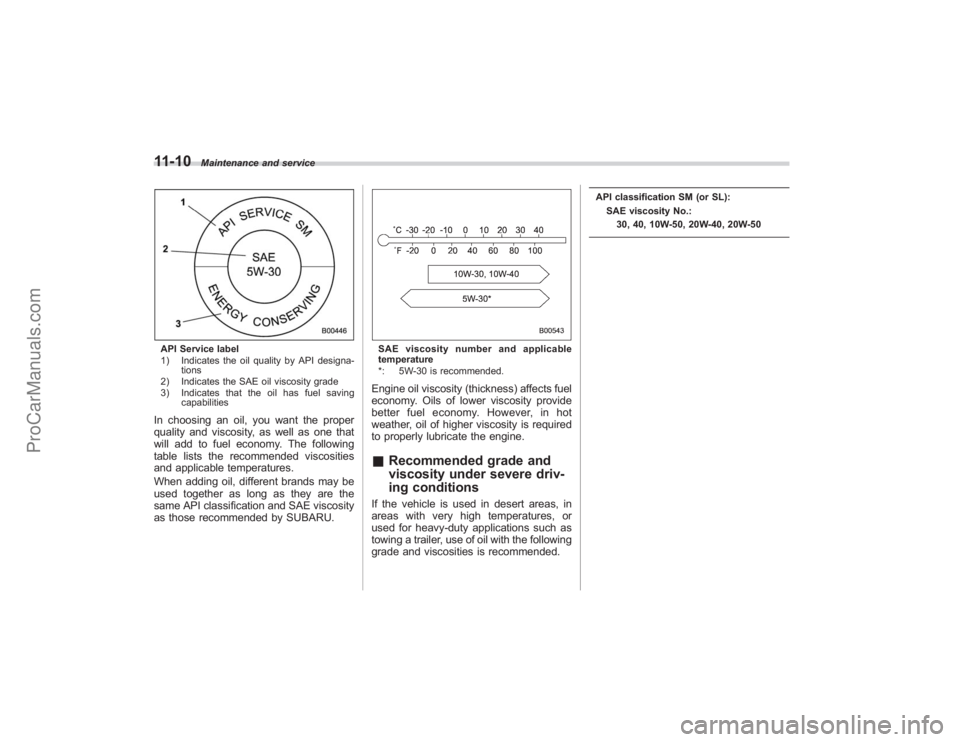
API Service label
1) Indicates the oil quality by API designa-tions
2) Indicates the SAE oil viscosity grade
3) Indicates that the oil has fuel saving capabilitiesIn choosing an oil, you want the proper
quality and viscosity, as well as one that
will add to fuel economy. The following
table lists the recommended viscosities
and applicable temperatures.
When adding oil, different brands may be
used together as long as they are the
same API classification and SAE viscosity
as those recommended by SUBARU.
SAE viscosity number and applicable
temperature
*: 5W-30 is recommended.Engine oil viscosity (thickness) affects fuel
economy. Oils of lower viscosity provide
better fuel economy. However, in hot
weather, oil of higher viscosity is required
to properly lubricate the engine.&Recommended grade and
viscosity under severe driv-
ing conditionsIf the vehicle is used in desert areas, in
areas with very high temperatures, or
used for heavy-duty applications such as
towing a trailer, use of oil with the following
grade and viscosities is recommended.
API classification SM (or SL):
SAE viscosity No.:30, 40, 10W-50, 20W-40, 20W-50
ProCarManuals.com
Page 333 of 409
Cooling system
WARNING
Never attempt to remove the radia-
tor cap until the engine has been
shut off and has cooled down
completely. Since the coolant is
under pressure, you may suffer
serious burns from a spray of boil-
ing hot coolant when the cap is
removed.
CAUTION
.The cooling system has been
filled at the factory with a high
quality, corrosion-inhibiting,
year-around coolant which pro-
vides protection against freezing
down to −33 8F( −36 8C).
Subaru engines use aluminum
components that require the
anti-corrosive and anti-freeze
properties of Subaru Genuine
Coolant, which is specifically
formulated for the Subaru cool-
ing system. Failure to use Subaru
Genuine Coolant along with
Subaru Cooling System Condi-
tioner at the recommended main- tenance intervals may result in
problems, including, but not lim-
ited to shortened life of engine
components and cooling system
clogging, coolant leaks and en-
gine damage from overheating.
Problems caused by the failure to
use Subaru Genuine Coolant and
Subaru Cooling System Condi-
tioner at recommended intervals
are not covered under the
Subaru Limited Warranty.
While there may be other generic
products that may provide the
required protection, they have
not been tested for compatibility
with Subaru engines and cooling
system components, and there-
fore not recommended.
. Do not splash the engine coolant
over painted parts. The alcohol
contained in the engine coolant
may damage the paint surface.
& Hose and connectionsYour vehicle employs an electric cooling
fan which is thermostatically controlled to
operate when the engine coolant reaches
a specific temperature.
If the radiator cooling fan does not operate even when the engine coolant tempera-
ture gauge exceeds the normal operating
range, the cooling fan circuit may be
defective. Check the fuse and replace it
if necessary. If the fuse is not blown, have
the cooling system checked by your
SUBARU dealer.
If frequent addition of coolant is neces-
sary, there may be a leak in the engine
cooling system. It is recommended that
the cooling system and connections be
checked for leaks, damage, or looseness.
&
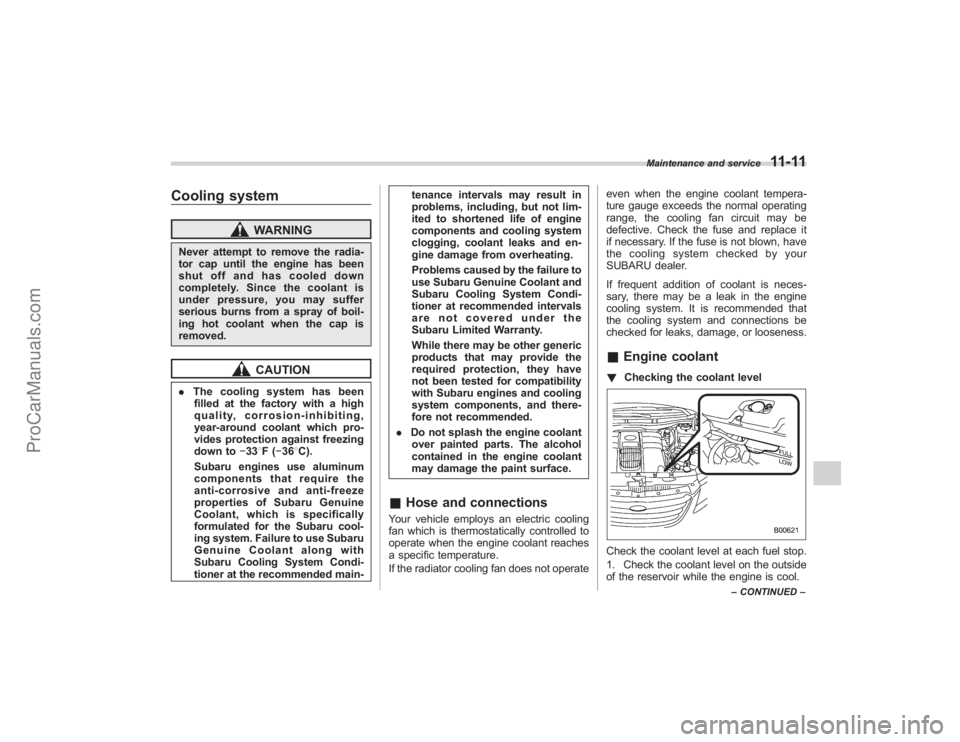
Engine coolant! Checking the coolant levelCheck the coolant level at each fuel stop.
1. Check the coolant level on the outside
of the reservoir while the engine is cool.
Maintenance and service
11-11
–CONTINUED –
ProCarManuals.com
Page 334 of 409
11-12
Maintenance and service
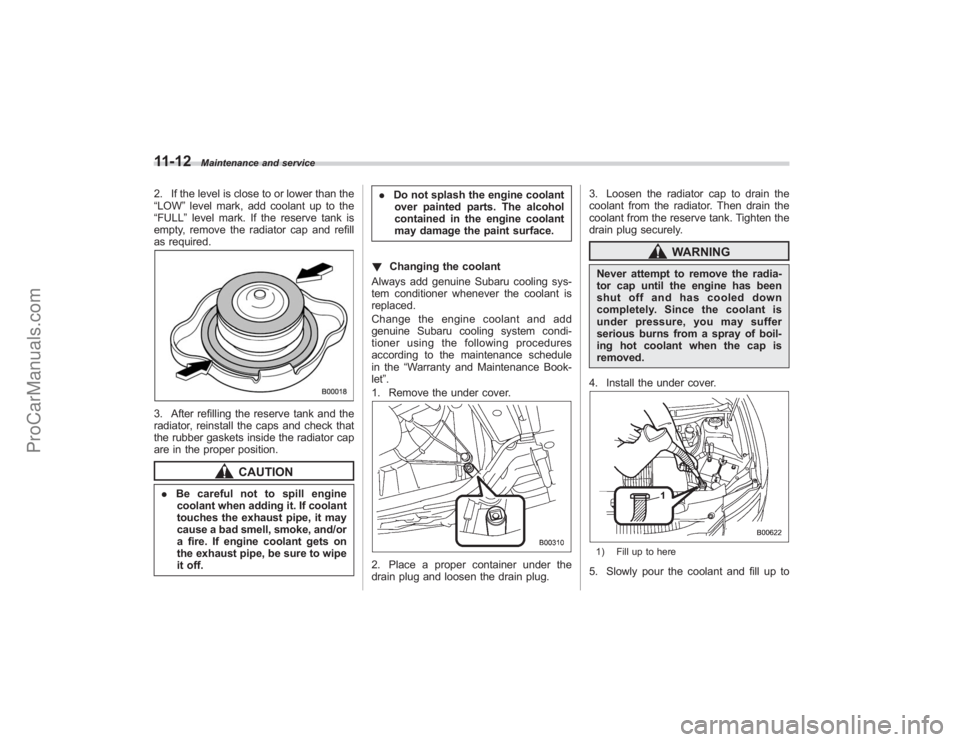
2. If the level is close to or lower than the
“LOW”level mark, add coolant up to the
“FULL ”level mark. If the reserve tank is
empty, remove the radiator cap and refill
as required.3. After refilling the reserve tank and the
radiator, reinstall the caps and check that
the rubber gaskets inside the radiator cap
are in the proper position.
CAUTION
. Be careful not to spill engine
coolant when adding it. If coolant
touches the exhaust pipe, it may
cause a bad smell, smoke, and/or
a fire. If engine coolant gets on
the exhaust pipe, be sure to wipe
it off. .
Do not splash the engine coolant
over painted parts. The alcohol
contained in the engine coolant
may damage the paint surface.
! Changing the coolant
Always add genuine Subaru cooling sys-
tem conditioner whenever the coolant is
replaced.
Change the engine coolant and add
genuine Subaru cooling system condi-
tioner using the following procedures
according to the maintenance schedule
in the “Warranty and Maintenance Book-
let ”.
1. Remove the under cover.
2. Place a proper container under the
drain plug and loosen the drain plug. 3. Loosen the radiator cap to drain the
coolant from the radiator. Then drain the
coolant from the reserve tank. Tighten the
drain plug securely.
WARNING
Never attempt to remove the radia-
tor cap until the engine has been
shut off and has cooled down
completely. Since the coolant is
under pressure, you may suffer
serious burns from a spray of boil-
ing hot coolant when the cap is
removed.
4. Install the under cover.1) Fill up to here5. Slowly pour the coolant and fill up to
ProCarManuals.com
Page 339 of 409
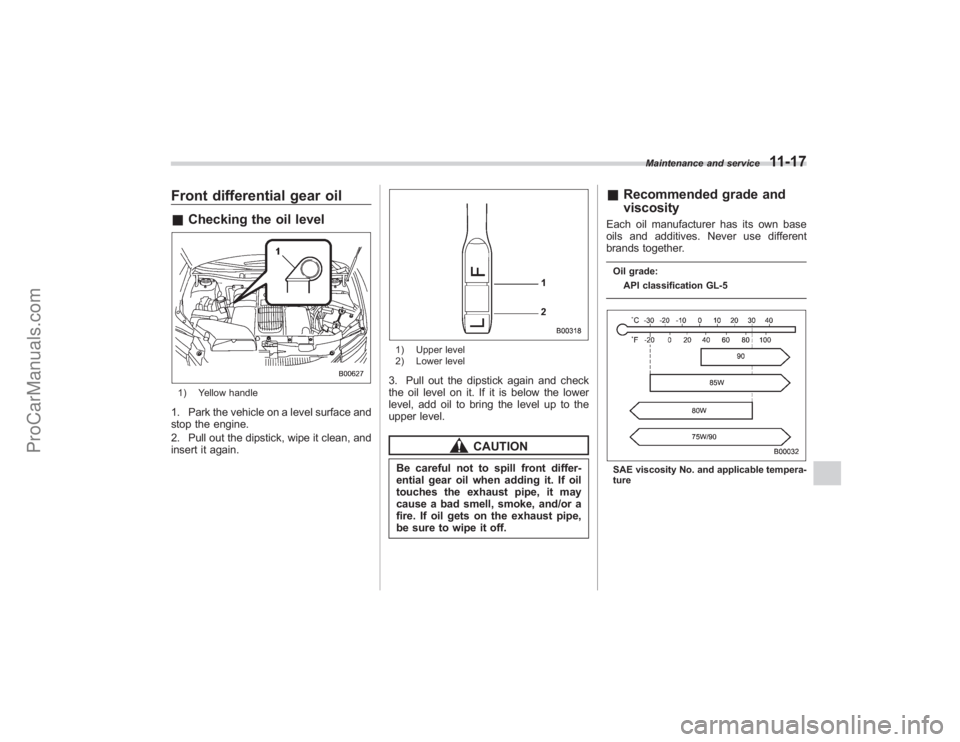
Front differential gear oil&Checking the oil level1) Yellow handle1. Park the vehicle on a level surface and
stop the engine.
2. Pull out the dipstick, wipe it clean, and
insert it again.
1) Upper level
2) Lower level3. Pull out the dipstick again and check
the oil level on it. If it is below the lower
level, add oil to bring the level up to the
upper level.
CAUTION
Be careful not to spill front differ-
ential gear oil when adding it. If oil
touches the exhaust pipe, it may
cause a bad smell, smoke, and/or a
fire. If oil gets on the exhaust pipe,
be sure to wipe it off.
&Recommended grade and
viscosityEach oil manufacturer has its own base
oils and additives. Never use different
brands together.Oil grade:
API classification GL-5SAE viscosity No. and applicable tempera-
ture Maintenance and service
11-17
ProCarManuals.com
Page 341 of 409
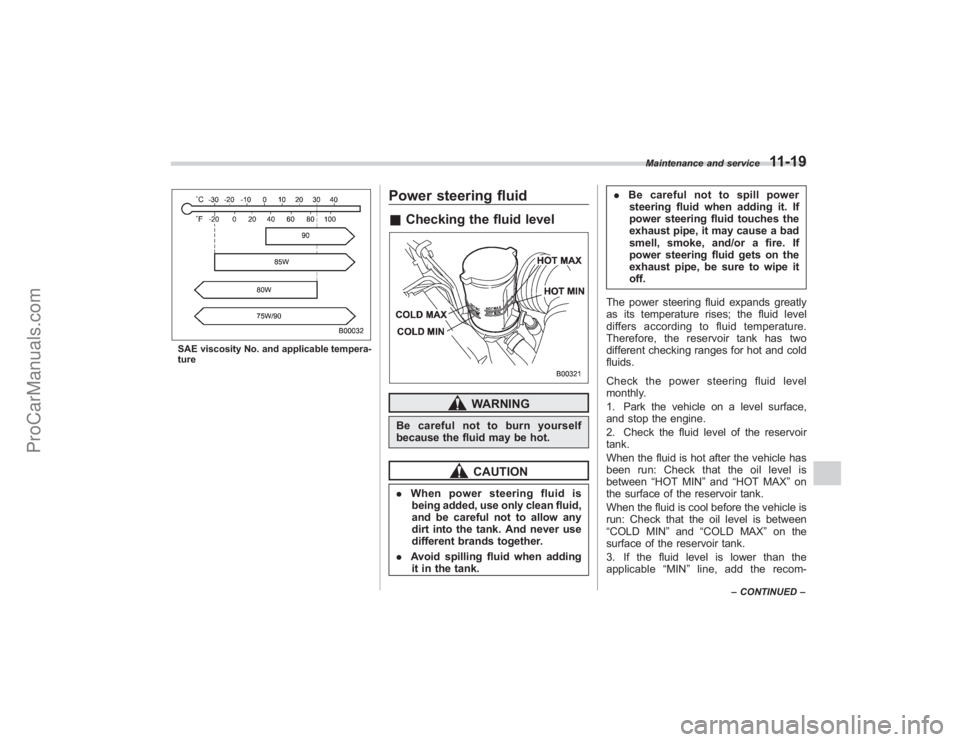
SAE viscosity No. and applicable tempera-
ture
Power steering fluid&Checking the fluid level
WARNING
Be careful not to burn yourself
because the fluid may be hot.
CAUTION
. When power steering fluid is
being added, use only clean fluid,
and be careful not to allow any
dirt into the tank. And never use
different brands together.
. Avoid spilling fluid when adding
it in the tank. .
Be careful not to spill power
steering fluid when adding it. If
power steering fluid touches the
exhaust pipe, it may cause a bad
smell, smoke, and/or a fire. If
power steering fluid gets on the
exhaust pipe, be sure to wipe it
off.
The power steering fluid expands greatly
as its temperature rises; the fluid level
differs according to fluid temperature.
Therefore, the reservoir tank has two
different checking ranges for hot and cold
fluids.
Check the power steering fluid level
monthly.
1. Park the vehicle on a level surface,
and stop the engine.
2. Check the fluid level of the reservoir
tank.
When the fluid is hot after the vehicle has
been run: Check that the oil level is
between “HOT MIN ”and “HOT MAX ”on
the surface of the reservoir tank.
When the fluid is cool before the vehicle is
run: Check that the oil level is between
“COLD MIN ”and “COLD MAX ”on the
surface of the reservoir tank.
3. If the fluid level is lower than the
applicable “MIN ”line, add the recom-
Maintenance and service
11-19
–CONTINUED –
ProCarManuals.com
Page 375 of 409
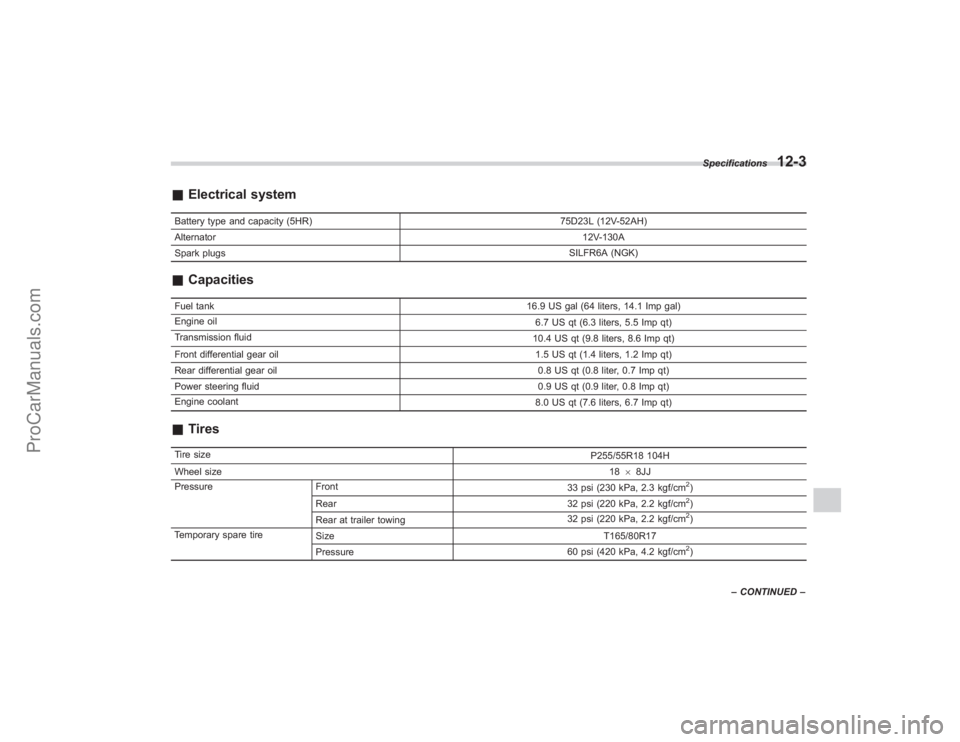
&Electrical systemBattery type and capacity (5HR) 75D23L (12V-52AH)
Alternator 12V-130A
Spark plugs SILFR6A (NGK)&
CapacitiesFuel tank 16.9 US gal (64 liters, 14.1 Imp gal)
Engine oil 6.7 US qt (6.3 liters, 5.5 Imp qt)
Transmission fluid 10.4 US qt (9.8 liters, 8.6 Imp qt)
Front differential gear oil 1.5 US qt (1.4 liters, 1.2 Imp qt)
Rear differential gear oil 0.8 US qt (0.8 liter, 0.7 Imp qt)
Power steering fluid 0.9 US qt (0.9 liter, 0.8 Imp qt)
Engine coolant 8.0 US qt (7.6 liters, 6.7 Imp qt)&TiresTire size
P255/55R18 104H
Wheel size 1868JJ
Pressure Front 33 psi (230 kPa, 2.3 kgf/cm
2)
Rear 32 psi (220 kPa, 2.2 kgf/cm2)
Rear at trailer towing 32 psi (220 kPa, 2.2 kgf/cm2)
Temporary spare tire Size T165/80R17
Pressure 60 psi (420 kPa, 4.2 kgf/cm2)Specifications
12-3
–
CONTINUED –
ProCarManuals.com
Page 399 of 409
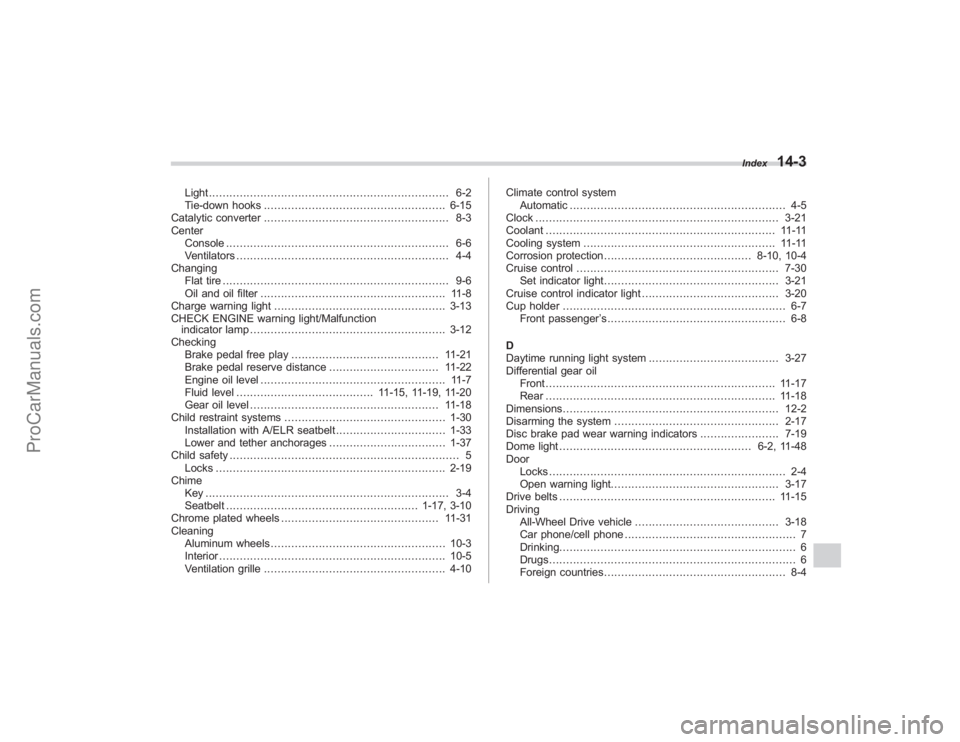
Light...................................................................... 6-2
Tie-down hooks ..................................................... 6-15
Catalytic converter ...................................................... 8-3
Center Console ................................................................. 6-6
Ventilators .............................................................. 4-4
Changing Flat tire .................................................................. 9-6
Oil and oil filter ...................................................... 11-8
Charge warning light .................................................. 3-13
CHECK ENGINE warning light/Malfunction indicator lamp ......................................................... 3-12
Checking Brake pedal free play ........................................... 11-21
Brake pedal reserve distance ................................ 11-22
Engine oil level ...................................................... 11-7
Fluid level ........................................ 11-15, 11-19, 11-20
Gear oil level ....................................................... 11-18
Child restraint systems ............................................... 1-30
Installation with A/ELR seatbelt ................................ 1-33
Lower and tether anchorages .................................. 1-37
Child safety ................................................................... 5
Locks ................................................................... 2-19
Chime Key ....................................................................... 3-4
Seatbelt ........................................................ 1-17, 3-10
Chrome plated wheels .............................................. 11-31
Cleaning Aluminum wheels ................................................... 10-3
Interior .................................................................. 10-5
Ventilation grille ..................................................... 4-10 Climate control system
Automatic ............................................................... 4-5
Clock ....................................................................... 3-21
Coolant ................................................................... 11-11
Cooling system ........................................................ 11-11
Corrosion protection ........................................... 8-10, 10-4
Cruise control ........................................................... 7-30
Set indicator light ................................................... 3-21
Cruise control indicator light ........................................ 3-20
Cup holder ................................................................. 6-7
Front passenger ’s.................................................... 6-8
D
Daytime running light system ...................................... 3-27
Differential gear oil Front ................................................................... 11-17
Rear ................................................................... 11-18
Dimensions ............................................................... 12-2
Disarming the system ................................................ 2-17
Disc brake pad wear warning indicators ....................... 7-19
Dome light ........................................................ 6-2, 11-48
Door Locks ..................................................................... 2-4
Open warning light. ................................................ 3-17
Drive belts ............................................................... 11-15
Driving All-Wheel Drive vehicle .......................................... 3-18
Car
phone/cell phone .................................................. 7
Drinking. .................................................................... 6
Drugs ........................................................................\
6
Foreign countries ..................................................... 8-4
Index
14-3
ProCarManuals.com
Page 400 of 409

14-4
Index
Pets........................................................................\
. 7
Snowy and icy roads ............................................... 8-9
Tips....................................................................... 8-4
Tired or sleepy. .......................................................... 7
E
Electrical system ........................................................ 12-3
Electronic Brake Force Distribution (EBD) system ................................................. 3-17, 7-22
Emergency Locking Retractor (ELR) ............................. 1-17
Engine
Compartment overview ........................................... 11-6
Coolant ............................................................... 11-11
Exhaust gas (Carbon monoxide) ............................ 5, 8-2
Hood .................................................................... 11-4
Oil........................................................................\
11-7
Overheating .......................................................... 9-14
Starting .................................................................. 7-7
Stopping ................................................................ 7-8
Exterior care .............................................................. 10-2
F
Flat tires .................................................................... 9-6
Floor mat .................................................................. 6-12
Fluid level Automatic transmission ........................................ 11-15
Brake ................................................................. 11-20
Power steering .................................................... 11-19
Fog light switch .......................................................... 3-32
Folding mirror switch .................................................. 3-41 Front
Differential gear oil ................................................ 11-17
Fog light .............................................................. 11-45
Seatbelt pretensioners ........................................... 1-27
Seats ..................................................................... 1-2
Turn signal light .................................................... 11-45
Front seats Fore and aft adjustment ........................................... 1-3
Reclining ................................................................ 1-3
Fuel ........................................................................\
... 7-2
Economy hints ........................................................ 8-2
Filler lid and cap ...................................................... 7-3
Gauge .................................................................... 3-8
Requirements ......................................................... 7-2
Fuses ..................................................................... 11-38
Fuses and circuits ..................................................... 12-5
G
GAWR (Gross Axle Weight Rating) .............................. 8-12
Glove box ................................................................... 6-5
GVWR (Gross Vehicle Weight Rating) ... ....................... 8-12
H
Hazard warning flasher .......................................... 3-5, 9-2
Head restraint adjustment ............................................. 1-5
Rear .................................................................... 1-11
Headlight Beam leveler. ........................................................ 3-29
Flasher ................................................................. 3-27
Indicator light ........................................................ 3-21
Headlights ....................................................... 3-26, 11-42
ProCarManuals.com