ECO mode SUBARU TRIBECA 2010 1.G User Guide
[x] Cancel search | Manufacturer: SUBARU, Model Year: 2010, Model line: TRIBECA, Model: SUBARU TRIBECA 2010 1.GPages: 422, PDF Size: 12.87 MB
Page 64 of 422
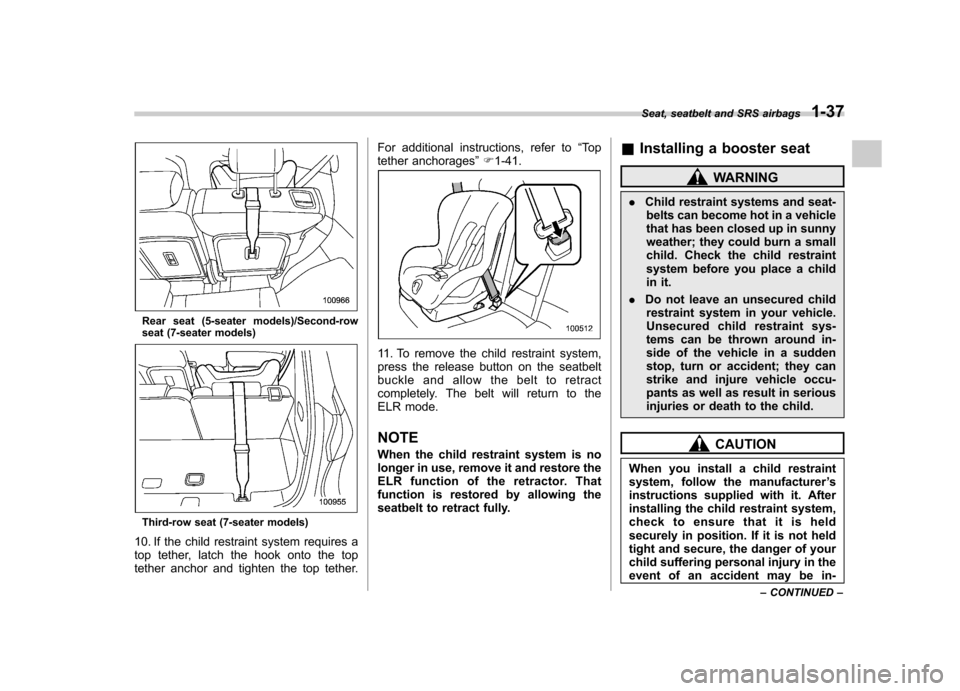
Rear seat (5-seater models)/Second-row
seat (7-seater models)
Third-row seat (7-seater models)
10. If the child restraint system requires a
top tether, latch the hook onto the top
tether anchor and tighten the top tether. For additional instructions, refer to
“To p
tether anchorages ”F 1-41.
11. To remove the child restraint system,
press the release button on the seatbelt
buckle and allow the belt to retract
completely. The belt will return to the
ELR mode. NOTE
When the child restraint system is no
longer in use, remove it and restore the
ELR function of the retractor. That
function is restored by allowing the
seatbelt to retract fully. &
Installing a booster seat
WARNING
. Child restraint systems and seat-
belts can become hot in a vehicle
that has been closed up in sunny
weather; they could burn a small
child. Check the child restraint
system before you place a child
in it.
. Do not leave an unsecured child
restraint system in your vehicle.
Unsecured child restraint sys-
tems can be thrown around in-
side of the vehicle in a sudden
stop, turn or accident; they can
strike and injure vehicle occu-
pants as well as result in serious
injuries or death to the child.
CAUTION
When you install a child restraint
system, follow the manufacturer ’s
instructions supplied with it. After
installing the child restraint system,
check to ensure that it is held
securely in position. If it is not held
tight and secure, the danger of your
child suffering personal injury in the
event of an accident may be in- Seat, seatbelt and SRS airbags
1-37
– CONTINUED –
Page 66 of 422
restraint system in your vehicle.
Unsecured child restraint sys-
tems can be thrown around in-
side of the vehicle in a sudden
stop, turn or accident; they can
strike and injure vehicle occu-
pants as well as result in serious
injuries or death to the child.
CAUTION
When you install a child restraint
system, follow the manufacturer ’s
instructions supplied with it. After
installing the child restraint system,
check to ensure that it is held
securely in position. If it is not held
tight and secure, the danger of your
child suffering personal injury in the
event of an accident may be in-creased.
Some types of child restraint systems can
be installed in a rear seating position of
your vehicle without use of the seatbelts.
Such child restraint systems are secured
to the dedicated anchorages provided on
the vehicle body.
The lower and tether anchorages are
sometimes referred to as the LATCH
system ( Lower Anchors and Tethers for
CH ildren).
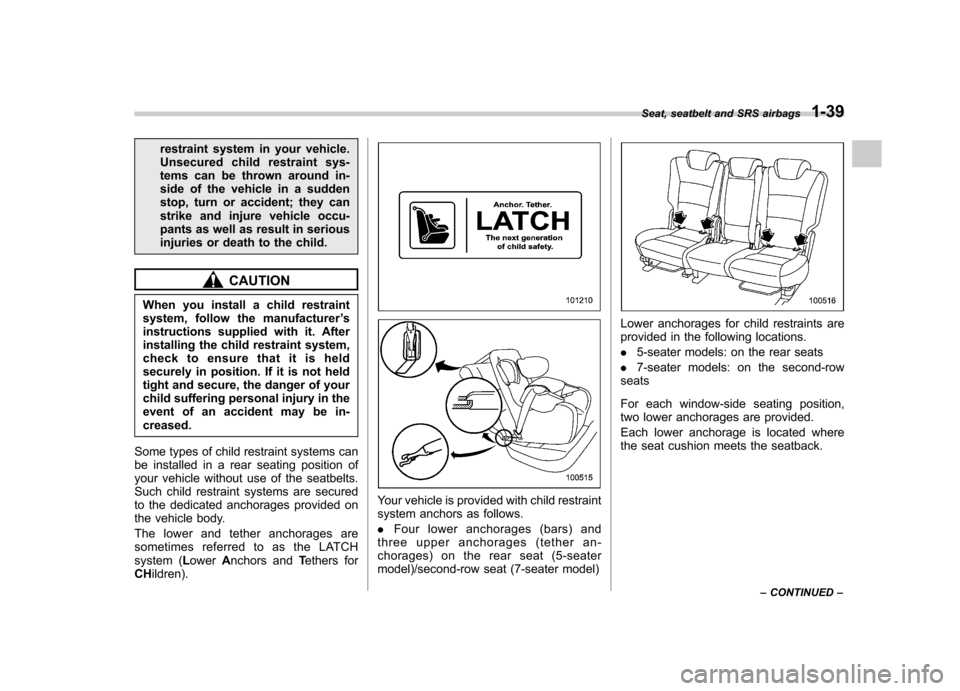
Your vehicle is provided with child restraint
system anchors as follows. .Four lower anchorages (bars) and
three upper anchorages (tether an-
chorages) on the rear seat (5-seater
model)/second-row seat (7-seater model)
Lower anchorages for child restraints are
provided in the following locations. . 5-seater models: on the rear seats
. 7-seater models: on the second-row
seats
For each window-side seating position,
two lower anchorages are provided.
Each lower anchorage is located where
the seat cushion meets the seatback. Seat, seatbelt and SRS airbags
1-39
– CONTINUED –
Page 67 of 422
1-40Seat, seatbelt and SRS airbags
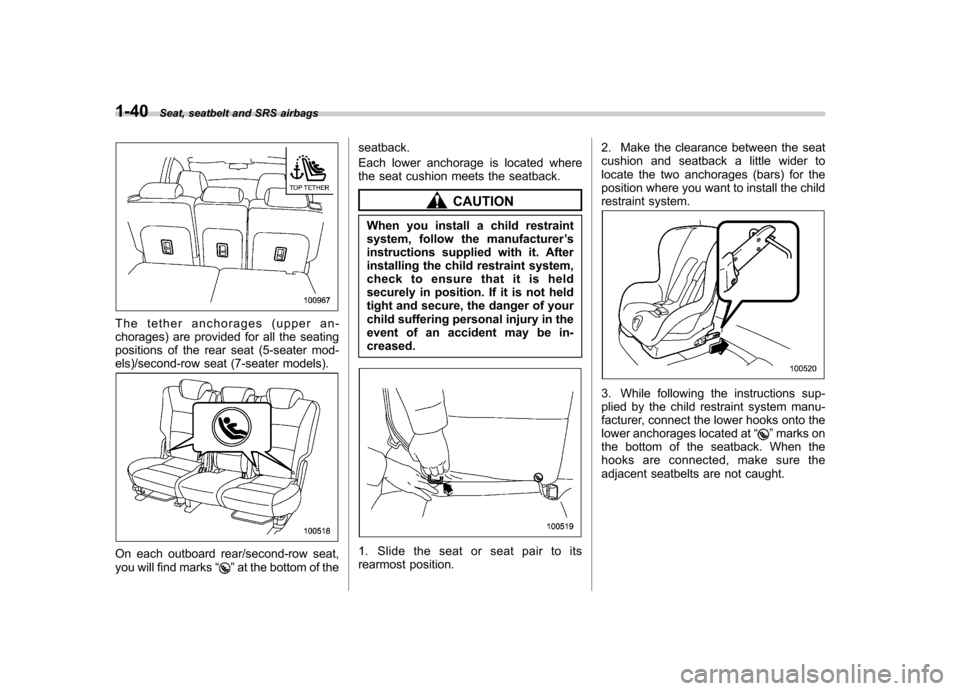
The tether anchorages (upper an-
chorages) are provided for all the seating
positions of the rear seat (5-seater mod-
els)/second-row seat (7-seater models).
On each outboard rear/second-row seat,
you will find marks “”at the bottom of the seatback.
Each lower anchorage is located where
the seat cushion meets the seatback.
CAUTION
When you install a child restraint
system, follow the manufacturer ’s
instructions supplied with it. After
installing the child restraint system,
check to ensure that it is held
securely in position. If it is not held
tight and secure, the danger of your
child suffering personal injury in the
event of an accident may be in-creased.
1. Slide the seat or seat pair to its
rearmost position. 2. Make the clearance between the seat
cushion and seatback a little wider to
locate the two anchorages (bars) for the
position where you want to install the child
restraint system.
3. While following the instructions sup-
plied by the child restraint system manu-
facturer, connect the lower hooks onto the
lower anchorages located at
“
”marks on
the bottom of the seatback. When the
hooks are connected, make sure the
adjacent seatbelts are not caught.
Page 68 of 422
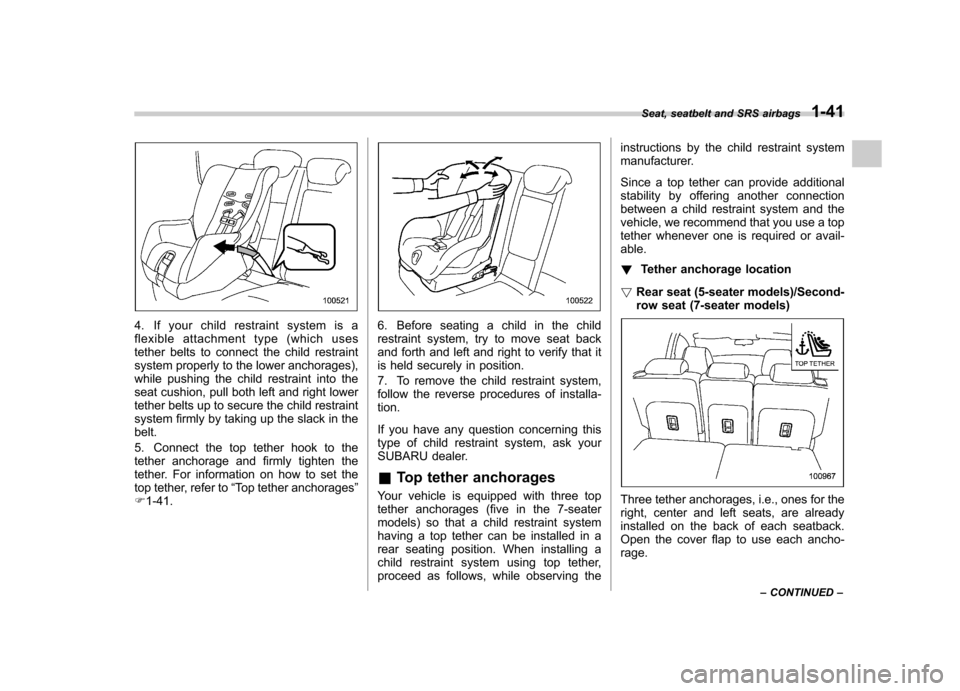
4. If your child restraint system is a
flexible attachment type (which uses
tether belts to connect the child restraint
system properly to the lower anchorages),
while pushing the child restraint into the
seat cushion, pull both left and right lower
tether belts up to secure the child restraint
system firmly by taking up the slack in thebelt.
5. Connect the top tether hook to the
tether anchorage and firmly tighten the
tether. For information on how to set the
top tether, refer to“Top tether anchorages ”
F 1-41.6. Before seating a child in the child
restraint system, try to move seat back
and forth and left and right to verify that it
is held securely in position.
7. To remove the child restraint system,
follow the reverse procedures of installa-tion.
If you have any question concerning this
type of child restraint system, ask your
SUBARU dealer. & Top tether anchorages
Your vehicle is equipped with three top
tether anchorages (five in the 7-seater
models) so that a child restraint system
having a top tether can be installed in a
rear seating position. When installing a
child restraint system using top tether,
proceed as follows, while observing the instructions by the child restraint system
manufacturer.
Since a top tether can provide additional
stability by offering another connection
between a child restraint system and the
vehicle, we recommend that you use a top
tether whenever one is required or avail-able. !
Tether anchorage location
! Rear seat (5-seater models)/Second-
row seat (7-seater models)
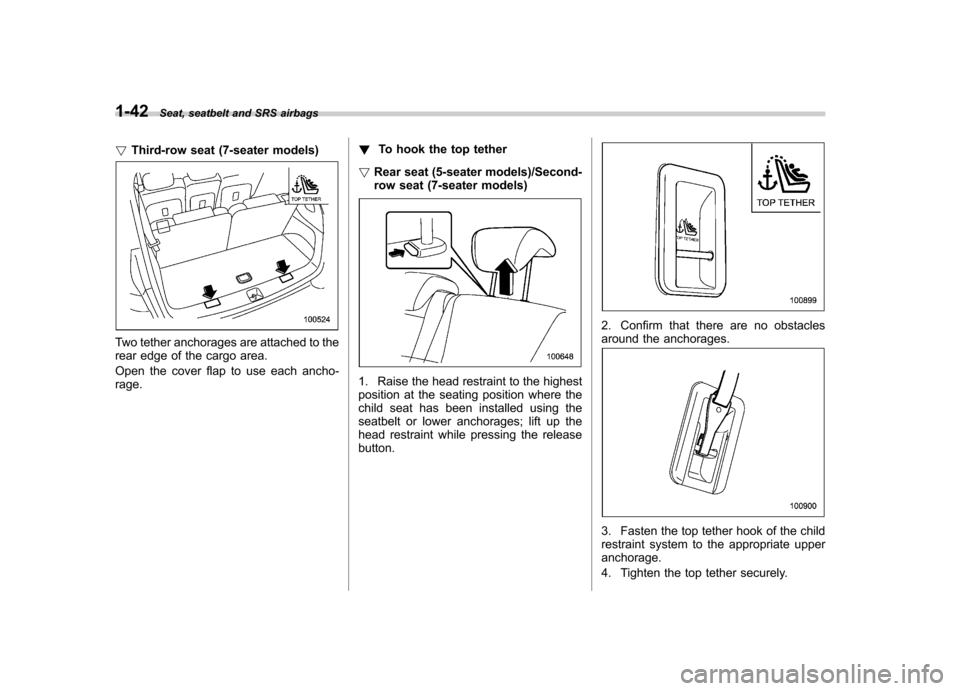
Three tether anchorages, i.e., ones for the
right, center and left seats, are already
installed on the back of each seatback.
Open the cover flap to use each ancho- rage. Seat, seatbelt and SRS airbags
1-41
– CONTINUED –
Page 69 of 422
1-42Seat, seatbelt and SRS airbags
! Third-row seat (7-seater models)
Two tether anchorages are attached to the
rear edge of the cargo area.
Open the cover flap to use each ancho- rage. !
To hook the top tether
! Rear seat (5-seater models)/Second-
row seat (7-seater models)
1. Raise the head restraint to the highest
position at the seating position where the
child seat has been installed using the
seatbelt or lower anchorages; lift up the
head restraint while pressing the releasebutton.
2. Confirm that there are no obstacles
around the anchorages.
3. Fasten the top tether hook of the child
restraint system to the appropriate upperanchorage.
4. Tighten the top tether securely.
Page 75 of 422
1-48Seat, seatbelt and SRS airbags
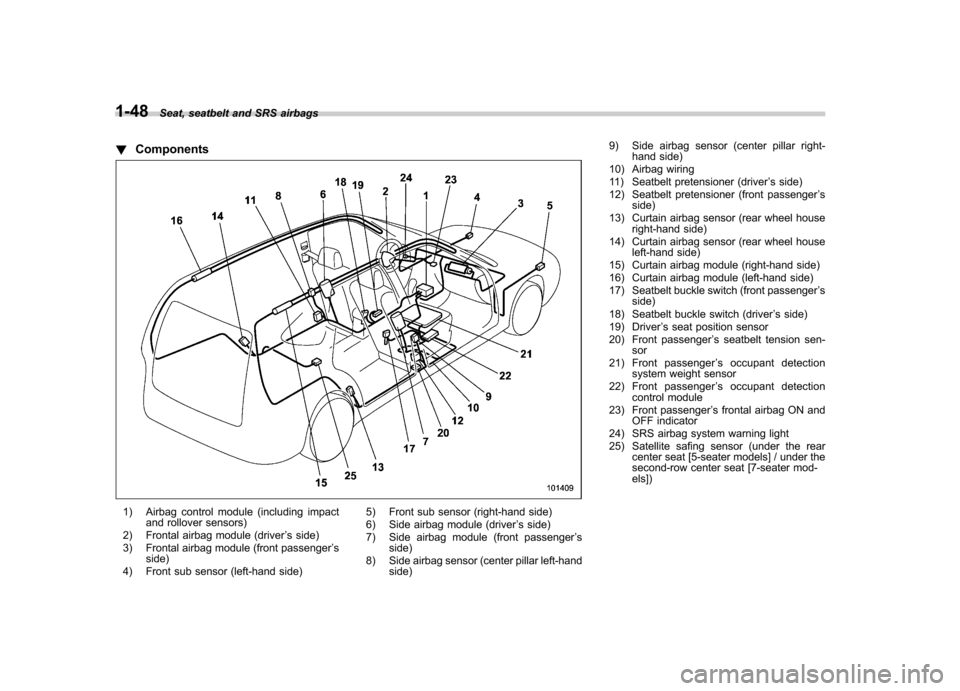
! Components
1) Airbag control module (including impact
and rollover sensors)
2) Frontal airbag module (driver ’s side)
3) Frontal airbag module (front passenger ’s
side)
4) Front sub sensor (left-hand side) 5) Front sub sensor (right-hand side)
6) Side airbag module (driver
’s side)
7) Side airbag module (front passenger ’s
side)
8) Side airbag sensor (center pillar left-hand side) 9) Side airbag sensor (center pillar right-
hand side)
10) Airbag wiring
11) Seatbelt pretensioner (driver ’s side)
12) Seatbelt pretensioner (front passenger ’s
side)
13) Curtain airbag sensor (rear wheel house right-hand side)
14) Curtain airbag sensor (rear wheel house left-hand side)
15) Curtain airbag module (right-hand side)
16) Curtain airbag module (left-hand side)
17) Seatbelt buckle switch (front passenger ’s
side)
18) Seatbelt buckle switch (driver ’s side)
19) Driver ’s seat position sensor
20) Front passenger ’s seatbelt tension sen-
sor
21) Front passenger ’s occupant detection
system weight sensor
22) Front passenger ’s occupant detection
control module
23) Front passenger ’s frontal airbag ON and
OFF indicator
24) SRS airbag system warning light
25) Satellite safing sensor (under the rear center seat [5-seater models] / under the
second-row center seat [7-seater mod- els])
Page 87 of 422
1-60Seat, seatbelt and SRS airbags
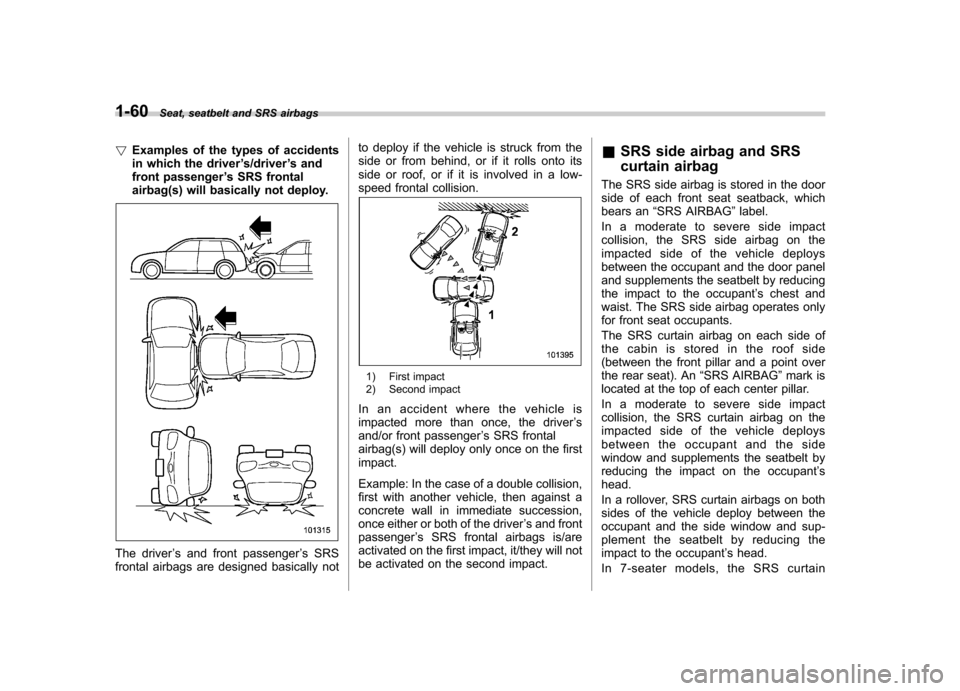
! Examples of the types of accidents
in which the driver ’s/driver ’s and
front passenger ’s SRS frontal
airbag(s) will basically not deploy.
The driver ’s and front passenger ’s SRS
frontal airbags are designed basically not to deploy if the vehicle is struck from the
side or from behind, or if it rolls onto its
side or roof, or if it is involved in a low-
speed frontal collision.
1) First impact
2) Second impact
In an accident where the vehicle is
impacted more than once, the driver ’s
and/or front passenger ’s SRS frontal
airbag(s) will deploy only once on the firstimpact.
Example: In the case of a double collision,
first with another vehicle, then against a
concrete wall in immediate succession,
once either or both of the driver ’s and front
passenger ’s SRS frontal airbags is/are
activated on the first impact, it/they will not
be activated on the second impact. &
SRS side airbag and SRS
curtain airbag
The SRS side airbag is stored in the door
side of each front seat seatback, which
bears an “SRS AIRBAG ”label.
Inamoderatetoseveresideimpact
collision, the SRS side airbag on the
impacted side of the vehicle deploys
between the occupant and the door panel
and supplements the seatbelt by reducing
the impact to the occupant ’s chest and
waist. The SRS side airbag operates only
for front seat occupants.
The SRS curtain airbag on each side of
the cabin is stored in the roof side
(between the front pillar and a point over
the rear seat). An “SRS AIRBAG ”mark is
located at the top of each center pillar.
Inamoderatetoseveresideimpact
collision, the SRS curtain airbag on the
impacted side of the vehicle deploys
between the occupant and the side
window and supplements the seatbelt by
reducing the impact on the occupant ’s
head.
In a rollover, SRS curtain airbags on both
sides of the vehicle deploy between the
occupant and the side window and sup-
plement the seatbelt by reducing the
impact to the occupant ’s head.
In 7-seater models, the SRS curtain
Page 91 of 422
1-64Seat, seatbelt and SRS airbags
force, is located in each of the left and
right center pillars and rear wheel houses.
Another impact sensor, which also senses
impact force, is located under the rear
center seat (5-seater models)/under the
second-row center seat (7-seater models).
In addition, a rollover sensor is located
inside the airbag control module.
If one of the center pillar impact sensors
and the impact sensor that is located
under the rear center seat (5-seater
models)/under the second-row center seat
(7-seater models) together sense an im-
pact force above a predetermined level in
a side collision, the control module causes
both the SRS side airbag and curtain
airbag on the impacted side to inflate
regardless of whether the rear wheel
house impact sensor on the same side
senses an impact. At this time, the driver ’s
and front passenger ’s seatbelt preten-
sioners also operate at the same time.
If one of the rear wheel house impact
sensors and the impact sensor that is
located under the rear center seat (5-
seater models)/under the second-row
center seat (7-seater models) together
sense an impact force above a predeter-
mined level in a side collision, the control
module causes only the SRS curtain
airbag on the impacted side to inflate. If the rollover sensor detects rollover of the
vehicle, the control module inflates the
SRS curtain airbags. At this time, the
driver
’s and front passenger ’s seatbelt
pretensioners also operate at the sametime.
After deployment, the SRS side airbag
immediately starts to deflate. The time
required from detection of an impact to
deflation of an SRS side airbag after
deployment is shorter than the blink of
an eye.
The SRS curtain airbag remains inflated
for a while following deployment then
slowly deflates.
The SRS side airbag and SRS curtain
airbag deploy even when no one occupies
the seat on the side on which an impact isapplied.
When the SRS side airbag and SRS
curtain airbag deploy, a sudden, fairly loud
inflation noise will be heard and some
smoke will be released. These occur-
rences are a normal result of the deploy-
ment. This smoke does not indicate a fire
in the vehicle.
CAUTION
Do not touch the SRS side airbag
system components around the front seat seatback with bare hands
right after deployment. Doing so can
cause burns because the compo-
nents can be very hot as a result ofdeployment.
After deployment, do not touch any
part of the SRS curtain airbag
system (from the front pillar to the
part of the roof side over the rear
seat). Doing so can cause burns
because the components can be
very hot as a result of deployment.
The SRS side airbag and SRS curtain
airbag are designed to deploy in the event
of an accident involving a moderate to
severe side impact collision. Also, in the
case of a rollover, the SRS curtain airbag
deploys. They are basically not designed
to deploy in a lesser side impact. Also,
they are basically not designed to deploy
in frontal or rear impacts because SRS
side airbag and SRS curtain airbag
deployment would not help the occupant
in those situations.
Each SRS side airbag and SRS curtain
airbag are designed to function on a one-
time-only basis.
SRS side airbag and SRS curtain airbag
deployment depend on the level of force
experienced in the passenger compart-
Page 98 of 422
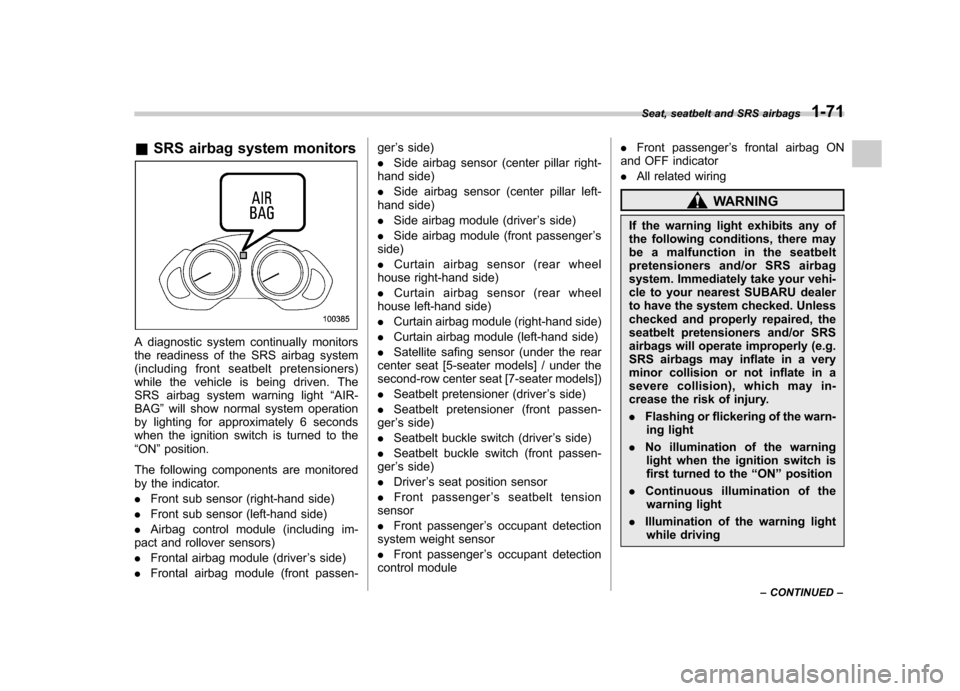
&SRS airbag system monitors
A diagnostic system continually monitors
the readiness of the SRS airbag system
(including front seatbelt pretensioners)
while the vehicle is being driven. The
SRS airbag system warning light “AIR-
BAG ”will show normal system operation
by lighting for approximately 6 seconds
when the ignition switch is turned to the“ ON ”position.
The following components are monitored
by the indicator. . Front sub sensor (right-hand side)
. Front sub sensor (left-hand side)
. Airbag control module (including im-
pact and rollover sensors). Frontal airbag module (driver ’s side)
. Frontal airbag module (front passen- ger
’s side)
. Side airbag sensor (center pillar right-
hand side). Side airbag sensor (center pillar left-
hand side). Side airbag module (driver ’s side)
. Side airbag module (front passenger ’s
side). Curtain airbag sensor (rear wheel
house right-hand side). Curtain airbag sensor (rear wheel
house left-hand side). Curtain airbag module (right-hand side)
. Curtain airbag module (left-hand side)
. Satellite safing sensor (under the rear
center seat [5-seater models] / under the
second-row center seat [7-seater models]) . Seatbelt pretensioner (driver ’s side)
. Seatbelt pretensioner (front passen-
ger ’s side)
. Seatbelt buckle switch (driver ’s side)
. Seatbelt buckle switch (front passen-
ger ’s side)
. Driver ’s seat position sensor
. Front passenger ’s seatbelt tension
sensor. Front passenger ’s occupant detection
system weight sensor. Front passenger ’s occupant detection
control module .
Front passenger ’s frontal airbag ON
and OFF indicator. All related wiring
WARNING
If the warning light exhibits any of
the following conditions, there may
be a malfunction in the seatbelt
pretensioners and/or SRS airbag
system. Immediately take your vehi-
cle to your nearest SUBARU dealer
to have the system checked. Unless
checked and properly repaired, the
seatbelt pretensioners and/or SRS
airbags will operate improperly (e.g.
SRS airbags may inflate in a very
minor collision or not inflate in a
severe collision), which may in-
crease the risk of injury. . Flashing or flickering of the warn-
ing light
. No illumination of the warning
light when the ignition switch is
first turned to the “ON ”position
. Continuous illumination of the
warning light
. Illumination of the warning light
while driving
Seat, seatbelt and SRS airbags
1-71
– CONTINUED –
Page 119 of 422

2-18Keys and doors
6. Push the front side ( “LOCK ”side) of
the power door locking switch to set the
door locks.
7. Close the door. An electronic chirp will
sound once, the turn signal lights will flash
once and the indicator lights will start
flashing rapidly. After rapid flashing for 30
seconds (standby time), the indicator
lights will then flash slowly (twice approxi-
mately every 2 seconds), indicating that
the system has been armed for surveil-lance. NOTE . The system can be armed even if the
engine hood, the windows and/or
moonroof are opened. Always make
sure that they are fully closed before
arming the system. .
The 30-second standby time can be
eliminated if you prefer. Have it per-
formed by your SUBARU dealer.. The system is in the standby mode
for a 30-second period after locking the
doors with the remote transmitter. The
security indicator light will flash at
short intervals during this period.. If any of the following actions is
done during the standby period, the
system will not switch to the surveil-
lance state.
–Doors are unlocked using the
remote transmitter. – Any of the doors or the rear gate
is opened. – Ignition switch is turned to the
“ ON ”position.
& Disarming the system
Briefly press the “
”button (for less than
2 seconds) on the remote transmitter. The driver ’s door will unlock, an electronic
chirp will sound twice, the turn signal
lights will flash twice and the indicator
light will turn off.
To unlock all other doors and the rear
gate, briefly press the “
”button a
second time within 5 seconds. NOTE
If the interval between the first and
second presses of the
“
”button (for
unlocking of all of the doors and the
rear gate) is extremely short, the sys-
tem may not respond. ! Emergency disarming
If you cannot disarm the system using the
transmitter (i.e. the transmitter is lost,
broken or the transmitter battery is too
weak), you can disarm the system without
using the transmitter.
The system can be disarmed if you turn
the ignition switch from the “LOCK ”to the
“ ON ”position with a registered key.
& Valet mode
When you choose the valet mode, the
alarm system does not operate. In valet
mode, the remote transmitter is used only
for locking and unlocking the doors and
rear gate and panic activation.
To enter the valet mode, change the
setting of your vehicle ’s alarm system for
deactivation mode. Refer to “Activating
and deactivating the alarm system ”F 2-
16. The security indicator light will con-
tinue to flash once every 3 seconds
indicating that the system is in the valetmode.