light SUBARU TRIBECA 2014 1.G Owners Manual
[x] Cancel search | Manufacturer: SUBARU, Model Year: 2014, Model line: TRIBECA, Model: SUBARU TRIBECA 2014 1.GPages: 426, PDF Size: 6.37 MB
Page 335 of 426
Maintenance and service
Rear window wiper blade rubber....................... 11-31
Battery............................................................... 11-33
Fuses................................................................ 11-34
Main fuse.......................................................... 11-35
Installation of accessories............................... 11-36
Replacing bulbs............................................... 11-36Headlights(models with HID headlights)........... 11-36Headlights (models without HID headlights) ...... 11-36Parking light (right-hand side)........................... 11-38Front turn signal light (right-hand side)............. 11-39
Front fog light.................................................. 11-39Rear combination lights................................... 11-39Backup light/Tail light...................................... 11-40Rear gate light................................................. 11-41License plate light........................................... 11-41Dome light....................................................... 11-42Map light......................................................... 11-43Vanity mirror light............................................ 11-43Door step light................................................. 11-43Cargo area light............................................... 11-44
Page 338 of 426
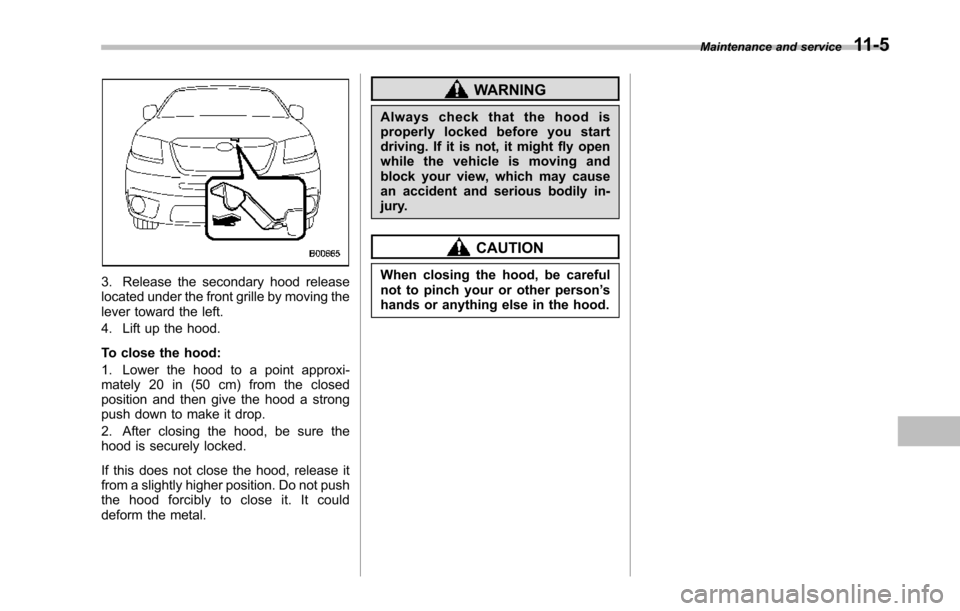
3. Release the secondary hood releaselocated under the front grille by moving thelever toward the left.
4. Lift up the hood.
To close the hood:
1. Lower the hood to a point approxi-mately 20 in (50 cm) from the closedposition and then give the hood a strongpush down to make it drop.
2. After closing the hood, be sure thehoodis securely locked.
If this does not close the hood, release itfrom a slightly higher position. Do not pushthe hood forcibly to close it. It coulddeform the metal.
WARNING
Always check that the hood isproperly locked before you startdriving. If it is not, it might fly openwhile the vehicle is moving andblock your view, which may causean accident and serious bodily in-jury.
CAUTION
When closing the hood, be carefulnot to pinch your or other person’shands or anything else in the hood.
Maintenance and service11-5
Page 342 of 426
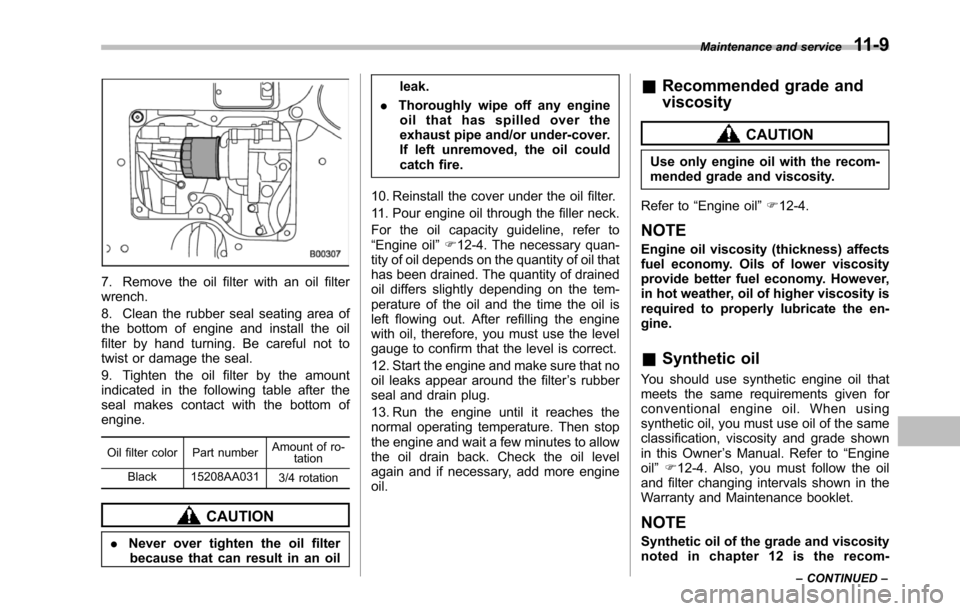
7. Remove the oil filter with an oil filterwrench.
8. Clean the rubber seal seating area ofthe bottom of engine and install the oilfilterby hand turning. Be careful not totwist or damage the seal.
9. Tighten the oil filter by the amountindicatedin the following table after theseal makes contact with the bottom ofengine.
Oil filter color Part numberAmount of ro-tation
Black 15208AA0313/4 rotation
CAUTION
.Never over tighten the oil filterbecause that can result in an oil
leak.
.Thoroughly wipe off any engineoil that has spilled over theexhaust pipe and/or under-cover.If left unremoved, the oil couldcatch fire.
10. Reinstall thecover under the oil filter.
11. Pour engine oil through the filler neck.
For the oil capacity guideline, refer to“Engine oil”F12-4. The necessary quan-tity of oil depends on the quantity of oil thathas been drained. The quantity of drainedoil differs slightly depending on the tem-perature of the oil and the time the oil isleft flowing out. After refilling the enginewith oil, therefore, you must use the levelgauge to confirm that the level is correct.
12.Start the engine and make sure that nooil leaks appear around the filter’s rubberseal and drain plug.
13. Run the engine until it reaches thenormal operating temperature. Then stopthe engine and wait a few minutes to allowthe oil drain back. Check the oil levelagain and if necessary, add more engineoil.
&Recommended grade and
viscosity
CAUTION
Use only engine oil with the recom-mended grade and viscosity.
Refer to“Engine oil”F12-4.
NOTE
Engine oil viscosity (thickness) affectsfuel economy. Oils of lower viscosityprovide better fuel economy. However,in hot weather, oil of higher viscosity isrequired to properly lubricate the en-gine.
&Synthetic oil
You should use synthetic engine oil thatmeets the samerequirements given forconventional engine oil. When usingsynthetic oil, you must use oil of the sameclassification,viscosity and grade shownin this Owner’s Manual. Refer to“Engineoil”F12-4. Also, you must follow the oiland filter changing intervals shown in theWarranty and Maintenance booklet.
NOTE
Synthetic oil of the grade and viscositynoted in chapter 12 is the recom-
Maintenance and service11-9
–CONTINUED–
Page 351 of 426
11-18Maintenance and service
Alcohol contained in the brakefluid may damage them.
.Be careful not to spill brake fluidwhen adding it. If brake fluidtouches the exhaust pipe, it maycause a bad smell, smoke, and/ora fire. If brake fluid gets on theexhaust pipe, be sure to wipe itoff.
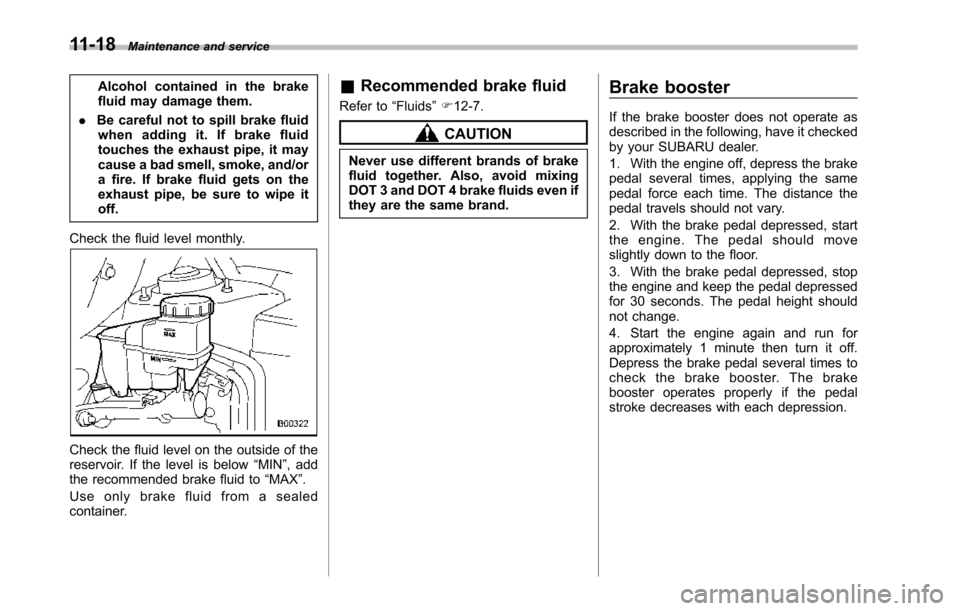
Check the fluid level monthly.
Check thefluid level on the outside of thereservoir. If the level is below“MIN”, addthe recommended brake fluid to“MAX”.
Use only brake fluid from a sealedcontainer.
&Recommended brake fluid
Refer to“Fluids”F12-7.
CAUTION
Never use different brands of brakefluid together. Also, avoid mixingDOT 3 and DOT 4 brake fluids even ifthey are the same brand.
Brake booster
If the brake booster does not operate asdescribed in the following, have it checkedby your SUBARU dealer.
1. With the engine off, depress the brakepedal several times, applying the samepedal force each time. The distance thepedal travels should not vary.
2. With the brake pedal depressed, startthe engine. The pedal should moveslightly down to the floor.
3. With the brake pedal depressed, stopthe engine and keep the pedal depressedfor 30 seconds. The pedal height shouldnot change.
4. Start the engine again and run forapproximately 1 minute then turn it off.Depress the brake pedal several times tocheck the brake booster. The brakebooster operates properly if the pedalstroke decreases with each depression.
Page 352 of 426
Brake pedal
Check the brake pedal free play andreserve distance according to the main-tenance schedule in the“Warranty andMaintenance Booklet”.
&Checking the brake pedal
free play
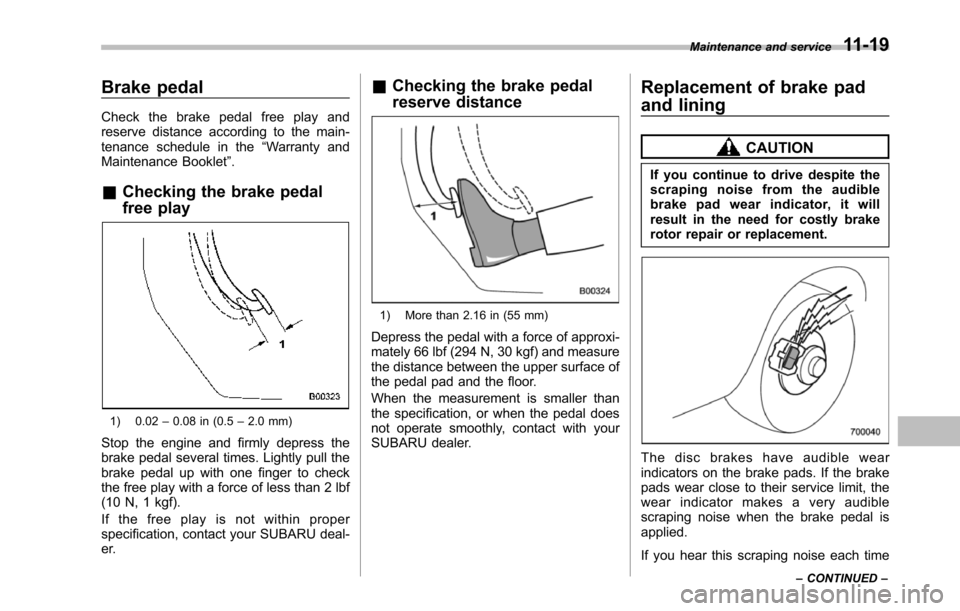
1) 0.02–0.08 in (0.5–2.0 mm)
Stop the engine and firmly depress thebrake pedal several times. Lightly pull thebrake pedal up with one finger to checkthe free play with a force of less than 2 lbf(10 N, 1 kgf).
If the free play is not within properspecification, contact your SUBARU deal-er.
&Checking the brake pedal
reserve distance
1) More than 2.16 in (55 mm)
Depress the pedal with a force of approxi-mately 66 lbf (294 N, 30 kgf) and measurethe distance between the upper surface ofthe pedal pad and the floor.
When the measurement is smaller thanthe specification, or when the pedal doesnot operate smoothly, contact with yourSUBARU dealer.
Replacement of brake pad
and lining
CAUTION
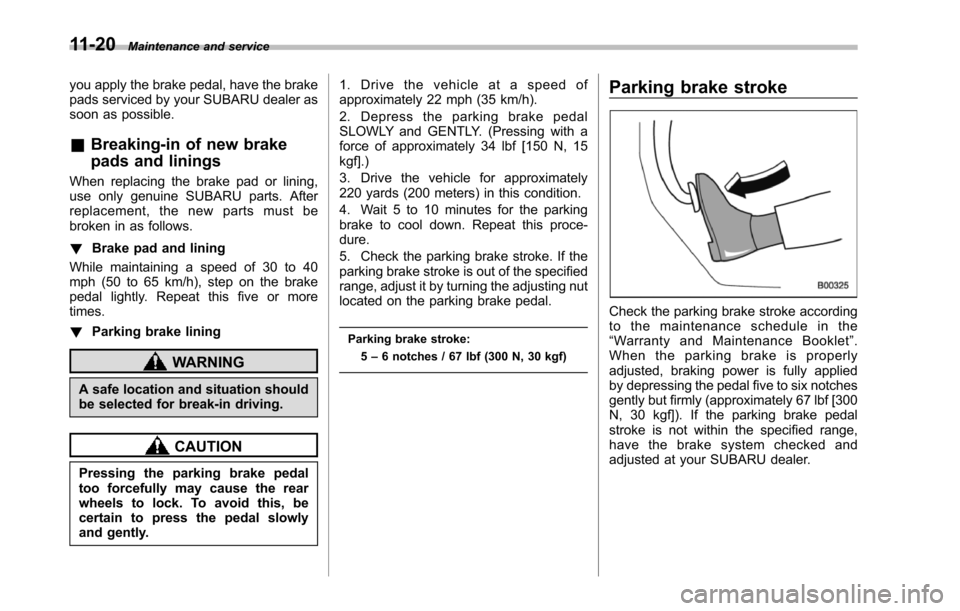
If you continue to drive despite thescraping noise from the audiblebrake pad wear indicator, it willresult in the need for costly brakerotor repair or replacement.
The disc brakes have audible wearindicators on the brake pads. If the brakepads wear close to their service limit, thewear indicator makes a very audiblescraping noise when the brake pedal isapplied.
If you hear this scraping noise each time
Maintenance and service11-19
–CONTINUED–
Page 353 of 426
11-20Maintenance and service
you apply the brake pedal, have the brakepads serviced by your SUBARU dealer assoon as possible.
&Breaking-in of new brake
pads and linings
When replacing the brake pad or lining,use only genuine SUBARU parts. Afterreplacement, the new parts must bebroken in as follows.
!Brakepad and lining
While maintaining a speed of 30 to 40mph (50 to 65 km/h), step on the brakepedal lightly. Repeat this five or moretimes.
!Parking brake lining
WARNING
A safe location and situation shouldbe selected for break-in driving.
CAUTION
Pressing the parking brake pedaltoo forcefully may cause the rearwheels to lock. To avoid this, becertain to press the pedal slowlyand gently.
1. Drive the vehicle at a speed ofapproximately 22 mph (35 km/h).
2. Depress the parking brake pedalSLOWLY and GENTLY. (Pressing with aforce of approximately 34 lbf [150 N, 15kgf].)
3. Drive the vehicle for approximately220 yards (200 meters) in this condition.
4. Wait 5 to 10 minutes for the parkingbrake to cool down. Repeat this proce-dure.
5. Check the parking brake stroke. If theparking brake stroke is out of the specifiedrange, adjust it by turning the adjusting nutlocated on the parking brake pedal.
Parking brake stroke:
5–6 notches / 67 lbf (300 N, 30 kgf)
Parking brake stroke
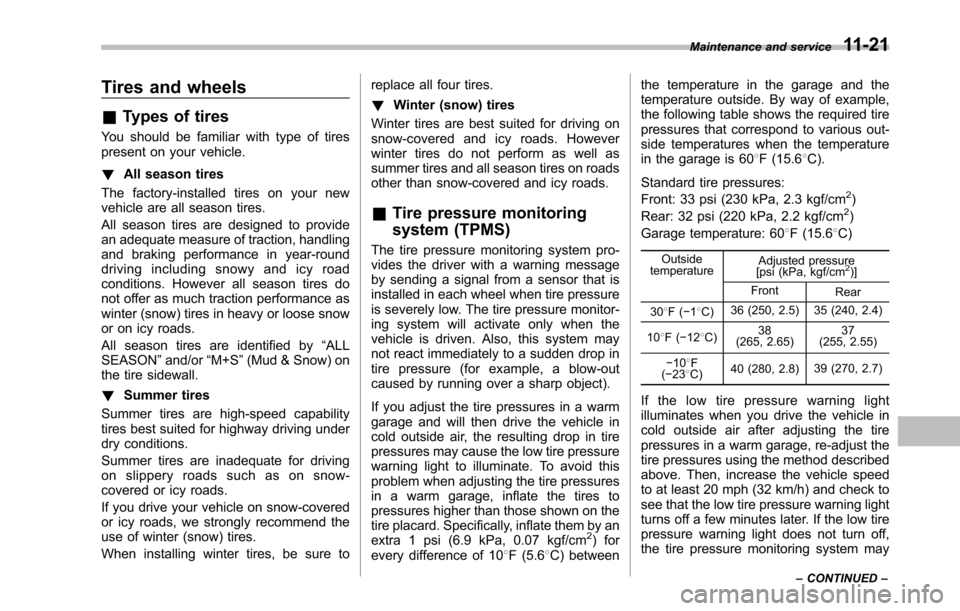
Check the parking brake stroke accordingto the maintenance schedule in the“Warranty and Maintenance Booklet”.When the parking brake is properlyadjusted, braking power is fully appliedby depressing the pedal five to six notchesgently but firmly (approximately 67 lbf [300N, 30 kgf]). If the parking brake pedalstroke is not within the specified range,have the brake system checked andadjusted at your SUBARU dealer.
Page 354 of 426
Tires and wheels
&Types of tires
You should be familiar with type of tirespresent on your vehicle.
!All season tires
The factory-installed tires on your newvehicle are all season tires.
All season tires are designed to providean adequate measure of traction, handlingand braking performance in year-rounddriving including snowy and icy roadconditions. However all season tires donot offer as much traction performance aswinter (snow) tires in heavy or loose snowor on icy roads.
All season tires are identified by“ALLSEASON”and/or“M+S”(Mud & Snow) onthe tire sidewall.
!Summer tires
Summer tires are high-speed capabilitytires best suited for highway driving underdry conditions.
Summer tires are inadequate for drivingon slippery roads such as on snow-covered or icy roads.
If you drive your vehicle on snow-coveredor icy roads, we strongly recommend theuse of winter (snow) tires.
When installing winter tires, be sure to
replace all four tires.
!Winter (snow) tires
Winter tires are best suited for driving onsnow-covered and icy roads. Howeverwinter tires do not perform as well assummer tires and all season tires on roadsother than snow-covered and icy roads.
&Tire pressure monitoring
system (TPMS)
The tire pressure monitoring system pro-vides the driver with a warning messageby sending a signal from a sensor that isinstalled in each wheel when tire pressureis severely low. The tire pressure monitor-ing system will activate only when thevehicle is driven. Also, this system maynot react immediately to a sudden drop intire pressure (for example, a blow-outcausedby running over a sharp object).
If you adjust the tire pressures in a warmgarage and will then drive the vehicle incold outside air, the resulting drop in tirepressures may cause the low tire pressurewarning light to illuminate. To avoid thisproblem when adjusting the tire pressuresin a warm garage, inflate the tires topressures higher than those shown on thetire placard. Specifically, inflate them by anextra 1 psi (6.9 kPa, 0.07 kgf/cm2) forevery difference of 108F (5.68C) between
the temperature in the garage and thetemperature outside. By way of example,the following table shows the required tirepressures that correspond to various out-side temperatures when the temperaturein the garage is 608F (15.68C).
Standard tire pressures:
Front: 33 psi (230 kPa, 2.3 kgf/cm2)
Rear: 32 psi (220 kPa, 2.2 kgf/cm2)
Garage temperature: 608F (15.68C)
OutsidetemperatureAdjusted pressure[psi (kPa, kgf/cm2)]
FrontRear
308F(!18C)36 (250, 2.5) 35 (240, 2.4)
108F(!128C)38(265, 2.65)37(255, 2.55)
!108F(!238C)40 (280, 2.8)39 (270, 2.7)
If the low tire pressure warning lightilluminates when you drive the vehicle incold outside air after adjusting the tirepressures in a warm garage, re-adjust thetire pressures using the method describedabove. Then, increase the vehicle speedto at least 20 mph (32 km/h) and check tosee that the low tire pressure warning lightturns off a few minutes later. If the low tirepressure warning light does not turn off,the tire pressure monitoring system may
Maintenance and service11-21
–CONTINUED–
Page 355 of 426
11-22Maintenance and service
not be functioning normally. In this event,go to a SUBARU dealer to have thesystem inspected as soon as possible.
While the vehicle is driven, friction be-tween tires and the road surface causesthe tires to warm up. After illumination ofthe low tire pressure warning light, anyincrease in the tire pressures caused byan increase in the outside air temperatureor by an increase in the temperature in thetires can cause the low tire pressurewarning light to turn off.
System resetting is necessary when thewheels are changed (for example, aswitch to snow tires) and new TPMSvalves are installed on the newly fittedwheels. Have this work performed by aSUBARU dealer following wheel replace-ment.
It may not be possible to install TPMSvalves on certain wheels that are on themarket. Therefore, if you change thewheels (for example, a switch to snowtires), use wheels that have the same partnumber as the standard-equipmentwheels. Without four operational TPMSvalve/sensors on the wheels, the TPMSwill not fully function and the warning lightin the instrument panel will illuminatesteadily after blinking for approximatelyone minute.
When a tire is replaced, adjustments arenecessary to ensure continued normaloperation of the tire pressure monitoringsystem. As with wheel replacement, there-fore, you should have the work performedby a SUBARU dealer.
WARNING
If the low tire pressure warning lightdoes not illuminate briefly after theignition switch is turned ON or thelight illuminates steadily after blink-ing for approximately one minute,you shouldhave your Tire PressureMonitoring System checked at aSUBARU dealer as soon as possi-ble.
If this light illuminates while driving,never brake suddenly and keepdriving straight ahead while gradu-ally reducing speed. Then slowlypull off the road to a safe place.Otherwise an accident involvingserious vehicle damage and seriouspersonal injury could occur.
If this light still illuminates whiledriving after adjusting the tire pres-sure, a tire may have significantdamage and a fast leak that causesthe tire to lose air rapidly. If you havea flat tire, replace it with a spare tire
as soon as possible.
When a spare tire is mounted or awheel rim is replaced without theoriginal pressure sensor/transmitterbeing transferred, the low tire pres-sure warning light will illuminatesteadily after blinking for approxi-mately one minute. This indicatesthe TPMS is unable to monitor allfour road wheels. Contact yourSUBARU dealer as soon as possiblefor tire and sensor replacement and/or system resetting. If the lightilluminates steadily after blinkingfor approximately one minute,promptly contact a SUBARU dealerto have the system inspected.
&Tire inspection
Checkon a daily basis that the tires arefree from serious damage, nails, andstones. At the same time, check the tiresfor abnormal wear.
Contact your SUBARU dealer immedi-ately if you find any problem.
NOTE
.When the wheels and tires strikecurbs or are subjected to harsh treat-ment as when the vehicle is driven on arough surface, they can suffer damage
Page 358 of 426
&Wheel balance
Each wheel was correctly balanced whenyour vehicle was new, but the wheels willbecome unbalanced as the tires becomeworn during use. Wheel imbalance causesthe steering wheel to vibrate slightly atcertain vehicle speeds and detracts fromthe vehicle’s straight-line stability. It canalso cause steering and suspension sys-tem problems and abnormal tire wear. Ifyou suspect that the wheels are notcorrectly balanced, have them checkedand adjusted by your SUBARU dealer.Also have themadjusted after tire repairsand after tire rotation.
CAUTION
Loss of correct wheel alignmentcauses the tires to wear on one sideand reduces the vehicle’s runningstability. Contact your SUBARUdealer if you notice abnormal tirewear.
NOTE
The suspension system is designed toholdeach wheel at a certain alignment(relative to the other wheels and to theroad) for optimum straight-line stabilityand cornering performance.
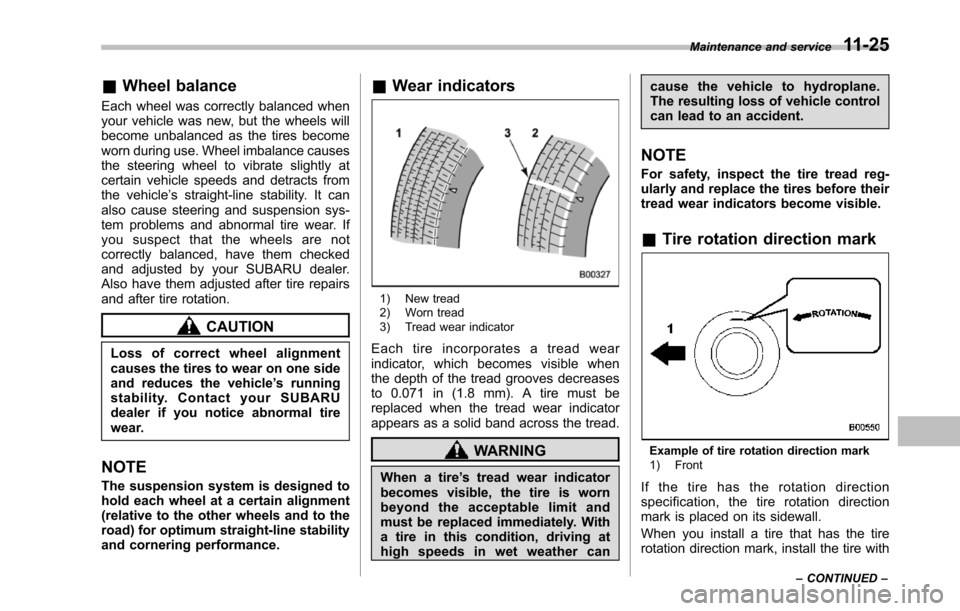
&Wear indicators
1) New tread2) Worn tread3) Tread wear indicator
Each tire incorporates a tread wearindicator, which becomes visible whenthe depth of the tread grooves decreasesto 0.071 in (1.8 mm). A tire must bereplaced when the tread wear indicatorappears as a solid band across the tread.
WARNING
When a tire’s tread wear indicatorbecomes visible, the tire is wornbeyond the acceptable limit andmust be replaced immediately. Witha tire in this condition, driving athigh speeds in wet weather can
cause the vehicle to hydroplane.The resulting loss of vehicle controlcan lead to an accident.
NOTE
For safety, inspect the tire tread reg-ularly and replace the tires before theirtread wear indicators become visible.
&Tire rotation direction mark
Example of tire rotation direction mark1) Front
If the tire has the rotation directionspecification, the tire rotation directionmark is placed on its sidewall.
When you install a tire that has the tirerotationdirection mark, install the tire with
Maintenance and service11-25
–CONTINUED–
Page 361 of 426
11-28Maintenance and service
Windshield washer fluid
CAUTION
Never use engine coolant as washerfluid because it could cause paintdamage.
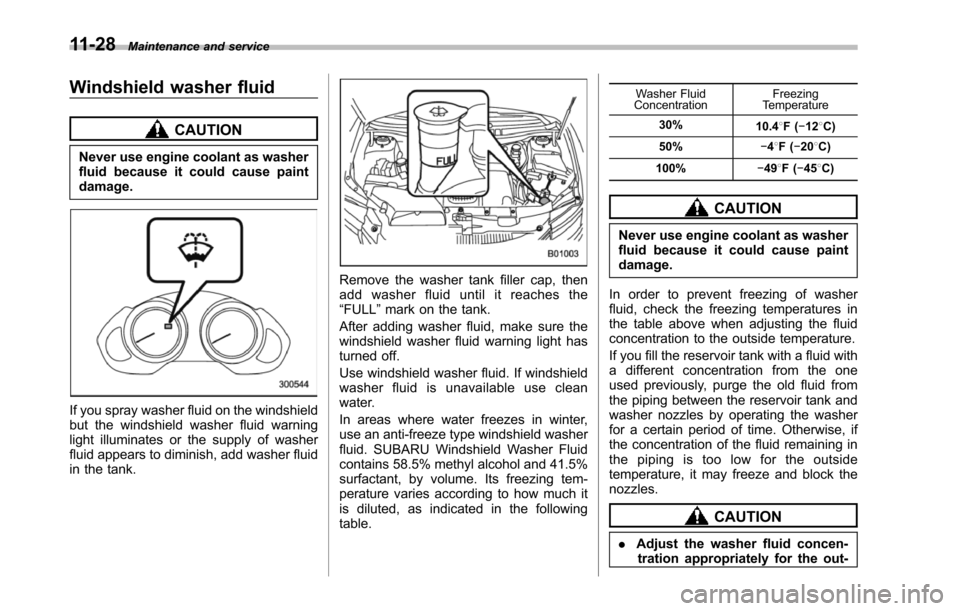
If you spray washer fluid on the windshieldbut thewindshield washer fluid warninglight illuminates or the supply of washerfluid appears to diminish, add washer fluidin the tank.
Remove the washer tank filler cap, thenadd washer fluid until it reaches the“FULL”mark on the tank.
After adding washer fluid, make sure thewindshieldwasher fluid warning light hasturned off.
Use windshield washer fluid. If windshieldwasher fluid is unavailable use cleanwater.
In areas where water freezes in winter,use an anti-freeze type windshield washerfluid. SUBARU Windshield Washer Fluidcontains 58.5% methyl alcohol and 41.5%surfactant, by volume. Its freezing tem-perature varies according to how much itis diluted, as indicated in the followingtable.
Washer FluidConcentrationFreezingTemperature
30%10.48F(!128C)
50%!48F(!208C)
100%!498F(!458C)
CAUTION
Never use engine coolant as washerfluid because it could cause paintdamage.
In order to prevent freezing of washerfluid, check the freezing temperatures inthe table above when adjusting the fluidconcentration to the outside temperature.
If you fill the reservoir tank with a fluid witha different concentration from the oneused previously, purge the old fluid fromthe piping between the reservoir tank andwasher nozzles by operating the washerfor a certain period of time. Otherwise, ifthe concentration of the fluid remaining inthe piping is too low for the outsidetemperature, it may freeze and block thenozzles.
CAUTION
.Adjust the washer fluid concen-tration appropriately for the out-